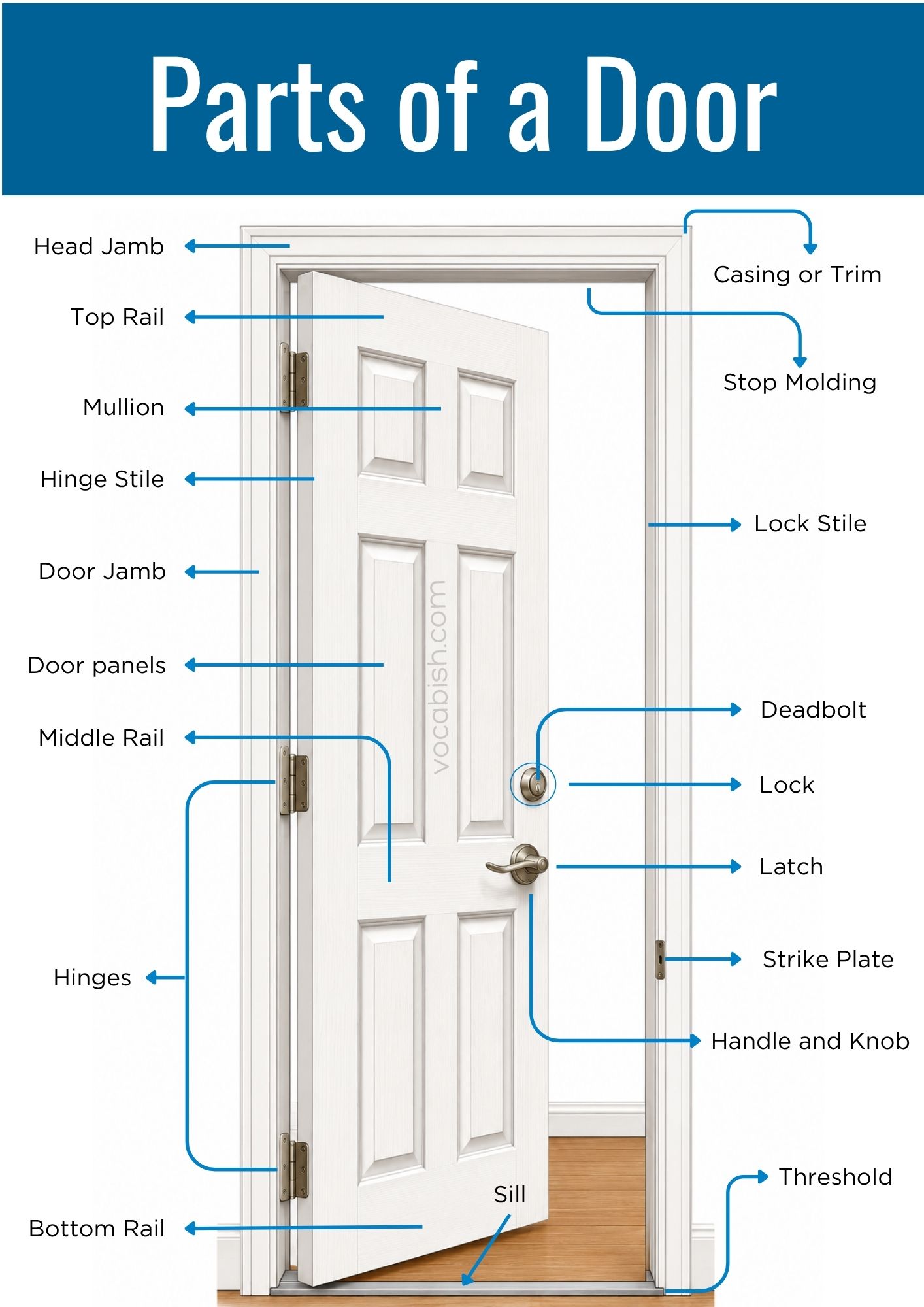
We use doors every day at home, at school, in offices, and in shops. Learning the parts of a door helps you describe things clearly in real life. The main parts of a door include the door, door frame, hinges, handle, knob, lock, keyhole, latch, bolt, threshold, sill, jamb, panels, rails, stiles, casing, weatherstrip, peephole, and door closer. Each part has a simple job. Some parts help the door open and close, some keep it safe, and some make it look neat and finished.
This lesson will help you learn door vocabulary in a simple way. You will learn the name, meaning, function, and example sentence for each part.
Parts of a Door and Their Functions
1. Door
The door is the main moving part that opens and closes an entrance. It helps people enter or leave a room, house, classroom, or building. A door also gives privacy and safety.
2. Door Frame
The door frame is the strong border around the door. It holds the door in the correct place and supports it when it opens and closes. Without a frame, the door would not fit properly.
3. Hinges
Hinges are the metal parts fixed on one side of the door. They connect the door to the frame and help the door swing open and shut. If the hinges are loose, the door may make noise or hang badly.
4. Door Handle
The door handle is the part you hold with your hand to open or close the door. Some handles are straight, and some are curved. You often push down or pull the handle to move the door.
5. Door Knob
A door knob is a round type of handle. You turn it with your hand to open the door. Many bedroom and bathroom doors have knobs.
6. Lock
The lock is the safety part of the door. It keeps the door closed so other people cannot open it without permission. A lock may use a key, a code, or a small button.
7. Keyhole
The keyhole is the small hole where you put the key. It is usually near the lock or inside the lock. When you turn the key in the keyhole, the door can lock or unlock.
8. Key
A key is a small metal tool used to open or lock a door. Each key usually fits one special lock. People keep keys in bags, pockets, or on key rings.
9. Latch
The latch is a small part that catches the door when it closes. It helps keep the door shut, even when the door is not locked. You often hear a small click when the latch catches.
10. Bolt
A bolt is a strong metal bar used for extra safety. You slide or turn it into place to keep the door closed. Many people use a bolt at night for more protection.
11. Threshold
The threshold is the strip at the bottom of the doorway. You step over it when you enter or leave a room. It can also help cover the small gap under the door.
12. Door Sill
The door sill is the lower part of the door frame. It sits near the floor and helps support the doorway. On outside doors, it can help keep water, dust, and dirt from coming inside.
13. Jamb
The jamb is the side part of the door frame. It helps hold the door in place. Hinges and locks often connect to the jamb.
14. Head Jamb
The head jamb is the top part of the door frame. It runs across the doorway above the door. It helps complete the frame and gives support from the top.
15. Side Jamb
The side jamb is one of the vertical parts of the door frame. There is usually one side jamb on the left and one on the right. One side may hold the hinges, and the other side may hold the latch or lock plate.
16. Door Panel
A door panel is a flat or raised section on the face of a door. Panels can make a door look plain, modern, or decorative. Some doors have one large panel, while others have many smaller panels.
17. Rail
A rail is a horizontal part of a door. It goes across the door from side to side. Rails help give the door shape and strength.
18. Stile
A stile is a vertical part on the left or right side of a door. It runs from top to bottom. Stiles help make the door strong and hold parts like the lock or hinges.
19. Casing
The casing is the trim around the door frame. It covers small gaps between the frame and the wall. It also makes the doorway look clean and finished.
20. Weatherstrip
The weatherstrip is a soft strip placed around the edges of a door. It helps stop cold air, dust, rain, and noise from coming inside. It is very useful on outside doors.
21. Peephole
A peephole is a small round hole in a door. You look through it to see who is standing outside before you open the door. It helps you stay safe because you can check the person first.
22. Door Closer
A door closer is a device fixed at the top of a door. It helps the door close by itself slowly and safely. You often see door closers on school doors, office doors, shop doors, and building entrance doors.
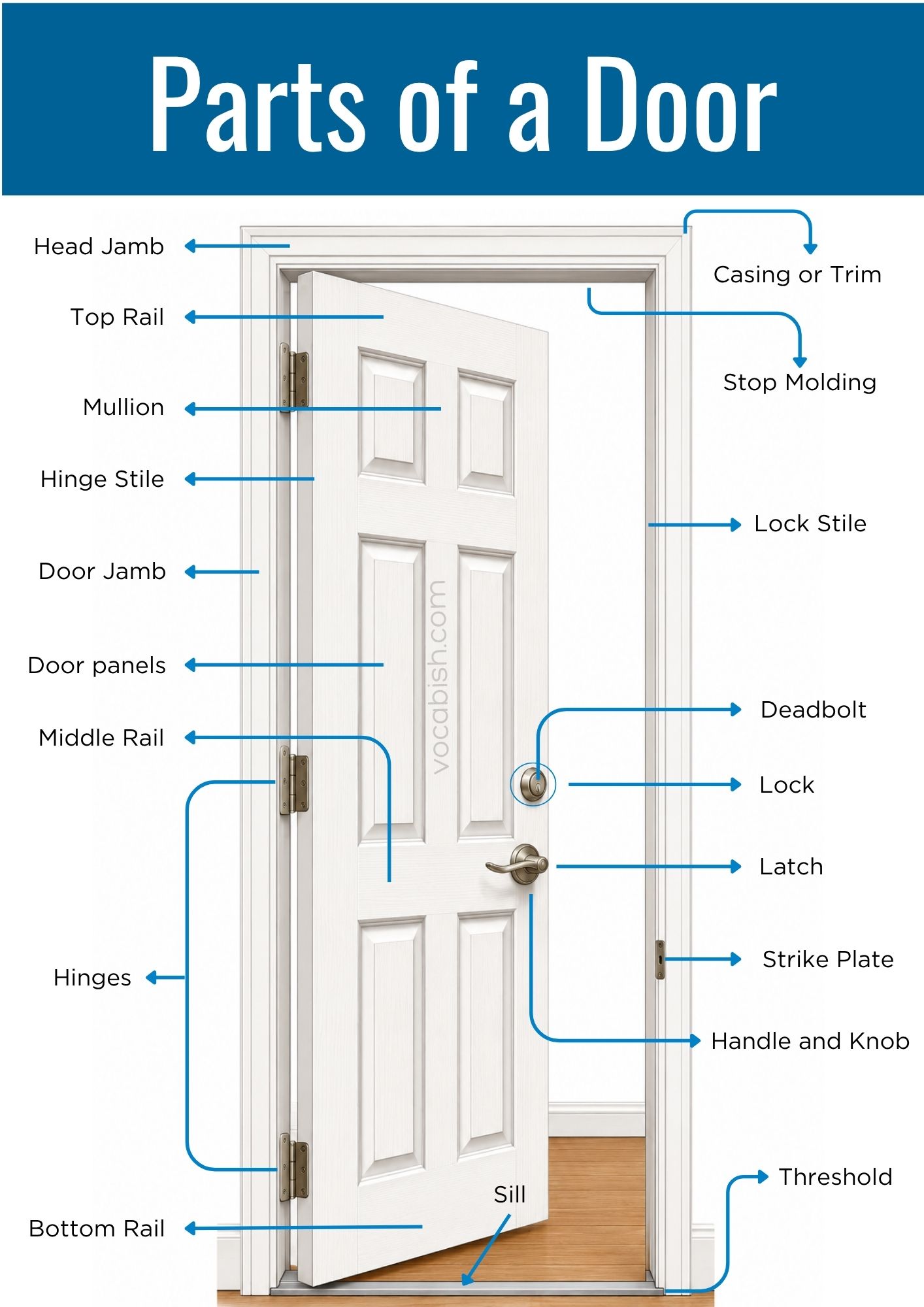
Picture Guide to Door Parts
Outside Parts of a Door
The outside parts of a door are the parts you can see when you stand in front of it.
Door Part | Simple Function |
|---|---|
Door handle | Helps you pull or push the door |
Lock | Keeps the door safe |
Keyhole | Holds the key |
Panel | Gives the door shape |
Casing | Makes the doorway look clean |
Threshold | Covers the bottom gap |
Inside Parts of a Door
Door Part | Simple Function |
|---|---|
Hinges | Help the door swing |
Latch | Holds the door shut |
Bolt | Gives extra safety |
Door knob | Opens the door |
Weatherstrip | Blocks air and dust |
Door Hardware Parts
Door hardware means the metal or working parts attached to a door.
Common door hardware includes:
- Handle
- Knob
- Lock
- Keyhole
- Key
- Hinges
- Latch
- Bolt
- Door closer
- Peephole
Door Frame Words
The door frame is the border that surrounds the door. It helps the door stay in the right place.
Frame Word | Meaning |
|---|---|
Door frame | Full border around the door |
Jamb | Side part of the frame |
Head jamb | Top part of the frame |
Side jamb | Left or right frame part |
Sill | Bottom part of the frame |
Casing | Trim around the frame |
Think of the door frame like a picture frame. The picture frame holds a picture. The door frame holds a door.
Summary on Door Parts Vocabulary
Word | Easy Meaning | Function |
|---|---|---|
Door | Moving entrance cover | Opens and closes a space |
Frame | Border around the door | Holds the door |
Hinges | Metal swing parts | Let the door move |
Handle | Hand part | Opens the door |
Knob | Round handle | Turns to open |
Lock | Safety part | Keeps the door closed |
Keyhole | Hole for key | Lets the key enter |
Latch | Catching part | Holds door shut |
Bolt | Metal lock bar | Adds safety |
Threshold | Bottom strip | Covers bottom gap |
Panel | Flat door section | Adds shape |
Rail | Horizontal door part | Adds support |
Stile | Vertical door part | Adds support |
Casing | Trim around frame | Covers gaps |
Weatherstrip | Soft edge strip | Blocks air and dust |
Practice Sentences with Door Vocabulary
Read these sentences out loud.
- The door handle is cold.
- The hinges need oil.
- The lock is new.
- The key is under the mat.
- The latch is broken.
- The door frame is white.
- The threshold is dirty.
- The weatherstrip keeps the room warm.
- The peephole is small.
- The door closer works slowly.
Common Mistakes English Learners Make
1: Saying “door hand”
Say door handle, not “door hand.”
Correct:
“The door handle is broken.”
2: Calling every handle a knob
A knob is round. A handle can be long, curved, or straight.
Correct:
“This door has a round knob.”
3: Mixing up frame and door
The door moves. The frame stays in place.
Correct:
“The door is brown, and the frame is white.”
4: Saying “key place”
Say keyhole, not “key place.”
Correct:
“The keyhole is small.”
FAQs About Parts of a Door
The main parts of a door are the door, frame, hinges, handle, knob, lock, keyhole, latch, bolt, threshold, panels, rails, and stiles.
The part around a door is called the door frame. It holds the door in place.
They are called hinges. Hinges help the door swing open and closed.
The bottom strip under the door is often called the threshold. The bottom part of the frame can also be called the sill.
A door handle is the part you hold to open a door. A door knob is a round handle that you turn.
Final Tip
You do not need to learn every door word in one day. Start with the words you use most: door, handle, lock, key, hinges, frame, and latch. Then learn the rest step by step.
Small words can make your English sound much clearer.
You May Also Like: