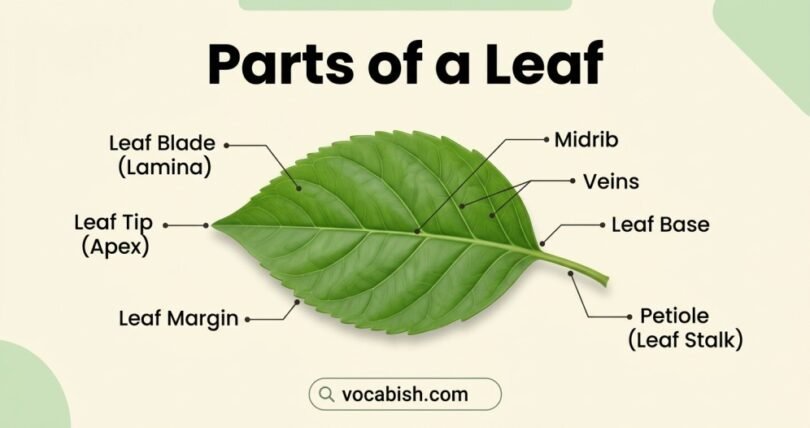

Leaves may look simple, but each leaf has several parts that work together to keep a plant healthy. Some parts collect sunlight, some carry water, and others help the leaf exchange gases with the air.
The main parts of a leaf are the leaf blade, petiole, midrib, veins, margin, leaf tip, leaf base, and stomata. Learning these parts helps you understand how plants make food, breathe, and grow.
What Is a Leaf?
A leaf is the flat, usually green part of a plant that grows from a stem or branch. It collects sunlight and uses it to make food for the plant.
Most green leaves contain a natural substance called chlorophyll. Chlorophyll gives leaves their green color and helps them capture energy from sunlight.
Leaves can be large, small, round, narrow, smooth, or pointed. Although they come in many shapes, most leaves have similar basic parts.
Here’s a comprehensive guide on: Types of Leaves and Their Functions
Main Parts of a Leaf at a Glance
Here is a quick look at the main leaf parts and what they do:
Leaf Part | Simple Function |
|---|---|
Leaf blade | Collects sunlight and makes food |
Petiole | Connects the leaf to the stem |
Midrib | Supports the leaf and carries materials |
Veins | Move water, minerals, and food |
Margin | Forms the outer edge of the leaf |
Leaf tip | Forms the upper end of the leaf |
Leaf base | Joins the blade to the petiole |
Stomata | Allow gases and water vapour to move |
These parts do not work alone. They form a complete leaf structure that helps the plant survive.
Labelled Diagram of the Parts of a Leaf
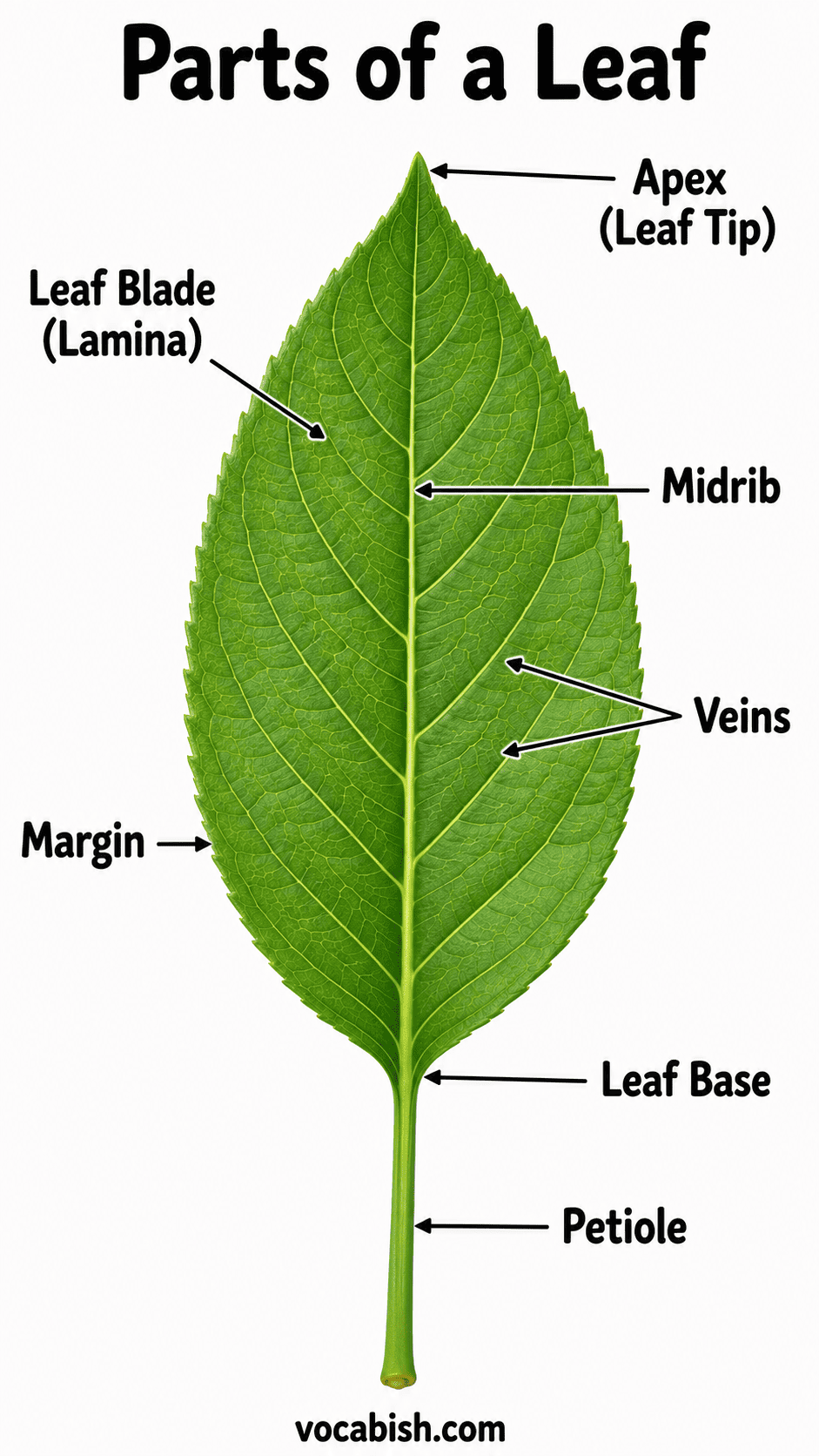
Parts of a Leaf and Their Functions
Each part of a leaf has a special job. Let us look at these parts one by one.
Leaf Blade or Lamina
The leaf blade, also called the lamina, is the broad and flat part of a leaf. It is usually the easiest part to see.
The blade collects sunlight and contains many cells that help the plant make food. Its wide surface also allows the leaf to take in carbon dioxide from the air.
A mango leaf has a long, narrow blade, while a maple leaf has a broad blade with pointed sections.
Petiole or Leaf Stalk
The petiole is the small stalk that connects the leaf blade to the plant stem. It is sometimes called the leaf stalk.
The petiole holds the leaf in a position where it can receive sunlight. It also contains tiny tubes that carry water into the leaf and move prepared food to other parts of the plant.
Not every leaf has a noticeable petiole. Some leaves connect directly to the stem.
Midrib
The midrib is the thick main line running through the center of the leaf blade. It is the largest vein in many leaves.
It gives the leaf support and helps keep the blade open. It also carries water and minerals into the leaf and transports food away from it.
You will often feel the raised midrib by gently touching the lower side of a leaf.
Leaf Veins
Leaf veins are the smaller lines that spread out from the midrib. Together, they form a vein pattern across the leaf blade.
Veins carry water and minerals to different areas of the leaf. They also move the food made by the leaf to the stem, roots, flowers, and fruits.
Veins also strengthen the leaf. Without them, the soft blade would not hold its shape as easily.
Leaf Margin
The leaf margin is the outer edge of the leaf blade. It forms the outline of the leaf.
Leaf margins can have different shapes:
- A smooth margin has an even edge.
- A toothed margin has tiny pointed edges.
- A wavy margin rises and falls gently.
- A lobed margin has deep, rounded, or pointed sections.
The margin can help learners identify and compare different plant leaves.
Leaf Apex or Tip
The leaf apex is the top end of a leaf. It is more commonly called the leaf tip.
A leaf tip may be pointed, rounded, narrow, or blunt. Its shape depends on the type of plant.
In some leaves, the pointed tip helps rainwater move away from the blade.
Leaf Base
The leaf base is the lower part of the blade where it joins the petiole. In leaves without a petiole, the base may connect directly to the plant stem.
Leaf bases can also have different shapes. Some are rounded, while others are narrow or heart-shaped.
To find the leaf base, start at the petiole and look at the place where the flat blade begins.
Stomata
Stomata are extremely small openings on the surface of a leaf. One opening is called a stoma.
Stomata allow carbon dioxide to enter the leaf. They also allow oxygen and water vapour to leave.
Many plants have more stomata on the lower surface of their leaves. This position can help reduce water loss because the lower side receives less direct sunlight. However, the number and location of stomata can vary between plants.
Stomata are too small to see clearly without a microscope.
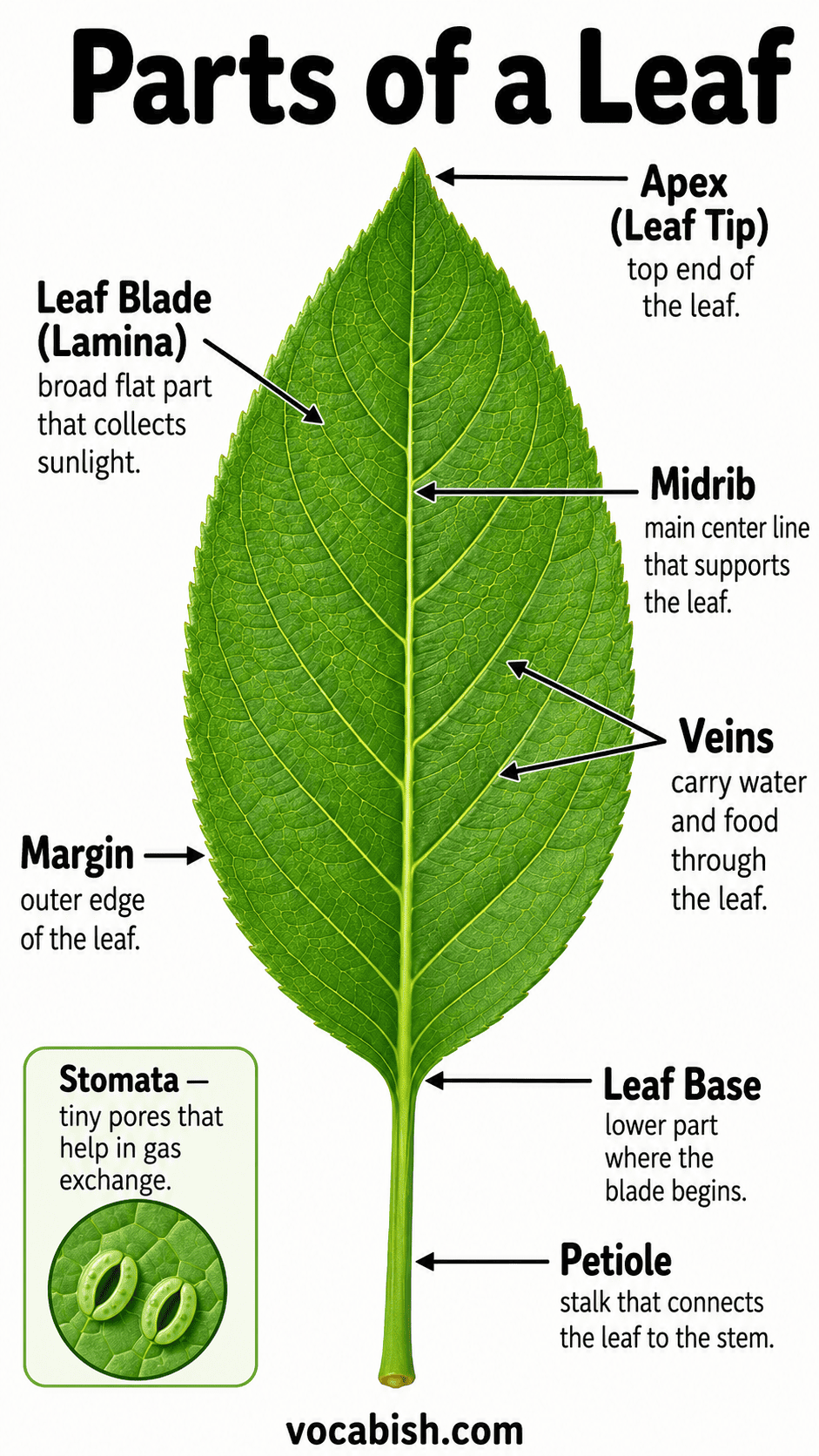
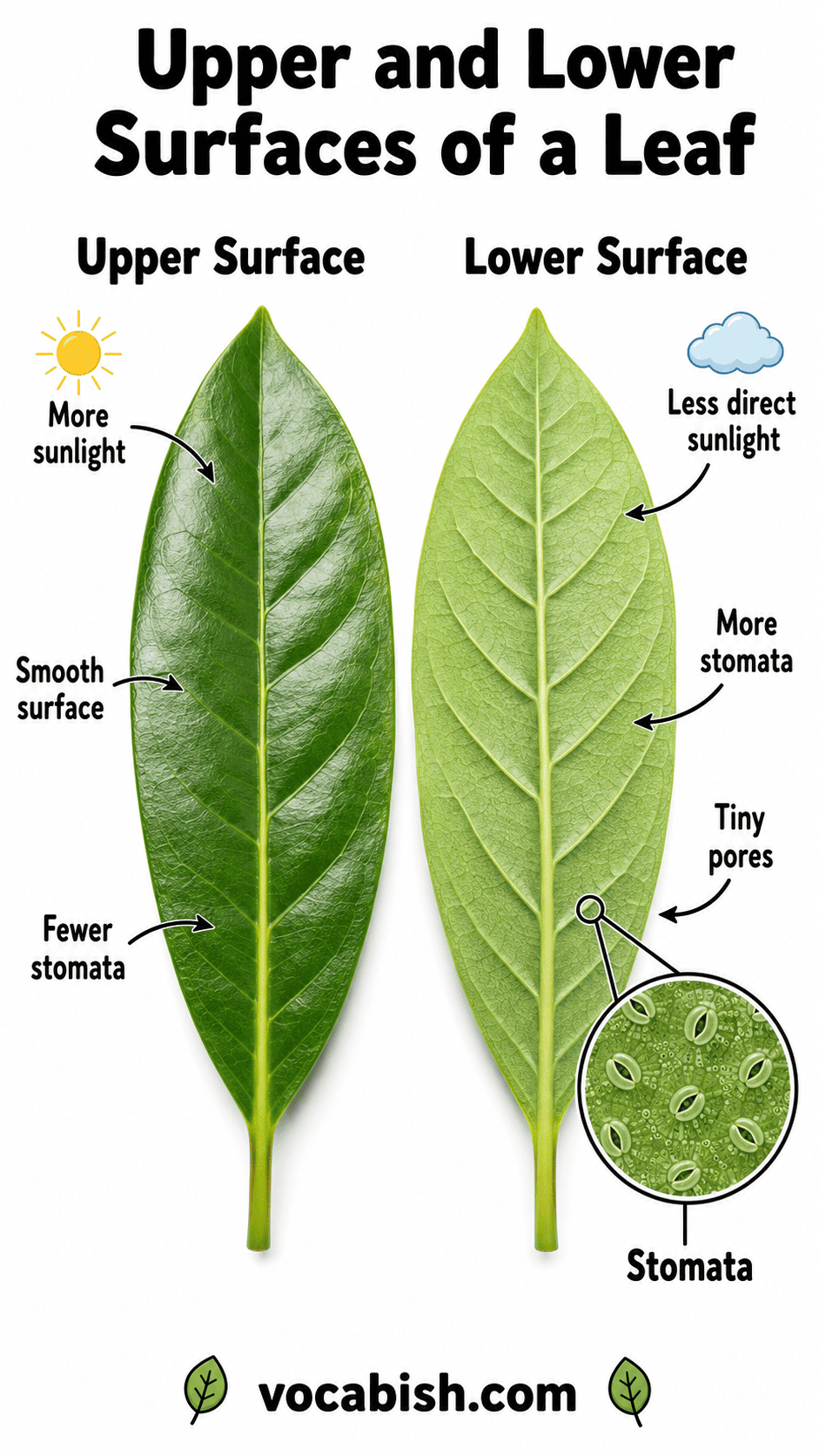
Upper and Lower Surfaces of a Leaf
A leaf has an upper surface and a lower surface. These two sides may look similar, but they often have different features.
The upper surface usually receives more sunlight. It may look darker, smoother, or shinier because it often has a protective waxy layer.
The lower surface usually receives less direct sunlight. In many plants, it contains more stomata than the upper surface.
You can compare both surfaces by turning over a fresh leaf. They may notice changes in color, texture, or the appearance of the veins.
How the Parts of a Leaf Work Together
A leaf works like a small food-making system.
The leaf blade collects sunlight. Water and minerals travel from the roots, through the stem and petiole, and into the leaf veins. Carbon dioxide enters through the stomata.
The leaf then uses sunlight, water, and carbon dioxide to make food. The veins carry this food to other parts of the plant.
Each part supports the process:
- The blade collects sunlight.
- The petiole connects the leaf to the stem.
- The midrib supports the blade.
- The veins transport water and food.
- The stomata exchange gases.
- The margin, base, and tip form the leaf’s outer structure.
A leaf cannot perform its jobs properly when its important parts become badly damaged.
What Does a Leaf Do for a Plant?
Leaves perform several important jobs. Their main functions include making food, exchanging gases, and releasing extra water.
Making Food
The main job of a leaf is to make food for the plant through photosynthesis.
During photosynthesis, the leaf uses:
- Sunlight from the Sun
- Water absorbed by the roots
- Carbon dioxide from the air
The leaf changes these materials into sugar, which the plant uses as food. Oxygen is also produced and released into the air.
This process usually takes place in the green parts of the leaf because they contain chlorophyll.
Exchanging Gases
Plants need carbon dioxide to make food. Carbon dioxide enters the leaf through the stomata.
During photosynthesis, the leaf produces oxygen. Much of this oxygen leaves through the same tiny openings.
This movement of carbon dioxide and oxygen is called gas exchange.
Releasing Extra Water
Leaves also release water vapour through their stomata. This process is called transpiration.
Transpiration helps move water from the roots to the leaves. It can also help cool the plant during warm weather.
A plant must control this water loss carefully. Losing too much water may cause its leaves to droop or wilt.
Simple Leaf and Compound Leaf
Leaves can be grouped into different types. Two common types are simple leaves and compound leaves.
A simple leaf has one complete leaf blade. The blade may have cuts or lobes, but it is not divided into separate leaflets. Mango, guava, and hibiscus plants have simple leaves.
A compound leaf has a blade divided into several smaller parts called leaflets. Neem and rose plants are common examples.
A leaflet may look like a small leaf, but it does not have a bud where it joins the main stalk. This helps learners distinguish a leaflet from a complete leaf.
Easy Way to Remember the Parts of a Leaf
You can remember the main external parts by saying this simple line:
“Blade, stalk, midrib, veins, edge, base, tip.”
Here, “stalk” means petiole, and “edge” means margin.
Try pointing to each part on a real leaf while repeating the words:
- Touch the flat blade.
- Hold the petiole.
- Trace the midrib.
- Follow the small veins.
- Move a finger around the margin.
- Find the base.
- Point to the tip.
Using a real leaf makes the names easier to understand and remember.
Common Mistakes Learners Make
Learning the parts of a leaf becomes easier when you understand these common mistakes.
Confusing the Petiole with the Stem
The petiole is not the main plant stem. It is the smaller stalk that connects one leaf blade to the stem.
Treating the Midrib and Veins as the Same Part
The midrib is the main central vein. Smaller veins usually branch from it and spread across the blade.
Thinking the Margin Is a Separate Piece
The margin is not an extra structure attached to the leaf. It is simply the outer edge of the blade.
Expecting to See Stomata Easily
Stomata are microscopic openings. You normally cannot see them clearly without a microscope.
Calling the Blade the Complete Leaf
The blade is the broad, flat part of a leaf. A complete leaf may also include the petiole, base, veins, midrib, and other structures.
Calling Every Small Section a Leaf
On a compound leaf, the small sections are called leaflets. Together, they form one complete leaf.
Quick Revision: Parts of a Leaf
Use this quick revision box before a lesson, quiz, or test.
- Leaf blade or lamina: The broad, flat part that collects sunlight.
- Petiole: The stalk connecting the blade to the stem.
- Midrib: The thick central vein that supports the leaf.
- Veins: Branching lines that transport water, minerals, and food.
- Margin: The outer edge of the blade.
- Apex: The upper tip of the leaf.
- Leaf base: The lower part where the blade joins the petiole.
- Stomata: Tiny openings used for gas exchange and water release.
Remember: the blade collects sunlight, the veins transport materials, and the stomata connect the inside of the leaf with the air.
FAQs About Parts of a Leaf
The main external parts of a leaf are the leaf blade, petiole, midrib, veins, margin, apex or tip, and leaf base. Leaves also have tiny openings called stomata.
The flat, broad part of a leaf is called the leaf blade or lamina. It collects sunlight and performs most of the leaf’s food-making work.
The petiole, or leaf stalk, connects the leaf blade to the plant stem.
Leaf veins carry water and minerals into the leaf. They also transport food from the leaf to other parts of the plant and help support the blade.
The midrib is the thick central vein of a leaf. Smaller veins branch from the midrib and spread across the leaf blade.
Stomata are found on the leaf surface. In many plants, more stomata occur on the lower surface, although their position varies between plant species.
Photosynthesis mainly takes place in the leaf blade. Its cells contain chlorophyll, which captures energy from sunlight.
No. Leaves differ in size, shape, color, margin, tip, and vein pattern. Some are round, while others are narrow, pointed, heart-shaped, or divided into leaflets.
Conclusion
A leaf is made of several parts that work together. The blade collects sunlight, the petiole joins the leaf to the stem, the midrib supports it, and the veins carry water and food. The margin, base, and tip form its visible shape, while tiny stomata help it exchange gases and release water vapour.
The easiest way to learn the parts of a leaf is to observe a real one. Pick a safe fallen leaf, find its blade, petiole, midrib, veins, margin, base, and tip, and then create your own labelled drawing.
Related Resources