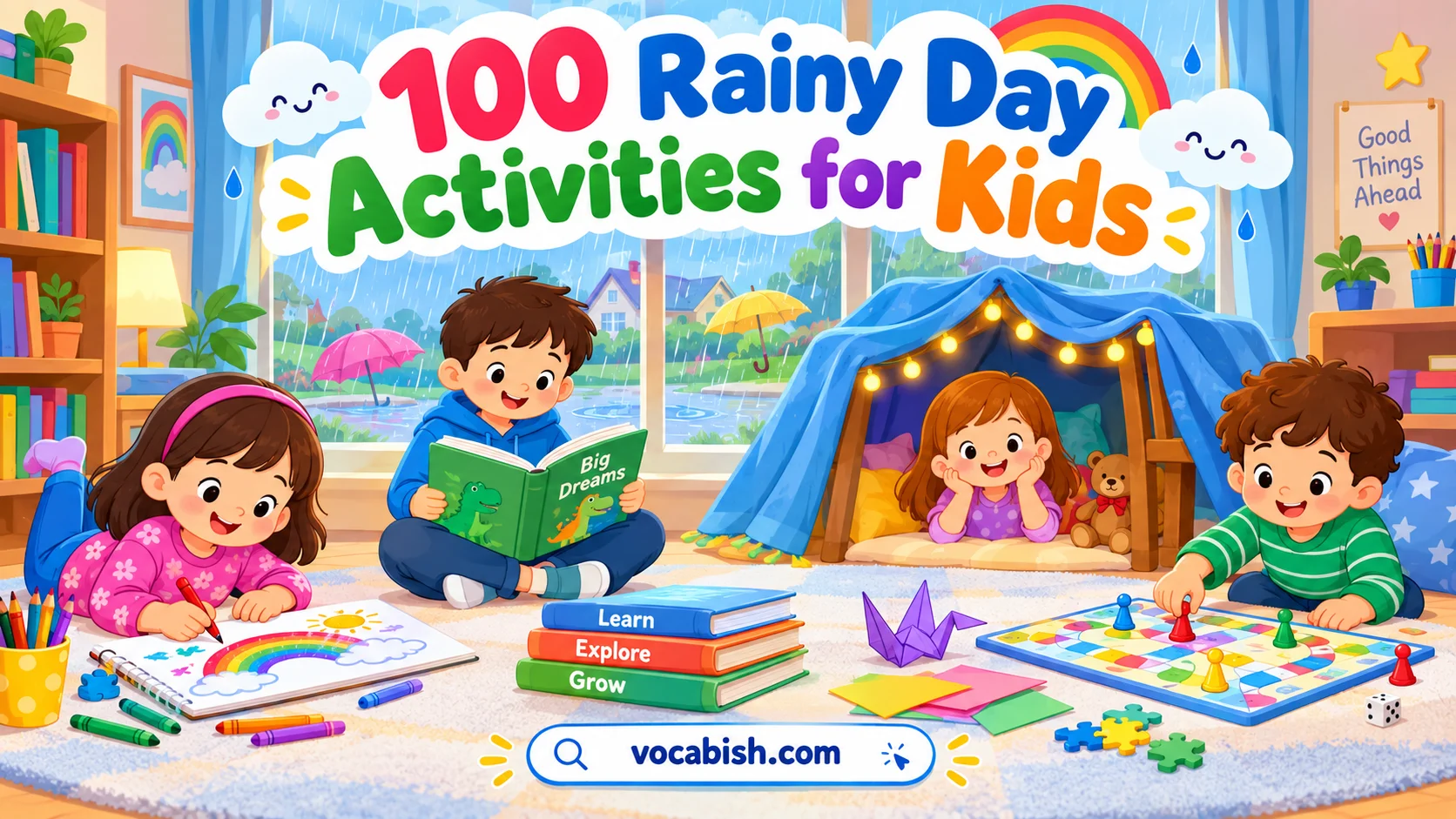

Rain can cancel outdoor plans, but it does not have to cancel the fun. These Rainy Day Activities for Kids turn a wet afternoon into an opportunity to play, create, learn, move, and spend meaningful time together.
From indoor games and crafts to reading, science experiments, classroom activities, and quiet challenges, there are ideas here for preschoolers, elementary students, and older kids. Many require little or no special equipment, making them useful for families, teachers, and ESL learners.
What Are Good Rainy Day Activities for Kids?
Good rainy day activities keep children engaged without depending on outdoor space or good weather. The best choices match the child’s age, interests, available materials, and energy level.
Children can spend a rainy day doing something creative, educational, physical, social, imaginative, or relaxing. A useful mix gives them variety instead of making the entire day feel like school or screen time.
100 Rainy Day Activities for Kids
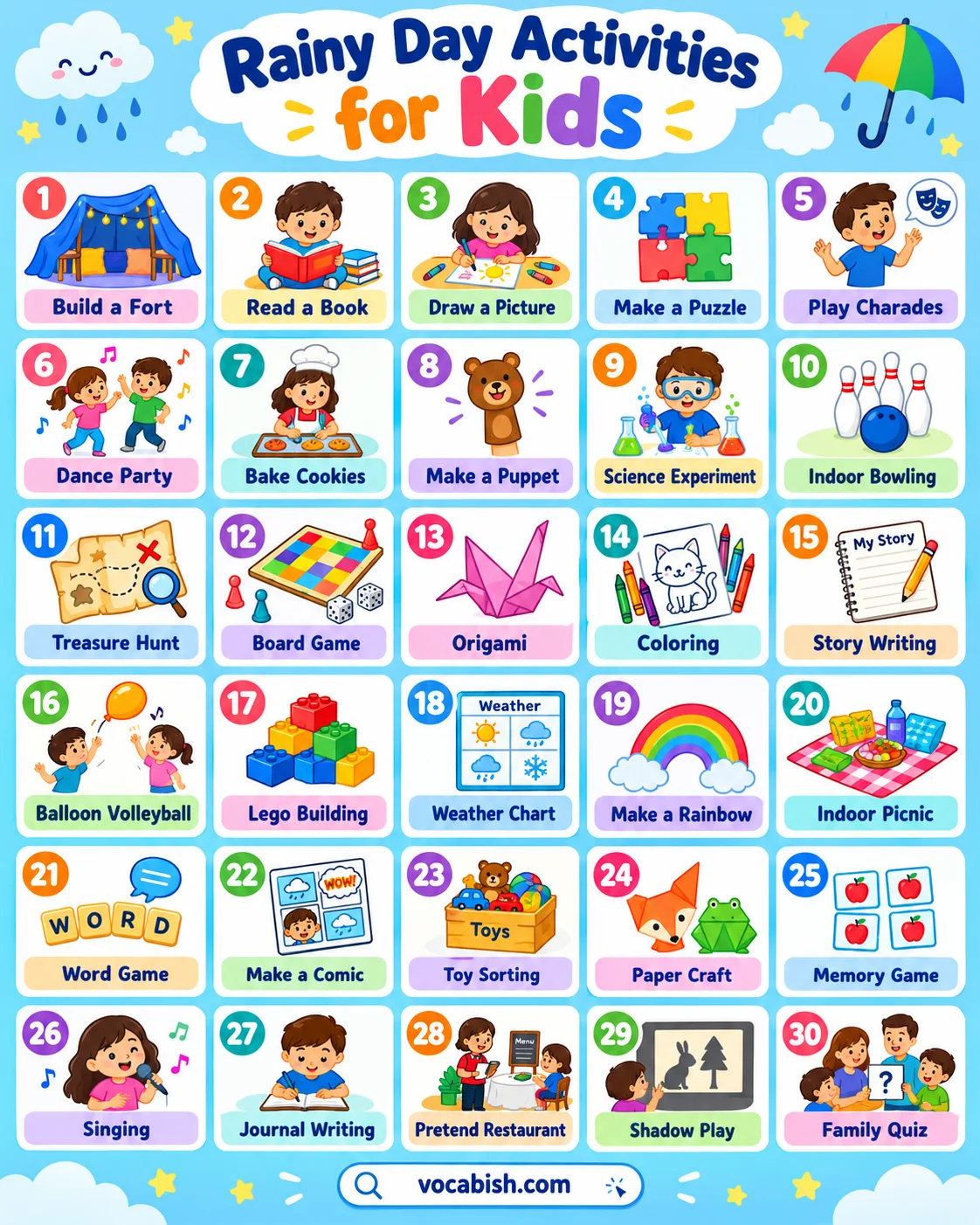
Here are 100 ideas covering play, creativity, learning, movement, family time, school activities, and quiet indoor fun.
Creative and Art Activities
1. Draw a Rainy-Day Picture — Ask kids to draw umbrellas, puddles, rain clouds, boots, houses, or anything they see outside the window.
2. Make a Paper Umbrella — Use coloured paper, scissors, and glue to create a decorative umbrella.
3. Paint With Cotton Balls — Dip cotton balls into washable paint and create clouds, raindrops, flowers, or abstract artwork.
4. Create a Rain Cloud Craft — Cut out a cloud shape from paper and attach hanging strips of blue paper as raindrops.
5. Design a Dream Umbrella — Let children invent an umbrella with unusual colours, patterns, shapes, or magical features.
6. Make a Paper Raincoat — Design a pretend raincoat using paper and decorate it with buttons, pockets, and colourful patterns.
7. Create a Weather Collage — Cut pictures from old magazines and arrange sunny, windy, snowy, and rainy weather into one collage.
8. Make a Rainbow Craft — Use coloured paper, crayons, paint, yarn, or recycled materials to create a rainbow.
9. Build a Recycled Robot — Turn empty boxes, cardboard tubes, bottle caps, and clean containers into a pretend robot.
10. Make a Friendship Card — Children can create handmade cards for friends, relatives, teachers, or neighbours.
Imaginative Play Activities
11. Build a Blanket Fort — Use blankets, cushions, and chairs to create a cosy indoor hideout.
12. Play Pretend Restaurant — Kids can make a pretend menu, take orders, serve imaginary food, and practise polite conversation.
13. Open a Toy Shop — Turn toys into products and let children act as customers, shopkeepers, and cashiers.
14. Create a Puppet Show — Make simple puppets from socks or paper bags and perform a short story.
15. Play Doctor or Nurse — Use toy medical equipment or safe household objects for imaginative role-play.
16. Pretend to Be Weather Reporters — Children can present a fake weather forecast using a map, drawings, and weather words.
17. Create a Space Mission — Turn a bedroom or classroom into a spaceship and imagine travelling to another planet.
18. Play Detective — Hide a harmless object and create clues that lead children toward the hidden item.
19. Build a Mini City — Use blocks, cardboard, paper, and toys to design roads, houses, shops, and parks.
20. Have a Story Character Day — Children choose a favourite character and pretend to speak, act, or dress like that character.
Reading and Language Activities
21. Read a Rainy-Day Story — Choose a picture book, short story, or chapter book and read it together.
22. Write a Rainy-Day Story — Ask children to begin with, “The rain started, and then something surprising happened…”
23. Create a Comic Strip — Draw several boxes and tell a short story through pictures and speech bubbles.
24. Make a Word List — Collect words related to rain, such as cloud, puddle, umbrella, storm, and raincoat.
25. Play a Rhyming Game — Take a word such as rain and challenge children to think of rhyming words.
26. Describe a Picture — Show children an image and ask them to describe what they see using complete sentences.
27. Write a Friendly Letter — Children can write a short letter to a friend or family member.
28. Make a Mini Dictionary — Choose five to ten new English words and write each word with its meaning and an example sentence.
29. Play “Finish the Story” — One person starts a story and each child adds another sentence.
30. Have a Vocabulary Hunt — Ask children to find objects around the house or classroom and name them in English.
Educational Rainy Day Activities
31. Sort Objects by Colour — Gather safe household or classroom objects and group them by colour.
32. Count Everyday Items — Count books, pencils, toys, spoons, buttons, or other suitable objects.
33. Measure Household Objects — Use a ruler or measuring tape to compare the length of books, toys, or furniture.
34. Make a Weather Chart — Record whether the day is rainy, cloudy, windy, or sunny.
35. Create a Homemade Calendar — Make a monthly calendar and practise naming days and months.
36. Build a Shape Hunt — Find circles, squares, rectangles, triangles, and other shapes around the room.
37. Make a Science Observation Journal — Ask children to record what they notice about the weather, plants, clouds, or light.
38. Try a Floating and Sinking Test — With adult supervision, test safe objects in a container of water to see which float and which sink.
39. Grow a Bean in Cotton — Place a bean in damp cotton and observe changes over the following days.
40. Make a Simple Rain Gauge — Use a clear container to collect rainwater outside and observe the amount collected.
Indoor Movement Activities
41. Have a Dance Break — Play an appropriate song and let children invent their own dance movements.
42. Make an Indoor Obstacle Course — Arrange cushions, chairs, tape lines, and other safe objects to create a movement course.
43. Play Follow the Leader — One child leads simple movements while everyone else copies.
44. Have an Animal Walk Race — Move across a safe area like different animals, such as a crab, bear, frog, or penguin.
45. Play Balloon Volleyball — Keep a balloon in the air without letting it touch the floor.
46. Try a Balance Challenge — Walk along a taped line or balance carefully on one foot.
47. Play Freeze Dance — Dance while music plays and freeze whenever it stops.
48. Have a Stretching Session — Practise gentle stretches suitable for children’s age and ability.
49. Play Indoor Bowling — Use lightweight bottles and a soft ball to create a safe bowling game.
50. Create a Movement Dice Game — Write movements such as jump, clap, spin, march, and stretch on cards or a homemade spinner.
Board Games and Family Activities
51. Play a Board Game — Choose a game that matches the children’s age and number of players.
52. Play Card Games — Try age-appropriate games such as matching, memory, or simple counting games.
53. Complete a Jigsaw Puzzle — Work alone, with siblings, or as a family.
54. Play Charades — Act out animals, actions, jobs, or objects while others guess.
55. Play Simon Says — Give movement commands while children listen carefully for the words “Simon says.”
56. Play Twenty Questions — Think of an object and let children ask questions to figure out what it is.
57. Have a Memory Challenge — Place several objects on a table, let children observe them, cover them, and ask what they remember.
58. Play Bingo — Create simple number, picture, colour, letter, or vocabulary bingo cards.
59. Have a Family Quiz — Ask fun questions about animals, food, school subjects, nature, or family memories.
60. Play a Homemade Matching Game — Draw pairs of pictures or words on small cards and mix them face down.
Quiet Rainy Day Activities
61. Have a Reading Hour — Give children uninterrupted time to enjoy age-appropriate books.
62. Colour in a Colouring Book — Choose detailed pictures for older children or large shapes for younger ones.
63. Make a Sticker Scene — Use stickers to create an imaginary park, farm, city, classroom, or underwater world.
64. Try a Dot-to-Dot Puzzle — Join numbered dots and discover the hidden picture.
65. Complete a Word Search — Choose a puzzle that matches the child’s vocabulary level.
66. Make a Gratitude List — Ask children to write or draw three things they appreciate.
67. Start a Journal — Kids can write about their day, feelings, ideas, or favourite memories.
68. Fold Origami — Make simple animals, boats, flowers, or paper shapes.
69. Make a Bookmark — Design a bookmark with drawings, words, patterns, or inspirational messages.
70. Create a Quiet Corner — Arrange books, cushions, drawing materials, and other calm activities in one comfortable space.
Cooking and Food Activities
71. Make Fruit Skewers — Arrange soft fruit pieces on suitable sticks with adult supervision.
72. Decorate Biscuits — Use icing, fruit, or edible decorations to design colourful biscuits.
73. Make a Sandwich Face — Use safe foods to create eyes, a nose, a mouth, and other facial features.
74. Prepare Homemade Popcorn — With adult help, make popcorn and practise measuring ingredients.
75. Make a Fruit Salad — Let children help wash, count, and arrange fruit pieces.
76. Decorate Cupcakes — Allow children to choose colours and decorations for cupcakes prepared with adult assistance.
77. Make a Smoothie — Combine suitable fruits with milk, yogurt, or another preferred ingredient under adult supervision.
78. Create a Pretend Café Menu — Children can write prices, names, descriptions, and categories for imaginary foods.
79. Measure Ingredients — Turn baking into a mathematics activity by counting, weighing, and measuring ingredients.
80. Have an Indoor Picnic — Spread a blanket on the floor and enjoy snacks together as though you were outside.
Rainy Day Activities for Kids in School
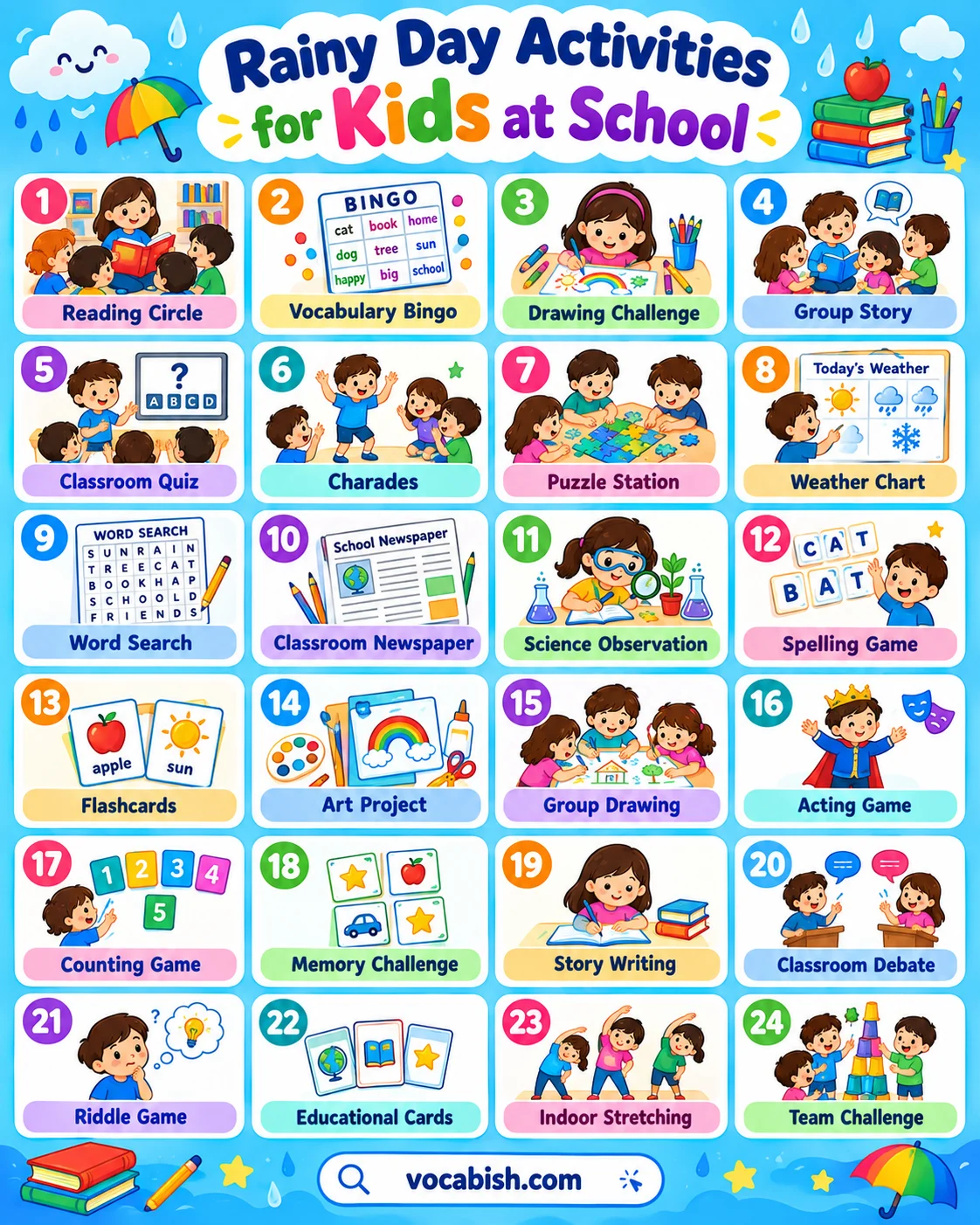
81. Make a Classroom Weather Chart — Students record the weather and practise weather-related vocabulary.
82. Have a Rainy-Day Reading Circle — Students read short stories or take turns reading aloud.
83. Play Classroom Charades — Use vocabulary words, classroom objects, animals, or actions as prompts.
84. Create a Group Story — Each student contributes one sentence to a shared story.
85. Have a Classroom Drawing Challenge — Give everyone the same theme and compare the different creative results.
86. Play Vocabulary Bingo — Use English words that students have recently learned.
87. Organize a Puzzle Station — Provide age-appropriate puzzles that students can complete independently or in small groups.
88. Have a Quick Quiz Game — Divide students into teams and ask questions from different subjects.
89. Create a Classroom Newspaper — Students can write short reports, draw pictures, create headlines, and interview classmates.
90. Play “What Am I?” — Give clues about an animal, object, profession, or place while students guess the answer.
Free and Low-Cost Activities
91. Watch the Rain From a Safe Window — Ask children to observe the clouds, puddles, trees, vehicles, and changing light.
92. Make Art From Recyclables — Use clean cardboard, paper tubes, boxes, and containers for creative projects.
93. Build With Household Items — Use cushions, books, boxes, and safe objects to construct a pretend structure.
94. Create a Family Storybook — Everyone contributes a page with words or pictures.
95. Make a Home Treasure Hunt — Hide an ordinary object and create clues that guide children to it.
96. Have a Home Science Hour — Choose safe experiments using common household materials and adult guidance.
97. Create a Paper Maze — Draw a maze on paper and challenge siblings or friends to solve it.
98. Make Shadow Shapes — Use a safe light source and objects to explore shapes and shadows.
99. Organize a Toy Sorting Challenge — Sort toys by size, colour, type, material, or function.
100. Plan the Next Sunny-Day Adventure — Let children draw or write a plan for what they want to do when the weather improves.
Rainy Day Activities for Kids at Home
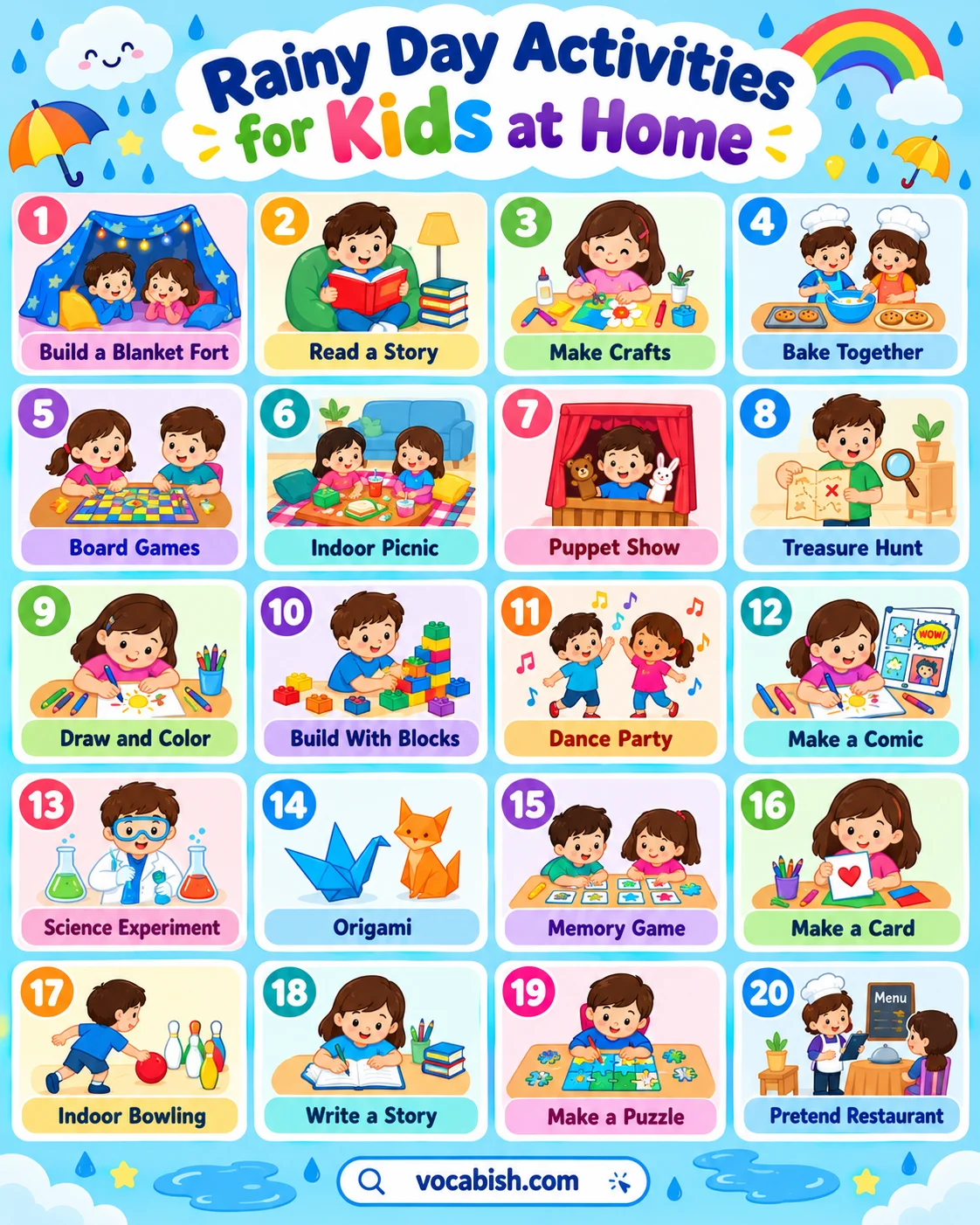
When children are stuck inside, the goal is not to keep them busy every second. A better approach is to mix active play, creative projects, quiet time, learning, and family activities.
Some particularly useful Rainy Day Activities for Kids at Home include:
- Build a blanket fort.
- Create a treasure hunt.
- Bake or decorate a snack with an adult.
- Read a story together.
- Make a family scrapbook.
- Try a safe science experiment.
- Have a dance break.
- Play board or card games.
- Make homemade puppets.
- Create a comic book.
- Set up a pretend restaurant.
- Build something from recycled materials.
- Start a rainy-day journal.
- Make an indoor picnic.
- Design a dream house.
For younger children, activities with clear steps and visible results often work well. Older children may prefer projects that give them more freedom to plan, solve problems, or create something original.
Rainy Day Activities for Kids in School
Rainy weather can create an unexpected opportunity for classroom interaction. Teachers can turn indoor time into a combination of learning and play.
Useful Rainy Day Activities for Kids in School include:
- Weather vocabulary games
- Storytelling circles
- Classroom bingo
- Drawing challenges
- Reading sessions
- Group quizzes
- Charades
- Puzzle stations
- Word searches
- Group storytelling
- Classroom newspapers
- Science observation journals
- Educational card games
- Indoor movement breaks
- Collaborative art projects
For ESL learners, rainy-day activities can also become natural English practice. Students can describe pictures, form sentences about weather, ask classmates questions, learn new vocabulary, or act out everyday conversations.
Rainy Day Activities for Preschoolers
Preschoolers usually benefit from activities that involve movement, colours, sounds, simple instructions, and hands-on exploration.
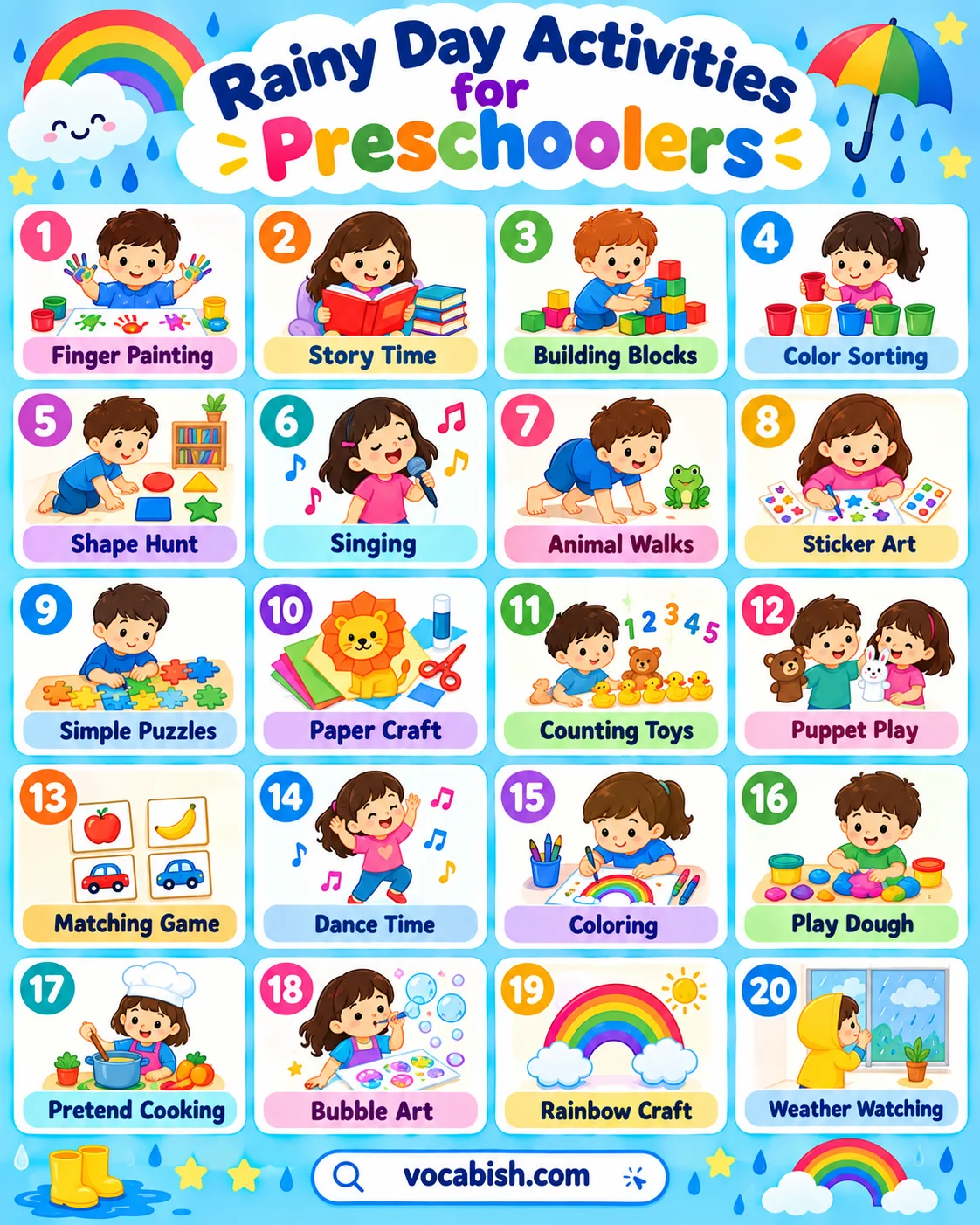
Good Rainy Day Activities for Preschoolers include:
- Finger painting
- Colour sorting
- Shape hunts
- Building blocks
- Simple puzzles
- Puppet play
- Singing and movement
- Storytime
- Paper crafts
- Sticker scenes
- Counting toys
- Pretend cooking
- Animal walks
- Matching games
- Simple obstacle courses
Keep small objects, scissors, food preparation, water activities, and other potentially unsafe materials under appropriate adult supervision.
Free Rainy Day Activities for Kids
You do not need expensive toys or paid attractions to make a rainy day enjoyable. Many memorable activities use materials already available at home or school.
Try:
- Reading books you already own
- Drawing with pencils
- Making paper crafts
- Building forts with blankets
- Creating stories
- Playing charades
- Counting household objects
- Making paper puzzles
- Sorting toys
- Playing “Simon Says”
- Creating homemade cards
- Designing a family newspaper
- Having a dance session
- Making a treasure hunt
- Planning a future family outing
These free rainy day activities for kids can be especially useful during long school breaks or when families want to reduce screen time.
Indoor Rainy Day Activities for Kids
Indoor activities can serve different needs throughout the day. Physical games are useful when children have lots of energy, while reading and drawing can work better during quieter periods.
Some indoor rainy day activities for kids include:
- Indoor bowling
- Balloon volleyball
- Freeze dance
- Obstacle courses
- Fort building
- Board games
- Puzzles
- Reading
- Drawing
- Origami
- Cooking
- Storytelling
- Science experiments
- Pretend play
- Word games
A helpful routine is to alternate between active and quiet activities rather than expecting children to sit still for hours.
Outdoor Rainy Day Activities for Kids
Being indoors is often the safest choice during heavy rain, thunderstorms, strong winds, flooding, or unsafe conditions. However, light rain can sometimes provide opportunities for supervised outdoor observation and play when the environment is safe.
Possible outdoor rainy day activities for kids include:
- Watching raindrops from a covered area
- Measuring rainfall with a rain gauge
- Looking for puddles
- Observing clouds
- Listening to different rain sounds
- Watching how water moves along safe surfaces
- Looking for worms or other small creatures after gentle rain
- Photographing rain patterns
- Comparing wet and dry surfaces
- Observing how plants look after rainfall
Children should stay away from flooded areas, fast-moving water, lightning, fallen electrical wires, unstable trees, and other hazards.
Rainy Day Activities for Different Ages
For Preschoolers
Focus on sensory, creative, movement-based, and short activities.
Good choices include:
- Painting
- Colour sorting
- Building blocks
- Songs
- Storytime
- Matching games
- Simple crafts
- Pretend play
For Elementary School Kids
Children in elementary grades can handle more structured challenges.
Try:
- Science experiments
- Board games
- Writing stories
- Treasure hunts
- Puzzles
- Cooking with adult help
- Indoor obstacle courses
- Vocabulary games
- Art projects
- Group quizzes
For Older Kids
Older children often enjoy activities that give them independence and a meaningful challenge.
Try:
- Creative writing
- Photography
- Cooking
- Journaling
- Puzzle solving
- DIY projects
- Learning a new skill
- Designing a board game
- Making a short video
- Planning a future project or outing
How to Choose the Right Rainy Day Activity
The best activity depends on more than age. Consider what the child needs at that moment.
When choosing an activity, think about:
- Energy level: Choose movement games for children who need to be active.
- Age: Select instructions and materials that match the child’s development.
- Available space: A large movement game may not work in a small room.
- Materials: Start with objects you already have before buying supplies.
- Time: A ten-minute activity can be better than a large project when time is limited.
- Interests: Art-loving children may prefer crafts, while curious children may enjoy experiments.
- Number of children: Some games work best with groups, while others suit one child.
- Supervision: Activities involving water, cooking, tools, or small objects may require adult help.
Common Mistakes to Avoid
A rainy day does not need to become stressful. Avoid these common problems:
- Planning only one activity: Children may lose interest quickly, so prepare a few alternatives.
- Choosing activities that are too difficult: Complicated instructions can create frustration.
- Ignoring safety: Keep water, cooking, scissors, and small objects age-appropriate and supervised.
- Forcing constant productivity: Children also need free play and quiet time.
- Relying entirely on screens: Digital entertainment can be one option, but it does not need to fill the entire day.
A Simple Rainy-Day Routine
A flexible routine can help children know what comes next without making the day feel overly structured.
You might begin with a creative activity, move to an indoor game, take a quiet reading break, have lunch or a snack, complete a learning activity, and finish with free play.
For example:
Morning: Art project → movement game → reading
Afternoon: Lunch → puzzle or science activity → pretend play
Evening: Family game → quiet activity → storytime
The exact schedule can change according to children’s ages, energy levels, and interests.
FAQs About Rainy Day Activities for Kids
Fun rainy day activities include indoor games, crafts, reading, cooking, puzzles, pretend play, science experiments, dance games, and treasure hunts.
Kids can build forts, draw, read, bake, make crafts, play board games, complete puzzles, conduct safe experiments, or create imaginative games.
Teachers can use reading circles, vocabulary bingo, group storytelling, drawing challenges, quizzes, puzzles, charades, and weather-related classroom activities.
Preschoolers can enjoy painting, singing, shape hunts, building blocks, simple puzzles, storytelling, matching games, and pretend play.
Free options include drawing, reading, dancing, building forts, storytelling, sorting toys, making paper crafts, playing charades, and creating treasure hunts.
Children may play outside during light rain when conditions are safe, but they should stay indoors during thunderstorms, flooding, lightning, or other dangerous weather.
Use a mix of crafts, books, puzzles, movement games, pretend play, cooking, family games, writing, building projects, and safe science activities.
Older children may enjoy cooking, photography, creative writing, DIY projects, puzzles, journaling, science projects, board games, and learning new skills.
Conclusion
Rainy weather does not have to mean a boring day indoors. The right Rainy Day Activities for Kids can turn a few hours at home or school into time for creativity, movement, learning, imagination, and connection.
From free crafts and indoor games to classroom challenges and supervised outdoor observations, there are options for almost every age and interest. The best rainy-day plan is flexible: give children choices, mix energetic and quiet activities, and let them enjoy some unstructured play too.
Explore More Kids Learning Guides