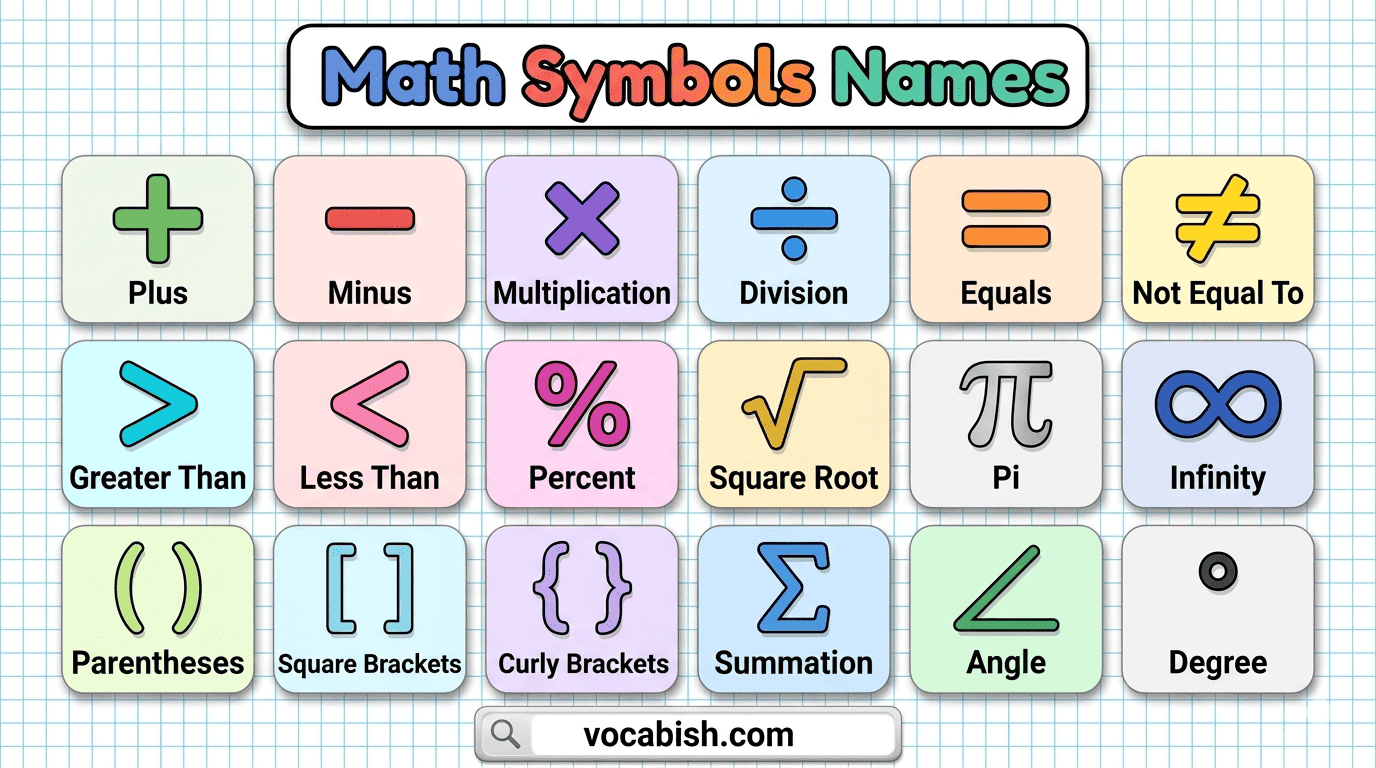

Want to know what symbols like +, −, ×, ÷, ∑, ∫, ∞, or ∈ actually mean? This complete guide to Math Symbols explains the names, meanings, and practical uses of the most common mathematical symbols in one place. You’ll find an easy-to-understand list of all mathematical symbols, including basic arithmetic, geometry, algebra, linear algebra, probability, statistics, set theory, logic, calculus, and numeral symbols, each with clear definitions and examples. Whether you’re a student, ESL learner, teacher, or simply looking up a symbol you don’t recognize, this page helps you understand mathematical notation quickly and use it with confidence.
What Are Math Symbols?
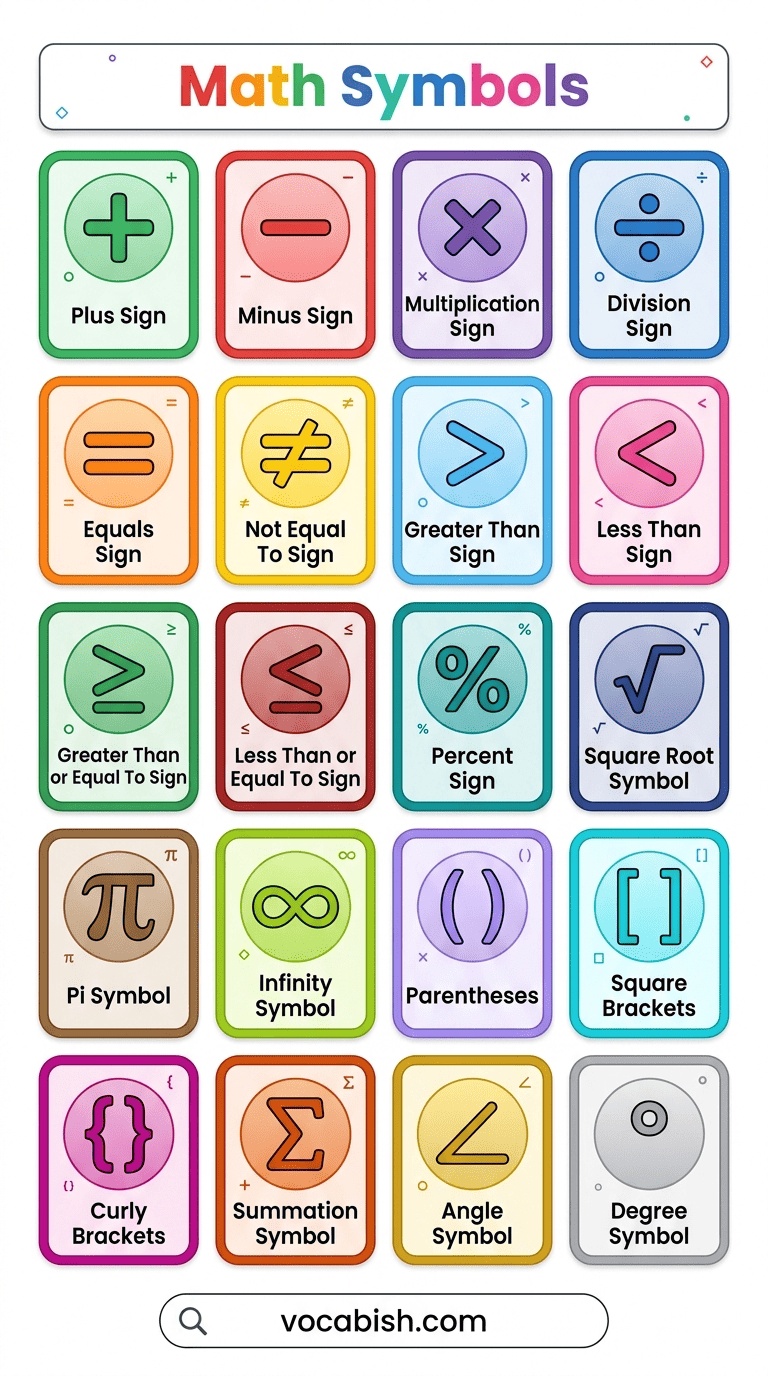
Math symbols are special signs that represent numbers, operations, relationships, or mathematical ideas. Instead of writing long descriptions, mathematicians use symbols to communicate quickly and clearly.
For example, the plus sign (+) means addition, while the equals sign (=) shows that two values are the same. More advanced symbols can describe angles, sets, limits, vectors, probabilities, and much more.
These symbols create a universal language that students, teachers, scientists, and engineers use around the world.
Basic Math Symbols
Symbol | Symbol Name | Meaning / Definition | Example |
|---|---|---|---|
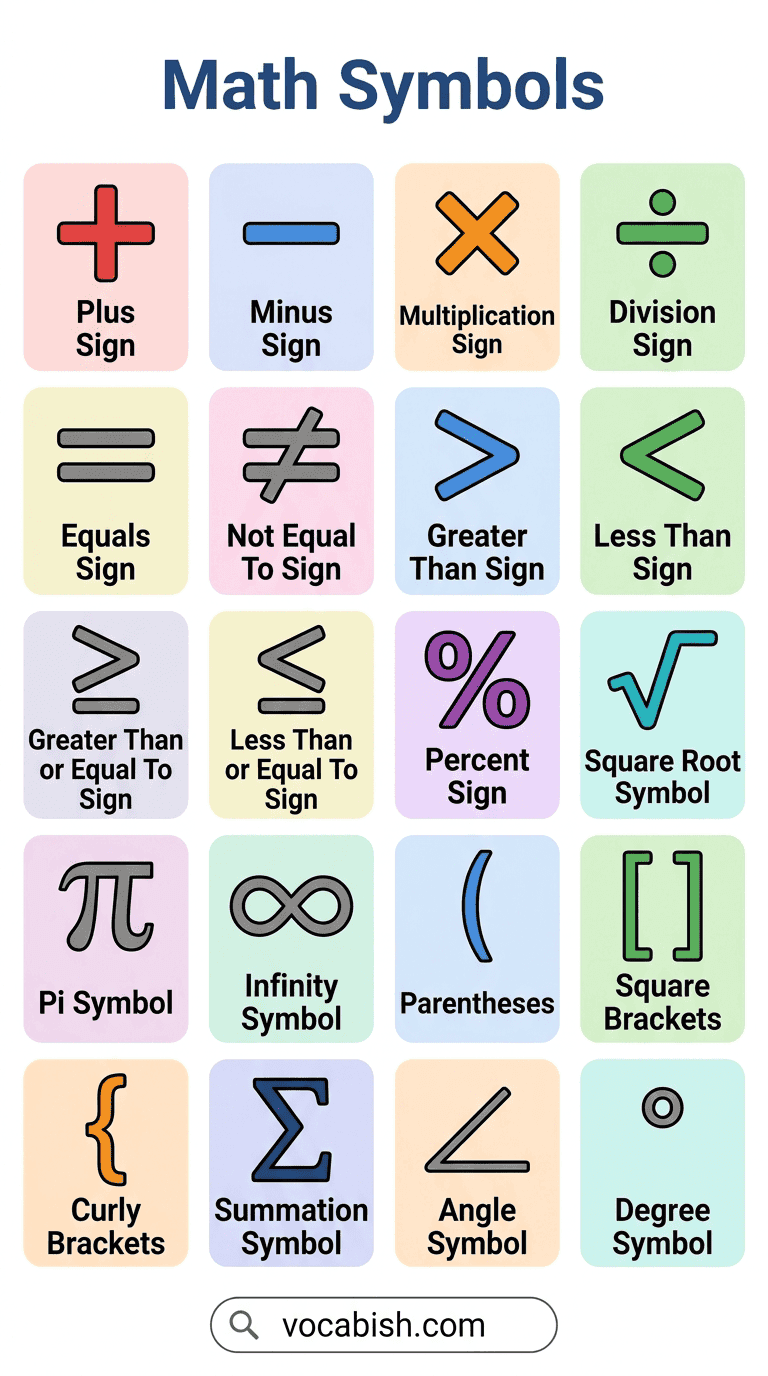
+ | Plus | Addition | 5 + 3 = 8 |
− | Minus | Subtraction | 9 − 4 = 5 |
× | Multiplication | Multiply values | 6 × 7 = 42 |
÷ | Division | Divide values | 20 ÷ 5 = 4 |
= | Equals | Two values are equal | 8 = 8 |
≠ | Not Equal To | Values are different | 5 ≠ 7 |
< | Less Than | Smaller than | 3 < 8 |
> | Greater Than | Larger than | 10 > 6 |
≤ | Less Than or Equal To | Smaller or equal | x ≤ 15 |
≥ | Greater Than or Equal To | Larger or equal | y ≥ 9 |
± | Plus or Minus | Either positive or negative | x = ±5 |
∓ | Minus or Plus | Opposite paired sign | a ∓ b |
% | Percent | Out of 100 | 50% = 0.5 |
‰ | Per Mille | Per thousand | 25‰ |
: | Ratio | Comparison of quantities | 2:5 |
/ | Slash | Fraction or division | 3/4 |
√ | Square Root | Root of a number | √49 = 7 |
∛ | Cube Root | Third root | ∛27 = 3 |
^ | Power/Exponent | Raise to a power | 2^3 = 8 |
! | Factorial | Product of integers | 5! = 120 |
≈ | Approximately Equal | Nearly equal | π ≈ 3.14 |
∝ | Proportional To | Changes together | y ∝ x |
∞ | Infinity | Unlimited quantity | lim x → ∞ |
· | Dot Multiplication | Alternative multiplication | 3 · 4 = 12 |
Geometry Symbols
Symbol | Symbol Name | Meaning / Definition | Example |
|---|---|---|---|
∠ | Angle | Represents an angle | ∠ABC = 90° |
° | Degree | Unit for measuring angles | 45° |
⊥ | Perpendicular | Lines meet at 90° | AB ⊥ CD |
∥ | Parallel | Lines never intersect | AB ∥ CD |
△ | Triangle | Represents a triangle | △ABC |
□ | Square | Represents a square | □ABCD |
▭ | Rectangle | Represents a rectangle | Rectangle PQRS |
○ | Circle | Represents a circle | Circle O |
⌒ | Arc | Portion of a circle | ⌒AB |
⊙ | Circle with Center | Circle centered at a point | ⊙O |
≅ | Congruent To | Same shape and size | △ABC ≅ △DEF |
∼ | Similar To | Same shape, different size | △ABC ∼ △XYZ |
≡ | Identically Equal / Congruent | Exactly equal in geometry | AB ≡ CD |
↔ | Line | Infinite line through points | ↔AB |
→ | Ray | Starts at one point | →AB |
(\overline{AB}) | Line Segment | Finite part of a line | (\overline{AB}) |
π | Pi | Ratio of circumference to diameter | Area = πr² |
r | Radius | Distance from center | r = 5 cm |
d | Diameter | Twice the radius | d = 10 cm |
C | Circumference | Distance around circle | C = 2πr |
A | Area | Surface measurement | A = l × w |
V | Volume | Space occupied | V = l × w × h |
Algebra Symbols
Symbol | Symbol Name | Meaning / Definition | Example |
|---|---|---|---|
x, y, z | Variables | Unknown values | x + 5 = 10 |
= | Equals | Equality | x = 7 |
≠ | Not Equal To | Inequality | x ≠ y |
+ | Addition | Add values | a + b |
− | Subtraction | Subtract values | a − b |
× | Multiplication | Multiply values | ab or a × b |
÷ | Division | Divide values | a ÷ b |
^ | Exponent | Raise to a power | x² |
√ | Square Root | Root of value | √x |
∛ | Cube Root | Third root | ∛8 = 2 |
∝ | Proportional To | Varies together | y ∝ x |
≈ | Approximately Equal | Nearly equal | π ≈ 3.14 |
< | Less Than | Smaller value | x < 10 |
> | Greater Than | Larger value | y > 4 |
≤ | Less Than or Equal To | Smaller or equal | x ≤ 20 |
≥ | Greater Than or Equal To | Greater or equal | y ≥ 5 |
∈ | Element Of | Belongs to a set | x ∈ A |
∉ | Not Element Of | Does not belong | y ∉ B |
∑ | Summation | Sum of terms | ∑i |
Π | Product | Product of terms | Πx |
f(x) | Function | Maps input to output | f(x)=x² |
→ | Maps To | Transformation | x → x+1 |
Linear Algebra Symbols
Symbol | Symbol Name | Meaning / Definition | Example |
|---|---|---|---|
A | Matrix | Rectangular array of numbers | A = [[1,2],[3,4]] |
I | Identity Matrix | Matrix with ones on diagonal | I₂ |
0 | Zero Matrix | Matrix of all zeros | 0₃×₃ |
Aᵀ | Transpose | Rows become columns | Aᵀ |
A⁻¹ | Inverse Matrix | Matrix inverse | AA⁻¹ = I |
det(A) | Determinant | Scalar from matrix | det(A)=5 |
rank(A) | Rank | Number of independent rows/columns | rank(A)=2 |
tr(A) | Trace | Sum of diagonal entries | tr(A)=7 |
λ | Eigenvalue | Special scalar | λ = 3 |
v | Eigenvector | Vector associated with λ | Av = λv |
u, v | Vector | Ordered list of numbers | u=(1,2) |
‖v‖ | Norm | Length of vector | ‖v‖=5 |
· | Dot Product | Scalar product | u·v |
× | Cross Product | Vector product | u×v |
⊗ | Tensor Product | Product of tensors | A⊗B |
span | Span | Generated vector space | span(v₁,v₂) |
ker(A) | Kernel | Null space | ker(A) |
im(A) | Image | Column space | im(A) |
dim(V) | Dimension | Number of basis vectors | dim(V)=3 |
⊕ | Direct Sum | Combination of spaces | U⊕W |
Probability and Statistics Symbols
Symbol | Symbol Name | Meaning / Definition | Example |
|---|---|---|---|
P(A) | Probability | Chance of event A | P(A)=0.5 |
P(A∩B) | Joint Probability | Both events occur | P(A∩B) |
P(A∪B) | Union Probability | Either event occurs | P(A∪B) |
Aᶜ | Complement | Event does not occur | P(Aᶜ) |
E(X) | Expected Value | Average outcome | E(X)=5 |
Var(X) | Variance | Spread of data | Var(X)=4 |
σ | Population Standard Deviation | Data dispersion | σ=2 |
σ² | Population Variance | Squared deviation | σ²=4 |
μ | Population Mean | Average | μ=50 |
x̄ | Sample Mean | Mean of sample | x̄=12 |
s | Sample Standard Deviation | Sample spread | s=3 |
s² | Sample Variance | Sample variance | s²=9 |
n | Sample Size | Number of observations | n=100 |
N | Population Size | Total observations | N=500 |
ρ | Correlation Coefficient | Relationship strength | ρ=0.8 |
z | Z-score | Standardized value | z=1.5 |
χ² | Chi-Square | Chi-square statistic | χ²=6.2 |
t | t-Statistic | Student’s t value | t=2.1 |
α | Significance Level | Error threshold | α=0.05 |
β | Beta | Type II error rate | β=0.2 |
Combinatorics Symbols
Symbol | Symbol Name | Meaning / Definition | Example |
|---|---|---|---|
n! | Factorial | Product of integers | 5! = 120 |
(n choose k) or C(n,k) | Binomial Coefficient | Number of combinations | C(5,2)=10 |
P(n,r) | Permutation | Ordered arrangements | P(5,2)=20 |
C(n,r) | Combination | Unordered selections | C(5,2)=10 |
∑ | Summation | Sum of terms | ∑₁ⁿ i |
Π | Product | Product of terms | Π₁ⁿ i |
∈ | Element Of | Membership | x∈S |
∉ | Not Element Of | Non-membership | y∉S |
∪ | Union | Combine sets | A∪B |
∩ | Intersection | Common elements | A∩B |
⊆ | Subset | Included within | A⊆B |
⊂ | Proper Subset | Strict subset | A⊂B |
∅ | Empty Set | No elements | ∅ |
ℕ | Natural Numbers | Positive counting numbers | 1,2,3… |
ℤ | Integers | Whole numbers | …−2,−1,0,1… |
ℚ | Rational Numbers | Fractions | 3/4 |
ℝ | Real Numbers | All real values | √2 ∈ ℝ |
ℂ | Complex Numbers | a + bi numbers | 2+3i |
↦ | Maps To | Function assignment | x ↦ x² |
Set Theory Symbols
Set theory provides the foundation for many areas of mathematics. These symbols describe collections of objects, relationships between sets, and operations performed on them.
Symbol | Symbol Name | Meaning / Definition | Example |
|---|---|---|---|
∅ | Empty Set | A set with no elements | A = ∅ |
∈ | Element Of | Belongs to a set | 3 ∈ A |
∉ | Not Element Of | Does not belong to a set | 7 ∉ B |
⊂ | Proper Subset | All elements belong, but sets are not equal | A ⊂ B |
⊆ | Subset or Equal | A is contained in or equal to B | A ⊆ B |
⊄ | Not a Subset | Not contained in another set | A ⊄ B |
⊇ | Superset or Equal | Contains another set | B ⊇ A |
⊃ | Proper Superset | Strictly contains another set | B ⊃ A |
∪ | Union | Elements in either set | A ∪ B |
∩ | Intersection | Elements common to both sets | A ∩ B |
− | Set Difference | Elements in first but not second | A − B |
△ | Symmetric Difference | Elements in one set but not both | A △ B |
Aᶜ | Complement | Elements not in A | Aᶜ |
× | Cartesian Product | Ordered pairs from two sets | A × B |
|A| | Cardinality | Number of elements in a set | |A| = 5 |
ℕ | Natural Numbers | Counting numbers | 1, 2, 3, … |
ℤ | Integers | Positive, negative, and zero | −3 ∈ ℤ |
ℚ | Rational Numbers | Fractions and ratios | 3/5 ∈ ℚ |
ℝ | Real Numbers | All real values | π ∈ ℝ |
ℂ | Complex Numbers | Numbers with imaginary parts | 2 + 3i ∈ ℂ |
Logic Symbols
Logic symbols help express statements, conditions, and reasoning in mathematics, computer science, and philosophy.
Symbol | Symbol Name | Meaning / Definition | Example |
|---|---|---|---|
¬ | Not | Negation | ¬P |
∧ | And | Both statements are true | P ∧ Q |
∨ | Or | At least one statement is true | P ∨ Q |
⊕ | Exclusive Or | Exactly one statement is true | P ⊕ Q |
→ | Implies | If P then Q | P → Q |
↔ | If and Only If | Two-way implication | P ↔ Q |
⇒ | Implies | Logical consequence | x > 2 ⇒ x > 1 |
⇔ | Equivalent | Logical equivalence | A ⇔ B |
∀ | For All | Universal quantifier | ∀x > 0 |
∃ | There Exists | Existential quantifier | ∃x such that x² = 4 |
∄ | There Does Not Exist | No such element exists | ∄x < 0 |
⊢ | Proves | Derivation in logic | A ⊢ B |
⊨ | Models | Semantic implication | A ⊨ B |
⊥ | False / Contradiction | Impossible statement | P ∧ ¬P = ⊥ |
⊤ | True | Always true | ⊤ |
≡ | Logically Equivalent | Same truth value | P ≡ Q |
Calculus and Analysis Symbols
Calculus uses symbols to describe change, limits, rates, areas, and infinite processes.
Symbol | Symbol Name | Meaning / Definition | Example |
|---|---|---|---|
d/dx | Derivative | Rate of change | d/dx(x²) = 2x |
∂ | Partial Derivative | Derivative with respect to one variable | ∂f/∂x |
∫ | Integral | Area under a curve | ∫x dx |
∬ | Double Integral | Integral over a surface | ∬f(x,y)dA |
∭ | Triple Integral | Integral over a volume | ∭f(x,y,z)dV |
∮ | Contour Integral | Integral around a closed path | ∮f(z)dz |
lim | Limit | Value approached by a function | lim x→0 |
Δ | Change | Difference between values | Δx |
δ | Small Change | Infinitesimal quantity | δx |
∇ | Nabla | Gradient operator | ∇f |
∇² | Laplacian | Second-order differential operator | ∇²f |
∑ | Summation | Sum of terms | ∑₁ⁿ i |
Π | Product | Product of terms | Π₁ⁿ i |
∞ | Infinity | Unlimited value | x → ∞ |
≈ | Approximately Equal | Nearly equal | e ≈ 2.718 |
→ | Approaches | Tends toward | x → 5 |
o() | Little-o Notation | Smaller-order growth | o(n) |
O() | Big-O Notation | Asymptotic upper bound | O(n²) |
f′(x) | First Derivative | First rate of change | f′(x)=2x |
f″(x) | Second Derivative | Second rate of change | f″(x)=2 |
Numeral Symbols
Numeral symbols represent different types of numbers and number systems used throughout mathematics.
Symbol | Symbol Name | Meaning / Definition | Example |
|---|---|---|---|
0 | Zero | No quantity | 0 apples |
1,2,3… | Natural Numbers | Counting numbers | 1, 2, 3 |
ℕ | Natural Number Set | Set of natural numbers | 5 ∈ ℕ |
ℤ | Integer Set | Whole numbers including negatives | −8 ∈ ℤ |
ℚ | Rational Number Set | Numbers expressible as fractions | 2/7 ∈ ℚ |
ℝ | Real Number Set | All real values | √2 ∈ ℝ |
ℂ | Complex Number Set | Numbers with imaginary parts | 4 + 5i |
π | Pi | Mathematical constant | π ≈ 3.14159 |
e | Euler’s Number | Base of natural logarithm | e ≈ 2.71828 |
i | Imaginary Unit | √−1 | i² = −1 |
∞ | Infinity | Endless quantity | ∞ |
% | Percent | Per hundred | 25% |
‰ | Per Mille | Per thousand | 15‰ |
½ | One Half | Fraction | ½ cup |
¼ | One Quarter | Fraction | ¼ hour |
¾ | Three Quarters | Fraction | ¾ meter |
⅓ | One Third | Fraction | ⅓ pizza |
⅔ | Two Thirds | Fraction | ⅔ vote |
10² | Power | Exponent notation | 10² = 100 |
10³ | Cube | Third power | 10³ = 1000 |
Download PDF of Math Symbols
You May Also Like:
Frequently Asked Questions
Math symbols are special signs used to represent operations, relationships, numbers, and mathematical concepts. They make equations shorter, clearer, and easier to understand.
Knowing mathematical symbols helps you solve problems faster, read formulas correctly, understand textbooks, and communicate mathematical ideas with confidence.
The equals sign (=) shows two values are exactly the same, while approximately equal (≈) means the values are close but not perfectly equal.
The symbol ∞ represents infinity, which describes something without any limit or end. It does not represent a specific number.
Some common symbols include + for addition, − for subtraction, × for multiplication, ÷ for division, = for equality, < for less than, and > for greater than.
The summation symbol (∑) tells you to add a sequence of numbers together. It is widely used in algebra, statistics, and calculus.
The symbol ∈ means “is an element of” or “belongs to.” For example, 5 ∈ ℕ means that 5 belongs to the set of natural numbers.
Conclusion
Math symbols are much more than marks on a page—they are the language that connects numbers, formulas, and ideas across every branch of mathematics. From everyday calculations with basic arithmetic symbols to advanced topics like calculus, logic, and linear algebra, each symbol has a specific purpose that makes mathematical expressions clear and efficient.
As you become familiar with the names of mathematical symbols and their meanings, reading equations and solving problems becomes easier and more natural. Instead of memorizing everything at once, focus on learning a few symbols at a time and practice using them in examples.