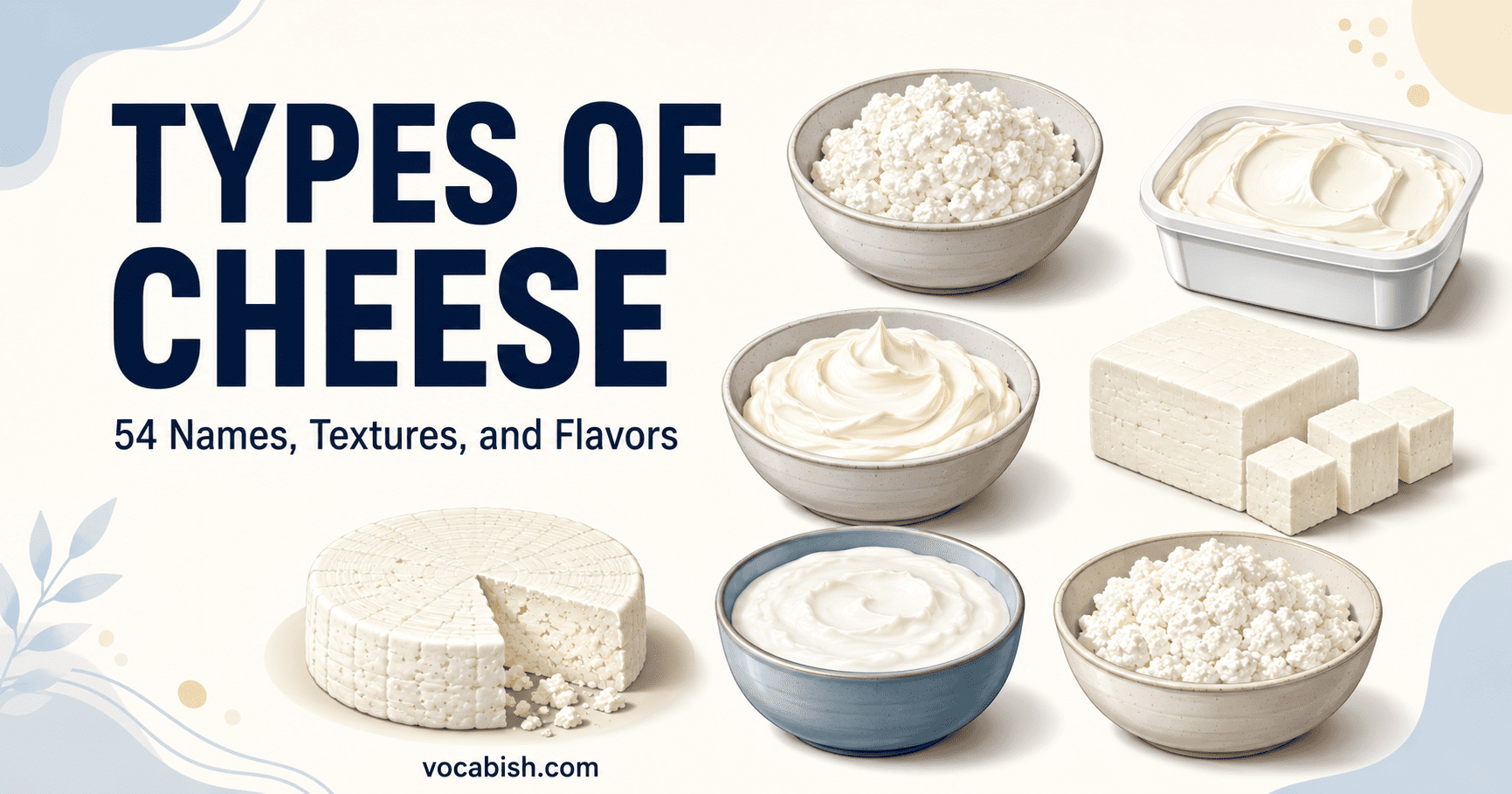

Different types of cheese are commonly grouped by moisture, texture, ripening method, rind, curd treatment, and storage. Fresh cheeses such as ricotta and paneer differ from bloomy-rind Brie, blue Roquefort, stretched-curd mozzarella, brined feta, and hard Parmigiano Reggiano.
In this blog post, you will learn 54 important types of cheese, organised into eight practical families. The article explains their identifying features, flavours, textures, culinary uses, and important differences. There is no universal total because thousands of regional cheeses exist and classification systems frequently overlap.
What Is Cheese?
Cheese is a ripened or unripened dairy product made by coagulating milk proteins and separating part of the liquid whey. Milk, cream, bacterial cultures, enzymes and salt may be used according to the particular cheese and production standard.
In this context, types of cheese means recognised cheese varieties grouped according to practical characteristics such as:
- Moisture and firmness
- Freshness or length of ageing
- Surface or internal ripening
- Rind treatment
- Curd preparation
- Storage in brine
- Milk source and geographical tradition
Codex officially recognises terms including soft, semi-hard, hard, extra-hard, ripened, mould-ripened, fresh and in-brine. However, cheesemakers, retailers and competitions may use additional families such as bloomy-rind, washed-rind and pasta filata. Therefore, a cheese can legitimately fit more than one category.
This article covers 54 representative natural cheese varieties. Processed cheese slices, cheese spreads, flavoured cheese products and general milk-source labels such as “goat’s cheese” are not counted as individual varieties.
Complete List of 54 Types of Cheese
Below is a complete list of 54 different types of cheese and their names:
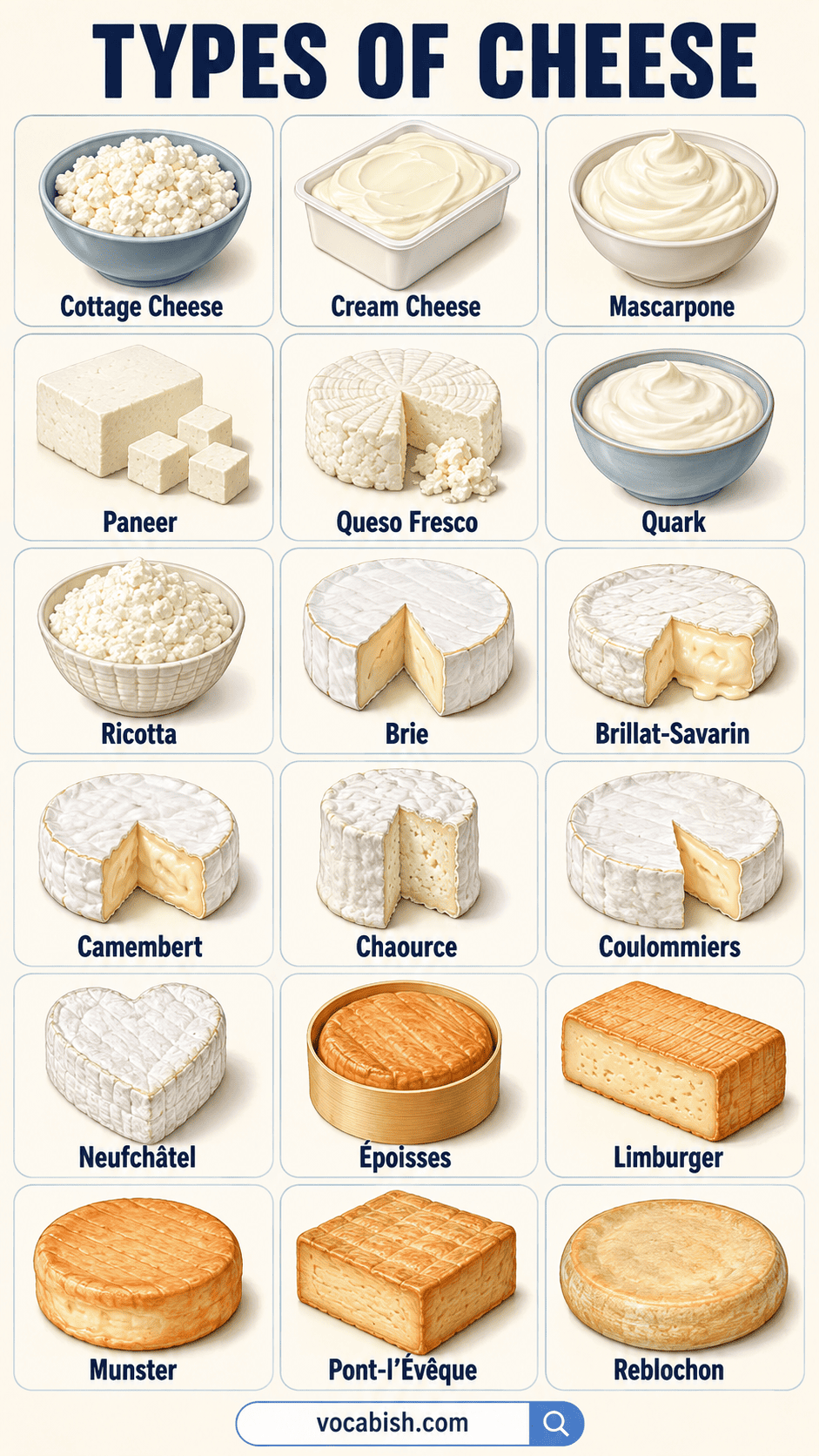
Cottage Cheese | Cream Cheese | Mascarpone |
Paneer | Queso Fresco | Quark |
Ricotta | Brie | Brillat-Savarin |
Camembert | Chaource | Coulommiers |
Neufchâtel | Époisses | Limburger |
Munster | Pont-l’Évêque | Reblochon |
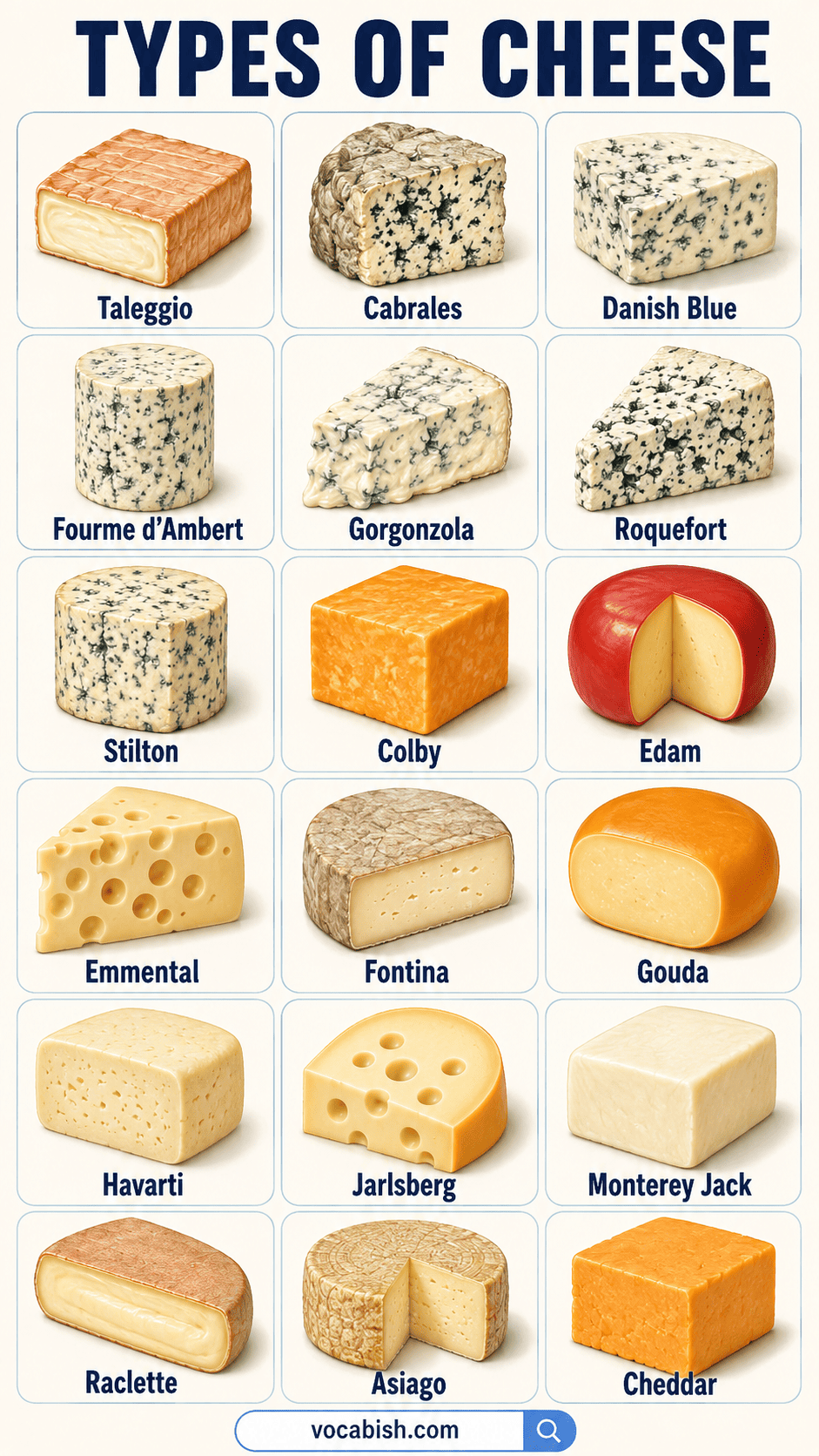
Taleggio | Cabrales | Danish Blue |
Fourme d’Ambert | Gorgonzola | Roquefort |
Stilton | Colby | Edam |
Emmental | Fontina | Gouda |
Havarti | Jarlsberg | Monterey Jack |
Raclette | Asiago | Cheddar |
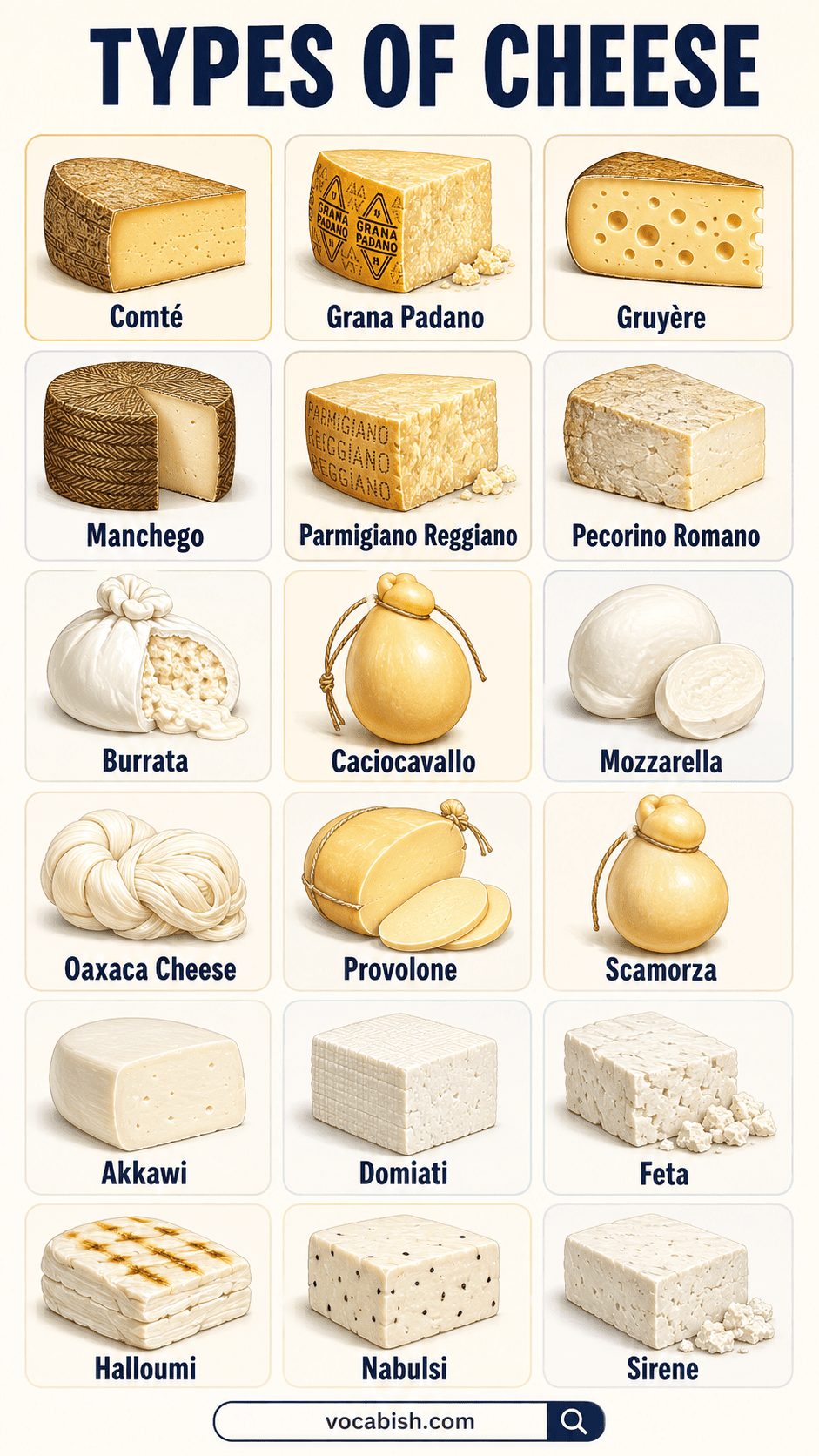
Comté | Grana Padano | Gruyère |
Manchego | Parmigiano Reggiano | Pecorino Romano |
Burrata | Caciocavallo | Mozzarella |
Oaxaca Cheese | Provolone | Scamorza |
Akkawi | Domiati | Feta |
Halloumi | Nabulsi | Sirene |
54 Types of Cheese Explained By Categories
Fresh and Unripened Cheeses
Fresh cheeses are ready for consumption soon after production and generally retain considerable moisture. They usually have mild, milky or lightly acidic flavours and little or no developed rind.
- Cottage Cheese: Moist curds offer mild flavour for breakfasts, salads, and baking.
- Cream Cheese: Smooth, spreadable cheese enriches bagels, frostings, sauces, dips, and cheesecakes.
- Mascarpone: Rich Italian cream cheese provides silky texture for tiramisu and sauces.
- Paneer: Firm Indian fresh cheese holds shape when grilled, fried, or simmered.
- Queso Fresco: Crumbly Latin American cheese adds fresh, milky flavour to savoury dishes.
- Quark: Tangy European fresh cheese suits baking, spreads, desserts, and breakfasts.
- Ricotta: Soft whey-based curds fill pasta, pastries, pancakes, and savoury dishes.
Bloomy-Rind Cheeses
Bloomy-rind cheeses develop a thin white mould covering and normally ripen from the outside towards the centre. Their paste becomes softer and more aromatic as ripening progresses.
- Brie: Soft cow’s-milk cheese develops creamy paste beneath an edible white rind.
- Brillat-Savarin: Triple-cream French cheese combines buttery richness with a delicate bloomy rind.
- Camembert: Small French-style wheel ripens inward, becoming earthy, creamy, and aromatic.
- Chaource: Soft French cheese offers a chalky centre and creamy outer layer.
- Coulommiers: Brie-like French cheese has a smaller wheel and rich mushroomy flavour.
- Neufchâtel: Soft Normandy cheese often appears heart-shaped with a slightly grainy texture.
Washed-Rind Cheeses
These cheeses are repeatedly washed or treated during ripening with brine or another permitted liquid. The process encourages surface microorganisms that often create orange colouring, a strong aroma, and a soft interior.
- Époisses: Burgundian soft cheese has an orange washed rind and a powerful aroma.
- Limburger: Pungent washed-rind cheese develops a soft interior and savoury character.
- Munster: Alsatian cheese combines a strong aroma with a supple, gently savoury paste.
- Pont-l’Évêque: Square Normandy cheese offers a washed rind and creamy, earthy centre.
- Reblochon: Soft Alpine cheese melts smoothly and brings nutty, cellar-like flavours.
- Taleggio: Italian washed-rind cheese balances a pungent aroma with mild fruitiness.
The smell of a washed rind can be stronger than the flavour of its interior. Some firm Alpine cheeses also receive rind washing but are usually classified by texture and production style instead.
Blue Cheeses
Blue cheese contains intentionally cultivated mould within the paste, usually producing blue or blue-green veins. Its texture may range from creamy to firm, so “blue” describes the ripening method rather than one firmness level.
- Cabrales: Spanish cave-ripened blue delivers intense spice and a moist, crumbly texture.
- Danish Blue: Cow’s-milk blue cheese offers sharp saltiness and an easily crumbled body.
- Fourme d’Ambert: Mild French blue combines creamy texture with delicate mushroomy notes.
- Gorgonzola: Italian blue ranges from soft and sweet to firmer, sharper styles.
- Roquefort: Sheep’s-milk blue cheese tastes salty, tangy, creamy, and distinctly piquant.
- Stilton: English blue cheese combines crumbly texture, blue veining, and mellow richness.
Roquefort PDO is specifically produced from raw sheep’s milk under protected geographical rules. It should not be used as a general name for every blue cheese.
Semi-Soft and Semi-Hard Cheeses
These cheeses sit between moist soft cheese and low-moisture hard cheese. They are usually sliceable, elastic or supple and often melt more evenly than highly aged varieties. Exact boundaries differ between legal and commercial systems.
- Colby: American stirred-curd cheese stays moist, mild, elastic, versatile, and easy-melting.
- Edam: Dutch cheese has a smooth texture, restrained flavour, and waxed rind.
- Emmental: Swiss-style cheese features large eyes, gentle nuttiness, and excellent melting.
- Fontina: Alpine cow’s-milk cheese melts smoothly with earthy, nutty, buttery flavours.
- Gouda: Dutch washed-curd cheese becomes firmer, nuttier, and sweeter with ageing.
- Havarti: Danish-style cheese has tiny openings, buttery flavour, and supple texture.
- Jarlsberg: Norwegian-style cheese combines large holes, mild sweetness, and nutty flavour.
- Monterey Jack: American semi-soft cheese melts evenly and carries a mild, buttery taste.
- Raclette: Alpine melting cheese becomes creamy when heated for potatoes and vegetables.
Age can move a variety between practical categories. Young Gouda is generally supple, whereas long-aged Gouda becomes significantly harder, darker and more suitable for grating.
Hard and Aged Cheeses
Hard cheeses lose more moisture during production and ageing. Their dense structure and concentrated flavour make many suitable for grating, shaving, long storage and adding savoury depth to cooked dishes.
- Asiago: Italian cheese ranges from smooth young wheels to firm, grateable ageing.
- Cheddar: Pressed cheese develops flavours from mild and creamy to sharp.
- Comté: French Alpine cheese offers firm texture and layered nutty, fruity flavours.
- Grana Padano: Granular Italian cheese provides savoury depth for grating and table use.
- Gruyère: Swiss cheese melts smoothly while retaining complex nutty and savoury notes.
- Manchego: Spanish sheep’s-milk cheese has firm texture and distinctive patterned rind.
- Parmigiano Reggiano: Long-aged Italian cheese has granular texture and concentrated savoury complexity.
- Pecorino Romano: Hard sheep’s-milk cheese brings salty sharpness to pasta and sauces.
Parmigiano Reggiano and Grana Padano are separate protected cheeses with different production specifications and geographical areas. Pecorino Romano is a cooked hard cheese made with sheep’s milk, not a cow’s-milk Parmesan substitute.
Stretched-Curd Cheeses
Stretched-curd cheeses are also called pasta filata, meaning that acidified curd is heated, worked and stretched. The method creates a fibrous or elastic structure, although ageing can make some members considerably firmer.
- Burrata: Mozzarella shell encloses cream and soft curds for a luscious centre.
- Caciocavallo: Aged stretched-curd cheese develops firm texture and increasingly sharp flavour.
- Mozzarella: Fresh stretched curd gives milky flavour, elasticity, and gentle melt.
- Oaxaca Cheese: Mexican stretched-curd cheese pulls into strings and melts exceptionally well.
- Provolone: Aged pasta-filata cheese ranges from mild sweetness to piquant sharpness.
- Scamorza: Pear-shaped Italian cheese is firmer than mozzarella and often smoked.
Not every stretched-curd cheese behaves like fresh mozzarella. Provolone and Caciocavallo are normally aged, while burrata contains a soft filling enclosed by a stretched mozzarella shell.
Brined Cheeses
Brined cheeses are salted, matured, packaged, or preserved in a saltwater solution. Brining contributes to their characteristic salinity, texture, and storage properties, but members vary considerably in milk source and firmness.
- Akkawi: Mild Middle Eastern white cheese has a smooth texture and restrained saltiness.
- Domiati: Egyptian white cheese is salted early and commonly matured in brine.
- Feta: Greek brined cheese has a crumbly texture and tangy, salty flavour.
- Halloumi: Cypriot brined cheese resists melting, making it ideal for grilling.
- Nabulsi: Levantine white cheese is brined, firm, and sometimes flavoured with spices.
- Sirene: Balkan brined cheese offers a crumbly texture and pronounced salty tang.
Feta PDO is made in Greece from specified sheep’s and goat’s milk under protected rules. Halloumi or Hellim PDO is a Cypriot semi-hard cheese known for retaining its shape during grilling or frying.
Important Differences Between Types of Cheese
No single feature classifies every cheese. Moisture, ageing, mould development, rind treatment, and curd preparation must often be considered together.
Category | Main Identifying Feature | Typical Texture | Common Examples | Common Uses |
|---|---|---|---|---|
Fresh | Little or no ageing | Moist and mild | Ricotta, paneer, quark | Fillings, spreads, salads |
Bloomy-rind | White surface mould | Softening from outside | Brie, Camembert | Boards, baking, sandwiches |
Washed-rind | Rind repeatedly washed | Soft or supple | Taleggio, Époisses | Boards, melting, baking |
Blue | Internal mould veining | Creamy to crumbly | Roquefort, Stilton | Sauces, salads, boards |
Semi-soft or semi-hard | Moderate moisture | Sliceable and elastic | Gouda, Havarti | Sandwiches, sauces, melting |
Hard and aged | Low moisture and long ageing | Dense or granular | Cheddar, Parmigiano Reggiano | Grating, shaving, cooking |
Stretched-curd | Heated and stretched curd | Elastic or fibrous | Mozzarella, Provolone | Pizza, grilling, sandwiches |
Brined | Stored or matured in brine | Crumbly to elastic | Feta, Halloumi | Salads, grilling, pastries |
How to Choose the Right Types of Cheese
- Choose by purpose: Use mozzarella for stretch, halloumi for grilling and Parmigiano Reggiano for grating.
- Consider intensity: Fresh cheeses are generally milder than mature blue or washed-rind cheeses.
- Check texture: Soft cheese spreads easily, while firm cheese slices or grates cleanly.
- Read the milk information: Cow, sheep, goat and buffalo milk create different flavour profiles.
- Check the coagulant: Look for vegetarian, microbial or plant-based rennet when required.
- Examine the rind: Bloomy, washed, natural and waxed rinds indicate different ripening treatments.
Commonly Confused Cheese Types and Terms
- A cheese type is not always a category. Brie is a variety, while bloomy-rind is a broader family.
- Soft does not automatically mean fresh. Camembert is soft but undergoes mould ripening.
- Blue cheese is not one variety. It includes differently made cheeses such as Stilton, Gorgonzola and Roquefort.
- Milk source does not define one cheese. “Goat’s cheese” covers many fresh, mould-ripened and aged varieties.
- Parmesan and Parmigiano Reggiano are not universally interchangeable. Protected-name rules and market terminology differ geographically.
- American Neufchâtel differs from French Neufchâtel. The American product resembles reduced-fat cream cheese, while the Normandy cheese is mould-ripened.
- Washed curd and washed rind are different processes. Gouda uses curd washing; Taleggio receives surface washing during ripening.
- Strong aroma does not guarantee strong flavour. A washed-rind cheese may smell more powerful than it tastes.
Summary of the Main Types of Cheese and Categories
Category | Key Characteristic | Common Examples | Best Known For |
|---|---|---|---|
Fresh and unripened | High moisture, minimal ageing | Ricotta, paneer, quark | Mild flavour and versatility |
Bloomy-rind | White mould-ripened surface | Brie, Camembert | Creamy paste and edible rind |
Washed-rind | Brine-treated ripening surface | Époisses, Taleggio | Pungent aroma |
Blue | Internal blue mould | Stilton, Roquefort | Veining and piquant flavour |
Semi-soft and semi-hard | Moderate moisture | Gouda, Havarti | Slicing and melting |
Hard and aged | Dense, low-moisture paste | Cheddar, Parmigiano Reggiano | Grating and concentrated flavour |
Stretched-curd | Heated and worked curd | Mozzarella, Provolone | Elasticity and melting |
Brined | Saltwater storage or maturation | Feta, Halloumi | Salty flavour and firm structure |
FAQs About Types of Cheese
The main practical groups are fresh, bloomy-rind, washed-rind, blue, semi-soft or semi-hard, hard-aged, stretched-curd, and brined cheeses. Other systems may instead emphasise moisture, milk source, rind, or production method.
Fresh cheese is ready soon after manufacture and normally has high moisture and mild flavour. Ripened cheese is held under controlled conditions so biochemical and physical changes develop its texture, aroma, rind, and flavour.
Moisture is a major factor: softer cheeses generally retain more water, while harder cheeses contain less. Cutting, cooking, pressing, salting, and ageing also affect firmness, so texture categories sometimes overlap between systems.
Yes, blue veining is deliberately produced using selected Penicillium cultures during ripening. The mould changes flavour and appearance, although individual blue cheeses vary greatly in moisture, milk source, strength, saltiness, and texture.
A washed-rind cheese is surface-ripened while its rind is repeatedly treated with brine or another liquid. This encourages characteristic microorganisms, often producing an orange surface, strong aroma, and comparatively milder interior flavour.
Mozzarella, Fontina, Raclette, Monterey Jack, Gruyère and young Gouda generally melt smoothly. Results still depend on moisture, acidity, age and preparation; very dry aged cheeses may grate well but melt less evenly.
Parmigiano Reggiano, Grana Padano, Pecorino Romano, aged Asiago and mature hard cheeses grate effectively. Their lower moisture and concentrated flavour suit pasta, soups, salads, gratins, sauces and savoury baked dishes.
No. Some cheeses use animal-derived rennet, while others use microbial, fermentation-produced, or plant-based coagulants.
What to Remember About Cheese Types
- This article includes 54 representative cheeses organised into eight practical categories.
- Cheese can be classified by moisture, firmness, ripening, rind, curd treatment, or storage.
- Fresh cheese is consumed quickly, while ripened cheese develops through controlled ageing.
- Bloomy-rind, washed-rind, and blue cheeses use different surface or internal ripening processes.
- Stretched-curd cheeses are defined by curd preparation, while brined cheeses are defined by salting and storage.
- Choose cheese according to flavour strength, texture, melting behaviour and intended dish.
Conclusion
Understanding the main types of cheese makes it easier to recognise their textures, anticipate their flavours and select an appropriate variety for cooking or serving. Fresh cheeses offer moisture and mildness, mould-ripened cheeses develop distinctive rinds or veining, and aged cheeses provide firmer textures and concentrated flavour. Stretched-curd and brined varieties are distinguished mainly by their production and preservation methods.
These categories are useful rather than absolute because varieties such as Gouda, Cheddar and Raclette can cross classification boundaries depending on age and production. Learning the major families provides a reliable starting point for comparing labels, preparing recipes and exploring unfamiliar cheeses.
You May Also Like