
Fun Facts for Kids are short facts that make learning more interesting. They help children discover animals, nature, science, space, food, countries, and the human body.
This collection includes 500 fun facts for kids. Each fact is easy to read and remember. Kids can use them for school projects, quizzes, presentations, and conversations.
Parents can share these facts at home. Teachers can use them for classroom questions and activities. English learners can also use them to build vocabulary and reading skills.
Some facts are surprising. For example, an octopus has three hearts. Jupiter is the largest planet in our solar system.
The facts are grouped by topic. This makes it easy to find the exact subject you want to explore. You can learn about animals, nature, the world, countries, science, space, food, the human body, and everyday life.
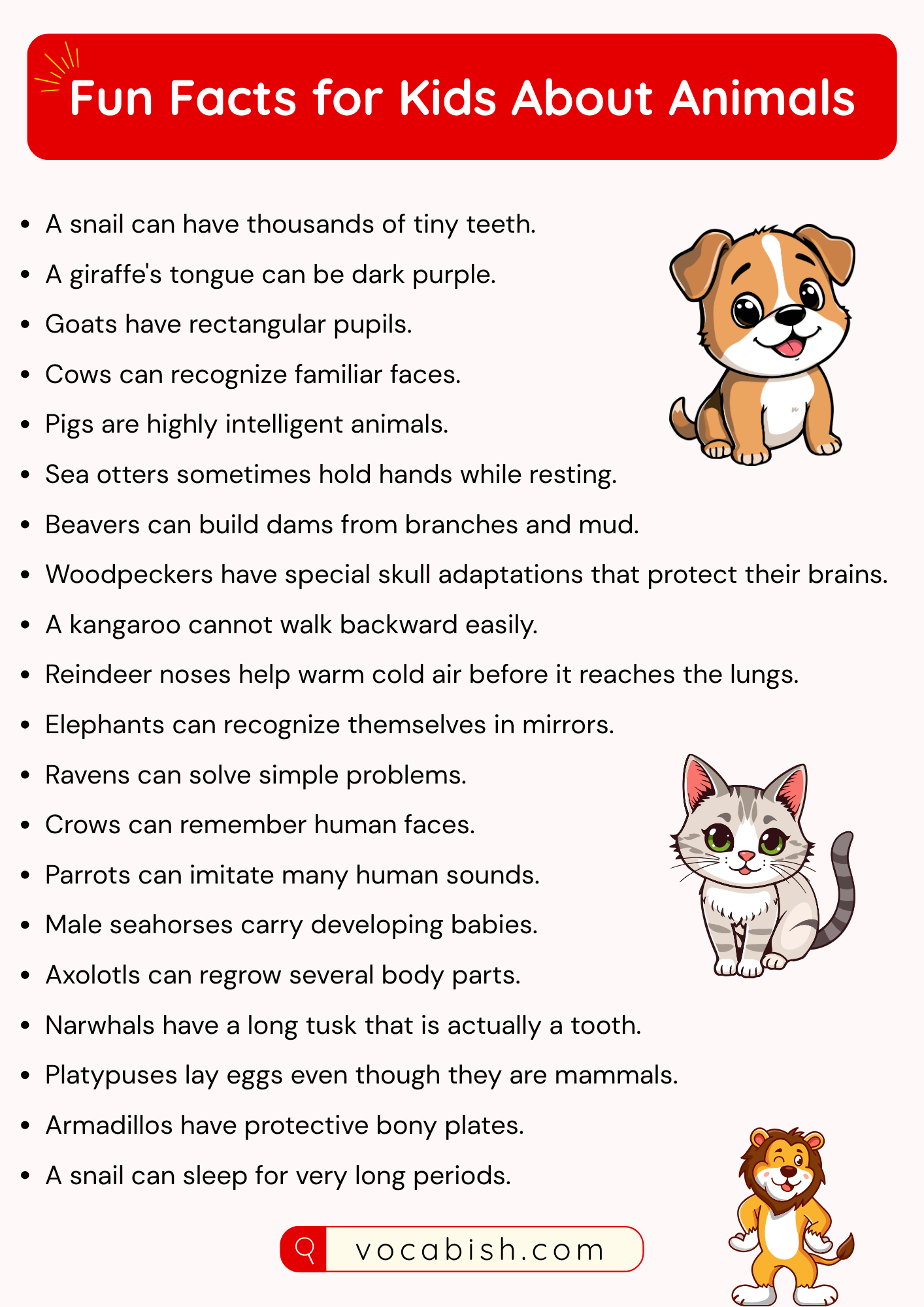
Fun Facts for Kids About Animals
Animals do some truly surprising things. These animal facts are great for classroom quizzes, family conversations, reading practice, and curiosity breaks.
1. A group of lions is called a pride.
2. A group of wolves is called a pack.
3. A group of fish is often called a school.
4. A group of elephants is called a herd.
5. Cows have four sections in their stomachs.
6. Giraffes have very long necks but only seven neck bones, just like humans.
7. An elephant’s trunk can be used for breathing, smelling, touching, drinking, and picking things up.
8. Elephants can communicate using sounds that humans may not easily hear.
9. A blue whale is the largest animal known to have lived on Earth.
10. Blue whales breathe air even though they live in the ocean.
11. Dolphins are mammals, not fish.
12. Dolphins use clicks and other sounds to communicate and find objects.
13. Octopuses have three hearts.
14. An octopus has blue blood because of a copper-based protein called hemocyanin.
15. Some octopuses can change their skin color and pattern.
16. Sharks have been on Earth for hundreds of millions of years.
17. Not all sharks need to keep swimming all the time.
18. Some sharks can replace lost teeth throughout their lives.
19. Sea turtles can travel long distances through the ocean.
20. Sea turtles are reptiles.
21. Penguins are birds that cannot fly through the air, but they are excellent swimmers.
22. Emperor penguins can survive extremely cold Antarctic conditions.
23. Flamingos are born with grayish feathers rather than bright pink feathers.
24. A flamingo’s pink color comes largely from pigments in its food.
25. Owls can turn their heads a long way, but they cannot rotate them all the way around.
26. Owls can often hunt successfully in low light.
27. Eagles have excellent eyesight.
28. Some birds migrate thousands of kilometers each year.
29. Hummingbirds can hover in place by rapidly moving their wings.
30. A hummingbird can fly backward.
31. Ostriches are the largest living birds.
32. Ostriches have long, powerful legs built for running.
33. Bats are mammals.
34. Bats are the only mammals capable of true sustained flight.
35. Many bats use echolocation to navigate and find food.
36. Cats use their whiskers to sense nearby objects and spaces.
37. A cat’s purring can happen in several situations, not only when it is happy.
38. Domestic cats spend a large part of the day sleeping.
39. Dogs have an excellent sense of smell.
40. A dog’s nose can help it detect scents that people cannot easily notice.
41. Puppies are born with their eyes and ears closed.
42. A rabbit’s front teeth continue growing throughout its life.
43. Rabbits can use their long ears to help regulate body temperature.
44. Guinea pigs are not pigs; they are rodents.
45. Hamsters can store food in special cheek pouches.
46. A koala’s fingerprints can look surprisingly similar to human fingerprints.
47. Koalas eat mostly eucalyptus leaves.
48. Kangaroos use their large tails for balance.
49. A baby kangaroo is called a joey.
50. Wombats produce cube-shaped droppings.
51. A panda’s diet is made mostly of bamboo.
52. Pandas are bears.
53. Giant pandas have an extra wrist bone that helps them grip bamboo.
54. Polar bears have black skin beneath their fur.
55. Polar bear fur looks white but is made of transparent hairs that reflect light.
56. Reindeer can have antlers on both males and females.
57. Deer antlers are among the fastest-growing animal tissues.
58. Camels have three eyelids.
59. Camels can close their nostrils during dusty conditions.
60. Camels store fat in their humps rather than storing water there.
61. Horses can sleep both standing up and lying down.
62. Zebras have unique stripe patterns.
63. Every zebra’s stripe pattern is different.
64. Cheetahs are the fastest land animals over short distances.
65. Cheetahs use their tails to help them balance while running.
66. Tigers have striped skin as well as striped fur.
67. No two tigers have exactly the same stripe pattern.
68. Leopards are strong climbers and may carry food into trees.
69. Sloths move slowly partly because their diet provides relatively little energy.
70. Sloths spend much of their lives in trees.
71. Some frogs can freeze partly during winter and survive until they thaw.
72. Frogs absorb water through their skin.
73. A toad is a type of frog.
74. Chameleons can change color for communication and temperature control as well as camouflage.
75. Some lizards can detach their tails to escape predators.
76. Crocodiles have been around for a very long time, with ancestors dating back to the age of dinosaurs.
77. Crocodiles can replace some of their teeth many times.
78. Snakes smell partly by using their tongues to collect particles from the air.
79. Snakes do not have external ears.
80. Some snakes can detect heat from warm-blooded animals.
81. Butterflies taste with sensors on their feet.
82. Butterflies begin life as caterpillars.
83. Caterpillars may shed their skin several times as they grow.
84. Bees communicate information about food locations using movement known as a waggle dance.
85. Worker honeybees are female.
86. Honeybees use nectar to make honey.
87. Ants can carry objects much heavier than their own body weight.
88. Some ants farm fungi for food.
89. Spiders are not insects; they are arachnids.
90. Spiders have eight legs.
91. Most insects have six legs.
92. Dragonflies spend much of their lives as aquatic young insects before becoming flying adults.
93. Mosquitoes use several cues, including carbon dioxide and body heat, to find hosts.
94. Ladybugs are beetles.
95. Some ladybugs are brightly colored to warn predators that they may taste unpleasant.
96. Earthworms help move and mix soil as they burrow.
97. Starfish are more accurately called sea stars.
98. Sea stars can regrow some lost body parts.
99. Jellyfish have no bones.
100. Jellyfish have existed in Earth’s oceans for hundreds of millions of years.
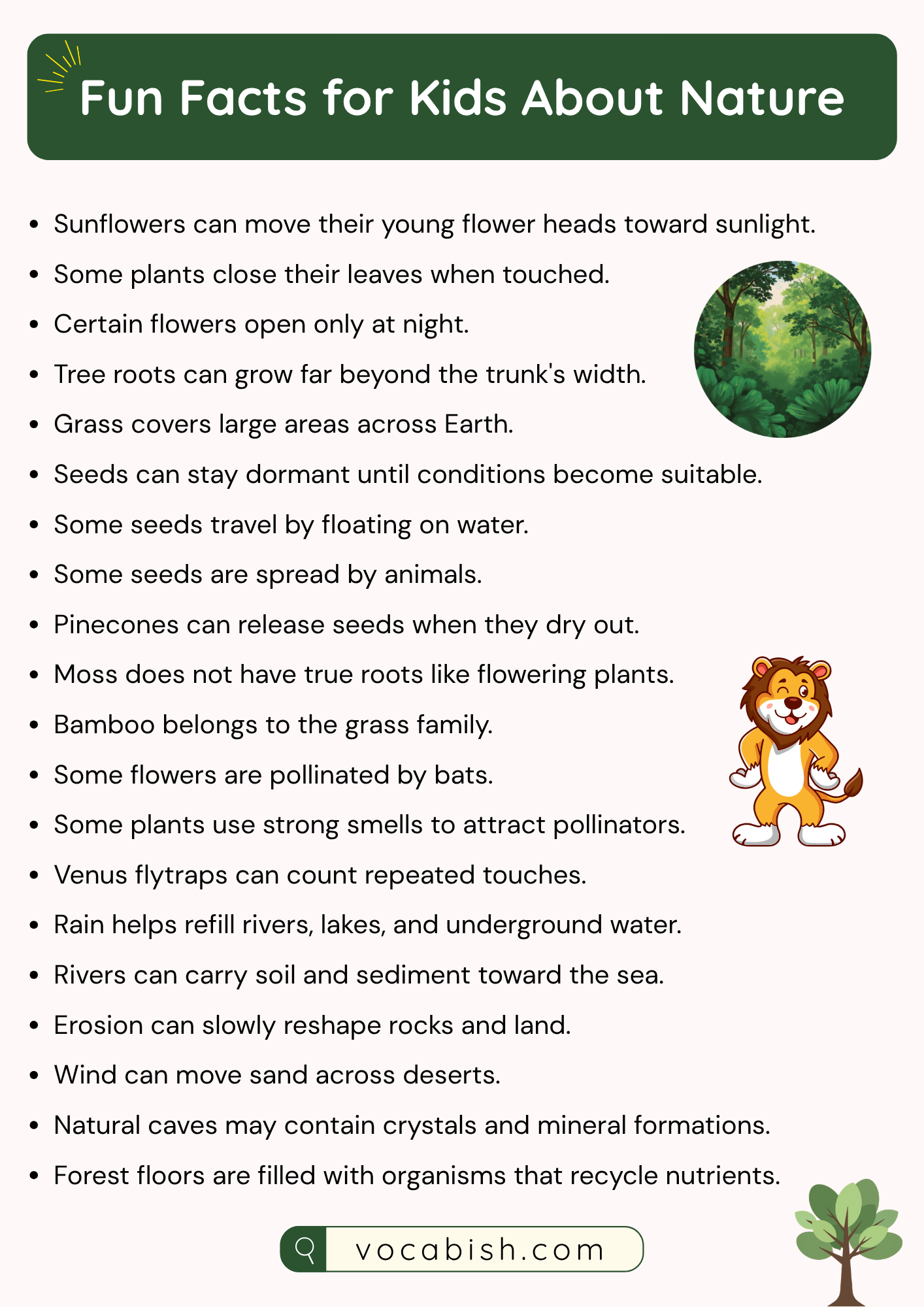
Fun Facts for Kids About Nature
Nature is full of patterns, cycles, colors, and unusual events. These facts can help children notice what is happening around them every day.
101. Sunlight takes about eight minutes to travel from the Sun to Earth.
102. Water can exist as a solid, liquid, or gas.
103. Ice is solid water.
104. Water vapor is water in gas form.
105. Clouds are made of tiny water droplets, ice crystals, or both.
106. Rainbows form when light interacts with water droplets in the air.
107. A rainbow is actually a full circle, but the ground often hides the lower part.
108. Lightning can heat nearby air to extremely high temperatures.
109. Thunder is caused by rapidly expanding air heated by lightning.
110. You usually see lightning before hearing thunder because light travels faster than sound.
111. Snowflakes form when water vapor freezes into ice crystals.
112. Many snow crystals develop six-sided patterns.
113. Not every snowflake looks exactly the same.
114. Wind is moving air.
115. A tornado is a rapidly rotating column of air connected to a thunderstorm.
116. Hurricanes are large rotating storms that form over warm ocean water.
117. Hurricanes are called different names in different parts of the world.
118. The eye of a hurricane can be much calmer than the surrounding storm.
119. Fog is made of tiny water droplets suspended near the ground.
120. Dew forms when moist air cools and water condenses on surfaces.
121. Plants release oxygen during photosynthesis.
122. Photosynthesis allows green plants to use sunlight to help make food.
123. Chlorophyll helps give many plants their green color.
124. Roots can absorb water and minerals from soil.
125. A tree’s leaves help capture sunlight for photosynthesis.
126. Some trees can live for hundreds or even thousands of years.
127. Bamboo can grow very quickly compared with many other plants.
128. Cacti are specially adapted to dry environments.
129. Some cactus species store large amounts of water in their tissues.
130. Venus flytraps are plants that can trap insects.
131. Not all plants need soil to grow; some can grow in water or other supports.
132. Mushrooms are fungi, not plants.
133. Fungi help break down dead organic material.
134. Lichens are partnerships involving fungi and photosynthetic organisms such as algae or cyanobacteria.
135. Forests provide habitats for many kinds of plants and animals.
136. Mangrove forests can grow along tropical and subtropical coastlines.
137. Coral reefs are built by tiny animals called coral polyps.
138. Coral reefs support many different marine species.
139. A volcano can form when molten rock rises toward Earth’s surface.
140. Magma is molten rock below Earth’s surface.
141. Lava is molten rock that has reached Earth’s surface.
142. Earthquakes happen when energy is suddenly released in Earth’s crust.
143. Mountains can form in several different ways.
144. Some mountains form when tectonic plates push against one another.
145. Caves can form when water slowly dissolves certain types of rock.
146. A glacier is a large body of ice that moves slowly over land.
147. Glaciers can shape valleys and landscapes over long periods.
148. Deserts do not all have to be hot; some are very cold.
149. Antarctica is the largest desert on Earth because it receives very little precipitation.
150. The water cycle moves water between Earth’s surface, atmosphere, and underground areas.
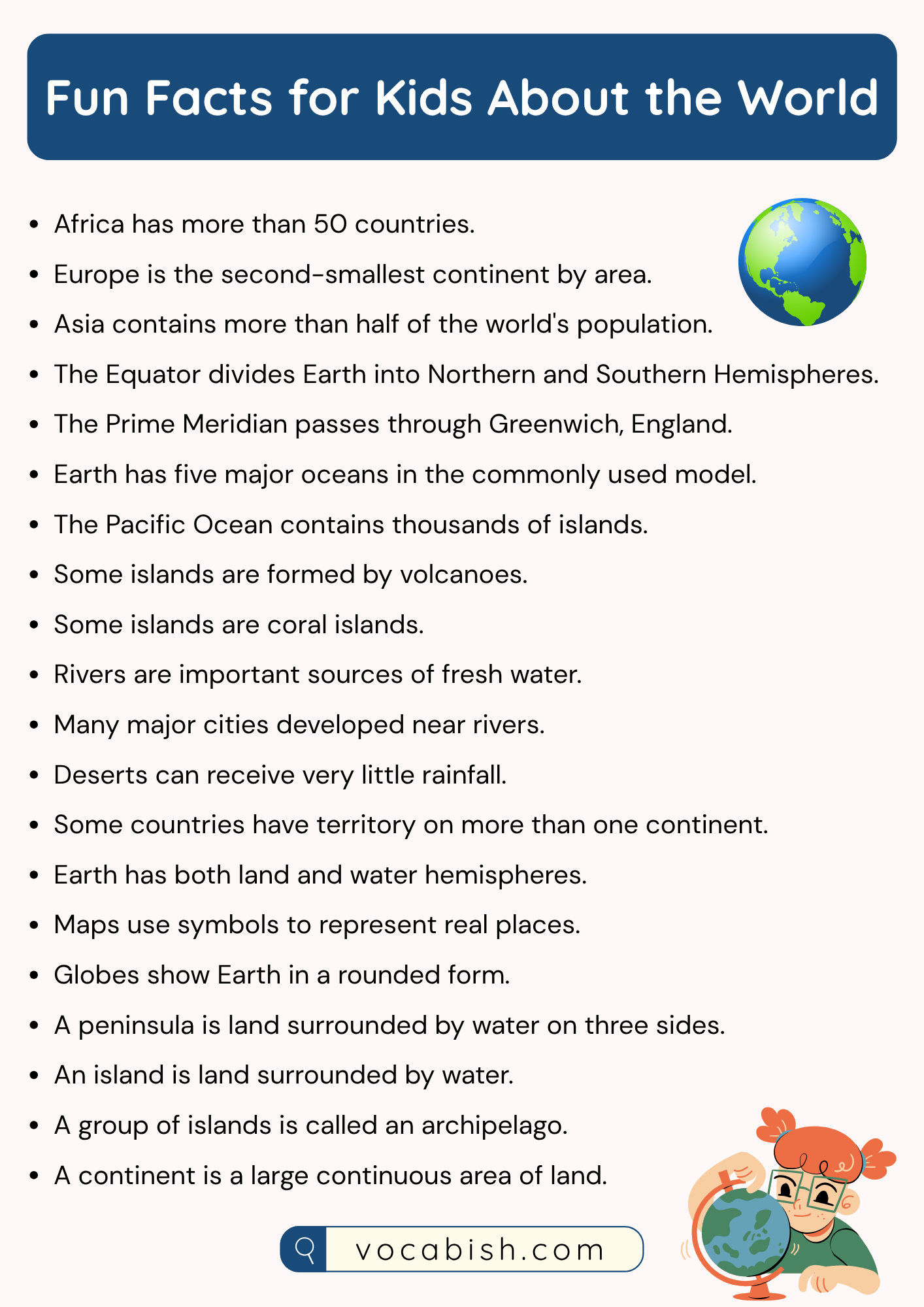
Fun Facts for Kids About the World
The world is full of huge oceans, fascinating languages, remarkable landmarks, and different ways of life.
151. Earth has seven continents in the commonly taught geographic model.
152. Asia is the largest continent by area.
153. Australia is the smallest continent in the commonly taught seven-continent model.
154. The Pacific Ocean is the largest ocean on Earth.
155. The Arctic Ocean is the smallest of the world’s five recognized oceans.
156. The Pacific Ocean is larger than all of Earth’s land area combined.
157. Africa is the only continent crossed by the Equator and both the Prime Meridian and the Tropic of Cancer.
158. Antarctica contains most of Earth’s fresh water in the form of ice.
159. The Sahara is the largest hot desert in the world.
160. The Amazon rainforest is famous for its enormous variety of plants and animals.
161. The Amazon River carries more water than any other river in the world by average discharge.
162. The Nile is traditionally regarded as one of the world’s longest rivers.
163. The Andes are the longest continental mountain range on Earth.
164. Mount Everest is the highest mountain above sea level.
165. The Dead Sea region is one of the lowest land areas on Earth’s surface.
166. Greenland is the world’s largest island that is not considered a continent.
167. Iceland is famous for volcanoes, glaciers, and geothermal activity.
168. Some places near the Equator can have nearly twelve hours of daylight and darkness throughout the year.
169. Earth’s seasons happen mainly because Earth’s axis is tilted.
170. Earth’s axis is tilted at about 23.5 degrees.
171. A day is approximately 24 hours long.
172. Earth takes about 365.25 days to orbit the Sun.
173. The extra fraction of a day is why leap years are needed.
174. Time zones help different regions organize local time.
175. There are thousands of languages spoken around the world.
176. English uses the Latin alphabet.
177. Arabic is written from right to left.
178. Japanese uses several writing systems, including hiragana, katakana, and kanji.
179. Spanish is one of the world’s major languages.
180. Mandarin Chinese is spoken by hundreds of millions of people.
181. The world’s population is distributed very unevenly across continents and countries.
182. Cities can be much warmer than nearby rural areas because buildings and roads store heat.
183. This urban warming effect is known as the urban heat island effect.
184. Public libraries exist in many countries to provide access to books and information.
185. Museums preserve objects, artworks, fossils, and other evidence from human and natural history.
186. UNESCO lists important cultural and natural places as World Heritage Sites.
187. The Olympic Games bring athletes from many countries together.
188. The world’s largest stadiums can hold tens of thousands of spectators.
189. People around the world celebrate birthdays in different ways.
190. Food, clothing, music, greetings, and traditions vary greatly from one culture to another.
Fun Facts for Kids About Countries
Country facts are useful for geography lessons, school projects, quizzes, and learning about different cultures.
Japan
191. Japan is an island country in East Asia.
192. Japan consists of thousands of islands.
193. Tokyo is the capital of Japan.
194. Mount Fuji is Japan’s highest mountain.
195. Japan is known for its high-speed Shinkansen trains.
196. Cherry blossoms are strongly associated with spring in Japan.
197. Japanese currency is the yen.
198. Japan has four main islands: Honshu, Hokkaido, Kyushu, and Shikoku.
199. Japan is located along the Pacific Ring of Fire and experiences earthquakes.
200. Japanese is the main language used in Japan.
Australia
201. Australia is both a country and a continent.
202. Canberra is the capital of Australia.
203. Australia is famous for animals such as kangaroos, koalas, and wombats.
204. The Great Barrier Reef lies off Australia’s northeastern coast.
205. Australia is home to the world’s largest coral reef system, the Great Barrier Reef.
206. The Australian dollar is the country’s currency.
207. Much of Australia’s interior is dry or semi-arid.
208. Australia has many unique species found nowhere else in the wild.
209. The Southern Hemisphere has summer when much of the Northern Hemisphere has winter.
210. English is the main language used in Australia.
Italy
211. Italy is a country in southern Europe.
212. Rome is the capital of Italy.
213. Italy is shaped somewhat like a boot on many maps.
214. The euro is Italy’s currency.
215. Italy is famous for foods such as pizza and pasta.
216. The Colosseum is an ancient Roman amphitheater in Rome.
217. Venice is famous for canals and water-based transportation.
218. Italy is home to Mount Etna, one of Europe’s most active volcanoes.
219. Vatican City is an independent country located within the city of Rome.
220. Italian is the main national language of Italy.
France
221. France is a country in Western Europe.
222. Paris is the capital of France.
223. The Eiffel Tower is one of France’s best-known landmarks.
224. The euro is the currency used in France.
225. France is famous for foods such as bread, cheese, and pastries.
226. The Louvre Museum is located in Paris.
227. French is spoken in many countries outside France.
228. France has both Atlantic and Mediterranean coastlines.
229. The French national flag has blue, white, and red vertical bands.
230. The Tour de France is a famous bicycle race held mainly in France.
Canada
231. Canada is the second-largest country in the world by total area.
232. Ottawa is the capital of Canada.
233. Canada has two official federal languages: English and French.
234. The Canadian dollar is Canada’s currency.
235. Canada has an enormous number of lakes.
236. The maple leaf appears on Canada’s national flag.
237. Niagara Falls lies on the border between Canada and the United States.
238. Canada extends from the Atlantic Ocean to the Pacific Ocean and northward toward the Arctic.
239. Ice hockey is one of Canada’s most popular sports.
240. Canada is known for its vast forests, mountains, lakes, and northern landscapes.
Mexico
241. Mexico is a country in North America.
242. Mexico City is the capital of Mexico.
243. The Mexican peso is the country’s currency.
244. Spanish is the most widely spoken language in Mexico.
245. Mexico has many Indigenous languages in addition to Spanish.
246. Mexico is famous for foods such as tacos, tamales, and mole.
247. Ancient Maya and Aztec civilizations developed in parts of present-day Mexico.
248. Chichén Itzá is a famous archaeological site in Mexico.
249. Mexico has coastlines on both the Pacific Ocean and the Gulf of Mexico.
250. Mexico celebrates Día de los Muertos, or Day of the Dead, as an important cultural tradition.
Fun Facts for Kids About Science
Science explains many of the things children see, touch, hear, eat, and use every day.
251. Matter is commonly taught as having three main states: solid, liquid, and gas.
252. Plasma is another state of matter found in stars and some high-energy environments.
253. Solids keep their own shape unless a force changes them.
254. Liquids take the shape of their containers.
255. Gases spread out to fill the space available to them.
256. Gravity pulls objects toward Earth.
257. Mass measures how much matter an object contains.
258. Weight depends on gravity.
259. Friction is a force that resists motion between surfaces.
260. Magnets can attract certain metals, including iron.
261. Like magnetic poles repel each other.
262. Opposite magnetic poles attract each other.
263. Sound needs a medium, such as air, water, or a solid, to travel through.
264. Sound cannot travel through a vacuum.
265. Light can travel through a vacuum.
266. Light travels much faster than sound.
267. A mirror reflects light.
268. A prism can separate white light into different visible colors.
269. Red, orange, yellow, green, blue, indigo, and violet are commonly named colors of the rainbow.
270. White light contains many visible wavelengths.
271. Electricity is the movement of electric charge.
272. Batteries can provide electrical energy to circuits.
273. An electric circuit needs a complete path for current to flow.
274. Conductors allow electric current to move relatively easily.
275. Copper is a good electrical conductor.
276. Rubber is commonly used as an electrical insulator.
277. An atom is a basic unit of ordinary matter.
278. Atoms contain protons, neutrons, and electrons.
279. Protons have a positive electric charge.
280. Electrons have a negative electric charge.
281. Neutrons have no electric charge.
282. The center of an atom is called the nucleus.
283. The periodic table organizes chemical elements.
284. Oxygen is an element.
285. Hydrogen is the lightest chemical element.
286. Water is made of hydrogen and oxygen.
287. The chemical formula for water is H₂O.
288. Carbon dioxide contains carbon and oxygen.
289. Plants use carbon dioxide during photosynthesis.
290. Yeast is a living organism commonly used in baking.
291. Bacteria are microscopic organisms, and many types are harmless or useful.
292. Antibiotics are medicines used against certain bacterial infections, not viral infections.
293. A microscope helps scientists observe objects too small to see clearly with unaided eyes.
294. The human body contains trillions of cells.
295. A cell is the basic structural and functional unit of living organisms.
296. DNA carries genetic information in living things.
297. Genes are sections of DNA that help influence inherited traits.
298. Plants and animals are made of cells.
299. Some organisms, such as many bacteria, consist of only one cell.
300. Scientists use experiments, observations, measurements, and evidence to investigate questions.
Fun Facts for Kids About Space
Space is enormous, mysterious, and full of objects moving through darkness. These facts are especially useful for science lessons and quizzes.
301. The Sun is a star.
302. The Sun is much larger than Earth.
303. The Sun contains most of the mass in our solar system.
304. Earth is the third planet from the Sun.
305. Mercury is the closest planet to the Sun.
306. Venus is the second planet from the Sun.
307. Mars is the fourth planet from the Sun.
308. Jupiter is the largest planet in our solar system.
309. Saturn is famous for its bright ring system.
310. Uranus rotates on a strongly tilted axis.
311. Neptune is the eighth planet from the Sun.
312. Pluto is classified as a dwarf planet.
313. The Moon is Earth’s natural satellite.
314. The Moon does not produce its own visible light; it reflects sunlight.
315. The same general side of the Moon always faces Earth because the Moon rotates at the same rate it orbits Earth.
316. The Moon’s gravity causes most of Earth’s ocean tides.
317. Earth has one natural satellite, the Moon.
318. Mars is often called the Red Planet because of iron-rich dust on its surface.
319. Mars has the largest volcano known in the solar system, Olympus Mons.
320. Jupiter has a giant storm known as the Great Red Spot.
321. Jupiter has dozens of known moons.
322. Saturn is less dense than water when considering an idealized calculation of average density.
323. Saturn has many icy and rocky moons.
324. Uranus is an ice giant.
325. Neptune is also an ice giant.
326. Mercury has extreme temperature differences between day and night.
327. Venus is hotter at its surface than Mercury despite being farther from the Sun.
328. Venus has a thick atmosphere rich in carbon dioxide.
329. Earth has a nitrogen-rich atmosphere.
330. Oxygen makes up about 21% of Earth’s atmosphere.
331. Astronauts aboard the International Space Station experience microgravity.
332. Objects in orbit are constantly falling around Earth rather than simply floating without gravity.
333. A spacesuit provides oxygen, pressure, and protection from the space environment.
334. The International Space Station orbits Earth.
335. Space is extremely cold in shadow but objects can become very hot in direct sunlight.
336. A galaxy is a huge collection of stars, gas, dust, and other matter.
337. The Milky Way is the galaxy that contains our solar system.
338. The Milky Way contains hundreds of billions of stars.
339. A light-year measures distance, not time.
340. One light-year is the distance light travels in one year.
341. Black holes have gravity so strong that light cannot escape from within their event horizons.
342. Stars are enormous balls of hot gas or plasma.
343. Stars can have different colors depending largely on their surface temperature.
344. The North Star is commonly known as Polaris.
345. Polaris appears near the north celestial pole in Earth’s sky.
346. A comet is made largely of ice, rock, and dust.
347. A comet can develop a glowing coma and tail when it approaches the Sun.
348. Asteroids are rocky or metallic objects that orbit the Sun.
349. Meteoroids are relatively small pieces of rock or metal traveling through space.
350. A meteor is the bright streak produced when a meteoroid enters a planetary atmosphere.
Fun Facts for Kids About Food
Food facts can make cooking, science lessons, vocabulary practice, and family meals more interesting.
351. Honey can last a very long time when stored properly.
352. Honey is made by bees from nectar.
353. Bananas are berries according to botanical definitions.
354. Strawberries are not true berries botanically.
355. Tomatoes are fruits botanically.
356. Cucumbers are fruits botanically.
357. Pumpkins are fruits.
358. Peanuts are legumes, not true nuts.
359. Almonds are seeds rather than true botanical nuts.
360. Coconut is a type of fruit called a drupe.
361. Potatoes are underground storage organs called tubers.
362. Carrots are roots.
363. Spinach is a leafy green vegetable.
364. Broccoli, cauliflower, cabbage, and kale belong to the same plant species, Brassica oleracea.
365. Corn is a grain.
366. Popcorn is made from a type of corn whose kernels can pop when heated.
367. Rice is one of the world’s most important staple foods.
368. Wheat is used to make many foods, including bread and pasta.
369. Pasta can come in many shapes and sizes.
370. Bread rises partly because yeast produces carbon dioxide during fermentation.
371. Salt can help preserve some foods.
372. Sugar can affect taste, texture, and food preservation.
373. Chocolate comes from cacao beans.
374. Cacao beans grow inside cacao pods.
375. Dark chocolate generally contains more cocoa solids than milk chocolate.
376. Vanilla comes from the pods of an orchid.
377. Cinnamon comes from the bark of certain trees.
378. Ginger is an underground stem called a rhizome.
379. Black pepper comes from dried peppercorns.
380. Mint belongs to a large plant family called Lamiaceae.
381. Apples float in water because they contain a lot of air in their structure.
382. Citrus fruits include oranges, lemons, limes, and grapefruits.
383. Lemons are sour because they contain citric acid.
384. Vinegar contains acetic acid.
385. Yogurt is made when bacteria ferment milk.
386. Cheese is usually made from milk that has been processed and fermented or coagulated.
387. Butter is made by churning cream.
388. Eggs contain protein, fats, vitamins, and minerals.
389. Eggshells are made mostly of calcium carbonate.
390. Milk contains calcium and other nutrients.
391. Water is the main ingredient in many fresh fruits and vegetables.
392. A watermelon can contain more than 90% water.
393. Carbohydrates provide a major source of energy for the human body.
394. Proteins help build and repair body tissues.
395. Fats are also a source of energy and help the body use certain vitamins.
396. Vitamin C is found in foods such as citrus fruits, peppers, and strawberries.
397. Iron is a mineral that helps the body make hemoglobin.
398. Fiber is found in plant foods and supports healthy digestion.
399. Different spices can change the flavor of the same basic food.
400. The way food is cooked can change its taste, texture, smell, and appearance.
Short Fun Facts for Kids About Everyday Life
These quick facts connect learning with things children encounter at home, at school, and during ordinary activities.
401. A pencil’s “lead” is actually graphite, not the metal lead.
402. Graphite is a form of carbon.
403. An eraser removes graphite from paper through friction.
404. Paper is mainly made from plant fibers.
405. Most paper is made from wood pulp or recycled paper fibers.
406. Books contain pages made from materials that can be folded because paper fibers are flexible.
407. A ruler is commonly used to measure length.
408. One meter contains 100 centimeters.
409. One kilogram contains 1,000 grams.
410. Sixty seconds make one minute.
411. Sixty minutes make one hour.
412. Twenty-four hours make one day.
413. Seven days make one week.
414. Twelve months make one year.
415. A calendar helps people organize dates and events.
416. A compass can help show direction.
417. North, south, east, and west are the four main cardinal directions.
418. A thermometer measures temperature.
419. A clock measures or displays time.
420. A mirror lets you see reflected light from your surroundings.
421. A zipper works by interlocking rows of teeth or elements.
422. Buttons are used to fasten clothing.
423. Shoes protect feet and can also provide support and traction.
424. Brushing teeth removes plaque and food particles.
425. Tooth enamel is the hard outer layer of a tooth.
426. A toothbrush is designed to clean the surfaces of teeth.
427. Soap helps lift oils, dirt, and microorganisms from skin when used with water.
428. Washing hands with soap and water can reduce the spread of many germs.
429. Germs include microorganisms such as bacteria, viruses, fungi, and some parasites.
430. A sneeze can send tiny droplets or particles into the air.
431. Covering a cough or sneeze helps reduce the spread of germs.
432. Sleep gives the body and brain time to rest and recover.
433. Children and teenagers generally need more sleep than adults.
434. Exercise makes the heart beat faster.
435. The heart is a muscular organ that pumps blood through the body.
436. Blood carries oxygen and nutrients to body tissues.
437. Lungs help the body exchange oxygen and carbon dioxide.
438. Reading regularly exposes learners to new words and ideas.
439. Asking questions is a useful part of learning.
440. Taking notes can help students remember important information.
441. Breaking a large task into smaller steps can make it easier to manage.
442. Practice can help improve many skills, including spelling, handwriting, sports, and music.
443. Checking your work can help catch mistakes before you submit it.
444. A dictionary can provide definitions, pronunciation, spelling, and word information.
445. A thesaurus lists words with related or similar meanings.
446. A sentence usually begins with a capital letter in English.
447. A period is commonly used to end a statement.
448. A question mark is used at the end of a direct question.
449. An exclamation mark can show strong feeling or emphasis.
450. Reading a fact aloud can help English learners practice pronunciation and speaking.
Fun Facts About Me
Children often need interesting facts about themselves for introductions, classroom activities, speeches, profiles, and “All About Me” projects. These ready-to-use ideas can be personalized.
451. Your first name is one part of your personal identity.
452. Your birthday is the date on which you were born.
453. Your favorite color can be a fun fact to share with classmates.
454. Your favorite food can make an easy conversation starter.
455. Your favorite book can tell others something about your interests.
456. Your favorite school subject can be an interesting introduction fact.
457. A hobby is an activity you enjoy doing in your free time.
458. Playing a sport can be included as a personal fun fact.
459. A musical instrument you play can be part of an “About Me” introduction.
460. A favorite animal is another easy fact to share.
461. A place you would like to visit can make a good classroom conversation topic.
462. A skill you are learning can be described in an “About Me” paragraph.
463. A favorite movie, game, or cartoon can be a personal interest fact.
464. A favorite season can show something about what activities you enjoy.
465. A favorite school memory can be shared as a personal fact.
466. A language you speak or are learning can be part of your self-introduction.
467. A favorite holiday is an easy topic for an “About Me” activity.
468. A person who inspires you can be part of a school introduction.
469. A personal goal can make an “About Me” presentation more meaningful.
470. A talent such as drawing, singing, writing, dancing, or building can be a fun personal fact.
471. A favorite subject-related topic can show what you enjoy learning.
472. A favorite place at school can be a simple fact for a class introduction.
473. A funny harmless habit can make an introduction memorable.
474. A favorite type of weather can be a fun personal detail.
475. A future job you are interested in can be included in an “About Me” project.
Quick Body and Health Facts for Kids
Understanding your body can make science, health, and English vocabulary lessons much more interesting.
476. The human skeleton has 206 bones in a typical adult body.
477. Babies are born with more bones than adults because some bones later join together.
478. The brain is part of the nervous system.
479. The brain helps control movement, memory, thinking, emotions, and many automatic functions.
480. The spinal cord carries signals between the brain and much of the body.
481. Muscles help the body move.
482. The heart has four chambers.
483. Arteries carry blood away from the heart.
484. Veins carry blood toward the heart.
485. Red blood cells carry oxygen using a protein called hemoglobin.
486. White blood cells help the body fight infections.
487. Platelets help the blood clot.
488. The skin is the body’s largest organ.
489. Hair and nails are made largely from a protein called keratin.
490. The pupil is the opening in the center of the eye that lets light enter.
491. The iris controls how much light enters the eye by changing pupil size.
492. The retina contains light-sensitive cells that help detect images.
493. The tongue helps with taste, movement, and speech.
494. Taste buds contain cells involved in detecting tastes.
495. Cartilage is a flexible connective tissue found in places such as the ears and joints.
496. Joints are places where two or more bones meet.
497. The kidneys help filter waste products from the blood and make urine.
498. The liver performs many jobs, including processing nutrients and helping remove harmful substances.
499. The digestive system breaks food into nutrients that the body can absorb.
500. Your body works as a connected system, with organs and tissues working together to keep you alive.
Related Resources: Body Parts for Kids with Labelled Diagram
Common Mistakes and Confusions
A few facts can sound strange because everyday language and scientific language are not always the same.
- “Bananas are berries” is botanically correct, while strawberries are not true botanical berries.
- “Pluto is a planet” is outdated in the current scientific classification; Pluto is a dwarf planet.
- “Camels store water in their humps” is a common myth; humps mainly store fat.
- “Bats are birds because they fly” is incorrect; bats are mammals.
- “Lightning is hotter than the Sun” needs context: the air in a lightning channel can briefly become hotter than the Sun’s visible surface, but that does not mean lightning is a hotter object overall.
Easy Ways to Use These Facts
These facts work well beyond reading practice. Teachers and parents can turn them into quick activities that help children remember information.
For Teachers
- Ask students to choose one fact and explain it in their own words.
- Turn five facts into a classroom quiz.
- Ask learners to sort facts into animals, nature, science, space, food, and geography.
- Use one fact as a writing prompt for a short paragraph.
- Let students find three facts they did not know before.
For Parents
- Share one fact during breakfast or dinner.
- Ask children which fact surprised them most.
- Use country facts when discussing travel or maps.
- Let children choose an animal and research three additional facts.
- Turn the list into a family trivia game.
For Kids
- Pick your favorite ten facts and memorize them.
- Use three facts in a school presentation.
- Tell a friend one surprising animal or space fact.
- Write five facts in your notebook each week.
- Create your own “Did You Know?” cards.
FAQs About Fun Facts for Kids
Fun facts for kids are short, interesting pieces of information about animals, science, nature, space, food, countries, history, and everyday life.
A fun animal fact is that octopuses have three hearts, while their blue blood helps transport oxygen efficiently in the ocean.
Five examples are: hummingbirds can fly backward, pandas eat bamboo, Jupiter is the largest planet, honey can last years, and bats are mammals.
Science facts include information about atoms, gravity, electricity, sound, cells, plants, chemical reactions, forces, and how the human body works.
A fun space fact is that sunlight takes about eight minutes to travel from the Sun to Earth.
Country facts can cover capitals, languages, landmarks, currencies, geography, foods, traditions, animals, and famous places around the world.
Short fun facts are quick statements that children can easily read, remember, discuss, or use in quizzes, classroom activities, and conversations.
Kids can use fun facts for school projects, introductions, quizzes, conversations, reading practice, presentations, family games, and learning activities.
Conclusion
These 500 Fun Facts for Kids bring together interesting ideas from animals, nature, geography, countries, science, space, food, health, school, and everyday life. A good fact does more than provide an answer—it can lead to another question.
Choose a few facts each day, talk about them, ask “why?” and “how?”, and keep exploring. Curiosity is one of the best tools a learner can have.
Explore More Kids Learning Resources
- 100 Rainy Day Activities for Kids
- Rhyming Words for Kids in English
- 25 Different Paragraph Writing Ideas for Kids
- 150+ General Knowledge Questions for Kids
- 150 Sentences for Kids in English for Daily Use