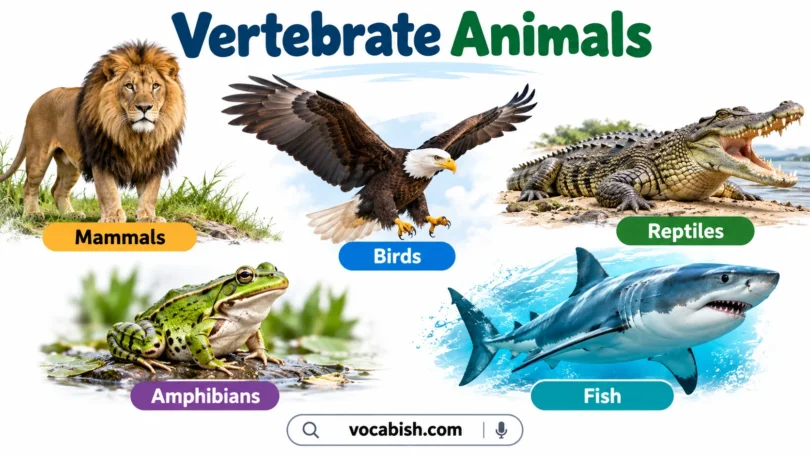

Vertebrate animals are animals that have a backbone and an internal skeleton. They include mammals, birds, reptiles, amphibians, and fish. These animals live in almost every habitat, from oceans and forests to deserts and mountains. Their bodies, movement, feeding habits, and life cycles can vary greatly. In this blog post, you will learn about their main groups, common names, habitats, useful examples, and interesting facts in a clear and organised way.
Note: Vertebrates include tens of thousands of living species, so a single article cannot list every individual species. The lists below cover the major vertebrate groups and a broad collection of commonly used English animal names.
How to use this article: Start with the common animals and their short facts. Then review the animal groups and vocabulary lists before testing yourself with the practice questions.
What Are Vertebrate Animals?
A vertebrate is an animal with a backbone made of small bones or structures called vertebrae. The backbone forms part of the skeleton and protects the spinal cord.
The word vertebrate is pronounced VER-tuh-brut. One animal is a vertebrate, while several are vertebrates.
Most vertebrates also have a skull that protects the brain and an internal skeleton that supports the body.
Examples: dog, cat, eagle, frog, turtle, salmon, elephant, whale, snake, and shark.
Term | Meaning | Example |
|---|---|---|
Vertebrate | Animal with a backbone | Dog |
Vertebra | One bone of the backbone | Spinal vertebra |
Vertebrae | Plural of vertebra | Bones in the spine |
Backbone | Row of bones supporting the body | Human spine |
Skeleton | Framework supporting the body | Bones of a horse |
Spinal cord | Nerve tissue protected by the backbone | Found inside the spine |
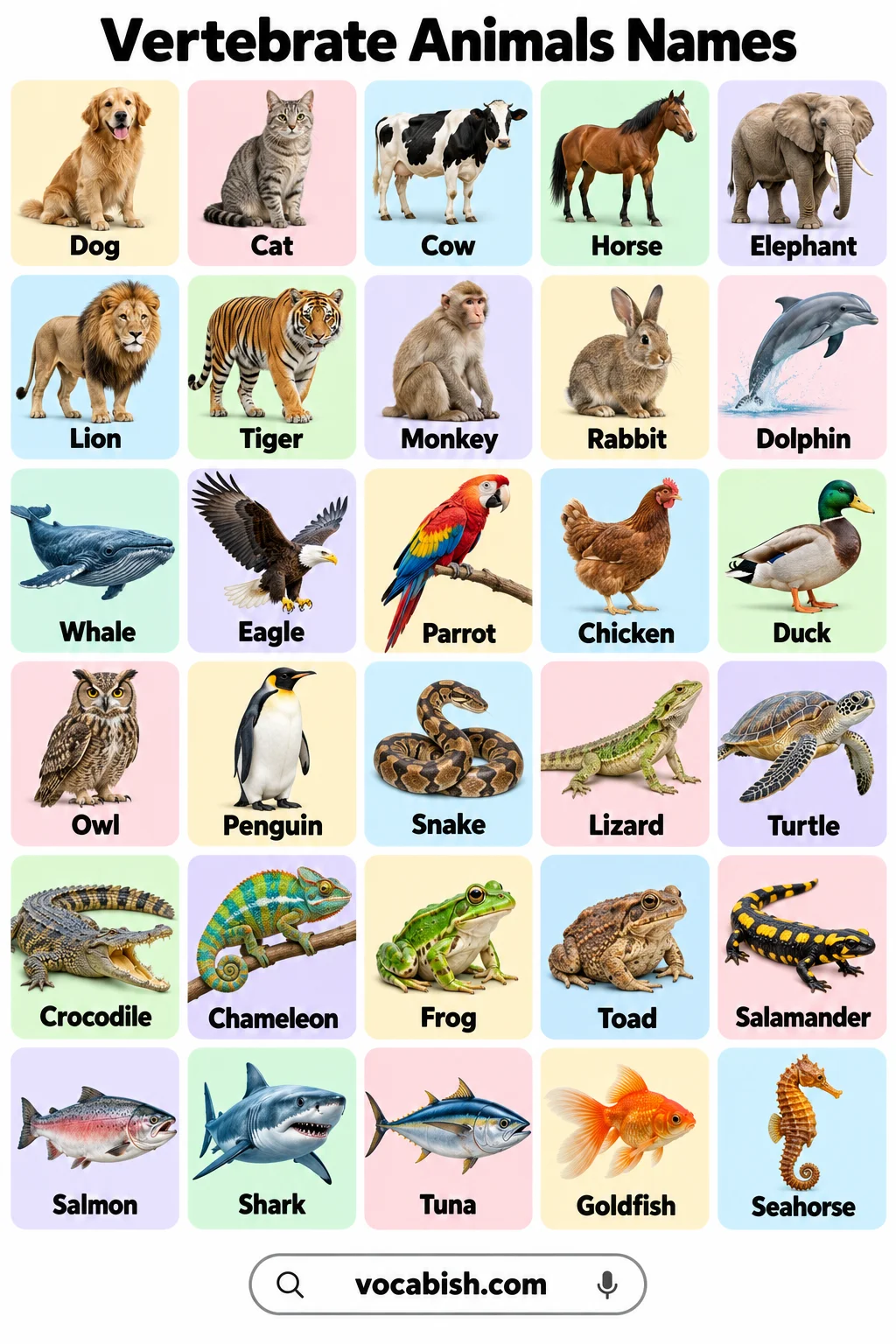
Most Common Vertebrate Animals with Pictures
Many animals seen around homes, farms, forests, oceans, rivers, and parks are vertebrates. These familiar examples make it easier to recognise how different vertebrate groups are related.
Dog

A dog is a mammal with fur, four legs, and a strong sense of smell. Dogs give birth to live young and feed their puppies with milk. They have been domesticated for thousands of years. Many dogs live with people as pets or working animals.
Cat

A cat is a small mammal with soft fur, sharp claws, and sensitive whiskers. Cats have excellent hearing and can see well in low light. They give birth to kittens and feed them with milk. Domestic cats are common pets throughout the world.
Cow
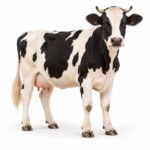
A cow is a large hoofed mammal commonly raised on farms. Cows eat grasses and other plant material. Female cattle produce milk for their calves. Cattle are also kept for meat, leather, and agricultural purposes.
Horse
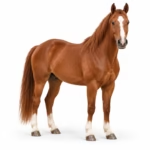
A horse is a large mammal with long legs, hooves, and a flowing mane. Horses are plant-eaters and mainly feed on grass and hay. People have used them for transport, farming, sport, and riding. A young horse is called a foal.
Elephant
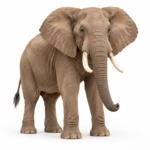
An elephant is the largest living land animal. It has a long trunk, large ears, thick legs, and tusks in many individuals. Elephants use their trunks for breathing, smelling, drinking, and picking up objects. They live naturally in parts of Africa and Asia.
Lion
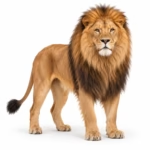
A lion is a large wild cat found mainly in Africa, with a small population also living in India. Adult male lions usually have a noticeable mane. Lions are carnivores and hunt other animals for food. They often live in social groups called prides.
Tiger
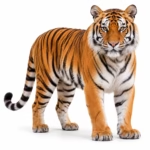
A tiger is a powerful wild cat with orange fur and dark vertical stripes. Each tiger has its own stripe pattern. Tigers are carnivores and usually hunt alone. Wild tigers live in parts of Asia.
Monkey
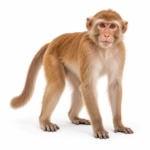
A monkey is a primate with grasping hands, forward-facing eyes, and a flexible body. Different monkey species live in forests, grasslands, mountains, and other habitats. Most eat a mixture of plant foods and small animals. Monkeys belong to the mammal group.
Rabbit
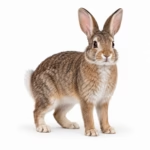
A rabbit is a small mammal with long ears and powerful hind legs. Rabbits mainly eat grasses and other plant material. They can move quickly by hopping and running. Their young are called kits or kittens.
Dolphin

A dolphin is an aquatic mammal, not a fish. Dolphins breathe air through a blowhole and must regularly come to the water’s surface. They are known for social behaviour and advanced communication. Most dolphin species live in oceans, although some live in rivers.
Whale
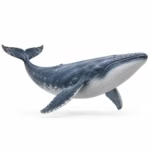
A whale is a large marine mammal that spends its entire life in water. Whales breathe air using lungs rather than gills. Some species have teeth, while others have baleen plates for filtering food. The blue whale is the largest known animal.
Eagle
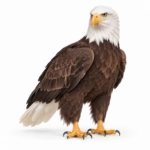
An eagle is a large bird of prey with powerful feet, curved claws, and a hooked beak. Eagles have strong eyesight that helps them locate food from a distance. Their bodies are covered with feathers. Like other birds, eagles lay eggs.
Parrot
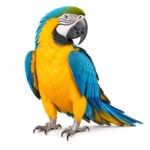
A parrot is a colourful bird with a strong curved beak. Parrots use their feet and beaks to climb and handle food. Many species eat fruits, seeds, nuts, flowers, and other plant material. Some parrots can imitate human speech and environmental sounds.
Chicken
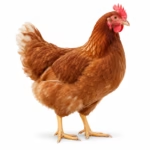
A chicken is a domesticated bird widely kept on farms and around homes. Chickens have feathers, wings, two legs, and a beak. Female chickens are called hens, while adult males are called roosters or cocks. Hens lay eggs.
Duck
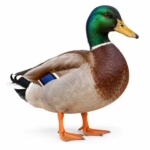
A duck is a water bird with webbed feet and a broad bill. Many ducks swim on ponds, rivers, lakes, and wetlands. Their webbed feet help them move through water. Ducks eat plants, insects, seeds, and small aquatic animals.
Owl
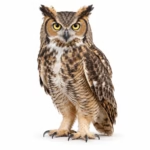
An owl is a bird of prey with large forward-facing eyes and a strongly hooked beak. Many owl species are active mainly at night. Their specialised feathers allow them to fly very quietly. Owls commonly feed on small mammals, insects, birds, and other animals.
Snake
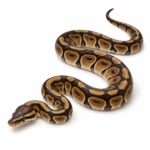
A snake is a long, legless reptile covered with scales. Snakes breathe with lungs and cannot regulate their body temperature internally like mammals. They eat other animals, including insects, rodents, frogs, birds, and fish. Some species produce venom, but many do not.
Lizard
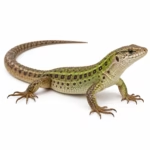
A lizard is a reptile usually recognised by its scaly skin, long body, tail, and four legs. Some species can lose part of their tail when escaping predators. Lizards live in deserts, forests, grasslands, mountains, and homes. Their diets vary greatly between species.
Turtle
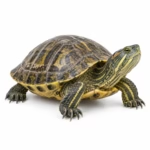
A turtle is a reptile with a protective shell surrounding much of its body. Different turtles live in oceans, rivers, lakes, wetlands, and on land. They breathe air with lungs. Turtles lay eggs rather than giving birth to live young in most species.
Crocodile
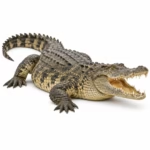
A crocodile is a large semi-aquatic reptile with a powerful tail and strong jaws. Crocodiles live around rivers, lakes, wetlands, and coastal areas in warmer regions. They are carnivores and eat fish, birds, mammals, and other animals. Female crocodiles lay eggs in nests.
Frog
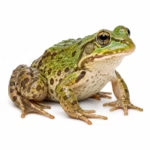
A frog is an amphibian with moist skin and powerful hind legs. Most frogs begin life as aquatic larvae called tadpoles. During development, tadpoles change into adult frogs through metamorphosis. Adult frogs usually breathe through lungs and their skin.
Salamander
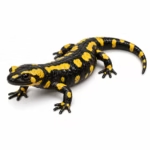
A salamander is an amphibian with a long body, tail, and usually four short legs. Most species have moist skin and live in damp environments. Many salamanders begin life in water. Some species can regenerate damaged body parts.
Salmon
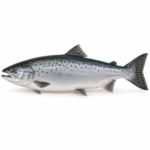
A salmon is a fish with fins, scales, gills, and a streamlined body. Salmon breathe by taking oxygen from water through their gills. Several species migrate between freshwater and the ocean. They are important predators, prey animals, and food sources.
Shark
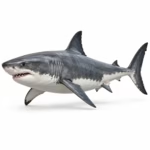
A shark is a fish with a skeleton made mainly of cartilage rather than bone. Sharks breathe through gills and have several rows of teeth in many species. They live mainly in oceans, although a few enter freshwater. Sharks range from small species to the enormous whale shark.
Goldfish
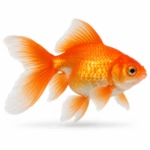
A goldfish is a freshwater fish commonly kept in ponds and aquariums. It has fins, gills, scales, and a bony internal skeleton. Goldfish belong to the carp family. They have been selectively bred into many colours and body shapes.
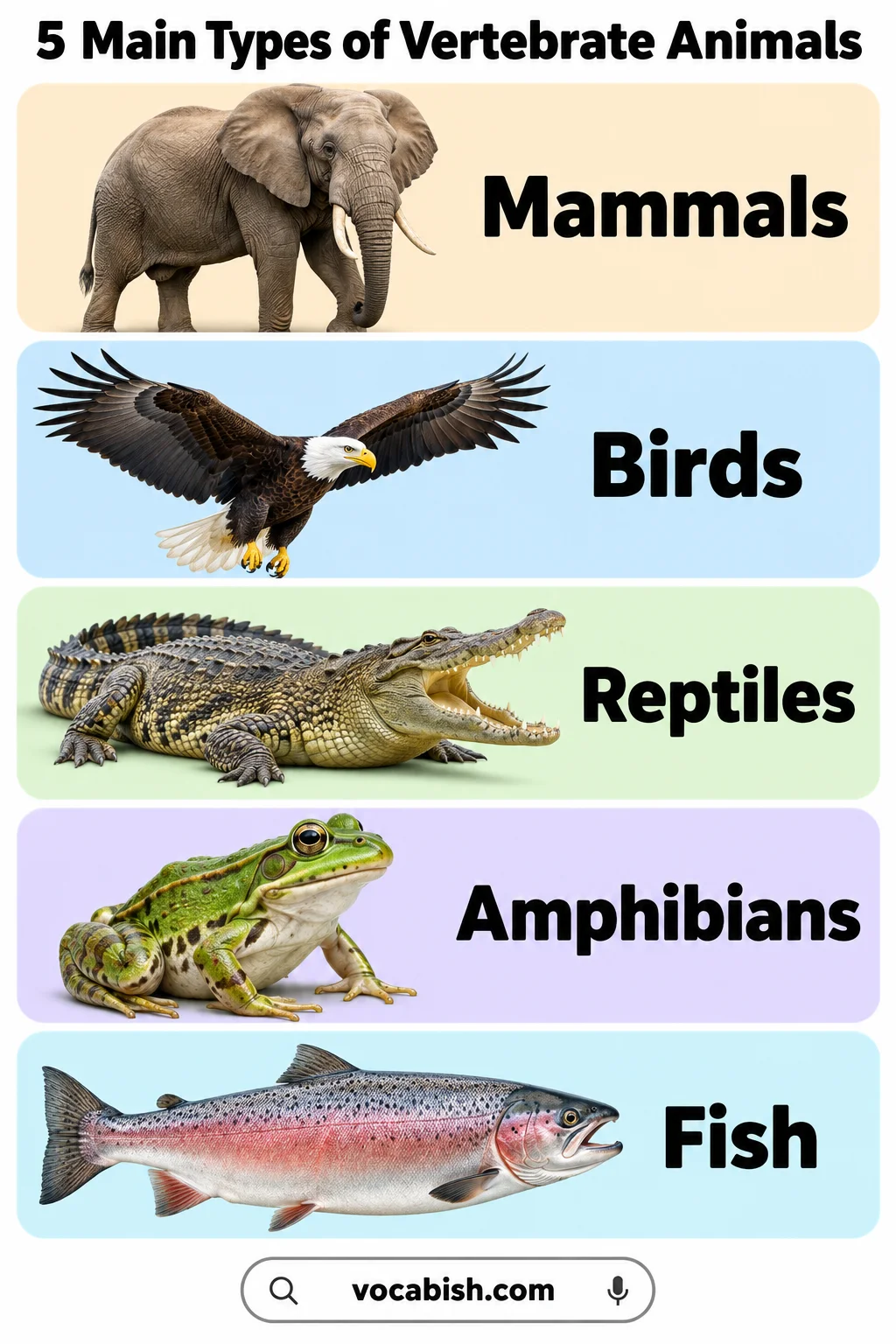
Main Types of Vertebrate Animals and Their Examples
Mammals
Mammals are warm-blooded vertebrates that usually have hair or fur on their bodies. Female mammals produce milk to feed their young, which is one of the clearest features of this group. Most mammals give birth to live young, but monotremes such as the platypus and echidnas lay eggs. Mammals live in almost every habitat, from oceans and deserts to forests and polar regions. Examples are included:
- Aardvark
- Alpaca
- Anteater
- Antelope
- Armadillo
- Baboon
- Badger
- Bat
- Bear
- Beaver
- Bison
- Bobcat
- Buffalo
- Camel
- Capybara
- Cat
- Cattle
- Cheetah
- Chimpanzee
- Chipmunk
- Cow
- Coyote
- Deer
- Dog
- Dolphin
- Donkey
- Echidna
- Elephant
- Elk
- Ferret
- Fox
- Gazelle
- Giraffe
- Goat
- Gorilla
- Hamster
- Hare
- Hedgehog
- Hippopotamus
- Horse
- Hyena
- Jaguar
- Kangaroo
- Koala
- Lemur
- Leopard
- Lion
- Llama
- Lynx
- Manatee
- Meerkat
- Mole
- Monkey
- Moose
- Mouse
- Otter
- Panda
- Pig
- Platypus
- Polar Bear
- Porcupine
- Possum
- Rabbit
- Raccoon
- Rat
- Rhinoceros
- Seal
- Sheep
- Shrew
- Skunk
- Sloth
- Squirrel
- Tapir
- Tiger
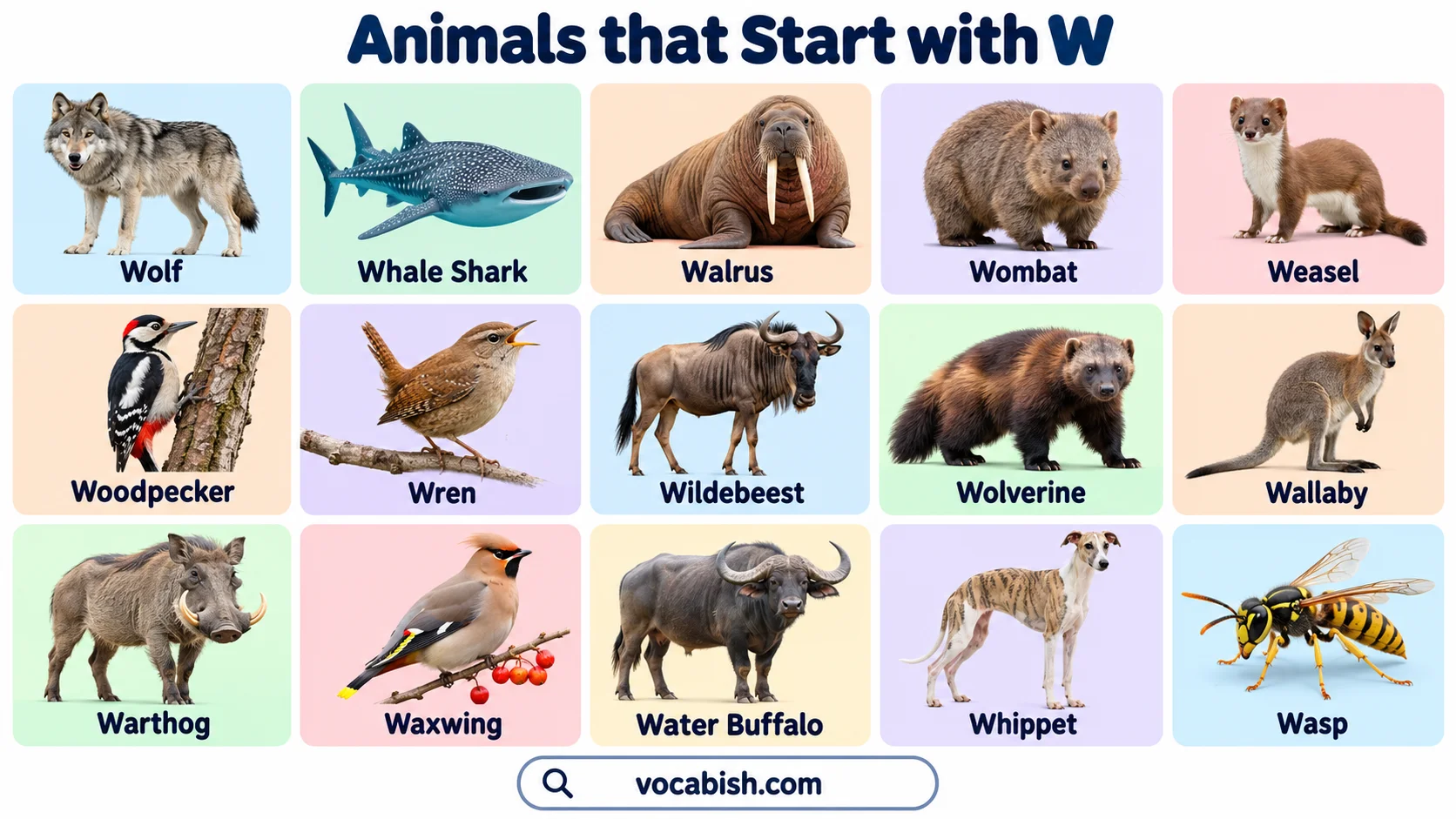
- Walrus
- Warthog
- Weasel
- Whale
- Wolf
- Wombat
- Yak
- Zebra
Birds
Birds are warm-blooded vertebrates covered with feathers, and all living bird species have beaks instead of teeth. They reproduce by laying hard-shelled eggs and breathe with highly efficient lungs supported by air sacs. Most birds can fly, but species such as penguins, ostriches, and kiwis cannot. Birds are found on every continent, including Antarctica.
Examples:
- Albatross
- Blackbird
- Canary
- Cardinal
- Cassowary
- Chicken
- Cockatoo
- Condor
- Crane
- Crow
- Cuckoo
- Dove
- Duck
- Eagle
- Emu
- Falcon
- Finch
- Flamingo
- Goose
- Hawk
- Heron
- Hummingbird
- Kingfisher
- Kiwi
- Lark
- Macaw
- Magpie
- Mynah
- Nightingale
- Ostrich
- Owl
- Parrot
- Peacock
- Pelican
- Penguin
- Pheasant
- Pigeon
- Puffin
- Quail
- Raven
- Robin
- Rooster
- Seagull
- Sparrow
- Stork
- Swallow
- Swan
- Toucan
- Turkey
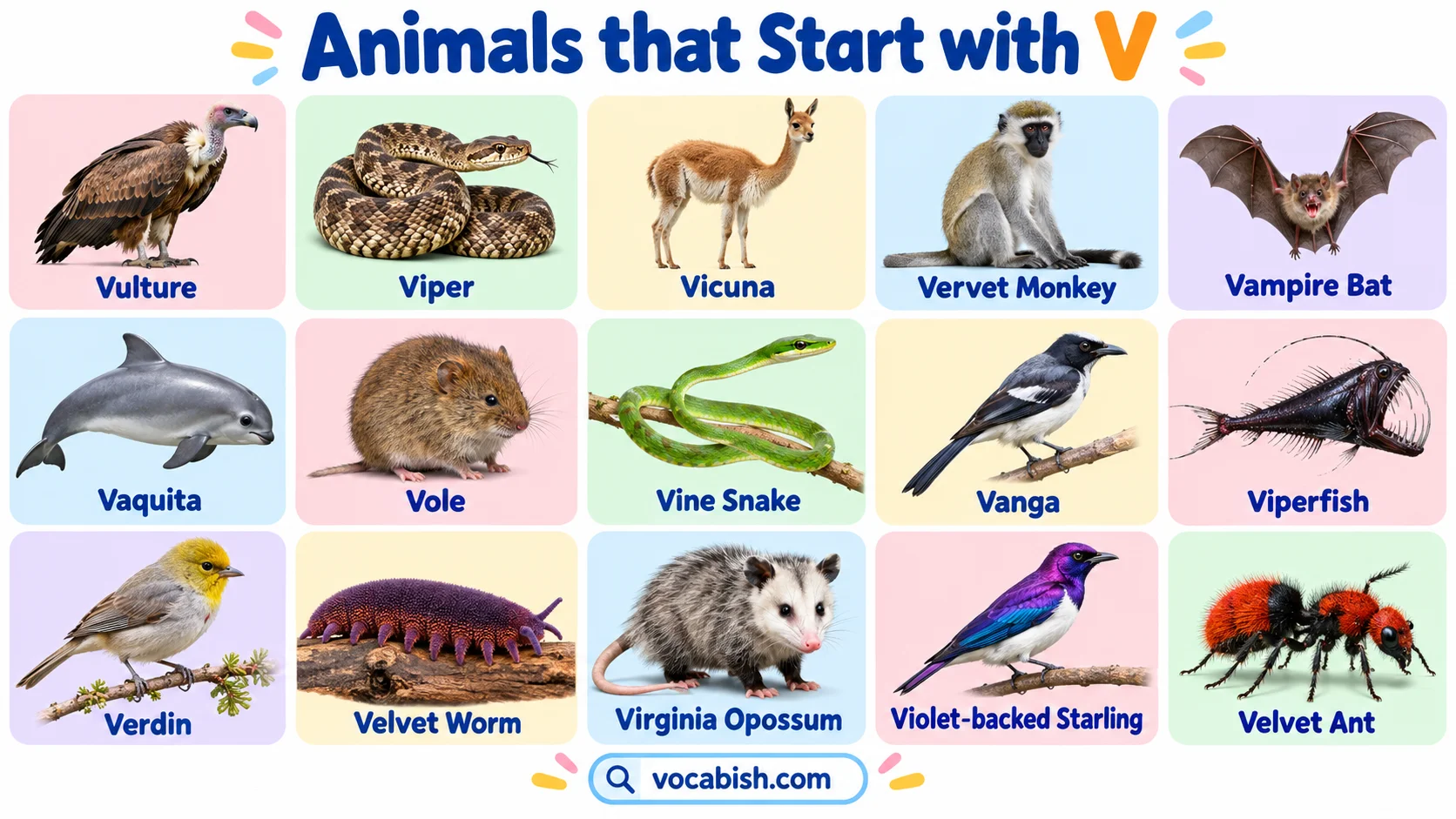
- Vulture
- Woodpecker
- Wren
Reptiles
Reptiles are vertebrates with dry skin covered mainly by scales or scutes. They are ectothermic, which means their body temperature is strongly influenced by the temperature of their surroundings. Most reptiles lay eggs on land, although some snakes and lizards give birth to live young. Modern reptiles include snakes, lizards, turtles, crocodilians, and the tuatara.
Examples:
- Alligator
- Anaconda
- Boa
- Chameleon
- Cobra
- Crocodile
- Gecko
- Gila Monster
- Iguana
- Kingsnake
- Komodo Dragon
- Lizard
- Monitor Lizard
- Python
- Rattlesnake
- Sea Snake
- Skink
- Snake
- Tortoise
- Turtle
- Viper
Amphibians
Amphibians are vertebrates that commonly spend part of their lives in water and part on land. Their skin is usually thin, moist, and able to absorb water and gases. Many amphibians begin life as aquatic larvae and later change into adults through metamorphosis, as tadpoles do when becoming frogs. They are especially sensitive to pollution and habitat changes because of their permeable skin.
Examples:
- Axolotl
- Bullfrog
- Caecilian
- Frog
- Glass Frog
- Newt
- Poison Dart Frog
- Salamander
- Toad
- Tree Frog
Fish
Fish are aquatic vertebrates that live in freshwater or saltwater and usually breathe through gills. Most have fins for movement and streamlined bodies that help them travel efficiently through water. Fish include jawless fishes, cartilaginous fishes such as sharks and rays, and bony fishes such as salmon and tuna. They form the largest and most diverse group of living vertebrates. Examples are included:
- Anchovy
- Angelfish
- Barracuda
- Bass
- Betta
- Catfish
- Clownfish
- Cod
- Eel
- Flounder
- Goldfish
- Grouper
- Guppy
- Haddock
- Hagfish
- Halibut
- Herring
- Koi
- Lamprey
- Lionfish
- Mackerel
- Marlin
- Minnow
- Moray Eel
- Perch
- Pike
- Piranha
- Ray
- Salmon
- Sardine
- Seahorse
- Shark
- Snapper
- Sole
- Sturgeon
- Swordfish
- Tilapia
- Trout
- Tuna
Scientific Groups of Vertebrates
Vertebrates can also be grouped more precisely according to their evolutionary relationships and body structure. In this classification, fishes are divided into several major groups.
- Jawless Fishes — Lampreys and hagfishes
- Cartilaginous Fishes — Sharks, rays, and skates
- Ray-Finned Fishes — Salmon, tuna, trout, cod, and most familiar fishes
- Lobe-Finned Fishes — Coelacanths and lungfishes
- Amphibians — Frogs, toads, salamanders, newts, and caecilians
- Reptiles — Snakes, lizards, turtles, crocodilians, and tuataras
- Birds — Eagles, parrots, ducks, owls, penguins, and other birds
- Mammals — Dogs, whales, bats, elephants, humans, and other mammals
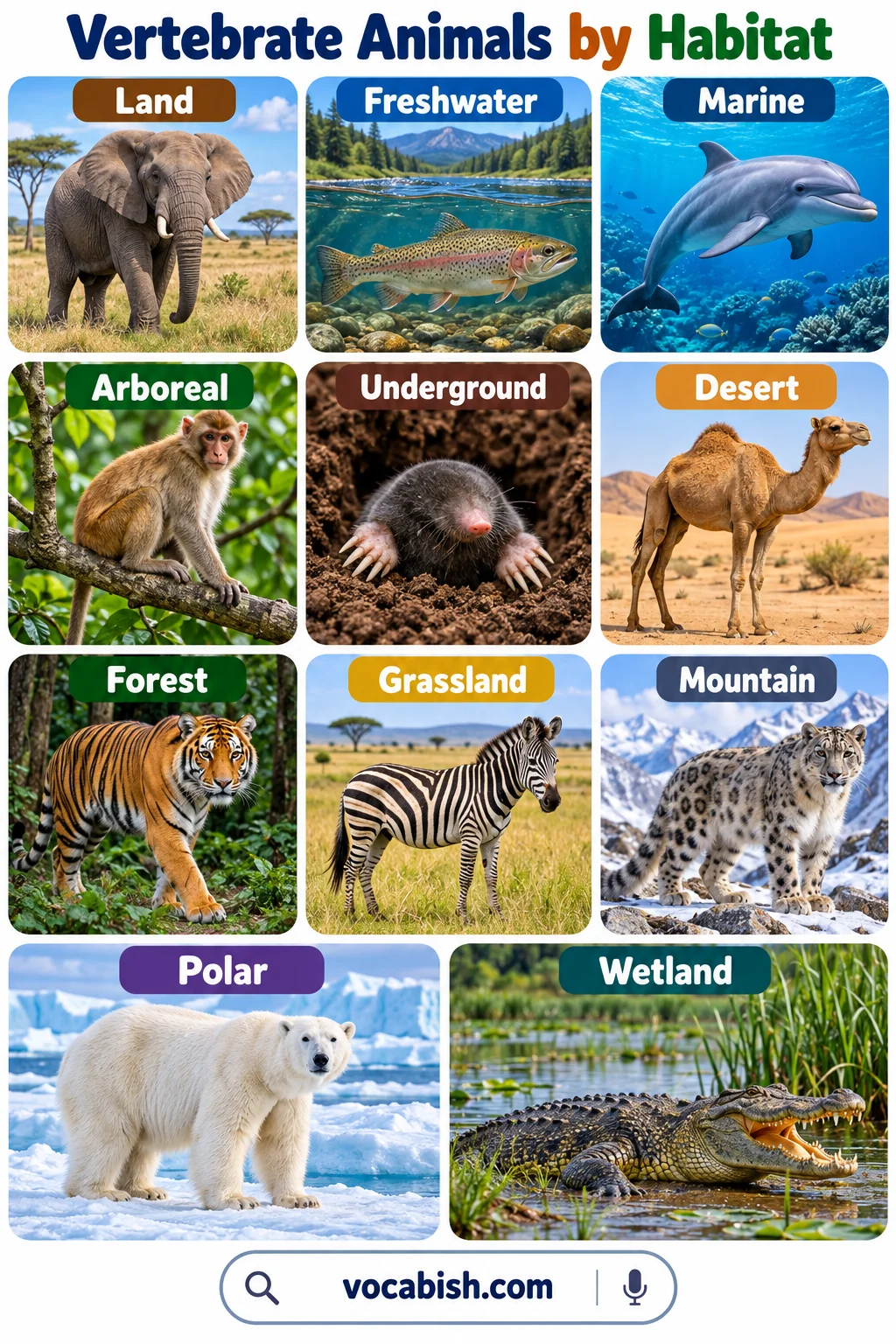
Vertebrate Animals by Habitat
Land Vertebrates
Land vertebrates are animals that spend most of their lives on the ground rather than in water or trees. They include many mammals, reptiles, birds, and some amphibians. Their bodies are adapted for walking, running, crawling, or hopping on solid surfaces, and they breathe air with lungs. Some land vertebrates can still swim or climb, but land remains their main habitat.
Examples: Elephant, lion, horse, zebra, dog, tortoise, ostrich, kangaroo
Freshwater Vertebrates
Freshwater vertebrates live in rivers, lakes, ponds, streams, and other waters with very low salt levels. Many fish and amphibians depend completely on freshwater, while some reptiles, birds, and mammals use it for feeding, breeding, or shelter. These animals must regulate water and salt levels in their bodies differently from marine species. Freshwater habitats can change quickly because of rainfall, drought, pollution, and seasonal water flow.
Examples: Trout, catfish, carp, frog, newt, freshwater turtle, river dolphin, beaver
Marine Vertebrates
Marine vertebrates live mainly in oceans and seas, where water contains much more salt than freshwater. This group includes fish, marine mammals, reptiles, and birds that depend on ocean ecosystems. Many have streamlined bodies, flippers, fins, or other adaptations that help them move efficiently through water. Some marine vertebrates breathe through gills, while whales, dolphins, turtles, and seabirds must breathe air.
Examples: Shark, tuna, dolphin, whale, sea turtle, seal, penguin, marlin
Arboreal Vertebrates
Arboreal vertebrates are animals that spend much of their time in trees. They often have strong limbs, gripping feet, claws, flexible joints, or prehensile tails that help them climb and move between branches. Tree-living animals may feed, sleep, hide from predators, or raise their young above the ground. Arboreal lifestyles are common among mammals, birds, reptiles, and some amphibians.
Examples: Monkey, sloth, koala, tree frog, chameleon, squirrel, woodpecker, tree snake
Underground Vertebrates
Underground vertebrates live or spend much of their time beneath the soil. Many have compact bodies, strong digging limbs, reduced eyesight, sensitive whiskers, or other features suited to dark and narrow tunnels. Living underground can protect animals from predators, extreme temperatures, and dry conditions. Some species build complex burrow systems for sleeping, storing food, or raising young.
Examples: Mole, mole rat, pocket gopher, armadillo, burrowing owl, burrowing snake, caecilian
Desert Vertebrates
Desert vertebrates live in dry regions where rainfall is low and temperatures may change sharply between day and night. Many avoid the hottest hours, conserve water efficiently, or obtain moisture from their food. Some have pale colouring, large ears, specialised kidneys, or burrowing behaviour that helps them survive harsh conditions. Desert vertebrates include mammals, birds, reptiles, and a smaller number of amphibians and fish.
Examples: Fennec fox, camel, desert tortoise, horned lizard, rattlesnake, kangaroo rat, roadrunner
Forest Vertebrates
Forest vertebrates live in habitats dominated by trees and dense plant growth. Forests provide food, shade, nesting sites, hiding places, and several vertical layers from the ground to the canopy. Animals living there may be adapted for climbing, gliding, camouflage, hunting in dense vegetation, or moving through leaf litter. Tropical, temperate, and boreal forests support very different vertebrate communities.
Examples: Tiger, deer, gorilla, woodpecker, owl, tree frog, salamander, python
Grassland Vertebrates
Grassland vertebrates live in open areas dominated by grasses rather than dense forests. Many species rely on speed, sharp eyesight, herd behaviour, burrows, or camouflage because there are fewer places to hide. Large grazing mammals are especially common, and predators often follow the movements of their prey. Grasslands include savannas, steppes, prairies, and other open habitats.
Examples: Zebra, antelope, bison, lion, cheetah, prairie dog, ostrich, grassland eagle
Mountain Vertebrates
Mountain vertebrates live in high, rocky, or steep environments where temperatures can be low and oxygen levels may decrease with altitude. Many have strong legs, specialised hooves or claws, thick fur or feathers, and excellent balance. Some migrate to lower elevations during winter, while others remain in high areas throughout the year. Mountain species often depend on cliffs, alpine meadows, rocky slopes, or cold streams.
Examples: Mountain goat, snow leopard, yak, ibex, marmot, golden eagle, Himalayan monal
Polar Vertebrates
Polar vertebrates live in or around the Arctic and Antarctic regions, where temperatures are extremely low for much of the year. Many have thick fur, dense feathers, or layers of body fat that reduce heat loss. Seasonal changes in sea ice, daylight, and food availability strongly influence their behaviour and migration. Polar animals may live on land, sea ice, or in cold surrounding oceans.
Examples: Polar bear, Arctic fox, reindeer, penguin, seal, walrus, Arctic hare, snowy owl
Wetland Vertebrates
Wetland vertebrates live in marshes, swamps, bogs, floodplains, mangroves, and other places where water covers the ground permanently or seasonally. Wetlands provide rich feeding and breeding areas for fish, amphibians, reptiles, birds, and mammals. Many wetland animals are adapted for swimming, wading, diving, or living among aquatic plants. These habitats are especially important for migratory birds and young aquatic animals.
Examples: Frog, alligator, crocodile, heron, duck, otter, beaver, turtle, catfish
Major Groups of Mammals
Mammals can be grouped by reproduction, evolutionary relationships, body structure, and lifestyle. Some categories below overlap because groups such as primates, rodents, bats, and cetaceans are also placental mammals.
- Monotremes — Egg-laying mammals found naturally in Australia and New Guinea. Examples include the platypus and echidnas.
- Marsupials — Mammals whose young are born at an early stage of development and usually continue growing while attached to a teat, often inside a pouch. Examples include kangaroos, koalas, wombats, and opossums.
- Placental Mammals — Mammals whose developing young are nourished through a placenta before birth. This is the largest mammal group and includes dogs, elephants, whales, bats, horses, and humans.
- Primates — Mammals with well-developed vision, flexible hands or feet, and relatively large brains. Examples include monkeys, apes, lemurs, tarsiers, and humans.
- Rodents — Mammals with continuously growing front incisors adapted for gnawing. Examples include mice, rats, squirrels, beavers, hamsters, and porcupines.
- Carnivorans — Members of the mammalian order Carnivora, many of which have teeth adapted for eating meat. Examples include lions, wolves, bears, seals, cats, and hyenas, although some carnivorans eat substantial amounts of plant food.
- Hoofed Mammals — Mammals that typically walk on enlarged toenails called hooves. Examples include horses, zebras, deer, cattle, goats, sheep, giraffes, and rhinoceroses.
- Cetaceans — Fully aquatic mammals adapted for life in water. Whales, dolphins, and porpoises breathe air with lungs, give birth to live young, and feed their young with milk.
- Bats — Mammals of the order Chiroptera and the only mammals capable of sustained powered flight. Examples include fruit bats, flying foxes, vampire bats, and insect-eating bats.
- Rabbits and Hares — Mammals belonging to the order Lagomorpha. They have two pairs of upper incisors and include rabbits, hares, and closely related pikas.
Major Groups of Birds
Birds may be grouped scientifically or by shared behaviour, habitat, feeding style, and body form. Categories such as seabirds and wading birds contain species from several different bird families.
- Birds of Prey — Predatory birds with strong feet, sharp talons, hooked beaks, and keen eyesight. Examples include eagles, hawks, falcons, vultures, and ospreys.
- Waterfowl — Water-associated birds belonging mainly to the duck, goose, and swan family. Examples include mallards, geese, swans, teal, and mergansers.
- Seabirds — Birds that spend much of their lives feeding or travelling at sea. Examples include albatrosses, petrels, puffins, gannets, frigatebirds, and many gulls.
- Songbirds — Birds belonging mainly to the large order Passeriformes, especially species known for complex vocalisations. Examples include robins, finches, thrushes, sparrows, and nightingales.
- Flightless Birds — Birds that have lost the ability to fly through evolution. Examples include ostriches, emus, cassowaries, kiwis, rheas, and penguins.
- Wading Birds — Birds commonly adapted for walking through shallow water while searching for food. Examples include herons, egrets, storks, ibises, spoonbills, and many sandpipers.
- Game Birds — Birds traditionally hunted or managed for food and sport. Examples include pheasants, quail, grouse, partridges, turkeys, and guinea fowl.
- Parrots — Colourful birds with strong curved bills and feet adapted for gripping. Examples include macaws, cockatoos, parakeets, lorikeets, and African grey parrots.
- Woodpeckers — Tree-living birds known for strong bills used to drill or tap wood. Examples include pileated woodpeckers, downy woodpeckers, flickers, and sapsuckers.
- Owls — Predatory birds with forward-facing eyes, hooked beaks, and specialised feathers that often allow quiet flight. Examples include barn owls, snowy owls, eagle-owls, and screech owls.
Major Groups of Reptiles
Living reptiles include several major evolutionary groups. Some familiar names, such as tortoises, crocodiles, alligators, caimans, and gharials, are subdivisions of larger reptile groups.
- Snakes — Legless reptiles with elongated bodies, flexible jaws, and scales. Examples include pythons, cobras, vipers, boas, rattlesnakes, and sea snakes.
- Lizards — Reptiles that usually have four limbs, external ear openings, movable eyelids, and long tails. Examples include geckos, iguanas, skinks, chameleons, and monitor lizards.
- Turtles — Reptiles protected by a bony or cartilaginous shell. The term includes marine turtles, freshwater turtles, and tortoises.
- Tortoises — Mainly land-dwelling members of the turtle group, usually with sturdy limbs and high-domed shells. Examples include Galápagos tortoises and African spurred tortoises.
- Crocodiles — Large semi-aquatic crocodilians with long snouts and powerful jaws. Examples include the Nile crocodile, saltwater crocodile, and American crocodile.
- Alligators — Crocodilians with generally broader, more rounded snouts than most crocodiles. Living species include the American alligator and Chinese alligator.
- Caimans — Crocodilians native mainly to Central and South America. Examples include the spectacled caiman, black caiman, and broad-snouted caiman.
- Gharials — Highly aquatic crocodilians recognised by their very long, narrow jaws, which are well suited for catching fish. The living gharial occurs in South Asia.
- Tuataras — Rare reptiles native to New Zealand and the only surviving members of an ancient reptile lineage called Rhynchocephalia. They resemble lizards but are not true lizards.
Major Groups of Amphibians
Living amphibians belong to three major scientific groups: frogs and toads, salamanders and newts, and caecilians. Some familiar terms below refer to subgroups rather than completely separate lineages.
- Frogs — Tailless amphibians with powerful hind legs and usually moist skin. Examples include tree frogs, bullfrogs, glass frogs, and poison dart frogs.
- Toads — Frog species commonly recognised by relatively dry, rough skin and stockier bodies. Examples include common toads, cane toads, and American toads.
- Salamanders — Amphibians with elongated bodies, tails, and usually four limbs. Examples include tiger salamanders, giant salamanders, mole salamanders, and axolotls.
- Newts — Salamanders whose life cycles commonly include aquatic or semi-aquatic stages. Examples include smooth newts, crested newts, fire-bellied newts, and eastern newts.
- Caecilians — Limbless, elongated amphibians that often live underground in tropical regions. Their bodies resemble worms or snakes, but they are true amphibians.
Major Groups of Fish
Fish can be classified by evolutionary relationships, skeleton type, fin structure, habitat, or migration pattern. Several categories below overlap; for example, most ray-finned fishes are also bony fishes.
- Jawless Fish — Primitive vertebrates that lack true jaws. Living examples include lampreys and hagfishes.
- Cartilaginous Fish — Fishes whose skeletons are made mainly of cartilage rather than bone. Examples include sharks, rays, skates, and chimaeras.
- Bony Fish — Fishes with skeletons made mainly of bone. This enormous group includes salmon, tuna, cod, goldfish, seahorses, and thousands of other species.
- Ray-Finned Fish — Bony fishes whose fins are supported by thin bony rays. They include the great majority of living fish species, such as tuna, trout, cod, carp, and clownfish.
- Lobe-Finned Fish — Bony fishes with fleshy, muscular fin bases containing internal bones. Living examples include coelacanths and lungfishes.
- Freshwater Fish — Fish that live primarily in rivers, lakes, ponds, and streams with low salt concentrations. Examples include carp, catfish, pike, many trout, and many cichlids.
- Marine Fish — Fish adapted to saltwater environments such as oceans and seas. Examples include tuna, cod, marlin, clownfish, groupers, and most sharks.
- Migratory Fish — Fish that travel regularly between habitats for feeding, reproduction, or different stages of life. Examples include salmon, eels, sturgeons, shads, and some lampreys.
Vertebrates and Invertebrates
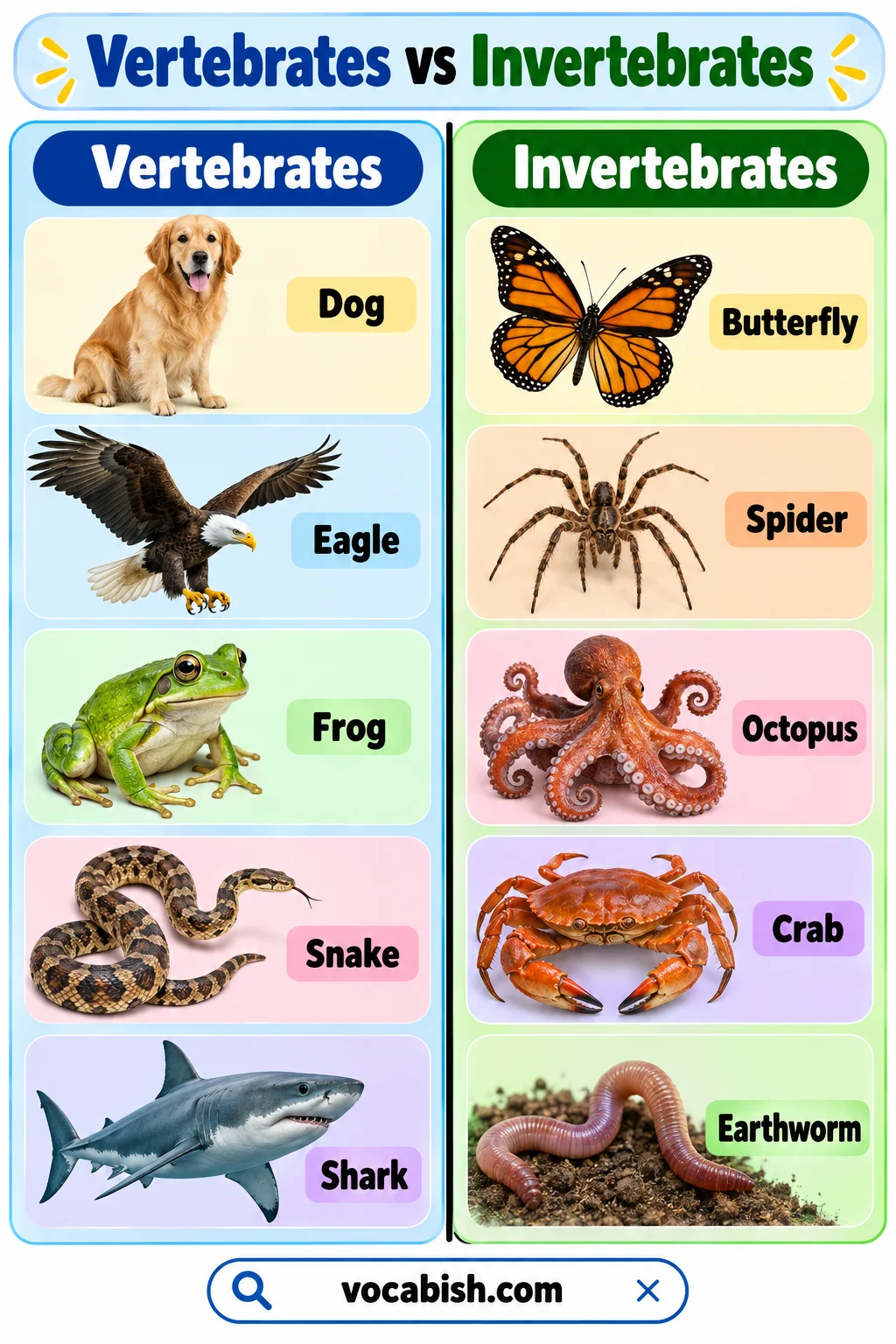
The easiest way to separate these two animal groups is to look at the backbone. Vertebrates have a vertebral column, while invertebrates do not.
Vertebrates | Invertebrates |
|---|---|
Have a backbone | Do not have a backbone |
Dog | Butterfly |
Eagle | Spider |
Frog | Earthworm |
Snake | Snail |
Shark | Octopus |
Salmon | Crab |
Animals such as insects, spiders, worms, snails, jellyfish, crabs, and octopuses are not vertebrates.
Interesting Facts About Vertebrate Animals
- The blue whale is the largest vertebrate ever known. It can grow to more than 30 metres long and weigh well over 100 tonnes.
- Some of the smallest vertebrates are tiny frogs. Paedophryne amauensis, a frog from Papua New Guinea, measures only about 7–8 millimetres as an adult.
- Birds are living dinosaurs. Modern birds evolved from small feathered theropod dinosaurs, which makes them part of the dinosaur lineage.
- Not all vertebrate skeletons are made mainly of bone. Sharks, rays, and skates have skeletons made mostly of cartilage, the flexible tissue also found in human noses and ears.
- Some mammals lay eggs. The platypus and echidnas are monotremes, an unusual group of mammals that reproduce by laying eggs instead of giving birth to live young.
- Amphibians can breathe through their skin. Many frogs and salamanders absorb oxygen through their moist skin as well as using lungs or gills at different life stages.
- Fish are the most species-rich group of vertebrates. They include an enormous variety of forms, from tiny reef fish and seahorses to sharks, tuna, and giant oceanic species.
- Some reptiles have temperature-dependent sex determination. In many turtles and crocodilians, the temperature at which eggs develop can influence whether the young become male or female.
Practice: Identify the Vertebrates
Choose the correct answer.
1. Which animal is a vertebrate?
A. Spider
B. Dog
C. Earthworm
D. Jellyfish
2. Which vertebrate group includes frogs?
A. Mammals
B. Birds
C. Amphibians
D. Reptiles
3. Which animal is a mammal?
A. Dolphin
B. Trout
C. Crocodile
D. Eagle
4. Which animal belongs to the reptile group?
A. Frog
B. Snake
C. Salmon
D. Parrot
5. Which animal is a bird?
A. Bat
B. Penguin
C. Dolphin
D. Lizard
6. Which animal is a fish?
A. Shark
B. Whale
C. Seal
D. Frog
7. What feature is shared by all vertebrates?
A. Wings
B. Fur
C. Backbone
D. Scales
8. Which animal is not a vertebrate?
A. Turtle
B. Octopus
C. Horse
D. Eagle
9. Which animal begins life as a tadpole?
A. Frog
B. Chicken
C. Cat
D. Snake
10. Which animal breathes air but lives in the ocean?
A. Tuna
B. Shark
C. Dolphin
D. Salmon
Answers
- B — Dog
- C — Amphibians
- A — Dolphin
- B — Snake
- B — Penguin
- A — Shark
- C — Backbone
- B — Octopus
- A — Frog
- C — Dolphin
FAQs
Vertebrate animals are animals with a backbone or vertebral column. Mammals, birds, reptiles, amphibians, and fish are the main groups.
The five commonly taught vertebrate groups are mammals, birds, reptiles, amphibians, and fish, although scientific classification divides several groups more precisely.
Dog, cat, horse, elephant, eagle, parrot, snake, turtle, frog, and salmon are ten common examples of animals with backbones.
Yes. Fish are vertebrates because they have internal skeletons containing a vertebral column, although their skeletons may be bone or cartilage.
Yes. A snake is a reptile and vertebrate. Its long spinal column contains many vertebrae that support movement and protect the spinal cord.
Yes. All birds are vertebrates because they have an internal skeleton, skull, and backbone, whether they can fly or remain flightless.
Whales are vertebrate mammals, not fish. They breathe with lungs, are warm-blooded, give birth to live young, and produce milk.
Insects, spiders, worms, snails, jellyfish, starfish, crabs, lobsters, and octopuses are invertebrates because they do not have a vertebral backbone.
Related Animal Vocabulary
- Animals That Start with A
- Animals That Start with M
- Animals That Start with S
- Animals That Start with W
- Animals That Start with Z
Conclusion
Vertebrate animals are animals with a backbone and include mammals, birds, reptiles, amphibians, and fish. Dogs, elephants, eagles, turtles, frogs, sharks, and thousands of other species belong to this broad animal group.
Learning the major groups first makes it much easier to identify animals, understand animal vocabulary, and classify unfamiliar species correctly.