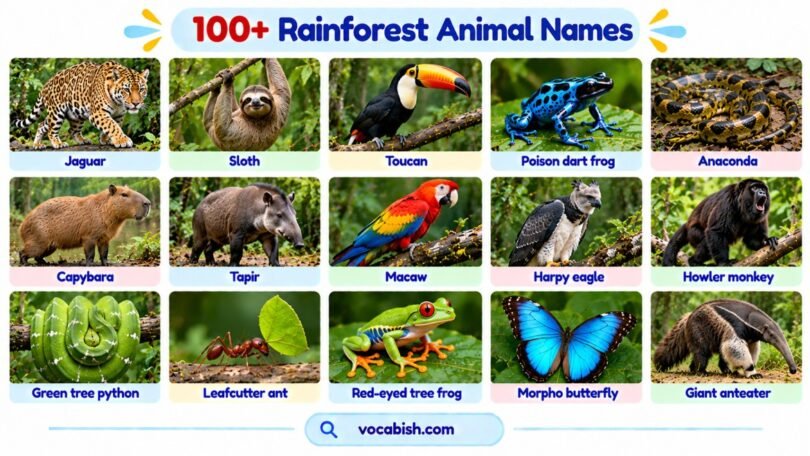

Rainforests are home to a remarkable variety of animals, from powerful jaguars and colourful toucans to tree frogs, monkeys, snakes, insects, and river species. This collection of rainforest animal names covers mammals, birds, reptiles, amphibians, fish, and invertebrates found in tropical forest habitats. Each name helps learners build useful animal vocabulary and recognize species from different rainforest regions. The list also makes it easier to understand how animals live in the canopy, understory, forest floor, and freshwater areas.
Common Rainforest Animal Names
Many familiar rainforest animals have special features that help them survive in warm, wet forests. These common examples are useful for learning animal vocabulary and understanding how different species live.
Jaguar
The jaguar is a large wild cat found mainly in Central and South America. It has a golden coat covered with dark rosette-shaped markings. Jaguars are powerful swimmers and often live near rainforest rivers. They hunt animals such as capybaras, peccaries, and caimans.
Sumatran Tiger
The Sumatran tiger lives on the Indonesian island of Sumatra. It is smaller than many other tiger subspecies and has dark, closely spaced stripes. It lives in forests ranging from lowland rainforest to mountain areas. Deer, wild pigs, and other mammals form much of its diet.
Orangutan
Orangutans are large apes native to the rainforests of Borneo and Sumatra. They spend much of their time in trees and use their long arms for climbing. Fruit makes up a large part of their diet. Orangutans are also known for using simple tools.
Western Lowland Gorilla
The western lowland gorilla lives in the tropical forests of Central Africa. It has a strong body, long arms, and dark hair. Gorillas mainly eat fruit, leaves, stems, and other plant material. They usually live in social groups led by an adult male.
Chimpanzee
Chimpanzees live in forests and woodlands across parts of tropical Africa. They eat fruit, seeds, leaves, insects, and sometimes small animals. Chimpanzees can use sticks, stones, and other objects as tools. They communicate using sounds, facial expressions, and gestures.
Three-toed Sloth
Three-toed sloths spend most of their lives hanging from rainforest trees. Their long claws help them grip branches securely. They mainly eat leaves and move very slowly to conserve energy. Algae may grow on their fur and give it a greenish appearance.
Howler Monkey
Howler monkeys live in the forests of Central and South America. They are famous for their deep calls, which can travel long distances through the forest. Their strong tails can grip tree branches. They mainly eat leaves, fruit, and flowers.
Capuchin Monkey
Capuchin monkeys are small, intelligent primates found in Central and South America. They have flexible hands and long tails that help them move through trees. Their diet includes fruit, seeds, insects, eggs, and small animals. Some capuchins also use tools to reach food.
Brazilian Tapir
The Brazilian tapir is a large plant-eating mammal found in South American forests and wetlands. Its short, flexible snout helps it pick leaves and fruit. Tapirs are strong swimmers and often stay close to water. They also help spread seeds through the forest.
Okapi
The okapi lives in dense rainforests of the Democratic Republic of the Congo. It has a dark body with striking white stripes on its legs. Although its markings resemble a zebra, the okapi is closely related to the giraffe. It feeds on leaves, shoots, fruit, and other vegetation.
Keel-billed Toucan
The keel-billed toucan is recognized by its large, brightly coloured bill. It lives in tropical forests from southern Mexico through Central America. Toucans mainly eat fruit but may also eat insects, eggs, and small animals. They usually move among branches rather than flying long distances.
Scarlet Macaw
The scarlet macaw is a large parrot with bright red, yellow, and blue feathers. It lives in tropical forests of Central and South America. Its powerful beak can crack hard nuts and seeds. Macaws often form strong pairs and communicate with loud calls.
Harpy Eagle
The harpy eagle is one of the largest and most powerful rainforest eagles. It lives in tropical forests of Central and South America. Its strong legs and talons allow it to catch monkeys, sloths, and other tree-dwelling animals. It usually nests in very tall trees.
Southern Cassowary
The southern cassowary is a large flightless bird found in New Guinea and northeastern Australia. It has strong legs and a distinctive helmet-like structure called a casque. Cassowaries mainly eat fallen fruit. By carrying seeds through the forest, they help many rainforest plants reproduce.
Red-eyed Tree Frog
The red-eyed tree frog lives in tropical forests of Central America. It has bright green skin, red eyes, and colourful legs. During the day, it often rests on leaves with its eyes closed. It becomes active at night and feeds mainly on insects.
Green Anaconda
The green anaconda is one of the heaviest snakes in the world. It lives around rivers, swamps, and flooded forests in South America. Its body is well adapted for swimming. It captures fish, birds, reptiles, and mammals.
Boa Constrictor
The boa constrictor is a large snake found in tropical parts of the Americas. It catches prey with its jaws and coils its body around the animal. Boas can climb trees but also spend time on the ground. They eat rodents, birds, lizards, and other small animals.
Spectacled Caiman
The spectacled caiman lives in freshwater habitats throughout parts of Central and South America. A raised ridge between its eyes gives it a spectacle-like appearance. It eats fish, crustaceans, insects, reptiles, and other animals. Rainforest rivers and wetlands provide important habitat for this reptile.
Leafcutter Ant
Leafcutter ants live in large colonies in tropical forests of the Americas. Workers cut pieces of leaves and carry them back to underground nests. They do not eat the leaves directly. Instead, they use the plant material to grow fungus that serves as food.
Tree Kangaroo
Tree kangaroos live in the rainforests of New Guinea and northeastern Australia. Unlike most kangaroos, they are skilled tree climbers. Their strong limbs and long tails help them balance among branches. They feed mainly on leaves, fruit, flowers, and other plant material.
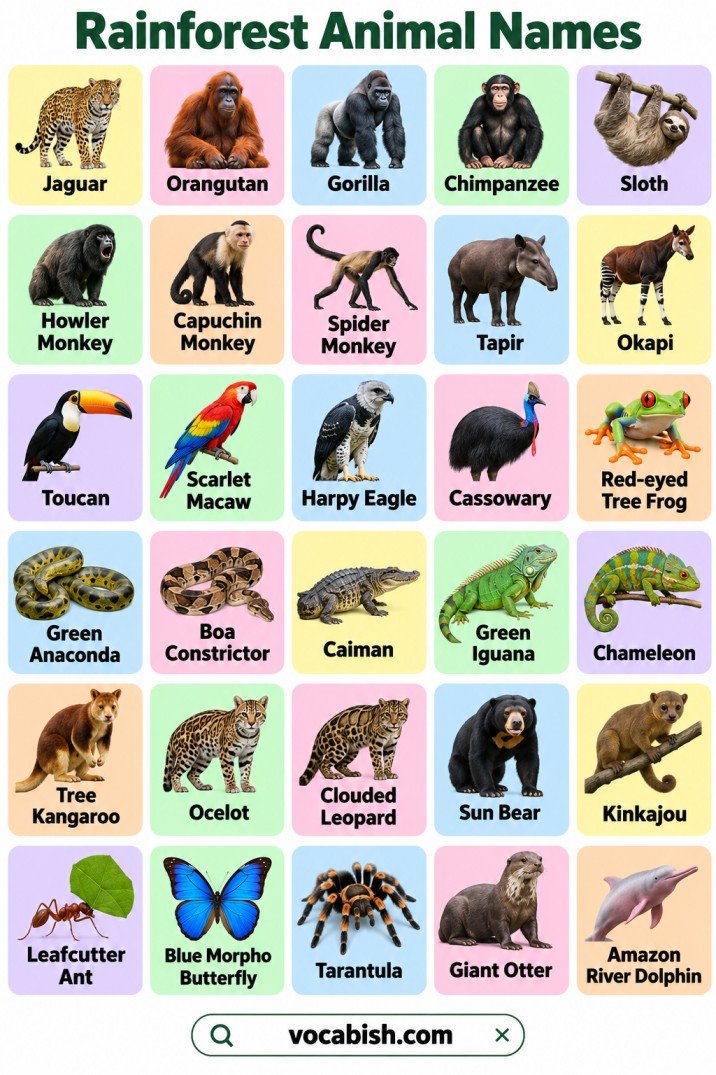
Rainforest Mammal Names
Here are the names of mammals commonly found in rainforests, including monkeys, big cats, bats, and other tree- and ground-dwelling animals.
- Bonobo
- Mandrill
- Black-and-white Colobus
- Spider Monkey
- Squirrel Monkey
- Golden Lion Tamarin
- Pygmy Marmoset
- Woolly Monkey
- Proboscis Monkey
- Lar Gibbon
- Siamang
- Slow Loris
- Tarsier
- Aye-aye
- Fossa
- Clouded Leopard
- Ocelot
- Margay
- Jaguarundi
- Binturong
- Sun Bear
- Spectacled Bear
- Silky Anteater
- Sunda Pangolin
- Kinkajou
- South American Coati
- Central American Agouti
- Lowland Paca
- White-lipped Peccary
- Lesser Mouse-deer
- Red Muntjac
- Blue Duiker
- African Forest Elephant
- Pygmy Hippopotamus
- Lowland Anoa
- Babirusa
- Large Flying Fox
- Tent-making Bat
- Common Vampire Bat
- Spotted Cuscus
Rainforest Bird Names
This list includes rainforest birds known for their bright colours, unusual calls, strong beaks, and life among dense forest trees.
- Great Hornbill
- Rhinoceros Hornbill
- Horned Guan
- Resplendent Quetzal
- Hoatzin
- Crowned Eagle
- African Grey Parrot
- Eclectus Parrot
- King Bird-of-paradise
- Twelve-wired Bird-of-paradise
- Victoria’s Riflebird
- Satin Bowerbird
- Great Curassow
- Crested Guan
- Tinamou
- Motmot
- Trogon
- Jacamar
- Antbird
- Manakin
- Potoo
- Sunbittern
- Aracari
- Turaco
- Pitta
- Broadbill
- Drongo
- Sunbird
- Honeycreeper
- Tanager
- Forest Kingfisher
- Frogmouth
- Coucal
- Megapode
- Cock-of-the-rock
- Toucanet
- Umbrellabird
Rainforest Reptile Names
Below are the names of reptiles you may find in rainforest habitats, from snakes and lizards to turtles, caimans, and crocodiles.
- Emerald Tree Boa
- Rainbow Boa
- Reticulated Python
- Green Tree Python
- Eyelash Viper
- Bushmaster
- Fer-de-lance
- Gaboon Viper
- Rhinoceros Viper
- Green Vine Snake
- Mangrove Snake
- Paradise Flying Snake
- King Cobra
- Green Iguana
- Common Basilisk
- Panther Chameleon
- Jackson’s Chameleon
- Tokay Gecko
- Satanic Leaf-tailed Gecko
- Crocodile Monitor
- Asian Water Monitor
- Caiman Lizard
- Matamata Turtle
- Red-footed Tortoise
- Asian Forest Turtle
- Dwarf Crocodile
- False Gharial
- New Guinea Crocodile
- Crocodile Skink
- Flying Dragon Lizard
Rainforest Amphibian Names
Here you can find the names of rainforest amphibians, including many frogs, salamanders, and other species that prefer warm, damp environments.
- Glass Frog
- Amazon Milk Frog
- Monkey Tree Frog
- Wallace’s Flying Frog
- Vietnamese Mossy Frog
- Tomato Frog
- Golden Mantella
- Harlequin Frog
- Horned Marsupial Frog
- Smoky Jungle Frog
- Surinam Horned Frog
- Lemur Leaf Frog
- Amazon Horned Frog
- Hourglass Tree Frog
- Rocket Frog
- Borneo Eared Frog
- Bornean Flat-headed Frog
- Panamanian Golden Frog
- Caecilian
- Tropical Climbing Salamander
- Web-footed Salamander
- Mushroom-tongue Salamander
Rainforest Insects and Other Invertebrates
This section brings together rainforest insects and other invertebrates, including butterflies, beetles, ants, spiders, centipedes, and similar small animals.
- Blue Morpho Butterfly
- Glasswing Butterfly
- Owl Butterfly
- Postman Butterfly
- Birdwing Butterfly
- Atlas Moth
- Comet Moth
- Hercules Beetle
- Goliath Beetle
- Rhinoceros Beetle
- Jewel Beetle
- Longhorn Beetle
- Bullet Ant
- Army Ant
- Weaver Ant
- Driver Ant
- Orchid Bee
- Stingless Bee
- Paper Wasp
- Termite
- Stick Insect
- Leaf Insect
- Katydid
- Praying Mantis
- Giant Centipede
- Millipede
- Tarantula
- Golden Silk Orb-weaver
- Huntsman Spider
- Tailless Whip Scorpion
- Forest Scorpion
- Velvet Worm
- Land Snail
- Leech
- Freshwater Crab
- Giant Earthworm
Rainforest River and Freshwater Animal Names
Rainforest rivers, streams, and wetlands support their own wildlife. Here are the names of fish, mammals, reptiles, and other animals found in these freshwater habitats.
- Amazon River Dolphin
- Giant Otter
- Arapaima
- Electric Eel
- Red-bellied Piranha
- Tambaqui
- Pacu
- Discus Fish
- Freshwater Angelfish
- Silver Arowana
- Redtail Catfish
- Freshwater Stingray
- Peacock Bass
- Black Ghost Knifefish
- Elephantnose Fish
- Congo Tetra
- African Butterflyfish
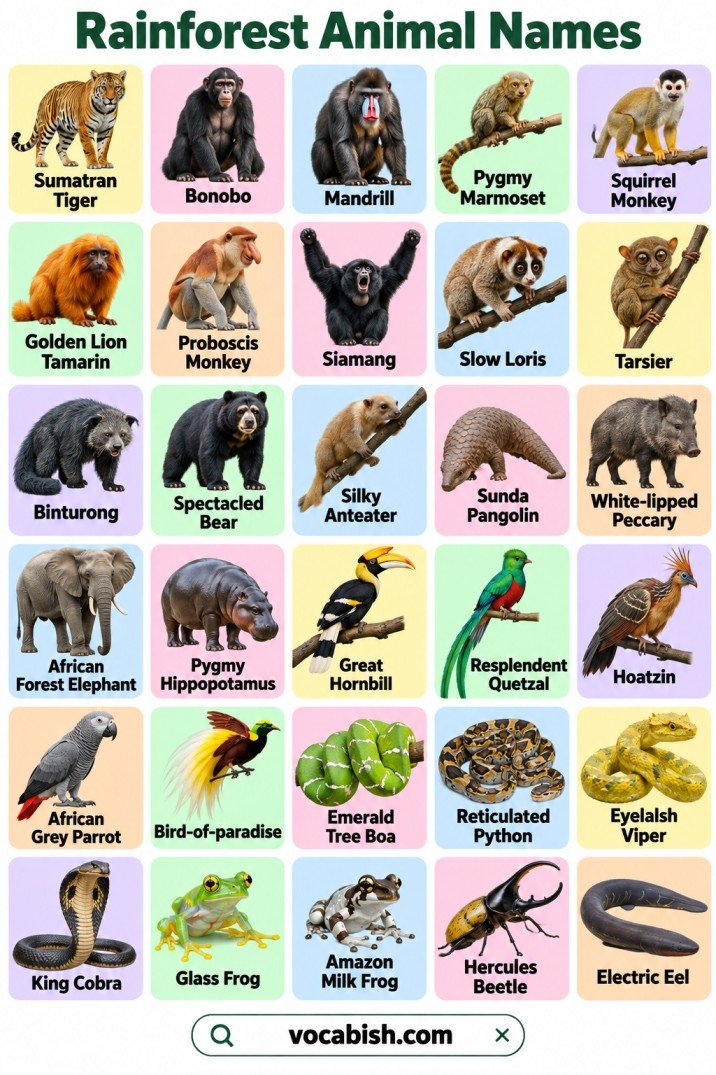
Useful Rainforest Vocabulary and Related Terms
Learning a few habitat and animal words makes rainforest vocabulary easier to understand. These terms often appear in wildlife books, school lessons, documentaries, and animal descriptions.
Word | Easy Meaning |
|---|---|
Rainforest | A dense forest with high rainfall |
Canopy | The upper layer formed by tree branches and leaves |
Understory | The shaded plant layer below the canopy |
Forest floor | The lowest part of the forest |
Arboreal | Living or spending much time in trees |
Nocturnal | Active mainly at night |
Diurnal | Active mainly during the day |
Camouflage | Colours or patterns that help an animal blend in |
Predator | An animal that hunts other animals |
Prey | An animal hunted for food |
Herbivore | An animal that mainly eats plants |
Carnivore | An animal that mainly eats other animals |
Omnivore | An animal that eats both plants and animals |
Amphibian | An animal group that includes frogs and salamanders |
Reptile | An animal group that includes snakes, lizards, turtles, and crocodilians |
Invertebrate | An animal without a backbone |
Vertebrate | An animal with a backbone |
Fun Facts About Rainforest Animals
- Sloths can grow algae on their fur. The greenish algae helps them blend with leaves and branches, giving them extra camouflage.
- Howler monkeys are among the loudest land animals. Their calls can travel several kilometres through dense rainforest.
- Toucans use their large bills to reach fruit. Their beaks also help them handle food growing on branches that are hard to reach.
- Harpy eagles have extremely powerful talons. They can catch animals such as sloths and monkeys high in the forest canopy.
- Poison dart frogs get many of their toxins from their diet. In the wild, certain insects they eat help produce the chemicals in their skin.
- Leafcutter ants do not actually eat the leaves they collect. They use the leaves to grow fungus, which becomes their main food.
- Jaguars are excellent swimmers. Unlike many cats, they often enter rivers and may hunt fish, turtles, and other aquatic animals.
- Orangutans can use tools. They have been observed using sticks to reach insects, open food, and solve simple problems.
Quick Practice for Rainforest Animals
Match each animal with the correct group.
- Harpy Eagle — Mammal, Bird, or Reptile?
- Ocelot — Bird, Mammal, or Amphibian?
- Green Tree Python — Reptile, Fish, or Insect?
- Glass Frog — Bird, Amphibian, or Mammal?
- Hercules Beetle — Reptile, Insect, or Fish?
- Arapaima — Mammal, Fish, or Bird?
Answers
- Bird
- Mammal
- Reptile
- Amphibian
- Insect
- Fish
FAQs
Common rainforest animals include jaguars, orangutans, gorillas, sloths, toucans, macaws, tree frogs, anacondas, caimans, monkeys, insects, and many reptiles.
Amazon rainforest animals include jaguars, sloths, howler monkeys, capuchins, green anacondas, harpy eagles, macaws, tapirs, caimans, arapaima, and river dolphins.
Orangutans, sloths, tree kangaroos, gibbons, monkeys, toucans, tree frogs, snakes, lizards, insects, and many birds spend much of their lives in trees.
Rainforest mammals include jaguars, gorillas, orangutans, chimpanzees, tapirs, monkeys, sloths, forest elephants, bats, anteaters, pangolins, okapis, and tree kangaroos.
Rainforest reptiles include anacondas, boas, pythons, cobras, vipers, iguanas, chameleons, geckos, monitors, caimans, crocodiles, turtles, and several kinds of tortoise.
Rainforest birds include toucans, macaws, hornbills, harpy eagles, cassowaries, parrots, quetzals, motmots, manakins, pittas, birds-of-paradise, and many colourful songbirds.
Warm temperatures, frequent rainfall, abundant food, dense vegetation, rivers, and several forest layers create many habitats where different animal species can survive.
No. Rainforests contain predators and venomous species, but many animals are harmless plant eaters, fruit eaters, insect eaters, birds, amphibians, and small invertebrates.
Related Vocabulary Topics
- Forest Animal Names and Types with Pictures
- Freshwater Animal Names and Pictures
- Vertebrate Animal Names and Types
- Invertebrate Animal Names with Pictures
- Marine Mammal Names with Pictures
- Mammal Names in English
- Bird Names and Their Types
- Reptile Names with Pictures
- Amphibian Names with Pictures
- Insect Names in English
- 100+ Animals from A to Z
Conclusion
Learning rainforest animal names is a useful way to build English vocabulary while discovering wildlife from the Amazon, Africa, Southeast Asia, New Guinea, and other rainforest regions. Mammals, birds, reptiles, amphibians, fish, insects, and other invertebrates all play different roles in these rich forest ecosystems. Using pictures with these names can make the vocabulary easier to recognize, remember, and use correctly.