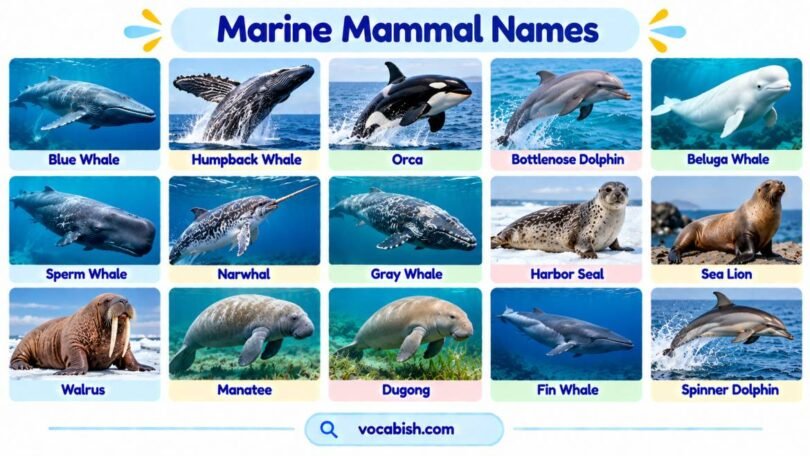

Marine mammal names include whales, dolphins, seals, sea lions, walruses, manatees, dugongs, and other mammals that depend on the ocean. These animals breathe air with lungs and are warm-blooded. They give birth to live young and feed their babies with milk. Some marine mammals spend their entire lives in water. Others rest, breed, or raise their young on beaches, rocky shores, or sea ice. Learning their names with pictures makes it easier to identify each animal and understand the main marine mammal groups.
Here’s a complete guide on: 100+ Ocean Animal Names with Pictures
Marine Mammal Names with Facts and Pictures
These are some of the best-known marine mammals found in oceans, coastal waters, or polar regions. Learning these names first makes the larger groups easier to understand.
Blue Whale
The blue whale is the largest animal known to have lived on Earth. It is a baleen whale that mainly eats tiny animals called krill. Blue whales breathe air through two blowholes on top of the head.
Humpback Whale
The humpback whale is known for its long pectoral fins and powerful jumps from the water. It feeds mainly on small fish and krill. Humpback whales travel long distances between feeding and breeding areas.
Sperm Whale
The sperm whale is the largest living toothed whale. It can dive to great depths while searching for squid and other prey. Its very large, square-shaped head makes it easy to recognize.
Orca
The orca, also called the killer whale, belongs to the dolphin family. Orcas often live and travel in social groups called pods. Different populations may hunt fish, seals, or other marine animals.
Bottlenose Dolphin
The bottlenose dolphin has a curved mouth that gives it a familiar smiling appearance. It uses whistles, clicks, and echolocation to communicate and find objects. Bottlenose dolphins commonly live in warm and temperate coastal waters.
Beluga Whale
The beluga whale is a white whale found mainly in Arctic and sub-Arctic waters. Adults have a rounded forehead called a melon. Belugas produce many different sounds and are highly social animals.
Narwhal
The narwhal is an Arctic whale famous for its long spiral tusk. The tusk is actually an enlarged tooth and is most common in males. Narwhals live in cold waters around Canada, Greenland, and other Arctic regions.
Harbor Porpoise
The harbor porpoise is a small cetacean found mainly in cool coastal waters of the Northern Hemisphere. It has a rounded face without the long beak seen in many dolphins. It usually feeds on small fish and squid.
Harbor Seal
The harbor seal is a true seal with a rounded head and spotted coat. It has no visible external ear flaps. Harbor seals rest on beaches, rocks, and sandbanks but hunt for food in the water.
California Sea Lion
The California sea lion has visible ear flaps and strong front flippers. It is an agile swimmer and can also move effectively on land. These sea lions are well known for their loud barking calls.
Walrus
The walrus is a large Arctic marine mammal with long tusks and sensitive whiskers. It uses its whiskers to help locate food on the seafloor. Walruses mainly eat clams and other bottom-dwelling animals.
Sea Otter
The sea otter has extremely thick fur that helps keep its body warm in cold water. It often floats on its back while eating shellfish. Some sea otters use rocks as tools to break open hard shells.
Dugong
The dugong is a large plant-eating marine mammal related to manatees. It feeds mainly on seagrass in warm coastal waters. A dugong has a fluked tail that looks somewhat like the tail of a whale.
West Indian Manatee
The West Indian manatee is a slow-moving aquatic mammal with a broad paddle-shaped tail. It eats seagrasses and other aquatic plants. It can live in coastal water, estuaries, and connected rivers.
Polar Bear
The polar bear is considered a marine mammal because it depends heavily on the sea and sea ice for food. It mainly hunts seals in the Arctic. Polar bears are also strong swimmers capable of travelling through cold ocean water.
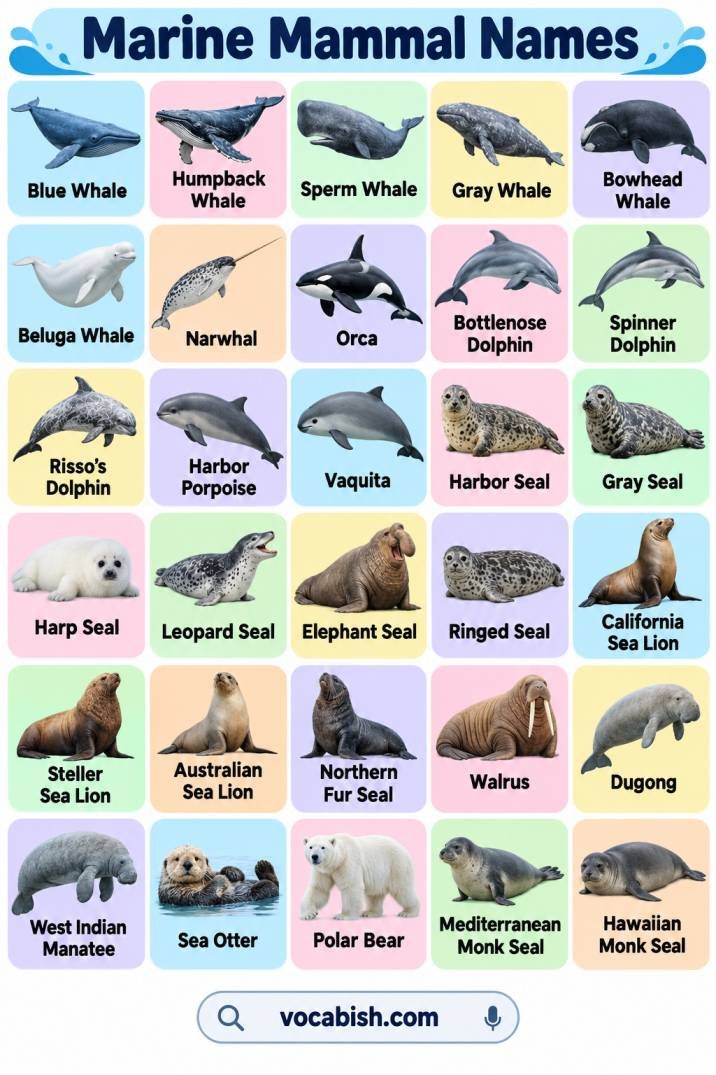
List of All Marine Mammal Names by Group
Marine mammals belong to several different biological groups. The lists below cover a wide range of living marine mammals and commonly used English names; classification can vary slightly as scientists update species relationships.
Baleen Whales
- Blue Whale
- Fin Whale
- Sei Whale
- Humpback Whale
- Common Minke Whale
- Antarctic Minke Whale
- Bryde’s Whale
- Eden’s Whale
- Omura’s Whale
- Rice’s Whale
- Bowhead Whale
- North Atlantic Right Whale
- North Pacific Right Whale
- Southern Right Whale
- Gray Whale
- Pygmy Right Whale
Sperm Whales
- Sperm Whale
- Pygmy Sperm Whale
- Dwarf Sperm Whale
Beaked Whales
- Arnoux’s Beaked Whale
- Baird’s Beaked Whale
- Sato’s Beaked Whale
- Northern Bottlenose Whale
- Southern Bottlenose Whale
- Longman’s Beaked Whale
- Cuvier’s Beaked Whale
- Shepherd’s Beaked Whale
- Andrews’ Beaked Whale
- Blainville’s Beaked Whale
- Deraniyagala’s Beaked Whale
- Gervais’ Beaked Whale
- Ginkgo-Toothed Beaked Whale
- Gray’s Beaked Whale
- Hector’s Beaked Whale
- Hubbs’ Beaked Whale
- Layard’s Beaked Whale
- Perrin’s Beaked Whale
- Pygmy Beaked Whale
- Ramari’s Beaked Whale
- Sowerby’s Beaked Whale
- Spade-Toothed Whale
- Stejneger’s Beaked Whale
- True’s Beaked Whale
Arctic Toothed Whales
- Beluga Whale
- Narwhal
Dolphins
- Orca
- Common Bottlenose Dolphin
- Indo-Pacific Bottlenose Dolphin
- Atlantic Spotted Dolphin
- Pantropical Spotted Dolphin
- Spinner Dolphin
- Clymene Dolphin
- Striped Dolphin
- Short-Beaked Common Dolphin
- Long-Beaked Common Dolphin
- Atlantic White-Sided Dolphin
- Pacific White-Sided Dolphin
- White-Beaked Dolphin
- Dusky Dolphin
- Hourglass Dolphin
- Peale’s Dolphin
- Risso’s Dolphin
- Rough-Toothed Dolphin
- Fraser’s Dolphin
- Northern Right Whale Dolphin
- Southern Right Whale Dolphin
- Atlantic Humpback Dolphin
- Indo-Pacific Humpback Dolphin
- Indian Ocean Humpback Dolphin
- Australian Humpback Dolphin
- Australian Snubfin Dolphin
- Irrawaddy Dolphin
- Chilean Dolphin
- Commerson’s Dolphin
- Heaviside’s Dolphin
- Hector’s Dolphin
- Māui Dolphin
- Guiana Dolphin
- False Killer Whale
- Pygmy Killer Whale
- Melon-Headed Whale
- Long-Finned Pilot Whale
- Short-Finned Pilot Whale
- Franciscana
Porpoises
- Harbor Porpoise
- Dall’s Porpoise
- Burmeister’s Porpoise
- Spectacled Porpoise
- Vaquita
- Indo-Pacific Finless Porpoise
- Narrow-Ridged Finless Porpoise
True Seals
- Harbor Seal
- Gray Seal
- Spotted Seal
- Ribbon Seal
- Harp Seal
- Ringed Seal
- Bearded Seal
- Hooded Seal
- Mediterranean Monk Seal
- Hawaiian Monk Seal
- Northern Elephant Seal
- Southern Elephant Seal
- Weddell Seal
- Ross Seal
- Crabeater Seal
- Leopard Seal
Sea Lions
- California Sea Lion
- Steller Sea Lion
- South American Sea Lion
- Australian Sea Lion
- New Zealand Sea Lion
- Galápagos Sea Lion
Fur Seals
- Northern Fur Seal
- Antarctic Fur Seal
- Subantarctic Fur Seal
- South American Fur Seal
- New Zealand Fur Seal
- Galápagos Fur Seal
- Guadalupe Fur Seal
- Juan Fernández Fur Seal
- Brown Fur Seal
- Cape Fur Seal
- Australian Fur Seal
Walruses
- Walrus
Manatees and Dugongs
- Dugong
- West Indian Manatee
- West African Manatee
Other Marine Mammals
- Sea Otter
- Polar Bear
Useful Marine Mammal Vocabulary
Knowing a few related words makes marine mammal descriptions much easier to understand.
Word | Meaning |
|---|---|
Marine mammal | A mammal that depends on the ocean or marine environment |
Cetacean | A whale, dolphin, or porpoise |
Pinniped | A seal, sea lion, fur seal, or walrus |
Sirenian | A manatee or dugong |
Baleen | Flexible plates used by some whales to filter food from water |
Blowhole | The breathing opening on top of a whale or dolphin’s head |
Blubber | A thick layer of body fat that helps many marine mammals stay warm |
Flipper | A flattened limb used for swimming |
Fluke | One half of a whale or dolphin’s tail |
Pod | A social group of whales or dolphins |
Calf | A young whale, dolphin, porpoise, manatee, or similar mammal |
Tusk | A long enlarged tooth, as seen in walruses and many male narwhals |
Echolocation | Finding objects by producing sounds and detecting returning echoes |
Krill | Tiny crustaceans eaten by many baleen whales |
Useful pronunciations:
- Cetacean: suh-TAY-shuhn
- Pinniped: PIN-ih-ped
- Sirenian: sy-REE-nee-uhn
Whale, Dolphin, Seal, or Sea Lion?
Some marine mammal names can be confusing because everyday names do not always match scientific relationships.
Animal | Main Group | Easy Feature |
|---|---|---|
Blue Whale | Baleen whale | Baleen plates and two blowholes |
Sperm Whale | Toothed whale | Large teeth and deep-diving behavior |
Bottlenose Dolphin | Dolphin | Beak-like snout and social pods |
Harbor Porpoise | Porpoise | Small body and rounded face |
Harbor Seal | True seal | No visible external ear flaps |
California Sea Lion | Sea lion | Visible ear flaps and large front flippers |
Walrus | Pinniped | Long tusks and whiskers |
Dugong | Sirenian | Seagrass eater with a fluked tail |
Fun Facts About Marine Mammals
- Blue whales are the largest animals ever known to live on Earth. Their bodies can grow longer than many buses placed end to end.
- Sperm whales can dive more than 1,000 meters deep. They hunt squid in dark ocean waters where sunlight cannot reach.
- Dolphins use echolocation to find food and objects. They send out clicking sounds and listen to the echoes that bounce back.
- Sea otters sometimes use rocks as tools. They place hard-shelled prey on their chests and break it open while floating on their backs.
- Narwhal tusks are actually enlarged teeth. The long spiral tusk is most common in males and can grow several meters long.
- Many marine mammals have a thick layer of fat called blubber. It helps whales, seals, and walruses stay warm in cold water.
- Humpback whales produce complex songs. Male humpbacks can repeat long patterns of sounds for many minutes during the breeding season.
- Some seals can sleep while floating in the water. They can rest for short periods and still return to the surface when they need to breathe.
How to Learn Marine Mammals Names
Use the names in small groups instead of trying to memorize the full list at once.
- Start with whales, dolphins, seals, and sea lions.
- Match each name with a clear picture.
- Learn one identifying feature with each animal.
- Sort animals into groups such as cetaceans, pinnipeds, and sirenians.
- Review difficult names aloud to remember their pronunciation.
- Test yourself by covering the names and identifying the animals from pictures.
Marine Mammal Practice
Choose the correct marine mammal for each clue.
- Which marine mammal is the largest animal on Earth?
Blue Whale / Walrus / Sea Otter - Which animal has a long spiral tusk?
Narwhal / Dugong / Harbor Seal - Which marine mammal belongs to the dolphin family despite having “whale” in its common name?
Orca / Blue Whale / Gray Whale - Which animal mainly feeds on seagrass?
Dugong / Sperm Whale / Leopard Seal - Which marine mammal is known for using rocks to open shellfish?
Sea Otter / Beluga Whale / Walrus - Which animal has visible external ear flaps?
California Sea Lion / Harbor Seal / Porpoise - Which animal is the largest living toothed whale?
Sperm Whale / Humpback Whale / Narwhal - Which Arctic marine mammal has large tusks and whiskers?
Walrus / Polar Bear / Beluga Whale
Answers
- Blue Whale
- Narwhal
- Orca
- Dugong
- Sea Otter
- California Sea Lion
- Sperm Whale
- Walrus
FAQs
Marine mammals are mammals that depend on marine environments. They breathe air, are warm-blooded, give birth to young, and produce milk.
Common marine mammals include blue whales, dolphins, orcas, seals, sea lions, walruses, belugas, narwhals, manatees, dugongs, sea otters, and polar bears.
Yes. Dolphins are marine mammals and members of the cetacean group. They breathe through blowholes, give birth, and feed their calves milk.
No. Sharks are fish. They breathe using gills, while marine mammals such as whales and dolphins breathe air using lungs.
The blue whale is the largest marine mammal and the largest known animal. Adults can reach extraordinary lengths and mainly eat krill.
No. Both are pinnipeds, but sea lions have visible ear flaps and stronger front flippers, while true seals lack external ear flaps.
Arctic marine mammals include polar bears, walruses, beluga whales, narwhals, bowhead whales, ringed seals, bearded seals, and several other seal species.
No. Marine mammals use lungs and must reach the surface to breathe. Some species can remain underwater for long periods between breaths.
Explore More Related Topics
- Vertebrate Animals
- Invertebrate Animals
- Animals That Start with A
- List of Mammal Animals and Pictures
- Mollusks Names with Pictures
Conclusion
Learning marine mammals names helps you describe ocean wildlife and understand words such as whale, dolphin, seal, porpoise, walrus, manatee, and dugong. Start with the common animals, use pictures for recognition, and then learn the larger groups to build stronger English animal vocabulary.