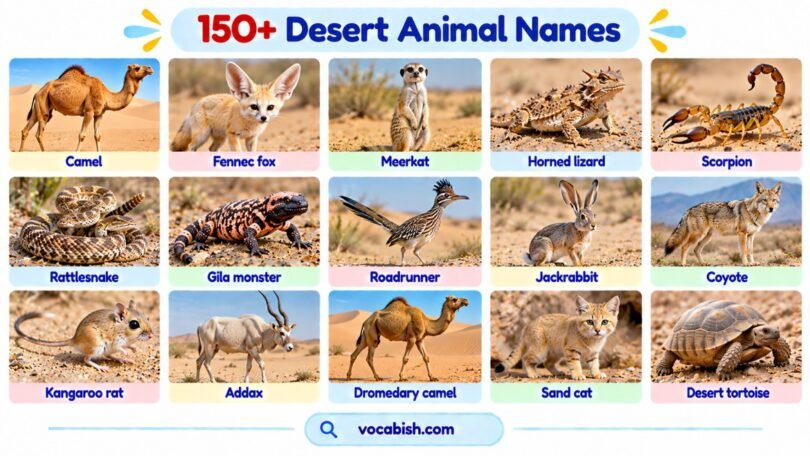

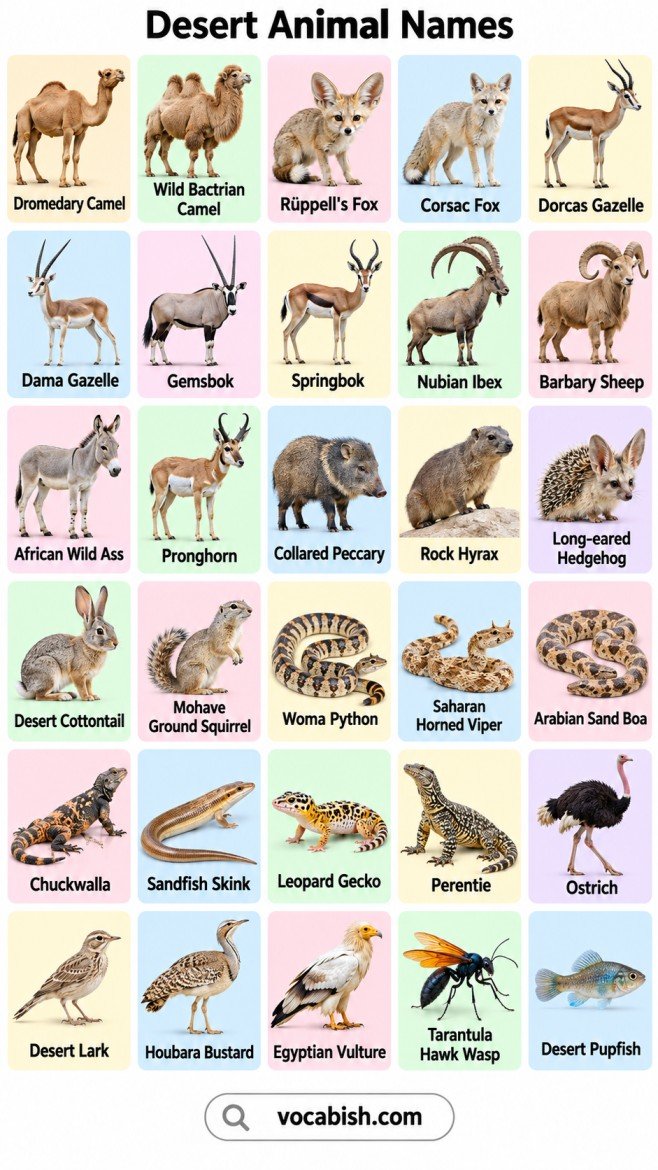
Desert animal names include familiar animals such as the camel, fennec fox, scorpion, desert tortoise, and rattlesnake, as well as many lesser-known species. These animals live in hot deserts, cold deserts, sandy dunes, rocky areas, and dry scrublands around the world. Some avoid daytime heat, while others have special body features that help them conserve water or handle extreme temperatures. The sections below cover common desert animals and a much wider range of mammals, birds, reptiles, amphibians, insects, fish, and other desert wildlife.
Common Desert Animal Names with Pictures
These are some of the best-known animals associated with desert and arid environments. Each one has physical or behavioral adaptations that help it survive difficult conditions.
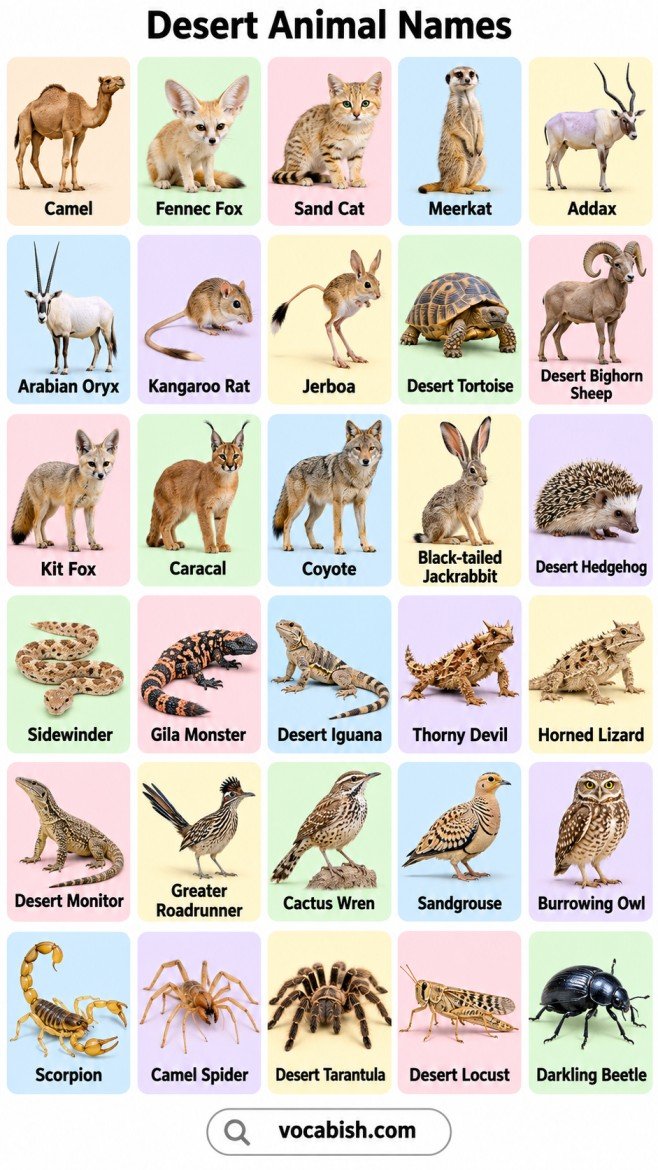
Camel
Camels are large mammals strongly associated with desert travel and life. Dromedary camels have one hump, while Bactrian camels have two. Their humps store fat rather than water, and their bodies can cope with heat and limited water.
Fennec Fox
The fennec fox is a small fox found in the Sahara and nearby dry regions. Its very large ears help release body heat and detect small prey. It usually becomes active at night when desert temperatures are lower.
Sand Cat
The sand cat is a small wild cat adapted to sandy and rocky deserts. Thick fur protects its paws from extremely hot and cold ground. It hunts rodents, reptiles, birds, and other small animals.
Arabian Oryx
The Arabian oryx is a white antelope of the Arabian Peninsula. Its pale coat reflects strong sunlight, while its broad hooves help it move across sand. It can survive for long periods without drinking free-standing water.
Addax
The addax is a desert antelope native to North Africa. It has long twisted horns and broad hooves suited to loose sand. The animal gains much of the moisture it needs from desert plants.
Meerkat
Meerkats live in dry areas of southern Africa, including parts of the Kalahari. They live in social groups and use underground burrows for protection. A standing meerkat often watches for predators while other group members search for food.
Kangaroo Rat
Kangaroo rats are small rodents found in dry parts of North America. Their long hind legs allow them to move by powerful jumps. Some species can meet most of their water needs through seeds and normal body processes.
Jerboa
Jerboas are small desert rodents with long hind legs and long tails. They occur across dry regions of North Africa and Asia. They usually stay inside burrows during the day and search for food at night.
Desert Bighorn Sheep
Desert bighorn sheep live in rocky desert mountains of North America. Their hooves provide good grip on steep cliffs and uneven rock. They can travel across difficult terrain to reach food and water.
Kit Fox
The kit fox is a small fox of deserts and dry grasslands in North America. Its large ears help with hearing and heat loss. It spends much of the hot day inside an underground den.
Desert Tortoise
Desert tortoises live in dry parts of the southwestern United States and northern Mexico. They spend much of their lives in burrows that protect them from temperature extremes. They mainly eat grasses, flowers, and other plants.
Sidewinder
The sidewinder is a rattlesnake found in sandy deserts of North America. It moves sideways across loose sand using a distinctive form of movement called sidewinding. This movement also reduces contact with extremely hot ground.
Gila Monster
The Gila monster is a large venomous lizard of the southwestern United States and northern Mexico. Its body has distinctive black and orange or pink markings. It spends much of its time underground and becomes active when conditions are suitable.
Thorny Devil
The thorny devil is a small Australian desert lizard covered with pointed scales. Tiny channels between its scales can move water toward its mouth. It feeds mainly on ants.
Greater Roadrunner
The greater roadrunner is a fast-running bird of deserts and dry scrublands in North America. It spends much of its time on the ground rather than flying. Its diet includes insects, lizards, snakes, rodents, and other small animals.
Sandgrouse
Sandgrouse are desert and dry-country birds found across Africa and Asia. Many species travel considerable distances to reach water. Adult males of some species can carry water in specialized belly feathers for their chicks.
Scorpion
Many scorpion species live successfully in deserts. They hide under rocks, in cracks, or underground during the hottest hours. Their pincers and venom help them capture insects and other small prey.
Camel Spider
Camel spiders are arachnids belonging to the order Solifugae. Despite their name, they are not true spiders and do not have camel-like features. Many species are fast-moving predators found in hot, dry environments.
Desert Mammal Names
Desert mammals range from tiny burrowing rodents to large antelopes and camels. The names below include animals from hot deserts, cold deserts, rocky drylands, and semi-desert habitats.
- Dromedary Camel
- Wild Bactrian Camel
- Fennec Fox
- Rüppell’s Fox
- Kit Fox
- Corsac Fox
- Tibetan Sand Fox
- Sand Cat
- Caracal
- Arabian Oryx
- Scimitar-horned Oryx
- Gemsbok
- Addax
- Dorcas Gazelle
- Dama Gazelle
- Goitered Gazelle
- Cuvier’s Gazelle
- Mountain Gazelle
- Springbok
- Blackbuck
- Desert Bighorn Sheep
- Nubian Ibex
- Barbary Sheep
- African Wild Ass
- Onager
- Kiang
- Pronghorn
- Collared Peccary
- Coyote
- Bobcat
- Puma
- Meerkat
- Yellow Mongoose
- Cape Ground Squirrel
- White-tailed Antelope Squirrel
- Harris’s Antelope Squirrel
- Round-tailed Ground Squirrel
- Mohave Ground Squirrel
- Kangaroo Rat
- Merriam’s Kangaroo Rat
- Banner-tailed Kangaroo Rat
- Kangaroo Mouse
- Desert Woodrat
- Desert Cottontail
- Black-tailed Jackrabbit
- Long-eared Jerboa
- Lesser Egyptian Jerboa
- Greater Egyptian Jerboa
- Fat-tailed Gerbil
- Mongolian Gerbil
- Desert Hedgehog
- Long-eared Hedgehog
- Rock Hyrax
- Pallid Bat
- Desert Long-eared Bat
- Gobi Bear
Desert Bird Names
Desert birds include ground-running species, birds of prey, seed eaters, vultures, larks, owls, and sandgrouse. Many also occur in dry grasslands and desert scrub.
- Greater Roadrunner
- Cactus Wren
- Curve-billed Thrasher
- LeConte’s Thrasher
- Gambel’s Quail
- Scaled Quail
- Burrowing Owl
- Elf Owl
- Verdin
- Phainopepla
- Gila Woodpecker
- Gilded Flicker
- Black-throated Sparrow
- Sagebrush Sparrow
- Costa’s Hummingbird
- Prairie Falcon
- Golden Eagle
- Harris’s Hawk
- Turkey Vulture
- Lappet-faced Vulture
- Egyptian Vulture
- Ostrich
- Emu
- Greater Sage-Grouse
- Namaqua Sandgrouse
- Chestnut-bellied Sandgrouse
- Pin-tailed Sandgrouse
- Spotted Sandgrouse
- Black-bellied Sandgrouse
- Crowned Sandgrouse
- Desert Lark
- Greater Hoopoe-Lark
- Bar-tailed Lark
- Cream-colored Courser
- Macqueen’s Bustard
- Houbara Bustard
- Arabian Bustard
- Desert Sparrow
- Trumpeter Finch
- Brown-necked Raven
- Saharan Scrub Warbler
- Desert Wheatear
- Mourning Wheatear
- Blackstart
Desert Reptile Names
Reptiles are especially diverse in warm deserts because many species can regulate their activity around changing temperatures. This group includes snakes, lizards, geckos, skinks, monitors, and tortoises.
- Mojave Desert Tortoise
- Sonoran Desert Tortoise
- Egyptian Tortoise
- African Spurred Tortoise
- Gila Monster
- Desert Iguana
- Common Chuckwalla
- Regal Horned Lizard
- Texas Horned Lizard
- Round-tailed Horned Lizard
- Zebra-tailed Lizard
- Long-nosed Leopard Lizard
- Side-blotched Lizard
- Western Banded Gecko
- Namib Web-footed Gecko
- Leopard Gecko
- Thorny Devil
- Central Bearded Dragon
- Perentie
- Sand Goanna
- Desert Monitor
- Saharan Spiny-tailed Lizard
- Egyptian Spiny-tailed Lizard
- Arabian Spiny-tailed Lizard
- Great Desert Skink
- Sandfish Skink
- Sidewinder
- Mojave Rattlesnake
- Western Diamondback Rattlesnake
- Speckled Rattlesnake
- Tiger Rattlesnake
- Saharan Horned Viper
- Arabian Horned Viper
- Horned Adder
- Saw-scaled Viper
- Desert Kingsnake
- Glossy Snake
- Coachwhip
- Western Hognose Snake
- Arabian Sand Boa
- Kenyan Sand Boa
- Woma Python
- Inland Taipan
- Desert Death Adder
- Black Desert Cobra
- Egyptian Cobra
- Saharan Sand Viper
- Schokari Sand Racer
Desert Amphibian Names
Amphibians may seem unusual in deserts, but several species survive by burrowing and becoming active after seasonal rain. Many depend on temporary pools for breeding.
- Sonoran Desert Toad
- Great Plains Toad
- Red-spotted Toad
- Couch’s Spadefoot
- Great Basin Spadefoot
- Plains Spadefoot
- Western Spadefoot
- Mexican Spadefoot
- Water-holding Frog
- Desert Tree Frog
- Desert Rain Frog
- Namaqua Rain Frog
- African Bullfrog
- Spencer’s Burrowing Frog
Desert Fish Names
Some deserts contain permanent springs, isolated pools, streams, and river systems. These waters support several highly specialized fish species.
- Desert Pupfish
- Devils Hole Pupfish
- Amargosa Pupfish
- Owens Pupfish
- White Sands Pupfish
- Leon Springs Pupfish
- Ash Meadows Amargosa Pupfish
- Warm Springs Pupfish
- Pahrump Poolfish
- Moapa Dace
- Desert Sucker
- Gila Topminnow
- Virgin River Chub
Desert Insect Names
Desert insects occupy sand dunes, dry soil, desert plants, rocky areas, and temporary wet places. The following names include beetles, ants, grasshoppers, moths, wasps, bees, and other insects.
- Desert Locust
- Saharan Silver Ant
- Desert Ant
- Honeypot Ant
- Red Harvester Ant
- Seed Harvester Ant
- Namib Desert Beetle
- Fog-basking Beetle
- Darkling Beetle
- Desert Stink Beetle
- Palo Verde Beetle
- Cactus Longhorn Beetle
- Desert Blister Beetle
- Ironclad Beetle
- Dung Beetle
- Desert Grasshopper
- Band-winged Grasshopper
- Mormon Cricket
- Jerusalem Cricket
- Antlion
- Velvet Ant
- Tarantula Hawk Wasp
- Sand Wasp
- Digger Wasp
- Desert Digger Bee
- Cactus Bee
- Yucca Moth
- White-lined Sphinx Moth
- Desert Swallowtail
- Queen Butterfly
- Painted Lady
- Desert Termite
- Desert Cicada
- Cactus Fly
- Robber Fly
- Sand Fly
Desert Arachnids and Other Invertebrates
Scorpions and camel spiders are among the best-known desert arachnids, but dry regions also support spiders, centipedes, millipedes, snails, crustaceans, and other small animals.
- Deathstalker Scorpion
- Arizona Bark Scorpion
- Giant Hairy Scorpion
- Arabian Fat-tailed Scorpion
- Yellow Fat-tailed Scorpion
- Camel Spider
- Desert Tarantula
- Arizona Blonde Tarantula
- Desert Recluse
- Vinegaroon
- Giant Desert Centipede
- Desert Millipede
- Desert Snail
- White Desert Snail
- Desert Isopod
- Tadpole Shrimp
- Fairy Shrimp
- Desert Harvestman
Desert Animal Names by Habitat
Not every desert looks like a field of sand. Desert wildlife can live among dunes, rocky mountains, dry scrub, cold plateaus, salt flats, and isolated water sources.
Sand Dune Animals
- Fennec Fox
- Sand Cat
- Addax
- Jerboa
- Sidewinder
- Sandfish Skink
- Arabian Sand Boa
- Namib Web-footed Gecko
- Saharan Horned Viper
- Darkling Beetle
Rocky Desert Animals
- Desert Bighorn Sheep
- Nubian Ibex
- Barbary Sheep
- Rock Hyrax
- Chuckwalla
- Gila Monster
- Desert Monitor
- Speckled Rattlesnake
- Golden Eagle
- Caracal
Desert Scrub Animals
- Kit Fox
- Coyote
- Collared Peccary
- Desert Cottontail
- Black-tailed Jackrabbit
- Greater Roadrunner
- Cactus Wren
- Gila Woodpecker
- Desert Iguana
- Western Diamondback Rattlesnake
Cold Desert Animals
- Wild Bactrian Camel
- Gobi Bear
- Kiang
- Corsac Fox
- Tibetan Sand Fox
- Goitered Gazelle
- Long-eared Jerboa
- Mongolian Gerbil
- Golden Eagle
- Houbara Bustard
Desert Water Animals
- Desert Pupfish
- Devils Hole Pupfish
- Amargosa Pupfish
- Moapa Dace
- Gila Topminnow
- Desert Sucker
- Sonoran Desert Toad
- Couch’s Spadefoot
- Tadpole Shrimp
- Fairy Shrimp
Nocturnal and Daytime Desert Animals
Temperature strongly affects when desert animals become active. Many avoid midday heat, while others can remain active under strong sunlight.
Nocturnal Desert Animals
- Fennec Fox
- Sand Cat
- Kit Fox
- Kangaroo Rat
- Jerboa
- Desert Hedgehog
- Pallid Bat
- Elf Owl
- Sidewinder
- Gila Monster
- Camel Spider
- Desert Tarantula
- Scorpion
Daytime Desert Animals
- Arabian Oryx
- Addax
- Desert Bighorn Sheep
- Meerkat
- Greater Roadrunner
- Cactus Wren
- Sandgrouse
- Desert Iguana
- Chuckwalla
- Thorny Devil
- Desert Locust
How Desert Animals Survive
Desert animals use different body features and behaviors to deal with heat, cold, limited rainfall, and scarce food.
Adaptation | How It Helps | Examples |
|---|---|---|
Night activity | Avoids intense daytime heat | Fennec Fox, Kangaroo Rat, Jerboa |
Burrowing | Provides cooler shelter and protection | Desert Tortoise, Meerkat, Spadefoot |
Water conservation | Reduces the amount of water the body loses | Camel, Kangaroo Rat, Addax |
Large ears | Help release heat and detect prey | Fennec Fox, Kit Fox |
Broad feet or hooves | Improve movement over loose sand | Camel, Addax |
Pale body color | Reflects some sunlight and provides camouflage | Arabian Oryx, Sand Cat |
Heat-tolerant movement | Limits contact with hot ground | Sidewinder |
Temporary dormancy | Helps survive long dry periods | Spadefoot, Desert Frog |
Water collection | Uses body surfaces to obtain moisture | Thorny Devil |
Fat storage | Provides stored energy when food is limited | Camel |
Fun Facts About Desert Animals
- Camels can close their nostrils during sandstorms. Their long eyelashes also help protect their eyes from blowing sand.
- Kangaroo rats can survive without drinking water. They get most of the moisture they need from seeds and from water produced inside their bodies.
- Fennec foxes use their huge ears to stay cool. Their ears help release body heat and also detect small animals moving under the sand.
- Sidewinder snakes move sideways across hot sand. This unusual movement reduces how much of their body touches the heated ground.
- Thorny devils can collect water through their skin. Tiny channels between their scales guide moisture toward their mouth.
- Sandgrouse can carry water in their feathers. Male sandgrouse soak special belly feathers so their chicks can drink from them.
- Desert tortoises spend most of their lives underground. Their burrows protect them from extreme heat, cold, and dry conditions.
- Many desert animals are nocturnal. Animals such as jerboas, kit foxes, scorpions, and sand cats become active at night to avoid daytime heat.
Desert Animal Vocabulary Practice
Match each desert animal with the correct animal group.
- Fennec Fox — Mammal / Bird / Reptile
- Sidewinder — Mammal / Reptile / Insect
- Cactus Wren — Bird / Amphibian / Mammal
- Desert Locust — Bird / Insect / Reptile
- Sonoran Desert Toad — Amphibian / Mammal / Fish
- Desert Pupfish — Fish / Reptile / Bird
- Camel Spider — Arachnid / Bird / Mammal
- Desert Tortoise — Reptile / Amphibian / Mammal
Answers
- Mammal
- Reptile
- Bird
- Insect
- Amphibian
- Fish
- Arachnid
- Reptile
FAQs
Common desert animals include camels, fennec foxes, sand cats, scorpions, desert tortoises, kangaroo rats, sidewinders, meerkats, roadrunners, and desert lizards.
Sahara wildlife includes fennec foxes, addax, dorcas gazelles, sand cats, jerboas, desert hedgehogs, horned vipers, desert monitors, scorpions, and desert birds.
The Arabian Desert supports Arabian oryx, sand gazelles, sand cats, Rüppell’s foxes, Arabian wolves, jerboas, spiny-tailed lizards, vipers, scorpions, and birds.
Fennec foxes, kangaroo rats, jerboas, kit foxes, sand cats, scorpions, camel spiders, tarantulas, and several snakes become active mainly after sunset.
Yes. Desert toads, spadefoots, rain frogs, and water-holding frogs survive dry periods underground and often emerge after seasonal rainfall.
Yes. Desert springs, pools, and rivers support fish such as desert pupfish, Devils Hole pupfish, Moapa dace, Gila topminnow, and desert sucker.
They conserve water through efficient body systems, obtain moisture from food, avoid daytime heat, use burrows, and reduce unnecessary water loss.
No. Cold deserts also support specialized animals. Wild Bactrian camels, kiangs, corsac foxes, Tibetan sand foxes, and Gobi bears tolerate very cold conditions.
Related Animal Vocabulary
- Forest Animal Names
- Rainforest Animal Names
- Freshwater Animal Names
- Aquatic Animal Names
- Marine Mammal Names
- Vertebrate Animal Names
- Invertebrate Animal Names
Conclusion
Learning desert animal names makes it easier to identify wildlife from deserts and other dry habitats while building useful English vocabulary. From camels and desert foxes to snakes, birds, insects, amphibians, and pupfish, desert ecosystems contain far more animal diversity than they may first appear to have.