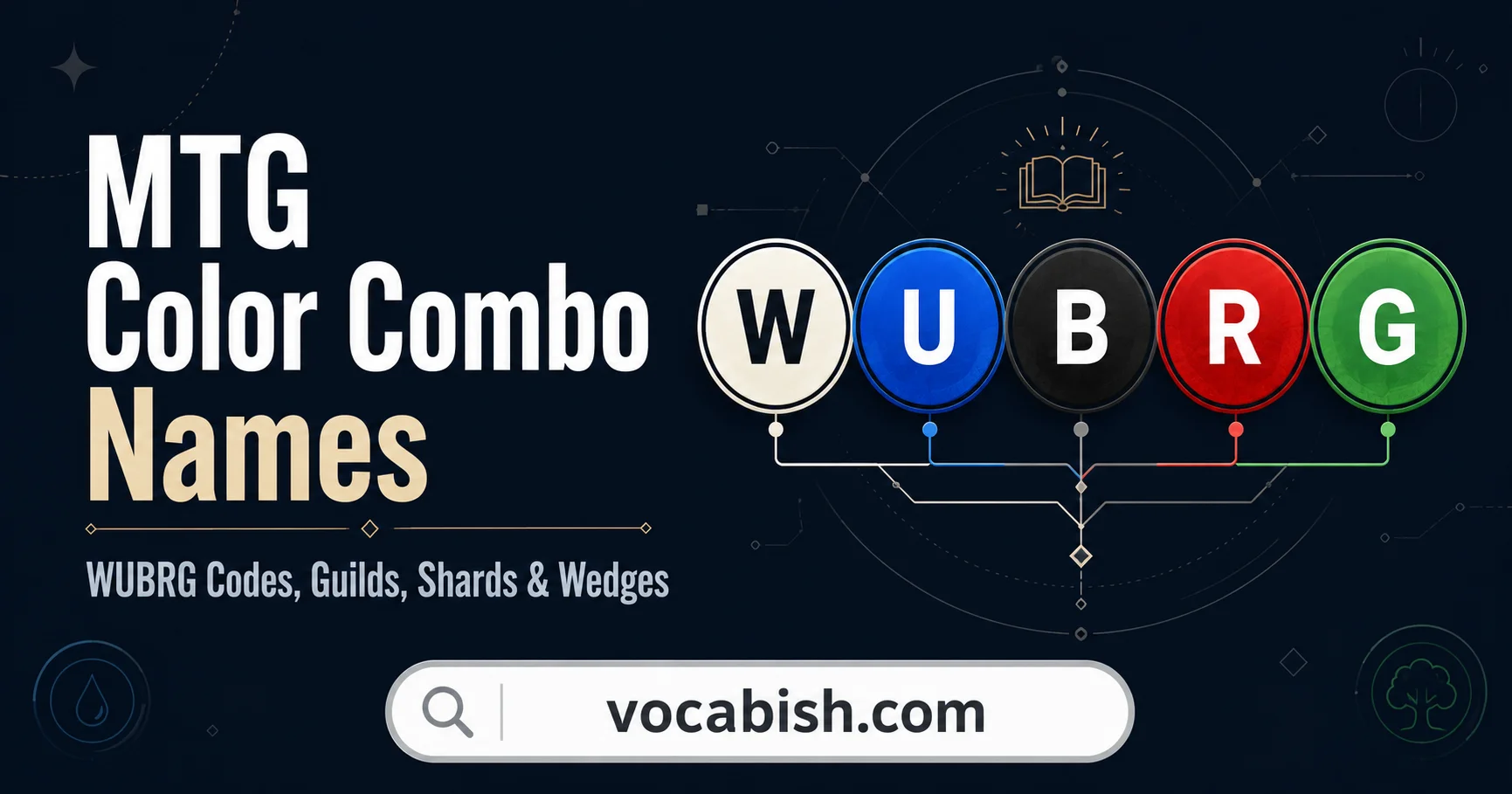

Have you seen an MTG deck described as Jund, Azorius, or WUBRG and wondered what those words mean? MTG Color Combo Names provide a quick way to identify the colors used by a Magic: The Gathering deck, card, or Commander.
Magic has five main colors: white, blue, black, red, and green. Players combine their letter codes to describe every possible color identity. Named combinations include the Ravnica guilds, Alara shards, Tarkir wedges, four-color groups, and five-color decks.
This article explains all 32 possible MTG color identities using easy definitions, visual color markers, pronunciation help, and a complete MTG color combo chart.
What Are MTG Color Combo Names?
MTG color combination names are shorthand labels for groups of Magic colors. Instead of saying “a white, blue, and black deck,” a player can call it an Esper deck.
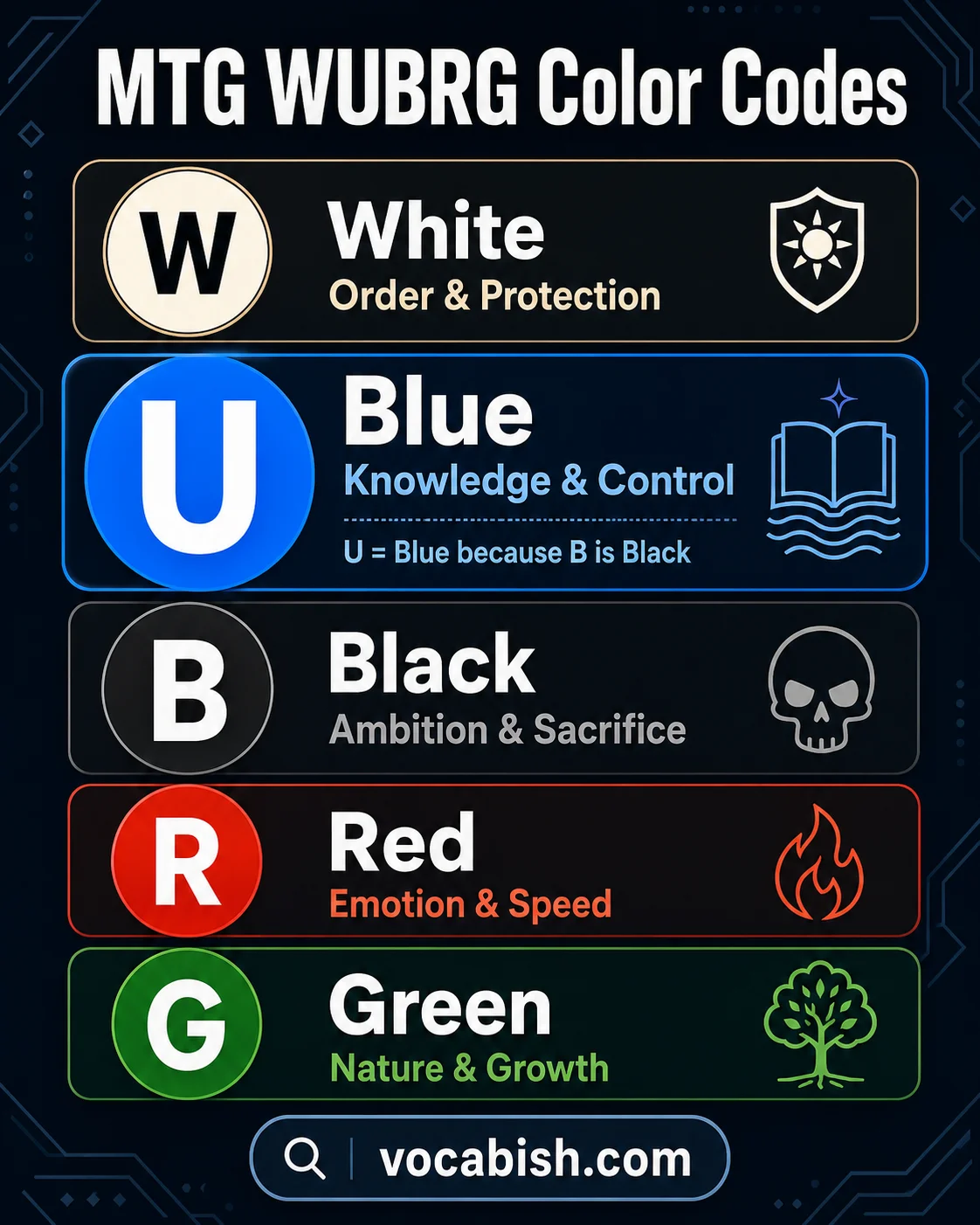
The five colored mana codes appear in WUBRG order:
- W = White
- U = Blue
- B = Black
- R = Red
- G = Green
The letter U represents blue because B is already used for black. Wizards of the Coast commonly calls WUBRG “woo-berg.”
Quick Answer
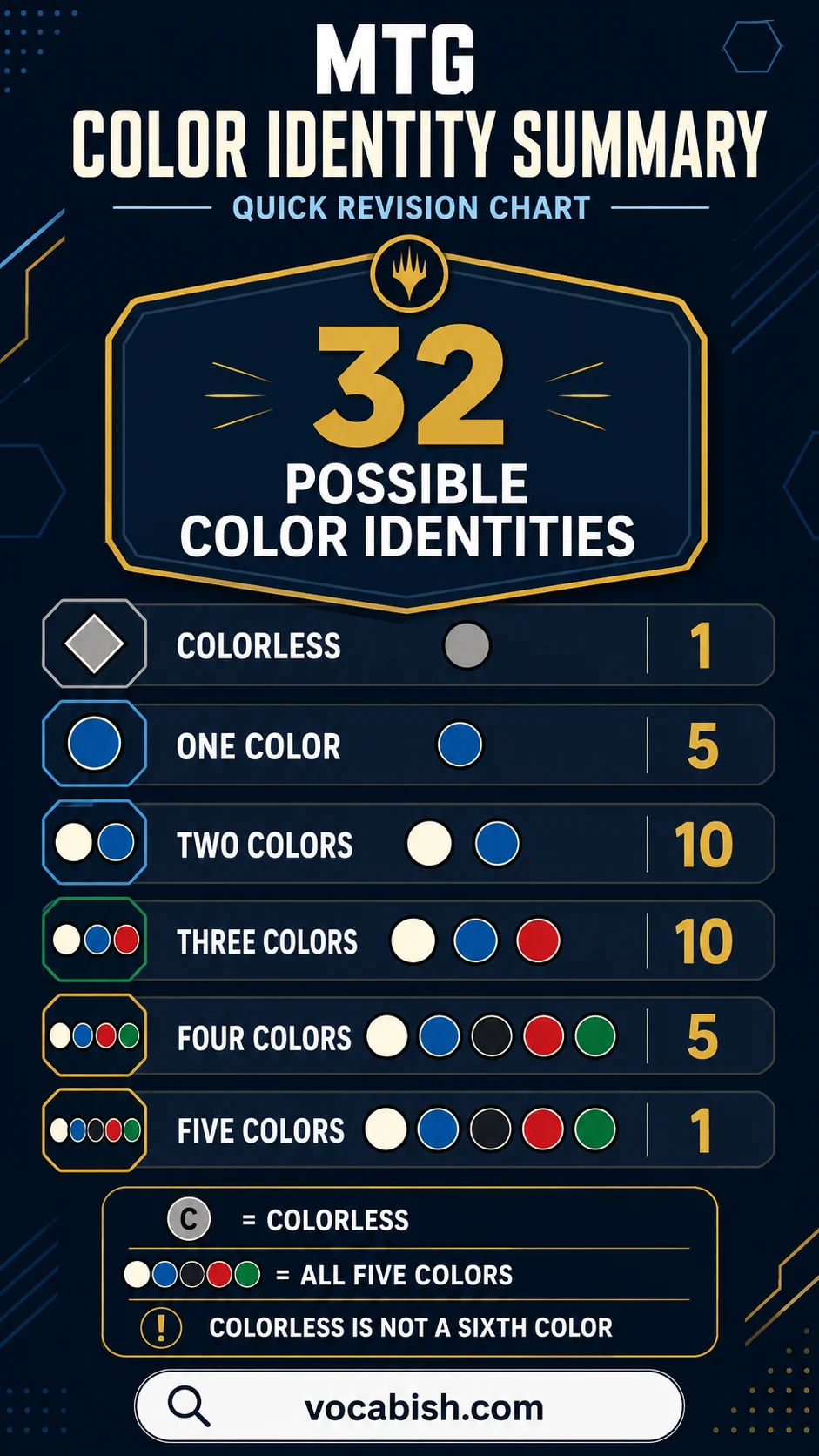
There are 32 possible MTG color identities:
- 1 colorless identity
- 5 one-color identities
- 10 two-color combinations
- 10 three-color combinations
- 5 four-color combinations
- 1 five-color identity
The best-known names come from factions, locations, and cards in Magic sets such as Ravnica, Shards of Alara, Khans of Tarkir, and Commander 2016.
MTG Color Codes and Visual Shades
MTG codes use letters rather than paint or digital color values. However, visual shades can help learners recognize each color more quickly.
The HEX and RGB values below are suggested display colors for charts and educational pictures. They are not official card-printing specifications.
Visual | MTG color | Letter code | HEX | RGB | General association |
|---|---|---|---|---|---|
⚪ | White | W | #F8F6D8 | 248, 246, 216 | Order, protection, community |
🔵 | Blue | U | #0E68AB | 14, 104, 171 | Knowledge, control, planning |
⚫ | Black | B | #2B2B2B | 43, 43, 43 | Ambition, sacrifice, power |
🔴 | Red | R | #D3202A | 211, 32, 42 | Emotion, speed, freedom |
🟢 | Green | G | #00733E | 0, 115, 62 | Nature, growth, strength |
◇ | Colorless | C | #A7A9AC | 167, 169, 172 | Artifacts, neutral mana |
🟡 | Multicolor gold | — | #C9A227 | 201, 162, 39 | Two or more colors |
C represents colorless mana, but colorless is not a sixth Magic color. A colorless mana cost must be paid with colorless mana, while a generic numbered cost can be paid with any type of mana.
Complete MTG Color Combo Chart
The following chart lists every possible color identity, from colorless to all five colors. The codes follow the established WUBRG color order, although some combinations begin at another point in that repeating sequence.
Number of colors | Visual | Code | Common MTG name | Group |
|---|---|---|---|---|
0 | ◇ | C | Colorless | No colored identity |
1 | ⚪ | W | White | Monocolor |
1 | 🔵 | U | Blue | Monocolor |
1 | ⚫ | B | Black | Monocolor |
1 | 🔴 | R | Red | Monocolor |
1 | 🟢 | G | Green | Monocolor |
2 | ⚪🔵 | WU | Azorius | Allied guild |
2 | 🔵⚫ | UB | Dimir | Allied guild |
2 | ⚫🔴 | BR | Rakdos | Allied guild |
2 | 🔴🟢 | RG | Gruul | Allied guild |
2 | 🟢⚪ | GW | Selesnya | Allied guild |
2 | ⚪⚫ | WB | Orzhov | Enemy guild |
2 | 🔵🔴 | UR | Izzet | Enemy guild |
2 | ⚫🟢 | BG | Golgari | Enemy guild |
2 | 🔴⚪ | RW | Boros | Enemy guild |
2 | 🟢🔵 | GU | Simic | Enemy guild |
3 | 🟢⚪🔵 | GWU | Bant | Shard |
3 | ⚪🔵⚫ | WUB | Esper | Shard |
3 | 🔵⚫🔴 | UBR | Grixis | Shard |
3 | ⚫🔴🟢 | BRG | Jund | Shard |
3 | 🔴🟢⚪ | RGW | Naya | Shard |
3 | ⚪⚫🟢 | WBG | Abzan | Wedge |
3 | 🔵🔴⚪ | URW | Jeskai | Wedge |
3 | ⚫🟢🔵 | BGU | Sultai | Wedge |
3 | 🔴⚪⚫ | RWB | Mardu | Wedge |
3 | 🟢🔵🔴 | GUR | Temur | Wedge |
4 | ⚪🔵⚫🔴 | WUBR | Artifice / Yore-Tiller | No green |
4 | 🔵⚫🔴🟢 | UBRG | Chaos / Glint-Eye | No white |
4 | ⚫🔴🟢⚪ | BRGW | Aggression / Dune-Brood | No blue |
4 | 🔴🟢⚪🔵 | RGWU | Altruism / Ink-Treader | No black |
4 | 🟢⚪🔵⚫ | GWUB | Growth / Witch-Maw | No red |
5 | ⚪🔵⚫🔴🟢 | WUBRG | Five-color / Rainbow | All five colors |
One-Color MTG Names
A one-color or monocolored deck uses only one of Magic’s five colors. Monocolored decks are usually described by the color itself rather than by a special faction name.
Each color has its own philosophy, strengths, weaknesses, and common game actions.
Code | Name | Common strengths | Common limitations |
|---|---|---|---|
W | White | Protection, small creatures, life gain, rules | Individual card advantage |
U | Blue | Card draw, counterspells, control, flying | Direct creature removal |
B | Black | Removal, graveyards, sacrifice, ambition | Often pays life or resources |
R | Red | Direct damage, haste, aggression, emotion | Long-term card advantage |
G | Green | Large creatures, mana growth, nature | Limited creature control |
These descriptions are broad patterns, not strict rules. Individual cards and sets may express each color in different ways.
How to Say Monocolor Codes
- Mono-white means W.
- Mono-blue means U.
- Mono-black means B.
- Mono-red means R.
- Mono-green means G.
The word mono means “one.” Therefore, a mono-green deck uses green as its only colored identity.
Two-Color MTG Guild Names
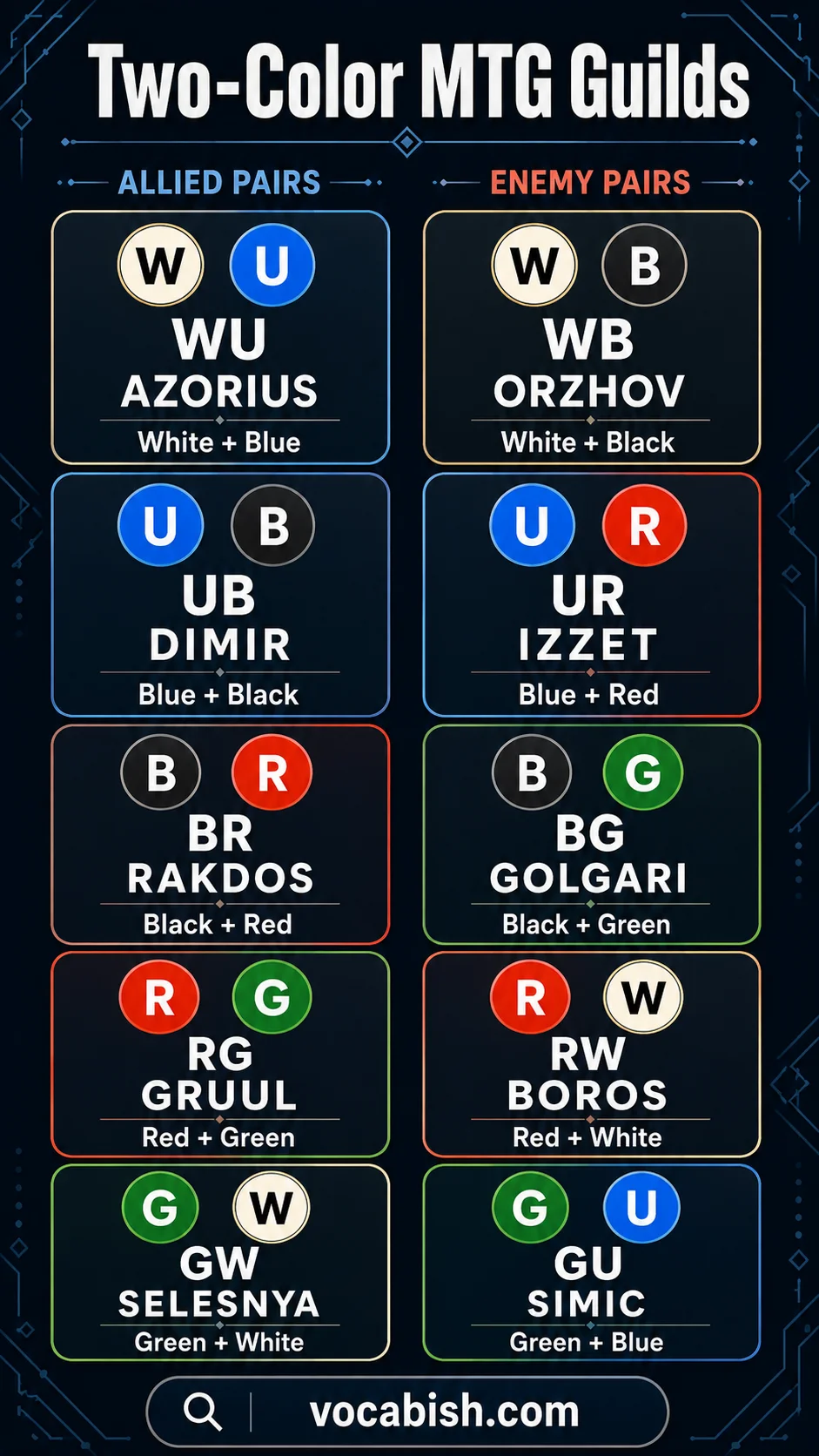
The ten two-color combinations take their best-known names from the ten guilds of Ravnica. Five are allied pairs, while five are enemy pairs.
Allied colors sit next to each other on the traditional Magic color wheel. Enemy colors are separated by another color. Wizards lists the guild pairs as Azorius, Dimir, Rakdos, Gruul, Selesnya, Orzhov, Izzet, Golgari, Boros, and Simic.
Allied-Color Guilds
Visual | Code | Guild name | Pronunciation | Colors |
|---|---|---|---|---|
⚪🔵 | WU | Azorius | uh-ZOR-ee-us | White–Blue |
🔵⚫ | UB | Dimir | dih-MEER | Blue–Black |
⚫🔴 | BR | Rakdos | RAK-dos | Black–Red |
🔴🟢 | RG | Gruul | GROOL | Red–Green |
🟢⚪ | GW | Selesnya | seh-LEZ-nee-uh | Green–White |
Enemy-Color Guilds
Visual | Code | Guild name | Pronunciation | Colors |
|---|---|---|---|---|
⚪⚫ | WB | Orzhov | ORZH-ov | White–Black |
🔵🔴 | UR | Izzet | IZ-it | Blue–Red |
⚫🟢 | BG | Golgari | gol-GAR-ee | Black–Green |
🔴⚪ | RW | Boros | BOR-os | Red–White |
🟢🔵 | GU | Simic | SIM-ik | Green–Blue |
Easy Two-Color Examples
- WU control can be called Azorius control.
- BR sacrifice can be called Rakdos sacrifice.
- RG creatures can be called a Gruul deck.
- UR spells can be called an Izzet deck.
- BG graveyard can be called a Golgari deck.
The guild name identifies the colors. It does not guarantee that the deck uses the guild’s original mechanics or story theme.
Three-Color MTG Names: Shards and Wedges
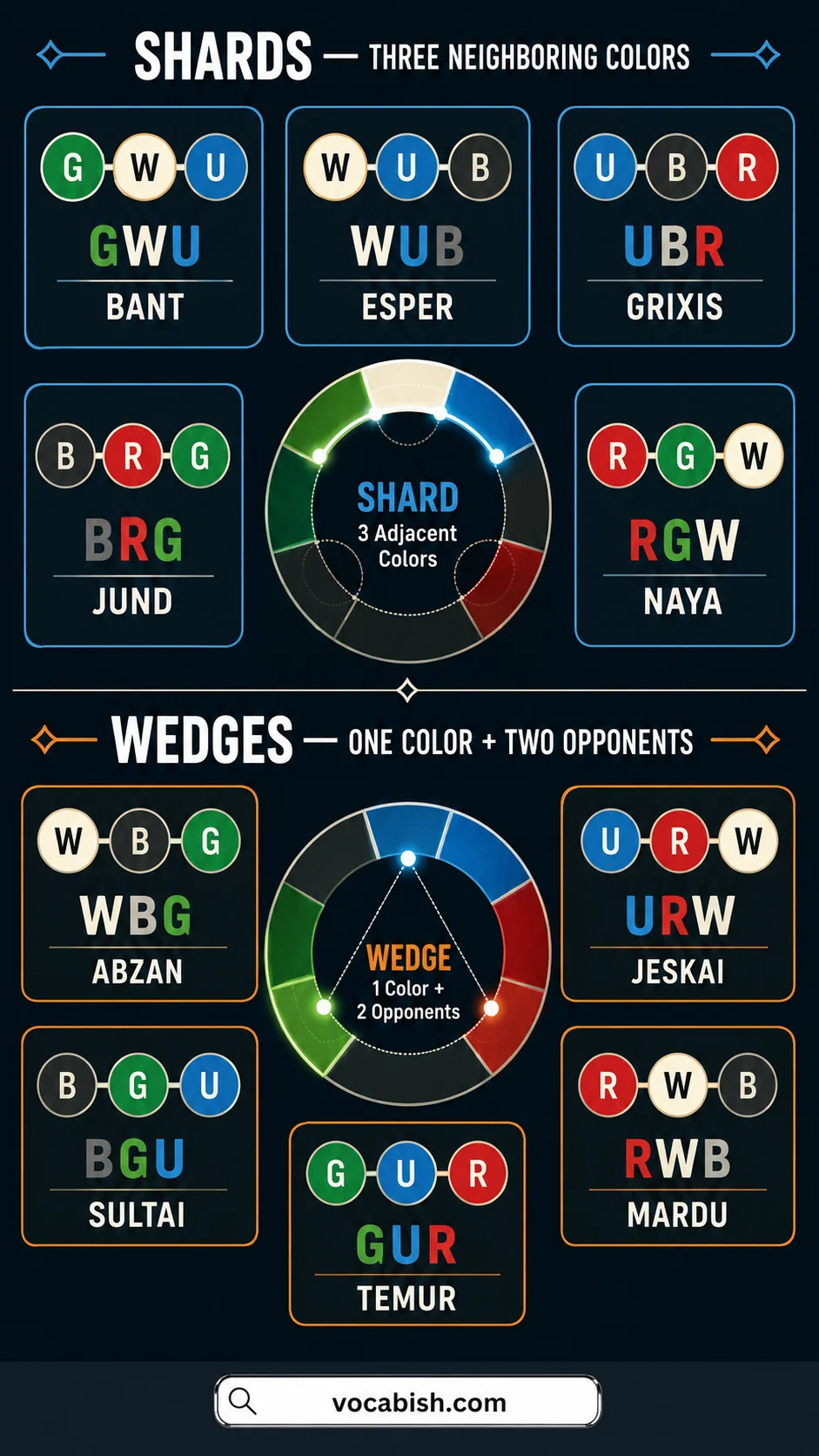
Magic’s ten three-color combinations are divided into five shards and five wedges. Their shapes come from the positions of their colors on the color wheel.
A shard contains three neighboring colors. A wedge contains one color and the two colors traditionally opposed to it.
Three-Color Shards
The shard names come from the five worlds of Shards of Alara: Bant, Esper, Grixis, Jund, and Naya. Each shard contains three consecutive colors on the Magic color wheel.
Visual | Code | Shard | Pronunciation | Colors |
|---|---|---|---|---|
🟢⚪🔵 | GWU | Bant | BANT | Green–White–Blue |
⚪🔵⚫ | WUB | Esper | ES-per | White–Blue–Black |
🔵⚫🔴 | UBR | Grixis | GRIK-sis | Blue–Black–Red |
⚫🔴🟢 | BRG | Jund | JUND | Black–Red–Green |
🔴🟢⚪ | RGW | Naya | NY-uh | Red–Green–White |
Examples
- Bant combines green, white, and blue.
- Esper means white, blue, and black.
- Grixis means blue, black, and red.
- Jund means black, red, and green.
- Naya means red, green, and white.
Three-Color Wedges
The wedge names come from the clans associated with Khans of Tarkir: Abzan, Jeskai, Sultai, Mardu, and Temur. Wizards formally identified their color combinations when introducing the wedges.
Visual | Code | Wedge | Pronunciation | Colors |
|---|---|---|---|---|
⚪⚫🟢 | WBG | Abzan | AB-zan | White–Black–Green |
🔵🔴⚪ | URW | Jeskai | JES-kye | Blue–Red–White |
⚫🟢🔵 | BGU | Sultai | SUL-tie | Black–Green–Blue |
🔴⚪⚫ | RWB | Mardu | MAR-doo | Red–White–Black |
🟢🔵🔴 | GUR | Temur | teh-MOOR | Green–Blue–Red |
Examples
- A white-black-green Commander deck has an Abzan color identity.
- A blue-red-white spells deck is Jeskai.
- A black-green-blue graveyard deck is Sultai.
- A red-white-black deck is Mardu.
- A green-blue-red deck is Temur.
Shard vs Wedge
Feature | Shard | Wedge |
|---|---|---|
Number of colors | Three | Three |
Color-wheel shape | Three neighboring colors | One color with two opposing colors |
Main naming source | Shards of Alara | Khans of Tarkir |
Example | Esper: WUB | Jeskai: URW |
Total combinations | Five | Five |
Four-Color Combination Names
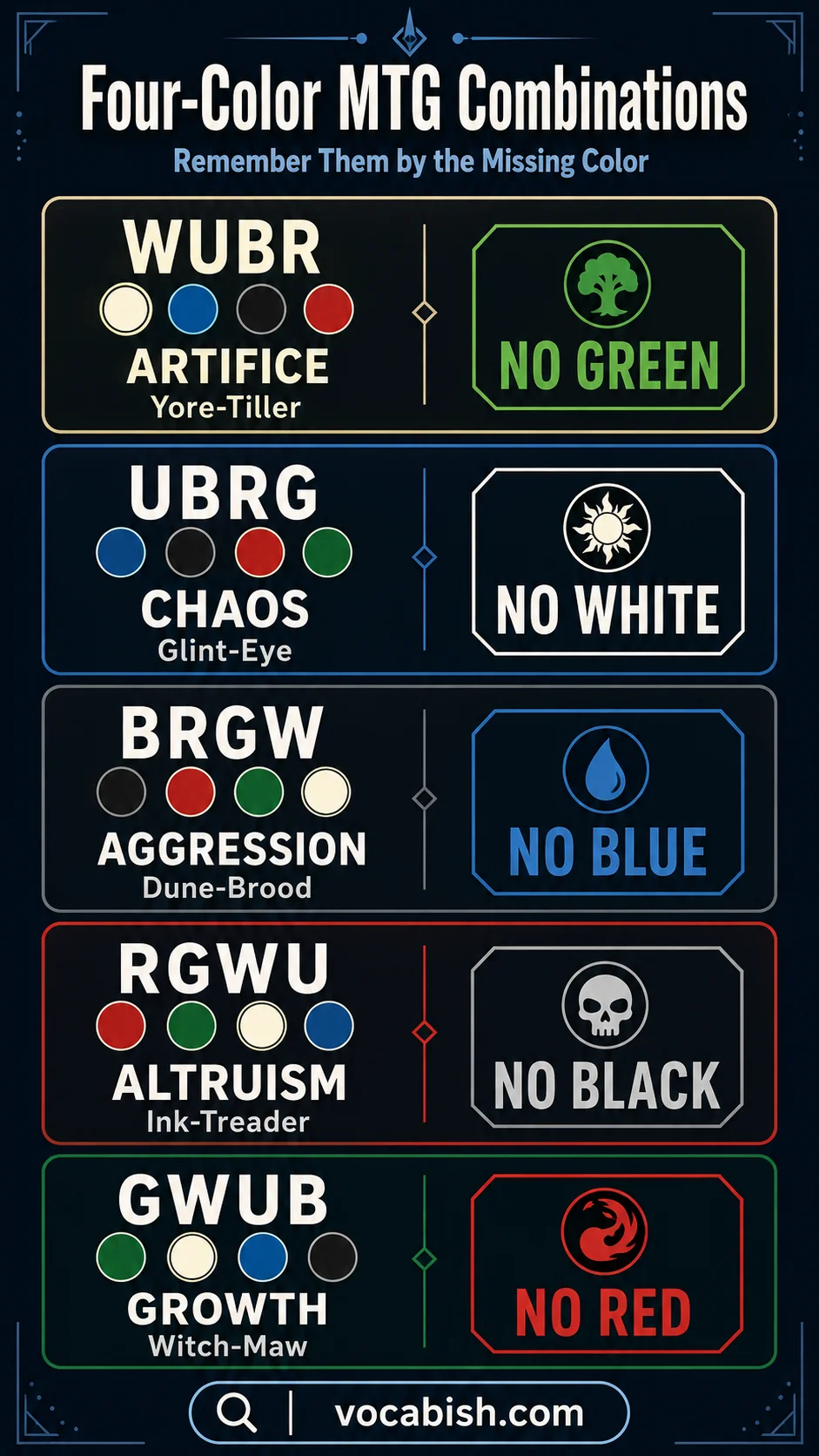
Each four-color combination contains every Magic color except one. For this reason, many players identify a four-color deck by saying which color is missing.
Commander 2016 also gave the combinations the theme names Artifice, Chaos, Aggression, Altruism, and Growth. Older shorthand comes from the five Nephilim cards.
Visual | Code | Commander 2016 name | Nephilim name | Missing color |
|---|---|---|---|---|
⚪🔵⚫🔴 | WUBR | Artifice | Yore-Tiller | Green |
🔵⚫🔴🟢 | UBRG | Chaos | Glint-Eye | White |
⚫🔴🟢⚪ | BRGW | Aggression | Dune-Brood | Blue |
🔴🟢⚪🔵 | RGWU | Altruism | Ink-Treader | Black |
🟢⚪🔵⚫ | GWUB | Growth | Witch-Maw | Red |
WUBR: Artifice or Yore-Tiller
WUBR contains white, blue, black, and red. Green is missing.
You may hear:
- Artifice
- Yore-Tiller
- Non-green
- Sans-green
- Four-color without green
The French word sans means “without.” Therefore, sans-green means every Magic color except green.
UBRG: Chaos or Glint-Eye
UBRG contains blue, black, red, and green. White is missing.
Common labels include:
- Chaos
- Glint-Eye
- Non-white
- Sans-white
BRGW: Aggression or Dune-Brood
BRGW contains black, red, green, and white. Blue is missing.
Common labels include:
- Aggression
- Dune-Brood
- Non-blue
- Sans-blue
RGWU: Altruism or Ink-Treader
RGWU contains red, green, white, and blue. Black is missing.
Common labels include:
- Altruism
- Ink-Treader
- Non-black
- Sans-black
GWUB: Growth or Witch-Maw
GWUB contains green, white, blue, and black. Red is missing.
Common labels include:
- Growth
- Witch-Maw
- Non-red
- Sans-red
Which Four-Color Names Should You Use?
The clearest choice depends on your audience:
- Use WUBR, UBRG, BRGW, RGWU, or GWUB in deck lists.
- Use sans-green or non-green when explaining the missing color.
- Use the Commander 2016 names when discussing those deck themes.
- Use Nephilim names when speaking with experienced players familiar with older terminology.
Unlike Ravnica guild names, four-color names are not always used consistently. Including both the letter code and missing color prevents confusion.
Five-Color and Colorless Decks
Five-color and colorless identities sit at opposite ends of the chart. One contains every colored mana type, while the other contains none.
Both can still use colorless cards, artifacts, and lands when the format’s deck-building rules permit them.
Five-Color: WUBRG
A five-color deck uses:
- White
- Blue
- Black
- Red
- Green
Its code is WUBRG.
Common names include:
- Five-color
- WUBRG
- Rainbow
- All colors
- Pentacolor
Five-color and WUBRG are the clearest terms. Rainbow is informal but easy to understand.
Colorless: C
A colorless deck has no colored identity. It may use artifacts, colorless creatures, colorless lands, and other cards that fit its format rules.
Its mana code is C, although deck lists may describe the identity simply as colorless.
Colorless should not be confused with generic mana:
- {C} requires one colorless mana.
- {1} can be paid with white, blue, black, red, green, or colorless mana.
How to Read MTG Color Codes
MTG codes are formed by joining the letters for each included color. The letters usually follow the repeating WUBRG sequence rather than alphabetical order.
This keeps deck labels consistent and makes long combinations easier to recognize.
Code-Building Examples
Colors | Letters joined | Code | Name |
|---|---|---|---|
White + Blue | W + U | WU | Azorius |
Black + Red | B + R | BR | Rakdos |
Black + Red + Green | B + R + G | BRG | Jund |
Blue + Red + White | U + R + W | URW | Jeskai |
White + Blue + Black + Red | W + U + B + R | WUBR | Artifice / Yore-Tiller |
All five colors | W + U + B + R + G | WUBRG | Five-color |
Why Is Bant Written GWU?
Bant contains white, blue, and green, but its standard code is normally written GWU.
Imagine WUBRG as a circle:
W → U → B → R → G → W
Starting at green and moving around the circle gives:
G → W → U
That produces GWU without breaking the standard color sequence.
The same idea explains:
- Naya = RGW
- Abzan = WBG
- Jeskai = URW
- Sultai = BGU
- Mardu = RWB
- Temur = GUR
MTG Color Combination vs Color Identity
A deck’s colors and its Commander color identity are closely related, but they are not always the same concept.
In Commander, color identity considers the card as a whole, including colored mana symbols in its casting cost and rules text. Every card in the deck must fit within the commander’s color identity.
Term | Meaning | Example |
|---|---|---|
Mana cost | Mana required to cast a spell | A cost containing W and U |
Card color | Color determined by the card’s characteristics | A white-blue multicolored card |
Deck colors | Colors actively used in a deck | A deck using white and blue cards |
Color identity | Colors counted for Commander deck building | WU identity may include W, U, WU, and colorless cards |
Color combination name | Shorthand name for those colors | WU is called Azorius |
A Helpful Commander Example
Suppose a commander has a red mana cost but a black mana symbol in its rules text.
- Its card color may be red.
- Its Commander color identity includes red and black.
- The deck’s color combination is BR.
- That combination is called Rakdos.
Color words written normally in a card’s text do not automatically add a color to its identity. Colored mana symbols are what matter in that situation.
Common MTG Color Name Mistakes
These errors are easy to make when learning the MTG color system:
- Writing B for blue. Blue uses U; black uses B.
- Calling colorless a sixth color. It has a mana symbol, but it is not one of WUBRG’s five colors.
- Mixing up shards and wedges. Bant is a shard, while Abzan is a wedge.
- Assuming a guild name guarantees a deck strategy. “Izzet” identifies blue-red, not one exact play style.
- Using a four-color nickname without its code. Adding WUBR or “sans-green” makes the meaning clearer.
FAQs About MTG Color Combo
WUBRG represents white, blue, black, red, and green in Magic’s standard color order. Players commonly pronounce the complete code “woo-berg.”
MTG uses U for blue because B already represents black. The different letters prevent confusion in deck lists, card files, and discussions.
There are 32 possible color identities: one colorless, five monocolored, ten two-color, ten three-color, five four-color, and one five-color identity.
They are Azorius, Dimir, Rakdos, Gruul, Selesnya, Orzhov, Izzet, Golgari, Boros, and Simic, representing all ten possible color pairs.
Shards contain three neighboring colors on the color wheel. Wedges contain one color alongside the two colors traditionally opposed to that color.
Commander 2016 assigned five theme names, but players also use Nephilim names, letter codes, and labels based on the missing color.
No. Colorless has the code C for colorless mana, but it is not a sixth member of the five-color WUBRG system.
Not necessarily. A name such as Azorius identifies white-blue colors, but decks with that identity can use many different strategies and card types.
Conclusion
Learning MTG Color Combo Names makes deck lists, Commander discussions, and Magic content much easier to understand. Begin with the five WUBRG codes, then connect two-color pairs to guilds, three-color groups to shards and wedges, and four-color identities to their missing colors.
The full system contains 32 identities, but its structure is logical: colorless, five monocolors, ten pairs, ten three-color groups, five four-color groups, and WUBRG. Keep the complete MTG color combo chart nearby, and names such as Esper, Jund, Jeskai, and Sultai will soon feel familiar.
Explore More Colors’ Names and Shades
- 100+ Orange Colors and Their Shades
- Yellow Color Names and Shades
- Black Colors and Their Shades with Chart
- 150 Funny Color Names and Pictures
- 100+ A to Z Colors and Charts