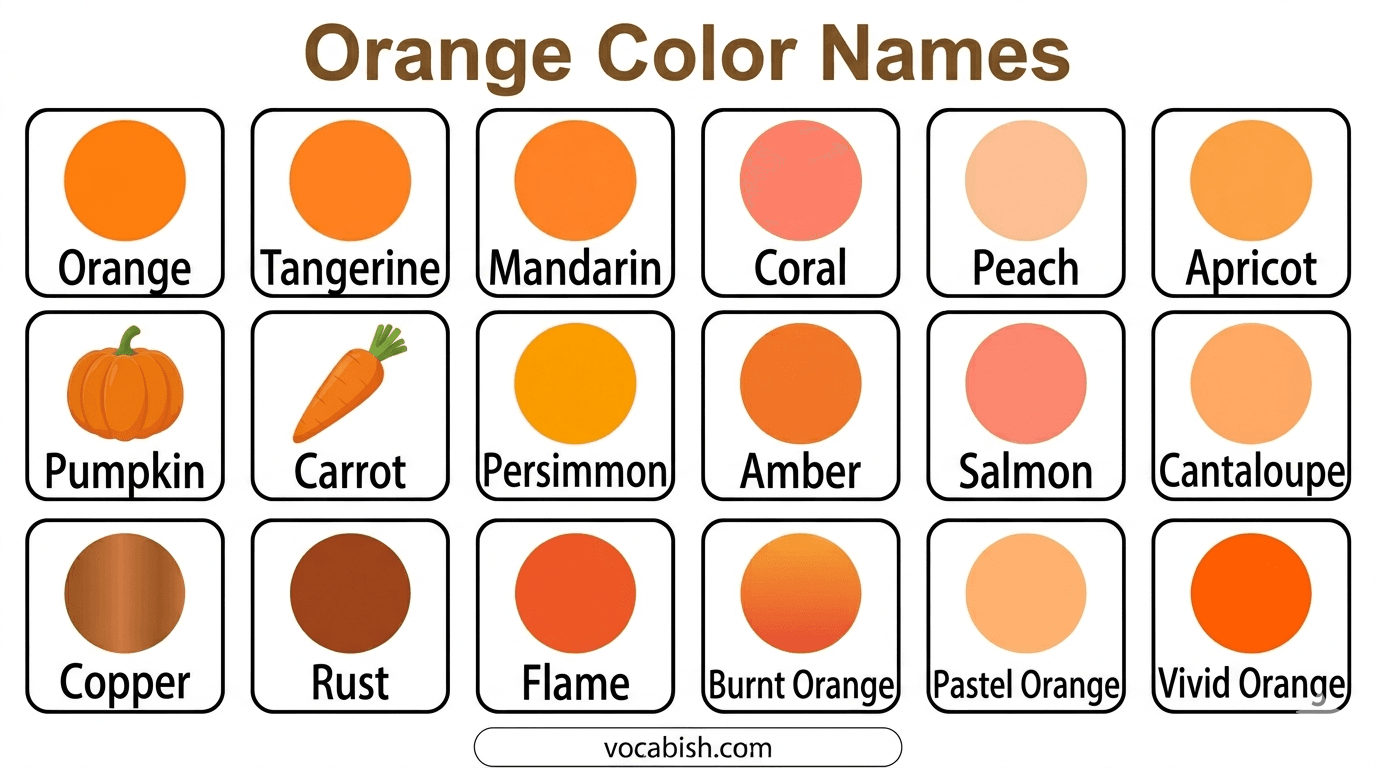

In this blog post, you will learn orange color names and understand how people use them in everyday English. Color vocabulary helps learners describe objects, fruits, clothes, and natural scenes more accurately. Instead of saying only “orange,” you can use words like peach, coral, pumpkin, or tangerine. These words often appear in books, conversations, design, and daily descriptions. When learners recognize these shades, they improve their color vocabulary and express ideas with better detail. Knowing these words also supports reading descriptions, listening to conversations, and writing more descriptive sentences. As you continue reading, you will explore different orange shades, see their real-life uses, and understand the color codes used in design and technology.
What Are Orange Color Names?
Orange color names are vocabulary words used to describe different shades of the color orange. Some shades look bright and strong, while others appear soft and light.
For example:
- Tangerine looks bright and vivid.
- Peach appears soft and light.
- Burnt orange looks darker and deeper.
These names help speakers describe colors more precisely in art, fashion, design, and everyday conversation.
Why Learning Orange Color Vocabulary Is Important
Color vocabulary helps learners speak and write English more clearly. When you know different color names, you can describe objects, clothing, nature, and pictures with greater detail.
For example:
- A basic description: orange flower
- A richer description: bright tangerine flower
Therefore, learning orange color names helps learners:
- Improve descriptive vocabulary
- Understand books and conversations
- Speak more naturally in English
- Write more detailed sentences
Common Orange Color Names
Below are common orange color names used in everyday English.
- Tangerine – A bright orange color like the tangerine fruit.
- Peach – A soft light orange color similar to peach fruit.
- Coral – A pinkish-orange shade often seen in coral reefs.
- Amber – A golden-orange color like fossilized tree resin.
- Pumpkin – A strong orange color like pumpkin skin.
- Carrot – A bright orange shade like fresh carrots.
- Apricot – A light orange color with a soft yellow tone.
- Salmon – A pink-orange shade similar to salmon fish.
- Persimmon – A deep orange color like the persimmon fruit.
- Mandarin – A vivid orange shade like mandarin oranges.
- Cantaloupe – A soft orange shade inspired by the melon fruit.
- Copper – A metallic reddish-orange color like copper metal.
- Rust – A darker orange-brown color like oxidized metal.
- Flame – A bright orange color like fire.
- Sunset Orange – A warm orange shade seen during sunset.
130 Orange Family Shades Name
Core Orange Shades
- Orange
- Pure Orange
- Classic Orange
- True Orange
- Web Orange
- Dark Orange
- Light Orange
- Bright Orange
- Deep Orange
- Pale Orange
- Soft Orange
- Pastel Orange
- Muted Orange
- Dusty Orange
- Warm Orange
Vivid and Safety Orange Shades
- Vivid Orange
- Neon Orange
- Electric Orange
- Fluorescent Orange
- Luminous Orange
- Safety Orange
- Blaze Orange
- Hunter Orange
- Construction Orange
- Traffic Orange
- Signal Orange
- International Orange
- Aerospace Orange
- Golden Gate Orange
- Fire Orange
- Flame Orange
- Lava Orange
- Ember Orange
Red-Orange and Coral Shades
- Orange-Red
- Red-Orange
- Vermilion
- Scarlet Orange
- Tomato
- Coral
- Dark Coral
- Light Coral
- Salmon Orange
- Bittersweet
- Bittersweet Shimmer
- Coquelicot
- Sinopia
- Persian Orange
- Spanish Orange
- Chinese Orange
Yellow-Orange and Golden Shades
- Yellow-Orange
- Golden Orange
- Amber
- Dark Amber
- Honey Orange
- Marigold
- Saffron
- Turmeric
- Orange Peel
- Orange Yellow
- Sunset Orange
- Sunrise Orange
- Solar Orange
- Goldenrod Orange
Earthy Orange Shades
- Burnt Orange
- Rust Orange
- Rust
- Copper Orange
- Copper
- Bronze Orange
- Terracotta
- Burnt Sienna
- Raw Sienna
- Orange Ochre
- Ochre Orange
- Clay Orange
- Adobe Orange
- Brick Orange
- Cinnamon Orange
- Ginger Orange
- Spice Orange
- Paprika Orange
- Cayenne Orange
- Chili Orange
- Autumn Orange
- Harvest Orange
- Maple Orange
Fruit and Food Orange Shades
- Tangerine
- Dark Tangerine
- Light Tangerine
- Atomic Tangerine
- Vivid Tangerine
- Mandarin Orange
- Clementine
- Satsuma
- Valencia Orange
- Navel Orange
- Blood Orange
- Marmalade
- Pumpkin
- Carrot Orange
- Neon Carrot
- Apricot
- Dark Apricot
- Peach Orange
- Peach
- Papaya
- Papaya Whip
- Mango Orange
- Mango Tango
- Cantaloupe
- Melon Orange
- Persimmon
- Kumquat Orange
- Citrus Orange
- Butterscotch Orange
- Jaffa
Named and Institutional Orange Shades
- Princeton Orange
- Syracuse Orange
- Clemson Orange
- Tennessee Orange
- Texas Orange
- Oregon State Orange
- Dutch Orange
- Portland Orange
- Crayola Orange
- Orange Soda
- Macaroni and Cheese
- Rajah
- Alloy Orange
- Fulvous
- Gamboge
Uses of Orange Colors in Daily Life
Orange is a strong and noticeable color. People use it in many areas.
Safety and Visibility
Orange is easy to see from far away.
Examples include:
- Traffic cones
- Safety vests
- Road construction signs
Because of its brightness, orange helps warn people about possible danger.
Nature
Many natural objects show beautiful orange shades.
Examples:
- Oranges and tangerines
- Pumpkins
- Autumn leaves
- Sunsets
- Marigold flowers
These objects help learners remember orange color vocabulary.
Design and Branding
Many companies use orange in logos and marketing because it feels energetic and friendly.
Orange often represents:
- Creativity
- Warmth
- Enthusiasm
- Energy
Fashion
Orange clothing can look bold and stylish.
Examples include:
- Burnt orange jackets
- Peach dresses
- Coral accessories
Different shades help create different fashion styles.
Orange Color Codes (HEX, RGB, and CMYK)
Designers use color codes to produce exact colors on screens and in printing.
Color Name | HEX Code | RGB Code | CMYK |
|---|---|---|---|
Orange | #FFA500 | (255, 165, 0) | 0, 35, 100, 0 |
Tangerine | #F28500 | (242, 133, 0) | 0, 45, 100, 5 |
Coral | #FF7F50 | (255, 127, 80) | 0, 50, 69, 0 |
Peach | #FFE5B4 | (255, 229, 180) | 0, 10, 29, 0 |
Amber | #FFBF00 | (255, 191, 0) | 0, 25, 100, 0 |
Burnt Orange | #CC5500 | (204, 85, 0) | 0, 58, 100, 20 |
Pumpkin | #FF7518 | (255, 117, 24) | 0, 54, 91, 0 |
Copper | #B87333 | (184, 115, 51) | 0, 38, 72, 28 |
Designers usually use HEX codes for websites, RGB codes for digital screens, and CMYK codes for printing.
30 Most Popular Orange Color Shades
Hover or tap a color to view its details.
Orange
#FFA500
Orange
HEX: #FFA500
RGB: 255, 165, 0
HSL: 39°, 100%, 50% |
Dark Orange
#FF8C00
Dark Orange
HEX: #FF8C00
RGB: 255, 140, 0
HSL: 33°, 100%, 50% |
Light Orange
#FFD580
Light Orange
HEX: #FFD580
RGB: 255, 213, 128
HSL: 40°, 100%, 75% |
Bright Orange
#FFAC1C
Bright Orange
HEX: #FFAC1C
RGB: 255, 172, 28
HSL: 38°, 100%, 55% |
Burnt Orange
#CC5500
Burnt Orange
HEX: #CC5500
RGB: 204, 85, 0
HSL: 25°, 100%, 40% |
Safety Orange
#FF6700
Safety Orange
HEX: #FF6700
RGB: 255, 103, 0
HSL: 24°, 100%, 50% |
International Orange
#FF4F00
International Orange
HEX: #FF4F00
RGB: 255, 79, 0
HSL: 19°, 100%, 50% |
Orange Red
#FF4500
Orange Red
HEX: #FF4500
RGB: 255, 69, 0
HSL: 16°, 100%, 50% |
Coral
#FF7F50
Coral
HEX: #FF7F50
RGB: 255, 127, 80
HSL: 16°, 100%, 66% |
Tomato
#FF6347
Tomato
HEX: #FF6347
RGB: 255, 99, 71
HSL: 9°, 100%, 64% |
Tangerine
#F28500
Tangerine
HEX: #F28500
RGB: 242, 133, 0
HSL: 33°, 100%, 47% |
Mandarin
#F37A48
Mandarin
HEX: #F37A48
RGB: 243, 122, 72
HSL: 18°, 88%, 62% |
Clementine
#F9690E
Clementine
HEX: #F9690E
RGB: 249, 105, 14
HSL: 23°, 95%, 52% |
Pumpkin
#FF7518
Pumpkin
HEX: #FF7518
RGB: 255, 117, 24
HSL: 24°, 100%, 55% |
Carrot Orange
#ED9121
Carrot Orange
HEX: #ED9121
RGB: 237, 145, 33
HSL: 33°, 85%, 53% |
Apricot
#FBCEB1
Apricot
HEX: #FBCEB1
RGB: 251, 206, 177
HSL: 24°, 90%, 84% |
Peach
#FFE5B4
Peach
HEX: #FFE5B4
RGB: 255, 229, 180
HSL: 39°, 100%, 85% |
Pastel Orange
#FAC898
Pastel Orange
HEX: #FAC898
RGB: 250, 200, 152
HSL: 29°, 91%, 79% |
Papaya
#FF9D5C
Papaya
HEX: #FF9D5C
RGB: 255, 157, 92
HSL: 24°, 100%, 68% |
Persimmon
#EC5800
Persimmon
HEX: #EC5800
RGB: 236, 88, 0
HSL: 22°, 100%, 46% |
Amber
#FFBF00
Amber
HEX: #FFBF00
RGB: 255, 191, 0
HSL: 45°, 100%, 50% |
Golden Orange
#FFB000
Golden Orange
HEX: #FFB000
RGB: 255, 176, 0
HSL: 41°, 100%, 50% |
Vermilion
#E34234
Vermilion
HEX: #E34234
RGB: 227, 66, 52
HSL: 5°, 76%, 55% |
Terracotta
#E2725B
Terracotta
HEX: #E2725B
RGB: 226, 114, 91
HSL: 10°, 70%, 62% |
Rust
#B7410E
Rust
HEX: #B7410E
RGB: 183, 65, 14
HSL: 18°, 86%, 39% |
Copper
#B87333
Copper
HEX: #B87333
RGB: 184, 115, 51
HSL: 29°, 57%, 46% |
Ochre Orange
#CC7722
Ochre Orange
HEX: #CC7722
RGB: 204, 119, 34
HSL: 30°, 71%, 47% |
Sienna
#A0522D
Sienna
HEX: #A0522D
RGB: 160, 82, 45
HSL: 19°, 56%, 40% |
Salmon Orange
#FF8066
Salmon Orange
HEX: #FF8066
RGB: 255, 128, 102
HSL: 10°, 100%, 70% |
Neon Orange
#FF5F1F
Neon Orange
HEX: #FF5F1F
RGB: 255, 95, 31
HSL: 17°, 100%, 56% |
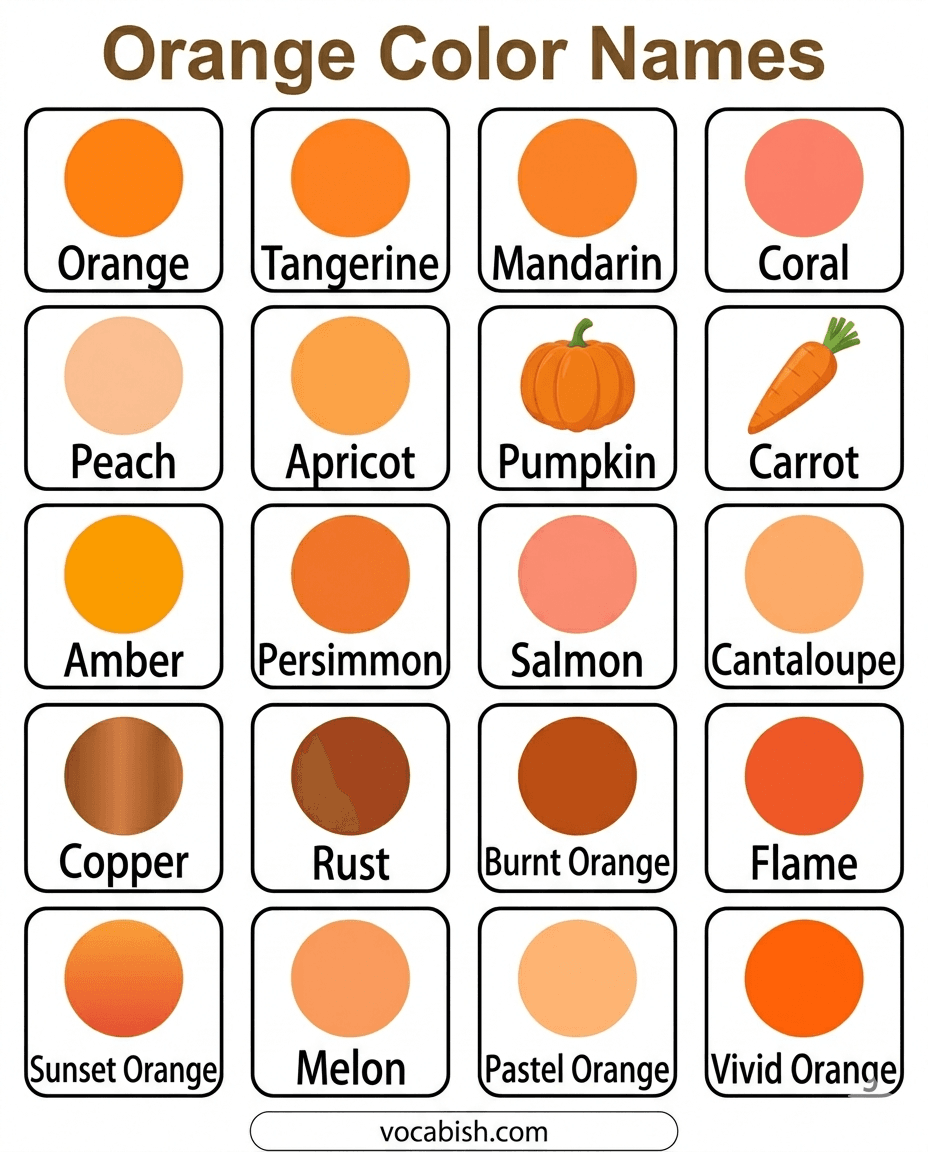
Orange Color Names Chart
Related Articles:
FAQs About Orange Colors
Orange color names are vocabulary words used to describe different shades of orange. Examples include tangerine, coral, peach, amber, and burnt orange. These words help describe colors more precisely in English.
Common orange color names include orange, tangerine, coral, peach, pumpkin, apricot, amber, and burnt orange. These shades appear often in nature, design, fashion, and everyday descriptions.
There are many shades of orange color, ranging from light tones like peach and apricot to deeper tones such as rust, copper, and burnt orange.
The standard digital orange color code is HEX #FFA500. In RGB format it is (255, 165, 0). Designers use these codes to display accurate orange colors on websites.
Peach is a light, soft orange shade with a gentle tone. Burnt orange is darker and deeper with a brownish tone often used in fashion, interior design, and autumn themes.
Orange color names for girls often include soft and warm shades such as peach, coral, apricot, melon, and sunset orange. These names appear in fashion, baby themes, and creative descriptions.
Bright orange color names describe strong and vivid shades of orange. Common examples include tangerine, flame orange, carrot orange, vivid orange, and mandarin.
Red-orange color names describe shades that blend red and orange tones. Examples include vermilion, scarlet orange, flame, coral red, and tomato orange.
Conclusion
Orange is a warm and lively color with many different shades. Learning orange color names helps English learners describe objects, clothing, nature, and artwork more clearly.
From peach and apricot to burnt orange and copper, each shade represents a unique variation of orange. When learners practice these words, they build stronger vocabulary and communicate with greater accuracy in English.