
Ever needed to say your age, a price, a phone number, or a date in Spanish and suddenly paused? Numbers in Spanish are used in almost every daily conversation, so learning them early makes Spanish feel much easier.
The helpful part is that Spanish numbers follow patterns. Once you know numbers from 0 to 20, the tens, hundreds, and larger numbers become much easier to understand. Below, you will learn Spanish numbers from 0 to 1 billion with English translation, pronunciation, examples, cardinal numbers, ordinal numbers, even numbers, and odd numbers.
What Are Numbers in Spanish?
Numbers in Spanish help you talk about quantity, order, time, age, dates, money, addresses, and measurements. You hear them in shops, schools, restaurants, airports, and normal conversations.
There are two main number types you should know: cardinal numbers and ordinal numbers. Cardinal numbers tell “how many,” while ordinal numbers show position or order.
Type | Meaning | Spanish Example | English Translation |
|---|---|---|---|
Cardinal number | Shows quantity | dos | two |
Ordinal number | Shows order | segundo | second |
Examples:
- Tengo dos libros.
I have two books. - Vivo en el segundo piso.
I live on the second floor.
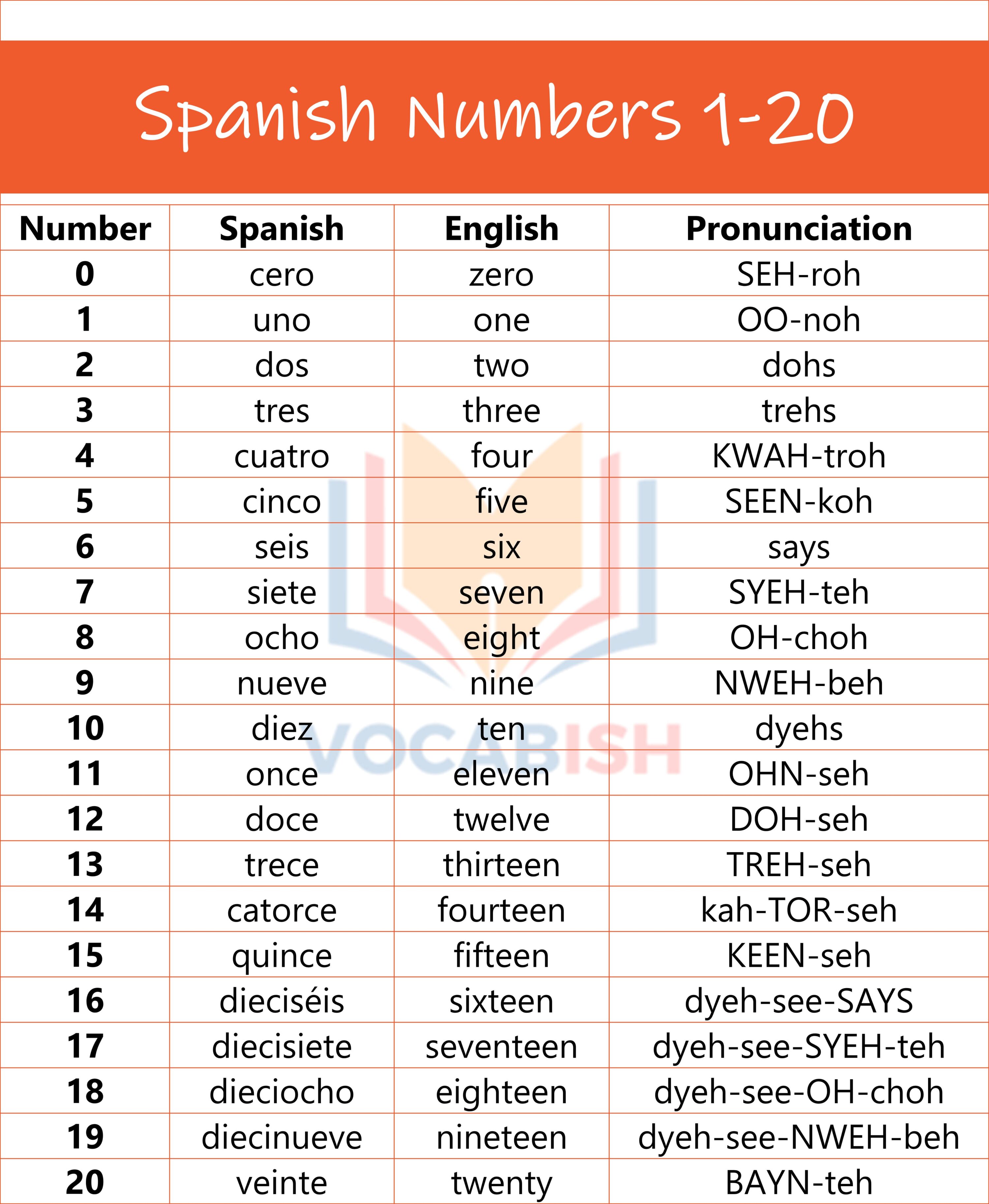
Spanish Numbers 0–20 with Pronunciation
0 to 20 Spanish numbers are the base for many larger numbers. Learn these first because numbers like 16, 17, 18, and 19 are built from the idea of “ten plus another number.”
Some Spanish numbers in this group have unique forms, so read them slowly and practice the pronunciation aloud.
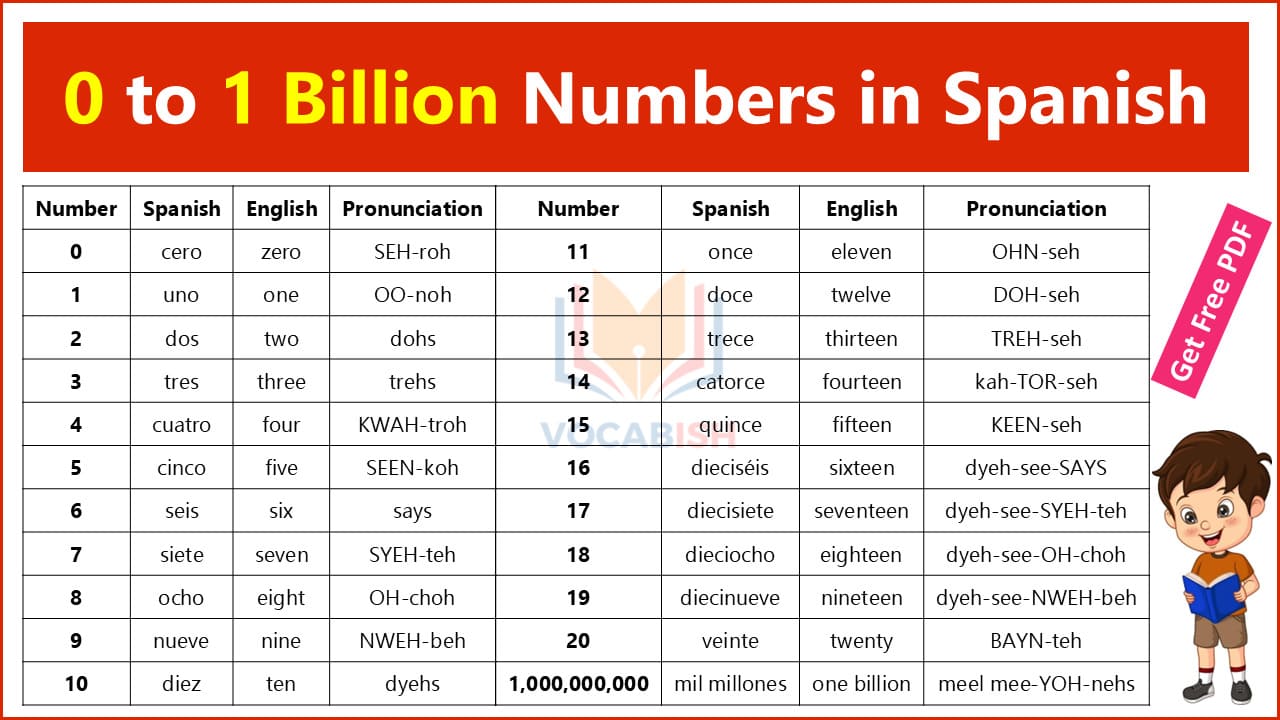
Number | Spanish | English Translation | Pronunciation |
|---|---|---|---|
0 | cero | zero | SEH-roh |
1 | uno | one | OO-noh |
2 | dos | two | dohs |
3 | tres | three | trehs |
4 | cuatro | four | KWAH-troh |
5 | cinco | five | SEEN-koh |
6 | seis | six | says |
7 | siete | seven | SYEH-teh |
8 | ocho | eight | OH-choh |
9 | nueve | nine | NWEH-beh |
10 | diez | ten | dyehs |
11 | once | eleven | OHN-seh |
12 | doce | twelve | DOH-seh |
13 | trece | thirteen | TREH-seh |
14 | catorce | fourteen | kah-TOR-seh |
15 | quince | fifteen | KEEN-seh |
16 | dieciséis | sixteen | dyeh-see-SAYS |
17 | diecisiete | seventeen | dyeh-see-SYEH-teh |
18 | dieciocho | eighteen | dyeh-see-OH-choh |
19 | diecinueve | nineteen | dyeh-see-NWEH-beh |
20 | veinte | twenty | BAYN-teh |
From 16 to 19, Spanish joins the words into one form:
- diez + seis = dieciséis
- diez + siete = diecisiete
- diez + ocho = dieciocho
- diez + nueve = diecinueve
Notice that dieciséis has an accent mark.
Numbers in Spanish 1–100
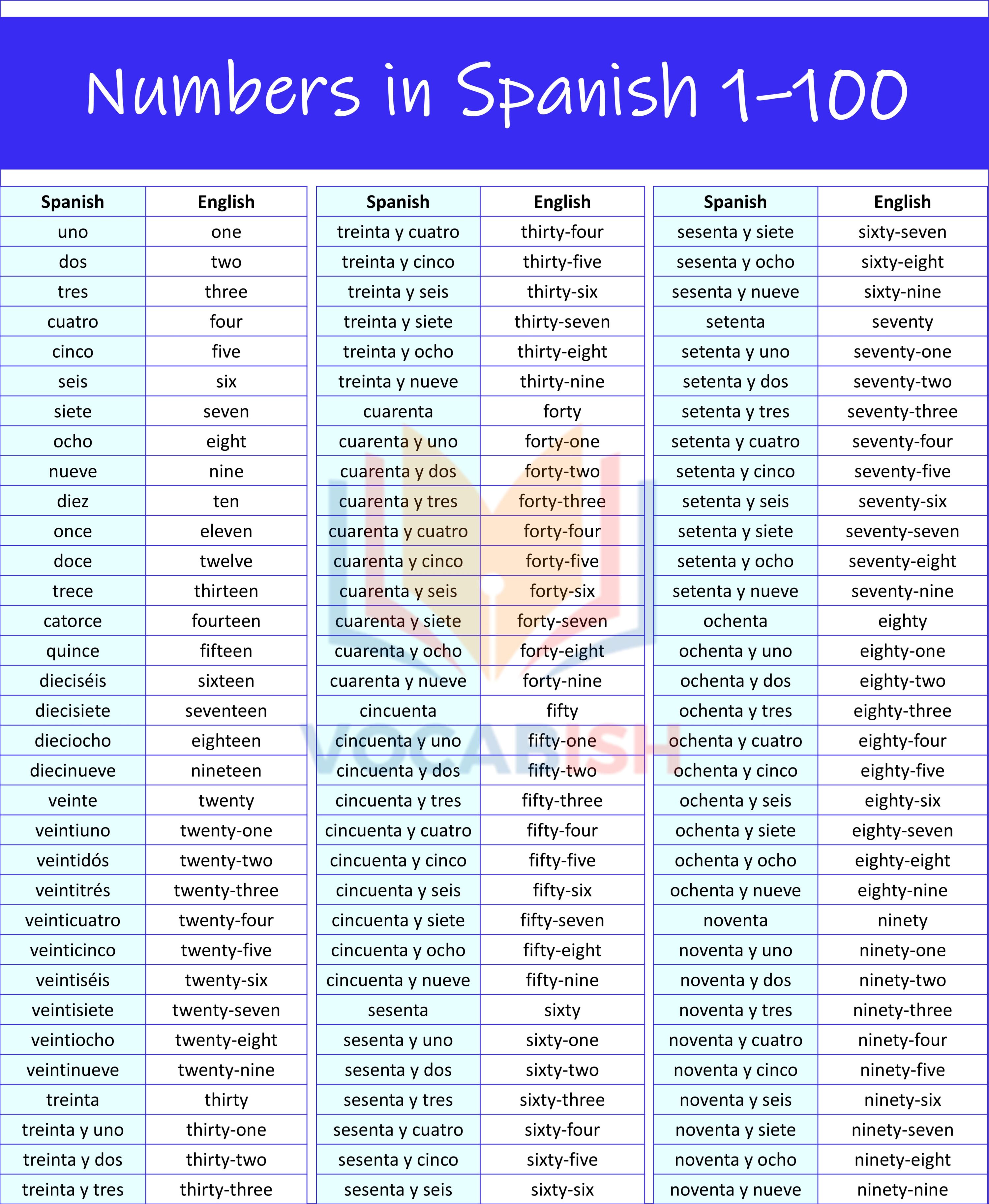
Numbers in Spanish 1-100 become easier when you learn them in groups. The numbers from 21 to 29 are written as one word, while numbers from 31 to 99 usually use y, which means “and.”
For example, treinta y uno means “thirty-one.” The structure is: ten + y + one.
Spanish Numbers 21–29
Numbers from 21 to 29 start with veinti-. This comes from veinte, which means twenty.
Number | Spanish | English Translation | Pronunciation |
|---|---|---|---|
21 | veintiuno | twenty-one | bayn-tee-OO-noh |
22 | veintidós | twenty-two | bayn-tee-DOHS |
23 | veintitrés | twenty-three | bayn-tee-TREHS |
24 | veinticuatro | twenty-four | bayn-tee-KWAH-troh |
25 | veinticinco | twenty-five | bayn-tee-SEEN-koh |
26 | veintiséis | twenty-six | bayn-tee-SAYS |
27 | veintisiete | twenty-seven | bayn-tee-SYEH-teh |
28 | veintiocho | twenty-eight | bayn-tee-OH-choh |
29 | veintinueve | twenty-nine | bayn-tee-NWEH-beh |
Accent marks appear in veintidós, veintitrés, and veintiséis because the natural stress needs to stay clear.
Spanish Tens from 30 to 100
From 30 onward, Spanish uses the tens word plus y plus the ones number.
Number | Spanish | English Translation | Pronunciation |
|---|---|---|---|
30 | treinta | thirty | TRAYN-tah |
40 | cuarenta | forty | kwah-REN-tah |
50 | cincuenta | fifty | seen-KWEN-tah |
60 | sesenta | sixty | seh-SEN-tah |
70 | setenta | seventy | seh-TEN-tah |
80 | ochenta | eighty | oh-CHEN-tah |
90 | noventa | ninety | noh-BEN-tah |
100 | cien | one hundred | syen |
Examples:
Number | Spanish | English Translation | Pronunciation |
|---|---|---|---|
31 | treinta y uno | thirty-one | TRAYN-tah ee OO-noh |
32 | treinta y dos | thirty-two | TRAYN-tah ee dohs |
33 | treinta y tres | thirty-three | TRAYN-tah ee trehs |
34 | treinta y cuatro | thirty-four | TRAYN-tah ee KWAH-troh |
35 | treinta y cinco | thirty-five | TRAYN-tah ee SEEN-koh |
36 | treinta y seis | thirty-six | TRAYN-tah ee says |
37 | treinta y siete | thirty-seven | TRAYN-tah ee SYEH-teh |
38 | treinta y ocho | thirty-eight | TRAYN-tah ee OH-choh |
39 | treinta y nueve | thirty-nine | TRAYN-tah ee NWEH-beh |
41 | cuarenta y uno | forty-one | kwah-REN-tah ee OO-noh |
42 | cuarenta y dos | forty-two | kwah-REN-tah ee dohs |
53 | cincuenta y tres | fifty-three | seen-KWEN-tah ee trehs |
64 | sesenta y cuatro | sixty-four | seh-SEN-tah ee KWAH-troh |
75 | setenta y cinco | seventy-five | seh-TEN-tah ee SEEN-koh |
86 | ochenta y seis | eighty-six | oh-CHEN-tah ee says |
97 | noventa y siete | ninety-seven | noh-BEN-tah ee SYEH-teh |
99 | noventa y nueve | ninety-nine | noh-BEN-tah ee NWEH-beh |
You use y only between the tens and ones from 31 to 99.
Correct:
- cuarenta y dos
forty-two - ciento cuarenta y dos
one hundred forty-two
Not natural:
- ciento y cuarenta y dos
Complete Numbers in Spanish 1–100
Use this table for quick study and review. Read each Spanish number aloud before checking the pronunciation.
Number | Spanish | English Translation | Pronunciation |
|---|---|---|---|
1 | uno | one | OO-noh |
2 | dos | two | dohs |
3 | tres | three | trehs |
4 | cuatro | four | KWAH-troh |
5 | cinco | five | SEEN-koh |
6 | seis | six | says |
7 | siete | seven | SYEH-teh |
8 | ocho | eight | OH-choh |
9 | nueve | nine | NWEH-beh |
10 | diez | ten | dyehs |
11 | once | eleven | OHN-seh |
12 | doce | twelve | DOH-seh |
13 | trece | thirteen | TREH-seh |
14 | catorce | fourteen | kah-TOR-seh |
15 | quince | fifteen | KEEN-seh |
16 | dieciséis | sixteen | dyeh-see-SAYS |
17 | diecisiete | seventeen | dyeh-see-SYEH-teh |
18 | dieciocho | eighteen | dyeh-see-OH-choh |
19 | diecinueve | nineteen | dyeh-see-NWEH-beh |
20 | veinte | twenty | BAYN-teh |
21 | veintiuno | twenty-one | bayn-tee-OO-noh |
22 | veintidós | twenty-two | bayn-tee-DOHS |
23 | veintitrés | twenty-three | bayn-tee-TREHS |
24 | veinticuatro | twenty-four | bayn-tee-KWAH-troh |
25 | veinticinco | twenty-five | bayn-tee-SEEN-koh |
26 | veintiséis | twenty-six | bayn-tee-SAYS |
27 | veintisiete | twenty-seven | bayn-tee-SYEH-teh |
28 | veintiocho | twenty-eight | bayn-tee-OH-choh |
29 | veintinueve | twenty-nine | bayn-tee-NWEH-beh |
30 | treinta | thirty | TRAYN-tah |
31 | treinta y uno | thirty-one | TRAYN-tah ee OO-noh |
32 | treinta y dos | thirty-two | TRAYN-tah ee dohs |
33 | treinta y tres | thirty-three | TRAYN-tah ee trehs |
34 | treinta y cuatro | thirty-four | TRAYN-tah ee KWAH-troh |
35 | treinta y cinco | thirty-five | TRAYN-tah ee SEEN-koh |
36 | treinta y seis | thirty-six | TRAYN-tah ee says |
37 | treinta y siete | thirty-seven | TRAYN-tah ee SYEH-teh |
38 | treinta y ocho | thirty-eight | TRAYN-tah ee OH-choh |
39 | treinta y nueve | thirty-nine | TRAYN-tah ee NWEH-beh |
40 | cuarenta | forty | kwah-REN-tah |
41 | cuarenta y uno | forty-one | kwah-REN-tah ee OO-noh |
42 | cuarenta y dos | forty-two | kwah-REN-tah ee dohs |
43 | cuarenta y tres | forty-three | kwah-REN-tah ee trehs |
44 | cuarenta y cuatro | forty-four | kwah-REN-tah ee KWAH-troh |
45 | cuarenta y cinco | forty-five | kwah-REN-tah ee SEEN-koh |
46 | cuarenta y seis | forty-six | kwah-REN-tah ee says |
47 | cuarenta y siete | forty-seven | kwah-REN-tah ee SYEH-teh |
48 | cuarenta y ocho | forty-eight | kwah-REN-tah ee OH-choh |
49 | cuarenta y nueve | forty-nine | kwah-REN-tah ee NWEH-beh |
50 | cincuenta | fifty | seen-KWEN-tah |
51 | cincuenta y uno | fifty-one | seen-KWEN-tah ee OO-noh |
52 | cincuenta y dos | fifty-two | seen-KWEN-tah ee dohs |
53 | cincuenta y tres | fifty-three | seen-KWEN-tah ee trehs |
54 | cincuenta y cuatro | fifty-four | seen-KWEN-tah ee KWAH-troh |
55 | cincuenta y cinco | fifty-five | seen-KWEN-tah ee SEEN-koh |
56 | cincuenta y seis | fifty-six | seen-KWEN-tah ee says |
57 | cincuenta y siete | fifty-seven | seen-KWEN-tah ee SYEH-teh |
58 | cincuenta y ocho | fifty-eight | seen-KWEN-tah ee OH-choh |
59 | cincuenta y nueve | fifty-nine | seen-KWEN-tah ee NWEH-beh |
60 | sesenta | sixty | seh-SEN-tah |
61 | sesenta y uno | sixty-one | seh-SEN-tah ee OO-noh |
62 | sesenta y dos | sixty-two | seh-SEN-tah ee dohs |
63 | sesenta y tres | sixty-three | seh-SEN-tah ee trehs |
64 | sesenta y cuatro | sixty-four | seh-SEN-tah ee KWAH-troh |
65 | sesenta y cinco | sixty-five | seh-SEN-tah ee SEEN-koh |
66 | sesenta y seis | sixty-six | seh-SEN-tah ee says |
67 | sesenta y siete | sixty-seven | seh-SEN-tah ee SYEH-teh |
68 | sesenta y ocho | sixty-eight | seh-SEN-tah ee OH-choh |
69 | sesenta y nueve | sixty-nine | seh-SEN-tah ee NWEH-beh |
70 | setenta | seventy | seh-TEN-tah |
71 | setenta y uno | seventy-one | seh-TEN-tah ee OO-noh |
72 | setenta y dos | seventy-two | seh-TEN-tah ee dohs |
73 | setenta y tres | seventy-three | seh-TEN-tah ee trehs |
74 | setenta y cuatro | seventy-four | seh-TEN-tah ee KWAH-troh |
75 | setenta y cinco | seventy-five | seh-TEN-tah ee SEEN-koh |
76 | setenta y seis | seventy-six | seh-TEN-tah ee says |
77 | setenta y siete | seventy-seven | seh-TEN-tah ee SYEH-teh |
78 | setenta y ocho | seventy-eight | seh-TEN-tah ee OH-choh |
79 | setenta y nueve | seventy-nine | seh-TEN-tah ee NWEH-beh |
80 | ochenta | eighty | oh-CHEN-tah |
81 | ochenta y uno | eighty-one | oh-CHEN-tah ee OO-noh |
82 | ochenta y dos | eighty-two | oh-CHEN-tah ee dohs |
83 | ochenta y tres | eighty-three | oh-CHEN-tah ee trehs |
84 | ochenta y cuatro | eighty-four | oh-CHEN-tah ee KWAH-troh |
85 | ochenta y cinco | eighty-five | oh-CHEN-tah ee SEEN-koh |
86 | ochenta y seis | eighty-six | oh-CHEN-tah ee says |
87 | ochenta y siete | eighty-seven | oh-CHEN-tah ee SYEH-teh |
88 | ochenta y ocho | eighty-eight | oh-CHEN-tah ee OH-choh |
89 | ochenta y nueve | eighty-nine | oh-CHEN-tah ee NWEH-beh |
90 | noventa | ninety | noh-BEN-tah |
91 | noventa y uno | ninety-one | noh-BEN-tah ee OO-noh |
92 | noventa y dos | ninety-two | noh-BEN-tah ee dohs |
93 | noventa y tres | ninety-three | noh-BEN-tah ee trehs |
94 | noventa y cuatro | ninety-four | noh-BEN-tah ee KWAH-troh |
95 | noventa y cinco | ninety-five | noh-BEN-tah ee SEEN-koh |
96 | noventa y seis | ninety-six | noh-BEN-tah ee says |
97 | noventa y siete | ninety-seven | noh-BEN-tah ee SYEH-teh |
98 | noventa y ocho | ninety-eight | noh-BEN-tah ee OH-choh |
99 | noventa y nueve | ninety-nine | noh-BEN-tah ee NWEH-beh |
100 | cien | one hundred | syen |
Spanish Numbers from 100 to 1,000
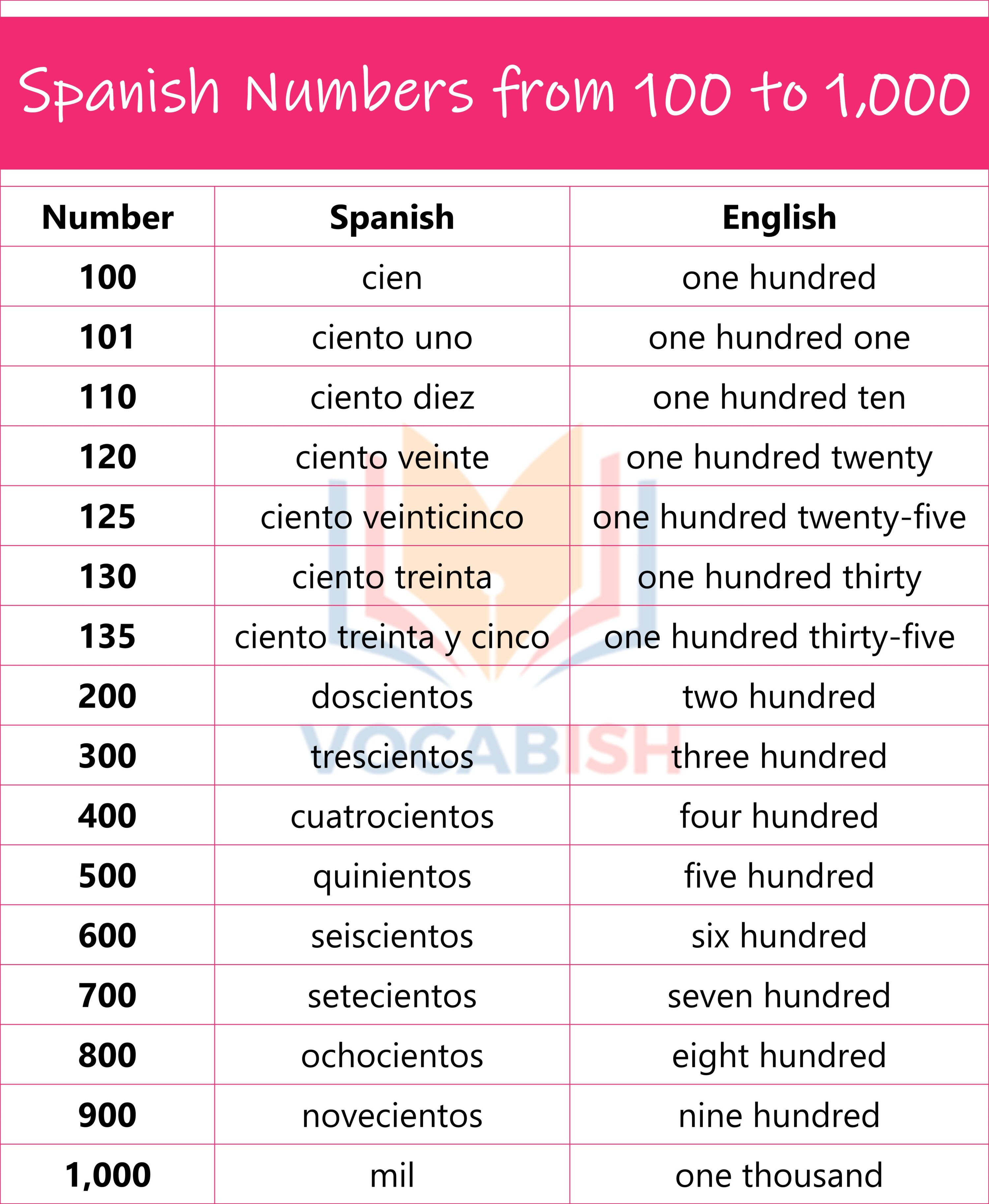
Spanish numbers from 100 to 1,000 follow a clear pattern. Use cien for exactly 100, but use ciento when another number comes after it.
For example, 100 is cien, but 101 is ciento uno.
Number | Spanish | English Translation | Pronunciation |
|---|---|---|---|
100 | cien | one hundred | syen |
101 | ciento uno | one hundred one | SYEN-toh OO-noh |
110 | ciento diez | one hundred ten | SYEN-toh dyehs |
120 | ciento veinte | one hundred twenty | SYEN-toh BAYN-teh |
125 | ciento veinticinco | one hundred twenty-five | SYEN-toh bayn-tee-SEEN-koh |
130 | ciento treinta | one hundred thirty | SYEN-toh TRAYN-tah |
135 | ciento treinta y cinco | one hundred thirty-five | SYEN-toh TRAYN-tah ee SEEN-koh |
200 | doscientos | two hundred | dohs-SYEN-tohs |
300 | trescientos | three hundred | trehs-SYEN-tohs |
400 | cuatrocientos | four hundred | kwah-troh-SYEN-tohs |
500 | quinientos | five hundred | kee-NYEN-tohs |
600 | seiscientos | six hundred | says-SYEN-tohs |
700 | setecientos | seven hundred | seh-teh-SYEN-tohs |
800 | ochocientos | eight hundred | oh-choh-SYEN-tohs |
900 | novecientos | nine hundred | noh-beh-SYEN-tohs |
1,000 | mil | one thousand | meel |
Some hundreds are irregular:
- 500 = quinientos
- 700 = setecientos
- 900 = novecientos
More Examples from 100 to 999
Number | Spanish | English Translation | Pronunciation |
|---|---|---|---|
214 | doscientos catorce | two hundred fourteen | dohs-SYEN-tohs kah-TOR-seh |
356 | trescientos cincuenta y seis | three hundred fifty-six | trehs-SYEN-tohs seen-KWEN-tah ee says |
478 | cuatrocientos setenta y ocho | four hundred seventy-eight | kwah-troh-SYEN-tohs seh-TEN-tah ee OH-choh |
599 | quinientos noventa y nueve | five hundred ninety-nine | kee-NYEN-tohs noh-BEN-tah ee NWEH-beh |
621 | seiscientos veintiuno | six hundred twenty-one | says-SYEN-tohs bayn-tee-OO-noh |
742 | setecientos cuarenta y dos | seven hundred forty-two | seh-teh-SYEN-tohs kwah-REN-tah ee dohs |
888 | ochocientos ochenta y ocho | eight hundred eighty-eight | oh-choh-SYEN-tohs oh-CHEN-tah ee OH-choh |
999 | novecientos noventa y nueve | nine hundred ninety-nine | noh-beh-SYEN-tohs noh-BEN-tah ee NWEH-beh |
Gender Agreement with Hundreds
Spanish hundreds from 200 to 900 change when they describe feminine nouns.
Masculine Form | Feminine Form | English Translation |
|---|---|---|
doscientos libros | doscientas casas | two hundred books / two hundred houses |
trescientos estudiantes | trescientas páginas | three hundred students / three hundred pages |
cuatrocientos dólares | cuatrocientas sillas | four hundred dollars / four hundred chairs |
Examples:
- Hay doscientos libros.
There are two hundred books. - Hay doscientas casas.
There are two hundred houses.
Spanish Numbers from 1,000 to 1 Billion
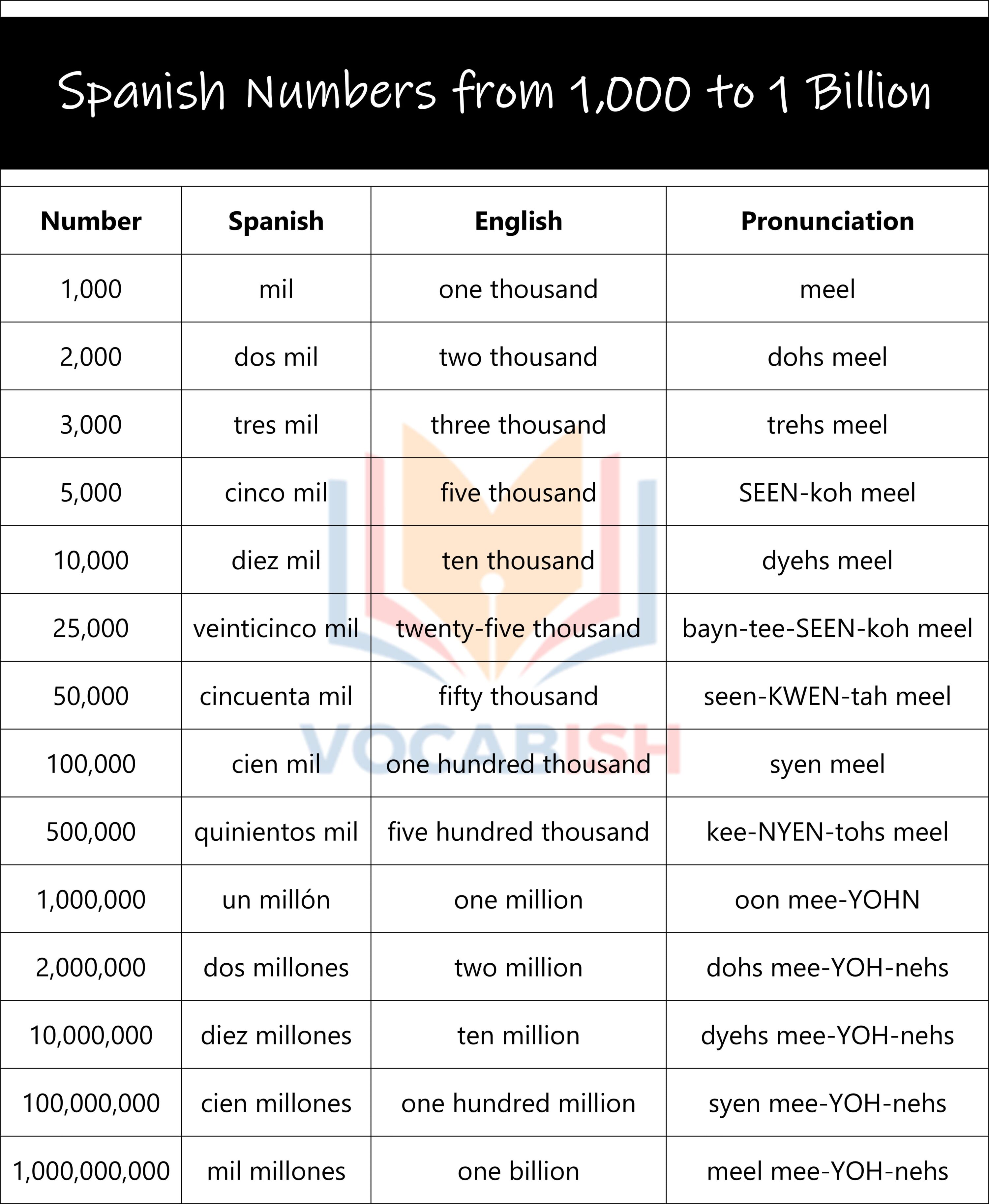
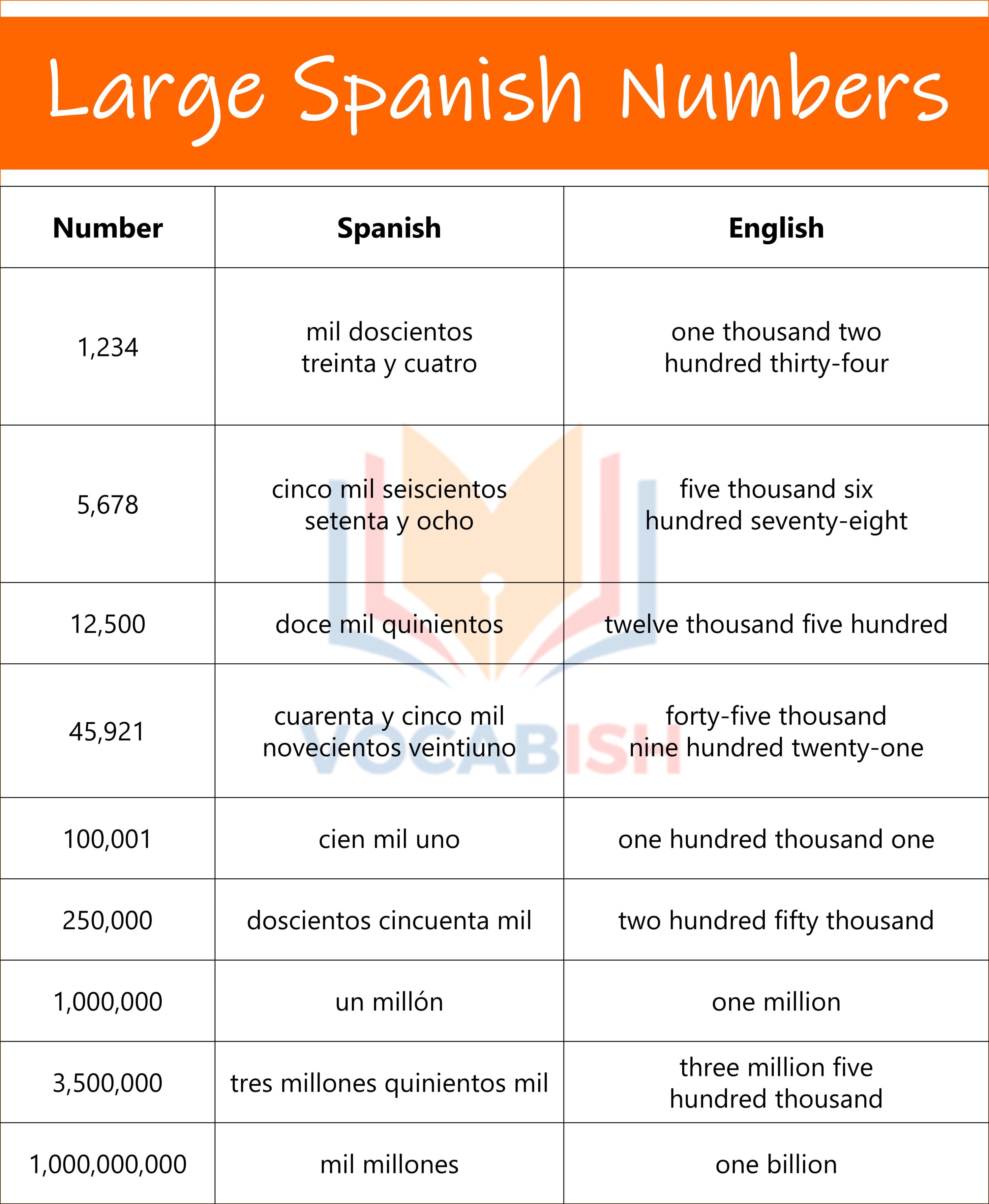
Large numbers in Spanish are useful for money, population, distance, news, business, and school subjects. The pattern is not difficult once you understand mil, millón, and mil millones.
In Spanish, 1,000 is simply mil. You normally do not say un mil for one thousand.
Number | Spanish | English Translation | Pronunciation |
|---|---|---|---|
1,000 | mil | one thousand | meel |
2,000 | dos mil | two thousand | dohs meel |
3,000 | tres mil | three thousand | trehs meel |
5,000 | cinco mil | five thousand | SEEN-koh meel |
10,000 | diez mil | ten thousand | dyehs meel |
25,000 | veinticinco mil | twenty-five thousand | bayn-tee-SEEN-koh meel |
50,000 | cincuenta mil | fifty thousand | seen-KWEN-tah meel |
100,000 | cien mil | one hundred thousand | syen meel |
500,000 | quinientos mil | five hundred thousand | kee-NYEN-tohs meel |
1,000,000 | un millón | one million | oon mee-YOHN |
2,000,000 | dos millones | two million | dohs mee-YOH-nehs |
10,000,000 | diez millones | ten million | dyehs mee-YOH-nehs |
100,000,000 | cien millones | one hundred million | syen mee-YOH-nehs |
1,000,000,000 | mil millones | one billion | meel mee-YOH-nehs |
Examples of Large Spanish Numbers
Number | Spanish | English Translation | Pronunciation |
|---|---|---|---|
1,234 | mil doscientos treinta y cuatro | one thousand two hundred thirty-four | meel dohs-SYEN-tohs TRAYN-tah ee KWAH-troh |
5,678 | cinco mil seiscientos setenta y ocho | five thousand six hundred seventy-eight | SEEN-koh meel says-SYEN-tohs seh-TEN-tah ee OH-choh |
12,500 | doce mil quinientos | twelve thousand five hundred | DOH-seh meel kee-NYEN-tohs |
45,921 | cuarenta y cinco mil novecientos veintiuno | forty-five thousand nine hundred twenty-one | kwah-REN-tah ee SEEN-koh meel noh-beh-SYEN-tohs bayn-tee-OO-noh |
100,001 | cien mil uno | one hundred thousand one | syen meel OO-noh |
250,000 | doscientos cincuenta mil | two hundred fifty thousand | dohs-SYEN-tohs seen-KWEN-tah meel |
1,000,000 | un millón | one million | oon mee-YOHN |
3,500,000 | tres millones quinientos mil | three million five hundred thousand | trehs mee-YOH-nehs kee-NYEN-tohs meel |
1,000,000,000 | mil millones | one billion | meel mee-YOH-nehs |
Million and Billion in Spanish
Use un millón for one million and millones for more than one million.
For one billion, you should use mil millones. This avoids confusion because billón can mean a much larger number in many Spanish-speaking countries.
Best choice:
- 1,000,000 = un millón
- 2,000,000 = dos millones
- 1,000,000,000 = mil millones
Cardinal Numbers in Spanish
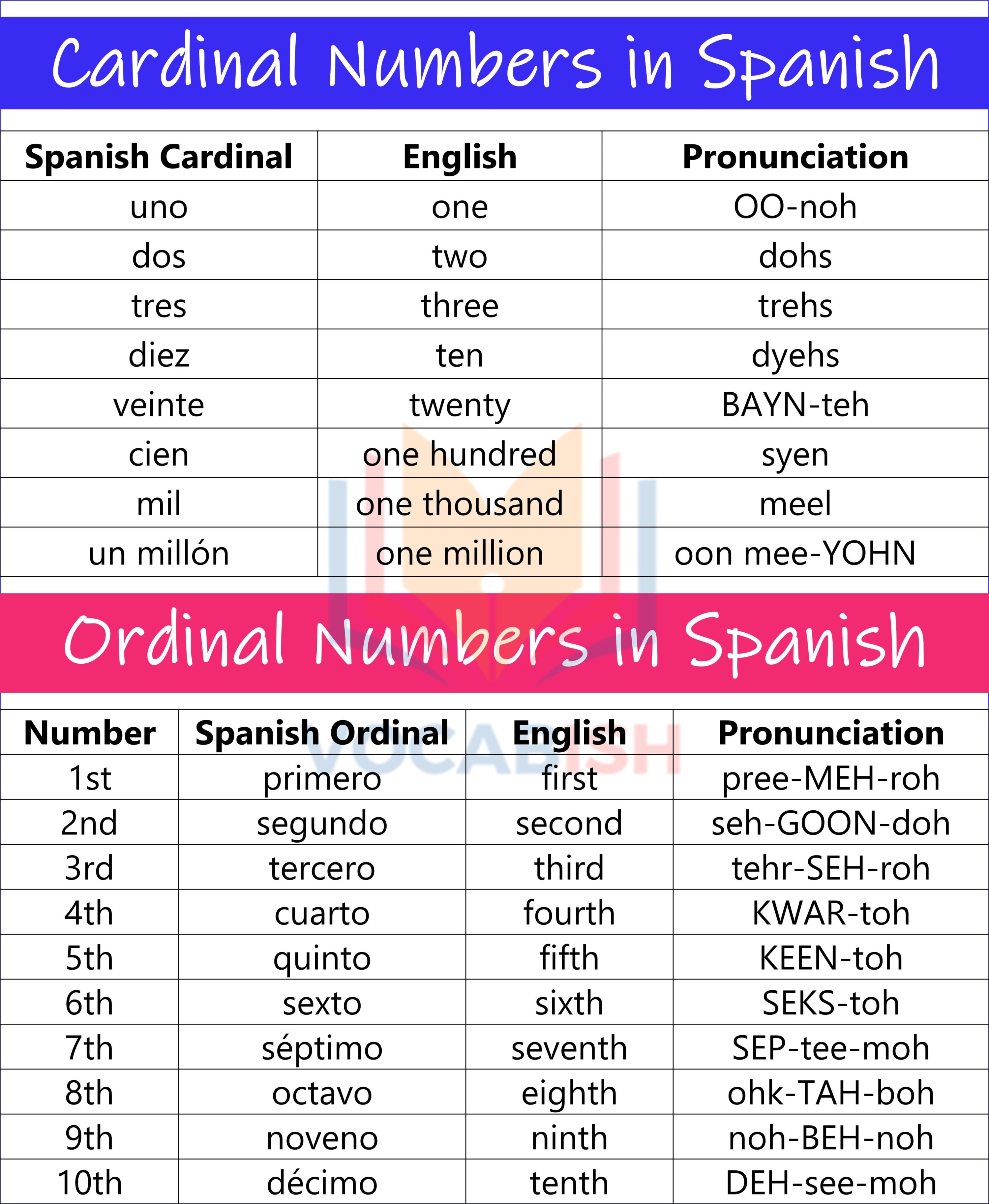
Cardinal numbers in Spanish tell how many people, things, places, or ideas there are. These are the numbers you use for normal counting.
You use cardinal numbers when talking about age, prices, quantities, dates, addresses, and phone numbers.
Spanish | English Translation | Pronunciation |
|---|---|---|
uno | one | OO-noh |
dos | two | dohs |
tres | three | trehs |
diez | ten | dyehs |
veinte | twenty | BAYN-teh |
cien | one hundred | syen |
mil | one thousand | meel |
un millón | one million | oon mee-YOHN |
Examples:
- Tengo tres hermanos.
I have three brothers. - Necesito cinco minutos.
I need five minutes. - Hay mil personas en el estadio.
There are one thousand people in the stadium.
Uno, Un, and Una
The Spanish number uno changes before nouns.
Form | Use | Example | English Translation | Pronunciation |
|---|---|---|---|---|
uno | Stands alone | Tengo uno. | I have one. | OO-noh |
un | Before masculine noun | un libro | one book | oon LEE-broh |
una | Before feminine noun | una casa | one house | OO-nah KAH-sah |
Examples:
- Tengo uno.
I have one. - Tengo un perro.
I have one dog. - Tengo una mochila.
I have one backpack.
The same change happens with numbers ending in one:
Spanish | English Translation | Pronunciation |
|---|---|---|
veintiún libros | twenty-one books | bayn-tee-OON LEE-brohs |
veintiuna casas | twenty-one houses | bayn-tee-OO-nah KAH-sahs |
treinta y un estudiantes | thirty-one students | TRAYN-tah ee oon ehs-too-DYAN-tehs |
treinta y una páginas | thirty-one pages | TRAYN-tah ee OO-nah PAH-hee-nahs |
Ordinal Numbers in Spanish
Ordinal numbers in Spanish show position or order. You use them for floors, chapters, competitions, school grades, rankings, and formal lists.
They answer the question “Which position?” instead of “How many?”
Number | Spanish Ordinal | English Translation | Pronunciation |
|---|---|---|---|
1st | primero | first | pree-MEH-roh |
2nd | segundo | second | seh-GOON-doh |
3rd | tercero | third | tehr-SEH-roh |
4th | cuarto | fourth | KWAR-toh |
5th | quinto | fifth | KEEN-toh |
6th | sexto | sixth | SEKS-toh |
7th | séptimo | seventh | SEP-tee-moh |
8th | octavo | eighth | ohk-TAH-boh |
9th | noveno | ninth | noh-BEH-noh |
10th | décimo | tenth | DEH-see-moh |
Examples:
- Es mi primer día.
It is my first day. - Vivo en el segundo piso.
I live on the second floor. - Ella ganó el tercer lugar.
She won third place.
Primero and Tercero Before Masculine Nouns
Before a singular masculine noun, primero becomes primer, and tercero becomes tercer.
Full Form | Short Form | Example | English Translation |
|---|---|---|---|
primero | primer | el primer día | the first day |
tercero | tercer | el tercer libro | the third book |
With feminine nouns, use the feminine form:
- la primera clase
the first class - la tercera pregunta
the third question
Even Numbers in Spanish
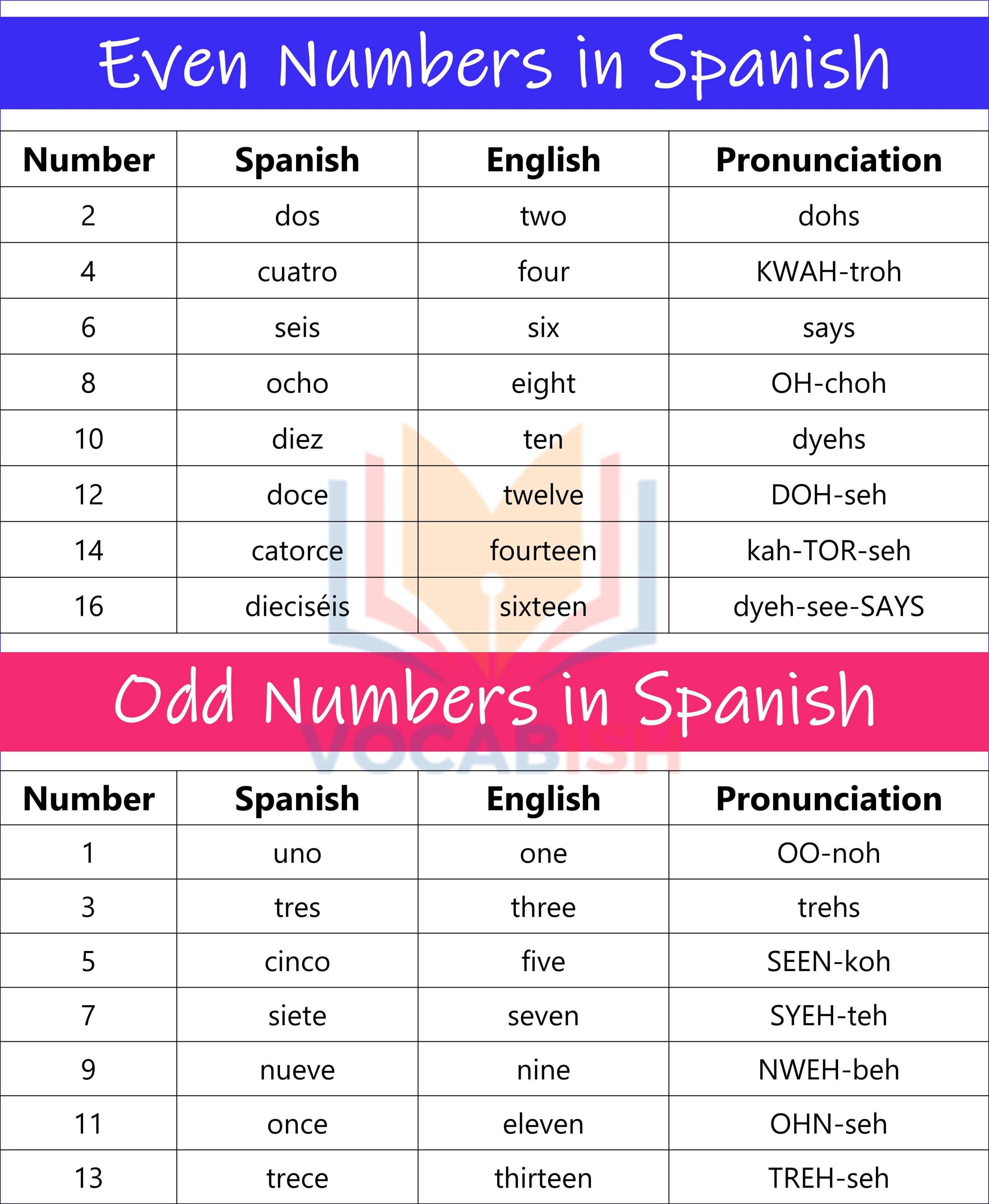
Even numbers in Spanish are called números pares. These are numbers that can be divided by 2 without a remainder.
You often see them in math lessons, classroom activities, number patterns, and address numbers.
Number | Spanish | English Translation | Pronunciation |
|---|---|---|---|
2 | dos | two | dohs |
4 | cuatro | four | KWAH-troh |
6 | seis | six | says |
8 | ocho | eight | OH-choh |
10 | diez | ten | dyehs |
12 | doce | twelve | DOH-seh |
14 | catorce | fourteen | kah-TOR-seh |
16 | dieciséis | sixteen | dyeh-see-SAYS |
18 | dieciocho | eighteen | dyeh-see-OH-choh |
20 | veinte | twenty | BAYN-teh |
Example sentences:
- Dos es un número par.
Two is an even number. - Cuarenta es un número par.
Forty is an even number. - Los números pares terminan en 0, 2, 4, 6 u 8.
Even numbers end in 0, 2, 4, 6, or 8.
Odd Numbers in Spanish
Odd numbers in Spanish are called números impares. These numbers cannot be divided evenly by 2.
They are common in math, games, number puzzles, and classroom practice.
Number | Spanish | English Translation | Pronunciation |
|---|---|---|---|
1 | uno | one | OO-noh |
3 | tres | three | trehs |
5 | cinco | five | SEEN-koh |
7 | siete | seven | SYEH-teh |
9 | nueve | nine | NWEH-beh |
11 | once | eleven | OHN-seh |
13 | trece | thirteen | TREH-seh |
15 | quince | fifteen | KEEN-seh |
17 | diecisiete | seventeen | dyeh-see-SYEH-teh |
19 | diecinueve | nineteen | dyeh-see-NWEH-beh |
Example sentences:
- Uno es un número impar.
One is an odd number. - Trece es un número impar.
Thirteen is an odd number. - Los números impares terminan en 1, 3, 5, 7 o 9.
Odd numbers end in 1, 3, 5, 7, or 9.
How to Use Spanish Numbers in Daily Life
Spanish numbers are easier to remember when you connect them to daily situations. Use them for age, prices, time, dates, phone numbers, school, shopping, and travel.
Instead of only memorizing lists, practice short phrases you can use in conversations.
Age
Spanish uses tener for age. In English, we say “I am fifteen.” In Spanish, the idea is “I have fifteen years.”
Spanish Sentence | English Translation | Pronunciation |
|---|---|---|
Tengo quince años. | I am fifteen years old. | TEN-goh KEEN-seh AH-nyohs |
Tengo veinte años. | I am twenty years old. | TEN-goh BAYN-teh AH-nyohs |
Ella tiene treinta y dos años. | She is thirty-two years old. | EH-yah TYEH-neh TRAYN-tah ee dohs AH-nyohs |
Prices
You will hear numbers often when buying food, clothes, tickets, or anything in a shop.
Spanish Sentence | English Translation | Pronunciation |
|---|---|---|
Cuesta diez dólares. | It costs ten dollars. | KWEHS-tah dyehs DOH-lah-rehs |
Son veinticinco euros. | It is twenty-five euros. | sohn bayn-tee-SEEN-koh EH-oo-rohs |
La camisa cuesta cincuenta pesos. | The shirt costs fifty pesos. | lah kah-MEE-sah KWEHS-tah seen-KWEN-tah PEH-sohs |
Time
Spanish uses numbers to talk about time, but the sentence pattern changes depending on whether it is one o’clock or another hour.
Spanish Sentence | English Translation | Pronunciation |
|---|---|---|
Es la una. | It is one o’clock. | ehs lah OO-nah |
Son las dos. | It is two o’clock. | sohn lahs dohs |
Son las tres y quince. | It is three fifteen. | sohn lahs trehs ee KEEN-seh |
Es la una y media. | It is one thirty. | ehs lah OO-nah ee MEH-dyah |
Dates
Spanish usually uses cardinal numbers for dates. For the first day of the month, Spanish often uses primero.
Spanish Date | English Translation | Pronunciation |
|---|---|---|
el primero de enero | January first | el pree-MEH-roh deh eh-NEH-roh |
el dos de mayo | May second | el dohs deh MAH-yoh |
el quince de agosto | August fifteenth | el KEEN-seh deh ah-GOHS-toh |
Phone Numbers
Spanish speakers may say phone numbers digit by digit or in small groups. For you, digit-by-digit practice works well.
Example:
Phone Number | Spanish | English Translation | Pronunciation |
|---|---|---|---|
555-1234 | cinco cinco cinco, uno dos tres cuatro | five five five, one two three four | SEEN-koh SEEN-koh SEEN-koh, OO-noh dohs trehs KWAH-troh |
Common Mistakes with Spanish Numbers
Many learners understand Spanish numbers but make small mistakes when speaking quickly. These errors are normal, and you can fix them by learning the patterns.
Pay close attention to cien vs. ciento, uno vs. un/una, and the gender of hundreds.
Incorrect | Correct | English Meaning |
|---|---|---|
un mil | mil | one thousand |
cien uno | ciento uno | one hundred one |
uno libro | un libro | one book |
dos millón | dos millones | two million |
treinta uno | treinta y uno | thirty-one |
doscientos casas | doscientas casas | two hundred houses |
Quick teacher note:
- Use uno when the number stands alone.
- Use un before a masculine noun.
- Use una before a feminine noun.
- Use cien for exactly 100.
- Use ciento when another number follows.
Practice Examples for Spanish Numbers
Practice helps you move from reading Spanish numbers to using them naturally. Say the Spanish number aloud, then check the English meaning and pronunciation.
Number Practice Table
Number | Spanish | English Translation | Pronunciation |
|---|---|---|---|
7 | siete | seven | SYEH-teh |
14 | catorce | fourteen | kah-TOR-seh |
22 | veintidós | twenty-two | bayn-tee-DOHS |
39 | treinta y nueve | thirty-nine | TRAYN-tah ee NWEH-beh |
48 | cuarenta y ocho | forty-eight | kwah-REN-tah ee OH-choh |
63 | sesenta y tres | sixty-three | seh-SEN-tah ee trehs |
75 | setenta y cinco | seventy-five | seh-TEN-tah ee SEEN-koh |
86 | ochenta y seis | eighty-six | oh-CHEN-tah ee says |
91 | noventa y uno | ninety-one | noh-BEN-tah ee OO-noh |
100 | cien | one hundred | syen |
Larger Number Practice
Number | Spanish | English Translation | Pronunciation |
|---|---|---|---|
101 | ciento uno | one hundred one | SYEN-toh OO-noh |
150 | ciento cincuenta | one hundred fifty | SYEN-toh seen-KWEN-tah |
275 | doscientos setenta y cinco | two hundred seventy-five | dohs-SYEN-tohs seh-TEN-tah ee SEEN-koh |
389 | trescientos ochenta y nueve | three hundred eighty-nine | trehs-SYEN-tohs oh-CHEN-tah ee NWEH-beh |
500 | quinientos | five hundred | kee-NYEN-tohs |
714 | setecientos catorce | seven hundred fourteen | seh-teh-SYEN-tohs kah-TOR-seh |
999 | novecientos noventa y nueve | nine hundred ninety-nine | noh-beh-SYEN-tohs noh-BEN-tah ee NWEH-beh |
1,000 | mil | one thousand | meel |
10,000 | diez mil | ten thousand | dyehs meel |
1,000,000 | un millón | one million | oon mee-YOHN |
Sentence Practice
Spanish Sentence | English Translation | Pronunciation |
|---|---|---|
Tengo dieciocho años. | I am eighteen years old. | TEN-goh dyeh-see-OH-choh AH-nyohs |
Hay treinta y dos estudiantes en la clase. | There are thirty-two students in the class. | eye TRAYN-tah ee dohs ehs-too-DYAN-tehs en lah KLAH-seh |
Mi casa tiene cuatro habitaciones. | My house has four rooms. | mee KAH-sah TYEH-neh KWAH-troh ah-bee-tah-SYOH-nehs |
El boleto cuesta cien dólares. | The ticket costs one hundred dollars. | el boh-LEH-toh KWEHS-tah syen DOH-lah-rehs |
Vivo en el segundo piso. | I live on the second floor. | BEE-boh en el seh-GOON-doh PEE-soh |
Download Spanish Numbers PDF
You May Also Like:
FAQs About Numbers in Spanish
Spanish numbers 1 to 10 are uno, dos, tres, cuatro, cinco, seis, siete, ocho, nueve, and diez.
Numbers in Spanish 1-100 include uno to veinte, veintiuno to veintinueve, and tens like treinta, cuarenta, cincuenta, and noventa.
Spanish pronunciation is mostly phonetic. Say each vowel clearly, stress accented syllables, and practice slowly with tables and short examples.
Cardinal numbers in Spanish show quantity. Examples include uno, dos, tres, veinte, cien, mil, and un millón.
Ordinal numbers in Spanish show order or position. Common examples include primero, segundo, tercero, cuarto, quinto, and décimo.
You say cien for exactly 100. Use ciento when another number follows, such as ciento uno or ciento treinta.
One thousand is mil, and one million is un millón. For two million or more, use millones.
The safest way to say one billion in Spanish is mil millones. This avoids confusion with billón in different regions.
Final Thoughts
Learning all numbers in Spanish becomes easier when you study them in groups. Start with 0 to 20, then learn the tens, hundreds, thousands, millions, and mil millones for one billion.
Use the tables to practice Spanish, English meaning, and pronunciation together. Say numbers aloud in daily situations: your age, prices, dates, time, phone numbers, and addresses. With regular practice, Spanish numbers will start to feel natural.