
Learning Colors in Spanish is a great way to build everyday vocabulary. Spanish color names are used when describing clothes, hair, eyes, food, nature, and many common objects. In this article, you’ll learn 50 color names in Spanish with English translations, pronunciation tips, and practical examples to help you use them naturally in conversation.
Why Learn Colors in Spanish?
Colors are part of everyday language. You use them when describing people, objects, clothing, food, weather, animals, and places.
Learning color names in Spanish helps you:
- Describe things more accurately
- Improve speaking skills
- Understand conversations better
- Build vocabulary faster
- Read Spanish texts with more confidence
12 Basic Colors in Spanish
These are the most common colors you should know first.
Spanish | English |
|---|---|
Rojo | Red |
Azul | Blue |
Verde | Green |
Amarillo | Yellow |
Negro | Black |
Blanco | White |
Naranja | Orange |
Rosa | Pink |
Morado | Purple |
Marrón | Brown |
Gris | Gray |
Celeste | Light Blue |
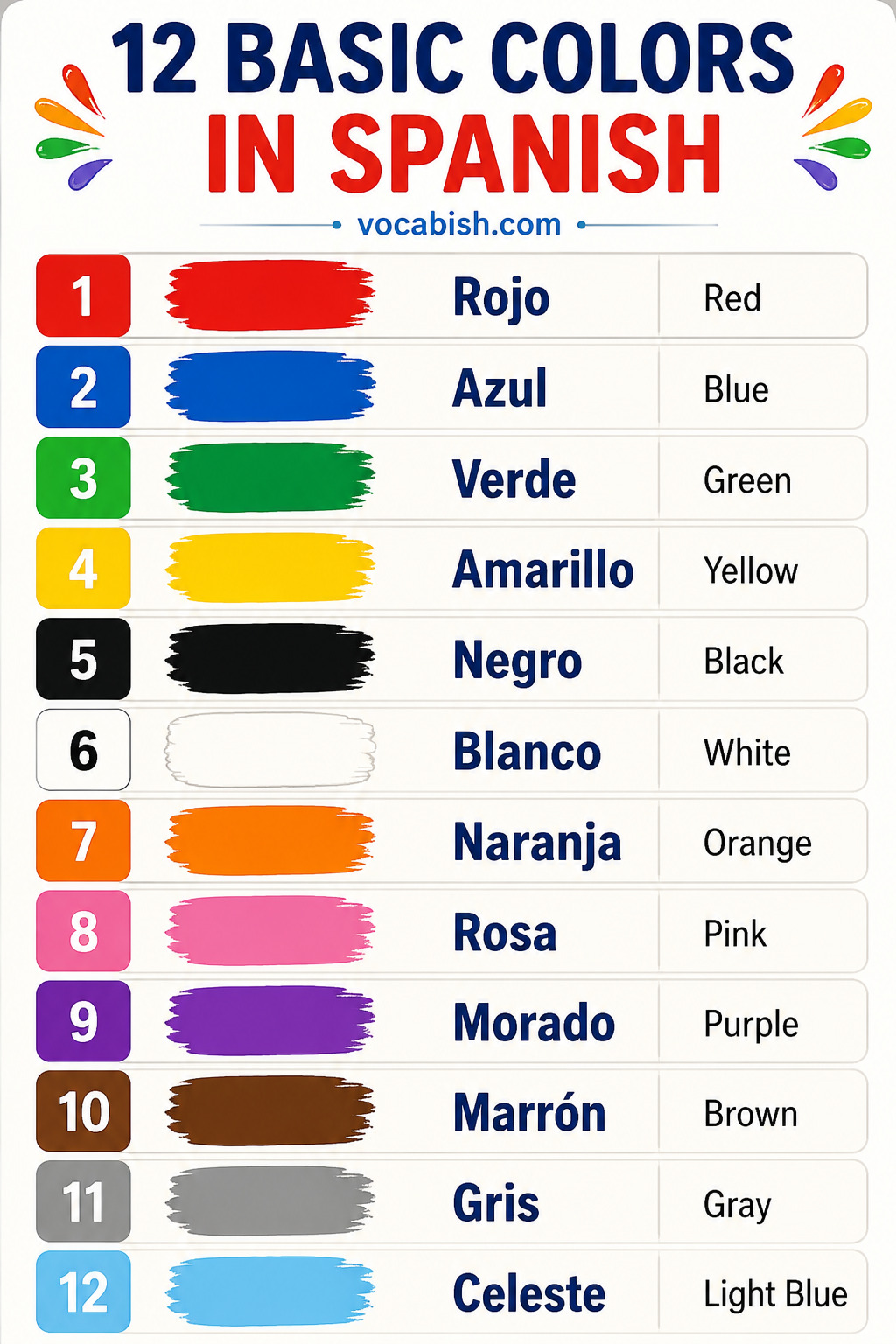
These are often called the 12 colors in Spanish because they form the foundation of color vocabulary.
Colors in Spanish List with English Translations
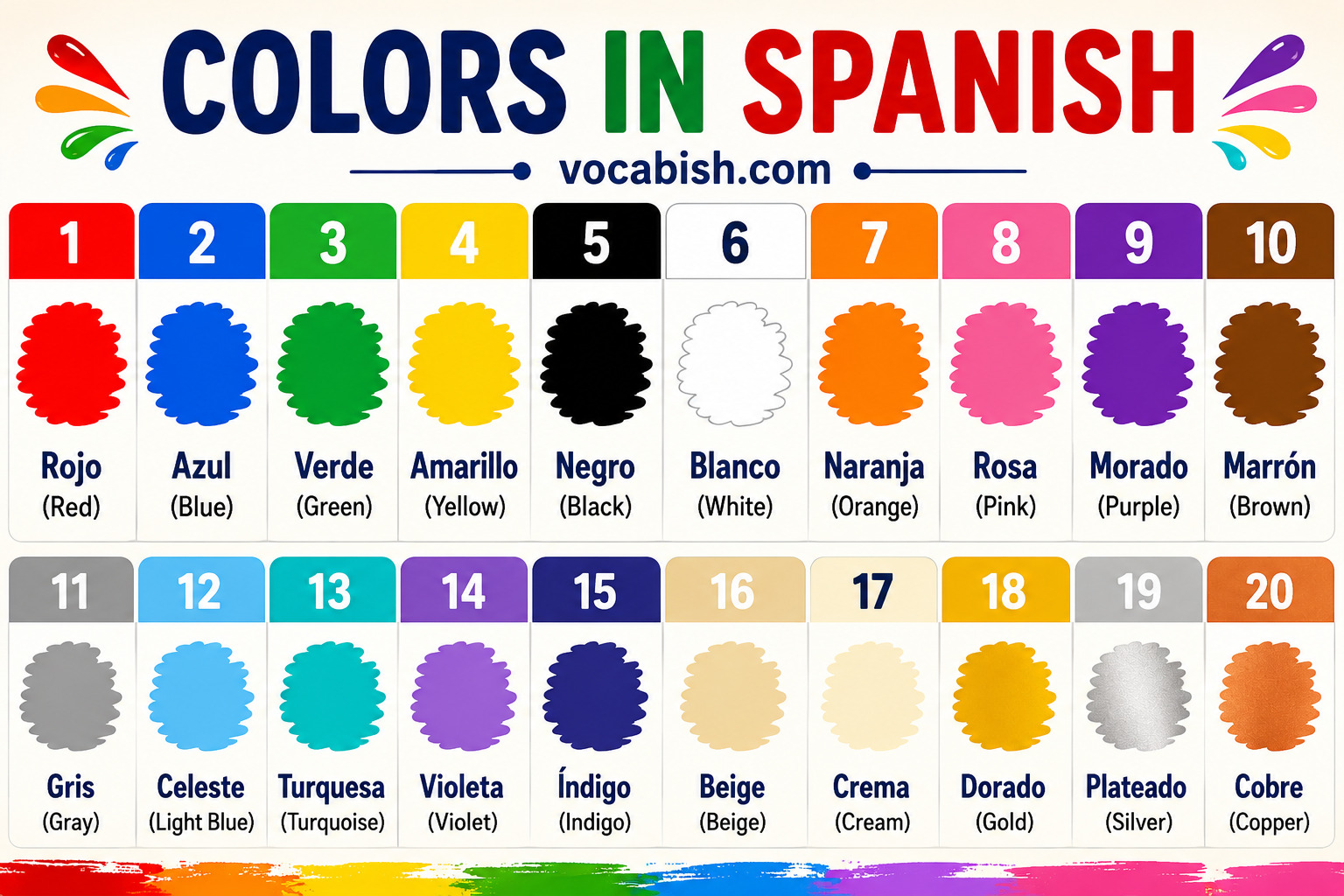
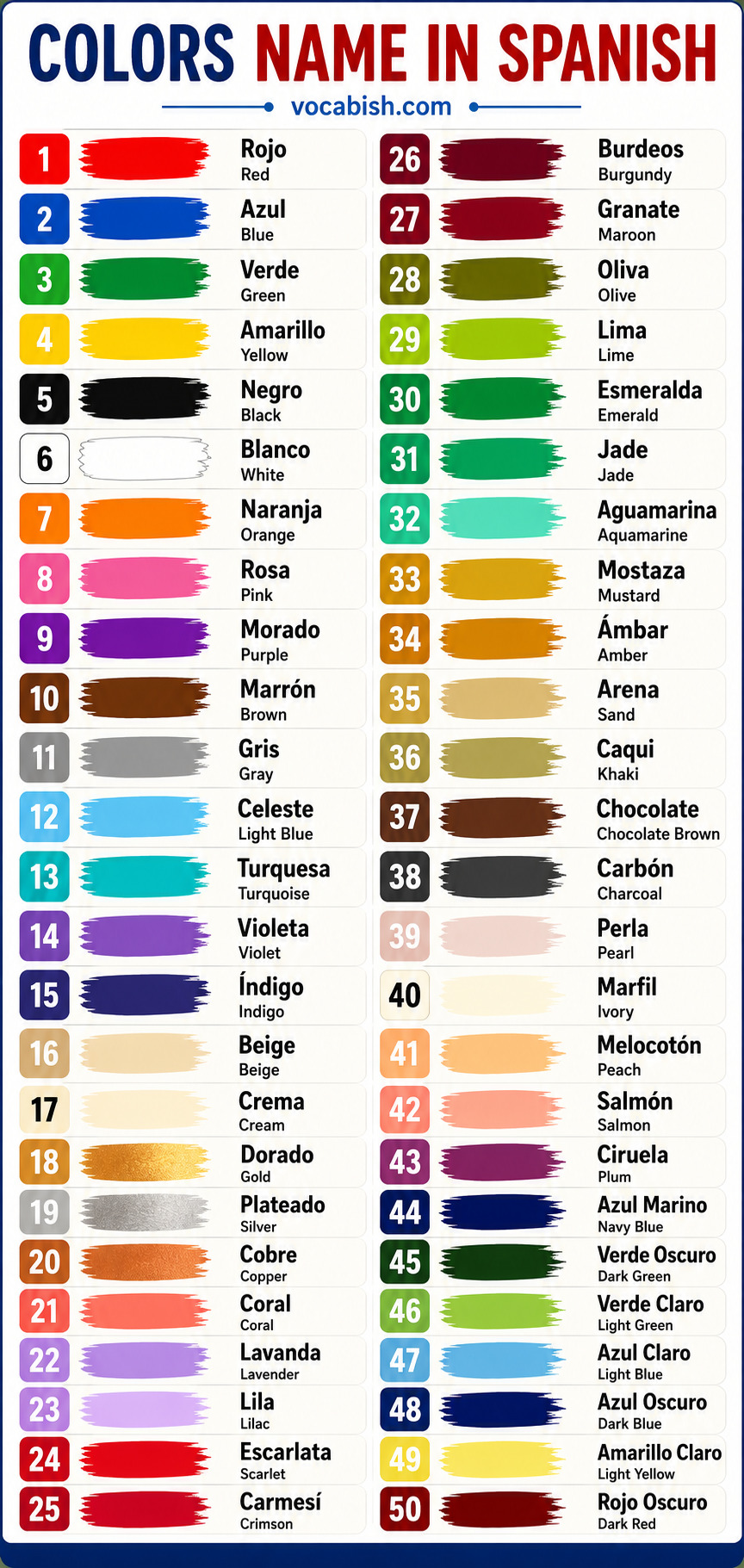
Below is a larger colors in Spanish list that includes common, light, dark, and specialized shades with pictures.
Spanish Color | English Translation |
|---|---|
Rojo | Red |
Azul | Blue |
Verde | Green |
Amarillo | Yellow |
Negro | Black |
Blanco | White |
Naranja | Orange |
Rosa | Pink |
Morado | Purple |
Marrón | Brown |
Gris | Gray |
Celeste | Light Blue |
Turquesa | Turquoise |
Violeta | Violet |
Índigo | Indigo |
Beige | Beige |
Crema | Cream |
Dorado | Gold |
Plateado | Silver |
Cobre | Copper |
Coral | Coral |
Lavanda | Lavender |
Lila | Lilac |
Escarlata | Scarlet |
Carmesí | Crimson |
Burdeos | Burgundy |
Granate | Maroon |
Oliva | Olive |
Lima | Lime |
Esmeralda | Emerald |
Jade | Jade |
Aguamarina | Aquamarine |
Mostaza | Mustard |
Ámbar | Amber |
Arena | Sand |
Caqui | Khaki |
Chocolate | Chocolate Brown |
Carbón | Charcoal |
Perla | Pearl |
Marfil | Ivory |
Melocotón | Peach |
Salmón | Salmon |
Ciruela | Plum |
Azul Marino | Navy Blue |
Verde Oscuro | Dark Green |
Verde Claro | Light Green |
Azul Claro | Light Blue |
Azul Oscuro | Dark Blue |
Amarillo Claro | Light Yellow |
Rojo Oscuro | Dark Red |
Hair Colors in Spanish
When talking about hair colors in Spanish, some color words are different from the ones commonly used for objects. Native Spanish speakers often use specific terms to describe hair color, especially when talking about someone’s appearance.
Learning these words helps you describe people more naturally in conversations, introductions, and physical descriptions.
These are the most common hair colors in Spanish:
Spanish | English Translation |
|---|---|
Canoso | Grey-haired |
Castaño | Brown / Chestnut / Brunette |
Rubio | Blond |
Güero | Blond (Common in Mexico) |
Negro | Black |
Pelirrojo | Redheaded |
Rojo | Red |
Here are some examples of how to use hair colors in Spanish.
One common structure is:
[Subject] + [verb] + cabello/pelo + [adjective] + [color]
Examples:
- Mi cabello es largo y negro.
My hair is long and black. - Letty se quiere pintar el cabello rojo.
Letty wants to dye her hair red. - Creo que Paola tiene el cabello castaño claro.
I think Paola has light brown hair. - La novia de Paco tiene el cabello muy güero.
Paco’s girlfriend has very blond hair. - El cabello de Lexi es rubio platino.
Lexi’s hair is platinum blond.
You may also hear these expressions when discussing hair color:
Spanish Phrase | English Meaning |
|---|---|
Rubio oscuro | Dark blond |
Rubio claro | Light blond |
Castaño claro | Light brown |
Castaño oscuro | Dark brown |
Negro azabache | Jet black |
Rubio platino | Platinum blond |
Everyday Sentences with Hair Colors:
- Mi hermano tiene el pelo castaño.
My brother has brown hair. - Ella es rubia.
She is blond. - Mi abuelo está canoso.
My grandfather has gray hair. - El niño es pelirrojo.
The boy is redheaded. - Tengo el cabello negro y corto.
I have short black hair.
Related Resource: Hair Color Names in English
Eye Colors in Spanish
Eye color is another common topic when describing a person’s appearance. Unlike hair, the Spanish word ojos (eyes) is plural. Because of this, the color adjectives used with eyes are often plural as well.
These words are useful when introducing people, describing family members, or talking about physical features.
Here are some of the most common eye colors we use in Spanish:
Spanish | English Translation |
|---|---|
Azules | Blue |
Cafés | Brown |
Castaños | Brown |
Grises | Gray |
Miel | Hazel |
Avellana | Hazel |
Negros | Black |
Verdes | Green |
A common sentence pattern for describing a person’s eyes in Spanish:
[Subject] + tener + los ojos + [adjective] + [color]
Examples:
- Tus primas no tienen los ojos azules.
Your cousins do not have blue eyes. - Katarina tiene ojos grandes y negros.
Katarina has big black eyes. - Mi bisabuela tenía los ojos de color miel.
My great-grandmother had hazel eyes. - ¿De qué color son tus ojos? Parecen verdes.
What color are your eyes? They seem green.
You can combine eye colors with other descriptive adjectives.
Spanish Description | English Translation |
|---|---|
Ojos azules y brillantes | Bright blue eyes |
Ojos verdes grandes | Large green eyes |
Ojos cafés oscuros | Dark brown eyes |
Ojos grises claros | Light gray eyes |
Ojos color miel | Hazel eyes |
Everyday Examples with Eye Colors:
- Mi madre tiene los ojos verdes.
My mother has green eyes. - Él tiene ojos cafés.
He has brown eyes. - La niña tiene los ojos azules.
The girl has blue eyes. - Tengo los ojos grises.
I have gray eyes. - Sus ojos son color avellana.
Her eyes are hazel.
Quick Note:
When describing appearance in Spanish:
- Hair colors often use specialized vocabulary such as rubio, castaño, and pelirrojo.
- Eye colors are usually used in plural form because ojos is a plural noun.
- The verb tener (to have) is commonly used when talking about eye color, while both tener and ser can be used when describing hair.
How Colors Work in Spanish Grammar
Spanish colors often change to match the noun they describe.
Singular Examples:
- El coche rojo.
(The red car.) - La casa blanca.
(The white house.)
Plural Examples:
- Los coches rojos.
(The red cars.) - Las flores blancas.
(The white flowers.)
Notice how some color words change their endings to agree with the noun.
Colors in Spanish with Examples
Seeing colors in context makes them easier to remember.
Spanish Sentence | English Translation |
|---|---|
Mi camisa es azul. | My shirt is blue. |
El coche es negro. | The car is black. |
Tengo una flor roja. | I have a red flower. |
La pared es blanca. | The wall is white. |
El césped es verde. | The grass is green. |
Su vestido es rosa. | Her dress is pink. |
El cielo está celeste. | The sky is light blue. |
Tengo zapatos marrones. | I have brown shoes. |
El gato es gris. | The cat is gray. |
La mochila es amarilla. | The backpack is yellow. |
Tips to Remember Spanish Color Names
Learning Spanish colors becomes much easier when you connect them to things you already see every day. Instead of memorizing long lists, try linking each color to a familiar object. For example, think of rojo (red) when you see an apple or verde (green) when you look at grass. This creates a stronger memory connection and helps the vocabulary stay with you longer.
Another useful approach is to practice colors in short phrases rather than single words. For example, learning coche rojo (red car) or camisa azul (blue shirt) helps you remember how colors are actually used in Spanish conversations.
Pronunciation Tips for Colors Vocabulary in Spanish
Many Spanish color names are pronounced more consistently than their English equivalents because Spanish words are generally spoken as they are written. Pay attention to vowel sounds, which stay nearly the same in every word.
For example:
- Rojo → Rojo (RO-ho)
- Azul → Azul (ah-SOOL)
- Verde → Verde (BER-deh)
Notice that the Spanish r, j, and vowel sounds may sound different from English. Listening to native pronunciation and repeating color names aloud can help you develop a more natural accent and improve speaking confidence.
You May Also Like:
- 300+ Spanish Words that Start with C
- 200+ Spanish Words List and Meanings
- 30 Common Spanish Phrases for Conversation
Frequently Asked Questions
The most common Spanish colors are rojo, azul, verde, amarillo, negro, blanco, naranja, rosa, morado, marrón, gris, and celeste.
The word “colors” in Spanish is colores. The singular form is color.
The 12 common colors are rojo, azul, verde, amarillo, negro, blanco, naranja, rosa, morado, marrón, gris, and celeste.
Many Spanish colors change to match the gender and number of the noun they describe, especially colors ending in -o.
Practice with flashcards, label household objects, use colors in sentences, and review them regularly during daily vocabulary exercises.
Red and yellow are strongly associated with Spain because they appear on the Spanish national flag and are widely recognized cultural colors.
Yes. Common examples include azul claro (light blue), azul oscuro (dark blue), azul marino (navy blue), and celeste (sky blue).
Final Thoughts
Learning Colors in Spanish is one of the fastest ways to improve your vocabulary and speaking skills. Start with the basic colors, then expand into lighter shades, darker tones, and specialty colors. With regular practice, you’ll naturally use Spanish color words when describing people, places, clothing, food, and everyday objects.