
Think about the words you use when describing an ordinary day: teacher, bus, street, lunch, phone, and dog. These words do not name one specific person, place, or thing. Instead, they give general names to the people, places, animals, and objects around us.
That is exactly what common nouns do.
Common nouns are among the first grammar topics English learners meet, but using them correctly involves more than memorizing a definition. You also need to understand capitalization, singular and plural forms, countable and uncountable uses, and the difference between common nouns and proper nouns.
This guide explains each point with clear examples and natural sentences.
What Is a Common Noun?
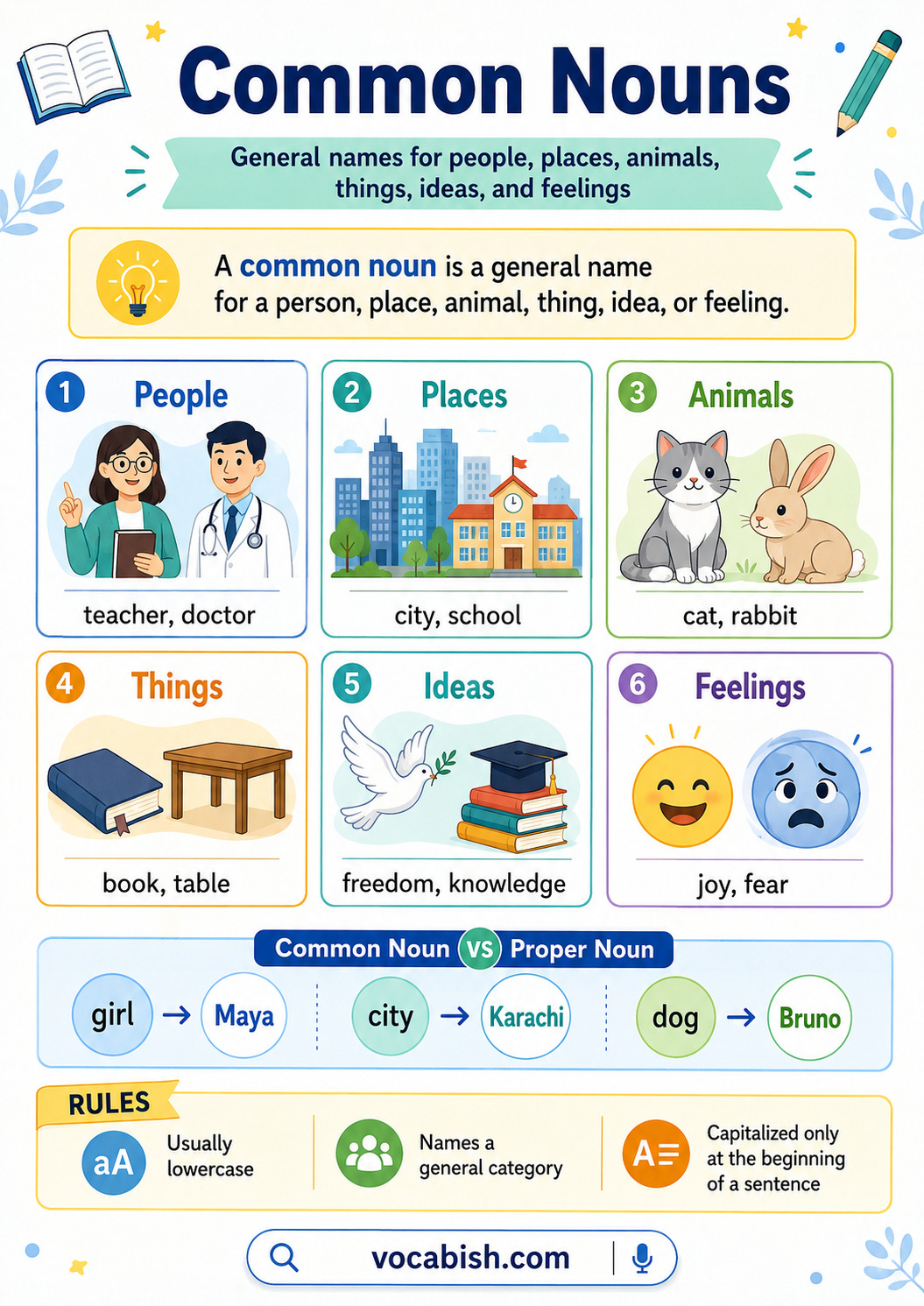
A common noun is a general name for a person, place, animal, object, idea, feeling, or activity.
For example:
- teacher
- city
- cat
- table
- happiness
- conversation
These words identify a type or category rather than one specific person or thing.
Compare these sentences:
- A girl entered the room.
- Maya entered the room.
The word girl is a common noun because it could refer to any girl. The word Maya is a proper noun because it names a particular person.
Here are a few more everyday common nouns:
- brother
- doctor
- village
- restaurant
- bird
- bicycle
- music
- kindness
Common nouns normally begin with a lowercase letter unless they come at the beginning of a sentence.
Correct:
- The doctor checked my arm.
- We visited a small museum.
- Her cat sleeps near the window.
At the beginning of a sentence, a common noun takes a capital letter because of its position:
- Teachers need patience.
- Books can introduce us to new ideas.
The capital letter does not turn the word into a proper noun. It is capitalized only because it begins the sentence.
What Do Common Nouns Name?
Common nouns name many kinds of things. They are not limited to physical objects.
A common noun can name:
- a person: student, mother, singer
- a place: park, country, office
- an animal: horse, rabbit, eagle
- an object: chair, key, laptop
- an idea: freedom, knowledge, success
- a feeling: anger, joy, fear
- an activity: reading, swimming, travel
- a group: team, family, audience
Look at this sentence:
The children showed courage during the storm.
The common nouns are:
- children — people
- courage — a quality
- storm — an event
Although the three nouns name different things, all of them are common nouns because they are general names.
Common Nouns for People
Common nouns for people describe roles, jobs, family relationships, age groups, or social positions.
Examples include:
- teacher
- student
- nurse
- driver
- uncle
- child
- neighbour
- customer
- musician
- manager
In sentences:
- The teacher wrote the answer on the board.
- A customer asked for help.
- My uncle works in a hospital.
- The musician played a beautiful melody.
- Every student received a worksheet.
These nouns do not tell us the exact names of the people.
In the sentence:
The doctor spoke to Ahmed.
Doctor is a common noun, while Ahmed is a proper noun.
Job titles are usually common nouns when they are used generally:
- She wants to become a pilot.
- My sister is an engineer.
- The president gave a speech.
A title may be capitalized when it appears directly before a person’s name as part of the name:
- President Khan gave a speech.
- We met Professor Ali.
However, styles can vary with formal titles. In ordinary general use, job names remain lowercase.
Common Nouns for Places
Common nouns can name general locations, buildings, areas, or geographical features.
Examples include:
- school
- hospital
- market
- village
- country
- beach
- river
- office
- station
- garden
In sentences:
- We waited outside the station.
- Her children walk to school.
- They opened a shop near the market.
- A narrow river runs through the village.
- The family spent the afternoon at the beach.
These words do not identify exact places.
Compare:
- They live in a large city.
- They live in Karachi.
City is a common noun. Karachi is a proper noun.
Another example:
- We crossed a long bridge.
- We crossed Tower Bridge.
The word bridge gives a general name, while Tower Bridge names one particular bridge.
Common Nouns for Animals
Animal names are normally common nouns unless an animal has a personal name.
Examples:
- dog
- cat
- lion
- parrot
- horse
- whale
- ant
- rabbit
- butterfly
- chicken
In sentences:
- A rabbit ran across the field.
- The dog barked at the gate.
- We saw a whale from the boat.
- A colourful butterfly landed on the flower.
- The farmer keeps several chickens.
Now compare:
- The dog is sleeping.
- Bruno is sleeping.
Dog is a common noun because it names the kind of animal. Bruno is a proper noun because it is the animal’s personal name.
Animal species and breed names can follow different capitalization rules. General animal words are lowercase:
- golden retriever
- Persian cat
- African elephant
Some words within breed or species names are capitalized because they come from place names or proper names, while the general animal word may remain lowercase.
Common Nouns for Objects
Objects are physical things that we can usually see or touch.
Common nouns for objects include:
- book
- cup
- phone
- door
- computer
- bag
- spoon
- bicycle
- camera
- lamp
Examples in sentences:
- She placed the book on the desk.
- My phone needs charging.
- The lamp beside the bed is broken.
- He carried the groceries in a large bag.
- We bought a new camera.
Common nouns can also name substances and materials:
- water
- glass
- wood
- cotton
- plastic
- sugar
For example:
- The chair is made of wood.
- Please add some sugar.
- The bottle contains water.
These are common nouns even though they may also belong to other noun categories, such as material nouns or uncountable nouns.
Common Nouns in Sentences
Common nouns can perform several jobs in a sentence.
As the Subject
The subject tells us who or what performs the action or is being described.
- The baby is sleeping.
- A car stopped outside.
- The students finished the task.
- Patience takes time to develop.
As the Object of a Verb
The object receives the action.
- She opened the window.
- We watched a film.
- The child kicked the ball.
- He needs more practice.
After a Preposition
A common noun can follow words such as in, on, at, under, beside, or with.
- The keys are on the table.
- She walked through the garden.
- We spoke with the manager.
- The shoes are under the bed.
As a Complement
A complement gives more information about the subject.
- My father is a teacher.
- Her greatest strength is patience.
- Their new pet is a rabbit.
These examples show that a common noun is not defined by its position. It can appear in several parts of a sentence.
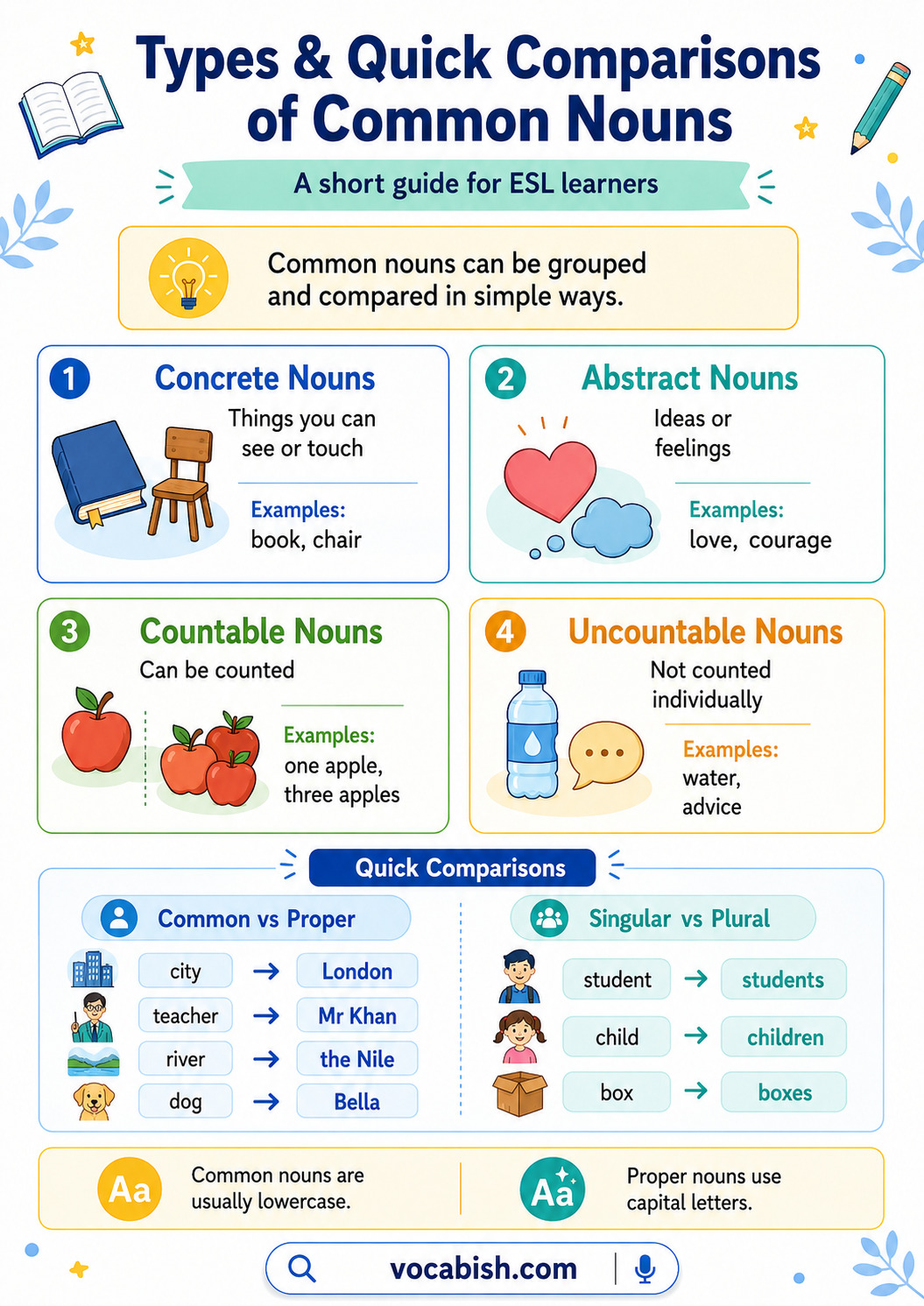
Common Nouns vs Proper Nouns
The main difference is simple:
A common noun gives a general name.
A proper noun gives a specific name.
Common noun | Proper noun |
|---|---|
girl | Aisha |
country | Pakistan |
city | London |
month | August |
river | the Nile |
company | Samsung |
language | English |
school | Green Valley School |
Compare these sentence pairs:
- The boy moved to another city.
- Omar moved to Birmingham.
- We visited a museum on Sunday.
- We visited the British Museum on Sunday.
- Her company sells phones.
- Apple sells phones.
Proper nouns usually begin with capital letters. Common nouns usually do not.
However, learners should remember that a common noun may still be capitalized when it begins a sentence:
- Cities can become crowded.
- Children learn through play.
The words cities and children are still common nouns.
Related Resources: Common Nouns vs Proper Nouns
Capitalization Rules for Common Nouns
Common nouns normally use lowercase letters.
Correct:
- The teacher entered the classroom.
- My sister works in a bank.
- We bought fruit from the market.
Incorrect:
- The Teacher entered the Classroom.
- My Sister works in a Bank.
These words should not be capitalized because they are general names.
1. Capitalize a Common Noun at the Beginning of a Sentence
- Dogs need regular exercise.
- Books were scattered across the floor.
- Music can affect our mood.
2. Capitalize It When It Forms Part of a Proper Name
The word may be common by itself but capitalized inside an official name.
- river → the River Thames
- university → Oxford University
- hospital → City General Hospital
- park → Hyde Park
- school → Greenwood School
Compare:
- The children played in the park.
- The children played in Hyde Park.
3. Do Not Capitalize Family Words Automatically
Words such as mother, father, aunt, and uncle are common nouns when used generally.
- My mother is at work.
- Her uncle lives abroad.
They may be capitalized when used as a name or direct form of address:
- I asked Mum for help.
- Thank you, Uncle.
Capitalization style can vary by region and family preference, but the grammatical distinction remains the same.
Singular and Plural Common Nouns
Most common nouns can appear in singular or plural form.
A singular noun refers to one person, place, animal, or thing:
- a student
- one chair
- a village
- an apple
A plural noun refers to more than one:
- students
- chairs
- villages
- apples
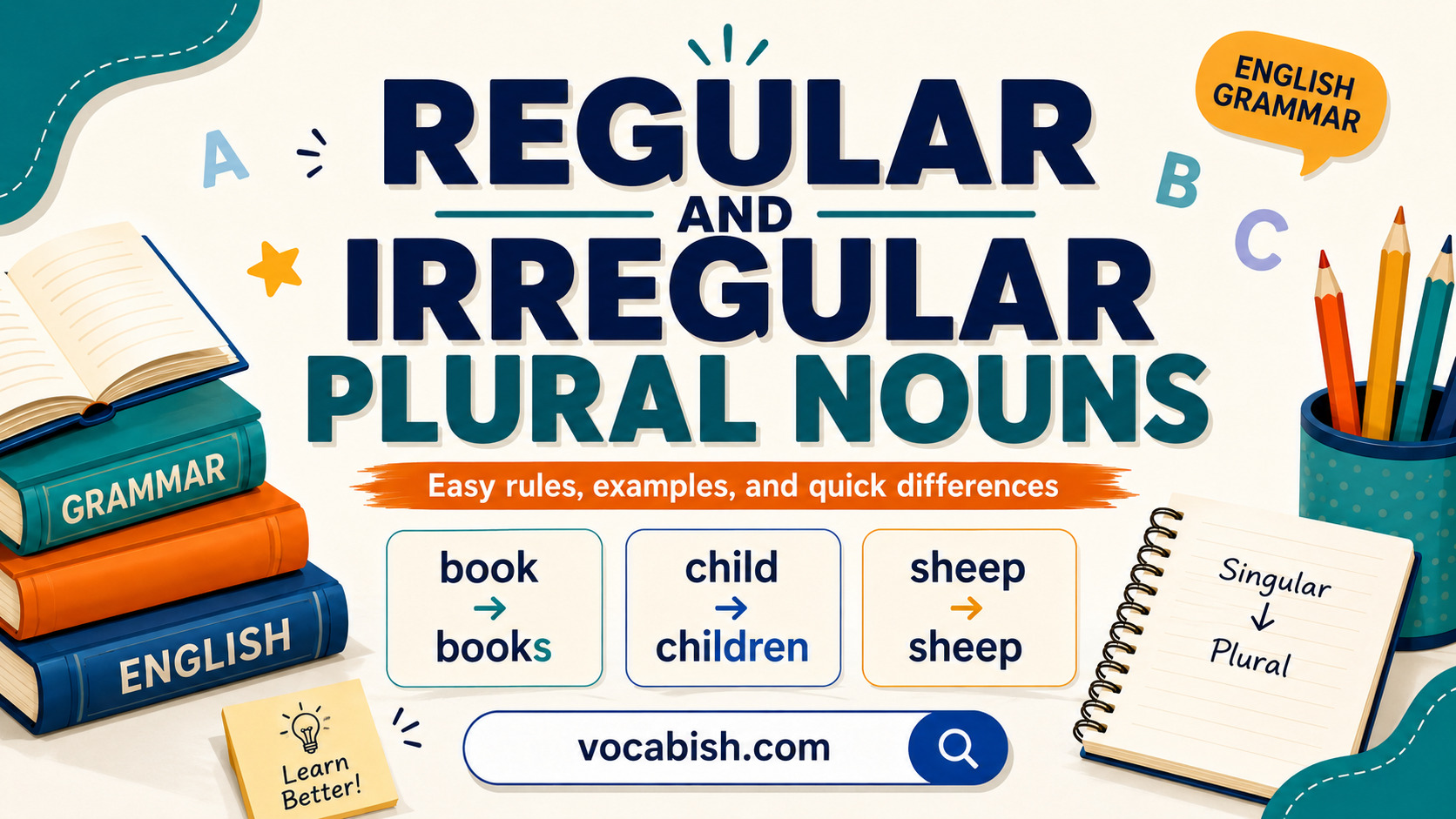
Regular Plurals
Most nouns form the plural by adding -s:
- book → books
- car → cars
- teacher → teachers
- table → tables
Nouns ending in -s, -sh, -ch, -x, or -z often take -es:
- bus → buses
- dish → dishes
- watch → watches
- box → boxes
Some nouns ending in consonant + y change y to i and add -es:
- city → cities
- baby → babies
- story → stories
When a vowel comes before the y, usually add only -s:
- boy → boys
- key → keys
- day → days
Irregular Plurals
Some common nouns have irregular plural forms:
- man → men
- woman → women
- child → children
- person → people
- tooth → teeth
- foot → feet
- mouse → mice
Other nouns have the same singular and plural form:
- sheep → sheep
- deer → deer
- fish → fish
In some contexts, fishes is used when discussing different species of fish, especially in scientific writing.
Related Resources: Singular and Plural Nouns in English
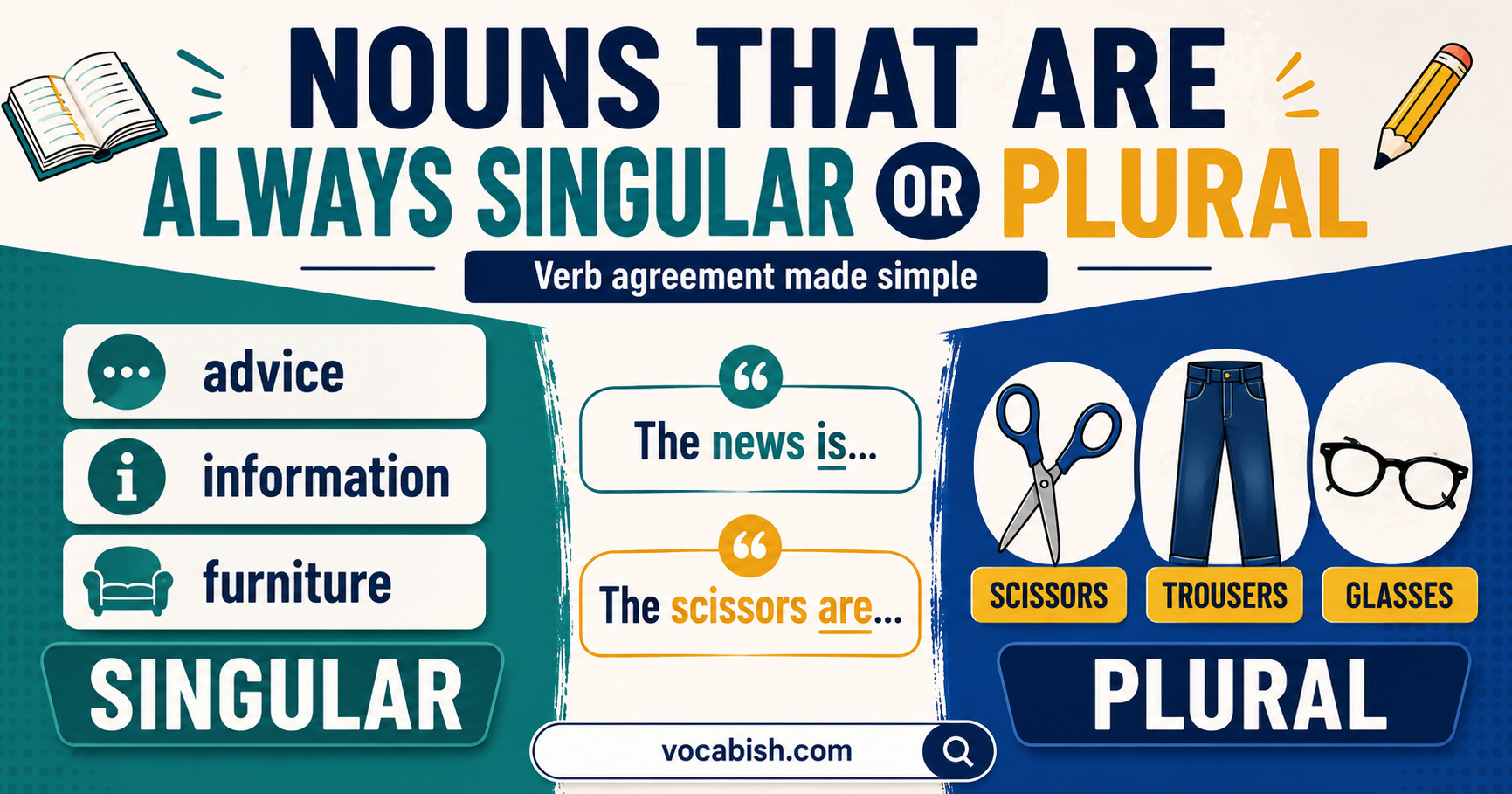
Nouns Used Only or Mainly in the Plural
Some common nouns are normally plural:
- scissors
- trousers
- glasses
- clothes
- shorts
We say:
- These scissors are sharp.
- My trousers are too long.
To count them, use a pair:
- a pair of scissors
- two pairs of trousers
Countable and Uncountable Common Nouns
Common nouns can be countable or uncountable.
Countable Common Nouns
Countable nouns refer to things that can be counted individually.
Examples:
- one chair, three chairs
- one apple, five apples
- one teacher, ten teachers
- one idea, several ideas
They can use a or an in the singular:
- a book
- a student
- an umbrella
- an idea
They can also use quantity words such as:
- many
- few
- several
- a number of
Examples:
- There are many shops nearby.
- She asked several questions.
- Only a few students were late.
Uncountable Common Nouns
Uncountable nouns are not normally counted as individual units.
Examples:
- water
- rice
- information
- advice
- furniture
- music
- traffic
- equipment
They do not normally take a or an, and they usually do not have plural forms.
Correct:
- some information
- useful advice
- new furniture
- heavy traffic
Incorrect:
- an information
- two advices
- many furnitures
- several traffics
To express quantity, use a measuring phrase:
- a piece of information
- two pieces of advice
- an item of furniture
- a glass of water
- three bags of rice
Some common nouns can be countable in one meaning and uncountable in another.
Chicken
- We ate chicken for dinner.
Here, chicken means meat and is uncountable. - Three chickens were walking in the yard.
Here, chickens means individual animals and is countable.
Paper
- I need some paper.
The material is uncountable. - I submitted two papers.
The word means written assignments and is countable.
Coffee
- She drinks coffee every morning.
It refers to the drink in general. - We ordered three coffees.
It means three cups or servings.
The sentence meaning helps you decide how the noun is being used.
Can a Common Noun Become a Proper Noun?
Yes. A common noun can become part of a proper name.
For example:
- river → River Avon
- school → Hilltop School
- street → King Street
- doctor → Doctor Ahmed
- hotel → Grand Palace Hotel
The word street is a common noun in this sentence:
- The shop is on a quiet street.
It becomes part of a proper noun here:
- The shop is on King Street.
A common noun can also become a brand or official title:
- apple — a type of fruit
- Apple — a company name
- target — a goal or object
- Target — a company name
- amazon — a powerful woman or geographical term in some contexts
- Amazon — a company or the name of a river and region
The capital letter signals that the word is being used as a specific name.
The opposite can also happen. A proper noun may sometimes be used informally as a common noun when it represents a type or style.
For example:
- He thinks he is an Einstein.
Here, Einstein does not literally mean the scientist Albert Einstein. It means a very intelligent person. This is a figurative use, and capitalization is usually retained because the word comes from a personal name.
Common Mistakes with Common Nouns
1: Capitalizing Every Important Word
Incorrect:
- My Brother works in a Hospital.
- The Students entered the Classroom.
Correct:
- My brother works in a hospital.
- The students entered the classroom.
Importance does not control capitalization. General names remain lowercase.
2: Forgetting Capitals in Proper Names
Incorrect:
- We travelled from lahore to islamabad.
- She speaks english.
Correct:
- We travelled from Lahore to Islamabad.
- She speaks English.
The words are proper nouns because they are specific names.
3: Using a Singular Countable Noun Without a Determiner
Incorrect:
- She bought book.
- I saw dog outside.
Correct:
- She bought a book.
- I saw a dog outside.
- She bought the book.
- I saw your dog outside.
A singular countable noun usually needs an article, possessive, demonstrative, or another determiner.
4: Adding Plural Endings to Uncountable Nouns
Incorrect:
- I need more informations.
- She gave me good advices.
- They bought expensive furnitures.
Correct:
- I need more information.
- She gave me good advice.
- They bought expensive furniture.
5: Confusing a General Name with an Official Name
Incorrect:
- We visited the National museum.
- He studies at Greenwood university.
Correct:
- We visited the National Museum.
- He studies at Greenwood University.
When the words form an official name, the main words are capitalized.
6: Treating Every Capitalized Noun as a Proper Noun
Consider:
- Children enjoy stories.
Children begins with a capital letter, but it is still a common noun. It is capitalized only because it starts the sentence.
7: Using “Much” with Countable Plural Nouns
Incorrect:
- There are much cars outside.
Correct:
- There are many cars outside.
Use many with countable plural nouns and much with uncountable nouns:
- many cars
- much traffic
Practice Exercise
A: Find the Common Nouns
Identify the common nouns in each sentence.
- The nurse carried a tray into the room.
- Our neighbour owns a small bakery.
- The children watched a bird in the garden.
- Patience can make learning easier.
- My brother left his phone on the table.
- A crowd gathered near the station.
- The artist painted a picture of the village.
- We need more sugar for the cake.
B: Common or Proper Noun?
Write common or proper for the bold noun.
- We travelled to Turkey last year.
- The country has many beautiful beaches.
- My teacher gave us extra homework.
- Mrs Harris teaches mathematics.
- They crossed the river by boat.
- The Amazon River is in South America.
- We have a meeting on Tuesday.
- The day began with heavy rain.
C: Correct the Capitalization
Rewrite these sentences correctly.
- My Uncle works at a Bank.
- We visited london in april.
- The Teacher opened the Classroom door.
- Sara bought a book from City Bookshop.
- The Children played in central park.
D: Choose the Correct Form
- She gave me two useful advices / pieces of advice.
- There are many chair / chairs in the hall.
- We need more information / informations.
- A student / students is waiting outside.
- My trouser / trousers are too long.
- He ordered three coffee / coffees for the group.
Answers and Explanations
A
- nurse, tray, room
- neighbour, bakery
- children, bird, garden
- patience, learning
- brother, phone, table
- crowd, station
- artist, picture, village
- sugar, cake
All of these words are general names rather than specific names.
B
- Turkey — proper noun
- country — common noun
- teacher — common noun
- Mrs Harris — proper noun
- river — common noun
- Amazon River — proper noun
- Tuesday — proper noun
- day — common noun
C
- My uncle works at a bank.
- We visited London in April.
- The teacher opened the classroom door.
- Sara bought a book from City Bookshop.
- The children played in Central Park.
D
- She gave me two useful pieces of advice.
- There are many chairs in the hall.
- We need more information.
- A student is waiting outside.
- My trousers are too long.
- He ordered three coffees for the group.
In the final sentence, coffees means three cups or servings of coffee, so it is countable. For more practice you may visit our worksheet page: Common Nouns Worksheet
FAQs About Common Nouns
A common noun is a general name for a person, place, animal, object, feeling, idea, or activity. Examples include teacher, city, dog, chair, and happiness.
Ten common noun examples are:
student, mother, school, park, cat, table, phone, water, friendship, music
Yes, school is a common noun when it refers to a school in general.
The children walked to school.
It becomes part of a proper noun when it appears in an official name:
They attend Greenwood School.
A common noun gives a general name, while a proper noun identifies a specific person, place, organization, or thing.
city — common noun
Paris — proper noun
teacher — common noun
Mr Khan — proper noun
Yes, mother is usually a common noun.
My mother is cooking.
It may be capitalized when it is used as a name or direct form of address:
I asked Mother for help.
General animal names such as dog, cat, elephant, and rabbit are common nouns. A personal animal name, such as Bruno or Bella, is a proper noun.
Yes. Words such as love, courage, patience, and freedom are common nouns because they are general names. They are also abstract nouns because they name feelings, qualities, or ideas.
Many common nouns are countable, including book, student, car, and idea. Other common nouns, such as water, advice, and furniture, are uncountable.
Final Thoughts
Common nouns help us name the ordinary people, places, animals, objects, ideas, and feelings we discuss every day. Words such as doctor, village, horse, computer, and happiness are common nouns because they describe general categories rather than specific names.
To use them correctly, remember these points:
- Common nouns usually begin with lowercase letters.
- Proper nouns begin with capital letters.
- Singular countable nouns generally need a determiner.
- Common nouns may be singular, plural, countable, or uncountable.
- A common noun can become part of a proper name.
- A capital letter at the beginning of a sentence does not change a common noun into a proper noun.
As you read or listen to English, notice how general names and specific names work together. That simple habit will make noun identification, capitalization, article use, and sentence building much easier.
You May Also Like