
Countable nouns name people, animals, places, objects, and ideas that we can count as separate units. They are among the most commonly used nouns in English.
You can count them with numbers:
- one student
- two chairs
- three questions
- four cities
- five mistakes
A countable noun can usually appear in both singular and plural forms.
Singular | Plural |
|---|---|
a book | books |
an apple | apples |
a child | children |
a city | cities |
an idea | ideas |
Knowing whether a noun is countable helps you choose the correct article, plural form, verb, and quantity word.
What Is a Countable Noun?
A countable noun is a noun that refers to something we can count individually.
For example, a classroom may contain one teacher, twenty students, thirty desks, and several windows. Each of these nouns represents separate people or objects, so they are countable.
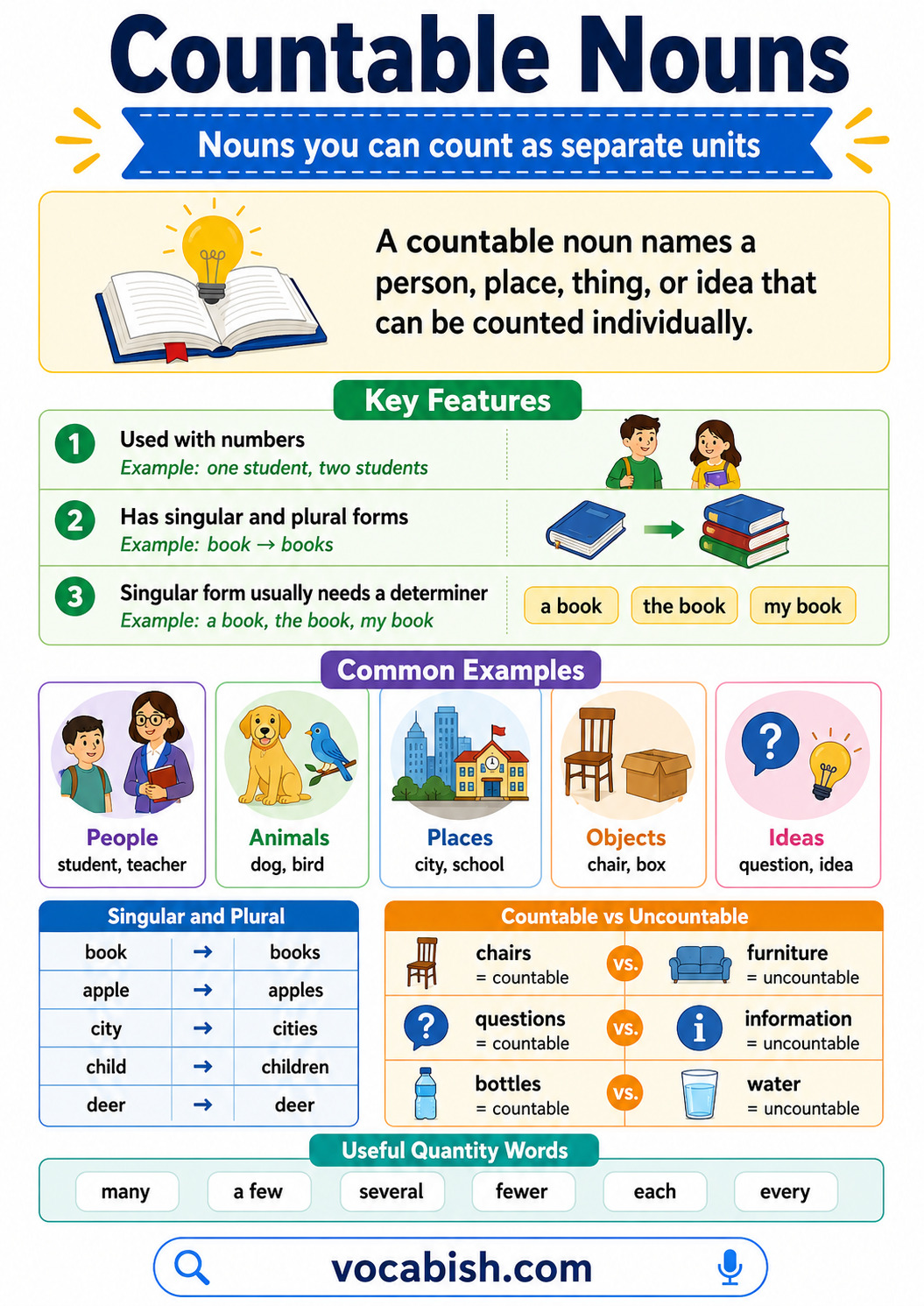
Countable nouns have three main features:
- They can be used with numbers: three dogs
- They usually have singular and plural forms: dog–dogs
- Their singular forms normally need a determiner: a dog, the dog, my dog
Countable nouns do not only name physical objects. Ideas and events can also be countable when we treat them as separate units.
- She gave me two useful suggestions.
- We had an interesting conversation.
- The team faced several problems.
- He told us a funny story.
Although you cannot touch a suggestion or conversation, you can count individual suggestions and conversations.
Singular and Plural Countable Nouns
A singular countable noun refers to one person, place, object, or idea.
- a student
- one answer
- the building
- my friend
A plural countable noun refers to two or more.
- students
- two answers
- the buildings
- my friends
The noun form often affects the verb used in the sentence.
- The student is waiting.
- The students are waiting.
- This answer seems correct.
- These answers seem correct.
Most singular countable nouns cannot stand alone without a word before them.
Incorrect:
- I bought book.
- Teacher entered the room.
- She needs umbrella.
Correct:
- I bought a book.
- The teacher entered the room.
- She needs an umbrella.
Plural countable nouns can appear without an article when speaking generally.
- Books can teach us new ideas.
- Teachers need patience.
- Smartphones are useful tools.
Regular Plural Forms
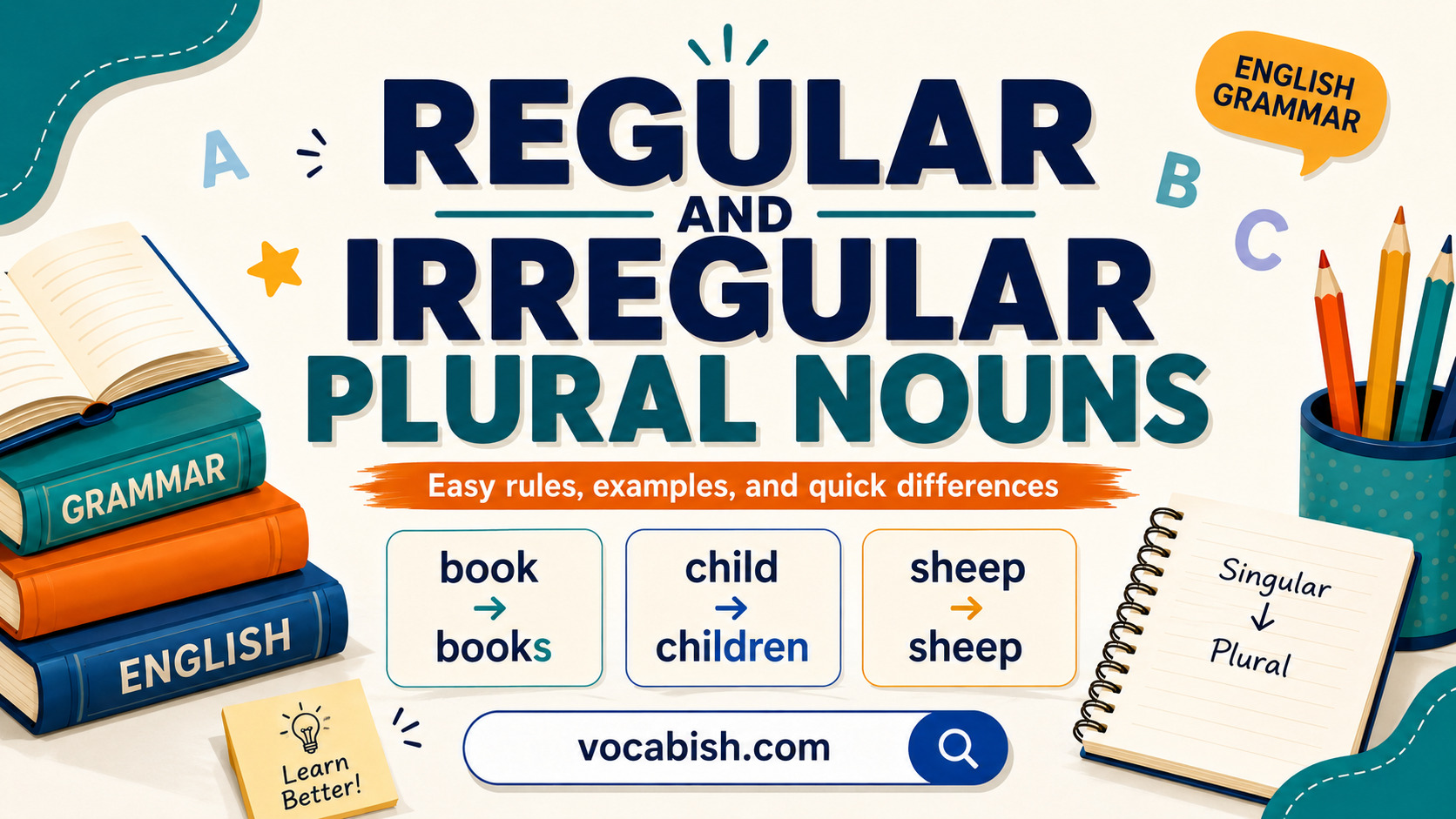
Most countable nouns form their plurals by adding -s.
Singular | Plural |
|---|---|
chair | chairs |
lesson | lessons |
student | students |
computer | computers |
Nouns ending in -s, -ss, -sh, -ch, -x, or -z usually take -es.
Singular | Plural |
|---|---|
bus | buses |
class | classes |
dish | dishes |
watch | watches |
box | boxes |
When a noun ends in a consonant followed by -y, change y to i and add -es.
- city → cities
- story → stories
- family → families
- country → countries
When a vowel comes before -y, simply add -s.
- day → days
- key → keys
- boy → boys
- journey → journeys
Some nouns ending in -f or -fe change to -ves.
- leaf → leaves
- knife → knives
- wife → wives
- life → lives
However, this pattern does not apply to every noun ending in -f.
- roof → roofs
- chef → chefs
- belief → beliefs
Some nouns ending in -o take -es, while others take only -s.
- tomato → tomatoes
- potato → potatoes
- hero → heroes
- photo → photos
- piano → pianos
- video → videos
Because these endings are not completely predictable, learning the plural together with the singular form is helpful.
Irregular Plural Forms
Irregular countable nouns do not form their plurals by simply adding -s or -es.
Singular | Plural |
|---|---|
man | men |
woman | women |
child | children |
person | people |
tooth | teeth |
foot | feet |
mouse | mice |
goose | geese |
A few nouns have the same form in the singular and plural.
- one sheep → ten sheep
- one deer → several deer
- one fish → many fish
Fish is the usual plural when talking about several individual fish. Fishes may be used when referring to different species.
Some words borrowed from other languages keep traditional plural forms, especially in formal or academic English.
- analysis → analyses
- criterion → criteria
- phenomenon → phenomena
- basis → bases
In everyday English, certain borrowed nouns may also use regular plural forms.
- formula → formulas or formulae
- index → indexes or indices
Articles Used with Countable Nouns
Articles help show whether a countable noun is general, specific, singular, or already known.
The three English articles are:
- a
- an
- the
The choice depends on the noun’s number, sound, and meaning.
Compare:
- I saw a dog outside.
- The dog was standing near the gate.
- Dogs often enjoy playing outdoors.
The first sentence introduces one dog. The second refers to that specific dog. The third discusses dogs in general.
Using “A” and “An”
Use a or an before a singular countable noun when mentioning one nonspecific person or thing.
- I need a pen.
- She bought a dress.
- He asked a question.
- We saw an accident.
Use a before a consonant sound.
- a car
- a university
- a European country
- a useful guide
Although university, European, and useful begin with vowel letters, they begin with a consonant sound similar to y.
Use an before a vowel sound.
- an apple
- an hour
- an honest person
- an interesting book
The h in hour and honest is silent, so both words begin with a vowel sound.
Use a or an when describing someone’s job or identity.
- She is a doctor.
- He wants to become an engineer.
- My sister is a university student.
Do not use a or an with plural countable nouns.
Incorrect:
- a books
- an ideas
- a children
Correct:
- books
- some ideas
- three children
Using “The”
Use the with singular or plural countable nouns when the listener or reader knows which person or thing you mean.
- Please close the window.
- I returned the books you lent me.
- The students in this class are preparing for an exam.
A noun may become specific because it was mentioned earlier.
- I saw a bicycle near the shop. The bicycle had a broken wheel.
Use the when additional information identifies the noun.
- The woman wearing a red coat is my aunt.
- The keys on the table belong to Ali.
- The restaurant near our office serves Italian food.
The definite article can also refer to a unique person, object, or position in a particular situation.
- the principal of our school
- the first chapter
- the only answer
- the tallest building in the city
Do not automatically use the with plural countable nouns when making a general statement.
- Cats are independent animals.
- Children learn through play.
- Cars produce pollution.
Using the would make these nouns refer to a specific group.
- The cats in our garden are sleeping.
- The children in this room are quiet.
- The cars outside belong to our guests.
Using Singular Countable Nouns Correctly
A singular countable noun normally needs an article, possessive, demonstrative, number, or another determiner.
Correct patterns include:
- a message
- the message
- my message
- this message
- one message
- each message
- every message
A common learner mistake is using a singular countable noun without any determiner.
Incorrect:
- She is reading newspaper.
- We stayed in hotel.
- He made mistake.
Correct:
- She is reading a newspaper.
- We stayed in a hotel.
- He made a mistake.
A singular countable noun also takes a singular verb.
- This machine works well.
- Every student has a workbook.
- One window was open.
Words such as each and every are followed by singular countable nouns.
- each employee
- every lesson
- each question
- every opportunity
Incorrect:
- every students
- each books
Correct:
- every student
- each book
Quantity Words Used with Countable Nouns
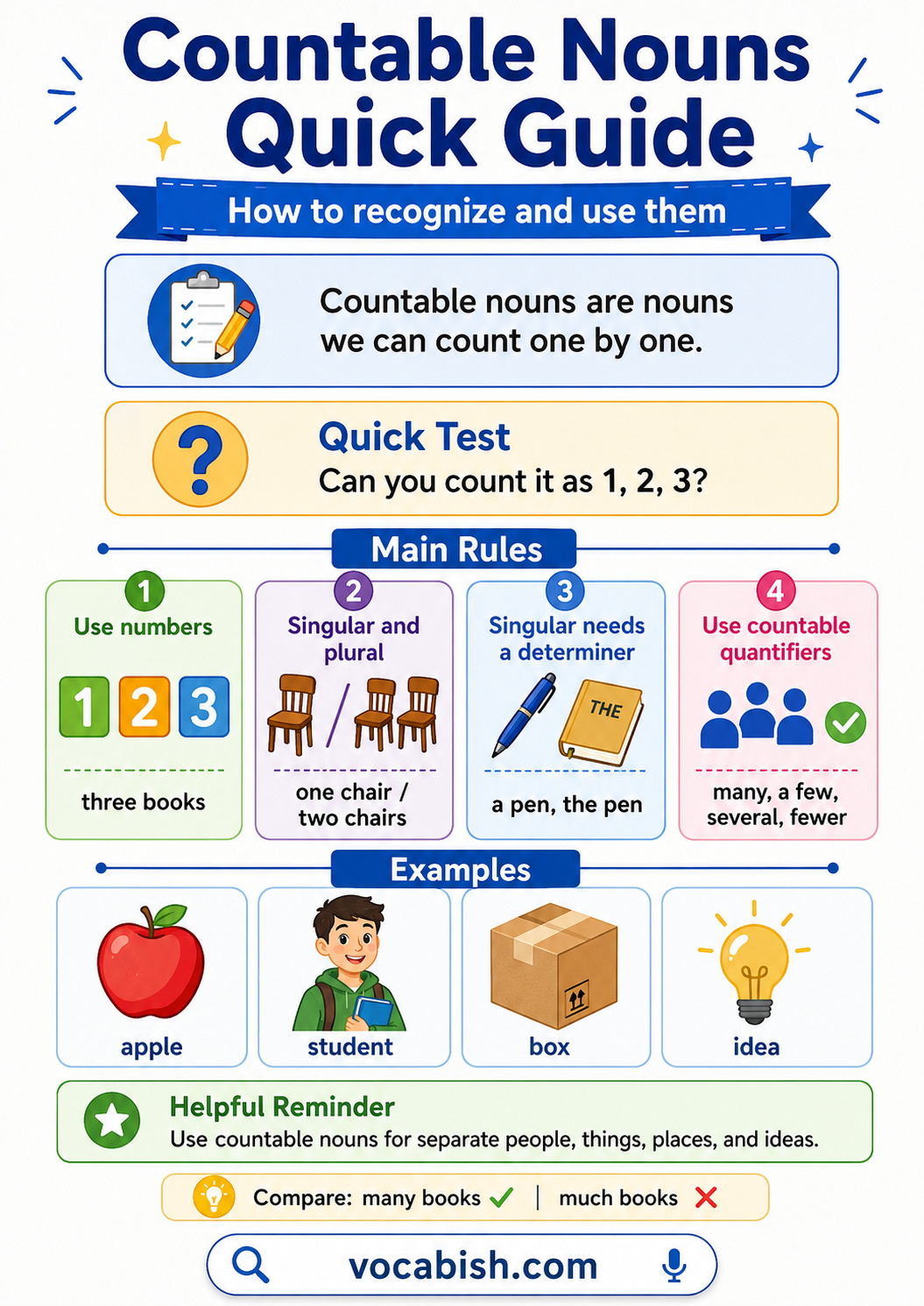
Quantity words show how many people or things are being discussed.
Many
Use many with plural countable nouns, especially in questions and negative sentences.
- How many languages do you speak?
- There are not many seats available.
- Many students use online dictionaries.
A few and few
A few means a small but useful or positive number.
- I have a few questions.
- We invited a few friends.
- She made a few changes to the report.
Few means almost none and often expresses a negative idea.
- Few students understood the final question.
- He has few opportunities to practise English.
Several
Several means more than two but not a large number.
- Several customers complained.
- I visited the museum several times.
- She suggested several solutions.
A number of
Use a number of with a plural countable noun and a plural verb.
- A number of employees are working remotely.
- A number of problems have appeared.
Do not confuse this with the number of, which takes a singular verb.
- The number of employees is increasing.
- The number of errors has fallen.
Fewer
Use fewer when comparing numbers of countable nouns.
- This class has fewer students than the other class.
- We made fewer mistakes this time.
- Fewer people attended the meeting.
Some, any, enough, and a lot of
These quantity words can be used with plural countable nouns.
- We bought some chairs.
- Do you have any questions?
- There are enough plates for everyone.
- A lot of visitors come here in summer.
Each, every, and both
Use each and every with singular countable nouns.
- Each participant received a certificate.
- Every room has a window.
Use both with plural countable nouns when referring to two.
- Both answers are correct.
- Both children were laughing.
Countable Nouns in Sentences
The following sentences show countable nouns in different situations:
- A customer left a message for the manager.
- Three birds were sitting on the roof.
- My brother has two part-time jobs.
- We need several boxes for these books.
- Each applicant must complete a form.
- There are a few spelling mistakes in your paragraph.
- The neighbours invited us to a party.
- Many shops close early on Sundays.
- That student asked an excellent question.
- Fewer buses operate during the holiday.
- Every employee received a new ID card.
- The two buildings have separate entrances.
Notice how articles, numbers, possessives, demonstratives, and quantity words help complete the meaning of each noun.
Countable Nouns vs Uncountable Nouns
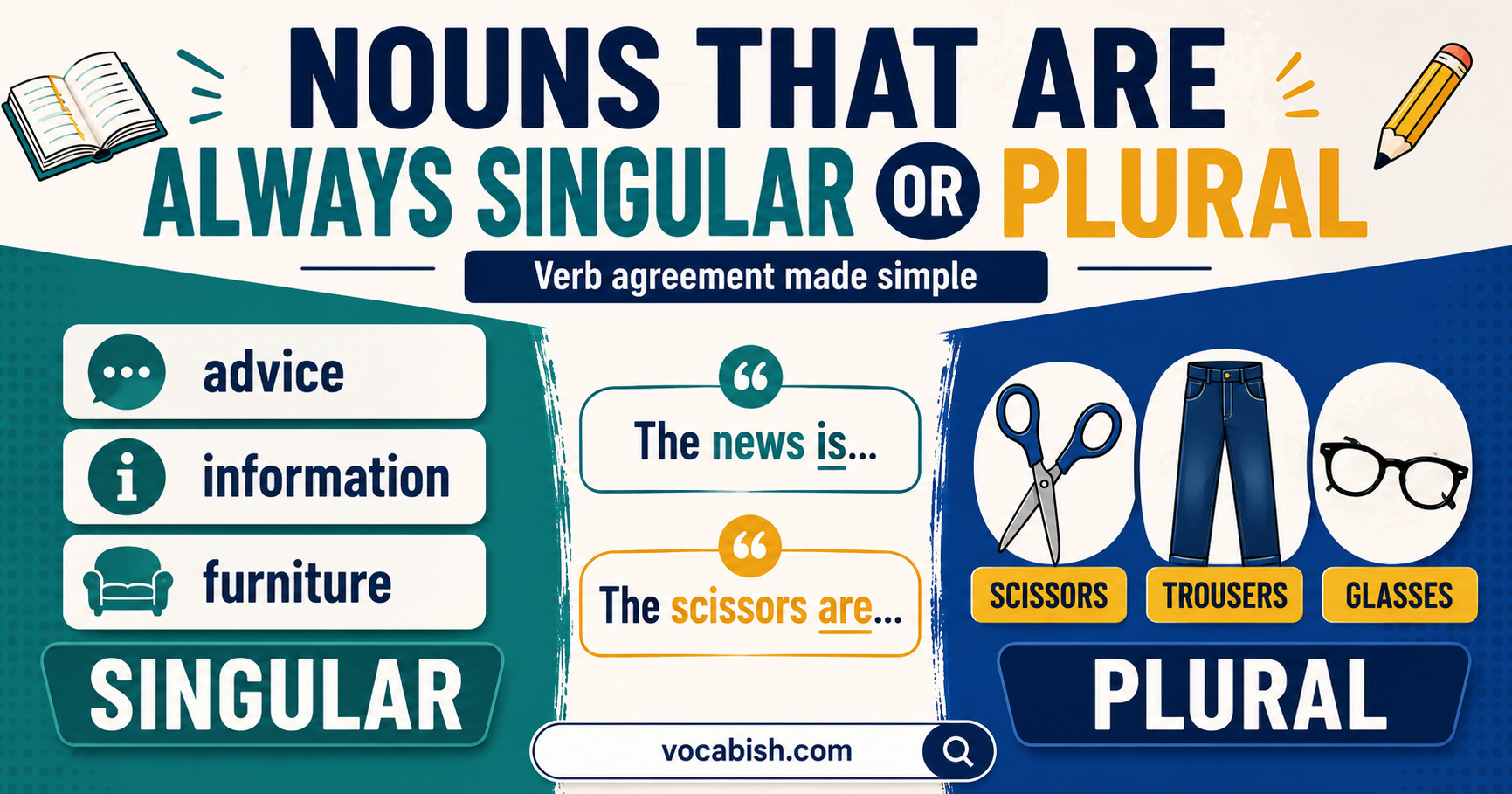
Countable nouns refer to separate items that can be counted. Uncountable nouns refer to substances, materials, activities, or general ideas not normally divided into individual units.
Countable Nouns | Uncountable Nouns |
|---|---|
a chair, two chairs | furniture |
a coin, five coins | money |
an idea, several ideas | information |
a suitcase, three suitcases | luggage |
a task, many tasks | work |
a bottle, four bottles | water |
Countable nouns can use numbers directly.
- two chairs
- five coins
- three suitcases
Uncountable nouns do not usually take direct numbers or plural endings.
Incorrect:
- two furnitures
- five informations
- three luggages
Correct:
- two pieces of furniture
- five pieces of information
- three items of luggage
Use many, a few, and fewer with plural countable nouns.
- many books
- a few questions
- fewer mistakes
Use much, a little, and less with uncountable nouns.
- much time
- a little information
- less traffic
Some quantity expressions work with both types.
- some books / some water
- a lot of problems / a lot of work
- enough chairs / enough space
- no questions / no information
Here’s a complete guide: Countable and Uncountable Nouns
Nouns That Can Be Countable or Uncountable
Some nouns can be countable or uncountable depending on their meaning.
Chicken
Chicken is uncountable when it means meat.
- We had chicken for dinner.
It is countable when it means an animal.
- There are six chickens on the farm.
Paper
Paper is uncountable when it means the material.
- I need some paper for the printer.
It is countable when it means a newspaper, academic article, or written document.
- She published three research papers.
- I bought a morning paper.
Glass
Glass is uncountable when it refers to the material.
- The door is made of glass.
It is countable when it means a drinking container.
- Please bring two glasses.
Hair
Hair is usually uncountable when referring to the hair on someone’s head.
- Her hair is very long.
It becomes countable when referring to individual strands.
- I found two hairs on my jacket.
Experience
Experience is uncountable when it means knowledge gained through work or life.
- She has experience in customer service.
It is countable when it means a particular event.
- Travelling alone was an unforgettable experience.
- We had several strange experiences during the trip.
Coffee
Coffee is generally uncountable when referring to the drink.
- I do not drink much coffee.
In cafés and restaurants, it can be countable when it means cups or servings.
- We ordered two coffees.
Time
Time is uncountable when it refers to the general concept.
- I do not have enough time.
It is countable when it means an occasion.
- I called him three times.
- We had a wonderful time at the wedding.
Common Mistakes with Countable Nouns
- Leaving out an article before a singular countable noun
Incorrect: She bought new phone.
Correct: She bought a new phone. - Using “a” or “an” with a plural noun
Incorrect: He gave me an instructions.
Correct: He gave me some instructions. - Using an uncountable quantity word
Incorrect: There are much students here.
Correct: There are many students here. - Forgetting the plural ending after a number
Incorrect: We stayed for three day.
Correct: We stayed for three days. - Using a plural noun after “each” or “every”
Incorrect: Every employees received an email.
Correct: Every employee received an email. - Using “less” instead of “fewer” with countable nouns
Less is common in informal signs and speech, but fewer is the standard choice when individual items are counted.
Better: We received fewer complaints this month. - Making irregular plurals regular
Incorrect: childs, womans, tooths
Correct: children, women, teeth - Using a plural verb with a singular noun
Incorrect: This problem are difficult.
Correct: This problem is difficult.
Countable Noun Practice Exercise
Choose the correct answer for each sentence.
- She bought a new laptop / new laptop yesterday.
- How many / much questions did the students ask?
- There are only a few / a little tickets left.
- Every applicant / applicants must bring identification.
- We saw three deer / deers near the road.
- He gave me two useful advices / pieces of advice.
- The company received fewer / less complaints this week.
- I ordered a coffee / coffee at the café.
- One of the window / windows is broken.
- She has several interesting idea / ideas.
- A number of employees is / A number of employees are absent today.
- He made a mistake / mistake in the final paragraph.
- There were not many / much people at the event.
- Each child has / children have a separate locker.
- We need five more box / boxes.
Answers and Explanations
- A new laptop
Laptop is a singular countable noun, so it needs an article or another determiner. - Many
Use many with plural countable nouns such as questions. - A few
Tickets is plural and countable. A few means that a small number remains. - Applicant
Every is followed by a singular countable noun. - Deer
The singular and plural forms of deer are the same. - Pieces of advice
Advice is uncountable, so use a counting expression such as pieces of advice. - Fewer
Use fewer with plural countable nouns such as complaints. - A coffee
In a café, a coffee commonly means one cup or serving of coffee. - Windows
The pattern is one of the + plural noun. - Ideas
Several is followed by a plural countable noun. - A number of employees are
A number of means several and takes a plural verb. - A mistake
A singular countable noun normally needs an article or another determiner. - Many
People is a plural countable noun, so many is correct. - Each child has
Each takes a singular noun and a singular verb. - Boxes
A noun used after a number greater than one must normally be plural.
FAQs About Countable Nouns
Most countable nouns have plural forms, but some, including deer and sheep, keep the same spelling in both singular and plural uses.
A singular countable noun normally needs an article, possessive, demonstrative, number, or another determiner to make its meaning grammatically complete.
Yes. People is the usual plural of person and can be used with numbers and quantity words such as many or several.
Common quantifiers for countable nouns include many, a few, few, several, fewer, both, each, every, and a number of.
Yes. Some is used with plural countable nouns when the exact number is unknown, unimportant, or unnecessary to mention.
Yes. Nouns such as paper, chicken, coffee, and experience can change category when their meaning or use changes within a sentence.
Fewer is traditionally used for separate countable items, while less is used for uncountable amounts such as time, water, or money.
Summary on Countable Nouns
Countable nouns name people, places, objects, animals, or ideas that can be counted, such as one book, two chairs, or three questions. They have singular and plural forms and often use articles like a, an, and the. Singular countable nouns usually need a determiner, while plural forms can appear alone when used generally.
Most countable nouns form regular plurals with -s or -es, while others have irregular forms, such as child–children and person–people. Common quantity words used with countable nouns include many, a few, several, fewer, each, every, and both.
Countable nouns differ from uncountable nouns because they can be used directly with numbers. Some nouns, including coffee, paper, chicken, and experience, can be countable or uncountable depending on their meaning. Correct use requires attention to articles, plural endings, quantifiers, and subject-verb agreement.
You May Also Like