
Imagine that you walk into a kitchen early in the morning. You see a window, hear a kettle, touch a cold glass, smell fresh bread, and taste warm tea.
Each bold word names something you can experience through your senses. These words are concrete nouns.
Concrete nouns help us describe the physical world. They name people, animals, places, objects, substances, sounds, smells, foods, and events that can be seen, heard, touched, smelled, or tasted.
Some are easy to recognize, such as chair or dog. Others need a little more thought. You cannot hold thunder in your hand, for example, but you can hear it. That sensory experience makes thunder a concrete noun.
What Is a Concrete Noun?
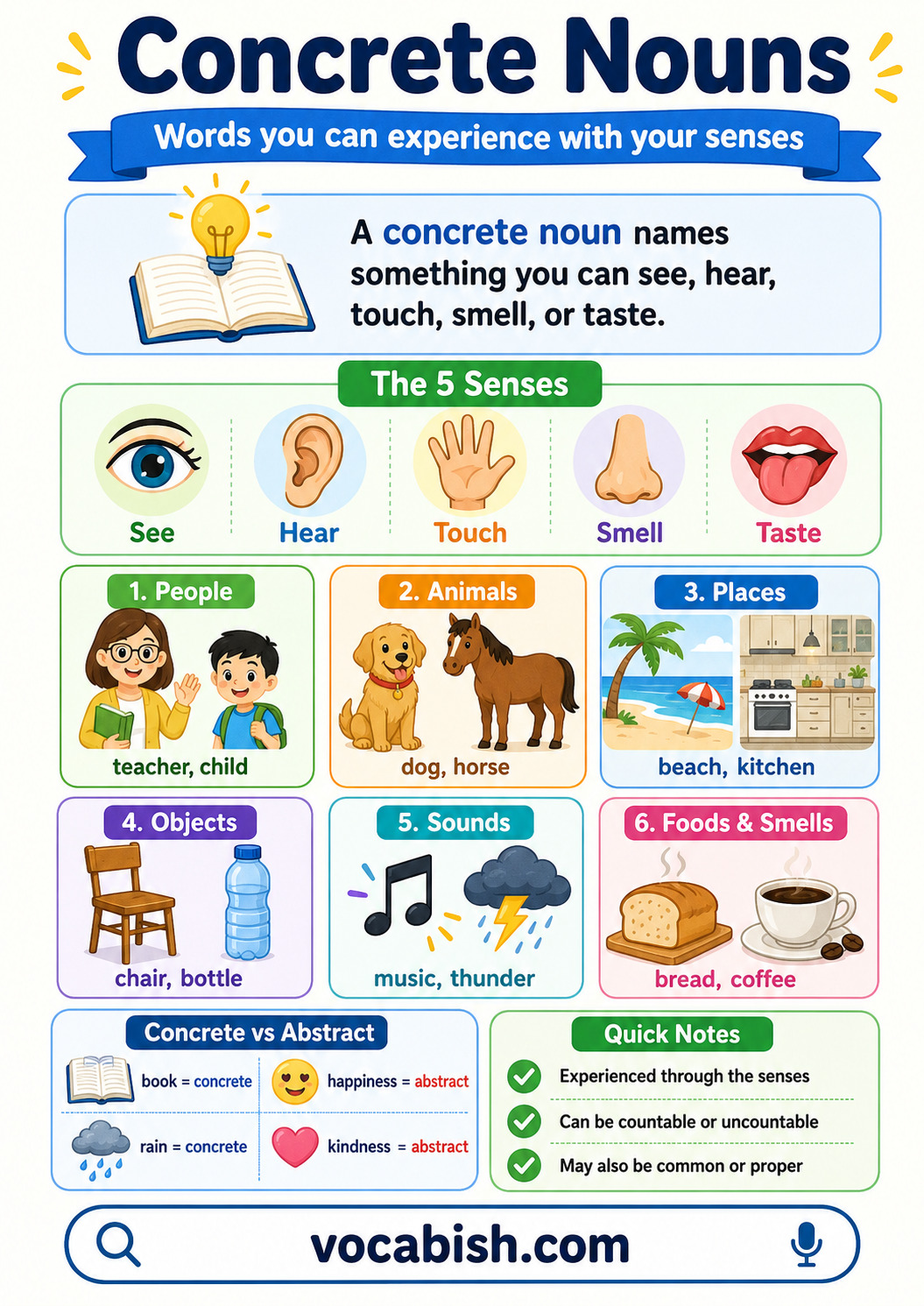
A concrete noun names something that can be experienced through one or more of the five senses.
The five senses are:
- sight
- hearing
- touch
- smell
- taste
Common examples of concrete nouns include:
- child
- horse
- street
- bottle
- rain
- music
- perfume
- chocolate
A concrete noun does not have to be solid. It only needs to refer to something that can be physically experienced.
Consider these sentences:
- The cat is sleeping on the sofa.
- We heard loud thunder.
- Her perfume filled the room.
- The soup tastes salty.
- Cold rain touched my face.
The nouns cat, thunder, perfume, soup, and rain connect with the senses. They are concrete nouns.
A Quick Sensory Test
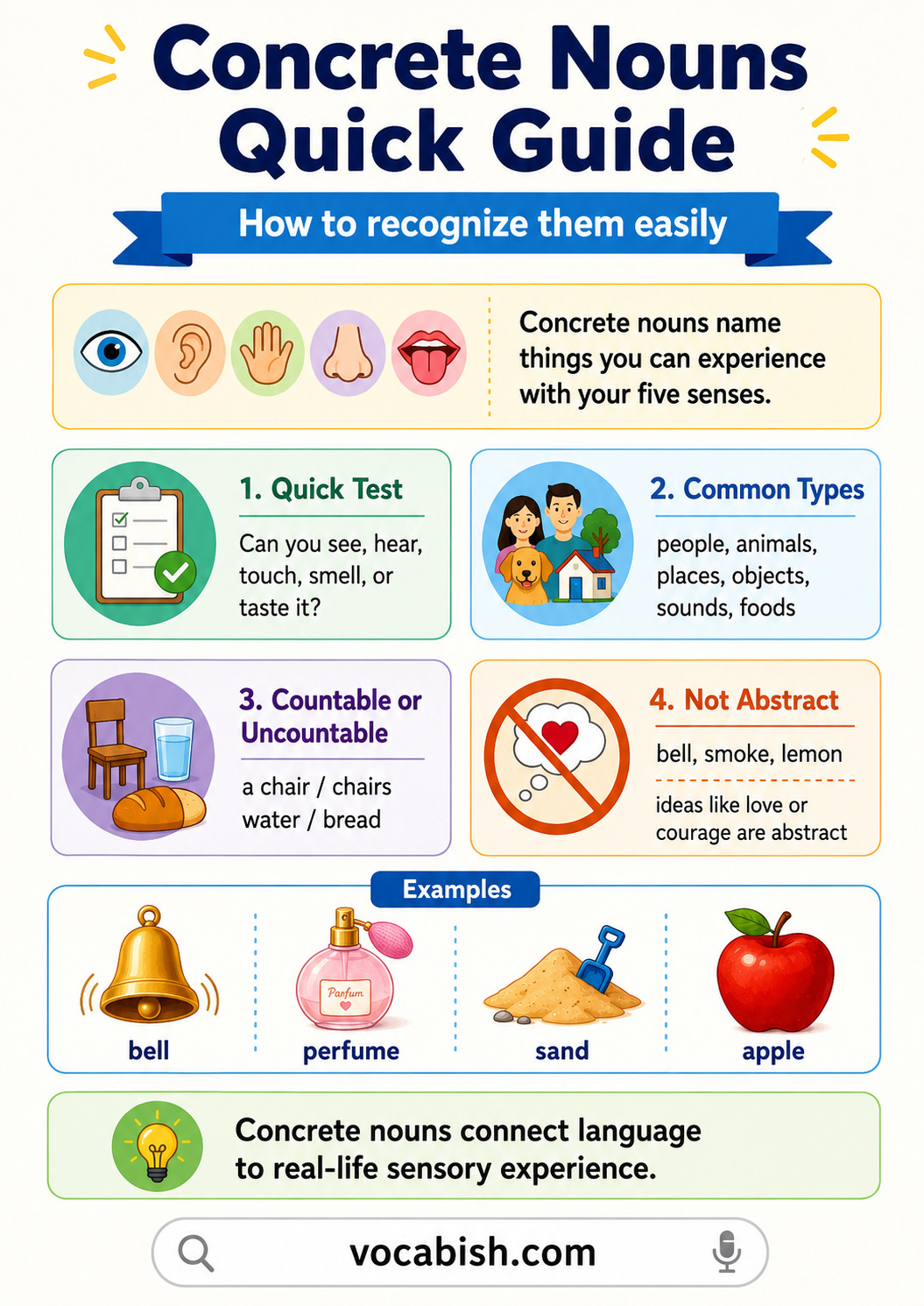
When you are unsure whether a noun is concrete, ask:
Can I see, hear, touch, smell, or taste what this noun names?
If the answer is yes, the noun is probably concrete.
Noun | Sensory experience |
|---|---|
rainbow | seen |
bell | seen, heard, and touched |
smoke | seen and smelled |
velvet | seen and touched |
lemon | seen, touched, smelled, and tasted |
thunder | heard |
wind | felt and sometimes heard |
coffee | seen, smelled, and tasted |
Some things connect with several senses. A lemon, for example, can be seen, touched, smelled, and tasted. It remains one concrete noun even though several senses are involved.
Understanding Concrete Nouns Through the Five Senses
The five-senses method is useful, but it should not be treated as a mechanical rule. Context still matters. A word may describe a physical experience in one sentence and a non-physical idea in another.
Start with clear examples before looking at more complex cases.
Things We Can See
Many concrete nouns name visible people, animals, places, and objects.
Examples:
- teacher
- baby
- mountain
- bicycle
- eagle
- building
- cloud
- river
- notebook
- candle
In sentences:
- A cloud covered the sun.
- The teacher stood beside the board.
- An eagle flew over the mountain.
- She placed her notebook on the desk.
- We crossed the river by boat.
These nouns name things that can be seen. Most can also be experienced through other senses.
A candle, for instance, may be seen, touched, and smelled. A river can be seen, heard, and touched.
Things We Can Hear
A concrete noun can name a sound, even when the sound cannot be held or seen.
Examples:
- thunder
- music
- whistle
- laughter
- bell
- explosion
- voice
- applause
- cough
- alarm
Examples in context:
- The alarm woke everyone.
- We heard laughter in the hallway.
- Her voice sounded tired.
- Loud applause followed the performance.
- A sharp whistle came from the playground.
Some grammar books classify words such as music differently because music is not a solid object. For ESL learning, it is commonly treated as concrete when it refers to something physically heard.
Compare:
- Soft music was playing in the café.
- Her love of music began in childhood.
In the first sentence, music refers to an audible experience. In the second, it refers more broadly to an art form or area of interest. Depending on the grammar system being used, the second meaning may be discussed as less clearly concrete.
Things We Can Touch
Concrete nouns often name physical objects, materials, liquids, people, and animals.
Examples:
- stone
- blanket
- water
- sand
- kitten
- wall
- snow
- leather
- coin
- branch
In sentences:
- The blanket felt soft.
- She picked up a smooth stone.
- The child played in the sand.
- Cold snow covered the road.
- A thin branch touched the window.
Some touchable nouns are countable:
- one stone
- two coins
- three blankets
Others are usually uncountable:
- water
- sand
- snow
- leather
Being concrete does not automatically make a noun countable.
Related: Material Nouns Definition and Examples
Things We Can Smell
Smells and the sources of smells can be expressed with concrete nouns.
Examples:
- perfume
- smoke
- garlic
- soap
- coffee
- petrol
- flowers
- paint
- bread
- fragrance
In sentences:
- The garlic smelled strong.
- Fresh bread filled the kitchen with a pleasant smell.
- We noticed smoke near the building.
- Her perfume remained on the scarf.
- The room smelled of wet paint.
The noun smell itself can also be concrete when it refers to a particular sensory experience:
- A strange smell came from the cupboard.
- The smell of coffee woke him.
It can be countable when referring to one recognizable smell and uncountable in broader expressions.
Things We Can Taste
Food, drinks, ingredients, and flavours are commonly represented by concrete nouns.
Examples:
- apple
- milk
- sugar
- soup
- lemon
- bread
- honey
- rice
- chocolate
- salt
In sentences:
- The lemon tasted sour.
- She added sugar to her tea.
- This soup needs more salt.
- The children shared a bar of chocolate.
- Warm bread was served with the meal.
A food noun may be countable or uncountable depending on its meaning:
- I ate a chicken.
This would mean an entire individual chicken, though the sentence is unusual in ordinary situations. - We ate chicken.
Here, chicken means meat and is uncountable.
The noun remains concrete in both uses because it refers to something physically experienced.
Examples of Concrete Nouns by Category
Concrete nouns can be organized according to what they name. These categories often overlap.
People and Animals
Names for people and living creatures are normally concrete nouns.
People
- mother
- neighbour
- doctor
- driver
- child
- singer
- farmer
- customer
- athlete
- visitor
Animals
- tiger
- rabbit
- butterfly
- whale
- parrot
- horse
- ant
- puppy
- dolphin
- spider
Examples:
- The doctor examined the patient.
- A visitor knocked on the door.
- The rabbit disappeared into the grass.
- A small spider was hanging from the ceiling.
- The dolphin jumped above the water.
Names of specific people and animals are also concrete nouns, though they are proper nouns at the same time.
- Amina called her brother.
- Bruno chased the ball.
Amina and Bruno are proper nouns because they are individual names. They are also concrete because they name living beings who can be seen and touched.
Places
Physical locations are concrete nouns.
Examples:
- classroom
- beach
- market
- village
- kitchen
- hospital
- forest
- station
- garden
- island
In sentences:
- The children waited inside the classroom.
- We bought vegetables at the market.
- A narrow path led through the forest.
- The train arrived at the station.
- They spent the afternoon on the beach.
Specific place names can also be concrete:
- London
- Pakistan
- Lake Victoria
- Central Park
- Mount Fuji
These names are both proper and concrete nouns.
Objects
Objects are among the easiest concrete nouns to identify.
Examples:
- pencil
- table
- phone
- shoe
- suitcase
- key
- plate
- camera
- window
- umbrella
Examples in sentences:
- She opened the umbrella.
- I cannot find my key.
- The camera is inside the bag.
- A clean plate was placed on the table.
- His suitcase was too heavy.
Compound nouns can also be concrete:
- washing machine
- toothbrush
- bus stop
- coffee cup
- dining table
The number of words does not affect the category. Washing machine is a concrete noun because it names a physical object.
Substances and Materials
Concrete nouns can name things that do not have a fixed shape.
Examples:
- water
- oil
- cotton
- steel
- plastic
- flour
- dust
- gold
- air
- ice
In sentences:
- The bottle contains oil.
- Her dress is made of cotton.
- A thin layer of dust covered the shelf.
- The ring is made of gold.
- The lake was covered with ice.
These nouns are often uncountable because we usually measure them rather than count them individually.
We say:
- a glass of water
- a piece of cotton
- a sheet of plastic
- a bag of flour
- a bar of gold
Sounds, Smells, and Physical Events
Not every concrete noun names an object. Some name sensory experiences or events that happen in the physical world.
Sounds
- bang
- cry
- whisper
- roar
- knock
- scream
- echo
- applause
Smells
- scent
- fragrance
- odour
- aroma
- perfume
- smoke
Physical Events
- storm
- earthquake
- flood
- snowfall
- explosion
- collision
- rainfall
- fire
Examples:
- A loud bang came from the garage.
- We heard a soft whisper.
- The aroma of coffee filled the room.
- The storm damaged several trees.
- Heavy rainfall caused flooding.
An event such as a storm is concrete because it can be seen, heard, and felt. It occurs physically rather than existing only as an idea.
Concrete Nouns in Sentences
Concrete nouns can appear in different grammatical positions.
As the Subject
The subject performs an action or is described.
- The baby is crying.
- A bus stopped outside.
- The rain continued all night.
- Fresh bread smells wonderful.
As a Direct Object
A direct object receives the action of a verb.
- She washed the car.
- We heard the bell.
- He opened the window.
- The child ate an orange.
As an Indirect Object
An indirect object usually tells us who receives something.
- She gave the child a toy.
- We sent the teacher a message.
Both child and teacher are concrete nouns.
After a Preposition
- The shoes are under the bed.
- We walked through the park.
- A bird landed on the fence.
- She poured milk into the cup.
As a Complement
- Her brother is a pilot.
- That animal is a fox.
- The building became a museum.
The noun’s grammatical role does not determine whether it is concrete. Its meaning does.
Concrete Nouns vs Abstract Nouns
Concrete nouns name things experienced through the senses. Abstract nouns name ideas, feelings, qualities, conditions, or concepts that cannot be directly seen, heard, touched, smelled, or tasted.
Concrete noun | Abstract noun |
|---|---|
child | childhood |
friend | friendship |
smile | happiness |
tears | sadness |
soldier | courage |
painting | beauty |
judge | justice |
classroom | education |
Look closely at these pairs:
Smile and Happiness
A smile is something you can see, so it is concrete.
Happiness, however, cannot be seen directly. You may notice signs of it, but happiness itself is a feeling, which makes it abstract.
Tears and Sadness
You can see and touch tears.
You cannot touch sadness because it is an emotion.
Gift and Kindness
A gift is a physical object.
Kindness is a quality shown through actions.
Book and Knowledge
A book can be seen and touched.
Knowledge is a state of understanding.
A sentence can contain both concrete and abstract nouns:
- The firefighter showed great courage.
Firefighter is concrete because it names a person. Courage is abstract because it names a quality.
Another example:
- Her voice gave me confidence.
Voice is concrete because it can be heard. Confidence is abstract because it is a feeling or mental state.
Do Not Confuse the Evidence with the Feeling
A common learner mistake is to classify an abstract noun as concrete because its effects can be seen.
For example, you may see someone crying, but you cannot directly see sadness. You see the tears, facial expression, and body movement that show sadness.
- tears — concrete
- sadness — abstract
You may hear people cheering, but you do not physically hear excitement itself.
- cheering — concrete when referring to the sound or physical activity
- excitement — abstract
This distinction becomes easier when you ask what the noun itself names, not what signs it produces.
Are All Concrete Nouns Countable?
No. Concrete nouns may be countable or uncountable.
A noun is concrete because it can be physically experienced.
A noun is countable or uncountable because of how English treats its quantity.
These are two separate classifications.
Concrete Countable Nouns
Countable concrete nouns can be counted as separate people, animals, places, or objects.
Examples:
- one chair, two chairs
- one dog, three dogs
- one bottle, six bottles
- one student, twenty students
- one sound, several sounds
They may use a or an in the singular:
- a table
- an apple
- a horse
- an island
They can also use number words and plural forms:
- four tables
- seven apples
- several horses
- many islands
Examples:
- A bird sat on the roof.
- Three birds flew away.
- She heard a strange sound.
- Several sounds came from the attic.
Concrete Uncountable Nouns
Uncountable concrete nouns name substances, materials, foods, or physical matter that English does not normally divide into separate countable units.
Examples:
- water
- milk
- rice
- sand
- furniture
- air
- smoke
- bread
- snow
- traffic
Examples in sentences:
- There is water on the floor.
- We bought new furniture.
- Thick smoke filled the room.
- Fresh bread was on the table.
- Heavy traffic delayed the bus.
These nouns are physically experienced, so they are concrete. However, they are not normally used with a, an, or regular plural endings.
Incorrect:
- a furniture
- three breads
- many smokes
- two traffics
Correct:
- an item of furniture
- three loaves of bread
- clouds of smoke
- heavy traffic
Measuring Concrete Uncountable Nouns
Use quantity expressions when you need to count them:
- a bottle of water
- two glasses of milk
- three bags of rice
- a grain of sand
- a piece of furniture
- a loaf of bread
- a breath of air
- a cloud of smoke
The measuring word becomes countable, while the substance noun remains uncountable.
Can a Word Be Both Concrete and Abstract?
Yes. Some words change category according to their meaning in a sentence.
The spelling stays the same, but the meaning shifts.
Light
- Bright light entered through the window.
Here, light refers to a visible physical phenomenon, so it is concrete. - The discovery brought light to a difficult subject.
Here, light is used figuratively to mean understanding, so the meaning is abstract.
Warmth
- I felt the warmth of the fire.
This refers to physical heat that can be felt. - Her warmth made the guests feel welcome.
Here, it means friendliness, an abstract quality.
Taste
- The soup has a salty taste.
The noun refers to a sensory experience and can be treated as concrete. - She has excellent taste in clothes.
Here, taste means judgment or preference and is abstract.
Sound
- We heard a strange sound outside.
This is concrete because it was physically heard. - That is a sound decision.
Here, sound is an adjective, not a noun, and means sensible or reliable.
Experience
- The trip was an unforgettable experience.
It refers to an event that happened, though many grammar systems classify experience as abstract because it represents something lived rather than a physical object. - She has five years of teaching experience.
This refers to knowledge gained through practice and is abstract.
Words such as experience, warmth, music, and silence do not fit every classroom classification perfectly. When your teacher, textbook, or exam follows a particular definition, use that system consistently.
For everyday ESL grammar, choose examples with clear sensory or non-sensory meanings whenever possible.
One Noun Can Belong to Several Categories
A noun does not belong to only one grammatical group.
Consider the word dog:
- It is a common noun because it is a general name.
- It is a concrete noun because it names an animal that can be seen and touched.
- It is a countable noun because we can say one dog or three dogs.
The word water is:
- a common noun
- a concrete noun
- an uncountable noun
The name London is:
- a proper noun
- a concrete noun
- normally a singular noun
The word team may be:
- a common noun
- a collective noun
- a countable noun
- a concrete noun when it refers to an actual group of people
Each label tells us something different about the noun.
Common Learner Confusions
1: “If I Cannot Touch It, It Must Be Abstract”
Touch is only one sense.
You cannot touch thunder, but you can hear it. You cannot hold perfume in the air, but you can smell it.
- thunder — concrete
- fragrance — concrete
- music — commonly treated as concrete when heard
- smoke — concrete
A noun can be concrete without being solid.
2: Feelings Are Visible Through Expressions
A facial expression may show a feeling, but the feeling itself remains abstract.
- smile — concrete
- happiness — abstract
- tears — concrete
- grief — abstract
- shout — concrete when it refers to a sound
- anger — abstract
Focus on what the word names.
3: All Physical Nouns Are Countable
Many concrete nouns are uncountable:
- water
- sand
- furniture
- air
- rice
- traffic
They name physical things but are not normally counted directly.
Not:
- two waters, when referring to the substance in general
- three furnitures
- many rices
Instead:
- two bottles of water
- three items of furniture
- many bags of rice
In restaurants, two waters may informally mean two bottles or glasses of water. The container or serving is understood.
4: Proper Nouns Cannot Be Concrete
Proper and concrete describe different features.
- Sara is proper because it is a specific name.
- Sara is concrete because it names a person.
- Paris is proper because it is a specific city.
- Paris is concrete because it names a physical place.
A noun can be both.
5: Every Sound Word Is Concrete
A word referring to an actual sound is concrete:
- a bang
- a whistle
- a scream
A related idea may be abstract:
- communication
- annoyance
- fear
Compare:
- A loud scream came from the house.
- The scream caused fear among the neighbours.
Scream is heard. Fear is felt emotionally.
Concrete Nouns in a Short Description
Read this paragraph:
Maya opened the wooden door and stepped into the bakery. Warm bread lay on a shelf beside several cakes. She heard music from a small radio and noticed the smell of coffee in the air. A grey cat was sleeping near the window.
The concrete nouns include:
- Maya
- door
- bakery
- bread
- shelf
- cakes
- music
- radio
- smell
- coffee
- air
- cat
- window
Why are they concrete?
- Maya and cat name living beings.
- Door, shelf, radio, and window name objects.
- Bakery names a physical place.
- Bread, cakes, and coffee can be tasted and smelled.
- Music can be heard.
- Smell can be sensed.
- Air can be physically felt, even though it cannot usually be seen.
The paragraph also contains words such as warm and grey, but these are adjectives because they describe nouns.
Find the Concrete Nouns Exercise
A: Identify the Concrete Nouns
Find all the concrete nouns in each sentence.
- The puppy carried a sock into the kitchen.
- We heard thunder above the mountains.
- A strong smell of garlic filled the restaurant.
- The children built a castle from sand.
- Sofia placed three oranges in the basket.
- Cold rain fell on the roof.
- The singer’s voice came through the speakers.
- A butterfly landed on the flower.
- Smoke rose from the fire.
- The waiter brought coffee and bread.
B: Concrete or Abstract?
Write concrete or abstract for the bold noun.
- Her kindness helped the new student.
- The bell rang at noon.
- His anger disappeared quickly.
- A smile appeared on her face.
- The children showed great curiosity.
- We heard a loud crash.
- Their friendship lasted for years.
- A friend waited outside.
- The room was filled with smoke.
- Everyone admired her courage.
C: Countable or Uncountable Concrete Noun?
Identify whether the bold concrete noun is countable or uncountable.
- She poured milk into the cup.
- Three cups were on the table.
- The room needs new furniture.
- A small chair stood near the window.
- We walked across wet sand.
- Several shells lay on the beach.
- Fresh bread was served.
- He bought two loaves.
- Thick fog covered the road.
- The road had several sharp turns.
D: Choose the Concrete Noun
Choose the concrete noun in each pair.
- happiness / balloon
- patience / teacher
- perfume / honesty
- courage / soldier
- freedom / key
- friendship / letter
- beauty / painting
- anger / shout
- knowledge / book
- sadness / tears
E: Complete the Sentences
Use a suitable concrete noun in each blank.
- I heard the __________ ringing.
- She poured water into the __________.
- A __________ was flying above the trees.
- The room smelled of fresh __________.
- He placed the keys on the __________.
- Cold __________ covered the mountain.
- We bought fruit from the __________.
- The baby touched the soft __________.
More than one answer may be possible.
Answers with Explanations
A
- puppy, sock, kitchen
- thunder, mountains
- smell, garlic, restaurant
- children, castle, sand
- Sofia, oranges, basket
- rain, roof
- singer, voice, speakers
- butterfly, flower
- smoke, fire
- waiter, coffee, bread
These nouns name people, animals, places, objects, substances, sounds, or other things experienced through the senses.
B
- kindness — abstract; it names a quality
- bell — concrete; it can be seen, touched, and heard
- anger — abstract; it names an emotion
- smile — concrete; it can be seen
- curiosity — abstract; it names a mental quality
- crash — concrete; it refers to a sound or physical event
- friendship — abstract; it names a relationship
- friend — concrete; it names a person
- smoke — concrete; it can be seen and smelled
- courage — abstract; it names a quality
C
- milk — uncountable
- cups — countable
- furniture — uncountable
- chair — countable
- sand — uncountable
- shells — countable
- bread — uncountable
- loaves — countable
- fog — uncountable
- turns — countable
All these nouns are concrete, but countability depends on how English treats their quantity.
D
- balloon
- teacher
- perfume
- soldier
- key
- letter
- painting
- shout
- book
- tears
The other words name feelings, qualities, states, or ideas.
E: Sample Answers
- I heard the telephone ringing.
- She poured water into the bottle.
- A bird was flying above the trees.
- The room smelled of fresh bread.
- He placed the keys on the table.
- Cold snow covered the mountain.
- We bought fruit from the market.
- The baby touched the soft blanket.
Other answers are correct when they name something physically experienced and fit the sentence.
FAQs About Concrete Nouns
A concrete noun names something you can experience through sight, hearing, touch, smell, or taste. Examples include dog, rain, music, perfume, and bread.
Ten examples are: child, tree, river, phone, thunder, smoke, milk, flower, horse, blanket
Yes. Water is a concrete noun because it can be seen, touched, and tasted. It is also usually an uncountable noun.
Music is often treated as a concrete noun when it refers to something that can be heard. Some grammar systems classify it differently when it refers broadly to an art form or subject.
Yes. Names of individual people and physical places are both proper and concrete nouns.
Maria, London, and Mount Everest.
Names of physical objects are concrete nouns. Examples include chair, computer, bottle, and shoe. However, not every concrete noun is an object. Sounds, smells, liquids, animals, and places can also be concrete.
Yes. Air is normally considered concrete because it is a physical substance that can be felt, measured, and observed through its effects, even though it is usually invisible.
No. Love is an abstract noun because it names a feeling. You may see actions that express love, but the feeling itself cannot be directly experienced through the five senses.
Remember the Meaning, Not Only the Word
Concrete nouns make language vivid because they connect sentences to physical experience. They allow us to picture a place, hear a sound, notice a smell, or imagine the texture and taste of something.
The easiest examples are physical people, animals, places, and objects:
- nurse
- rabbit
- garden
- bottle
Concrete nouns also include less solid things:
- thunder
- smoke
- rain
- perfume
- air
Keep these distinctions in mind:
- A concrete noun may be countable or uncountable.
- A proper noun can also be concrete.
- Something does not need to be touchable to be concrete.
- Feelings and ideas remain abstract even when their effects are visible.
- Context can change how a word is classified.
Rather than memorizing isolated lists, practise finding nouns in real sentences. Ask what each noun names and which sense connects you to it. That approach is more reliable than judging the word by appearance alone.
You May Also Like