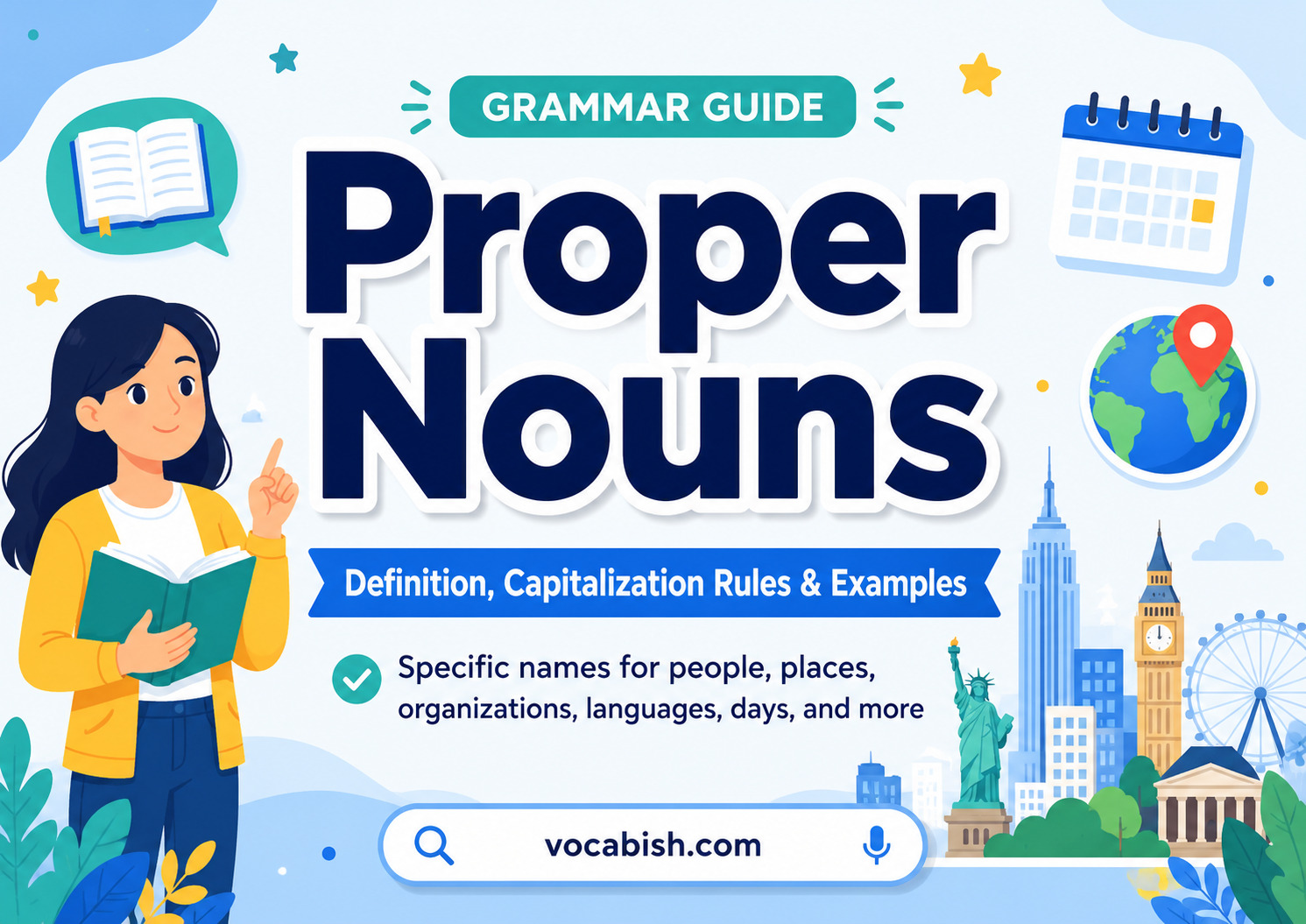

Why do we write city with a lowercase letter but Manchester with a capital letter? Why is it the Pacific Ocean, but simply Asia? These small differences can seem inconsistent until you understand how proper nouns work.
Proper nouns identify particular people, places, organizations, events, products, and works. They help a listener or reader know exactly who or what you mean. Because they function as names, they usually begin with capital letters.
Compare these two sentences:
- A student entered the library.
- Daniel entered the library.
The word student gives a general description. Daniel identifies one particular person. That distinction separates common nouns from proper nouns.
This guide explains what proper nouns name, how to capitalize them, when to use the, and which mistakes English learners should watch for.
What Is a Proper Noun?
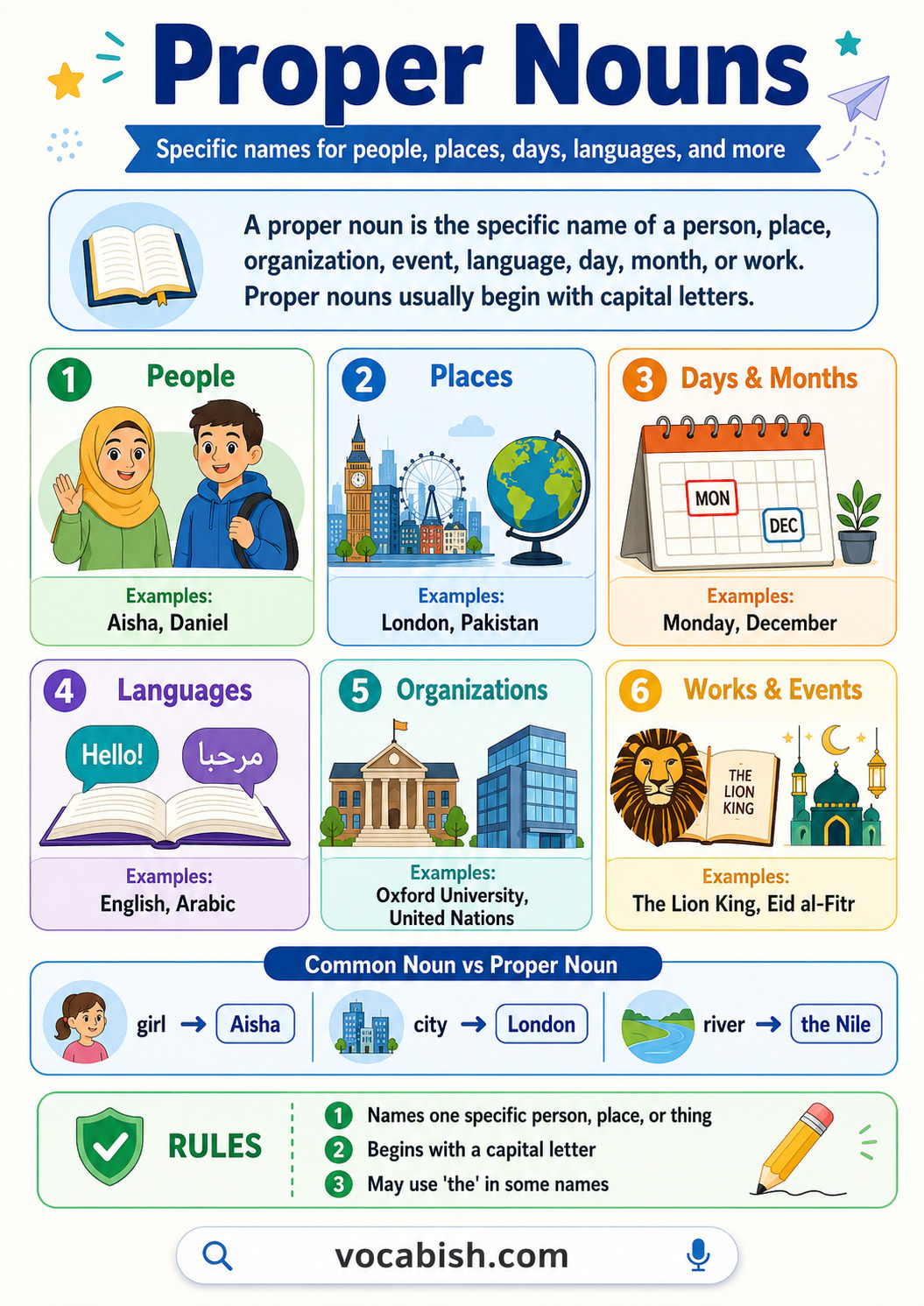
A proper noun is the specific name of a person, place, organization, brand, day, month, language, event, book, film, or other individual entity.
Examples include:
- Maria
- Pakistan
- Tokyo
- Monday
- December
- Arabic
- Microsoft
- the United Nations
- Romeo and Juliet
Proper nouns normally begin with capital letters, even when they appear in the middle of a sentence.
- My cousin Hassan lives in Dubai.
- We have an English class on Thursday.
- She works for Samsung.
- They travelled across Europe last summer.
A proper noun may contain one word or several words:
- Aisha
- London
- New York
- South Africa
- the British Museum
- the University of Oxford
When a proper name contains several words, the main words are usually capitalized. Small grammar words such as of, the, and, and in may remain lowercase, depending on their position and the naming style.
Proper Nouns Point to Something Specific
A proper noun does not simply tell us what type of person or thing we are discussing. It tells us its particular name.
Consider these pairs:
General noun | Specific name |
|---|---|
woman | Nadia |
country | Canada |
river | the Amazon |
university | Harvard University |
company | Toyota |
month | September |
newspaper | The Guardian |
The first item in each pair is a common noun. The second is a proper noun.
In natural English, both types often appear together:
- My friend Nadia studies at Harvard University.
- The river Thames flows through London.
- The company Toyota produces vehicles.
Words such as friend, river, and company describe a category. Nadia, Thames, London, and Toyota identify specific people, places, or organizations.
What Can a Proper Noun Name?
Proper nouns cover much more than personal names. They appear in addresses, calendars, school subjects, business names, entertainment, history, and everyday conversation.
Names of People
The names of individual people are proper nouns.
- Ali
- Sofia
- David Chen
- Fatima Zahra
- Nelson Mandela
Both first names and family names begin with capital letters.
- Sara Ahmed is our new manager.
- I spoke to Mr Wilson after class.
- Dr Khan will see you shortly.
Titles Used with Names
A title is capitalized when it comes directly before a name as part of that person’s identification.
- Professor Lewis
- President Lincoln
- Doctor Ahmed
- Queen Elizabeth II
When the same word is used generally, it is usually lowercase.
- The professor entered the room.
- We spoke to Professor Lewis.
- The president gave a speech.
- President Lincoln delivered many important speeches.
Job descriptions are also normally lowercase:
- Amina is a doctor.
- Mr Patel is the company’s director.
- My uncle works as an engineer.
Family Words as Names
Words such as mother, father, aunt, and grandfather are usually common nouns when used with a possessive word.
- My mother is at work.
- Her uncle lives in Scotland.
- Their grandmother tells wonderful stories.
They may be capitalized when used as a personal name or direct form of address.
- I asked Mum to help me.
- Is Dad coming with us?
- Thank you, Aunt Sara.
Compare:
- My aunt called this morning.
- Aunt Maria called this morning.
In the first sentence, aunt describes a family relationship. In the second, it forms part of a specific name.
Countries, Cities, and Places
The official names of geographical places are proper nouns.
Countries and Continents
- Pakistan
- Brazil
- Japan
- the United Kingdom
- South Africa
- Europe
- Asia
- North America
Examples:
- She was born in Pakistan.
- We hope to visit Japan next year.
- Africa is the second-largest continent.
- He moved to the United Kingdom for work.
Cities, Towns, and Villages
- Karachi
- Paris
- New Delhi
- New York City
- Stratford-upon-Avon
- Paris attracts visitors from around the world.
- My brother lives in New York City.
- They stayed in a small village near Lahore.
The general words city, town, and village are common nouns unless they form part of an official place name.
- They moved to another city.
- They moved to Mexico City.
Streets, Roads, and Buildings
Official names of streets, roads, buildings, parks, and monuments are proper nouns.
- Oxford Street
- Fifth Avenue
- Buckingham Palace
- Central Park
- the Eiffel Tower
- the Empire State Building
Examples:
- Their office is on Oxford Street.
- We walked through Central Park.
- She took a photograph of the Eiffel Tower.
Compare:
- We crossed a busy street.
- We crossed King Street.
Natural Geographical Features
Names of mountains, rivers, oceans, deserts, lakes, and forests are proper nouns.
- Mount Everest
- the River Nile
- the Atlantic Ocean
- the Sahara Desert
- Lake Victoria
- the Amazon Rainforest
Some names use the, while others do not. This depends on the type and structure of the geographical name, not simply on whether it is proper.
- They climbed Mount Everest.
- The ship crossed the Atlantic Ocean.
- We visited Lake Como.
- The explorers travelled through the Sahara Desert.
Article use is explained in more detail later in this guide.
Days, Months, and Holidays
The names of days, months, and recognized holidays are proper nouns and begin with capital letters.
Days of the Week
- Monday
- Tuesday
- Wednesday
- Thursday
- Friday
- Saturday
- Sunday
- The meeting is on Wednesday.
- We usually visit our grandparents on Sunday.
Months of the Year
- January
- March
- August
- December
- School begins in September.
- Her birthday is in May.
Seasons are usually common nouns and are not normally capitalized.
- We travel in summer.
- The leaves fall in autumn.
- It gets cold here in winter.
A season may be capitalized if it forms part of an official title or event name.
- the Winter Olympics
- the Spring Festival
Holidays and Special Days
- Eid al-Fitr
- Christmas
- New Year’s Day
- Independence Day
- Valentine’s Day
- Families gather during Eid al-Fitr.
- The office closes on New Year’s Day.
- They decorated the house for Christmas.
A general reference remains lowercase:
- It was a national holiday.
- We enjoyed the spring festival.
Languages and Nationalities
Names of languages, nationalities, and recognized ethnic or cultural groups are proper nouns.
- English
- Urdu
- Arabic
- Spanish
- Pakistani
- Canadian
- Japanese
- French
Examples:
- She speaks English and Urdu.
- They are learning Spanish.
- My neighbour is Canadian.
- We ate at a Japanese restaurant.
Words for nationalities remain capitalized even when they work as adjectives.
- Italian food
- Chinese history
- Brazilian music
- French literature
Incorrect:
- She speaks english.
- We bought italian cheese.
Correct:
- She speaks English.
- We bought Italian cheese.
School subjects such as mathematics, science, and history are normally lowercase unless they refer to a language or appear in an official course title.
- I enjoy history.
- She studies English.
- He enrolled in Introduction to European History.
Companies, Brands, and Organizations
The official names of businesses, institutions, charities, government bodies, and other organizations are proper nouns.
Examples include:
- Toyota
- Samsung
- the World Health Organization
- the United Nations
- Oxford University
- the British Council
In sentences:
- She works for Google.
- He drives a Toyota.
- The report was published by the World Health Organization.
- They attended a conference at Oxford University.
The general category is lowercase:
- Google is a technology company.
- Oxford is a famous university.
- The British Council is an international organization.
Official Names and Shortened References
The full official name is capitalized:
- the Department of Education
- Green Valley School
- City General Hospital
A shortened word may be lowercase when it is used only as a general description.
- The Department of Education released a statement.
- The department will publish more details later.
- She works at City General Hospital.
- The hospital opened a new department.
Some organizations adopt specific capitalization as part of their branding. In formal writing, it is usually best to follow the organization’s official spelling.
Books, Films, Songs, and Works of Art
Titles of books, films, plays, poems, newspapers, magazines, television programmes, and works of art are treated as proper names.
Examples:
- Pride and Prejudice
- The Lion King
- Harry Potter and the Philosopher’s Stone
- The Starry Night
- The Times
In English title style, the first and last words are usually capitalized, along with important nouns, verbs, adjectives, and adverbs.
Short words such as a, an, the, and, but, of, and to are often lowercase unless they appear at the beginning or end of the title.
- The Lord of the Rings
- A Tale of Two Cities
- Beauty and the Beast
Capitalization systems can differ between publishers. Some use title case, while others use sentence case. The safest approach is to copy the official title exactly when it is known.
Titles of books, films, and complete published works are often written in italics:
- I recently read The Old Man and the Sea.
- We watched The Sound of Music.
Quotation marks are commonly used for shorter works such as poems, articles, or individual song titles, depending on the style guide being followed.
Historical Events and Periods
Named historical events, movements, treaties, wars, and clearly defined periods are generally capitalized.
- the First World War
- the Industrial Revolution
- the Renaissance
- the Great Depression
- the French Revolution
- the Treaty of Versailles
Examples:
- The Industrial Revolution changed manufacturing.
- Many countries were affected by the Great Depression.
- The Treaty of Versailles was signed in 1919.
General descriptions are not proper nouns:
- The country experienced a political revolution.
- They signed a peace treaty.
- The region suffered through a long war.
Capitalization may vary for loosely defined eras or cultural periods, so published style guides do not always make identical choices. When writing for a school, university, or publication, follow its preferred style.
Capitalization Rules for Proper Nouns
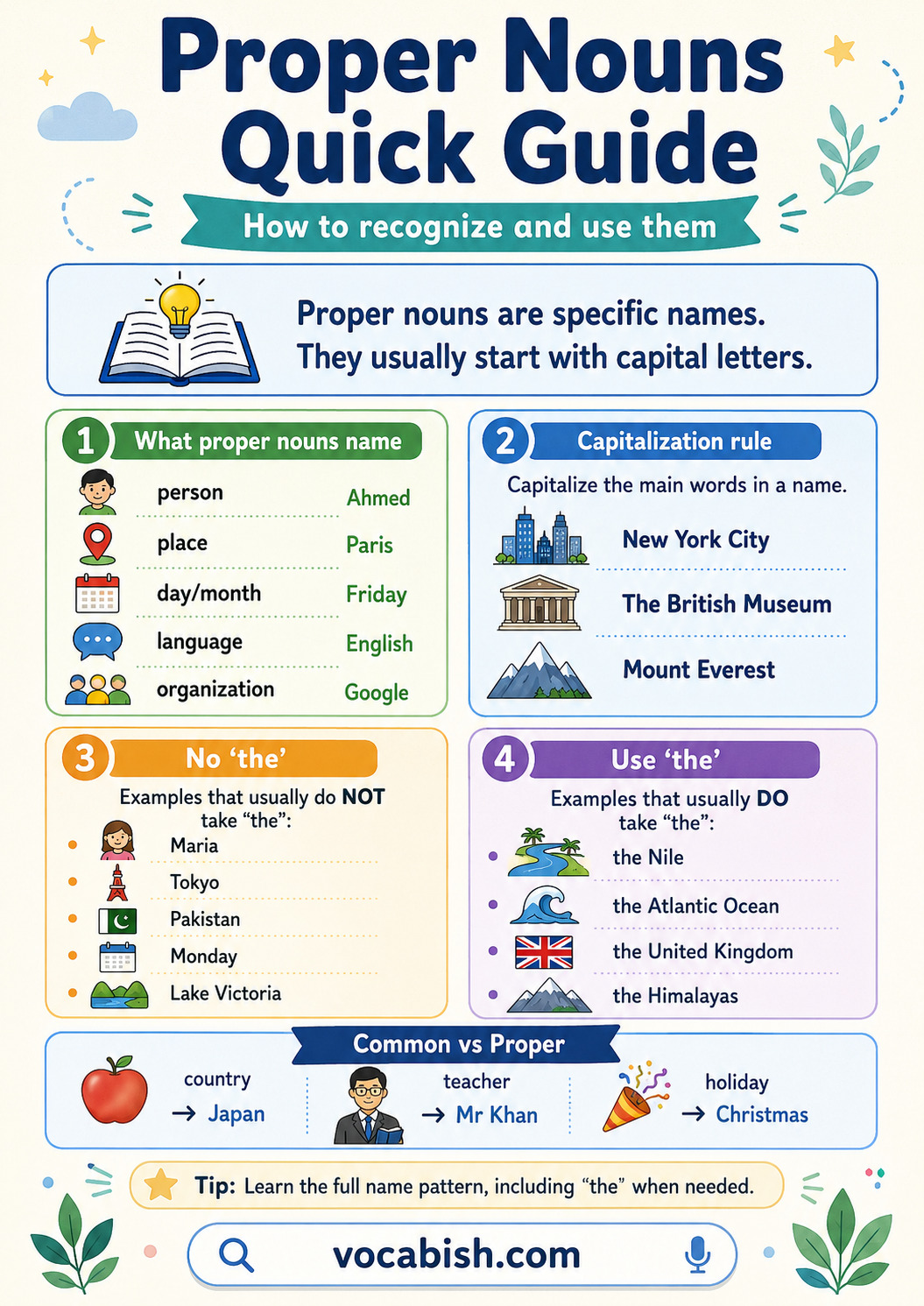
The basic rule is straightforward: capitalize the first letter of each proper noun.
- amir → Amir
- london → London
- monday → Monday
- spanish → Spanish
Multiword proper nouns usually capitalize their important words.
- Green Valley School
- South Africa
- New York City
- University of Cambridge
- National History Museum
Small words may remain lowercase within a name:
- the University of London
- Bank of America
- War and Peace
- Stratford-upon-Avon
However, an official name may follow its own spelling. Check the organization’s or place’s preferred form when accuracy matters.
Personal Names and Initials
- Muhammad Ali
- J. K. Rowling
- Martin Luther King Jr.
Titles Before Names
- Dr Ahmed
- Professor Williams
- Queen Victoria
Use lowercase when the title is general or follows the name as a description:
- Ahmed is a doctor.
- Victoria was the queen.
- Mr Lewis, the school principal, welcomed the parents.
Place Names
- the Indian Ocean
- Mount Fuji
- Hyde Park
- Baker Street
Languages and Nationalities
- English
- Turkish
- African
- European
Days, Months, and Holidays
- Friday
- October
- Easter
Do not normally capitalize seasons:
- spring
- summer
- autumn
- winter
Official Organizations and Institutions
- the University of Manchester
- the European Union
- the Red Cross
Do Not Capitalize General Categories
- university
- hospital
- company
- river
- president
- teacher
Correct:
- Cambridge University is a well-known university.
- The River Thames is a famous river.
- Samsung is an international company.
Proper Nouns in Sentences
Proper nouns can do the same grammatical jobs as other nouns.
As the Subject
- Amira opened the window.
- London attracts millions of tourists.
- Microsoft released a new product.
As the Object
- We visited Rome.
- She called David.
- They watched Titanic.
After a Preposition
- He travelled through Europe.
- The parcel came from Australia.
- We met outside Buckingham Palace.
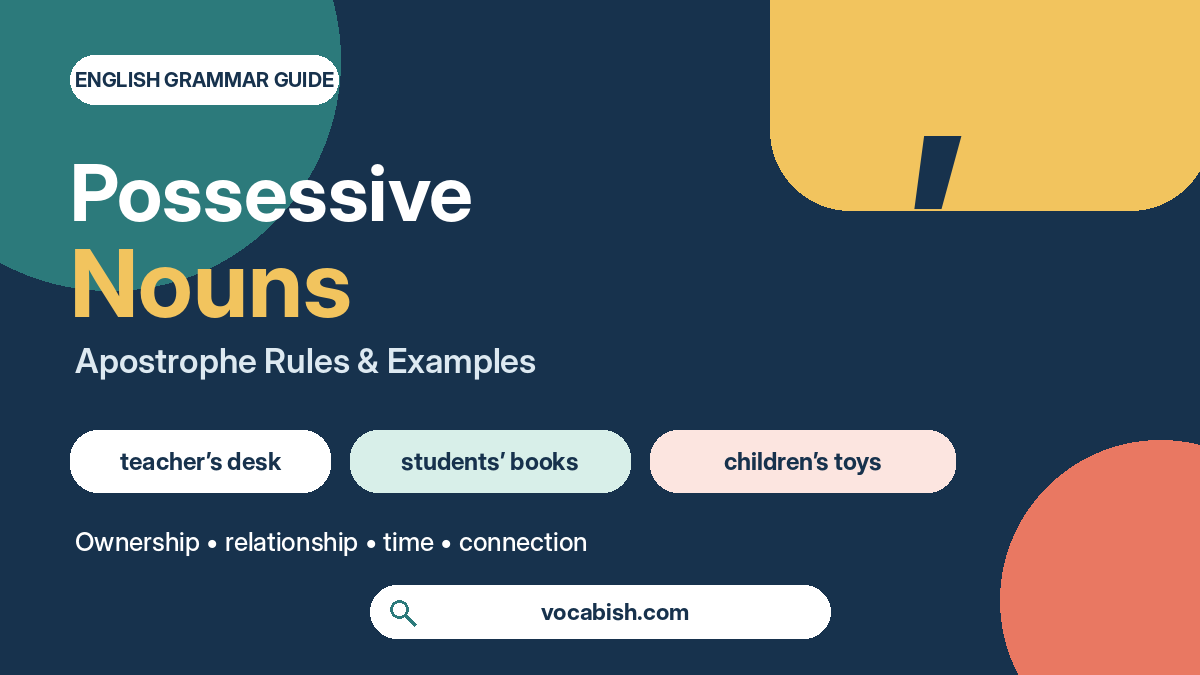
As a Possessive Noun
Proper nouns can show possession by using an apostrophe and s.
- Sara’s notebook
- James’s bicycle
- Pakistan’s history
- Google’s headquarters
For plural family names ending in s, add an apostrophe after the plural form.
- the Khans’ house
- the Smiths’ garden
Writing styles differ on possessive names that already end in s. Many modern styles prefer:
- James’s book
- Charles’s office
Some styles accept:
- James’ book
- Charles’ office
Consistency is more important than switching between the two forms.
Proper Nouns vs Common Nouns
A common noun names a general category. A proper noun names one particular member of that category.
Common noun | Proper noun |
|---|---|
person | Emma |
city | Madrid |
country | Egypt |
river | the Thames |
university | Stanford University |
day | Saturday |
language | German |
company | Amazon |
Look at the difference in context:
- The girl studies at a university.
- Mina studies at Stanford University.
- We crossed a river near the city.
- We crossed the Thames in London.
- The company opened a new office.
- Microsoft opened a new office in Dublin.
A common noun may appear next to a proper noun as a description:
- the city of London
- Professor Ahmed
- Lake Victoria
- Toyota Motor Corporation
Whether the descriptive word is capitalized depends on whether it forms part of the official name.
Related Resources: Common Nouns vs Proper Nouns
Articles Used with Proper Nouns
One of the hardest areas for learners is deciding whether a proper noun needs the. Many proper names do not use an article, but some categories regularly do.
The article is part of the normal English pattern for that name.
Proper Nouns Without an Article
We usually do not use the before the names of individual people.
- I spoke to Maria.
- Ahmed is my neighbour.
- We invited Mr Brown.
Not:
- I spoke to the Maria.
Most cities, towns, and streets also appear without an article.
- Paris
- Islamabad
- Tokyo
- Oxford Street
- Fifth Avenue
- They live in Paris.
- Her office is on Oxford Street.
Most singular country names do not take the.
- Pakistan
- France
- China
- Brazil
- Canada
- She travelled to Canada.
- He was born in Brazil.
Continents normally appear without the.
- Asia
- Europe
- Africa
- South America
Languages, days, months, and most holidays also take no article.
- She speaks Arabic.
- We will meet on Monday.
- My birthday is in November.
- They celebrate Christmas with their family.
Individual mountains and lakes generally do not use the.
- Mount Everest
- Mount Fuji
- Lake Victoria
- Lake Geneva
- They climbed Mount Fuji.
- We stayed near Lake Geneva.
Proper Nouns Used with “The”
We commonly use the with certain geographical and institutional names.
Oceans, Seas, Rivers, and Canals
- the Atlantic Ocean
- the Mediterranean Sea
- the Nile
- the River Thames
- the Suez Canal
- Their boat crossed the Mediterranean Sea.
- Cairo lies near the Nile.
Mountain Ranges and Groups of Islands
- the Himalayas
- the Alps
- the Andes
- the Maldives
- the Philippines
- They went skiing in the Alps.
- She spent her holiday in the Maldives.
Individual mountains usually take no article, but mountain ranges use the:
- Mount Everest
- the Himalayas
Deserts and Regions
- the Sahara
- the Middle East
- the Arctic
- the Antarctic
- The camel crossed the Sahara.
- He has worked in the Middle East.
Plural or Descriptive Country Names
Countries with plural names or descriptive political terms often use the.
- the Netherlands
- the United States
- the United Kingdom
- the United Arab Emirates
- the Czech Republic
- She moved to the United States.
- They live in the Netherlands.
Compare:
- France
- the French Republic
The shorter country name has no article, but the descriptive official name uses the.
Some Buildings, Hotels, Museums, and Theatres
- the British Museum
- the Ritz Hotel
- the National Theatre
- the Empire State Building
- We visited the British Museum.
- They stayed at the Ritz.
However, not every building or institution uses the in the same way:
- Buckingham Palace
- Oxford University
- Heathrow Airport
The official name and normal usage determine the pattern.
Newspapers and Organizations
- The Times
- The Guardian
- the United Nations
- the European Union
- the World Health Organization
- I read the report in The Guardian.
- The decision was discussed by the European Union.
A useful learning habit is to record the article as part of the name. Instead of memorizing only United Kingdom, learn the United Kingdom.
Can a Proper Noun Become a Common Noun?
Sometimes a name becomes widely used to describe a general type of person, object, idea, or product. When that happens, it may begin to function like a common noun.
For example:
- He is no Einstein.
Here, Einstein refers figuratively to a highly intelligent person, not specifically to Albert Einstein. The capital letter is usually kept because the expression still clearly comes from a person’s name.
Other words have become ordinary common nouns over time:
- sandwich
- diesel
- braille
These words developed from personal or place names, but in general modern use they are commonly written with lowercase letters.
A proper name may also describe a work created by someone:
- The gallery owns a Picasso.
- She is reading Shakespeare.
In the first example, a Picasso means a painting by Picasso. In the second, Shakespeare refers to Shakespeare’s writing rather than the person directly.
Brand names can also be used casually as general labels, but careful writers often avoid using a trademark as a generic noun. It is usually clearer to write:
- facial tissue instead of using a brand name for every tissue
- search online instead of using a brand name as a general verb
- adhesive bandage instead of treating one product name as the entire category
Whether a word has fully become a common noun depends on normal language use, dictionaries, and regional style.
Frequent Capitalization Mistakes
1. Writing Proper Nouns with Lowercase Letters
Incorrect:
- maria moved to canada in september.
- he speaks english and french.
Correct:
- Maria moved to Canada in September.
- He speaks English and French.
2. Capitalizing Ordinary Common Nouns
Incorrect:
- My Brother is a Teacher.
- We visited a Museum near the River.
Correct:
- My brother is a teacher.
- We visited a museum near the river.
These words are general descriptions, not names.
3. Forgetting Capitals in Multiword Names
Incorrect:
- united nations
- new york city
- green valley school
Correct:
- United Nations
- New York City
- Green Valley School
4. Capitalizing Seasons Automatically
Incorrect:
- We travel in Summer.
- The weather changes in Autumn.
Correct:
- We travel in summer.
- The weather changes in autumn.
Use capitals when the season belongs to an official name:
- the Summer Olympics
- the Winter Festival
5. Using “The” Before Every Place Name
Incorrect:
- the London
- the Pakistan
- the Asia
- the Mount Everest
Correct:
- London
- Pakistan
- Asia
- Mount Everest
But:
- the United Kingdom
- the Himalayas
- the Atlantic Ocean
- the Nile
Proper Noun Identification Exercise
A: Find the Proper Nouns
Identify every proper noun in these sentences.
- Amina travelled to Turkey in April.
- We visited the National Gallery on Saturday.
- Mr Harris teaches English at Westwood School.
- The River Nile flows through Egypt.
- My aunt works for Microsoft in London.
- They watched The Lion King during the holiday.
- Mount Everest is part of the Himalayas.
- Sara reads The Guardian every morning.
- The United Nations held a meeting in New York.
- Our flight leaves from Heathrow Airport on Friday.
B: Choose the Correct Capitalization
- My cousin studies history / History and english / English.
- We moved to king street / King Street.
- They visited the british museum / the British Museum.
- Her birthday is in october / October.
- My Father / father works in a bank.
- I asked Mum / mum to call me.
- They crossed the atlantic ocean / the Atlantic Ocean.
- She works at green valley hospital / Green Valley Hospital.
C: Add “The” Where Needed
Rewrite each name correctly.
- United Kingdom
- Mount Fuji
- Pacific Ocean
- France
- Netherlands
- Lake Victoria
- Alps
- Oxford University
- United Arab Emirates
- River Thames
D: Common or Proper?
State whether the bold noun is common or proper.
- We visited a large museum.
- We visited the British Museum.
- Her brother lives abroad.
- Omar lives abroad.
- The company opened a new office.
- Toyota opened a new office.
- She speaks Arabic.
- The language is difficult for beginners.
- We walked beside the river.
- We walked beside the Thames.
Answer Key
A
- Amina, Turkey, April
- National Gallery, Saturday
- Mr Harris, English, Westwood School
- River Nile, Egypt
- Microsoft, London
- The Lion King
- Mount Everest, the Himalayas
- Sara, The Guardian
- the United Nations, New York
- Heathrow Airport, Friday
Words such as aunt, flight, morning, and meeting remain common nouns because they do not identify a particular named person, object, or event.
B
- My cousin studies history and English.
- We moved to King Street.
- They visited the British Museum.
- Her birthday is in October.
- My father works in a bank.
- I asked Mum to call me.
- They crossed the Atlantic Ocean.
- She works at Green Valley Hospital.
In sentence 6, Mum functions as a personal name. In sentence 5, father follows my and describes a relationship, so it remains lowercase.
C
- the United Kingdom
- Mount Fuji
- the Pacific Ocean
- France
- the Netherlands
- Lake Victoria
- the Alps
- Oxford University
- the United Arab Emirates
- the River Thames
D
- museum — common noun
- British Museum — proper noun
- brother — common noun
- Omar — proper noun
- company — common noun
- Toyota — proper noun
- Arabic — proper noun
- language — common noun
- river — common noun
- Thames — proper noun
FAQs About Proper Nouns
A proper noun is the specific name of a particular person, place, organization, event, day, language, or work. It normally begins with a capital letter.
Examples include: Ahmed, London, Pakistan, Monday, January, English, Amazon, Oxford, University, the Nile, The Lion King.
No. Country is a common noun because it gives a general name.
Japan is a country.
Japan is a proper noun because it identifies one specific country.
Yes. Days and months begin with capital letters:
Monday
Friday
January
August
Seasons such as summer and winter are usually common nouns.
Some categories normally take the, including oceans, rivers, mountain ranges, plural country names, and many organizations.
the Pacific Ocean
the Nile
the Andes
the United States
the World Health Organization
Yes. A proper noun can be plural when referring to several people with the same family name or several individuals sharing a name.
The Smiths live next door.
There are three Saras in our class.
It may also refer to several works or products connected with a name:
The gallery owns two Picassos.
A Practical Way to Remember Proper Nouns
Ask one question: Is this word the official or individual name of someone or something?
When the answer is yes, it is probably a proper noun.
- person → Aisha
- city → Lahore
- day → Tuesday
- language → English
- organization → the United Nations
Then check whether that name normally requires the. Most personal names, cities, singular countries, languages, days, and months do not. Rivers, oceans, mountain ranges, plural countries, and many institutions often do.
Capitalization becomes easier when you learn names as complete expressions:
- the Netherlands, not only Netherlands
- the River Thames, not only River Thames
- Oxford University, not the Oxford University
- Mount Everest, not the Mount Everest
Proper nouns are not difficult because they name unusual things. They are difficult because English treats different kinds of names in different ways. Reading carefully and recording full name patterns will help you use them with greater confidence.
You May Also Like