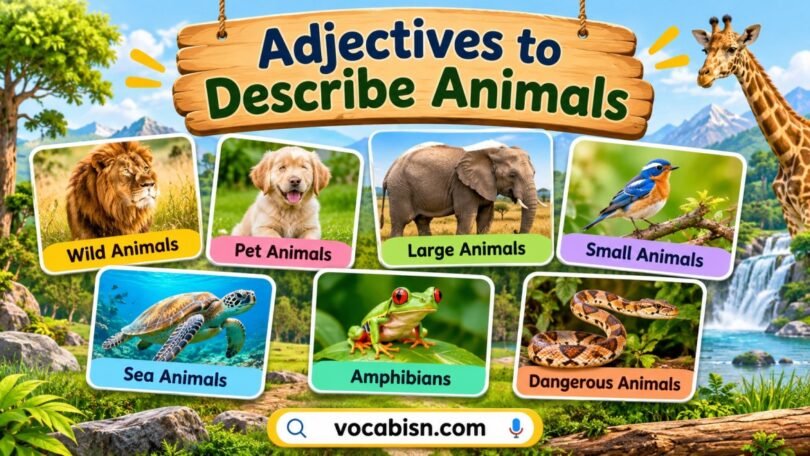

The right adjectives to describe animals help you explain what an animal looks like, how it behaves, how it moves, and what makes it different. Words such as fluffy, fierce, gentle, tiny, playful, and noisy make your English more descriptive and natural.
Whether you are describing a pet, talking about wild animals, writing a school paragraph, or having an everyday conversation, knowing different adjectives for animals helps you express your ideas clearly. This article covers animal adjectives by meaning and purpose, with definitions and practical example sentences for English learners.
What Are Adjectives to Describe Animals?
Adjectives to describe animals are words that give information about an animal’s appearance, size, color, behavior, personality, movement, sounds, health, or abilities.
For example:
- The fluffy cat is sleeping on the sofa.
- A massive elephant walked across the grassland.
- The playful puppy chased its tail.
- We heard a noisy parrot in the garden.
- The swift cheetah ran across the plain.
In these sentences, fluffy, massive, playful, noisy, and swift are adjectives because they describe the animals.
You can use animal adjectives before a noun or after linking verbs such as be, look, seem, and feel.
- Before a noun: A gentle horse stood near the fence.
- After a linking verb: The horse looks gentle.
- With an observation: The rabbit seems nervous.
- With a comparison: This puppy is smaller than its brother.
The best adjective depends on what you want to communicate. Use tiny to emphasize size, timid to describe a lack of confidence, and skittish for an animal that startles or moves away easily.
Adjectives for Animal Size
Size adjectives help you explain how big or small an animal is. They are useful when comparing breeds, describing wildlife, or telling someone about an animal you saw.
- Big — large in size. The big dog guarded the farm.
- Small — little in size. A small mouse ran under the table.
- Tiny — extremely small. A tiny frog sat on the leaf.
- Huge — very large. A huge whale appeared near the boat.
- Massive — exceptionally large and heavy. A massive elephant crossed the road.
- Giant — much larger than usual. A giant tortoise moved slowly.
- Enormous — extremely big. An enormous crocodile rested by the river.
- Large — bigger than average. A large eagle circled overhead.
- Little — small in size or age. The little kitten hid behind the chair.
- Miniature — very small compared with the usual size of its kind. The miniature horse stood beside the fence.
- Medium-sized — neither particularly large nor small. A medium-sized dog followed its owner.
- Compact — small and closely built. The compact rabbit fitted comfortably in its shelter.
- Bulky — large and heavy-looking. The bulky bear walked through the forest.
- Stocky — short and solidly built. The stocky bulldog sat beside the gate.
- Slender — thin in an attractive or graceful way. A slender gazelle moved across the field.
- Lean — thin and muscular, with little body fat. The lean wolf followed the herd.
- Lanky — tall and thin, often with long legs. The lanky young giraffe stretched its neck.
- Stout — thick-bodied and solid. The stout pony pulled the small cart.
- Petite — small and delicately built; commonly used for small animals in informal description. The petite kitten curled up in a basket.
- Oversized — larger than the usual size. The oversized rabbit needed a larger enclosure.
Adjectives for Animal Appearance
Appearance adjectives describe an animal’s general look, shape, and physical impression. They are particularly useful for picture descriptions, animal reports, and storytelling.
- Beautiful — pleasing to look at. A beautiful peacock displayed its feathers.
- Pretty — attractive in a delicate or charming way. The pretty butterfly landed on a flower.
- Handsome — attractive in appearance. A handsome stallion stood in the paddock.
- Cute — attractive in a sweet or charming way. The cute puppy wagged its tail.
- Adorable — extremely lovable or charming. An adorable kitten slept in the basket.
- Lovely — pleasant and attractive. The lovely white rabbit nibbled a carrot.
- Elegant — graceful and stylish in appearance or movement. An elegant swan glided across the lake.
- Graceful — moving or appearing smoothly and attractively. The graceful deer crossed the meadow.
- Majestic — impressive because of size, beauty, or dignity. A majestic lion rested on a rock.
- Striking — noticeably unusual or attractive. The butterfly had striking blue wings.
- Stunning — extremely impressive or beautiful. A stunning peacock spread its colorful tail.
- Distinctive — easy to recognize because of special features. The zebra has a distinctive striped coat.
- Unusual — different from what is common. The unusual bird had a long curved beak.
- Odd-looking — strange or unexpected in appearance. The odd-looking fish had a flat head.
- Ugly — unpleasant to look at according to someone’s opinion. The fictional monster had an ugly face.
- Plain — simple-looking, without striking features. The plain brown moth rested on the wall.
- Rugged — rough-looking and strongly built. The rugged mountain goat climbed the rocky slope.
- Delicate — appearing fragile or finely formed. A delicate butterfly rested on a petal.
- Well-built — having a strong, solid body. The well-built horse pulled the wagon.
- Unkempt — looking untidy or poorly groomed. The unkempt dog needed brushing.
Adjectives for Animal Colors and Patterns
Color and pattern adjectives help readers picture an animal accurately. They are especially useful when identifying birds, describing pets, and writing about wildlife.
Color Adjectives
- Black — having a black color. The black cat sat on the windowsill.
- White — having a white color. A white rabbit hopped across the grass.
- Brown — having a brown color. The brown bear searched for food.
- Gray — having a color between black and white. A gray squirrel climbed the tree.
- Grey — another spelling of gray, common in British English. The grey horse grazed quietly.
- Golden — having a gold-like color. The golden retriever ran toward the lake.
- Silver — having a shiny gray-white color. The silver fish flashed beneath the water.
- Golden-brown — having a mixture of golden and brown shades. The golden-brown puppy slept near the door.
- Cream-colored — having a pale yellowish-white color. A cream-colored cat stretched in the sun.
- Tan — having a light brown color. The tan dog waited outside.
- Reddish — having a slight red color. The fox had reddish fur.
- Orange — having the color of an orange. An orange butterfly flew past the window.
- Yellow — having a yellow color. The yellow chick followed its mother.
- Green — having a green color. A green parrot perched on a branch.
- Blue — having a blue color. The blue bird sang in the morning.
- Purple — having a purple color. The purple fish swam near the coral.
- Pink — having a pink color. A pink flamingo stood in the shallow water.
- Colorful — having several bright colors. The colorful macaw flew above the trees.
- Pale — having a light or weak color. The pale moth rested against the wall.
- Dark — having a deep or low-light shade. The dark horse stood under a tree.
Pattern Adjectives
- Spotted — covered with separate spots. The spotted leopard hid in the grass.
- Striped — marked with lines or stripes. The striped tiger walked through the forest.
- Spotted — having dots or small marks. A spotted fawn stood near its mother.
- Speckled — covered with many small spots. The speckled egg lay in the nest.
- Mottled — marked with irregular patches of different shades. The mottled frog blended into the leaves.
- Patchy — covered with uneven areas of color or fur. The patchy-coated dog had brown and white markings.
- Dappled — marked with small, rounded patches of lighter or darker color. The dappled horse grazed in the field.
- Banded — marked with broad or narrow bands. The banded snake moved through the undergrowth.
- Ringed — marked with circular bands. The ringed lemur raised its striped tail.
- Blotchy — marked with irregular, often large spots. The blotchy fish hid among the rocks.
- Solid-colored — having one main color without a pattern. The solid-colored black cat sat on the mat.
- Two-toned — having two main colors. The two-toned puppy had a white chest and brown back.
- Multicolored — having many colors. The multicolored parrot perched on the branch.
- Mottled-brown — having irregular brown markings. The mottled-brown owl rested in the tree.
Adjectives for Animal Body Features
These adjectives describe body shape, legs, tails, ears, beaks, horns, and other visible features. Choose them when you want to explain what makes an animal look or function a certain way.
- Long-tailed — having a long tail. The long-tailed bird perched on a wire.
- Short-tailed — having a short tail. The short-tailed rabbit hopped away.
- Bushy-tailed — having a thick, fluffy tail. The bushy-tailed squirrel climbed the oak tree.
- Curly-tailed — having a tail that curls. The curly-tailed pig rested in the mud.
- Long-legged — having long legs. The long-legged flamingo walked through the water.
- Short-legged — having short legs. The short-legged dachshund followed its owner.
- Long-necked — having a long neck. The long-necked giraffe reached for leaves.
- Short-necked — having a relatively short neck. The short-necked bird pecked at the ground.
- Big-eared — having large ears. The big-eared rabbit listened for movement.
- Pointy-eared — having ears with pointed tips. The pointy-eared fox watched the field.
- Droopy-eared — having ears that hang down. The droopy-eared puppy rested on the rug.
- Floppy-eared — having soft ears that hang or bend. The floppy-eared rabbit nibbled some grass.
- Sharp-beaked — having a pointed, sharp beak. The sharp-beaked bird caught an insect.
- Long-beaked — having a long beak. The long-beaked heron searched for fish.
- Hook-beaked — having a strongly curved beak. The hook-beaked parrot cracked a seed.
- Broad-winged — having wide wings. The broad-winged eagle soared above the valley.
- Long-winged — having long wings. The long-winged albatross glided over the ocean.
- Sharp-clawed — having sharp claws. The sharp-clawed cat climbed the fence.
- Horned — having horns. The horned goat stood on the hill.
- Antlered — having antlers. The antlered deer walked through the woods.
- Humpbacked — having a prominent hump on the back. The humpbacked camel crossed the desert.
- Flat-faced — having a broad or flattened face. The flat-faced dog rested in the shade.
- Long-snouted — having a long snout. The long-snouted anteater searched for ants.
- Broad-chested — having a wide chest. The broad-chested dog stood proudly.
- Muscular — having strong, well-developed muscles. The muscular horse pulled the heavy cart.
- Web-footed — having feet joined by skin that helps with swimming. The web-footed duck paddled across the pond.
- Cloven-hoofed — having hooves divided into two main parts. The cloven-hoofed goat climbed the rocky ground.
- Thick-necked — having a thick neck. The thick-necked bull stood beside the fence.
- Sharp-toothed — having sharp teeth. The sharp-toothed shark swam through the water.
- Bearded — having hair-like growth or feathers resembling a beard. The bearded dragon rested on a warm rock.
Adjectives for Animal Texture and Covering
An animal’s outer covering may be fur, feathers, scales, skin, or spines. Texture adjectives help you describe how that covering looks or feels, without assuming every animal has the same kind of body surface.
- Furry — covered with fur. The furry hamster slept in its bedding.
- Fluffy — covered with soft, light hair or feathers. The fluffy chick followed the hen.
- Hairy — covered with a noticeable amount of hair. The hairy caterpillar crawled along the leaf.
- Woolly — covered with thick, wool-like hair. The woolly sheep grazed in the field.
- Shaggy — having long, untidy hair or fur. The shaggy dog shook its coat.
- Silky — having a smooth, soft texture. The silky cat stretched in the sunshine.
- Sleek — smooth, neat, and close-fitting. The sleek dolphin moved through the water.
- Smooth — having an even surface without roughness. The smooth-skinned frog sat on a rock.
- Rough — having an uneven or coarse surface. The rough-skinned toad hid beneath a log.
- Coarse — having a thick or rough texture. The coarse fur covered the animal’s back.
- Soft — pleasant to touch and not hard. The soft rabbit rested in the child’s arms.
- Prickly — covered with sharp points. The prickly hedgehog curled into a ball.
- Spiny — having sharp spines. The spiny fish moved between the rocks.
- Scaly — covered with scales. The scaly lizard basked in the sun.
- Feathery — having soft, feather-like structures. The feathery crest stood up on the bird’s head.
- Downy — covered with soft, fine feathers or hair. The downy duckling rested beside the pond.
- Glossy — shiny and smooth-looking. The glossy black horse stood in the stable.
- Shiny — reflecting light. The shiny beetle crawled across the path.
- Dull — lacking brightness or shine. The dull-colored moth blended into the bark.
- Wiry — having stiff, thin hair. The wiry-haired terrier ran across the yard.
- Bristly — covered with short, stiff hairs. The bristly boar searched for roots.
- Leathery — having a tough texture like leather. The leathery skin of the turtle felt firm.
- Slimy — covered with slippery mucus. The slimy slug moved across the wet stone.
- Moist — slightly wet. The moist skin of the frog glistened.
- Dry — lacking moisture. The dry skin of the lizard looked rough.
- Feathered — covered with feathers. The feathered bird sheltered its chicks.
- Bare-skinned — having exposed skin with little or no covering. The bare-skinned young animal needed warmth.
- Thick-coated — having a thick layer of fur. The thick-coated husky stood in the snow.
- Short-haired — having short hair or fur. The short-haired cat sat by the window.
- Long-haired — having long hair or fur. The long-haired rabbit needed regular grooming.
Adjectives for Animal Personality and Temperament
Personality and temperament adjectives describe how an animal usually responds to people, other animals, and its surroundings. Some describe friendliness, while others describe fear, independence, or a tendency to react strongly.
Remember that an animal’s behavior depends on its species, individual temperament, health, and environment.
- Friendly — comfortable around people or other animals. Our friendly dog greets visitors at the door.
- Gentle — not rough or aggressive. The gentle horse allowed the child to approach.
- Affectionate — showing fondness through closeness or contact. The affectionate cat rubbed against my leg.
- Loving — showing care or attachment. The loving dog stayed close to its owner.
- Playful — enjoying games and physical activity. The playful puppy chased a ball.
- Sociable — enjoying the company of others. The sociable parrot interacted with the other birds.
- Calm — relaxed and not easily disturbed. The calm rabbit remained still during feeding.
- Patient — able to wait without becoming restless. The patient horse stood while its saddle was adjusted.
- Trusting — willing to approach or rely on someone. The trusting kitten slept beside its owner.
- Docile — generally easy to handle or control. The docile sheep followed the farmer.
- Tame — accustomed to living with people or being handled. The tame pigeon perched on the windowsill.
- Loyal — remaining devoted to a person or group. The loyal dog waited beside the gate.
- Protective — inclined to defend its young, territory, or companions. The protective mother bear stayed near her cubs.
- Independent — able to act without much help or attention. The independent cat explored the garden alone.
- Curious — eager to investigate something. The curious raccoon examined the box.
- Shy — uncomfortable around unfamiliar people or situations. The shy kitten hid behind the sofa.
- Timid — easily frightened or lacking confidence. The timid deer stepped away from the road.
- Nervous — anxious or uneasy. The nervous dog trembled during the storm.
- Skittish — easily startled and quick to move away. The skittish horse backed away from the sudden noise.
- Fearful — showing fear. The fearful rabbit hid inside its shelter.
- Cautious — careful to avoid danger. The cautious fox approached the food slowly.
- Wary — watchful because something may be dangerous. The wary bird kept its distance from the stranger.
- Aggressive — likely to threaten or attack. The aggressive dog lunged toward the fence.
- Territorial — inclined to defend an area. The territorial male bird chased intruders away.
- Dominant — having a stronger influence or higher social position within a group. The dominant wolf stood near the food.
- Submissive — showing a willingness to yield to another animal. The submissive dog lowered its body.
- Stubborn — unwilling to change its behavior or direction. The stubborn mule refused to move.
- Standoffish — not very friendly or willing to interact. The standoffish cat stayed at the far end of the room.
- Temperamental — likely to change mood or reactions quickly. The temperamental parrot sometimes reacted unpredictably.
- Easygoing — relaxed and not easily upset. The easygoing dog slept through the household noise.
Adjectives for Animal Behavior
Behavior adjectives describe what an animal does or how it responds to its surroundings. They can refer to everyday habits, social interaction, feeding, hunting, or activity levels.
- Active — moving or doing things regularly. The active squirrel searched for nuts.
- Energetic — full of energy. The energetic puppy raced around the garden.
- Lively — active and full of movement. The lively parrot jumped between branches.
- Restless — unable to stay still or settle comfortably. The restless horse paced inside its stall.
- Lazy — avoiding activity or moving very little. The lazy cat slept on the sofa all afternoon.
- Sleepy — ready to sleep or feeling tired. The sleepy kitten yawned in the basket.
- Alert — quick to notice what is happening. The alert meerkat watched for danger.
- Attentive — paying close attention. The attentive dog watched its owner’s hand.
- Watchful — looking carefully for possible danger or activity. The watchful owl observed the field.
- Observant — good at noticing details. The observant crow noticed the open container.
- Inquisitive — eager to find out about things. The inquisitive monkey examined the unfamiliar object.
- Mischievous — likely to cause playful trouble. The mischievous puppy stole a sock.
- Destructive — causing damage. The destructive goat chewed the wooden fence.
- Nocturnal — most active at night. The nocturnal bat emerged after sunset.
- Diurnal — most active during the day. The diurnal butterfly rested on a flower in the afternoon.
- Crepuscular — most active around dawn and dusk. The crepuscular rabbit became active near sunset.
- Social — living or interacting in groups. The social dolphins swam together.
- Solitary — usually living or hunting alone. The solitary leopard moved through the forest.
- Migratory — moving from one region to another seasonally. Migratory birds crossed the wetlands.
- Territorial — defending an area against others. The territorial bird chased another male away.
- Cooperative — working with others toward a shared goal. The cooperative dolphins hunted together.
- Playful — engaging in games or play. The playful otters rolled in the water.
- Destructive — damaging objects, plants, or surroundings. The destructive beaver gnawed through a small tree.
- Aggressive — acting in a threatening or attacking way. The aggressive bull charged at the gate.
- Submissive — yielding rather than challenging another animal. The submissive puppy moved away from the older dog.
- Reclusive — avoiding contact and staying out of sight. The reclusive wildcat remained hidden in the forest.
- Adaptable — able to adjust to changing conditions. The adaptable raccoon learned to find food in the city.
- Resourceful — good at finding ways to solve problems or obtain resources. The resourceful crow found food inside the container.
- Protective — acting to defend another animal or its territory. The protective hen gathered her chicks beneath her wings.
- Predatory — adapted to hunting other animals. The predatory eagle watched the field from above.
Adjectives for Animal Movement and Speed
Movement adjectives tell readers whether an animal runs quickly, walks slowly, climbs carefully, swims smoothly, or moves in another distinctive way.
- Fast — moving quickly. The fast cheetah chased its prey.
- Swift — moving with great speed. The swift falcon dived toward the ground.
- Speedy — moving faster than expected or usual. The speedy rabbit crossed the path.
- Slow — moving at a low speed. The slow tortoise crossed the garden.
- Sluggish — moving slowly with little energy. The sluggish lizard remained on the warm rock.
- Agile — able to move quickly and easily. The agile monkey jumped between branches.
- Nimble — moving lightly and skillfully. The nimble squirrel climbed the narrow trunk.
- Clumsy — moving awkwardly. The clumsy puppy stumbled over its paws.
- Graceful — moving smoothly and attractively. The graceful swan glided across the pond.
- Steady — moving in a controlled, consistent way. The steady camel walked across the sand.
- Wobbly — moving unsteadily from side to side. The wobbly foal tried to stand.
- Bouncy — moving with repeated light jumps. The bouncy puppy ran toward its owner.
- Leaping — moving by making long or high jumps. The leaping gazelle cleared the fence.
- Hopping — moving in short jumps. The hopping rabbit crossed the lawn.
- Crawling — moving close to a surface, usually on the body or legs. The crawling caterpillar reached the leaf.
- Slithering — moving with a smooth, twisting motion. The slithering snake crossed the path.
- Creeping — moving slowly and quietly. The creeping lizard approached the insect.
- Galloping — moving rapidly with a horse-like running gait. The galloping horse crossed the field.
- Trotting — moving at a pace faster than walking but slower than galloping. The trotting pony followed the rider.
- Pacing — repeatedly walking back and forth. The pacing tiger moved along the enclosure.
- Soaring — flying high and smoothly through the air. The soaring eagle circled above the cliffs.
- Gliding — moving smoothly with little visible effort. The gliding stingray passed over the seabed.
- Darting — moving suddenly and quickly in a particular direction. The darting fish disappeared between the rocks.
- Lumbering — moving slowly and heavily. The lumbering elephant walked through the forest.
- Bounding — moving forward in energetic jumps. The bounding deer crossed the meadow.
- Swimming — moving through water. The swimming otter surfaced near the bank.
- Climbing — moving upward using feet, claws, or other body parts. The climbing gecko reached the ceiling.
- Fluttering — moving the wings rapidly with small, light motions. The fluttering moth circled the lamp.
- Wriggling — twisting and turning the body. The wriggling worm moved through the soil.
- Waddling — walking with short steps and a side-to-side movement. The waddling duck crossed the path.
- Stealthy — moving quietly to avoid being noticed. The stealthy leopard approached its prey.
- Sure-footed — able to move safely over difficult ground. The sure-footed mountain goat climbed the rocks.
- Fleeting — lasting for a very short time or passing quickly. We caught a fleeting glimpse of the fox.
Adjectives for Animal Sounds
Sound adjectives help you describe what an animal sounds like. They are useful in stories, conversations about pets, nature observations, and writing for children.
- Noisy — making a lot of sound. The noisy parrot woke everyone up.
- Quiet — making little sound. The quiet rabbit rested in its cage.
- Silent — making no sound at a particular moment. The silent owl watched from a branch.
- Loud — producing a strong sound. The loud rooster crowed before sunrise.
- Soft-spoken — producing a gentle, low voice; used figuratively for animals with gentle vocalizations. The soft-spoken bird made quiet calls.
- Vocal — making sounds frequently. The vocal puppy whined when its owner left.
- Chatty — making frequent sounds that seem conversational. The chatty parrot repeated familiar noises.
- Chirping — making short, high-pitched bird sounds. The chirping chicks waited for food.
- Squeaky — producing short, high-pitched sounds. The squeaky mouse moved behind the cupboard.
- Raspy — having a rough, scratchy sound. The raspy crow called from the rooftop.
- Hoarse — having a rough or weak voice. The hoarse rooster crowed repeatedly.
- Mellow — having a soft, pleasant sound. The mellow cooing of the pigeon filled the garden.
- Shrill — producing a very high, sharp sound. The shrill parrot call echoed through the room.
- Piercing — having a sound that seems sharp enough to cut through other noise. The piercing cry of the peacock startled us.
- Rumbling — making a low, continuous sound. The rumbling growl of the big cat came from the enclosure.
- Growling — producing a low, threatening sound. The growling dog guarded its food.
- Howling — producing a long, loud call. The howling wolf called across the valley.
- Barking — making the characteristic sharp calls of a dog. The barking dog alerted the family.
- Whining — making a high, often complaining or distressed sound. The whining puppy waited near the door.
- Hissing — making a long, breathy sound. The hissing snake raised its head.
- Roaring — producing a very loud, deep call. The roaring lion echoed across the savanna.
- Murmuring — making a soft, low sound. The murmuring pigeons gathered on the roof.
- Croaking — making the rough call typical of frogs and some birds. The croaking frog sat beside the pond.
- Buzzing — producing a continuous vibrating sound. The buzzing bee circled the flower.
- Cooing — making soft, gentle calls. The cooing dove sat on the balcony.
- Trilling — producing a rapid series of musical notes. The trilling songbird sang from the tree.
- Melodious — having a pleasant, musical sound. The melodious bird sang at dawn.
- Thunderous — extremely loud and powerful. The thunderous roar of the tiger surprised the visitors.
- Raucous — loud, rough, and unpleasant. The raucous flock of geese gathered near the lake.
- Muffled — sounding quieter because something blocks the sound. The muffled barking came from inside the house.
Adjectives for Animal Strength and Physical Ability
Strength and ability adjectives explain what an animal’s body allows it to do. They can describe power, endurance, climbing, swimming, or other physical skills.
- Strong — having great physical power. The strong ox pulled the cart.
- Powerful — capable of producing great force. The powerful tiger sprang forward.
- Mighty — exceptionally strong or impressive. The mighty elephant pushed through the bushes.
- Muscular — having well-developed muscles. The muscular stallion stood near the stable.
- Sturdy — solidly built and able to withstand pressure. The sturdy pony carried the supplies.
- Robust — strong and healthy-looking. The robust farm dog ran across the field.
- Hardy — able to tolerate difficult conditions. The hardy mountain goat survived in cold weather.
- Resilient — able to recover or adjust after difficulty. The resilient stray cat recovered after a difficult winter.
- Enduring — able to continue for a long time. The enduring camel traveled across the desert.
- Athletic — naturally suited to physical activity. The athletic dog jumped over the hurdle.
- Acrobatic — able to perform agile, complex movements. The acrobatic gibbon swung between branches.
- Sure-footed — able to walk steadily on rough or steep ground. The sure-footed ibex climbed the cliff.
- Climbing — suited to moving upward. The climbing gecko scaled the wall.
- Aquatic — living or growing in water. The aquatic turtle swam near the rocks.
- Amphibious — able to live or function both in water and on land. The amphibious frog moved between the pond and the grass.
- Airborne — flying or being carried through the air. The airborne eagle passed over the valley.
- Fleet-footed — able to run quickly. The fleet-footed gazelle escaped the predator.
- Long-distance — suited to covering large distances. The long-distance migratory bird traveled across continents.
- Tireless — seeming to have a great supply of energy. The tireless working dog searched the field.
- Agile — able to change direction and position quickly. The agile mountain lion leaped across the rocks.
- Flexible — able to bend or move easily. The flexible cat squeezed through the narrow opening.
- Strong-jawed — having powerful jaws. The strong-jawed crocodile held its prey.
- Sharp-eyed — having keen vision or noticing details quickly. The sharp-eyed hawk spotted a mouse.
- Keen-sighted — able to see very well. The keen-sighted eagle searched the landscape.
- Sure-handed — able to use the hands or forelimbs skillfully; usually applied figuratively to animals. The sure-handed raccoon opened the container.
- Quick-witted — able to respond intelligently and quickly. The quick-witted crow solved the feeding puzzle.
Adjectives for Dangerous and Aggressive Animals
Use these words when describing an animal that can cause harm, defends itself, hunts other animals, or behaves in a threatening way. Remember that a dangerous species is not necessarily aggressive in every encounter.
- Dangerous — capable of causing injury or harm. The dangerous crocodile stayed near the riverbank.
- Deadly — capable of causing death. The deadly venomous snake remained hidden in the grass.
- Venomous — able to inject venom through a bite or sting. The venomous cobra raised its hood.
- Poisonous — harmful if eaten, touched, or otherwise absorbed, depending on the toxin. The poisonous frog had brightly colored skin.
- Aggressive — likely to attack or threaten. The aggressive bull charged at the fence.
- Fierce — showing great force or intensity. The fierce tiger defended its territory.
- Ferocious — extremely fierce or violent. The ferocious predator chased its prey.
- Savage — extremely violent or uncontrolled; often emotionally charged when applied to animals. The story described a savage beast.
- Predatory — adapted to hunting other animals. The predatory shark searched for food.
- Carnivorous — feeding mainly on other animals. The carnivorous leopard hunted at night.
- Territorial — inclined to defend an area. The territorial swan chased intruders from its nest.
- Defensive — acting to protect itself from a perceived threat. The defensive porcupine raised its quills.
- Hostile — showing opposition or threatening behavior. The hostile male bird drove others away.
- Threatening — appearing likely to cause harm. The threatening growl made the hikers step back.
- Intimidating — causing fear because of appearance or behavior. The intimidating bull stood in the narrow path.
- Fearsome — causing great fear. The fearsome-looking alligator rested on the bank.
- Formidable — difficult to challenge because of strength or ability. The formidable bison stood in the open field.
- Vicious — showing a tendency to attack or cause harm. The vicious dog was kept away from visitors.
- Unpredictable — likely to behave in unexpected ways. The unpredictable wild animal remained at a distance.
- Wild — living independently of domestication. The wild boar searched for roots.
- Untamed — not domesticated or controlled by people. The untamed horse ran across the plain.
- Poised — ready to act or move. The poised leopard watched its prey.
- Alert — ready to respond to possible danger. The alert guard dog noticed movement.
- Watchful — carefully observing what happens nearby. The watchful mother bear stayed close to her cubs.
Words to Describe Dangerous Animals: Important Differences
Some of these words describe different types of risk, so choose the one that matches your meaning.
- Venomous: injects venom, as a cobra or scorpion does.
- Poisonous: contains toxins that may cause harm through contact or ingestion.
- Predatory: hunts other animals for food, as an eagle does.
- Aggressive: displays threatening or attacking behavior.
- Defensive: reacts to protect itself, its young, or its territory.
- Dangerous: presents a risk of injury, illness, or death.
- Deadly: capable of causing death, depending on the circumstances.
For example, a venomous snake may avoid people, while a nonvenomous animal may still be dangerous because of its size, strength, or defensive behavior.
Adjectives for Pet Animals
Pet adjectives are useful when talking about dogs, cats, rabbits, birds, hamsters, fish, and other animals kept for companionship. They help you explain what an animal is like at home and how it behaves around people.
- Pet-friendly — comfortable or suitable around pets; usually describes an environment, not the animal itself. The pet-friendly hotel welcomed our dog.
- House-trained — trained to relieve itself in an appropriate place. Our house-trained puppy waits near the door.
- Well-behaved — behaving in an acceptable or controlled way. The well-behaved dog sat quietly at the café.
- Obedient — following commands or instructions. The obedient dog returned when called.
- Trainable — able to learn through training. The trainable puppy learned to sit quickly.
- Affectionate — showing fondness. The affectionate cat curled up beside me.
- Cuddly — enjoyable to hold close or cuddle. The cuddly kitten slept in my lap.
- Snuggly — inclined to settle close for warmth or comfort. The snuggly puppy rested under the blanket.
- Companionable — pleasant to spend time with. The companionable dog followed us around the house.
- Loving — showing attachment or fondness. The loving pet stayed close to its owner.
- Loyal — remaining attached or devoted. The loyal dog waited at the gate.
- Friendly — approachable and pleasant in its interactions. The friendly rabbit accepted food gently.
- Sociable — enjoying company. The sociable parakeet chirped when people entered the room.
- Independent — comfortable spending time alone. The independent cat explored the house by itself.
- Low-maintenance — needing relatively little daily care compared with similar animals. The low-maintenance pet still needed clean water and regular feeding.
- High-energy — needing or enjoying lots of activity. The high-energy dog needed a long walk.
- Household-friendly — suitable for a home environment. The household-friendly dog settled calmly indoors.
- Curious — eager to investigate. The curious hamster explored its tunnel.
- Playful — eager to play. The playful kitten chased a toy mouse.
- Gentle — not rough or aggressive. The gentle rabbit allowed careful handling.
- Quiet — making little noise. The quiet cat slept through the afternoon.
- Vocal — making frequent sounds. The vocal parrot called when its owner returned.
- Messy — tending to scatter food or create a mess. The messy hamster scattered bedding around its enclosure.
- Needy — seeking frequent attention or reassurance. The needy puppy whined when left alone.
- Clingy — wanting to remain very close to a person. The clingy kitten followed me from room to room.
- Easygoing — relaxed and usually easy to manage. The easygoing older dog tolerated household activity.
- Temperamental — likely to react differently in different situations. The temperamental parrot sometimes refused to interact.
- Skittish — easily startled. The skittish rescue cat hid when visitors arrived.
- Well-groomed — having a clean, tidy coat or appearance. The well-groomed poodle walked beside its owner.
- Healthy — in good physical condition. The healthy kitten played energetically.
- Housebroken — trained to relieve itself in the proper place, especially in American English. The housebroken puppy went outside to relieve itself.
Not every pet has the same personality. Even animals of the same breed may differ in energy, confidence, affection, and comfort with handling.
Adjectives for Wild Animals
Wild animal adjectives describe wildlife in forests, deserts, mountains, oceans, grasslands, and other natural environments. They can refer to habitat, behavior, appearance, or survival skills.
- Wild — living independently rather than being domesticated. The wild elephant moved through the forest.
- Free-roaming — moving around without being confined to a small area. The free-roaming horses crossed the plain.
- Elusive — difficult to find or observe. The elusive snow leopard remained hidden among the rocks.
- Reclusive — tending to avoid contact. The reclusive wildcat rarely appeared in daylight.
- Camouflaged — colored or patterned to blend into surroundings. The camouflaged insect looked like a dry leaf.
- Nocturnal — active mainly at night. The nocturnal owl hunted after sunset.
- Solitary — usually living alone. The solitary tiger moved through the forest.
- Migratory — moving seasonally between regions. The migratory bird traveled south for winter.
- Territorial — defending a particular area. The territorial crocodile remained near its resting place.
- Predatory — adapted to hunting other animals. The predatory hawk circled above the field.
- Prey-driven — strongly motivated to chase or catch potential prey. The prey-driven dog chased the moving squirrel.
- Well-camouflaged — blending effectively into the environment. The well-camouflaged gecko rested on the tree trunk.
- Hardy — able to survive difficult conditions. The hardy desert fox lived in a harsh environment.
- Adaptable — able to adjust to different conditions. The adaptable raccoon found food in several habitats.
- Resilient — able to recover or continue after hardship. The resilient wild horse survived the cold season.
- Endangered — facing a high risk of extinction. The endangered tiger lives in protected habitats.
- Threatened — at risk of becoming endangered or extinct. The threatened sea turtle needs safer nesting beaches.
- Rare — uncommon or found in small numbers. The rare bird appeared near the wetland.
- Native — naturally occurring in a particular region. The native lizard basked on a local rock.
- Invasive — introduced to a region where it spreads and causes harm. The invasive animal competed with native wildlife.
- Exotic — originating from a different region or unusual in a particular context. The exotic bird attracted attention at the sanctuary.
- Free-living — living independently rather than under human care. The free-living dolphin swam far from the shore.
- Untamed — not domesticated or controlled by people. The untamed horse ran across the grassland.
- Remote-dwelling — living in places far from human settlements. The remote-dwelling species was difficult to observe.
- Habitat-adapted — having features suited to a particular environment. The habitat-adapted lizard survived in the dry landscape.
Adjectives for Farm Animals
Farm animal adjectives help you describe animals kept for food production, work, breeding, or other agricultural purposes. These words can refer to temperament, physical condition, age, or usefulness.
- Domesticated — adapted to living with humans through generations of breeding. The domesticated cow stood in the barn.
- Tame — accustomed to human presence or handling. The tame goat approached the farmer.
- Docile — generally calm and easy to handle. The docile dairy cow entered the milking area.
- Hardworking — doing a lot of work or activity. The hardworking farm dog helped move the sheep.
- Productive — producing a useful output, such as milk or eggs. The productive hen laid eggs regularly.
- Healthy — in good physical condition. The healthy calf stood beside its mother.
- Robust — strong and healthy-looking. The robust pony pulled the cart.
- Sturdy — strongly built. The sturdy farm horse carried the equipment.
- Well-fed — receiving enough food. The well-fed lamb rested in the grass.
- Underfed — receiving too little food. The underfed calf needed proper care.
- Well-groomed — having a clean, tidy coat. The well-groomed show horse stood in the stable.
- Pregnant — carrying developing young before birth. The pregnant ewe rested in a quiet pen.
- Lactating — producing milk. The lactating goat fed its kid.
- Breeding — kept or selected for reproduction. The breeding bull stood in a separate enclosure.
- Working — trained or used to perform a task. The working dog guided the sheep.
- Heavyset — having a broad, solid body. The heavyset pig rested in the shade.
- Stocky — short and strongly built. The stocky pony stood near the barn.
- Horned — having horns. The horned cow grazed near the fence.
- Hornless — naturally without horns or having had them removed. The hornless sheep grazed with the flock.
- Free-range — allowed to move outdoors within an area, subject to the farming system. The free-range hens searched for insects.
- Pasture-raised — raised with access to pasture. The pasture-raised sheep grazed on green grass.
- Fertile — able to reproduce. The fertile breeding pair produced healthy offspring.
- Barren — unable to reproduce, or not producing offspring. The barren ewe remained with the flock.
- Ornamental — kept mainly for decorative or display purposes. The ornamental rooster displayed its colorful feathers.
- Well-trained — taught to respond reliably to commands. The well-trained farm dog guided the cattle.
Adjectives for Baby and Young Animals
Young animals often have different body proportions, behavior, and needs from adults. These adjectives are helpful when describing newborn animals, young pets, and offspring in wildlife stories.
- Young — not fully grown. The young deer followed its mother.
- Baby — very young; commonly used in everyday conversation. The baby rabbit slept in the nest.
- Newborn — recently born. The newborn foal lay beside its mother.
- Newly hatched — recently emerged from an egg. The newly hatched chick stayed beneath the hen.
- Tiny — extremely small. The tiny kitten fitted inside the basket.
- Small — little in size. The small puppy climbed onto the cushion.
- Little — small or young. The little lamb followed the flock.
- Fragile — easily harmed or damaged. The fragile hatchling needed protection from predators.
- Delicate — appearing easily injured or needing careful handling. The delicate baby bird remained in its nest.
- Helpless — unable to survive or manage independently. The helpless newborn depended on its mother.
- Dependent — relying on another animal for food or protection. The dependent cub stayed close to its mother.
- Vulnerable — easily harmed or at risk. The vulnerable hatchling remained inside the nest.
- Inexperienced — lacking experience. The inexperienced young fox struggled to catch its first prey.
- Curious — eager to explore. The curious puppy sniffed every corner.
- Playful — enjoying games and movement. The playful cub rolled in the grass.
- Energetic — full of energy. The energetic foal ran around the field.
- Wobbly — unsteady in movement. The wobbly duckling followed the mother duck.
- Clumsy — moving awkwardly. The clumsy young elephant stumbled over a branch.
- Fluffy — covered with soft hair or feathers. The fluffy chick rested under the lamp.
- Downy — covered with soft, fine feathers. The downy duckling paddled close to the shore.
- Weaned — no longer dependent on its mother’s milk. The weaned lamb began eating solid food.
- Juvenile — young and not yet fully mature. The juvenile eagle practiced flying.
- Immature — not fully developed physically or behaviorally. The immature bird still depended on its parents.
- Growing — increasing in size or development. The growing puppy needed regular meals.
- Developing — progressing toward maturity. The developing chick began growing adult feathers.
Adjectives for Animal Intelligence and Senses
These words describe how an animal learns, solves problems, notices its surroundings, or responds to information. Some describe observable abilities, while others are broader judgments that should be used carefully.
- Intelligent — able to learn and solve problems. The intelligent crow learned how to open the container.
- Clever — quick to understand or find solutions. The clever dog found a way around the gate.
- Smart — able to learn or respond effectively. The smart parrot learned several commands.
- Quick-witted — able to respond rapidly and effectively. The quick-witted monkey avoided the obstacle.
- Resourceful — good at finding solutions with available resources. The resourceful raccoon opened the food box.
- Trainable — able to learn through instruction or practice. The trainable dog learned to fetch.
- Responsive — reacting to signals or changes. The responsive horse followed the rider’s cues.
- Attentive — paying close attention. The attentive dog watched the trainer.
- Observant — quick to notice details. The observant crow noticed where the food was hidden.
- Curious — eager to investigate. The curious dolphin approached the floating object.
- Inquisitive — showing a strong desire to explore or learn. The inquisitive puppy sniffed the unfamiliar toy.
- Perceptive — good at noticing or understanding information. The perceptive dog reacted to a change in its owner’s behavior.
- Alert — quick to notice possible danger. The alert meerkat stood upright.
- Sharp-eyed — having good vision or noticing things quickly. The sharp-eyed hawk spotted a mouse.
- Keen-sighted — having strong visual ability. The keen-sighted eagle detected movement from above.
- Sharp-eared — able to hear small or distant sounds. The sharp-eared fox noticed a rustling leaf.
- Sensitive — responding strongly to touch, sound, light, or other stimuli. The sensitive dog reacted to the loud noise.
- Intuitive — seeming to respond effectively without obvious instruction. The intuitive dog approached its worried owner.
- Instinctive — acting through natural behavior rather than learned instruction. The instinctive response helped the fawn escape.
- Mimicking — copying sounds or actions. The mimicking parrot repeated the ringtone.
- Imitative — inclined to copy others. The imitative young ape copied the older animal.
- Problem-solving — able to work through a challenge. The problem-solving crow found food inside the puzzle box.
- Cooperative — working with others. The cooperative dolphins moved together.
- Communicative — able to send signals or interact through sounds, gestures, or other behaviors. The communicative parrot used calls to interact with its flock.
- Socially aware — responsive to interactions or signals from others. The socially aware dog responded to the other dog’s body language.
Adjectives for Animal Health and Condition
Health and condition adjectives describe an animal’s physical state, energy, coat, or visible signs of illness or injury. Use medical terms carefully: appearance alone cannot confirm a diagnosis.
- Healthy — in good physical condition. The healthy puppy played in the garden.
- Fit — physically strong and in good condition. The fit horse ran across the field.
- Strong — having physical power. The strong dog pulled the toy.
- Energetic — showing plenty of energy. The energetic kitten chased a leaf.
- Active — moving or engaging in activity. The active squirrel climbed the tree.
- Lively — showing energy and movement. The lively foal ran around the paddock.
- Weak — lacking strength. The weak bird remained on the ground.
- Frail — physically delicate or weak. The frail older dog walked slowly.
- Fragile — easily injured or harmed. The fragile hatchling needed a protected nest.
- Exhausted — extremely tired. The exhausted dog lay down after the long walk.
- Tired — needing rest. The tired kitten curled up on the blanket.
- Sluggish — moving slowly and lacking energy. The sluggish turtle stayed in the shade.
- Lethargic — unusually lacking energy or alertness. The lethargic cat barely moved from its bed.
- Unwell — not feeling healthy. The unwell puppy refused its food.
- Sick — affected by illness. The sick bird was taken to a wildlife rehabilitator.
- Injured — physically hurt. The injured deer received help from rescuers.
- Wounded — suffering from a wound. The wounded fox was found near the road.
- Recovering — returning to health after illness or injury. The recovering dog began walking again.
- Underweight — weighing less than is healthy or expected. The underweight kitten needed veterinary care.
- Overweight — weighing more than is healthy or expected. The overweight dog needed a suitable feeding and exercise plan.
- Well-nourished — receiving enough nutrients. The well-nourished foal grew steadily.
- Malnourished — not receiving the nutrients needed for health. The malnourished stray cat needed treatment.
- Dehydrated — lacking enough body water. The dehydrated animal needed prompt veterinary attention.
- Pregnant — carrying developing offspring. The pregnant cat rested in a quiet corner.
- Lactating — producing milk to feed young. The lactating rabbit cared for her kits.
- Senior — older, especially in reference to an older pet. The senior dog preferred shorter walks.
- Aging — becoming older. The aging horse moved at a slower pace.
- Well-groomed — having a neat, cared-for coat. The well-groomed dog stood beside its owner.
- Matted — having hair or fur tangled into thick clumps. The matted coat needed careful grooming.
- Scruffy — untidy in appearance. The scruffy stray dog wandered along the road.
If an animal suddenly becomes weak, lethargic, injured, or unusually unresponsive, an adjective can describe what you observe, but a veterinarian is needed to assess the cause.
Adjectives for Animal Habitats and Environmental Adaptation
Some animal adjectives describe where an animal lives or the conditions it can tolerate. These words are useful in science lessons, wildlife reports, and descriptions of animal adaptations.
- Aquatic — living mainly in water. The aquatic mammal surfaced near the shore.
- Marine — related to the sea or ocean. The marine turtle swam over the reef.
- Freshwater — living in water with low salt content. The freshwater fish hid among the plants.
- Terrestrial — living mainly on land. The terrestrial tortoise crossed the dry ground.
- Arboreal — adapted to living in trees. The arboreal monkey climbed through the canopy.
- Fossorial — adapted to digging and living underground. The fossorial mammal moved through its tunnel.
- Desert-adapted — suited to dry environments with little water. The desert-adapted fox rested during the hottest hours.
- Cold-adapted — suited to low temperatures. The cold-adapted seal rested on the ice.
- Heat-tolerant — able to tolerate high temperatures. The heat-tolerant lizard basked on the rocks.
- Cold-tolerant — able to tolerate low temperatures. The cold-tolerant mountain goat crossed the snowy slope.
- Drought-resistant — able to survive with limited water. The drought-resistant desert animal traveled across the dry landscape.
- Aquatic-breathing — using gills or other aquatic respiratory adaptations; the exact feature depends on the species. The aquatic-breathing fish stayed beneath the water.
- Air-breathing — obtaining oxygen from the air. The air-breathing dolphin surfaced to take a breath.
- Burrowing — adapted to digging or living in burrows. The burrowing rabbit disappeared into its tunnel.
- Tree-dwelling — living mainly in trees. The tree-dwelling sloth moved slowly along a branch.
- Ground-dwelling — living mainly on the ground. The ground-dwelling bird searched for seeds.
- Cave-dwelling — living in caves. The cave-dwelling bat hung from the ceiling.
- Nocturnal — active mainly at night. The nocturnal animal searched for food after dark.
- Migratory — traveling seasonally between regions. The migratory goose flew toward warmer areas.
- Cold-blooded — commonly used for animals whose body temperature depends largely on external conditions. The cold-blooded reptile warmed itself in the sun.
- Warm-blooded — commonly used for animals that regulate body temperature internally. The warm-blooded mammal remained active in cold weather.
- Camouflaged — blending into surroundings. The camouflaged insect looked like a twig.
- Well-insulated — having features that help retain heat. The well-insulated arctic fox survived freezing weather.
- Salt-tolerant — able to tolerate salty conditions. The salt-tolerant fish lived in coastal waters.
- Environmentally adapted — having features that suit its surroundings. The environmentally adapted animal survived in the harsh habitat.
Positive, Negative, and Neutral Animal Adjectives
The same animal can be described differently depending on the situation. Choosing positive, negative, or neutral adjectives helps you express your meaning without exaggerating.
Positive Adjectives for Animals
These words communicate admiration, affection, beauty, or useful qualities.
- Beautiful: The beautiful butterfly landed on the flower.
- Adorable: The adorable puppy slept in its basket.
- Gentle: The gentle horse stood quietly beside the fence.
- Friendly: The friendly dog welcomed the visitors.
- Loyal: The loyal dog stayed close to its owner.
- Playful: The playful kitten chased the toy.
- Graceful: The graceful deer crossed the meadow.
- Majestic: The majestic eagle soared above the mountains.
- Intelligent: The intelligent crow solved the puzzle.
- Hardy: The hardy goat survived the cold winter.
- Agile: The agile monkey jumped between branches.
- Affectionate: The affectionate cat curled up beside me.
- Curious: The curious otter explored the floating object.
- Energetic: The energetic puppy raced across the lawn.
- Calm: The calm rabbit rested in its shelter.
- Resilient: The resilient animal recovered after a difficult period.
- Elegant: The elegant swan glided across the water.
- Clever: The clever dog found the hidden toy.
- Sturdy: The sturdy pony carried the supplies.
- Sociable: The sociable parrot interacted with other birds.
Negative Adjectives for Animals
These words describe behavior, appearance, or condition that someone may find unpleasant or concerning.
- Aggressive: The aggressive dog barked at the stranger.
- Dangerous: The dangerous crocodile remained near the riverbank.
- Destructive: The destructive goat chewed the wooden gate.
- Noisy: The noisy rooster crowed repeatedly.
- Clumsy: The clumsy puppy stumbled over its paws.
- Stubborn: The stubborn mule refused to move.
- Timid: The timid kitten hid beneath the chair.
- Skittish: The skittish horse backed away from the sudden noise.
- Messy: The messy hamster scattered bedding around its enclosure.
- Unkempt: The unkempt dog had tangled fur.
- Vicious: The vicious animal attacked without warning.
- Hostile: The hostile bird chased others away from its nest.
- Sluggish: The sluggish lizard moved slowly.
- Restless: The restless horse paced inside the stall.
- Destructive: The destructive beaver damaged the wooden structure.
- Fierce: The fierce predator defended its territory.
- Fearful: The fearful rabbit hid from unfamiliar people.
- Unpredictable: The unpredictable animal reacted suddenly.
- Aggitated: The agitated dog barked and paced.
- Sickly: The sickly-looking kitten appeared weak and tired.
Neutral and Scientific Adjectives
Neutral adjectives provide information without necessarily praising or criticizing the animal.
- Nocturnal: The nocturnal bat emerged after sunset.
- Diurnal: The diurnal butterfly was active during the day.
- Aquatic: The aquatic turtle swam through the pond.
- Terrestrial: The terrestrial mammal moved across the grassland.
- Carnivorous: The carnivorous animal fed on other animals.
- Herbivorous: The herbivorous deer grazed on plants.
- Omnivorous: The omnivorous bear ate both plant and animal foods.
- Migratory: The migratory bird traveled to another region.
- Solitary: The solitary leopard hunted alone.
- Social: The social animal lived in a group.
- Endangered: The endangered species faced a high risk of extinction.
- Domesticated: The domesticated rabbit lived in a home.
- Juvenile: The juvenile eagle practiced flying.
- Adult: The adult elephant walked with its herd.
- Native: The native bird lived naturally in the region.
- Arboreal: The arboreal mammal lived in trees.
- Marine: The marine animal lived in the ocean.
- Freshwater: The freshwater species lived in rivers or lakes.
- Venomous: The venomous snake could inject venom.
- Camouflaged: The camouflaged animal blended into the background.
Adjectives to Describe Animals in Writing
When writing a paragraph about an animal, choose adjectives that help readers picture its appearance, understand its behavior, and recognize its most noticeable features. Avoid adding too many adjectives to one sentence.
1. Adjectives for Descriptive Paragraphs
Use a combination of appearance, size, movement, and behavior words.
- The majestic, golden-brown lion rested beneath a tree.
- A tiny, green frog sat on a wet leaf.
- The graceful, long-necked giraffe reached for fresh leaves.
- The fluffy, white rabbit nibbled a carrot.
- The powerful, muscular horse galloped across the field.
- A colorful, sharp-beaked parrot perched on a branch.
- The sleek, silver fish darted through the water.
- A shaggy, brown dog slept near the fireplace.
2. Adjectives for Narrative Writing
Stories often use adjectives that create a mood or help readers imagine an animal’s actions.
- The mysterious owl appeared at dusk.
- A fearless squirrel climbed the tall tree.
- The sneaky fox crept toward the chicken coop.
- The lonely wolf howled beneath the moon.
- The frightened rabbit rushed into its burrow.
- The mischievous monkey stole a piece of fruit.
- The fierce dragon guarded its hidden treasure.
- The curious kitten discovered a secret corner.
3. Adjectives for School Assignments
These sentences are useful for short animal descriptions, classroom writing, and vocabulary practice.
- An elephant is a large, intelligent mammal.
- A cheetah is a swift, spotted animal.
- A turtle is a slow-moving, shelled reptile.
- A peacock is a colorful, long-tailed bird.
- A dolphin is an intelligent, aquatic mammal.
- A camel is a hardy, desert-adapted animal.
- A penguin is a flightless, aquatic bird.
- A hedgehog is a small, spiny mammal.
4. Adjectives for Everyday Conversation
These natural sentences show how people might describe animals when talking with friends, family, or other English speakers.
- That puppy is so playful!
- Your cat looks very comfortable.
- The horse seems nervous around strangers.
- This rabbit has soft, fluffy fur.
- That bird is surprisingly noisy.
- The dog is friendly but a little shy.
- The squirrel is incredibly quick.
- The kitten looks sleepy.
- That snake looks dangerous, so let’s keep our distance.
- The parrot is very vocal in the morning.
- The old dog is gentle and easygoing.
- The little goat is energetic and curious.
5. Adjectives for Comparing Animals
Comparative adjectives help you explain how two animals differ.
- The cheetah is faster than the tortoise.
- An elephant is larger than a goat.
- This kitten is smaller than the adult cat.
- The peacock is more colorful than the brown hen.
- The mountain goat is more sure-footed than many animals on steep rocks.
- The puppy is more playful than the older dog.
- The owl is quieter than the noisy parrot.
- This rabbit is fluffier than the short-haired one.
How to Choose the Right Adjective for an Animal
Different situations call for different adjectives. Focus on the exact information you want to communicate.
- To describe appearance: Use beautiful, spotted, striped, fluffy, sleek, or colorful.
- To describe size: Use tiny, small, large, enormous, massive, or medium-sized.
- To describe personality: Use friendly, gentle, shy, affectionate, independent, or stubborn.
- To describe behavior: Use playful, restless, curious, territorial, social, or solitary.
- To describe movement: Use swift, agile, clumsy, graceful, sluggish, or nimble.
- To describe sounds: Use noisy, quiet, shrill, melodious, raspy, or raucous.
- To describe physical strength: Use powerful, muscular, sturdy, hardy, or robust.
- To describe danger: Use venomous, poisonous, aggressive, predatory, or dangerous.
- To describe pets: Use affectionate, house-trained, playful, loyal, or well-behaved.
- To describe wildlife: Use elusive, migratory, nocturnal, solitary, or camouflaged.
- To describe health: Use healthy, injured, weak, energetic, or lethargic.
- To describe habitats: Use aquatic, terrestrial, arboreal, marine, or desert-adapted.
A good rule is to select adjectives that match what you can observe or what you know about the animal. For example, quiet describes the sound an animal makes, while shy describes how it responds to social situations.
Common Mistakes When Describing Animals
Avoid these common errors when choosing adjectives for animals.
- Confusing venomous and poisonous: A venomous snake injects venom; a poisonous animal can cause harm through contact or ingestion.
- Using an adjective when a noun is needed: Write “The animal has sharp claws,” not “The animal has sharp-clawed” when you mean the claws themselves are sharp.
- Mixing up personality and behavior: Shy describes a tendency to avoid social contact, while skittish describes being easily startled.
- Using too many adjectives: “The large, brown, beautiful, fluffy, gentle dog” may be less natural than “The gentle, fluffy dog.”
- Spelling words incorrectly: Write agitated, not aggitated, and aggressive, not agressive.
Practice Exercises: Choose the Right Animal Adjective
Complete each sentence with the most suitable adjective from the options provided. Think about the meaning of the whole sentence before choosing.
- The ______ rabbit has very soft, light fur. (fluffy / venomous / noisy)
- The ______ cheetah can run at a very high speed. (swift / sluggish / timid)
- The ______ owl hunts mainly at night. (nocturnal / diurnal / aquatic)
- The ______ dog loves playing with its toys. (playful / poisonous / motionless)
- The ______ snake can inject venom through its bite. (venomous / furry / herbivorous)
- The ______ giraffe has a long neck. (long-necked / short-legged / flat-faced)
- The ______ horse moves carefully over steep, rocky ground. (sure-footed / clumsy / sluggish)
- The ______ parrot makes a lot of noise. (noisy / silent / timid)
- The ______ turtle lives mainly in water. (aquatic / arboreal / desert-adapted)
- The ______ kitten is uncomfortable around unfamiliar people. (shy / aggressive / robust)
- The ______ bear is extremely large and heavy. (massive / tiny / petite)
- The ______ deer blends into the forest background. (camouflaged / colorful / noisy)
- The ______ puppy has learned to relieve itself in the proper place. (house-trained / territorial / migratory)
- The ______ eagle has excellent eyesight. (sharp-eyed / short-tailed / sluggish)
- The ______ animal is recovering after an injury. (recovering / predatory / mischievous)
Answers
- Fluffy
- Swift
- Nocturnal
- Playful
- Venomous
- Long-necked
- Sure-footed
- Noisy
- Aquatic
- Shy
- Massive
- Camouflaged
- House-trained
- Sharp-eyed
- Recovering
Frequently Asked Questions
Adjectives to describe animals are words that explain their size, appearance, color, behavior, personality, movement, sounds, physical abilities, or condition.
Common animal adjectives include big, small, cute, fluffy, gentle, friendly, wild, fierce, fast, slow, playful, intelligent, and dangerous.
Positive adjectives include beautiful, adorable, affectionate, loyal, gentle, friendly, graceful, playful, intelligent, curious, energetic, and majestic.
Words that describe dangerous animals include dangerous, venomous, poisonous, aggressive, fierce, ferocious, predatory, territorial, deadly, and formidable.
Useful adjectives for pets include friendly, affectionate, cuddly, playful, loyal, gentle, energetic, house-trained, obedient, sociable, and well-behaved.
Behavior adjectives include active, restless, playful, curious, territorial, social, solitary, nocturnal, migratory, cooperative, destructive, and protective.
Mention its type and two or three relevant features. For example: “The small, fluffy rabbit is gentle and playful.”
Appearance describes visible features, such as striped, furry, or long-legged. Personality describes temperament, such as friendly, shy, or independent.
Conclusion
Learning adjectives to describe animals helps you communicate more clearly in everyday conversations, school assignments, stories, and wildlife descriptions. Words such as fluffy, muscular, graceful, playful, territorial, nocturnal, and aquatic describe different aspects of an animal, from its physical appearance to its behavior and habitat.
Choose adjectives according to the meaning you want to express, and use them naturally in complete sentences. With regular practice, you can describe pets, farm animals, birds, insects, and wild animals with greater accuracy and confidence.
Explore More Related Topics
- List of 100 Antonyms for Common Adjectives
- 100+ Adjectives to Describe Someone
- Positive Adjectives to Describe a Person in Spanish
- Positive Adjectives to Describe a Room
- 100+ Positive Adjectives to Describe Food
- 250+ Best Positive and Negative Adjectives
- A to Z Adjectives with Meanings and Examples
- 200+ Adjectives to Describe People in English