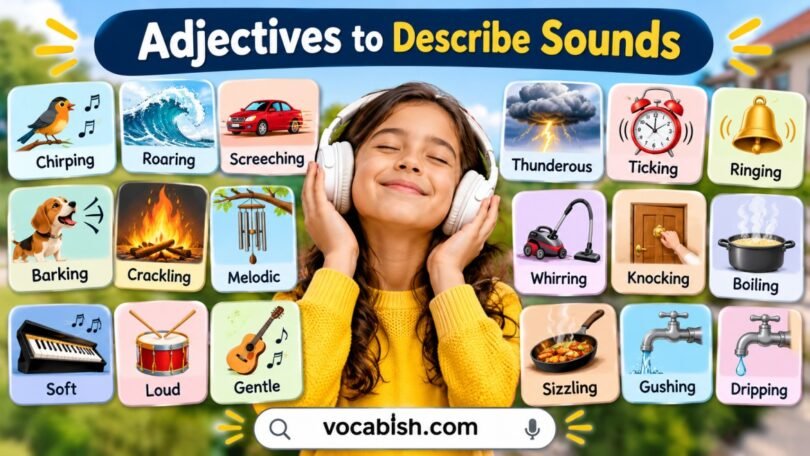

A door can slam loudly, rain can fall gently, and a bird can chirp sweetly. Adjectives to describe sounds help us explain how a sound feels, how it reaches our ears, and what makes it different from other sounds. Words such as loud, faint, sharp, muffled, melodious, and deafening make descriptions more precise and natural.
Learning descriptive words for sounds helps you talk about music, voices, animals, machines, weather, and everyday noises. The right adjective can describe a sound’s volume, pitch, quality, duration, rhythm, emotional effect, or level of clarity.
What Are Adjectives to Describe Sounds?
Adjectives to describe sounds are words that explain the characteristics of something we hear. They tell us whether a sound is loud, quiet, pleasant, harsh, high, low, clear, distant, or continuous.
For example:
- The loud thunder shook the windows.
- We heard a faint whisper from the next room.
- The singer has a melodious voice.
- A sharp whistle interrupted the conversation.
- The soothing sound of rain helped me relax.
Different adjectives describe different sound characteristics. Understanding these categories helps you choose the right word for the situation.
1. Adjectives for Loud and Quiet Sounds
These adjectives describe the volume or intensity of a sound. They are useful when talking about traffic, conversations, music, alarms, and household noises.
Loud Sound Adjectives
- Loud: Producing a lot of sound.
- The neighbors are playing loud music.
- Deafening: So loud that it is difficult to hear anything else.
- The deafening explosion frightened everyone.
- Thunderous: Extremely loud, like thunder.
- The audience gave the performers thunderous applause.
- Booming: Deep and powerful in volume.
- A booming voice came from the speakers.
- Blasting: Playing or producing sound at a very high volume.
- Music was blasting from the car.
- Piercing: Extremely sharp and loud, often uncomfortable to hear.
- A piercing scream came from the hallway.
- Ear-splitting: Uncomfortably loud.
- The ear-splitting noise made me cover my ears.
- Raucous: Loud, rough, and often uncontrolled.
- Raucous laughter filled the room.
- Resounding: Loud and clear, often spreading through a space.
- A resounding cheer welcomed the winning team.
- Explosive: Sudden and forceful in sound.
- An explosive bang came from the workshop.
Quiet Sound Adjectives
- Quiet: Producing little noise.
- The room was quiet after the guests left.
- Soft: Low in volume and not harsh.
- Soft music played in the background.
- Faint: Very weak or difficult to hear.
- I heard a faint knock at the door.
- Whispery: Resembling a whisper or containing a breathy quality.
- She spoke in a whispery voice.
- Muted: Reduced in volume or intensity.
- Muted sounds came through the closed window.
- Subdued: Quiet and restrained.
- Subdued conversations continued during dinner.
- Hushed: Very quiet, often because people are being careful not to make noise.
- The audience remained hushed during the speech.
- Murmuring: Low and indistinct, like quiet talking.
- Murmuring voices came from the waiting room.
- Inaudible: Impossible or extremely difficult to hear.
- His final words were inaudible from the back row.
- Low-key: Quiet and restrained in character or intensity.
- A low-key hum came from the equipment.
Everyday comparison:
- The television is loud.
- The television is quiet.
- The television is muted.
- The television is inaudible from the next room.
These words describe different degrees or conditions of sound, rather than exactly the same thing.
2. Adjectives for High-Pitched and Low-Pitched Sounds
Pitch describes how high or low a sound seems. These adjectives are useful for describing whistles, alarms, voices, musical instruments, engines, and animal calls.
High-Pitched Sound Adjectives
- High-pitched: Having a high musical tone.
- The child let out a high-pitched squeal.
- Shrill: Very high and piercing, often unpleasant.
- A shrill alarm rang through the building.
- Squeaky: Producing a short, high sound, often through friction.
- The old door has a squeaky hinge.
- Thin: Light and lacking depth or fullness.
- A thin whistle came from the distant field.
- Tinkling: Producing light, high, delicate sounds.
- Tinkling bells hung above the doorway.
- Whistling: Producing a clear, narrow, whistle-like tone.
- A whistling kettle signaled that the water was ready.
- Pealing: Ringing loudly and clearly, especially of bells.
- Pealing bells announced the celebration.
- Trilling: Producing a rapid series of musical notes.
- A trilling bird sang from the tree.
- Sibilant: Producing a hissing sound, especially an s or sh sound.
- The speaker had a sibilant pronunciation.
Low-Pitched Sound Adjectives
- Low-pitched: Having a low musical tone.
- A low-pitched engine rumbled nearby.
- Deep: Having a low, full tone.
- His deep voice carried across the hall.
- Bass-heavy: Dominated by low-frequency sounds.
- The bass-heavy music vibrated through the floor.
- Gravelly: Rough and low, often used for voices.
- The actor spoke in a gravelly voice.
- Rumbling: Producing a continuous, low, rolling sound.
- Low rumbling thunder approached the town.
- Growling: Producing a deep, rough, threatening sound.
- A growling dog stood beside the gate.
- Resonant: Rich and full, with sound that seems to vibrate or carry.
- The singer has a resonant voice.
- Boomy: Having an overly strong, rounded low-frequency sound.
- The recording sounded boomy in the small room.
- Sonorous: Deep, rich, and impressive in tone.
- A sonorous bell rang across the courtyard.
3. Adjectives for Pleasant and Unpleasant Sounds
Some sounds are enjoyable, relaxing, or beautiful. Others are irritating, uncomfortable, or difficult to tolerate. These adjectives help explain your reaction to what you hear.
Pleasant Sound Adjectives
- Pleasant: Giving enjoyment or comfort.
- We listened to the pleasant sound of birds singing.
- Melodious: Having a beautiful, musical quality.
- A melodious voice came from the stage.
- Harmonious: Combining different sounds in a pleasing way.
- The choir produced harmonious notes.
- Sweet: Soft, attractive, and pleasant to hear.
- A sweet melody drifted through the garden.
- Soothing: Helping someone feel calm.
- The soothing sound of flowing water relaxed me.
- Calming: Making a person feel less worried or excited.
- Calming music played in the waiting area.
- Gentle: Soft and not harsh.
- Gentle waves washed against the shore.
- Lyrical: Expressive and musical in a graceful way.
- Her lyrical singing filled the auditorium.
- Delicate: Light, subtle, and pleasing.
- Delicate chimes rang in the breeze.
- Euphonious: Pleasant and harmonious to the ear.
- The euphonious melody made the performance memorable.
Unpleasant Sound Adjectives
- Annoying: Causing irritation.
- The annoying buzz continued all morning.
- Irritating: Making someone feel uncomfortable or impatient.
- An irritating squeal came from the machine.
- Grating: Harsh and unpleasant to hear.
- The grating scrape of metal hurt my ears.
- Jarring: Sudden or harsh in a way that disturbs or shocks.
- A jarring crash interrupted the music.
- Nails-on-a-chalkboard: Extremely unpleasant or piercing in effect; an informal expression.
- That squeaky noise is like nails-on-a-chalkboard.
- Discordant: Lacking harmony or producing clashing sounds.
- Discordant notes came from the badly tuned piano.
- Harsh: Rough, strong, or unpleasant to hear.
- The harsh buzzer sounded at the end of the period.
- Unpleasant: Causing discomfort or dislike.
- An unpleasant grinding noise came from the motor.
- Clamorous: Making a loud, noisy mixture of sounds.
- A clamorous crowd gathered outside the stadium.
- Jangling: Producing a harsh, rattling sound, often from metal objects.
- The jangling keys disturbed the sleeping baby.
4. Adjectives for Clear and Unclear Sounds
These adjectives describe how easily we can recognize or understand a sound. They are particularly useful when discussing speech, phone calls, recordings, music, and sounds heard through walls.
Clear Sound Adjectives
- Clear: Easy to hear and understand.
- Her voice was clear during the online meeting.
- Crisp: Sharp, distinct, and well-defined.
- The recording captured crisp footsteps.
- Distinct: Easily recognizable as separate from other sounds.
- Distinct beeps came from the control panel.
- Articulate: Clearly and carefully pronounced, especially when describing speech.
- The presenter had an articulate speaking voice.
- Well-defined: Having clearly recognizable details.
- The microphone captured well-defined drum sounds.
- Clean: Free from unwanted noise or distortion.
- The recording produced a clean vocal sound.
- Pristine: Very clear and free from noticeable defects.
- The audio remained pristine throughout the performance.
Unclear Sound Adjectives
- Muffled: Dull or unclear, as if something is blocking the sound.
- Muffled voices came through the closed door.
- Indistinct: Not clear enough to identify easily.
- Indistinct talking continued in the hallway.
- Garbled: Distorted or mixed up so that words are difficult to understand.
- His words sounded garbled over the phone.
- Distorted: Changed from its natural or intended quality.
- The speaker produced distorted audio at high volume.
- Tinny: Thin, metallic, and lacking depth.
- The small radio had a tinny sound.
- Dull: Lacking sharpness, brightness, or clarity.
- The recording captured a dull thud.
- Fuzzy: Slightly unclear, noisy, or lacking definition.
- The old recording had a fuzzy sound.
- Hollow: Having an empty, resonant quality.
- His footsteps sounded hollow in the empty building.
5. Adjectives for Harsh, Sharp, and Sudden Sounds
These words describe sounds that are abrupt, cutting, forceful, or startling. They are often used for alarms, breaking objects, metal impacts, whistles, and unexpected noises.
- Sharp: Sudden and clearly defined.
- A sharp crack broke the silence.
- Abrupt: Starting or stopping suddenly.
- An abrupt bang interrupted the conversation.
- Sudden: Happening unexpectedly.
- A sudden crash came from the kitchen.
- Piercing: Very high or intense, often unpleasant.
- A piercing whistle echoed across the field.
- Clanging: Producing a loud metallic sound.
- Clanging pots filled the kitchen with noise.
- Clanking: Producing a series of heavy metallic impacts.
- The old gate made a clanking sound.
- Clattering: Producing repeated hard impacts as objects move or fall.
- Dishes came clattering onto the floor.
- Crackling: Producing a series of small, sharp sounds.
- The fire made a crackling noise.
- Snapping: Producing a quick, sharp breaking or striking sound.
- A snapping twig startled the hiker.
- Popping: Producing a short, sudden burst of sound.
- Popping balloons frightened the children.
- Crashing: Producing a loud sound when something strikes or falls.
- A crashing wave hit the rocks.
- Ringing: Producing a clear tone that may continue after the initial impact.
- A ringing bell signaled the end of the lesson.
- Screeching: Producing a very harsh, high sound.
- The brakes made a screeching noise.
- Squealing: Producing a high, often prolonged sound.
- The tires made a squealing sound on the road.
- Blaring: Producing a very loud, often harsh sound.
- A blaring horn forced the pedestrians to stop.
6. Adjectives for Soft, Gentle, and Soothing Sounds
These adjectives are helpful when describing peaceful environments, quiet conversations, lullabies, water, wind, and other sounds that do not feel harsh.
- Gentle: Soft and mild.
- A gentle breeze rustled the leaves.
- Whispering: Very quiet, like someone speaking in a whisper.
- Whispering voices came from the library corner.
- Rustling: Producing a soft sound as light objects rub or move against one another.
- Rustling leaves moved in the wind.
- Murmuring: Quiet and low, often without clearly distinguishable words.
- Murmuring water flowed beneath the bridge.
- Lulling: Having a repetitive, calming effect that may make someone sleepy.
- The lulling sound of rain made him drowsy.
- Hushed: Quiet or subdued.
- A hushed conversation continued after the announcement.
- Breathy: Containing noticeable airflow, especially in a person’s voice.
- She spoke in a breathy voice.
- Feathery: Extremely light and delicate in sound.
- A feathery rustle came from the curtains.
- Mellow: Smooth, warm, and not harsh.
- Mellow music played during dinner.
- Velvety: Smooth, rich, and soft in quality.
- The singer had a velvety voice.
- Airy: Light and breath-like.
- An airy flute melody floated through the room.
- Limpid: Clear and flowing in quality; more literary than conversational.
- A limpid melody played softly in the background.
7. Adjectives for Musical and Melodious Sounds
Music, singing, bells, and instruments can be described through tone, harmony, richness, and musical character. These words help you explain why a performance sounds beautiful, balanced, or unusual.
- Musical: Having a pleasing or recognizable musical quality.
- The musical chime sounded every hour.
- Melodic: Containing a clear, tuneful sequence of notes.
- The song has a melodic chorus.
- Harmonious: Combining notes in a pleasing way.
- Harmonious voices filled the church.
- Tuneful: Having an attractive and easy-to-follow tune.
- The children sang a tuneful song.
- Rhythmic: Following a regular pattern of beats.
- Rhythmic drumming came from the stage.
- Resonant: Rich and full, with strong vibrations.
- The cello produced a resonant tone.
- Sonorous: Deep, full, and powerful.
- A sonorous brass instrument led the procession.
- Mellow: Smooth and warm in tone.
- The mellow guitar sounded beautiful at sunset.
- Bright: Clear and lively in tone.
- The trumpet produced a bright sound.
- Warm: Rich and pleasing, without a harsh edge.
- The recording gave her voice a warm quality.
- Brassy: Bright, forceful, and somewhat metallic.
- A brassy trumpet sounded above the orchestra.
- Shrill: Very high and piercing.
- The shrill violin note stood out from the music.
- Off-key: Not at the correct musical pitch.
- The singer sounded off-key during the final verse.
- Discordant: Producing clashing or unpleasant combinations of notes.
- Discordant notes disrupted the melody.
- Monotonous: Having little variation in pitch or rhythm.
- The monotonous tune made the audience restless.
8. Adjectives for Rhythmic and Repetitive Sounds
Some sounds repeat in a regular pattern, while others continue unevenly or change speed. These adjectives are useful for describing clocks, machinery, footsteps, music, rain, and alarms.
- Rhythmic: Following a regular beat or pattern.
- Rhythmic footsteps approached the doorway.
- Steady: Continuing at a consistent rate or volume.
- A steady tapping came from the next room.
- Regular: Repeating at predictable intervals.
- The regular ticking of the clock helped me focus.
- Irregular: Repeating without a consistent pattern.
- Irregular knocks came from the upstairs room.
- Repetitive: Happening again and again.
- A repetitive beep warned the driver.
- Pulsating: Rising and falling repeatedly in intensity.
- Pulsating music came from the nightclub.
- Pounding: Producing repeated heavy impacts.
- Pounding drums shook the stage.
- Throbbing: Pulsing repeatedly with a strong, deep quality.
- Throbbing bass filled the dance floor.
- Staccato: Made up of short, separate sounds or notes.
- Staccato notes came from the piano.
- Syncopated: Placing emphasis on unexpected beats in music.
- Syncopated rhythms gave the song an energetic feel.
- Intermittent: Starting and stopping with gaps between sounds.
- Intermittent beeping came from the machine.
- Pattering: Producing many light, quick, repeated sounds.
- Pattering rain fell against the roof.
- Tapping: Producing light, repeated impacts.
- A tapping noise came from the window.
- Ticking: Producing short, regular, repeated sounds.
- A ticking clock stood on the shelf.
- Clattering: Producing a series of noisy impacts.
- Clattering wheels moved across the pavement.
9. Adjectives for Short, Long, and Continuous Sounds
The length of a sound can help explain what is happening. These adjectives distinguish brief noises from sounds that last, repeat, or continue without interruption.
- Brief: Lasting for a short time.
- A brief beep sounded when the machine started.
- Short: Not lasting long.
- A short whistle signaled the beginning of the race.
- Momentary: Lasting only for a moment.
- A momentary buzz came from the phone.
- Prolonged: Continuing longer than usual or expected.
- A prolonged horn sounded in the traffic.
- Sustained: Continuing at a steady level for a period.
- A sustained musical note filled the hall.
- Continuous: Happening without stopping.
- Continuous rain drummed against the windows.
- Constant: Continuing without much change.
- A constant hum came from the refrigerator.
- Endless: Seeming to continue for a very long time.
- The endless drone of the engine made the journey tiring.
- Lingering: Continuing or remaining after the original sound.
- A lingering echo remained after the bell rang.
- Fading: Gradually becoming quieter.
- Fading music came from the passing car.
- Intermittent: Occurring at intervals rather than continuously.
- Intermittent thunder rolled across the valley.
- Brief-lived: Lasting only a short time; less common than short-lived.
- The brief-lived ringing stopped almost immediately.
- Uninterrupted: Continuing without a break.
- Uninterrupted humming came from the ventilation system.
10. Adjectives for Animal Sounds
Animals produce many distinctive sounds. The right adjective can describe the pitch, intensity, repetition, or character of a bird’s call, a dog’s bark, or an insect’s noise.
- Chirping: Producing short, high birdlike sounds.
- Chirping birds woke us early.
- Tweeting: Producing short, light bird calls.
- Tweeting sparrows gathered near the window.
- Trilling: Producing a rapid sequence of notes.
- A trilling bird called from the treetop.
- Cooing: Producing a soft, low bird sound.
- Cooing pigeons rested on the roof.
- Squawking: Producing a loud, harsh bird call.
- Squawking parrots flew over the garden.
- Cawing: Producing the harsh call of a crow.
- Cawing crows gathered around the field.
- Hooting: Producing a rounded call, especially that of an owl.
- Hooting owls sounded from the woods.
- Howling: Producing a long, loud sound, often from dogs or wolves.
- Howling dogs disturbed the quiet night.
- Barking: Producing the sharp calls of a dog.
- Barking dogs ran along the fence.
- Yelping: Producing short, high cries.
- Yelping puppies crowded around their mother.
- Growling: Producing a low, rough, threatening sound.
- A growling dog guarded the gate.
- Whimpering: Producing soft, weak cries.
- A whimpering puppy waited beside the door.
- Purring: Producing a low, continuous vibrating sound, especially in cats.
- A purring cat slept on the sofa.
- Buzzing: Producing a continuous vibrating sound.
- Buzzing bees circled the flowers.
- Humming: Producing a low, steady sound.
- Humming insects gathered near the light.
- Croaking: Producing a rough call, especially from frogs.
- Croaking frogs filled the pond area.
- Ribbiting: Producing the characteristic call associated with frogs.
- Ribbiting frogs sounded after the rain.
- Bleating: Producing the characteristic cry of sheep or goats.
- Bleating goats gathered near the barn.
- Mooing: Producing the low call of cattle.
- Mooing cows waited near the feeding area.
- Neighing: Producing the characteristic call of a horse.
- Neighing horses stood in the stable.
- Clucking: Producing the short calls of a chicken.
- Clucking hens searched for food.
- Gobbling: Producing the characteristic rapid call of a turkey.
- Gobbling turkeys moved across the farm.
- Chattering: Producing rapid, repeated calls.
- Chattering monkeys climbed through the trees.
- Screeching: Producing a harsh, high-pitched call.
- Screeching bats flew over the cave entrance.
11. Adjectives for Human Voices and Speech
Voices can sound warm, confident, rough, shaky, tired, or emotional. These adjectives are especially helpful in everyday conversations, storytelling, presentations, and descriptions of people.
Voice Quality
- Clear: Easy to hear and understand.
- He has a clear speaking voice.
- Hoarse: Rough or strained, often because of illness or heavy voice use.
- My voice became hoarse after the match.
- Husky: Low, slightly rough, and often attractive in tone.
- She spoke in a husky voice.
- Raspy: Rough and scratchy.
- His raspy voice sounded tired.
- Gravelly: Deep and rough, like small stones rubbing together.
- The narrator had a gravelly voice.
- Breathy: Containing noticeable breath.
- Her breathy voice was barely audible.
- Nasal: Having a strong nose-resonant quality.
- He has a nasal speaking voice.
- Resonant: Full and rich, carrying well.
- The speaker’s resonant voice reached the back row.
- Muffled: Unclear or blocked.
- His muffled voice came through the thick scarf.
- Tremulous: Shaking slightly, often from nervousness or emotion.
- She answered in a tremulous voice.
- Quavering: Shaking or wavering in pitch.
- His quavering voice revealed his fear.
- Monotonous: Showing little change in pitch or expression.
- The lecturer had a monotonous voice.
- Animated: Full of energy and variation.
- She spoke in an animated voice.
- Authoritative: Sounding confident and commanding.
- The manager used an authoritative tone.
- Soothing: Making listeners feel calmer.
- The nurse spoke in a soothing voice.
Adjectives for the Way People Speak
- Whispered: Spoken very quietly.
- A whispered warning came from the doorway.
- Muttered: Spoken quietly and often unclearly.
- He muttered a complaint under his breath.
- Mumbled: Spoken without clear pronunciation.
- The tired child mumbled a few words.
- Shouted: Spoken very loudly.
- She shouted across the crowded room.
- Screamed: Spoken or cried out at a very high volume.
- He screamed when the lights suddenly went out.
- Bellowing: Speaking in an extremely loud, deep voice.
- A bellowing voice called the workers together.
- Rasping: Producing a rough, scratchy sound.
- He answered in a rasping voice.
- Stammering: Speaking with involuntary pauses or repeated sounds.
- The nervous speaker gave a stammering reply.
- Hesitant: Sounding uncertain or unwilling to speak confidently.
- She gave a hesitant answer.
- Confident: Sounding sure of oneself.
- His confident voice reassured the audience.
- Angry: Expressing anger through voice or tone.
- He replied in an angry voice.
- Cheerful: Sounding happy and positive.
- Her cheerful voice brightened the conversation.
- Sarcastic: Expressing mockery or criticism through tone.
- He made a sarcastic remark.
- Emotional: Showing strong feelings.
- She spoke in an emotional voice.
- Urgent: Communicating that something needs immediate attention.
- An urgent voice called for help.
12. Adjectives for Mechanical and Electronic Sounds
Machines, vehicles, appliances, and electronic devices often produce recognizable noises. These adjectives can help you explain what a device sounds like or describe a problem clearly.
- Mechanical: Having the characteristic sound of machinery.
- A mechanical clicking sound came from the printer.
- Electric: Produced by or associated with electrical equipment.
- An electric buzzing sound came from the device.
- Electronic: Produced by electronic equipment.
- An electronic beep signaled a completed payment.
- Robotic: Sounding machine-like or lacking natural variation.
- The navigation system used a robotic voice.
- Monotonous: Repeating with little variation.
- The monotonous drone of the fan continued overnight.
- Buzzing: Producing a continuous vibrating noise.
- A buzzing transformer stood beside the building.
- Whirring: Producing a continuous, light mechanical sound.
- The whirring fan cooled the room.
- Grinding: Producing a rough sound from surfaces rubbing together.
- A grinding noise came from the gearbox.
- Rattling: Producing repeated light impacts.
- The rattling window shook in the wind.
- Clanking: Producing heavy metallic impacts.
- Clanking machinery echoed through the factory.
- Humming: Producing a low, steady noise.
- The refrigerator made a humming sound.
- Beeping: Producing short, high electronic tones.
- A beeping alarm warned the driver.
- Pinging: Producing a short, high, clear tone.
- A pinging notification sounded on the phone.
- Clicking: Producing short, distinct sounds.
- Clicking buttons came from the control panel.
- Whining: Producing a high, continuous sound, often from a motor.
- The motor made a whining noise.
- Sputtering: Producing irregular bursts of sound, often because an engine is struggling.
- The sputtering engine failed to start.
- Roaring: Producing a very loud, powerful sound.
- A roaring engine approached the intersection.
- Chugging: Producing a repeated, heavy mechanical sound.
- The old train was chugging along the tracks.
- Purring: Producing a smooth, low, steady mechanical sound.
- The engine was purring smoothly.
- Rumbling: Producing a deep, continuous sound.
- A rumbling truck passed the house.
- Hissing: Producing a long, sharp breath-like sound.
- Hissing steam escaped from the pipe.
- Popping: Producing short, sudden bursts of sound.
- Popping noises came from the faulty speaker.
13. Adjectives for Natural Sounds
Nature produces a wide variety of sounds, from the soft movement of leaves to the heavy crash of thunder. These words are useful for describing landscapes, weather, outdoor experiences, and peaceful settings.
- Rustling: Making a soft sound as leaves or other light materials move.
- Rustling branches swayed above the path.
- Whistling: Producing a high, narrow tone.
- Whistling wind passed through the gaps in the fence.
- Howling: Producing a long, loud, forceful sound.
- Howling winds swept across the open plain.
- Roaring: Producing a powerful, continuous sound.
- Roaring waves struck the rocky coast.
- Gurgling: Producing a bubbling sound as liquid flows.
- Gurgling water ran through the stream.
- Trickling: Producing a gentle, light flowing sound.
- Trickling water moved over the stones.
- Babbling: Producing a continuous, light, irregular flowing sound, often associated with a stream.
- A babbling brook flowed beneath the bridge.
- Splashing: Producing a sound when liquid strikes a surface.
- Splashing waves reached the sandy beach.
- Dripping: Producing separate drops of liquid hitting a surface.
- Dripping water echoed in the cave.
- Pattering: Producing light, repeated impacts.
- Pattering rain fell on the leaves.
- Pouring: Producing a continuous sound as liquid falls in a stream.
- Pouring rain covered the roof with noise.
- Crackling: Producing many small, sharp sounds.
- Crackling branches burned in the fire.
- Thunderous: Extremely loud and deep.
- Thunderous waves crashed against the cliffs.
- Murmuring: Producing a soft, continuous sound.
- Murmuring streams wound through the forest.
- Whispering: Producing a soft, breath-like sound.
- Whispering leaves moved in the evening breeze.
- Breezy: Associated with light wind and its soft movement.
- A breezy rustle passed through the grass.
- Rolling: Moving through a series of low, continuing sounds.
- Rolling thunder spread across the sky.
- Crashing: Producing a loud impact.
- Crashing waves hit the seawall.
14. Adjectives for Mysterious, Strange, and Scary Sounds
Sounds can create suspense, signal danger, or make a place feel unfamiliar. These adjectives are particularly useful for storytelling, describing unusual experiences, and explaining why a sound feels unsettling.
- Eerie: Strange and frightening in a quiet or mysterious way.
- An eerie whistle came from the abandoned house.
- Spooky: Frightening in a ghostly or mysterious way.
- Spooky noises came from the empty basement.
- Haunting: Beautiful, sad, or frightening in a way that stays in the mind.
- A haunting melody echoed through the hall.
- Sinister: Suggesting danger or evil.
- A sinister whisper came from the dark corridor.
- Ominous: Suggesting that something bad may happen.
- An ominous rumble came from the distant hills.
- Creepy: Causing an uncomfortable or fearful feeling.
- A creepy scratching sound came from the wall.
- Unsettling: Making someone feel nervous or uncomfortable.
- An unsettling tapping continued after midnight.
- Ghostly: Strange, faint, or apparently supernatural.
- A ghostly moan drifted through the hallway.
- Unnatural: Not sounding normal or expected.
- An unnatural buzzing noise came from the device.
- Strange: Unusual or unfamiliar.
- A strange clicking sound came from the attic.
- Mysterious: Difficult to explain or identify.
- A mysterious ringing sound came from the woods.
- Frightening: Causing fear.
- A frightening scream broke the silence.
- Menacing: Suggesting a threat.
- A menacing growl came from behind the fence.
- Bloodcurdling: Extremely frightening.
- A bloodcurdling scream echoed through the building.
- Chilling: Causing fear or a strong feeling of unease.
- A chilling whisper came from the empty room.
15. Adjectives for Weak, Strong, and Intense Sounds
These words describe how powerful a sound seems, whether it is physically forceful or emotionally intense. They can be useful for describing explosions, music, storms, engines, and voices.
- Powerful: Having great force or strength.
- A powerful drumbeat shook the stage.
- Forceful: Strong and energetic.
- A forceful blast came from the exhaust pipe.
- Intense: Very strong or concentrated.
- Intense music filled the small room.
- Mighty: Very powerful or impressive.
- A mighty roar came from the waterfall.
- Fierce: Strong and forceful, often in an aggressive way.
- Fierce winds whistled around the building.
- Weak: Lacking strength or volume.
- A weak signal produced a faint buzzing sound.
- Feeble: Very weak and barely noticeable.
- A feeble knock came from the back door.
- Thin: Lacking fullness or strength.
- A thin voice struggled to rise above the noise.
- Robust: Full, strong, and substantial.
- The recording had a robust bass tone.
- Full-bodied: Rich and complete in sound.
- The instrument produced a full-bodied tone.
- Overpowering: So strong that it dominates other sounds.
- Overpowering music drowned out the conversation.
- Booming: Deep, loud, and powerful.
- A booming announcement filled the station.
- Thunderous: Extremely loud and forceful.
- Thunderous applause followed the performance.
- Subtle: Quiet or delicate, with small details.
- Subtle chimes played behind the main melody.
16. Adjectives for Echoing and Distant Sounds
The location of a sound can change how we describe it. Some sounds seem to bounce off walls, while others are difficult to hear because they come from far away.
- Echoing: Repeating after the original sound because it reflects off surfaces.
- Echoing footsteps moved through the tunnel.
- Reverberant: Continuing to resonate in an enclosed space.
- The reverberant hall made every note sound longer.
- Resonant: Rich and full, with noticeable vibration.
- A resonant bell rang across the courtyard.
- Distant: Coming from far away.
- Distant sirens could be heard at night.
- Faraway: Coming from a place that seems far away.
- A faraway horn sounded across the water.
- Faint: Weak and difficult to hear.
- A faint cry came from the distant field.
- Muffled: Reduced or unclear, often because something blocks the sound.
- Muffled music came from the apartment upstairs.
- Hollow: Having a deep, empty-sounding resonance.
- Hollow footsteps echoed in the corridor.
- Booming: Producing a deep sound that carries.
- Booming thunder rolled across the valley.
- Cavernous: Having a deep, spacious resonance like a cave.
- A cavernous echo followed the shout.
- Close: Seeming to come from nearby.
- A close rustling sound came from the bushes.
- Surrounding: Coming from several directions around a listener.
- Surrounding noises made the busy street feel overwhelming.
- Ambient: Present as background sound in an environment.
- Ambient noise filled the crowded café.
17. Adjectives for Dry, Wet, and Textured Sounds
Some sounds are described by the physical impression they create. These words can suggest whether a sound is crisp, rough, bubbly, crunchy, or smooth.
Dry and Crisp Sounds
- Crisp: Sharp, distinct, and clearly defined.
- Crisp footsteps sounded on the gravel path.
- Dry: Lacking a wet, resonant, or ringing quality.
- The drum produced a dry, short sound.
- Brittle: Sharp and fragile-sounding, as if something might break.
- Brittle twigs snapped underfoot.
- Crackly: Producing many small, sharp sounds.
- The crackly recording played through the old radio.
- Crunchy: Producing a hard, crushing sound.
- Crunchy leaves broke beneath our shoes.
- Scratchy: Producing a rough, scraping sound.
- A scratchy noise came from the old record.
- Raspy: Rough and coarse in quality.
- A raspy voice answered from the other end.
- Grating: Harsh and unpleasant, often because surfaces rub together.
- A grating noise came from the metal gate.
Wet and Liquid-Like Sounds
- Splashy: Producing frequent splashes.
- Splashy waves reached the edge of the pool.
- Squishy: Producing a soft, wet sound when pressed or moved.
- Squishy mud made noise beneath our boots.
- Squelchy: Producing a wet, sucking sound.
- Squelchy footsteps followed the rainy walk.
- Sloshing: Producing a sound as liquid moves inside a container or against a surface.
- Sloshing water moved inside the bucket.
- Gurgling: Producing bubbling sounds as liquid flows.
- Gurgling water passed through the drain.
- Bubbling: Producing small, rounded sounds as bubbles rise or burst.
- Bubbling water simmered in the pot.
- Fizzing: Producing many small bubbles that make a fine, rapid sound.
- Fizzing soda filled the glass.
- Drippy: Characterized by drops of liquid falling at intervals.
- A drippy tap disturbed the quiet kitchen.
Other Textured Sounds
- Smooth: Even and free from rough changes.
- The recording had a smooth vocal tone.
- Silky: Very smooth and soft in quality.
- A silky melody played on the flute.
- Rough: Uneven or harsh in sound.
- Rough scraping came from the workshop.
- Scratchy: Having a dry, abrasive quality.
- The scratchy microphone picked up every movement.
- Metallic: Having the ringing or hard quality of metal.
- A metallic clang came from the workshop.
- Woody: Having the warm, hollow quality associated with wood.
- The instrument produced a woody tone.
- Buzzy: Having a vibrating, slightly rough sound.
- A buzzy electric tone came from the speaker.
- Poppy: Having short, sharp attacks or bursts.
- The recording had a poppy, percussive quality.
18. Adjectives for Describing Sounds in Everyday Conversation
Choosing the right adjective makes your English sound more natural. The following examples show how to describe sounds in common situations without using complicated vocabulary.
Talking About Music
- The music is catchy and easy to remember.
- This song has a mellow sound.
- The bass is too boomy in this recording.
- The singer has a rich voice.
- The melody sounds soothing and relaxing.
- The drums are pounding and energetic.
- The recording sounds tinny through these speakers.
- The background music is too loud for conversation.
Talking About Voices
- You have a clear speaking voice.
- His voice sounds hoarse today.
- She has a soft-spoken manner.
- The announcer has a deep voice.
- That speaker sounds monotonous.
- Her voice became shaky when she heard the news.
- The microphone makes my voice sound muffled.
- He gave a sharp reply.
Talking About Household Noises
- The refrigerator makes a constant humming sound.
- The door has a squeaky hinge.
- The old fan makes a rattling noise.
- The clock has a steady ticking sound.
- There is a strange buzzing noise in the kitchen.
- The water tap makes a dripping sound.
- The floorboards make creaky noises at night.
- The washing machine produces a loud vibration.
Talking About Weather and Nature
- The wind sounds howling outside.
- The rain makes a gentle pattering sound.
- The thunder is deafening tonight.
- The stream has a peaceful, gurgling sound.
- The birds make cheerful chirping noises.
- The waves produce a powerful crashing sound.
- The leaves make a soft, rustling sound.
- The storm has an ominous rumble.
Talking About Traffic and Public Places
- The traffic is noisy this morning.
- A piercing siren came from the street.
- The train makes a rhythmic clattering sound.
- The crowd became raucous after the match.
- The bus engine has a deep rumble.
- The announcement sounded muffled.
- The brakes produced a sharp screech.
- The station was filled with constant background noise.
19. More Useful Words to Describe Sounds
The following adjectives expand your vocabulary for particular situations, including speech, music, environments, and unusual noises.
- Noisy: Full of sound or unwanted noise.
- The noisy classroom made it hard to concentrate.
- Quiet: Producing little noise.
- The street was quiet after midnight.
- Lively: Full of energy and activity.
- Lively music came from the festival.
- Vibrant: Full of energy, richness, or variation.
- The band produced a vibrant sound.
- Dramatic: Powerful or expressive enough to attract attention.
- A dramatic musical note ended the performance.
- Expressive: Communicating emotion or meaning effectively.
- The singer has an expressive voice.
- Emotive: Strongly expressing or creating emotion.
- An emotive melody moved the audience.
- Playful: Lighthearted and cheerful in character.
- Playful notes came from the xylophone.
- Dreamy: Soft, gentle, and somewhat unreal in quality.
- Dreamy music filled the room.
- Hypnotic: Repetitive or absorbing enough to hold attention.
- A hypnotic rhythm continued throughout the performance.
- Energetic: Full of activity or force.
- Energetic drumming energized the crowd.
- Loud-mouthed: Speaking loudly and often without restraint; generally describes a person rather than the sound itself.
- The loud-mouthed announcer dominated the room.
- Clipped: Short and sharply separated, often describing speech.
- The officer gave clipped instructions.
- Measured: Controlled and carefully paced.
- The speaker used a measured tone.
- Rapid: Happening or produced quickly.
- Rapid clicking came from the keyboard.
- Sluggish: Slow and lacking energy.
- A sluggish motor produced a weak hum.
- Fluttering: Making light, quick, repeated movements that create sound.
- Fluttering wings came from the nearby nest.
- Swishing: Producing a soft sweeping sound.
- Swishing fabric brushed against the floor.
- Whooshing: Producing a rushing sound as air or an object moves quickly.
- A whooshing sound came from the passing vehicle.
- Zipping: Producing a quick, high sound like a zip or rapid movement.
- A zipping noise came from the electric tool.
- Sizzling: Producing a continuous, fine crackling sound, often from hot food.
- Sizzling bacon filled the kitchen with sound.
- Roaring: Producing a loud, powerful, continuous sound.
- Roaring applause followed the final performance.
- Creaky: Producing slow, strained squeaking or groaning noises.
- The creaky staircase made noise with every step.
- Groaning: Producing a deep, strained sound.
- The old wooden floor made a groaning noise.
- Whimpering: Producing soft, weak cries.
- A whimpering dog waited beside the door.
- Clunky: Producing heavy, awkward mechanical sounds.
- The old printer made a clunky noise.
- Clumsy: Lacking smoothness or control, sometimes describing a sequence of awkward noises.
- Clumsy movements caused several clattering sounds.
- Droning: Producing a continuous, monotonous sound.
- Droning machinery filled the workshop.
- Hissy: Containing a noticeable hissing quality.
- The old recording had a hissy background.
- Blaring: Producing a loud, forceful sound.
- Blaring music came from the open car window.
- Brittle: Having a hard, sharp, fragile-sounding quality.
- Brittle ice cracked beneath our feet.
- Bouncy: Having a lively, springy rhythm.
- Bouncy music played during the exercise class.
- Muffled: Reduced in clarity or volume.
- Muffled laughter came from the next room.
- Resounding: Loud, clear, and carrying well.
- A resounding cheer filled the stadium.
- Ringing: Producing a clear tone that may linger.
- Ringing bells sounded across the town.
- Clattering: Producing repeated hard impacts.
- Clattering dishes came from the kitchen.
- Squealing: Producing a high, often prolonged sound.
- Squealing brakes stopped the vehicle.
- Thudding: Producing repeated, heavy, dull impacts.
- Thudding footsteps approached the door.
- Thumping: Producing strong, repeated impacts.
- Thumping music came from upstairs.
- Whizzing: Producing a quick rushing or buzzing sound.
- A whizzing object passed overhead.
- Zinging: Producing a high, sharp, lively sound.
- A zinging electronic tone came from the device.
- Rattly: Producing repeated light, loose impacts.
- The rattly exhaust disturbed the quiet street.
- Fluttery: Having a light, quick, wavering sound.
- A fluttery vibration came from the speaker.
- Bubbly: Producing light bubbling sounds or having a lively quality.
- Bubbly laughter came from the children.
- Crisply articulated: Pronounced with sharp, distinct separation.
- The presenter spoke in a crisply articulated voice.
Common Mistakes When Describing Sounds
Some adjectives are similar, but they do not always mean the same thing. Keep these distinctions in mind when speaking or writing.
- Loud vs. high-pitched: Loud describes volume; high-pitched describes the tone. A sound can be quiet and high-pitched.
- Soft vs. low-pitched: Soft usually describes low volume or a gentle quality; low-pitched describes a deep tone.
- Clear vs. loud: Clear means easy to hear or understand. A sound does not need to be loud to be clear.
- Muffled vs. faint: Muffled means blocked or dulled; faint means weak or difficult to hear.
- Melodious vs. rhythmic: Melodious describes a pleasing musical quality; rhythmic describes a pattern of beats or sounds.
Practice Exercises: Choose the Right Sound Adjective
Choose the best adjective for each sentence. Use the context to identify the intended meaning.
- The alarm was so __________ that everyone covered their ears. (deafening / mellow)
- I heard a __________ knock from the other side of the wall. (faint / thunderous)
- The old door made a __________ noise whenever someone opened it. (squeaky / melodious)
- A __________ voice came from the radio, but I could not understand the words clearly. (muffled / crisp)
- The __________ sound of the stream helped me relax. (soothing / piercing)
- The engine produced a deep, __________ rumble. (low-pitched / high-pitched)
- The clock made a __________ ticking sound throughout the night. (steady / explosive)
- A __________ scream suddenly broke the silence. (piercing / mellow)
- The singer had a rich, __________ voice that carried across the hall. (resonant / inaudible)
- The machine made an irregular, __________ noise before stopping. (sputtering / harmonious)
- The old recording sounded __________ because the audio was unclear and distorted. (garbled / euphonious)
- The __________ leaves made a soft sound in the breeze. (rustling / clanging)
- A __________ melody stayed in my mind long after the performance. (haunting / clunky)
- The children produced a __________ mixture of loud voices and laughter. (raucous / hushed)
- The bell made a clear, __________ sound that continued after it was struck. (ringing / muffled)
Answers
- Deafening
- Faint
- Squeaky
- Muffled
- Soothing
- Low-pitched
- Steady
- Piercing
- Resonant
- Sputtering
- Garbled
- Rustling
- Haunting
- Raucous
- Ringing
Frequently Asked Questions
Adjectives to describe sounds are words that explain volume, pitch, tone, clarity, rhythm, duration, or emotional effect, such as loud, faint, shrill, and soothing.
Common sound adjectives include loud, quiet, soft, harsh, clear, muffled, deep, high-pitched, pleasant, annoying, rhythmic, and melodious.
Deafening describes a sound that is extremely loud, while thunderous, ear-splitting, and booming describe other kinds of powerful sounds.
Pleasant sounds can be described as soothing, melodious, harmonious, gentle, mellow, sweet, tuneful, calming, or euphonious.
Unpleasant sounds may be described as harsh, grating, shrill, irritating, jarring, discordant, piercing, scratchy, or ear-splitting.
Loud describes how much sound is produced, while high-pitched describes the tone. A sound can be high-pitched without being loud.
Useful voice adjectives include deep, clear, hoarse, husky, raspy, breathy, resonant, shaky, monotonous, cheerful, and soothing.
Choose an adjective that matches the sound’s quality: a fan may be whirring, rain may be pattering, a bell may be ringing, and a dog may be barking.
Conclusion
Learning adjectives to describe sounds helps you communicate more accurately about voices, music, animals, machines, weather, and everyday noises. Words such as loud, faint, shrill, mellow, muffled, rhythmic, and resonant describe different sound qualities and help listeners picture what you hear.
To improve your vocabulary, practise using a few new adjectives each day. Describe the sounds around you, compare similar words, and use the expressions in everyday conversations. With regular practice, you will find it easier to choose precise descriptive words for sounds in both speaking and writing.
Explore More Related Topics
- 200+ Adjectives to Describe Feelings in English
- 150+ Adjectives to Describe Food in English
- 200+ Adjectives to Describe Emotions in English
- 1000+ Descriptive Words with Meanings and PDF
- 200+ Adjectives and Words to Describe Animals
- 100+ Adjectives to Describe Someone in English
- 100+ Words to Describe Yourself for a Job Interview