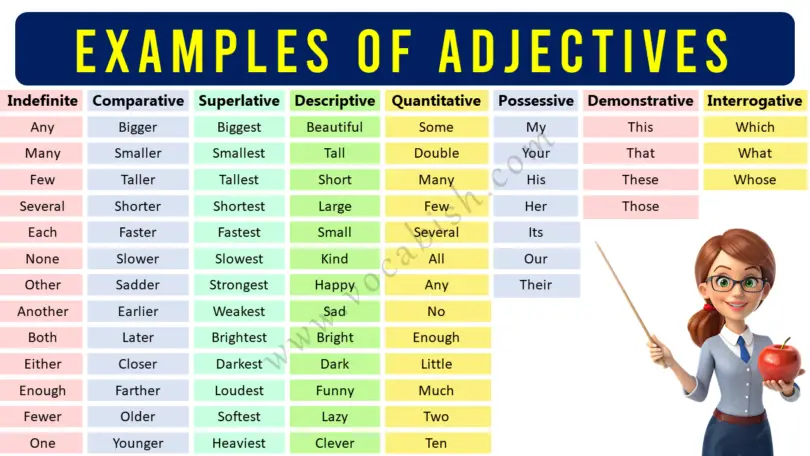

Adjectives are words that describe nouns. They tell us about size, color, shape, feeling, number, and quality. Words like happy, tall, blue, and small are common examples. In this blog post, you will learn 300+ A to Z adjectives in English with pictures to help you grow your vocabulary. When you understand adjectives, you can give more detail in your speaking and writing. Your sentences become richer and more meaningful. With regular practice, you will master how to choose the right adjectives and use them correctly in daily communication. Keep reading to explore the complete A to Z list and improve your English step by step.
Here’s the list of 300+ A to Z Adjectives list in English:
A to Z List of Adjectives in English
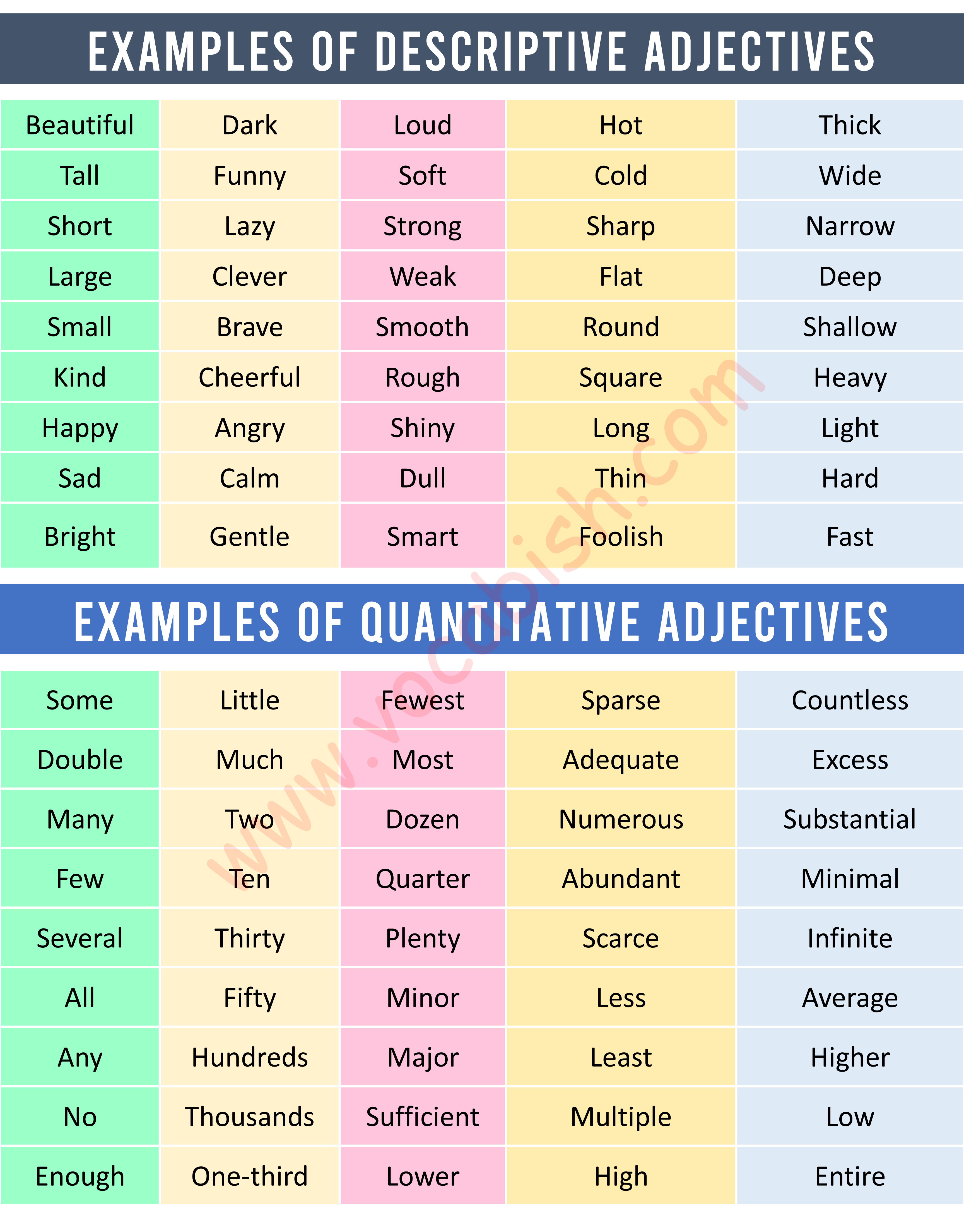
List of Descriptive Adjectives
These adjectives describe qualities of nouns.
- beautiful
- tall
- short
- large
- small
- kind
- happy
- sad
- bright
- dark
- funny
- lazy
- clever
- brave
- cheerful
- angry
- calm
- loud
- soft
- strong
- weak
- smooth
- rough
- shiny
- dull
- hot
- cold
- sharp
- flat
- round
- square
- long
- thin
- thick
- wide
- narrow
- deep
- shallow
- heavy
- light
- hard
- gentle
- smart
- foolish
- fast
- slow
- clean
- dirty
- fresh
- stale
List of Quantitative Adjectives
These adjectives indicate quantity or amount.
- some
- many
- few
- several
- all
- any
- no
- enough
- whole
- little
- much
- two
- ten
- thirty
- fifty
- hundreds
- thousands
- one-third
- half
- double
- fewest
- most
- dozen
- quarter
- plenty
- minor
- major
- sufficient
- sparse
- adequate
- numerous
- abundant
- scarce
- less
- least
- multiple
- countless
- excess
- substantial
- minimal
- infinite
- average
- higher
- lower
- minimal
- minimal
- high
- low
- entire
List of Adjectives
List of Demonstrative Adjectives
These point out specific nouns.
- this
- that
- these
- those
List of Possessive Adjectives
These indicate ownership or possession.
- my
- your
- his
- her
- its
- our
- their
List of Interrogative Adjectives
These are used to ask questions.
- which
- what
- whose
List of Indefinite Adjectives
These refer to non-specific nouns.
- any
- many
- few
- several
- each
- all
- some
- none
- other
- another
- both
- either
- neither
- most
- enough
- fewer
- one
- much
- plenty
- anyone
- somebody
- anything
- everybody
- nobody
- someone
- everybody
- anyone
- someone
- something
List of Comparative Adjectives
These compare two nouns.
- bigger
- smaller
- taller
- shorter
- faster
- slower
- stronger
- weaker
- brighter
- darker
- louder
- softer
- heavier
- lighter
- richer
- poorer
- better
- worse
- happier
- sadder
- earlier
- later
- closer
- farther
- older
- younger
- more beautiful
- less expensive
- more interesting
- more intelligent
- less important
- easier
- harder
- kinder
- simpler
- lazier
- sharper
- calmer
- cleaner
- dirtier
- fresher
- warmer
- cooler
- sweeter
- saltier
- healthier
- funnier
List of Superlative Adjectives
These describe the extreme or highest degree of something.
- biggest
- smallest
- tallest
- shortest
- fastest
- slowest
- strongest
- weakest
- brightest
- darkest
- loudest
- softest
- heaviest
- lightest
- richest
- poorest
- best
- worst
- happiest
- saddest
- earliest
- latest
- closest
- farthest
- oldest
- youngest
- most beautiful
- least expensive
- most interesting
- most intelligent
- least important
- easiest
- hardest
- kindest
- simplest
- laziest
- sharpest
- calmest
- cleanest
- dirtiest
- freshest
- warmest
- coolest
- sweetest
- saltiest
- healthiest
- funniest
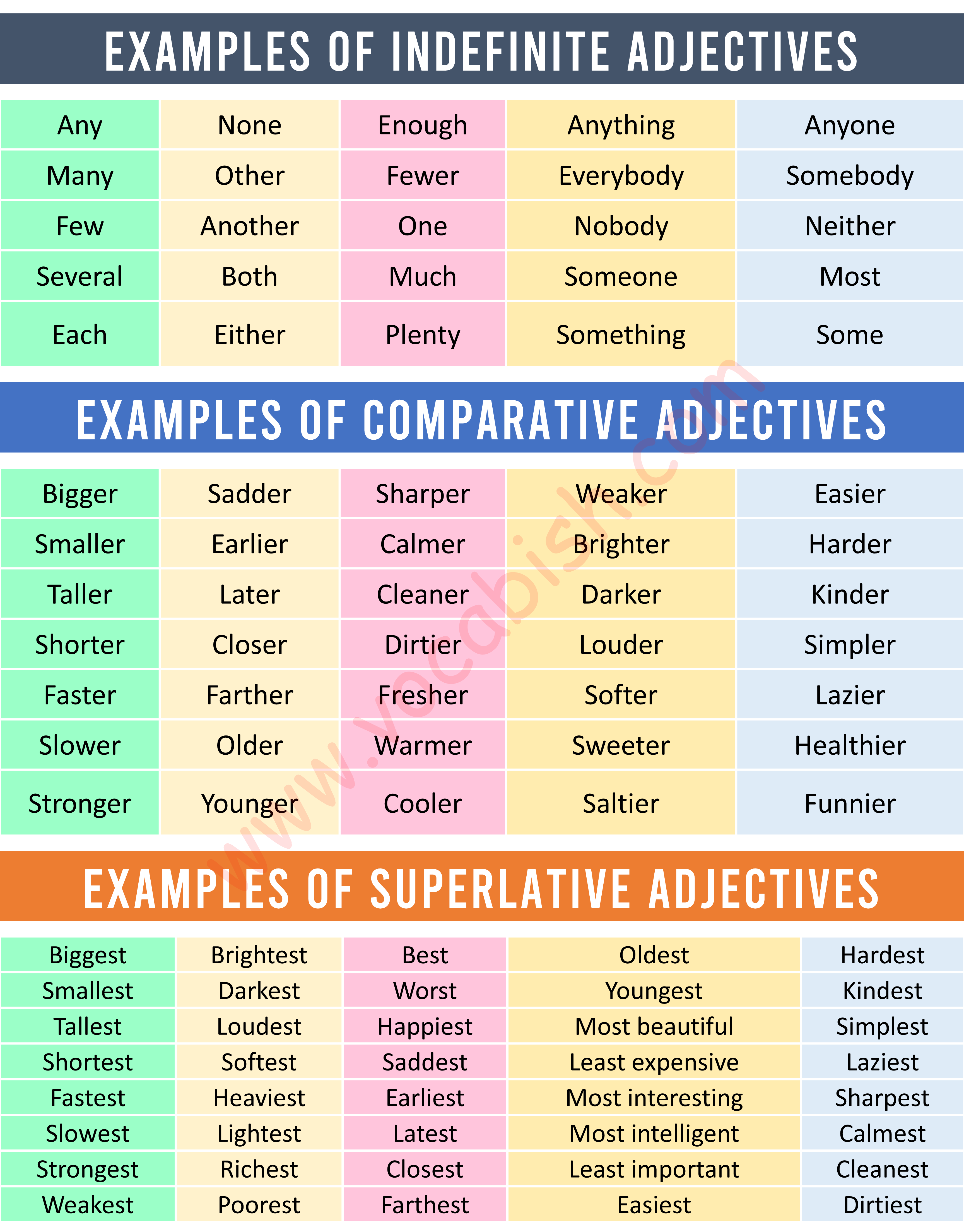
Adjectives List in English
Adjectives make your English sentences more colourful, clear, and interesting. They help describe people, places, and things in detail, making your communication more expressive.
FAQs
What is an adjective in English grammar?
An adjective is a word that describes a noun or pronoun. It tells more about the quality, size, colour, or number of something.
Example: a beautiful flower, three apples, a tall man.
What are some common examples of adjectives?
Common adjectives include:
happy, tall, red, small, beautiful, big, cold, easy, old, fast.
These words help make sentences more interesting and detailed.
What are the types of adjectives in English?
There are several types of adjectives, such as:
- Descriptive Adjectives → beautiful, large
- Quantitative Adjectives → some, many
- Demonstrative Adjectives → this, that
- Possessive Adjectives → my, our
- Interrogative Adjectives → which, what
How do adjectives make sentences better?
Adjectives make sentences clearer and more expressive by giving extra details.
Example: Instead of saying “I saw a car”, you can say “I saw a red car”.
What is the difference between adjectives and adverbs?
An adjective describes a noun (She is beautiful), while an adverb describes a verb, adjective, or another adverb (She sings beautifully).
Read More