
If you are learning English, you have probably noticed that words looking almost exactly the same can have totally different meanings. Credible and creditable are a perfect example of this.
Because they both come from the Latin root credere (to believe or trust), they look and sound very similar. However, native speakers use them in completely different situations. Let’s break down exactly how to tell them apart.
Credible vs Creditable: Quick Answer
Here is the quick answer that helps you know the difference between both words:
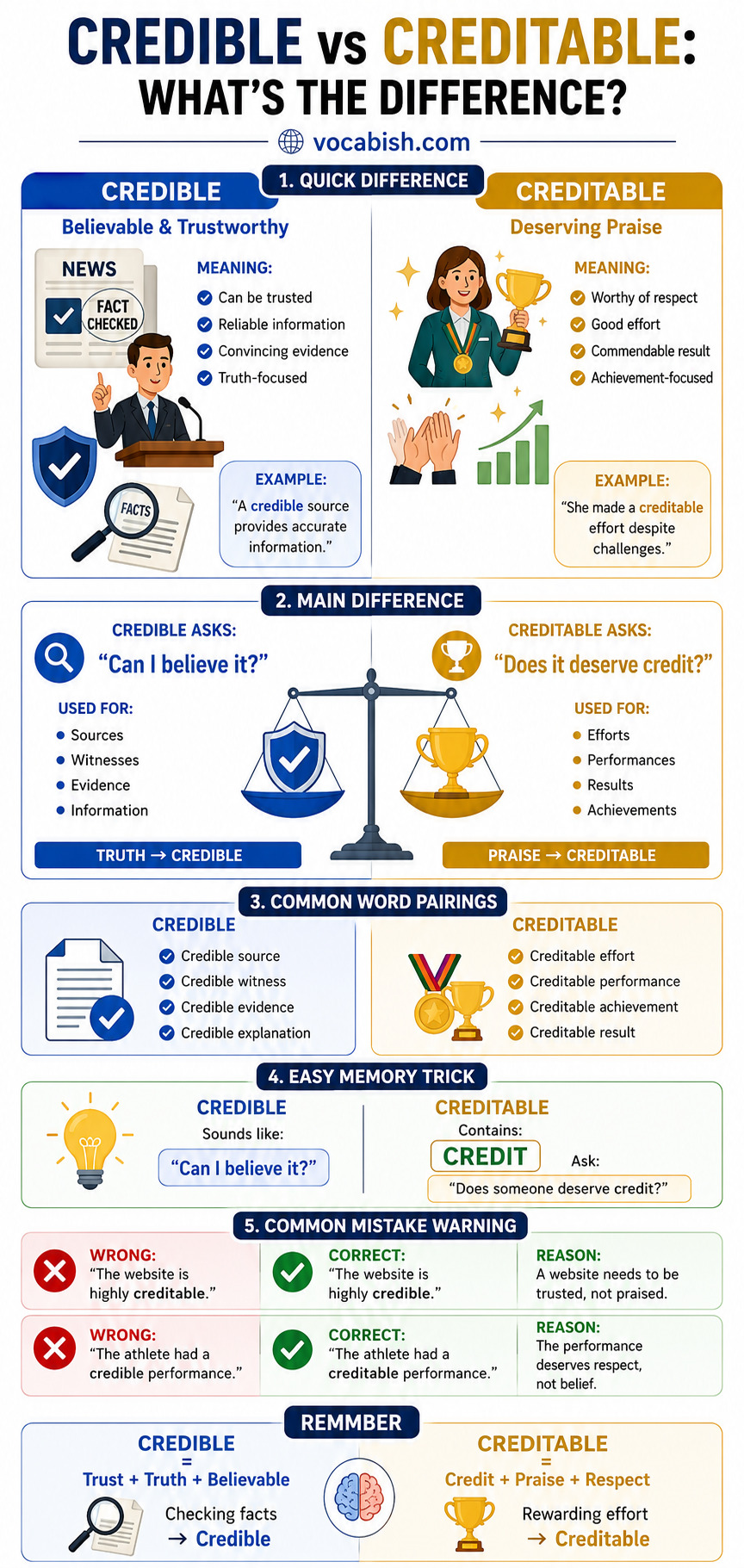
- Credible means believable, trustworthy, or convincing.
- Creditable means deserving praise, respect, or acknowledgment (even if not perfect).
If a witness tells the truth, they are credible. If a student tries very hard on a difficult project, their effort is creditable.
Meaning and Usage of Credible
When you call something or someone credible, you are saying that they can be believed. You trust the information or the person giving it. We usually use this word when talking about news, witnesses, data, or excuses.
How to use credible in a sentence:
- “The lawyer won the case because she had a highly credible witness.”
- “Make sure you get your medical advice from a credible source, not just social media.”
- “His excuse for being late was actually quite credible because of the heavy snowstorm.”
Quick Tip: Think of “credible” as the opposite of “fake” or “unbelievable.”
Meaning and Usage of Creditable
Creditable has to do with getting “credit” for something good. If an action or result is creditable, it is good enough to deserve respect or praise.
Native speakers often use this word to describe an attempt, a performance, or a result. It doesn’t necessarily mean something was the best in the world, but it means it was respectable and worthy of applause.
How to use creditable in a sentence:
- “Even though they lost the game, the team put up a creditable fight against the champions.”
- “She has done a creditable job managing the store while the boss was away.”
- “Graduating with honors while working full-time is a very creditable achievement.”
Main Difference Between Credible and Creditable
Here is a simple breakdown to help you see the difference side-by-side.
Feature | Credible | Creditable |
Meaning | Can be believed or trusted. | Deserves praise or respect. |
Focuses on | Truth and reliability. | Effort and performance. |
Commonly pairs with | Sources, evidence, witnesses, excuses. | Efforts, performances, attempts, results. |
Synonyms | Believable, reliable, trustworthy. | Praiseworthy, respectable, commendable. |
When to Use Credible and Creditable
Choosing between creditable and credible comes down to what you are trying to judge.
Use “credible” when judging information:
Are you trying to decide if a news article is real? Are you trying to figure out if someone is lying? If you are looking for the truth, you need something credible.
Use “creditable” when judging actions:
Are you reviewing a movie? Are you talking about how well a friend played in a tennis match? If you are deciding whether someone deserves a round of applause, you are talking about something creditable.
How These Two Adjectives Actually Work
In English grammar, both credible and creditable are adjectives. Their only job is to describe nouns. The trick to never mixing them up is knowing exactly which types of nouns they naturally stick to.
Credible attaches to information or the person sharing that information.
- Example: “She is a credible expert.” (Describes the person)
- Example: “They received a credible threat.” (Describes the information)
Creditable attaches to actions, efforts, or outcomes.
- Example: “That was a creditable attempt at fixing the sink.” (Describes the action)
- Example: “He has a creditable track record in sales.” (Describes the result)
Quick Tip: If you can replace the word with “believable,” use credible. If you can replace it with “respectable,” use creditable.
Real-Life Conversation Examples
Sometimes seeing the words in a natural conversation makes the usage of creditable and credible much easier to understand.
Conversation 1: Using Credible
- Anna: “I read online that eating only bananas for a week cures a cold.”
- Mark: “That doesn’t sound right. Was the website a credible medical source?”
- Anna: “No, it was just a random blog post.”
Conversation 2: Using Creditable
- Teacher: “How did the new student do on the math test?”
- Tutor: “He didn’t get an A, but he made a very creditable effort considering he just started learning the material.”
Common Mistakes to Avoid
Because the words look similar, ESL learners (and even some native speakers) accidentally swap them.
Mistake: “The website is highly creditable.”
- Why it’s wrong: A website doesn’t perform actions that deserve a round of applause. You are looking for a website you can trust.
- Correction: “The website is highly credible.”
Mistake: “The runner finished in 5th place, which was a very credible result.”
- Why it’s wrong: You aren’t questioning if the result is a lie. You are saying the runner did a good job.
- Correction: “The runner finished in 5th place, which was a very creditable result.”
A Quick Memory Trick
If you find yourself stuck on a test or while writing an email, use this simple trick to remember the difference:
- Credible sounds like Believable. (Both end in the simple -ible or -able sound and deal with truth).
- Creditable has the word Credit right in it. Ask yourself: “Does this person deserve credit for their hard work?” If yes, it’s creditable.
Practice Exercise: Test Your Knowledge
Try filling in the blanks with either credible or creditable.
- The police released the suspect because the witness was not __________.
- Fixing the broken engine with just a few basic tools was a truly __________ achievement.
- We need a __________ explanation for why the budget is suddenly empty.
- The young actor gave a __________ performance in his first major stage play.
(Answers: 1. credible, 2. creditable, 3. credible, 4. creditable)
Here is the clean version of the FAQs with all outside links removed:
FAQs About Credible and Creditable
Credible means information is believable and trustworthy, while creditable means a person’s action or effort truly deserves praise and respect.
You use credible to describe reliable things, like saying a witness gave a credible statement during the long court trial.
You use creditable to praise an action, such as saying the young athlete put on a very creditable performance today.
Yes, a person can be credible if they tell the truth, and creditable if their hard work deserves high praise.
No, credible means something is completely believable, whereas incredible is the exact opposite and means something is impossible to believe.
A report is credible if the facts are completely true, but it is creditable if the writer’s effort deserves praise.
Yes, both adjectives originate from the Latin root word credere, which directly translates to meaning either to believe or trust.
Conclusion
Mastering the difference between credible and creditable is a simple but powerful way to make your English sound much more natural. You just have to ask yourself what you are evaluating.
If you are looking for the truth and need to trust a fact, a source, or a person’s word, look for something credible. But if you want to give someone credit for a hard-working attempt or a job well done, call their effort creditable.
Keep practicing these in your daily conversations or writing, and soon enough, choosing the right adjective will become second nature.
You May Also Like:
