
English learners often stumble over words that look and sound almost the same. If you find yourself staring at definite and definitive wondering which one to type, you are not alone.
Both words come from the same root word, “define.” But they do slightly different jobs in a sentence. Let’s break down exactly how they work so you can use them with confidence.
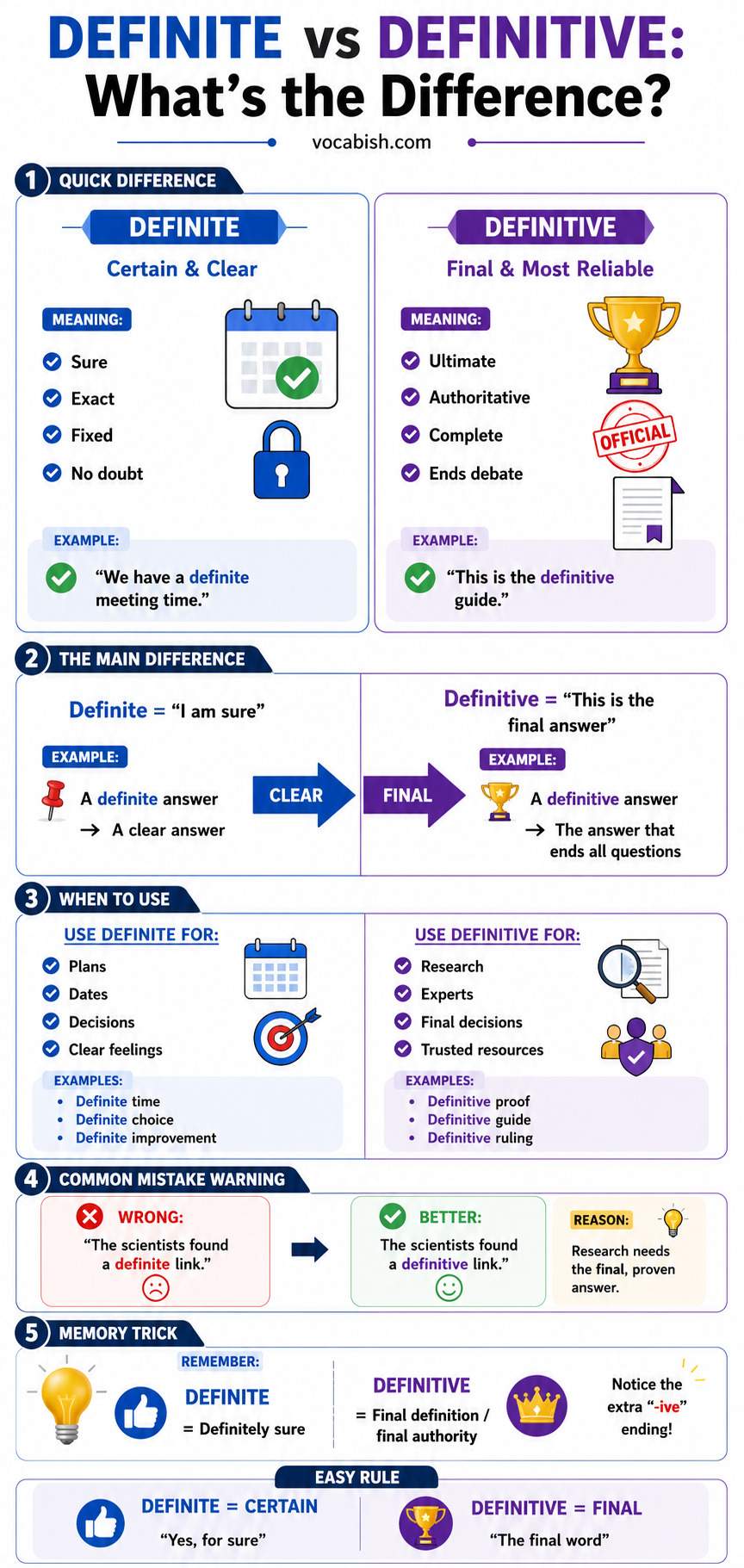
Definite vs Definitive: Quick Answer
If you only have a few seconds, here is the direct answer:
- Definite means something is certain, clear, or unlikely to change.
- Definitive means something is the final, most reliable, or absolute best version of something. It ends the discussion.
Quick Tip: If you want to say “yes, for sure,” use definite. If you want to say “this is the final word on the subject,” use definitive.
Meaning and Usage of Definite
Definite describes something that is clearly defined, certain, or exact. There is no guessing involved. You use it when you want to show that a plan, answer, or fact is solid.
How to use Definite in a sentence:
- “We need a definite time for the meeting tomorrow.” (An exact time, not “sometime around noon.”)
- “She gave me a definite ‘no’ when I asked if she wanted to go.” (A clear, certain answer.)
- “There is a definite improvement in your English pronunciation.” (A clear, noticeable improvement.)
Real-life conversation example:
Alex: “Are you coming to the dinner party on Friday?”
Sam: “I’m a maybe right now. I’ll give you a definite answer by Wednesday.”
Meaning and Usage of Definitive
Definitive takes things a step further. It means something provides a final solution, is the most authoritative, or puts an end to any doubt or debate. It often describes things like research, guides, decisions, or results.
How to use Definitive in a sentence:
- “The doctor ran a blood test to get a definitive diagnosis.” (The final, absolute answer that proves what the illness is.)
- “This book is the definitive guide to Italian cooking.” (The best, most complete, and most respected guide out there.)
- “The court issued a definitive ruling on the case.” (The final decision that ends the legal argument.)
Real-life conversation example:
Maria: “Did they ever figure out what broke the server?”
David: “Not yet. The IT team is still looking for a definitive cause so it never happens again.”
The Main Difference Between Definite and Definitive
The easiest way to understand the difference between definite and definitive is to see how they change the meaning of the exact same noun.
Let’s look at the word “answer.”
- A definite answer: An answer that is clear and certain. (e.g., “He gave a definite yes.”)
- A definitive answer: An answer that is so complete and well-researched that it ends all questions. (e.g., “The scientists finally provided a definitive answer to how the virus spreads.”)
A definite plan just means the plan is set. A definitive plan means it is the ultimate, final plan that replaces all others.
When to Use Definite and Definitive
Use definite when you are talking about:
- Schedules and plans (a definite date).
- Clear feelings or changes (a definite drop in temperature).
- Certainty (I am definite about my choice).
Use definitive when you are talking about:
- Authoritative resources (a definitive biography, a definitive edition).
- Medical or scientific proof (a definitive cure, definitive evidence).
- Final decisions (a definitive agreement).
Where Do These Words Fit in a Sentence?
Grammatically, both words are adjectives. Their main job is to describe a noun (a person, place, thing, or idea). You will almost always see them sitting directly in front of the word they are modifying.
- “We have a definite plan.” (Describing the noun “plan”)
- “This is the definitive version.” (Describing the noun “version”)
A quick tip on adverbs: If you want to describe an action (a verb) instead of a noun, just add -ly to the end of either word. They keep their core meanings, but now they describe how something happens.
- Definitely (for sure): “I will definitely call you tomorrow.”
- Definitively (finally and absolutely): “The argument was definitively settled by the judge.”
Can “Definite” and “Definitive” Be Interchanged?
In most cases, no. Swapping them will make your sentence sound unnatural to native speakers.
Incorrect: “I need a definitive answer: do you want pizza or tacos?”
(You just want a clear choice, not a deeply researched, historical conclusion. Use “definite” here.)
Incorrect: “That dictionary is the definite resource for English learners.”
(You mean it is the best, most authoritative resource. Use “definitive” here.)
Common Mistakes: How We Mix Them Up
It is very common for learners to use “definite” when they actually mean “definitive” simply because “definite” is a more common, everyday word.
- Mistake: “The researchers found a definite link between the two diseases.”
- Correction: “The researchers found a definitive link between the two diseases.” (Because research provides final, authoritative proof).
- Mistake: “Let’s make definitive plans for the weekend.”
- Correction: “Let’s make definite plans for the weekend.” (You just need a solid plan, not an authoritative one).
Quick Practice Exercise: Test Yourself
Fill in the blank with either definite or definitive. (Answers are at the bottom).
- We don’t have a ________ location for the wedding yet.
- The band just released the ________ collection of their greatest hits.
- I noticed a ________ shift in his attitude after the meeting.
- The DNA test gave the police the ________ proof they needed to close the case.
Answers:
- definite (a set, certain location)
- definitive (the final, most complete collection)
- definite (a clear, noticeable shift)
- definitive (absolute, unquestionable proof)
FAQs About Definite and Definitive
Definite simply means something is certain and clear. Definitive means it is the absolute best, final, or most reliable version available.
Use “definite answer” for a clear yes or no. Use “definitive answer” when providing a heavily researched, unquestionable, and final conclusion.
Yes, definitive often means something is completely final and ends all debate, like a judge’s ruling or a scientist’s proven discovery.
No, swapping these words sounds unnatural to native English speakers. One just shows certainty, while the other shows unmatched authority and finality.
A definitive guide is the most comprehensive, accurate, and trusted resource available on a specific topic. It replaces all other existing guides.
You use it to show absolute certainty about everyday things. For example, “I need a definite time for our dinner tomorrow night.”
In English grammar, “the” is called the definite article. We use it to point out one specific, known noun in a sentence.
Final Thoughts
Telling these two words apart really just comes down to one simple question: Are you talking about being sure, or being the absolute best?
If you just need a clear, solid plan or a simple “yes,” stick with definite. But if you want to end a debate with the final, most trusted version of something, reach for definitive.
Take a quick second to pause before you use either word. With just a little bit of practice, choosing the right one will become a natural habit, and your English vocabulary will sound that much sharper.
You May Also Like:
