
Have you ever said something that was easy to understand because you stated exactly what you meant? These Examples of Explicit Sentences show how clear language, direct statements, and specific information can remove confusion in everyday English.
An explicit sentence states an idea, fact, instruction, feeling, or request clearly and directly. Nothing important is left for the listener to guess.
What Is an Explicit Sentence?
An explicit sentence expresses its meaning directly and clearly. The reader or listener does not need to infer, guess, or read between the lines to understand the main message.
For example:
- Please close the window.
This is explicit because the speaker clearly says what they want.
Compare it with:
- It’s getting cold in here.
The second sentence may suggest that someone should close the window, but it does not say so directly. That makes it more implicit.
An explicit sentence can communicate:
- A fact
- A request
- An instruction
- An opinion
- A feeling
- A warning
- A decision
- A plan
- A question
- A specific piece of information
Explicit Sentence Meaning
The word explicit means clearly stated, directly expressed, or fully communicated without requiring the listener to guess the intended meaning.
In grammar and communication, an explicit sentence gives the information openly.
For example:
- The meeting starts at 9:00 a.m.
The time is directly stated.
- I do not agree with your decision.
The speaker directly expresses an opinion.
- Please send me the report before Friday.
The request and deadline are both clearly stated.
How to Pronounce Explicit
Explicit is pronounced approximately as:
ik-SPLIS-it
It is commonly used when talking about information that is direct, clear, or openly stated.
100+ Examples of Explicit Sentences
Here are clear Explicit Sentence Examples covering everyday situations, conversations, school, work, requests, instructions, feelings, and opinions.
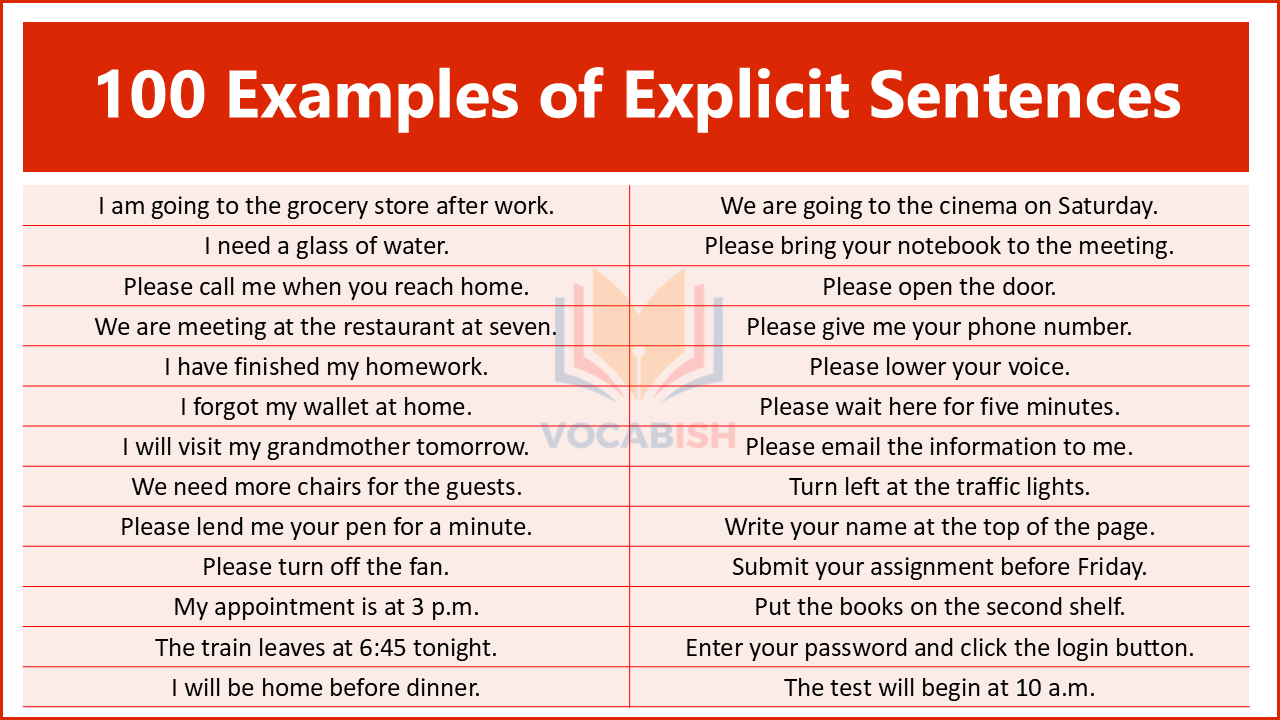
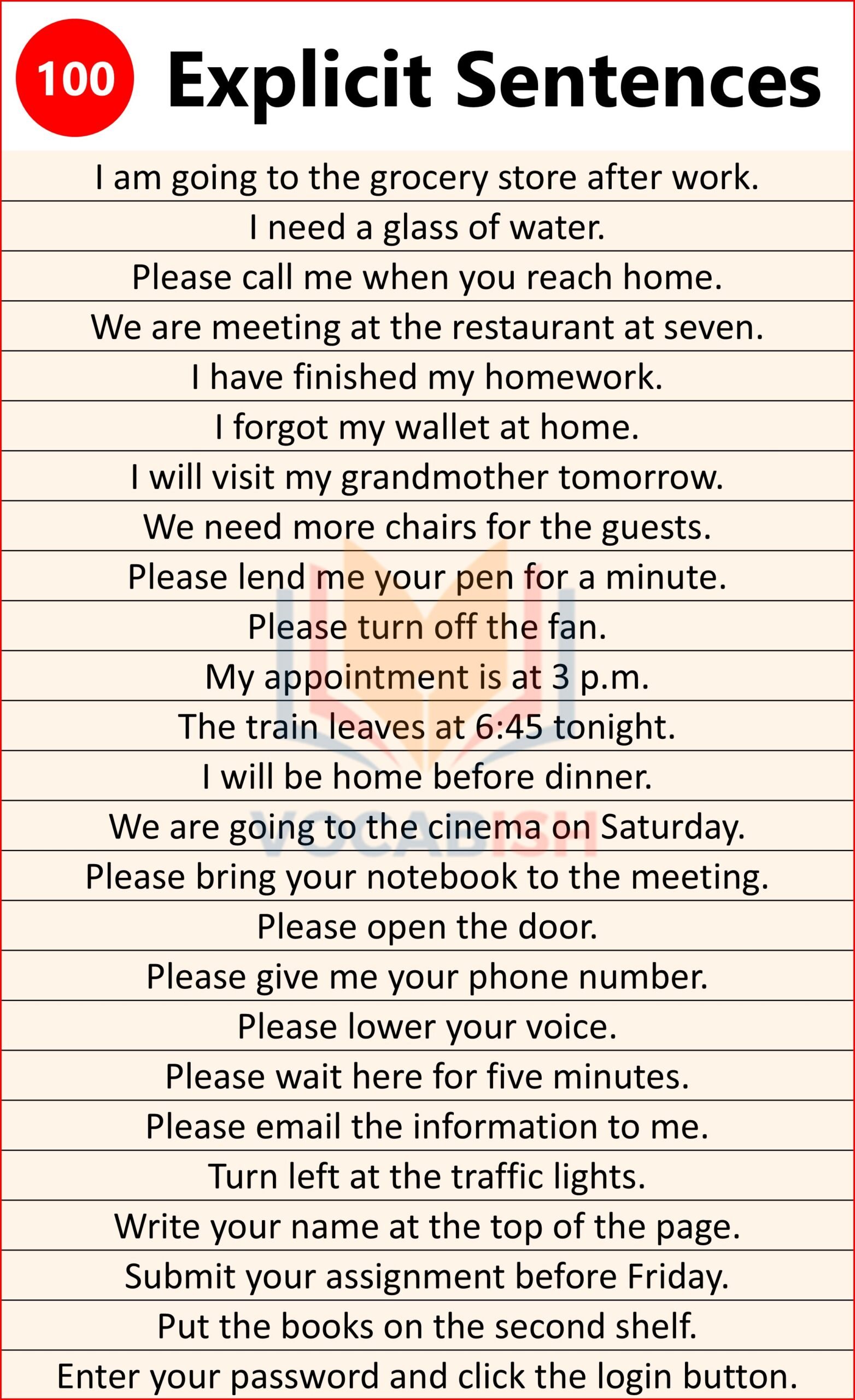
- I am going to the grocery store after work.
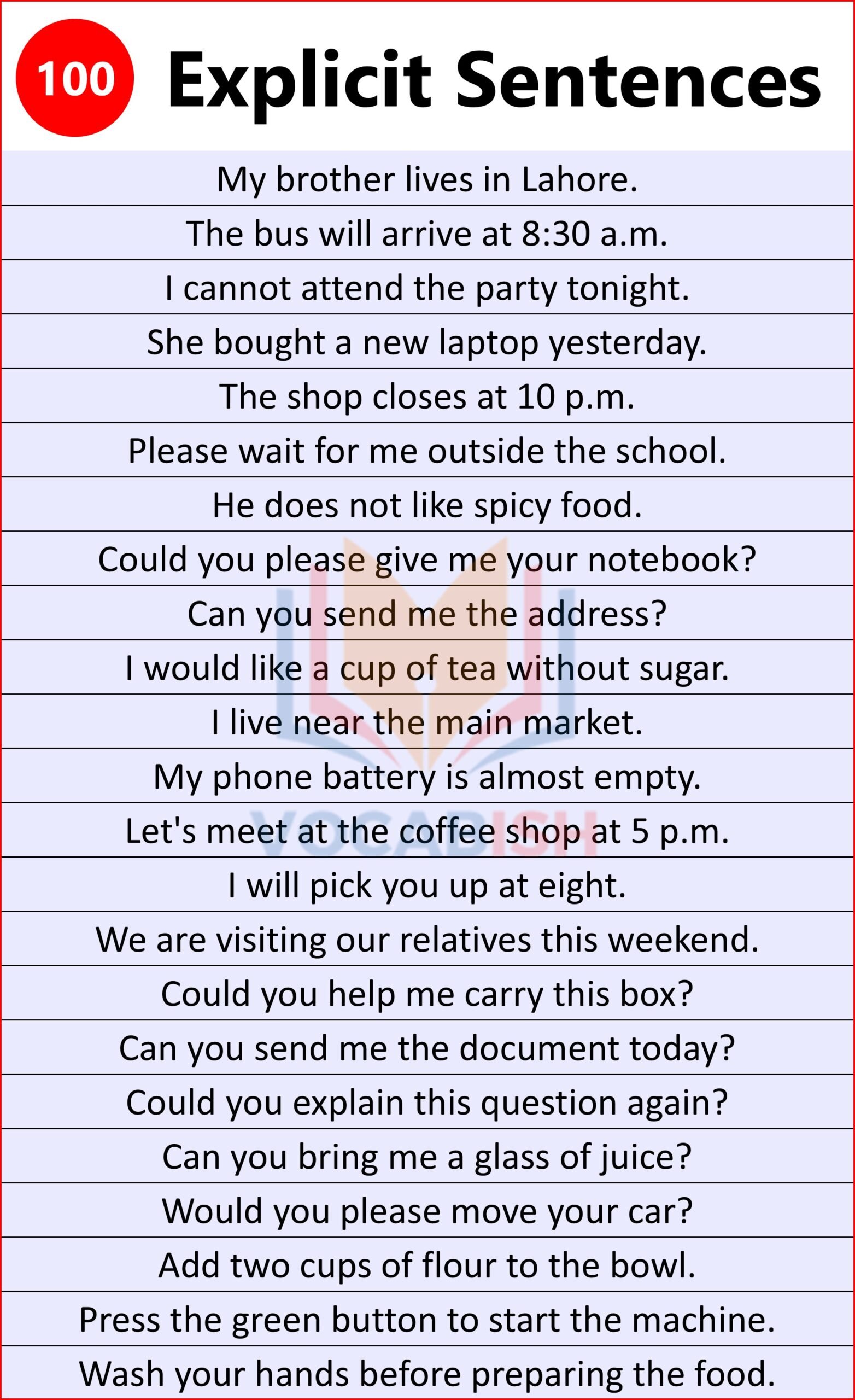
- My brother lives in Lahore.
- I need a glass of water.
- The bus will arrive at 8:30 a.m.
- Please call me when you reach home.
- I cannot attend the party tonight.
- We are meeting at the restaurant at seven.
- She bought a new laptop yesterday.
- I have finished my homework.
- The shop closes at 10 p.m.
- I forgot my wallet at home.
- Please wait for me outside the school.
- I will visit my grandmother tomorrow.
- He does not like spicy food.
- We need more chairs for the guests.
- Could you please give me a glass of water?
- Please lend me your pen for a minute.
- Can you send me the address?
- Please turn off the fan.
- I would like a cup of tea without sugar.
- My appointment is at 3 p.m.
- I live near the main market.
- The train leaves at 6:45 tonight.
- My phone battery is almost empty.
- I will be home before dinner.
- Let’s meet at the coffee shop at 5 p.m.
- We are going to the cinema on Saturday.
- I will pick you up at eight.
- Please bring your notebook to the meeting.
- We are visiting our relatives this weekend.
Examples of Explicit Sentences for Requests
An explicit request tells another person exactly what you want them to do.
Instead of expecting someone to understand a hint, state the request directly.
- Please open the door.
- Could you help me carry this box?
- Please give me your phone number.
- Can you send me the document today?
- Please lower your voice.
- Could you explain this question again?
- Please wait here for five minutes.
- Can you bring me a glass of water?
- Please email the information to me.
- Would you please move your car?
These sentences are useful in everyday conversations because the listener can immediately understand the requested action.
Examples of Explicit Sentences for Instructions
Explicit instructions are especially useful when accuracy matters. They tell someone what to do without leaving important steps unclear.
- Turn left at the traffic lights.
- Add two cups of flour to the bowl.
- Write your name at the top of the page.
- Press the green button to start the machine.
- Submit your assignment before Friday.
- Wash your hands before preparing the food.
- Put the books on the second shelf.
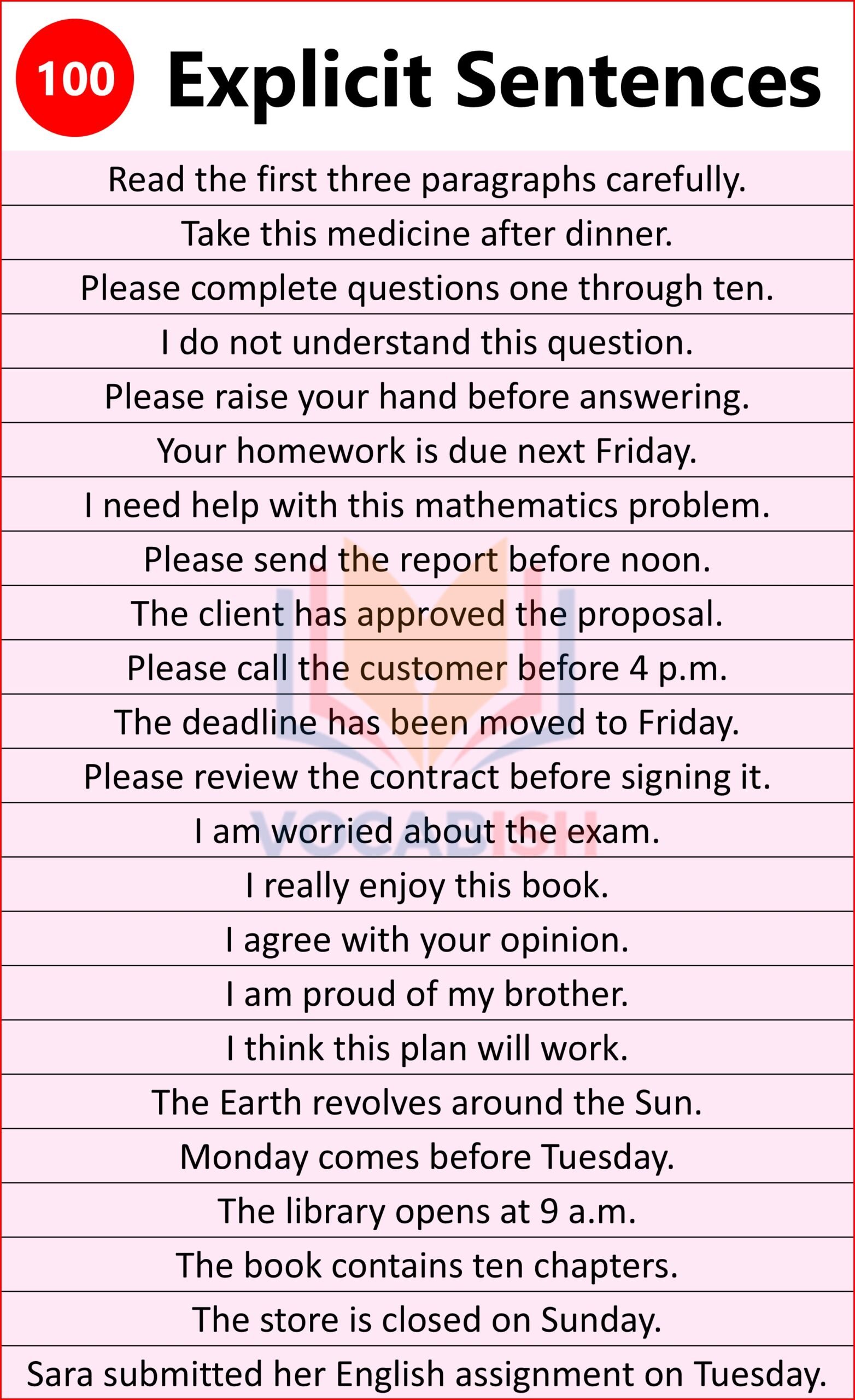
- Read the first three paragraphs carefully.
- Enter your password and click the login button.
- Take this medicine after dinner.
The final example is a direct instruction, but medical instructions should always come from an appropriate healthcare professional or the medicine’s official directions.
Examples of Explicit Sentences at School
Students and teachers often use explicit language to communicate instructions, answers, and expectations.
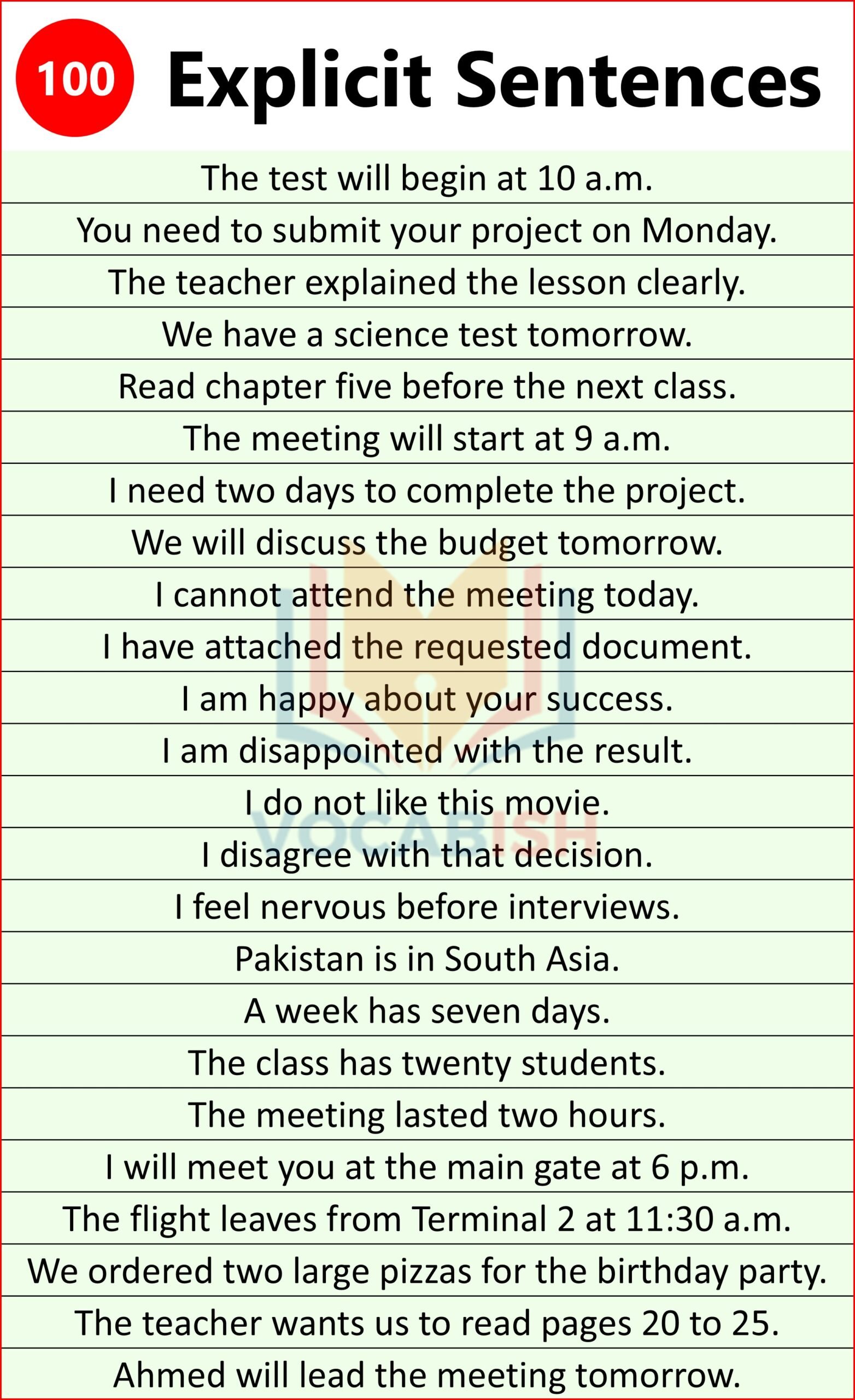
- The test will begin at 10 a.m.
- Please complete questions one through ten.
- You need to submit your project on Monday.
- I do not understand this question.
- The teacher explained the lesson clearly.
- Please raise your hand before answering.
- We have a science test tomorrow.
- Your homework is due next Friday.
- Read chapter five before the next class.
- I need help with this mathematics problem.
Explicit Answers in Class
When answering a question, an explicit answer gives the required information directly.
For example:
Question: Where do you live?
Explicit answer: I live in Multan.
Question: When is your exam?
Explicit answer: My English exam is on Monday.
Question: Why were you absent?
Explicit answer: I was absent because I was sick.
Examples of Explicit Sentences at Work
Clear communication is useful in professional conversations, emails, meetings, and workplace instructions.
- The meeting will start at 9 a.m.
- Please send the report before noon.
- I need two days to complete the project.
- The client has approved the proposal.
- We will discuss the budget tomorrow.
- Please call the customer before 4 p.m.
- I cannot attend the meeting today.
- The deadline has been moved to Friday.
- I have attached the requested document.
- Please review the contract before signing it.
Explicit workplace language can prevent misunderstandings because it identifies the action, person, deadline, or decision clearly.
Examples of Explicit Sentences for Feelings and Opinions
An explicit sentence can state a person’s emotions or opinions directly.
- I am happy about your success.
- I am worried about the exam.
- I am disappointed with the result.
- I really enjoy this book.
- I do not like this movie.
- I agree with your opinion.
- I disagree with that decision.
- I am proud of my brother.
- I feel nervous before interviews.
- I think this plan will work.
These sentences are explicit because the speaker directly identifies the feeling or opinion.
Examples of Explicit Sentences for Facts
Facts can also be communicated explicitly by stating the information directly.
- Water freezes at 0°C under standard atmospheric pressure.
- The Earth revolves around the Sun.
- Pakistan is in South Asia.
- Monday comes before Tuesday.
- A week has seven days.
- The library opens at 9 a.m.
- The class has twenty students.
- The book contains ten chapters.
- The meeting lasted two hours.
- The store is closed on Sunday.
The important feature is not the type of information but how directly the information is expressed.
Examples of Explicit Sentences With Specific Details
Adding specific details often makes a sentence more explicit.
- I will meet you at the main gate at 6 p.m.
- Sara submitted her English assignment on Tuesday.
- The flight leaves from Terminal 2 at 11:30 a.m.
- Please bring three copies of the report tomorrow.
- We ordered two large pizzas for the birthday party.
- My appointment is scheduled for September 10 at 2 p.m.
- The teacher wants us to read pages 20 to 25.
- I will stay at my uncle’s house for three nights.
Notice how these sentences provide information such as who, what, when, where, how many, or why.
Explicit Sentences With Who, What, When, Where, and Why
One useful way to make communication more explicit is to provide the missing details.
Who
- Ahmed will lead the meeting tomorrow.
What
- We need to prepare a presentation.
When
- The interview is scheduled for Monday at 10 a.m.
Where
- The students will meet in Room 12.
Why
- I left early because I had a doctor’s appointment.
How
- You can open the file by clicking the download button.
The more relevant details a sentence provides, the easier it is for the listener or reader to understand the intended message.
Explicit vs. Implicit Sentences
The main difference is directness.
An explicit sentence states the intended meaning openly. An implicit sentence communicates an idea indirectly, so the listener may need to infer the meaning.
For example:
- Explicit: Please turn off the lights.
- Implicit: The room is getting dark.
The first sentence directly asks someone to turn off the lights. The second gives information about the room but does not directly state what action is wanted.
Another example:
- Explicit: I am hungry. Let’s have dinner.
- Implicit: I haven’t eaten since breakfast.
The second statement may suggest hunger, but the listener has to interpret the speaker’s intended message.
Here are the 50+ Implicit Sentence Examples with their meanings.
More Explicit and Implicit Examples
- Explicit: Please be quiet.
- Implicit: The baby is sleeping.
- Explicit: I need your help.
- Implicit: This box is very heavy.
- Explicit: Please close the door.
- Implicit: There is a lot of noise outside.
- Explicit: I want to go home.
- Implicit: It’s getting late.
- Explicit: Please give me some space.
- Implicit: I need some time alone.
Neither style is always better. Explicit language is useful when clarity matters, while implicit language is common when people communicate through hints, context, or suggestions.
How to Identify an Explicit Sentence
Ask yourself one question:
Does the sentence directly state the intended message?
If the answer is yes, it is likely explicit.
Look for these features:
- The main idea is directly stated.
- The requested action is clearly named.
- Important information is not hidden.
- The speaker’s opinion or feeling is directly expressed.
- The sentence gives specific details when needed.
- The listener does not need to guess the main message.
For example:
“Please submit your assignment by Friday.”
This is explicit because it clearly identifies the action and deadline.
How to Make a Sentence More Explicit
If your sentence sounds vague, add the information the listener needs.
Instead of:
- I’ll see you later.
Say:
- I’ll see you at the library at 4 p.m.
Instead of:
- Bring it tomorrow.
Say:
- Please bring the science project to school tomorrow.
Instead of:
- She is upset.
Say:
- She is upset because her flight was canceled.
Instead of:
- Do that first.
Say:
- Finish your English homework before you start watching TV.
Instead of:
- It is over there.
Say:
- The keys are on the table beside the television.
Specific nouns, times, places, reasons, and actions can make communication much clearer.
Common Mistakes and Confusions
Learners sometimes confuse explicit with words such as exact, obvious, or direct. They are related, but they are not always interchangeable.
- Explicit means clearly and directly expressed.
- Implicit means suggested or understood without being directly stated.
- An explicit sentence does not have to be long; “Close the door.” is explicit.
- A sentence can contain facts but still be unclear if important details are missing.
- Explicit and implicit describe how meaning is communicated, not whether a sentence is grammatically correct.
Practice: Identify the Explicit Sentence
Choose the sentence that communicates the intended message most directly.
1.
- A. It’s quite noisy in here.
- B. Please close the window.
- C. I can hear the traffic.
2.
- A. I haven’t eaten anything today.
- B. The kitchen smells good.
- C. I am hungry, so let’s have lunch.
3.
- A. The exam is coming soon.
- B. Please study chapters four and five for tomorrow’s exam.
- C. You should probably study.
4.
- A. I have an appointment at 3 p.m.
- B. I have something to do later.
- C. I might be busy.
5.
- A. Your music is loud.
- B. I can hear your music from here.
- C. Please turn down the music.
Answers:
- 1. B — Please close the window.
- 2. C — I am hungry, so let’s have lunch.
- 3. B — Please study chapters four and five for tomorrow’s exam.
- 4. A — I have an appointment at 3 p.m.
- 5. C — Please turn down the music.
Each answer communicates the intended message directly rather than leaving the listener to interpret a hint.
Why Explicit Sentences Matter in English
Explicit language helps speakers communicate accurately when misunderstandings could cause problems.
It is particularly useful when:
- Giving directions
- Making requests
- Explaining instructions
- Making appointments
- Discussing deadlines
- Answering questions
- Communicating at work
- Giving information to students
- Expressing opinions
- Explaining plans
For ESL learners, practicing explicit sentences can also improve everyday speaking because it encourages you to say exactly what you mean.
FAQs About Explicit Sentences
An explicit sentence states its intended meaning clearly and directly, so the reader or listener does not need to guess what the speaker means.
Please close the door.
I need your help.
The meeting starts at nine.
I disagree with your opinion.
Submit your homework tomorrow.
An explicit sentence states the meaning directly, while an implicit sentence suggests the meaning and requires the listener to infer it.
Yes. “Please sit down” is explicit because it directly tells the listener what action the speaker wants them to take.
Explicit sentences make communication clearer by directly expressing requests, facts, instructions, opinions, feelings, and other intended messages.
Yes. An explicit sentence can be very short, such as “Stop,” “Come here,” or “Call me,” as long as the intended message is clear.
State the intended message directly and add relevant details about the person, action, time, place, reason, or requirement.
No. Explicitness and politeness are different. You can communicate directly while remaining polite by using phrases such as “please,” “could you,” and “would you.”
Conclusion
Examples of Explicit Sentences show how English speakers communicate ideas directly and clearly. An explicit sentence does not make the listener guess the main message; it states the intended meaning openly.
Whether you are making a request, giving instructions, expressing an opinion, answering a question, or making plans, explicit language can make your everyday English easier to understand. The key is to say what you mean and provide the details the listener needs.
Explore More Example Sentences
- Examples of Multiple Questions in a Sentence
- 120 Examples of Conditional Sentences
- Examples of Longest Palindrome Sentences in English
- 100+ Examples of Noun in English with Sentences
- 100 Example Sentences of Simple Sentences
- 100 Complex and Compound Complex Sentences
- Compound Sentence Examples
- 100 Complex Sentence Examples