
A sentence can become much more natural and expressive when two complete ideas are joined correctly. These Compound Sentence Examples show how independent clauses work together with coordinating conjunctions, semicolons, and everyday language.
You will find compound sentences for common conversations, school writing, opinions, requests, contrasts, choices, causes, results, and daily situations. Each Compound Sentence Example is written for elementary to intermediate English learners.
What Is a Compound Sentence?
A compound sentence contains two independent clauses joined together. Each independent clause can stand alone as a complete sentence.
Common ways to form a compound sentence include:
- Independent clause + comma + coordinating conjunction + independent clause
- Independent clause + semicolon + independent clause
The seven coordinating conjunctions are known as FANBOYS:
- For
- And
- Nor
- But
- Or
- Yet
- So
Example:
- I wanted to go outside, but it started raining.
Both parts are complete ideas:
- I wanted to go outside.
- It started raining.
The conjunction but connects them into one compound sentence.
Compound Sentence Examples With FANBOYS
These examples use the seven coordinating conjunctions. They are useful patterns for everyday speaking and writing.
Examples With “And”
“And” adds another related idea or action.
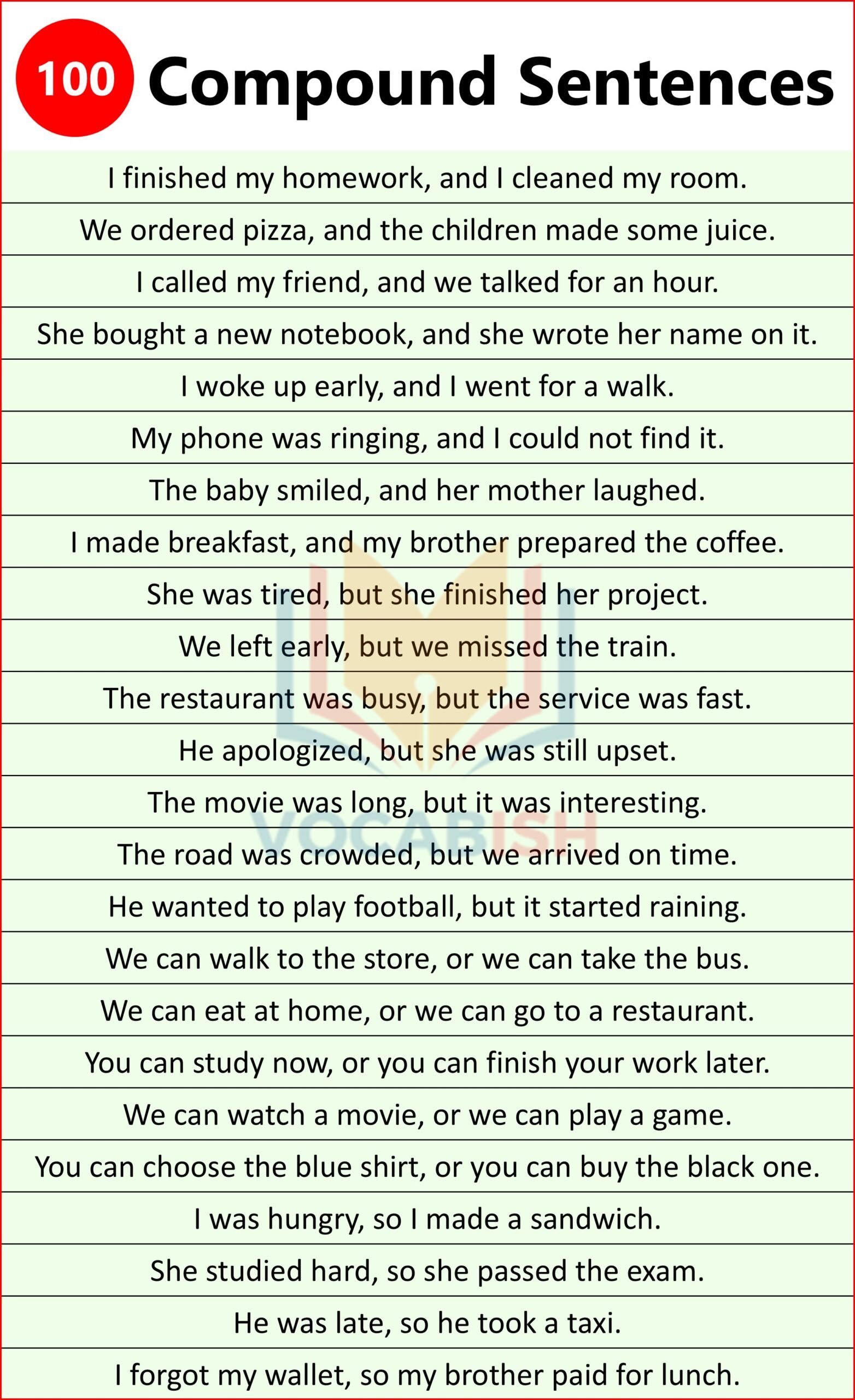
- I finished my homework, and I cleaned my room.
- Sarah opened the window, and fresh air filled the room.
- We ordered pizza, and the children made some juice.
- He plays the guitar, and his sister sings beautifully.
- I called my friend, and we talked for an hour.
- The bus arrived, and everyone got on quickly.
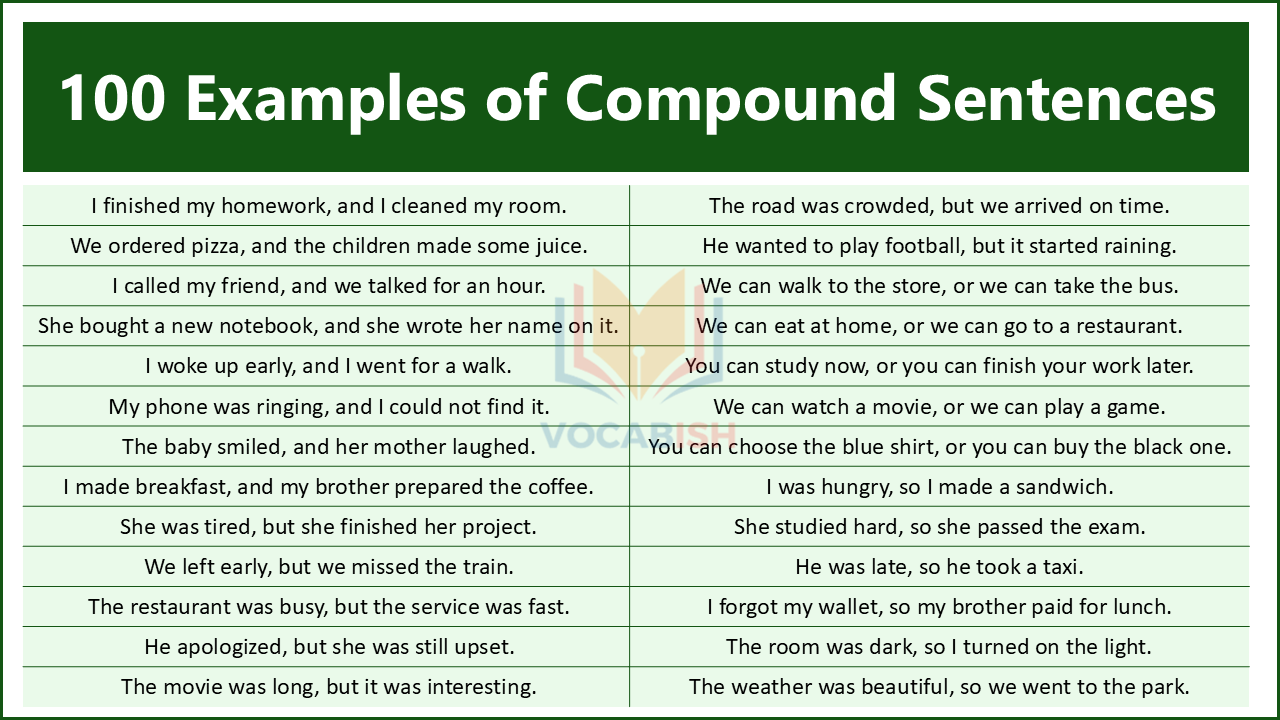
- She bought a new notebook, and she wrote her name on it.
- Tom washed the dishes, and Anna dried them.
- I woke up early, and I went for a walk.
- The teacher explained the lesson, and the students listened carefully.
- My phone was ringing, and I could not find it.
- We packed our bags, and we left the house.
- The baby smiled, and her mother laughed.
- Jack studied all evening, and he passed the test.
- I made breakfast, and my brother prepared the coffee.
Examples With “But”
“But” connects contrasting ideas.
- I wanted to buy the shirt, but it was too expensive.
- She was tired, but she finished her project.
- He practiced every day, but he still felt nervous.
- We left early, but we missed the train.
- I like coffee, but my sister prefers tea.
- The restaurant was busy, but the service was fast.
- It was cold outside, but we went for a walk.
- He apologized, but she was still upset.
- I called him twice, but he did not answer.
- The movie was long, but it was interesting.
- She felt sick, but she went to school.
- The road was crowded, but we arrived on time.
- I understood the question, but I did not know the answer.
- He wanted to play football, but it started raining.
- The bag looked small, but it held everything we needed.
Examples With “Or”
“Or” presents a choice or alternative.
- We can walk to the store, or we can take the bus.
- You can call me tonight, or you can send me a message.
- We can eat at home, or we can go to a restaurant.
- Hurry up, or we will miss the train.
- You can study now, or you can finish your work later.
- She can stay here, or she can come with us.
- We can watch a movie, or we can play a game.
- Take an umbrella, or you will get wet.
- You can choose the blue shirt, or you can buy the black one.
- We can leave at six, or we can wait until seven.
Examples With “So”
“So” shows a result or consequence.
- I was hungry, so I made a sandwich.
- It was raining, so we stayed inside.
- She studied hard, so she passed the exam.
- My car broke down, so I called a mechanic.
- He was late, so he took a taxi.
- The store was closed, so we went somewhere else.
- I forgot my wallet, so my brother paid for lunch.
- We were tired, so we went to bed early.
- The baby was crying, so her mother picked her up.
- I had some free time, so I visited my friend.
- The room was dark, so I turned on the light.
- She missed breakfast, so she was hungry before noon.
- The weather was beautiful, so we went to the park.
- He lost his keys, so he searched the whole house.
- My laptop stopped working, so I restarted it.
Examples With “Yet”
“Yet” introduces a contrast or unexpected result.
- He is young, yet he is very responsible.
- The task was difficult, yet she completed it quickly.
- I was tired, yet I could not sleep.
- She had little money, yet she bought a gift for her friend.
- The weather was cold, yet the children played outside.
- He knew the answer, yet he remained silent.
- The restaurant was crowded, yet we found a table.
- She was nervous, yet she spoke clearly.
- The box was heavy, yet he carried it upstairs.
- I had never met him, yet he seemed familiar.
Examples With “For”
“For” can give a reason, although it is more common in formal or literary English than everyday conversation.
- I stayed home, for I was feeling unwell.
- She went to bed early, for she had an important meeting.
- We left the park, for the rain had started.
- He carried an umbrella, for the sky looked dark.
- I brought some food, for I knew you might be hungry.
- They closed the windows, for the wind was getting stronger.
Examples With “Nor”
“Nor” usually follows a negative idea and adds another negative idea.
- She did not call me, nor did she send a message.
- He does not eat meat, nor does he drink milk.
- I have never visited France, nor have I visited Spain.
- Tom was not at home, nor was his brother there.
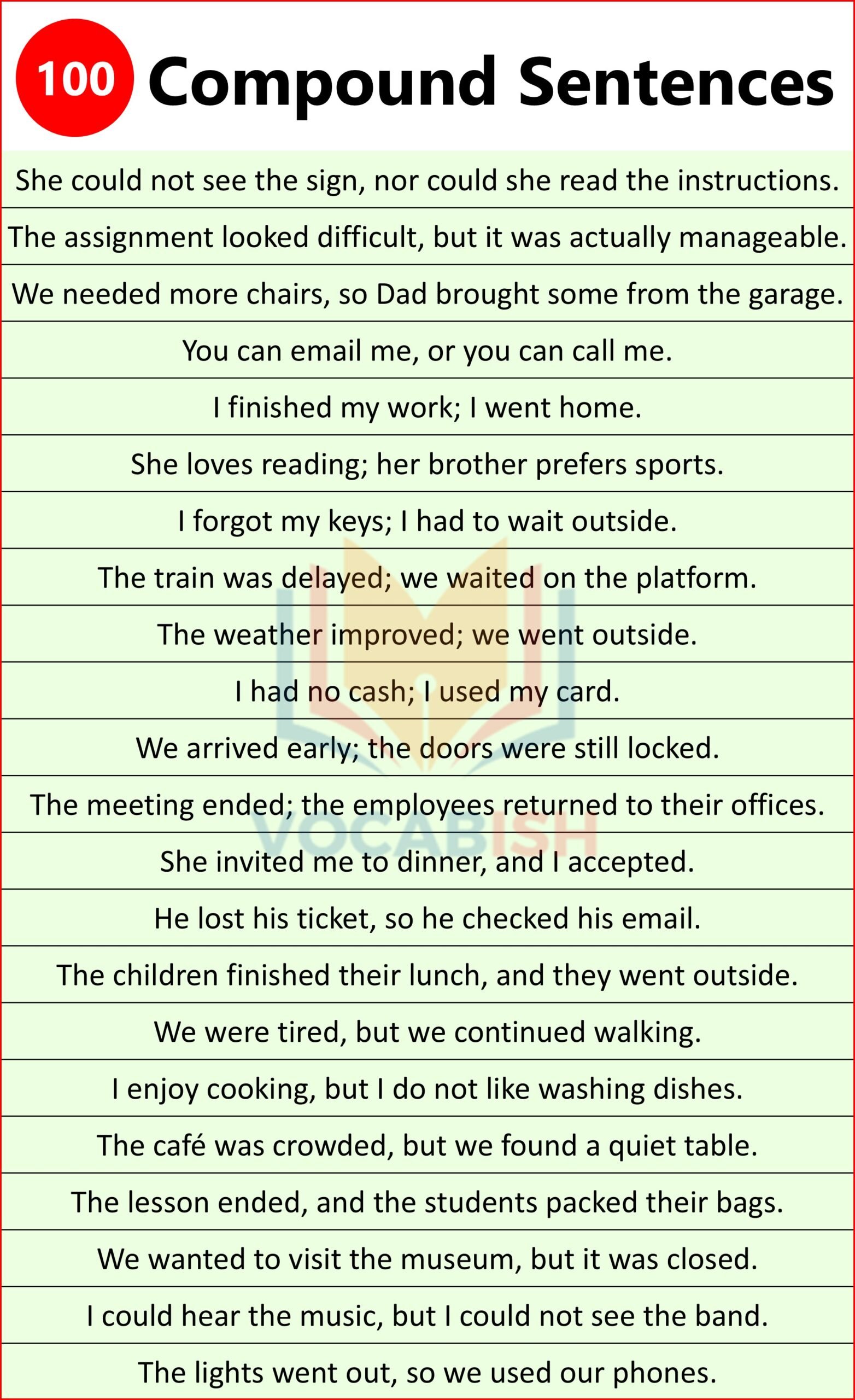
- She could not see the sign, nor could she read the instructions.
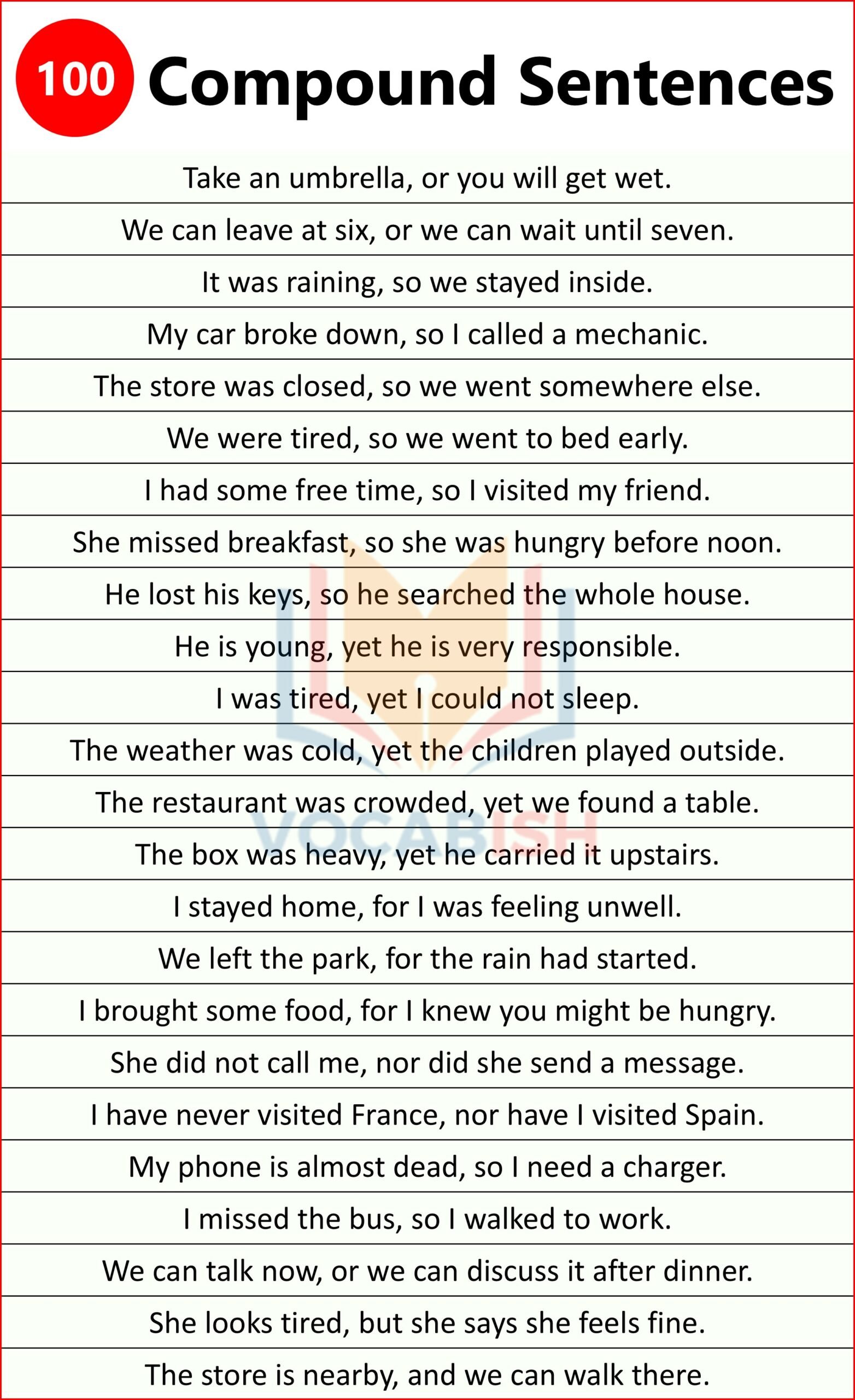
100 Examples of Compound Sentences
Compound sentences are common in conversations because people often connect two thoughts naturally.
- I am feeling tired, but I still want to finish this movie.
- The food looks delicious, and it smells amazing.
- I will call you later, so you do not need to wait for me.
- We can meet after work, or we can meet tomorrow morning.
- I wanted to help you, but I did not know what to do.
- My phone is almost dead, so I need a charger.
- She is preparing dinner, and I am setting the table.
- I missed the bus, so I walked to work.
- He wants to come with us, but he has to finish his homework.
- We can talk now, or we can discuss it after dinner.
- I opened the door, and my dog ran outside.
- She looks tired, but she says she feels fine.
- I forgot the address, so I checked my phone.
- The store is nearby, and we can walk there.
- You can sit here, or you can use the chair by the window.
- I wanted to order dessert, but everyone else was full.
- He finished his work, and he went home.
- We were running late, so we skipped breakfast.
- I like this restaurant, but the parking is difficult.
- She heard the news, and she immediately called her mother.
- The students completed the activity, and the teacher checked their work.
- Emma studied for the test, so she felt confident in class.
- The library was quiet, but the classroom was noisy.
- We finished the experiment, and we recorded the results.
- The teacher asked a question, and several students raised their hands.
- I wanted to join the competition, but I needed more practice.
- The lesson was challenging, yet everyone understood the main idea.
- He forgot his notebook, so he borrowed some paper.
- We can study together, or we can work separately.
- The students listened carefully, and they took notes.
- Maria wrote the introduction, and Daniel completed the conclusion.
- The assignment looked difficult, but it was actually manageable.
- I revised my paragraph, and my teacher gave me useful feedback.
- The class started early, so everyone arrived before eight.
- The school was closed, but the students attended their lessons online.
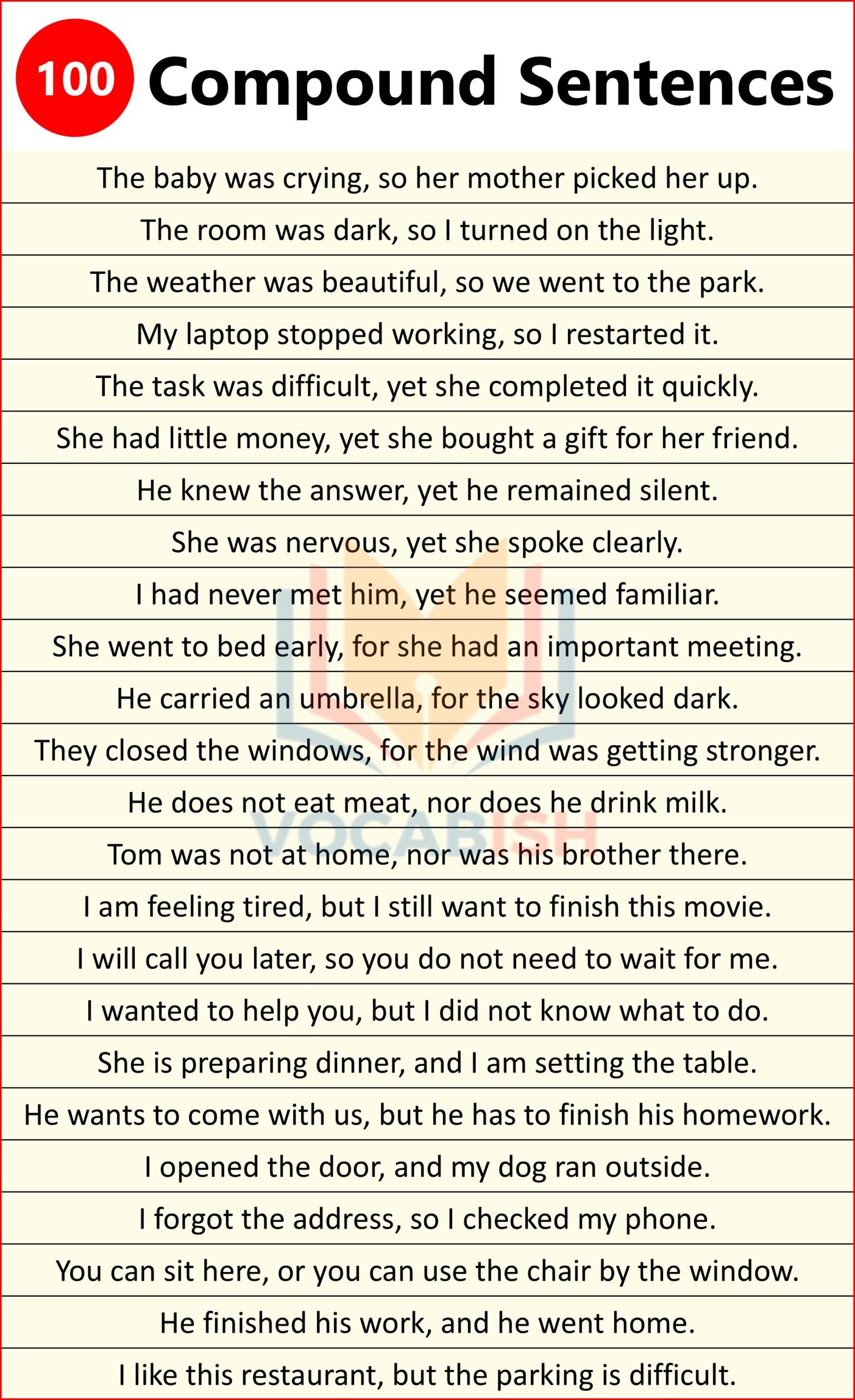
List of Compound Sentence Examples Showing Contrast
A compound sentence can make a contrast clear without making the writing repetitive.
- I enjoy winter, but my brother loves summer.
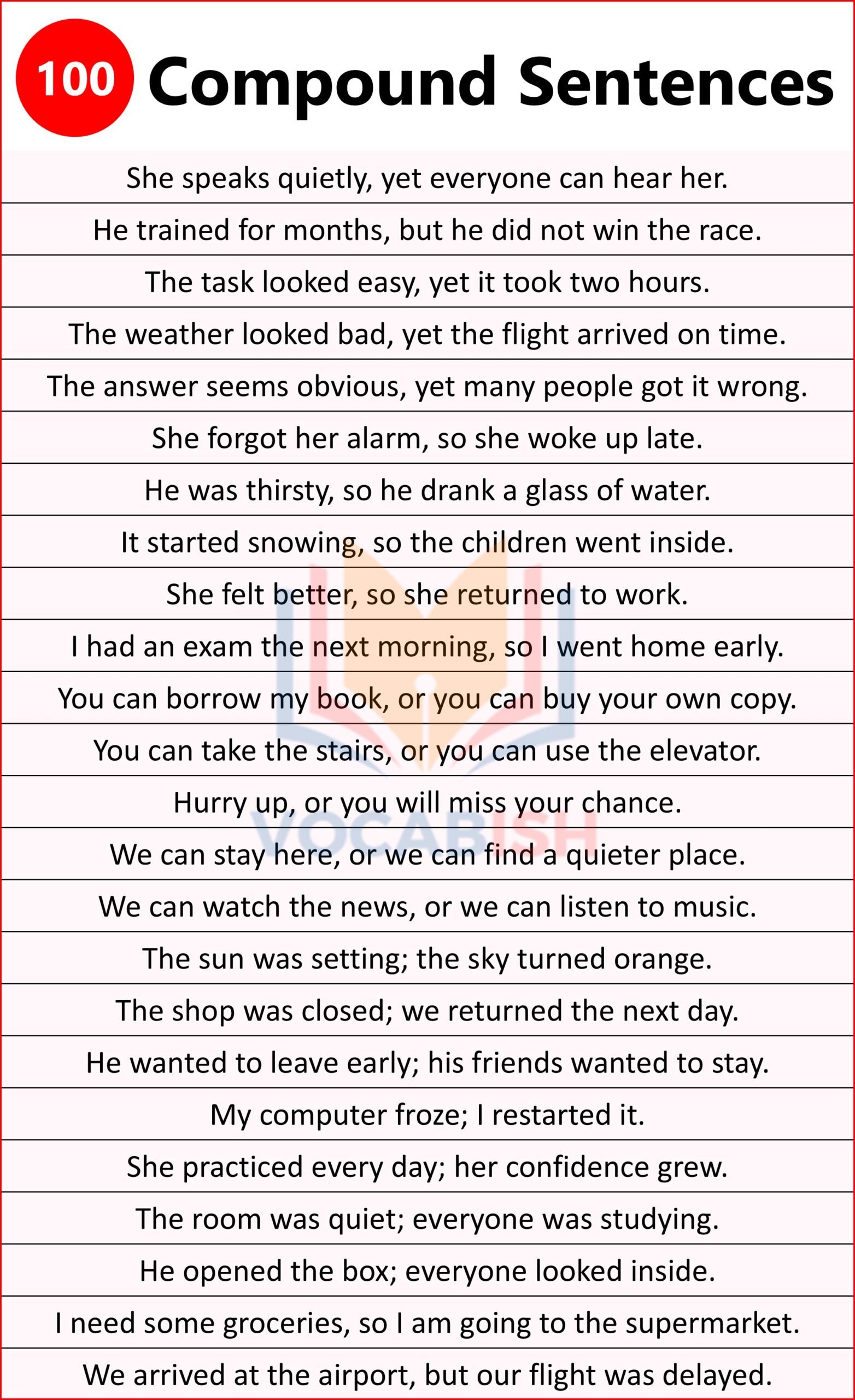
- She speaks quietly, yet everyone can hear her.
- The hotel was expensive, but the rooms were comfortable.
- He trained for months, but he did not win the race.
- I wanted to stay longer, but I had to leave.
- The task looked easy, yet it took two hours.
- She was afraid, but she did not give up.
- The weather looked bad, yet the flight arrived on time.
- He does not talk much, but he is very friendly.
- The answer seems obvious, yet many people got it wrong.
Compound Sentence Examples Showing Cause and Result
These examples connect an action, event, reason, or result.
- I was late, so I called the office.
- She forgot her alarm, so she woke up late.
- The road was blocked, so we took another route.
- He was thirsty, so he drank a glass of water.
- We needed more chairs, so Dad brought some from the garage.
- It started snowing, so the children went inside.
- My internet stopped working, so I restarted the router.
- She felt better, so she returned to work.
- The restaurant was full, so we found another place.
- I had an exam the next morning, so I went home early.
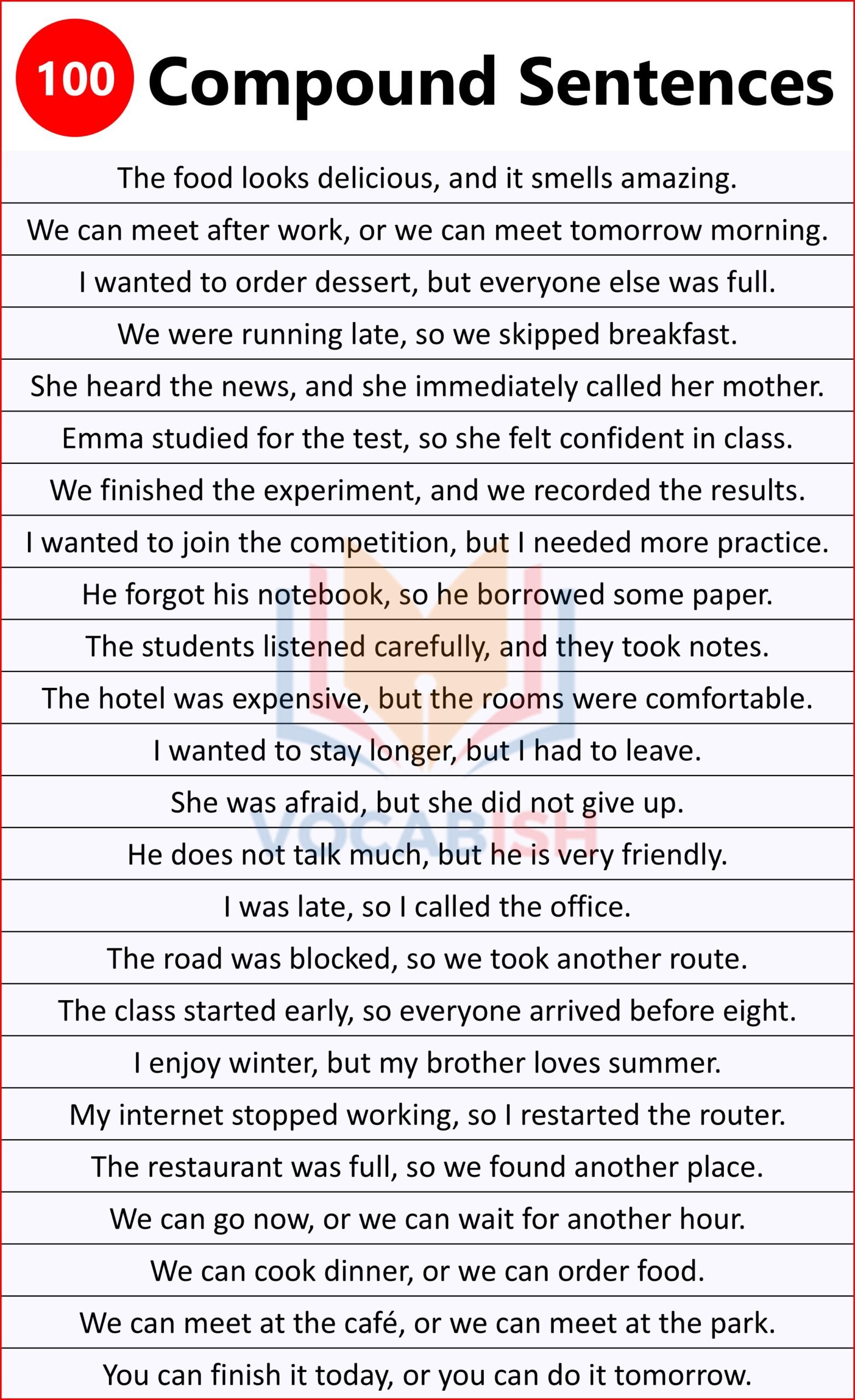
Compound Sentence Examples for Choices and Decisions
These sentences show alternatives, decisions, and possible outcomes.
- We can go now, or we can wait for another hour.
- You can borrow my book, or you can buy your own copy.
- We can cook dinner, or we can order food.
- You can take the stairs, or you can use the elevator.
- We can meet at the café, or we can meet at the park.
- Hurry up, or you will miss your chance.
- You can finish it today, or you can do it tomorrow.
- We can stay here, or we can find a quieter place.
- You can email me, or you can call me.
- We can watch the news, or we can listen to music.
Compound Sentence Examples With Semicolons
A semicolon can join two closely related independent clauses without a coordinating conjunction.
- I finished my work; I went home.
- The sun was setting; the sky turned orange.
- She loves reading; her brother prefers sports.
- The shop was closed; we returned the next day.
- I forgot my keys; I had to wait outside.
- He wanted to leave early; his friends wanted to stay.
- The train was delayed; we waited on the platform.
- My computer froze; I restarted it.
- The weather improved; we went outside.
- She practiced every day; her confidence grew.
- I had no cash; I used my card.
- The room was quiet; everyone was studying.
- We arrived early; the doors were still locked.
- He opened the box; everyone looked inside.
- The meeting ended; the employees returned to their offices.
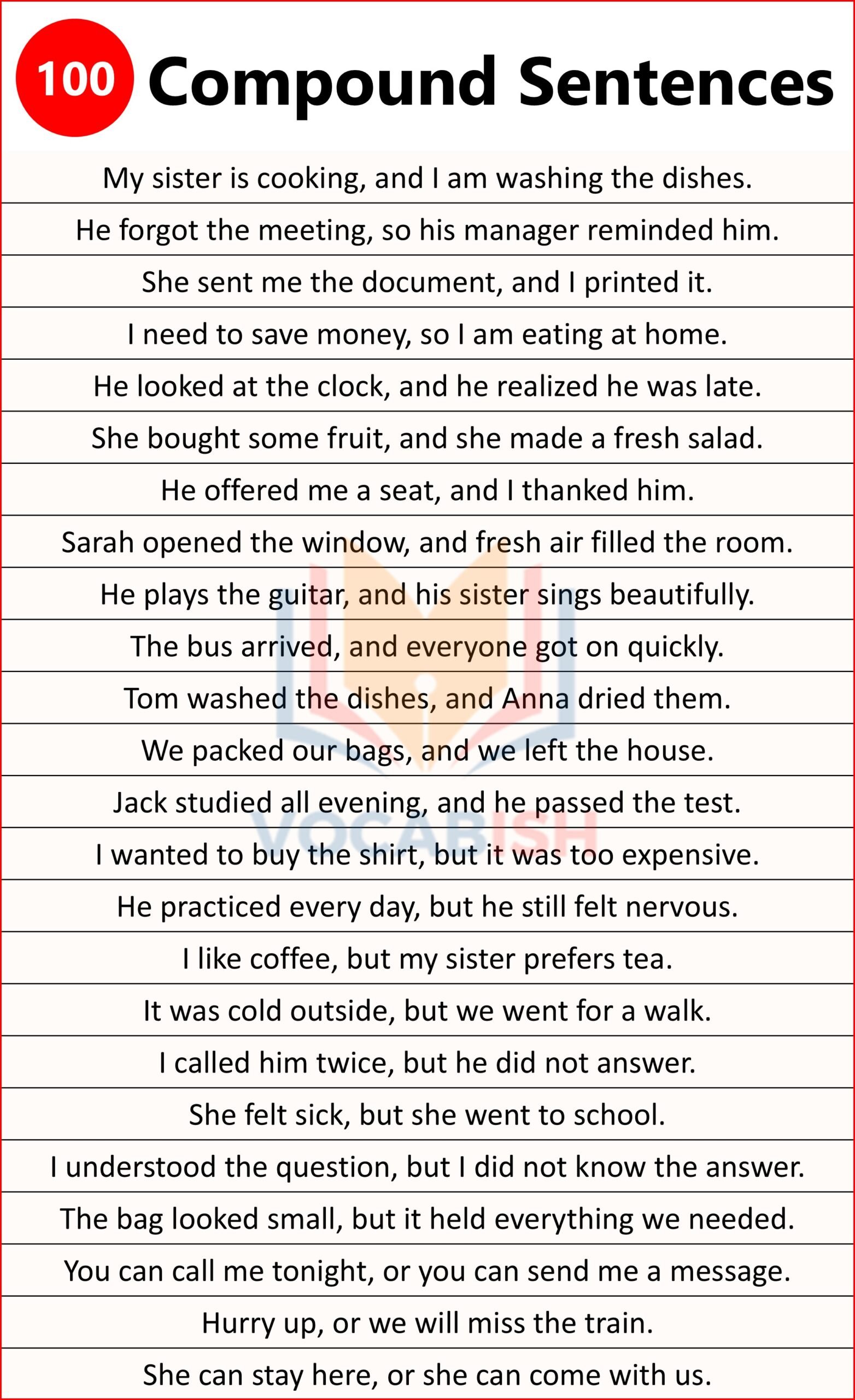
More Compound Sentence Examples for Everyday Situations
These examples cover common moments at home, work, school, shopping, travel, and social situations.
- I need some groceries, so I am going to the supermarket.
- She invited me to dinner, and I accepted.
- We arrived at the airport, but our flight was delayed.
- He lost his ticket, so he checked his email.
- I wanted to buy the shoes, but they were not available in my size.
- The children finished their lunch, and they went outside.
- My sister is cooking, and I am washing the dishes.
- We were tired, but we continued walking.
- He forgot the meeting, so his manager reminded him.
- I enjoy cooking, but I do not like washing dishes.
- She sent me the document, and I printed it.
- The café was crowded, but we found a quiet table.
- I need to save money, so I am eating at home.
- The lesson ended, and the students packed their bags.
- He looked at the clock, and he realized he was late.
- We wanted to visit the museum, but it was closed.
- She bought some fruit, and she made a fresh salad.
- I could hear the music, but I could not see the band.
- He offered me a seat, and I thanked him.
- The lights went out, so we used our phones.
Common Compound Sentence Patterns
Learning a few reliable patterns can make it easier to create your own sentences.
- Addition: Subject + verb, and + subject + verb.
- Contrast: Subject + verb, but + subject + verb.
- Choice: Subject + verb, or + subject + verb.
- Result: Subject + verb, so + subject + verb.
- Unexpected contrast: Subject + verb, yet + subject + verb.
- Formal reason: Subject + verb, for + subject + verb.
- Negative addition: Negative clause, nor + inverted clause.
- Close connection: Independent clause; independent clause.
Examples:
- I cooked dinner, and my brother washed the dishes.
- I wanted to go, but I was too tired.
- We can stay here, or we can leave.
- It was raining, so we stayed home.
- He was exhausted, yet he kept working.
- I stayed inside, for the weather was terrible.
- She did not complain, nor did she ask for help.
- The store was closed; we went home.
Compound Sentences vs. Other Sentence Types
It is useful to recognize what makes a compound sentence different.
A simple sentence contains one independent clause.
- I like chocolate.
A compound sentence contains two independent clauses.
- I like chocolate, and my sister likes vanilla.
A complex sentence contains one independent clause and at least one dependent clause.
- I stayed home because it was raining.
A compound-complex sentence contains at least two independent clauses and at least one dependent clause.
- I stayed home because it was raining, and my brother watched a movie.
The key point is that both parts of a compound sentence must be complete clauses. Explore our complete guide on: 4 Types of Sentences in English
Common Mistakes With Compound Sentences
Watch for these frequent problems when joining independent clauses.
- Comma splice: I was hungry, I made a sandwich.
- Missing comma with a coordinating conjunction: I was hungry so I made a sandwich.
- Incomplete second clause: I went to the store, and bought some milk.
- Using a dependent clause as if it were independent: I stayed home, because it was raining.
- Joining unrelated ideas without clear punctuation or logic: I like apples, and my car is blue.
For standard writing, use a comma before a coordinating conjunction when it joins two independent clauses.
Correct:
- I was tired, but I finished my homework.
Practice: Create Compound Sentences
Join each pair of ideas using a suitable coordinating conjunction or a semicolon.
- I was hungry. I made dinner.
- She wanted to go shopping. The store was closed.
- We can take the bus. We can walk.
- He studied hard. He passed the exam.
- I called her. She did not answer.
- The weather was cold. We went outside.
- I lost my keys. I searched the house.
- She likes tea. Her brother likes coffee.
- We were late. We took a taxi.
- The movie was long. It was interesting.
Practice Answers:
- I was hungry, so I made dinner.
- She wanted to go shopping, but the store was closed.
- We can take the bus, or we can walk.
- He studied hard, so he passed the exam.
- I called her, but she did not answer.
- The weather was cold, yet we went outside.
- I lost my keys, so I searched the house.
- She likes tea, but her brother likes coffee.
- We were late, so we took a taxi.
- The movie was long, but it was interesting.
How to Make Your Own Compound Sentences
Start with two complete thoughts.
For example:
- I was tired.
- I finished my homework.
Then choose the relationship between the ideas:
- Addition: and
- Contrast: but, yet
- Choice: or
- Result: so
- Reason: for
- Negative addition: nor
Now combine them:
- I was tired, but I finished my homework.
You can also use a semicolon when the two ideas are closely related:
- I was tired; I finished my homework.
The most important test is this: Can each side of the sentence stand alone as a complete sentence? If yes, you may have a compound sentence.
FAQs About Compound Sentences
A compound sentence joins two independent clauses, usually with a coordinating conjunction such as and, but, or, so, yet, for, or nor.
The seven coordinating conjunctions are for, and, nor, but, or, yet, and so. They are commonly remembered as FANBOYS.
“I wanted to go outside, but it started raining” is a compound sentence because it joins two complete clauses with “but.”
A comma is normally used before a coordinating conjunction when it joins two independent clauses. A semicolon can also join related independent clauses.
Yes. A semicolon can connect two closely related independent clauses without using a coordinating conjunction.
A compound sentence joins independent clauses, while a complex sentence combines an independent clause with at least one dependent clause.
Yes, but both sides of “and” must be independent clauses for the result to be a compound sentence.
Compound sentences help you connect related ideas naturally and make everyday speaking and writing more varied and effective.
Conclusion
These Compound Sentence Examples show how two complete ideas can be connected clearly with FANBOYS or a semicolon. Practicing different patterns—addition, contrast, choice, result, and everyday conversation—can help English learners build more natural sentences and stronger writing skills.
The easiest way to improve is to start with two short complete sentences and connect them with the word that shows their relationship.
Explore More Example Sentences