
Comma vs semicolon: a comma separates sentence elements or joins complete clauses with a conjunction, while a semicolon connects closely related complete clauses without a conjunction.
The easiest way to choose correctly is to check whether the words on both sides can stand as complete sentences.
Compare these examples:
- Comma: I wanted to call you, but my phone was dead.
- Semicolon: I wanted to call you; my phone was dead.
Both sentences express the same general relationship. The grammar, however, is different. The comma needs the conjunction but, while the semicolon can connect the two complete clauses directly.
Main Difference Between Comma and Semicolon
A comma creates a lighter separation. It appears in lists, after introductory expressions, around extra information, and before a coordinating conjunction joining two clauses.
A semicolon creates a stronger break than a comma but a closer connection than a full stop. Its main job is to connect independent clauses or separate complicated list items.
Point | Comma (,) | Semicolon (;) |
|---|---|---|
Strength | Creates a light separation | Creates a stronger separation |
Complete clauses | Needs a coordinating conjunction | Can join clauses without a conjunction |
Simple lists | Separates individual items | Usually unnecessary |
Complex lists | Separates details within each item | Separates the main items |
Sentence ending | Does not end a sentence | Does not fully end a sentence |
Example | Sara cooked, and Ali cleaned. | Sara cooked; Ali cleaned. |
A useful test is to replace the punctuation with a full stop:
- The shop was closed. We returned home.
- The shop was closed; we returned home.
Because both parts are complete sentences, the semicolon is correct.
Now look at this sentence:
- After the shop closed, we returned home.
After the shop closed is not a complete sentence. A semicolon would therefore be incorrect.
Joining Complete Clauses
An independent clause contains a subject and a complete verb and expresses a complete thought.
- The children were tired.
- They continued walking.
These clauses can be connected in two main ways.
With a comma and conjunction
Use a comma before a coordinating conjunction when it connects two independent clauses.
The seven coordinating conjunctions are:
- for
- and
- nor
- but
- or
- yet
- so
They are often remembered as FANBOYS.
Conjunction | Example |
|---|---|
and | The lesson ended, and the students packed their bags. |
but | I understood the rule, but I could not explain it. |
or | We can take the bus, or we can walk. |
yet | The task looked simple, yet several learners made mistakes. |
so | The roads were blocked, so we stayed at home. |
for | She lowered her voice, for the baby was sleeping. |
nor | He did not apologise, nor did he explain his behaviour. |
The comma comes before the conjunction:
- Correct: The weather improved**, so** we continued the match.
- Incorrect: The weather improved so, we continued the match.
Do not automatically place a comma before every and or but. The comma is normally needed here because both sides are complete clauses.
- She washed the cups and dried them.
The words dried them do not have their own subject, so a comma is unnecessary.
With a semicolon
Use a semicolon when the clauses are closely related and no coordinating conjunction appears between them.
- The lesson ended; the students packed their bags.
- I understood the rule; I could not explain it.
- We can take the bus; we can also walk.
- The task looked simple; several learners made mistakes.
Both sides must be able to stand alone:
- The lesson ended.
- The students packed their bags.
A semicolon should not connect a complete clause to a fragment:
- Incorrect: The lesson ended; after two difficult hours.
- Correct: The lesson ended after two difficult hours.
- Correct: The lesson ended; everyone looked relieved.
A semicolon often suggests that the writer sees a close relationship between the ideas.
- The restaurant was empty; the kitchen had already closed.
- Her answer was brief; her expression revealed much more.
- Do not open that cupboard; the shelves are unstable.
A full stop would also be grammatically correct, but it would separate the ideas more strongly.
Conjunctions and Linking Adverbs
Coordinating conjunctions and linking adverbs do not follow the same punctuation pattern.
Coordinating conjunctions
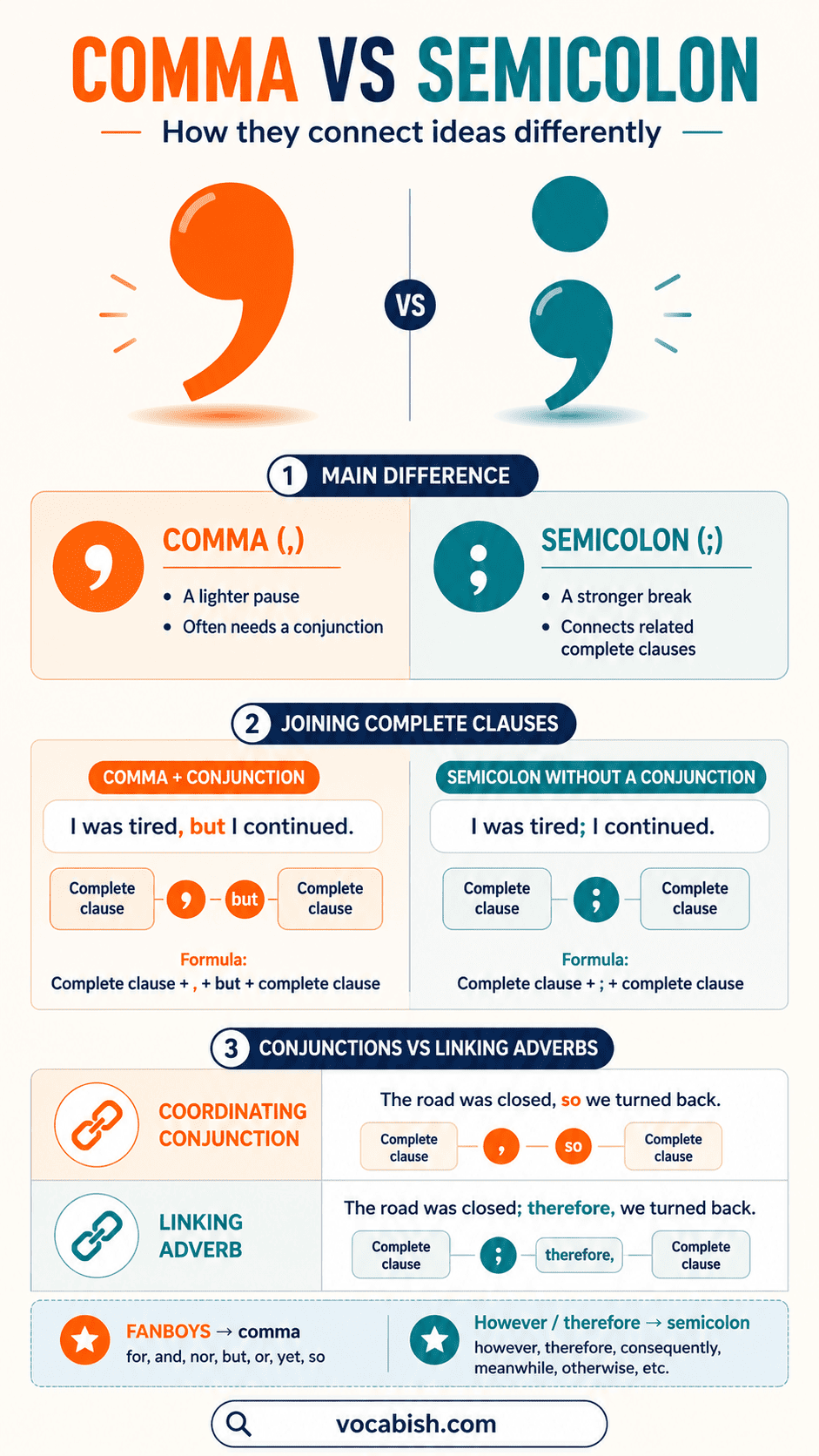
When and, but, or, nor, for, so, or yet joins two complete clauses, place a comma before it.
Complete clause + comma + coordinating conjunction + complete clause
- The instructions were clear, but I read them twice.
- We missed the first train, so we took a taxi.
- You can submit the form online, or you can deliver it personally.
Do not normally use a semicolon immediately before a coordinating conjunction:
- Awkward: The instructions were clear; but I read them twice.
- Correct: The instructions were clear, but I read them twice.
- Correct: The instructions were clear; I read them twice.
Linking adverbs
Words such as however, therefore, nevertheless, consequently, instead, otherwise, meanwhile, and thus can show a relationship between complete clauses.
When a linking adverb connects two independent clauses in one sentence, use:
Complete clause + semicolon + linking adverb + comma + complete clause
- The instructions were clear; however, I read them twice.
- We missed the first train; therefore, we took a taxi.
- You must leave now; otherwise, you will miss the flight.
- The first team prepared the room; meanwhile, the second team welcomed the guests.
Connector type | Correct punctuation | Example |
|---|---|---|
Coordinating conjunction | comma + conjunction | I was tired, but I finished the report. |
Linking adverb | semicolon + adverb + comma | I was tired; however, I finished the report. |
No connector | semicolon | I was tired; I finished the report. |
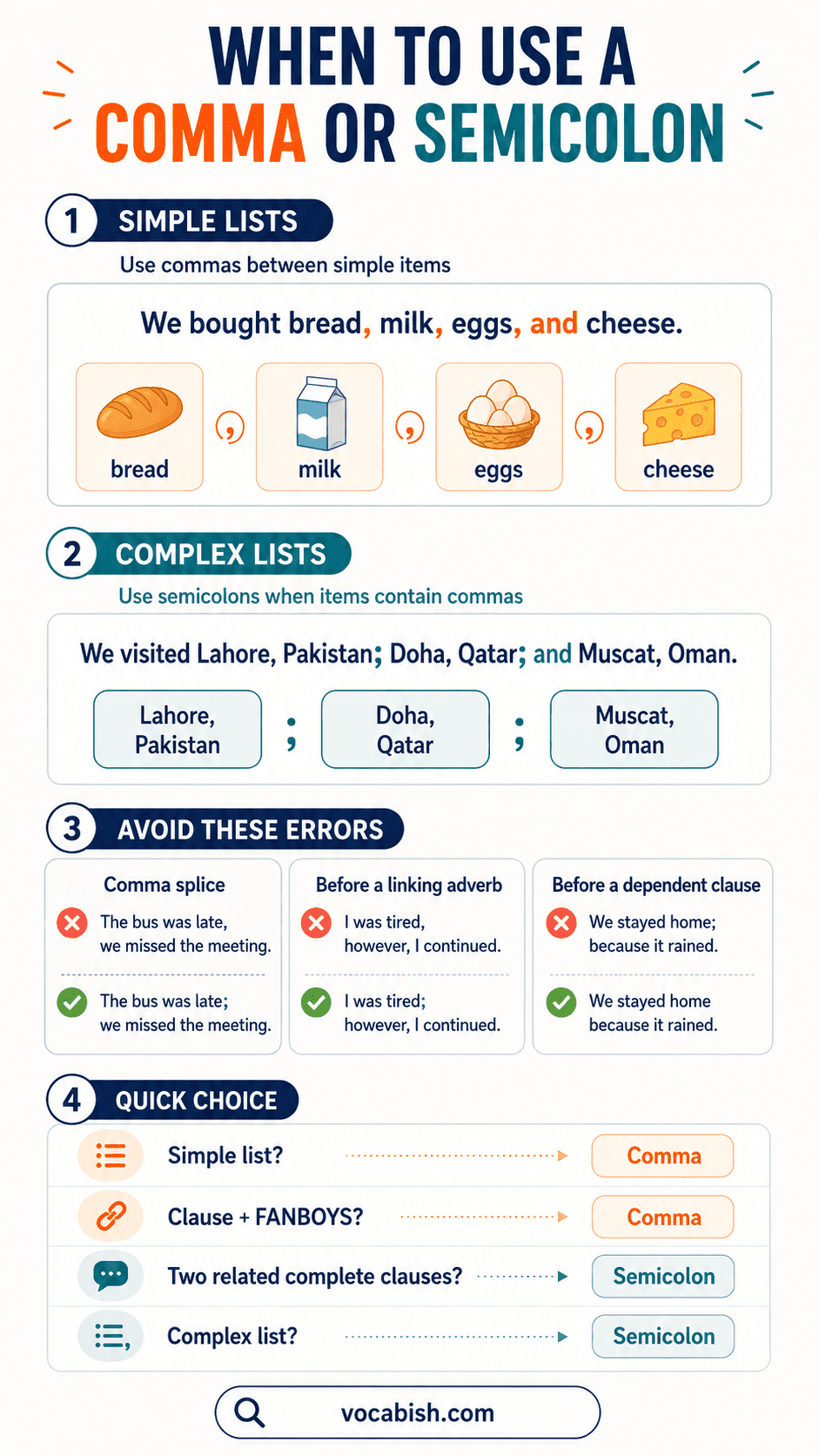
A comma alone before a linking adverb creates a comma splice:
- Incorrect: I was tired, however, I finished the report.
- Correct: I was tired; however, I finished the report.
- Correct: I was tired. However, I finished the report.
Subordinating conjunctions, including because, although, if, when, while, and since, introduce dependent clauses. Do not place a semicolon between a dependent clause and its main clause.
- Incorrect: Although the room was small; it felt comfortable.
- Correct: Although the room was small, it felt comfortable.
- Correct: The room felt comfortable although it was small.
Lists and Separators
Commas are the standard choice for simple lists.
- We bought bread, milk, eggs, and cheese.
- The course teaches reading, writing, listening, and speaking.
- Her bag contained a notebook, a charger, two pens, and a water bottle.
A semicolon becomes useful when list items already contain commas. It shows where one main item ends and the next begins.
Simple list
- The finalists were Hina, Bilal, Fatima, and Usman.
List containing internal commas
- The finalists came from Lahore, Pakistan; Doha, Qatar; Muscat, Oman; and Ankara, Türkiye.
Without semicolons, the sentence would contain too many commas:
- Confusing: The finalists came from Lahore, Pakistan, Doha, Qatar, Muscat, Oman, and Ankara, Türkiye.
- Clear: The finalists came from Lahore, Pakistan; Doha, Qatar; Muscat, Oman; and Ankara, Türkiye.
Semicolons can also separate longer descriptive items:
- The committee included Sana Ahmed, the finance manager; Hamza Khan, the legal adviser; and Maria Ali, the project director.
- Please bring your registration form, signed by a parent; your identity card, with a clear photograph; and your payment receipt.
Type of list | Punctuation | Example |
|---|---|---|
Short, simple items | Commas | We need paper, glue, scissors, and tape. |
Items containing commas | Semicolons | We visited Multan, Punjab; Sukkur, Sindh; and Quetta, Balochistan. |
Long descriptive items | Semicolons | Invite Ayesha, our designer; Hamid, our editor; and Omar, our photographer. |