
Asterisk punctuation refers to the small star-shaped symbol (*), which directs readers to notes, marks corrections, hides letters, or labels unusual language forms. Although it looks simple, its meaning changes according to where and how it appears.
The word asterisk comes from a Greek word meaning “little star.” In everyday English, the symbol is common in books, academic papers, advertisements, online messages, dictionaries, and linguistic studies.
Referring to Footnotes
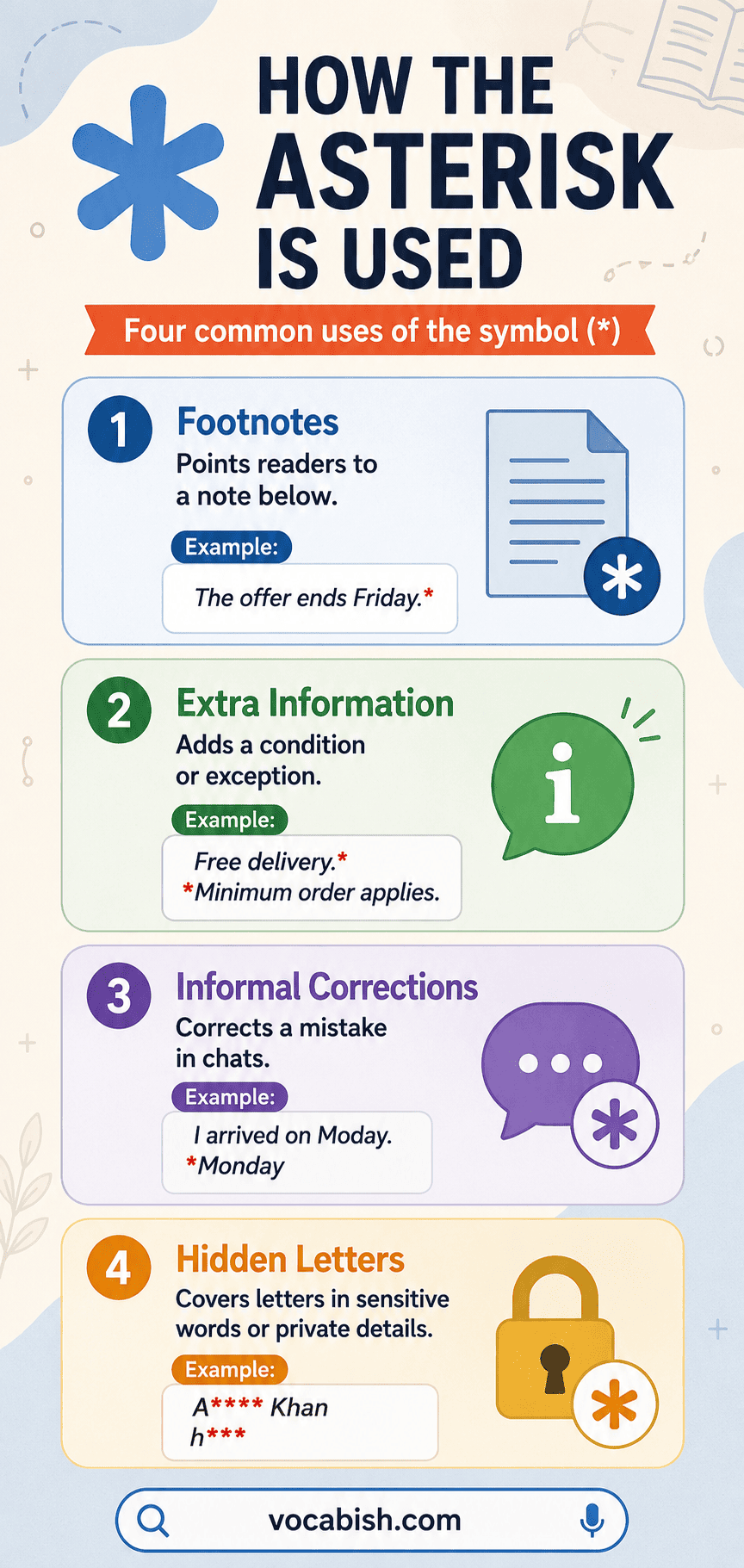
An asterisk can connect information in the main text with a footnote at the bottom of the page.
Example:
Registration is free for children under twelve.*
*Proof of age may be required.
The first asterisk tells readers that additional information appears elsewhere on the page.
Asterisks work best when a document contains only a small number of notes:
- Use one asterisk for the first note: *
- Use two asterisks for a second note: **
- Use numbered footnotes when several notes are needed.
- Keep the symbol close to the sentence or word it explains.
- Follow the same placement style throughout the document.
Text | Note |
|---|---|
The offer ends on Friday.* | *The closing date may vary by location. |
Students receive a 20% discount.* | *A valid student card is required. |
Delivery is available nationwide.* | *Some remote areas are excluded. |
Numbered references are usually easier to follow in research papers, reports, and longer documents.
Marking Additional Information
An asterisk may introduce a condition, exception, warning, or qualification connected to a statement.
All rooms include free breakfast.*
*Breakfast is not included on public holidays.
This use is common in:
- Advertisements
- Product descriptions
- Price lists
- Application forms
- Event announcements
- Terms and conditions
The additional note should be clear and easy to find. An asterisk should not be used to hide an important restriction in tiny or confusing text.
Main Statement and Added Condition
Main text | Additional information |
|---|---|
Free delivery on all orders.* | *Minimum order value applies. |
The course is available online.* | *Live classes are offered in selected regions. |
Members can cancel anytime.* | *Outstanding payments must be cleared first. |
The note may be grammatically complete or written as a short phrase, depending on the document style.
Correcting Words in Informal Writing
In chats, comments, and text messages, an asterisk can show that the writer is correcting a mistake.
I will meet you on Firday.
*Friday
The corrected word is often written in a new message with an asterisk before it.
Another common style places the symbol after the correction:
Friday*
Both forms are understood in informal communication, but placing the asterisk before the corrected word is often clearer.
Correcting More Than One Word
A longer correction may include the full corrected phrase:
She have completed the work.
*She has completed the work.
Use this method only in casual writing. In formal emails, reports, and academic work, rewrite the sentence correctly instead of adding an asterisk.
Hiding Letters in Sensitive Words
Asterisks sometimes replace letters in profanity, insults, or other sensitive terms.
What the h*** happened?
He used a d*** offensive expression.
This style allows readers to recognise the intended word without showing every letter.
Asterisks may also protect private information:
- Email: m****@example.com
- Phone number: 0300-*******
- Account number: **** 7842
- Personal name: A**** Khan
The symbol does not always make information fully private. Readers may still guess a hidden word from its context, length, or visible letters.
For accessible writing, avoid replacing too many letters when the exact word is necessary for understanding, reporting, or education.
Asterisks in Linguistics
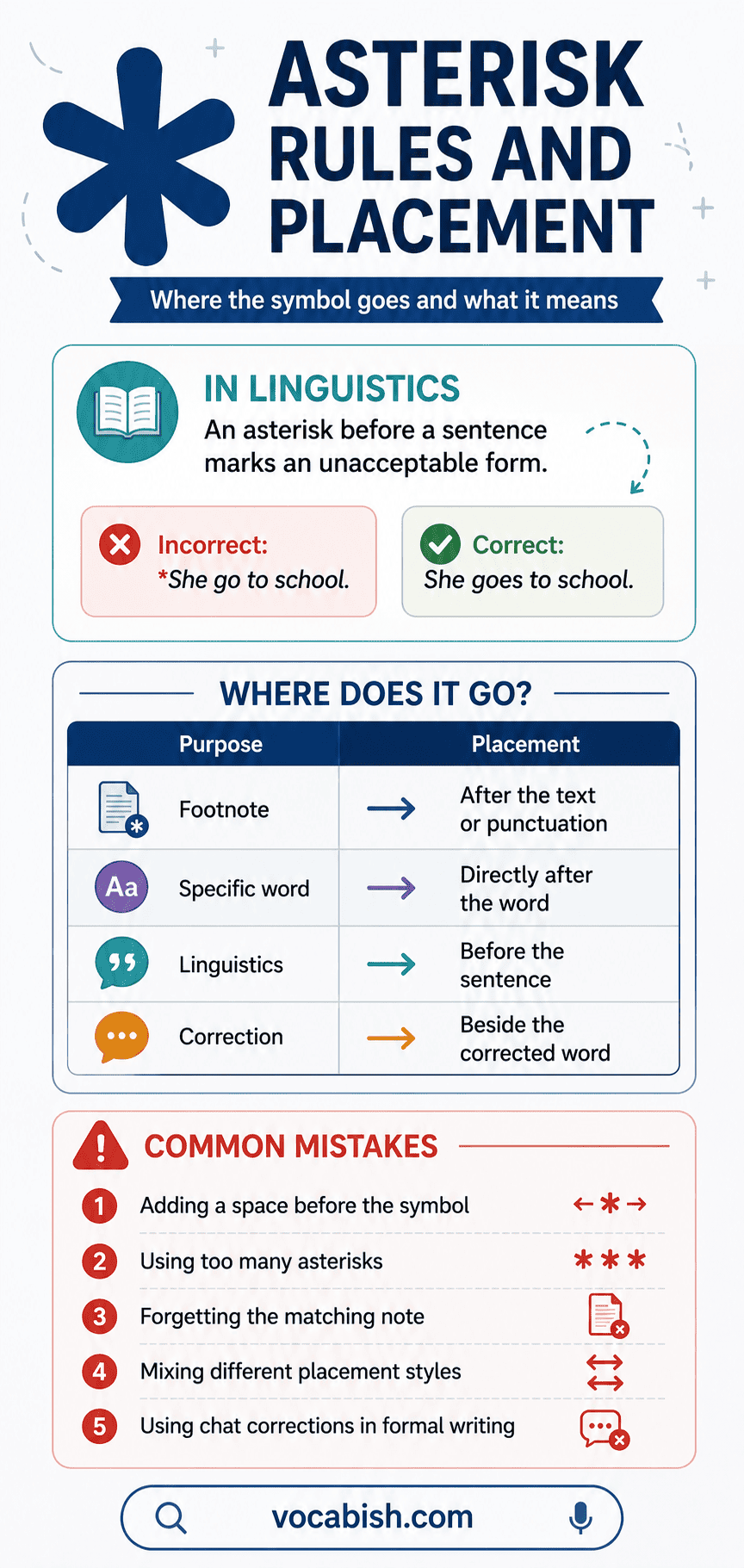
In linguistics, an asterisk before a word, phrase, or sentence usually shows that the form is grammatically unacceptable.
*She go to school every day.
The asterisk indicates that the sentence does not follow standard English grammar. The correct version is:
She goes to school every day.
Another example:
*He explained me the problem.
Correct forms include:
He explained the problem to me.
He explained the problem.
The symbol does not mean that the sentence is false. It means that the structure is considered grammatically unacceptable in the variety of English being analysed.
Common Linguistic Symbols
Symbol | Meaning | Example |
|---|---|---|
* | Grammatically unacceptable | *She are ready. |
? | Questionable or unnatural | ?She gave the book John. |
✓ | Acceptable form | She is ready. |
# | Grammatically possible but unsuitable in context | #The stone drank some tea. |
Linguistic judgements may depend on dialect, context, and meaning. A form marked unacceptable in standard written English may still appear in a regional dialect or informal speech.
Placement with Other Punctuation
The position of an asterisk depends on its purpose and the chosen style guide.
Footnote Asterisks
When an asterisk refers to a footnote, many style guides place it after the punctuation mark:
The results were unexpected.*
Only registered members may enter.*
When the note applies to one specific word, the symbol may appear directly after that word:
The basic* package does not include technical support.
*“Basic” refers to the monthly starter plan.
Linguistic Asterisks
In linguistics, place the asterisk before the unacceptable form:
*They was waiting outside.
Do not place it at the end of the sentence because it must immediately signal the grammatical judgement.
Informal Corrections
The symbol usually appears beside the corrected word:
*necessary
necessary*
The first style is often easier to recognise as a correction.
Purpose | Usual placement | Example |
|---|---|---|
Footnote reference | After the relevant text or punctuation | The fee is refundable.* |
Specific word note | Immediately after the word | Premium* users |
Grammar judgement | Before the sentence or form | *He don’t agree. |
Informal correction | Before or after the corrected word | receive / receive |
Hidden letters | Inside the word | s***d |
Private information | In place of hidden characters | A**** Khan |
Because publishers use different conventions, check the required style guide before preparing formal work.