
Angle Brackets in English: Meaning and Uses

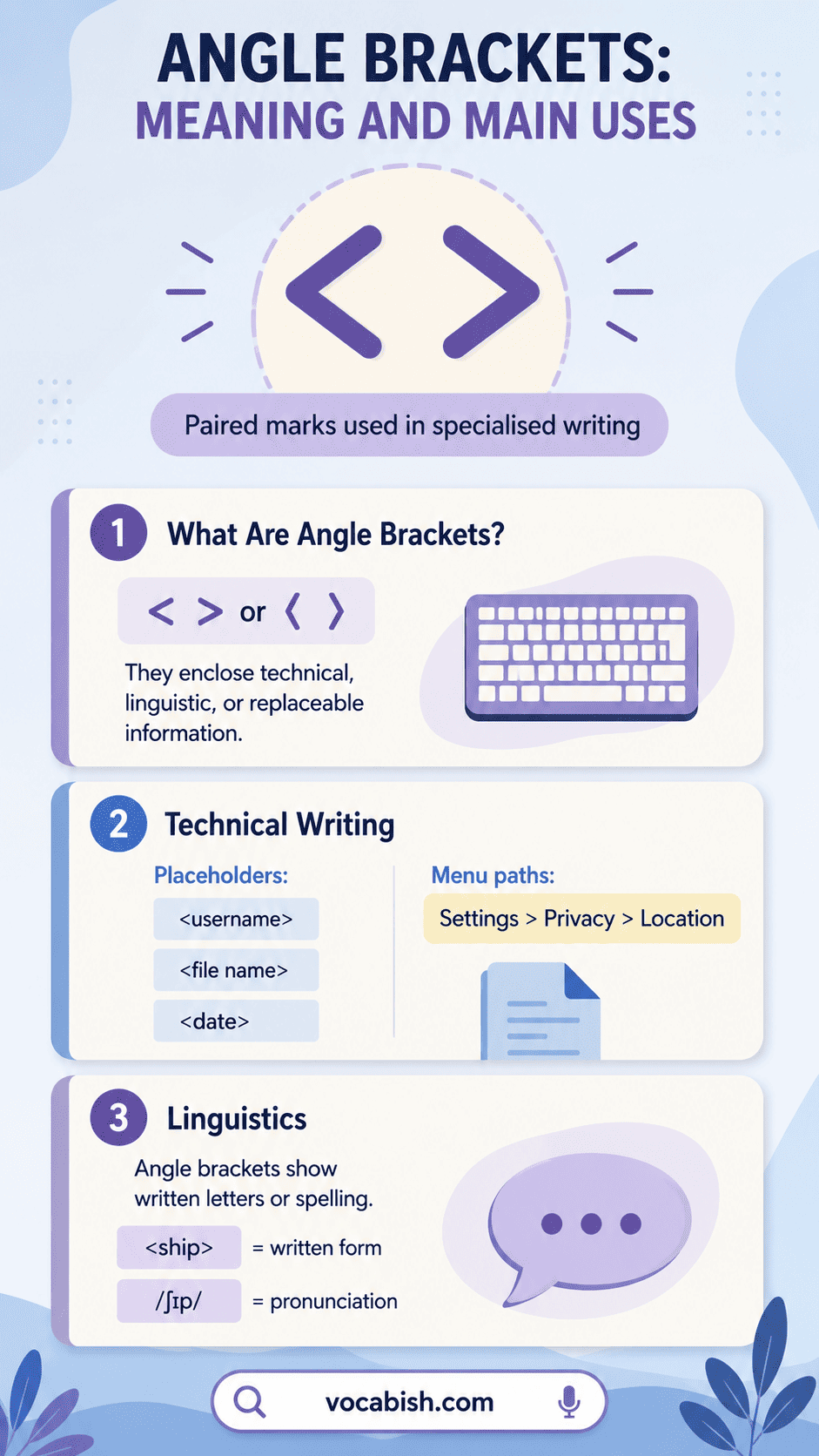
Angle brackets are the paired marks < > or ⟨ ⟩ used mainly to enclose technical, linguistic, or digital information. Unlike parentheses and square brackets, they rarely appear in ordinary English sentences.

You are most likely to see them in computer code, instructional placeholders, linguistic examples, and mathematical comparisons. Their meaning depends on the subject and whether the marks are being used as a pair.

What Are Angle Brackets?

Angle brackets consist of an opening mark and a closing mark:

  • Opening angle bracket: < or
  • Closing angle bracket: > or
  • Paired form: <text> or ⟨text⟩

On a standard keyboard, people commonly use < and > as angle brackets. Technically, Unicode identifies these characters as the less-than sign and greater-than sign. The typographic characters and are separate mathematical angle brackets. (Unicode)

The same visible marks can therefore perform different jobs:

  • <name> encloses a placeholder.
  • <p> represents an HTML tag.
  • <sh> identifies written letters in linguistics.
  • 4 < 9 means that four is less than nine.

Context usually makes the intended meaning clear.

Uses in Technical Writing

Technical writers use angle brackets when part of an instruction must be replaced with information supplied by the reader.

Showing placeholders

A placeholder represents a value that has not yet been entered.

  • Enter <username> to continue.
  • Save the document as <file name>.pdf.
  • Send the message to <email address>.
  • Replace <date> with the submission date.

The text inside the brackets is not normally typed exactly as shown. The reader replaces it with suitable information.

For example:

Type login <username>.

A user named Sara would type:

login Sara

Microsoft’s technical-writing guidance recommends angle brackets for code placeholders when those marks are not already part of the programming language’s syntax. (Microsoft Learn)

Presenting command patterns

Angle brackets can identify required information in a command:

  • rename <old file> <new file>
  • search <keyword>
  • send <message> <recipient>
  • create-user <name> <password>

Writers should explain the convention before using it because some beginners may type the brackets themselves.

Showing navigation paths

A single right angle bracket may separate steps in a menu or settings path:

  • Select Settings > Privacy > Location.
  • Go to File > Export > PDF.
  • Open Tools > Language > Spelling.

Here, the marks are not a pair. Each > means “go to the next option.” Style guidance commonly recommends spaces around these separators for readability. (Microsoft Learn)

Uses in Linguistics

In linguistics, angle brackets can show that the writer is discussing spelling, letters, or graphemes, rather than pronunciation.

  • The spelling <cat> contains three letters.
  • The grapheme <c> may represent different sounds.
  • The letter sequence <sh> usually represents one sound in English.
  • The ending <ed> has several pronunciations.

This notation helps distinguish written and spoken forms:

Notation
What It Represents
Example
< >
Spelling or graphemes
/ /
Phonemes
/ʃɪp/
[ ]
Detailed speech sounds
[ʃɪp]

Consider the word ship:

  • <ship> refers to its written form.
  • /ʃɪp/ represents its phonemic pronunciation.
  • [ʃɪp] may represent a more detailed phonetic transcription.

Angle brackets are therefore useful when comparing spelling with pronunciation. Linguistic notation guides commonly use them around orthographic letters and graphemes. (Universität Bremen)
Angle Brackets in English

Uses in Digital Text

Angle brackets play an important role in coding, markup, templates, and online instructions.

HTML tags

HTML uses angle brackets to mark elements on a webpage:

<p>This is a paragraph.</p>

In this example:

  • <p> opens the paragraph element.
  • </p> closes it.
  • The forward slash shows that the second tag is a closing tag.

Other familiar examples include:

<h1>Main Heading</h1>
<a>Link text</a>
<strong>Important text</strong>

The angle brackets separate the tags from the visible content. W3C documentation describes HTML tags as being set apart by < and >. (W3C)

Templates and automatic fields

Digital forms and templates may use angle brackets to identify information that will be inserted later:

  • Dear <customer name>,
  • Your order <order number> has been dispatched.
  • The meeting begins at <time>.
  • Contact <department> for assistance.

These marks tell the writer or software that the enclosed words are temporary instructions, not final text.

Code and structured data

Some programming and markup systems assign special meanings to angle brackets. Depending on the language, they may indicate:

  • Tags
  • Generic types
  • Comparison operations
  • Input or output
  • Replaceable values

Because the meaning changes between systems, writers should not assume that every use of < and > works in the same way.

');win.document.close();} if(p.mode==='hub'){state.title=p.title||'Punctuation Practice Centre';renderHub('');}else{begin(p.topic,p.title,p.questions,p.articleUrl,p.articleTitle);}} onReady(function(){document.querySelectorAll('.vbpq2-wrap').forEach(init);}); })();

Angle Brackets vs Comparison Symbols

The keyboard characters < and > may function as brackets or mathematical symbols. Their role depends on whether they enclose information or compare values.

Feature
Angle Brackets
Comparison Symbols
Main purpose
Enclose specialised information
Compare two values
Typical form
5 < 8
Used as a pair
Usually
No
Text or numbers inside
Often text
Usually numbers or quantities
Common fields
Technology, linguistics, coding
Mathematics, statistics, programming
How they are read
“Angle brackets”
“Less than” or “greater than”

Compare these examples:

  • <age> means “insert an age here.”
  • age < 18 means “age is less than eighteen.”
  • <th> refers to the written letter combination.
  • 20 > 12 means “twenty is greater than twelve.”

Spacing also helps show the difference:

  • A placeholder is commonly written without inner spaces: <name>
  • A comparison normally has spaces around the symbol: 10 > 6

Spacing conventions can vary in code, formulas, and publication styles.

Limited Use in General English

Angle brackets are not standard punctuation for ordinary paragraphs, essays, emails, or stories.

Do not normally use them instead of:

  • Parentheses for additional information
    Correct: The office closes early (usually at 3 p.m.).
  • Square brackets for editorial additions
    Correct: “They [the students] arrived early.”
  • Quotation marks for direct speech or quoted words
    Correct: She said, “I understand.”
  • Dashes for an interruption or added emphasis
    Correct: The final speaker—our new director—arrived late.

The following sentence looks unnecessarily technical:

My brother <who lives abroad> is visiting.

Use parentheses or commas instead:

My brother, who lives abroad, is visiting.

Angle brackets may occasionally appear in specialised editing, transcription, or academic notation, but readers should not be expected to understand an unexplained system.

Angle Brackets in Digital Text

Examples of Angle Brackets in English

Example
Context
Meaning
Technical instruction
Insert a password
Template
Replace with a title

HTML
Opens a paragraph element
HTML
Closes a paragraph element
Linguistics
Refers to the written word
Linguistics
Refers to a letter sequence
3 < 7
Mathematics
Three is less than seven
15 > 9
Mathematics
Fifteen is greater than nine
Home > Account > Security
Digital navigation
Follow a sequence of menu options
email
Command pattern
Replace the placeholder with a recipient

Short Summary on Angle Brackets

Angle brackets mainly appear in technical writing, linguistics, coding, templates, and digital navigation. They can enclose placeholders, mark written language, form HTML tags, or separate menu steps.

The symbols < and > also express mathematical comparisons. Check the context: paired marks generally enclose information, while individual symbols compare values.

FAQs About Angle Brackets

What are angle brackets used for?

Angle brackets are paired marks shaped like < and >, mainly used in technical writing, linguistics, programming, digital instructions, and specialised notation.

Why does HTML use angle brackets?

In HTML, angle brackets surround tag names, helping browsers recognise elements such as paragraphs, headings, links, and other page structures.

Are angle brackets the same as less-than and greater-than signs?

No. In mathematics, < and > express comparison, while paired angle brackets usually enclose technical, linguistic, placeholder, or coded information within specialised notation.

Why do linguists place words inside angle brackets?

Linguists place spellings or graphemes inside angle brackets to distinguish written forms from phonemes in slashes and speech sounds in square brackets.

Can angle brackets show information that users must replace?

Angle brackets can mark replaceable information, such as <username> or <file name>, when instructions require users to enter their own details.

Are angle brackets common in everyday English writing?

They are uncommon in ordinary sentences because parentheses, square brackets, quotation marks, and dashes already handle most general writing purposes.

Should spaces appear inside angle brackets?

Usually, no spaces appear immediately inside paired angle brackets, but spacing may depend on the software, notation system, or publication style.

Share or Save it for later:
Muhammad Matloob
Muhammad Matloob

Matloob is the founder of Vocabish, an educational website dedicated to helping students, teachers, and English learners improve their language skills. He creates practical learning resources on English grammar, vocabulary, phrasal verbs, confused words, speaking English, and worksheets. His goal is to make English learning simple, engaging, and accessible through clear explanations, real-life examples, and useful practice materials.

Articles: 554