

Colon vs semicolon becomes much easier when you understand the job each mark performs. A colon introduces information that explains or completes an earlier statement, while a semicolon connects two closely related complete sentences.
Although both marks create a pause stronger than a comma, they are not interchangeable. The colon points the reader toward what comes next; the semicolon shows a close relationship between two equal ideas.
Colon vs Semicolon: Main Difference
The main difference is simple:
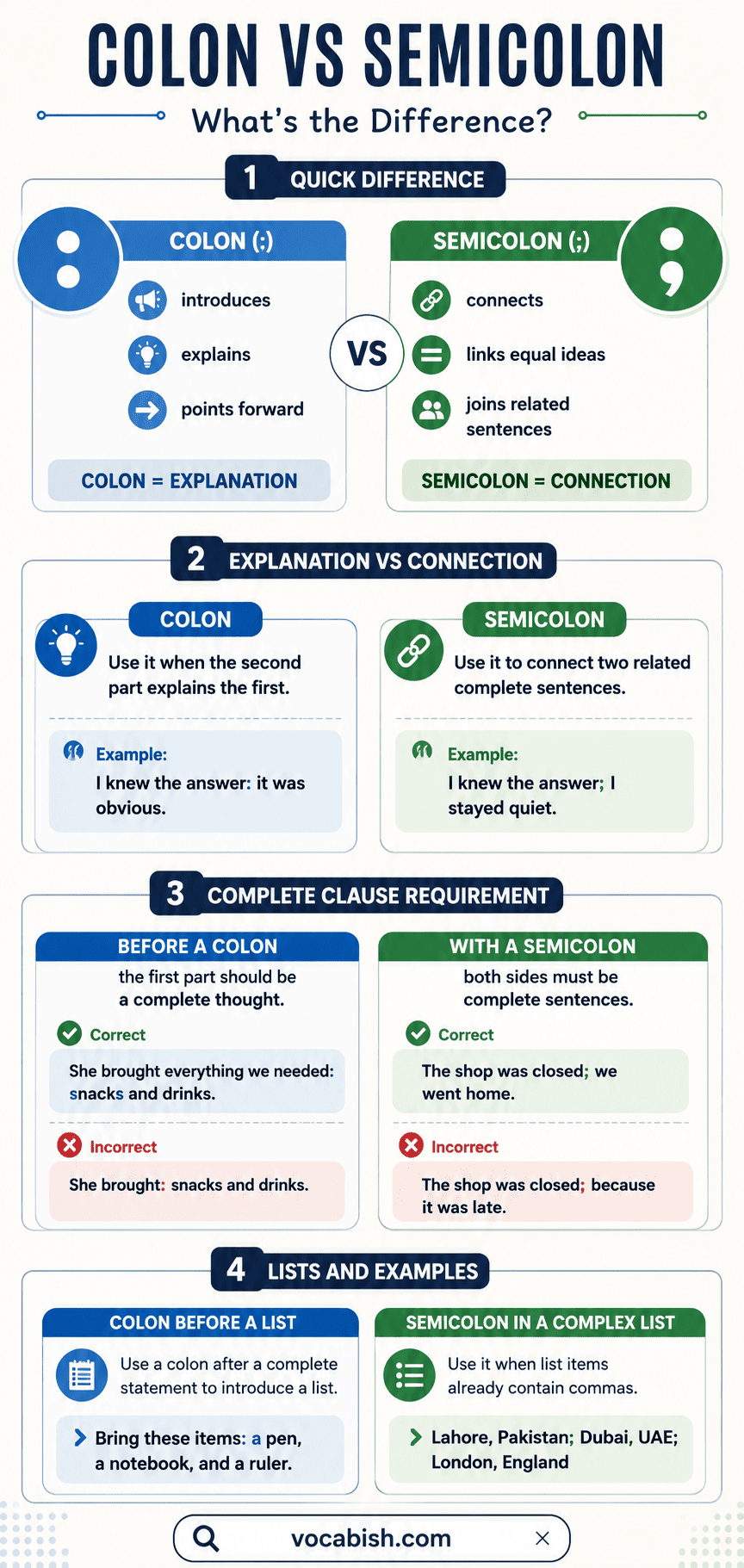
- A colon (:) introduces an explanation, example, list, quotation, or result.
- A semicolon (;) connects closely related independent clauses.
- A colon means “here is what I mean.”
- A semicolon means “these two complete ideas belong together.”
Punctuation Mark | Main Purpose | Example |
|---|---|---|
Colon | Introduces or explains information | Mia has one goal: to become a doctor. |
Semicolon | Connects related complete sentences | Mia studies every evening; she wants to become a doctor. |
Using a Colon for Explanation
A colon often introduces information that clarifies the statement before it.
- I finally understood the problem: the instructions were incomplete.
- Hamza had a simple reason for leaving: he felt unwell.
- The team faced one major difficulty: nobody had prepared a budget.
The words after the colon explain the earlier statement.
Using a Semicolon for Connection
A semicolon connects two complete but closely related thoughts.
- The instructions were incomplete; nobody understood the task.
- Hamza felt unwell; he decided to leave early.
- Nobody had prepared a budget; the meeting became difficult.
Each side could stand as a separate sentence, but the semicolon highlights their connection.
Complete Clause Requirement
A complete clause contains a subject and a verb and expresses a complete thought.
Before a Colon
In standard sentence structure, the words before a colon should form a complete clause.
Correct:
- She brought everything we needed: food, water, and blankets.
- I know why the printer stopped: it has run out of ink.
Incorrect:
- She brought: food, water, and blankets.
- My favourite subjects are: English, history, and art.
The words before each incorrect colon do not form a natural complete statement.
Around a Semicolon
When a semicolon connects clauses, both sides must be complete sentences.
Correct:
- The shop was closed; we returned home.
- My brother enjoys football; I prefer cricket.
Incorrect:
- The shop was closed; because it was Sunday.
- My brother enjoys football; but not cricket.
“Because it was Sunday” and “but not cricket” cannot stand alone as complete sentences.
Rule | Colon | Semicolon |
|---|---|---|
Complete clause before the mark | Usually required | Required when joining clauses |
Complete clause after the mark | Not always required | Required when joining clauses |
Can introduce a phrase | Yes | No |
Can introduce a single word | Yes | No |
Lists and Examples
Both marks can appear with lists, but they perform different jobs.
Colon Before a List
Use a colon after a complete statement to introduce a list.
- Please bring three items: a notebook, a pencil, and a ruler.
- The recipe requires basic ingredients: flour, milk, eggs, and sugar.
- We visited four cities: Lahore, Islamabad, Peshawar, and Multan.
Do not place a colon directly after a verb or preposition when the list completes the sentence naturally.
Incorrect:
- The recipe requires: flour, milk, eggs, and sugar.
- We travelled to: Lahore, Islamabad, and Multan.
Correct:
- The recipe requires flour, milk, eggs, and sugar.
- We travelled to Lahore, Islamabad, and Multan.
Semicolon Inside a Complex List
Use semicolons to separate list items that already contain commas.
- The guests came from Lahore, Punjab; Quetta, Balochistan; and Karachi, Sindh.
- The committee included Sara Khan, the chairperson; Ahmed Ali, the treasurer; and Maryam Noor, the secretary.
- Our stops were Paris, France; Rome, Italy; and Athens, Greece.
The semicolons make the boundaries between the longer list items clear.
List Situation | Correct Mark |
|---|---|
Introducing a list after a complete clause | Colon |
Separating simple list items | Comma |
Separating list items containing commas | Semicolon |
Colon Before an Example
A colon can introduce one or more examples.
- Some animals are active at night: owls, bats, and foxes.
- Certain verbs are irregular: “go” becomes “went,” not “goed.”
- One detail showed that he was nervous: his hands were shaking.
A semicolon does not normally introduce an example.
Incorrect:
- Some animals are active at night; owls, bats, and foxes.
Correct:
- Some animals are active at night: owls, bats, and foxes.
Related Independent Clauses
A semicolon is especially useful when two independent clauses are too closely connected to feel separate.
- The roads were flooded; the school remained closed.
- I sent her two messages; she did not reply.
- Bilal prefers working alone; his sister enjoys group projects.
A full stop would also be grammatically correct:
- The roads were flooded. The school remained closed.
The semicolon creates a closer connection between the ideas.
Semicolon with Linking Words
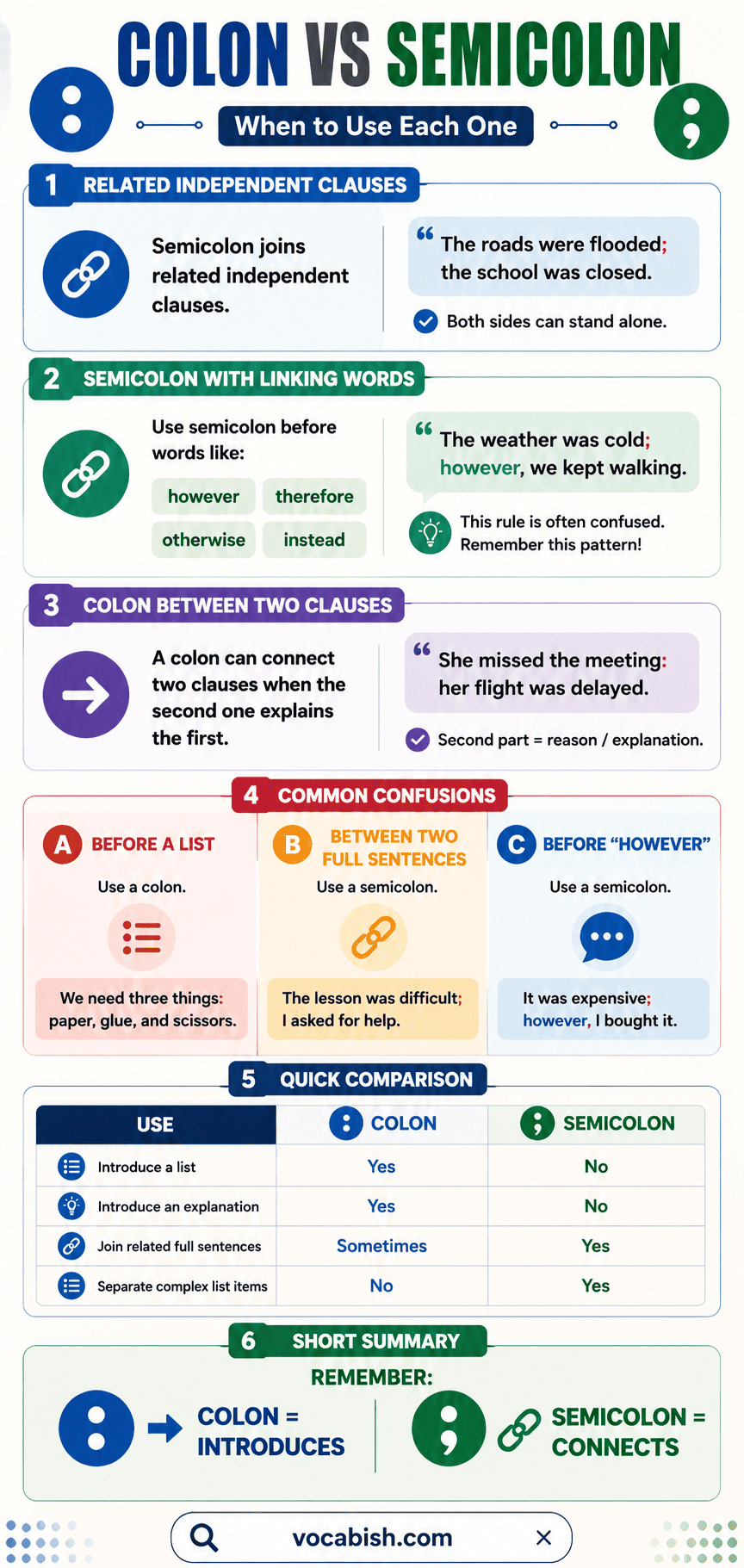
Use a semicolon before linking adverbs such as however, therefore, nevertheless, consequently, instead, and otherwise when they connect independent clauses. Place a comma after the linking word.
- The weather was cold; however, we continued walking.
- Ali had missed several lessons; therefore, he needed extra help.
- You should leave now; otherwise, you may miss the bus.
- The first plan was expensive; instead, we chose a cheaper option.
A comma alone cannot usually join these complete clauses.
Incorrect:
- The weather was cold, however, we continued walking.
Correct:
- The weather was cold; however, we continued walking.
- The weather was cold. However, we continued walking.
Colon Between Complete Clauses
A colon may also appear between two complete clauses when the second explains, proves, or illustrates the first.
- I knew the journey would be difficult: the roads were already covered in snow.
- She could not attend the meeting: her flight had been cancelled.
- The result surprised nobody: the strongest team won.
The relationship differs from a semicolon:
- Colon: the second clause explains the first.
- Semicolon: the clauses are closely related but grammatically equal.
Compare:
- I stayed home: I had developed a fever.
The second clause explains why I stayed home. - I stayed home; my friends went to the concert.
The clauses present two related but equal facts.
Common Confusions of Colon vs Semicolon
Colon vs Semicolon Before a List
Use a colon to introduce a list. Use semicolons only to divide complex items within that list.
- Correct: We need three supplies: paper, glue, and scissors.
- Correct: We invited Ayesha Khan, our manager; Bilal Ahmed, our designer; and Sara Ali, our editor.
- Incorrect: We need three supplies; paper, glue, and scissors.
Colon vs Semicolon Before an Explanation
Use a colon when the second part directly explains the first.
- The computer would not start: its battery was dead.
A semicolon is possible only when both clauses are complete and the relationship is presented as a connection rather than an explanation.
- The computer would not start; the battery indicator remained blank.
Semicolon vs Comma
A comma alone cannot connect two independent clauses. This error is called a comma splice.
Incorrect:
- The lesson was difficult, I asked the teacher for help.
Correct:
- The lesson was difficult; I asked the teacher for help.
- The lesson was difficult, so I asked the teacher for help.
- The lesson was difficult. I asked the teacher for help.
Semicolon Before Coordinating Conjunctions
Do not normally use a semicolon before and, but, or, so, yet, for, or nor when they connect two ordinary clauses.
Incorrect:
- The room was small; but it was comfortable.
Correct:
- The room was small, but it was comfortable.
- The room was small; however, it was comfortable.
A semicolon may appear before a coordinating conjunction in an unusually long or complicated sentence, but most learners should use a comma.
Capital Letters After Colons and Semicolons
A semicolon is normally followed by a lowercase letter unless the next word is a proper noun.
- The train arrived late; several passengers complained.
- We chose another destination; Islamabad was too far away.
Capitalization after a colon varies by style. A lowercase letter is common when the colon introduces a word, phrase, or ordinary explanation.
- She wanted only one thing: a peaceful evening.
A capital letter may be used when the colon introduces multiple sentences, a quotation, or a formally emphasized complete sentence.