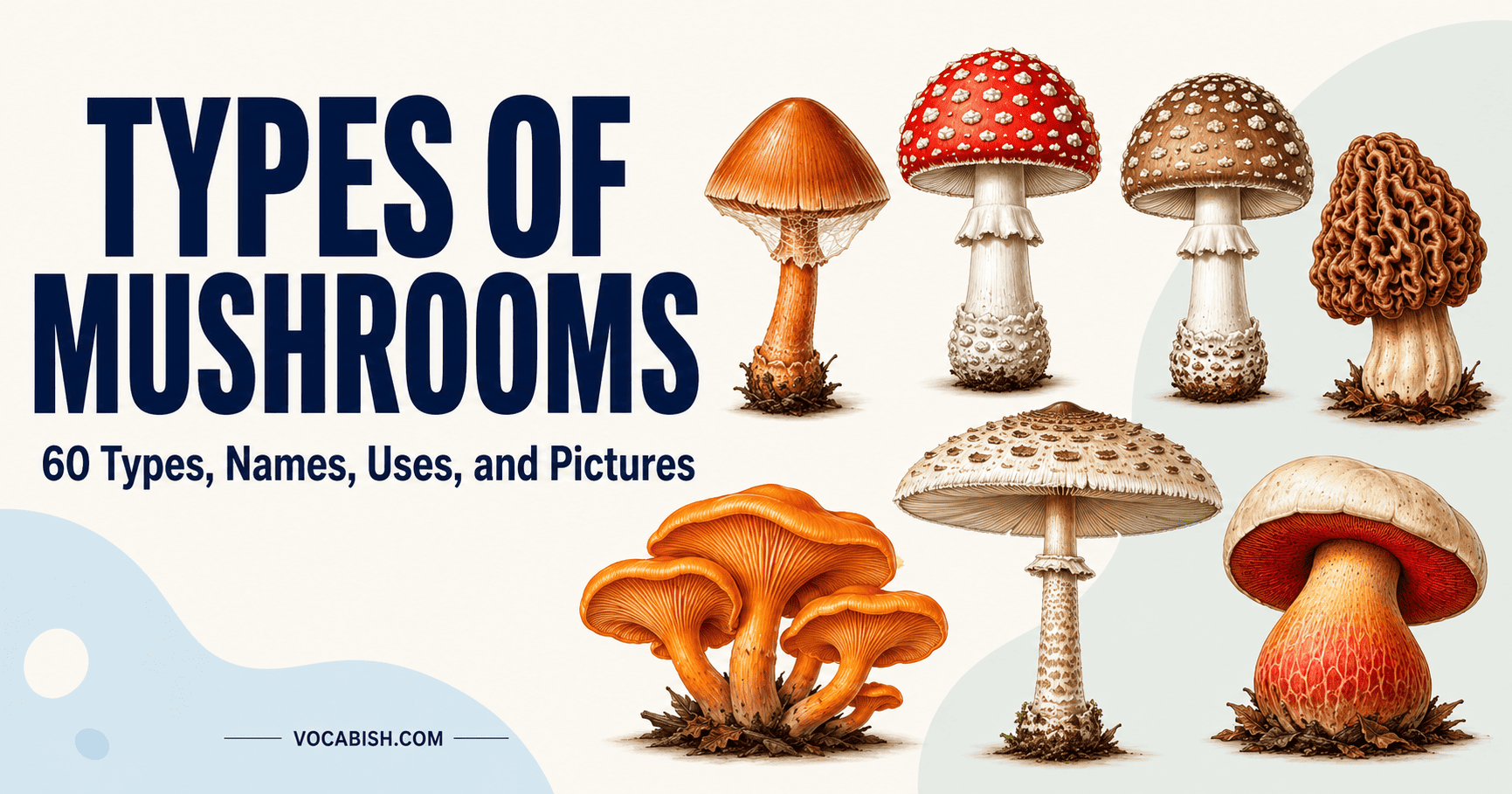

Mushrooms include familiar culinary varieties such as white button, shiitake, oyster, enoki, and portobello, alongside wild morels, chanterelles, puffballs, brackets, and poisonous Amanita species. Some are grown commercially, others develop naturally in forests, grasslands, or decaying wood.
In this blog post, you will learn about 60 types of mushrooms organised into cultivated, wild edible, traditional-use, poisonous, and unusual groups. Each entry highlights its most useful identifying feature, culinary role, appearance, or ecological form.
What Are Mushrooms?
Mushrooms are visible, spore-producing fruiting bodies formed by certain fungi. The main organism usually exists as microscopic threads called “hyphae,” which collectively form a network known as “mycelium” in soil, wood, or another substrate.
The word “type” is used here as a practical rather than strictly taxonomic term. The article includes commercially recognised forms, individual species, common-name species groups, and distinctive fruiting-body structures.
Most familiar cap-and-stem mushrooms belong to Basidiomycota, while morels, cup fungi, and several other forms belong to Ascomycota. Mushroom-producing fungi may release spores through gills, pores, teeth, internal sacs, or exposed surfaces.
White button, cremini, and portobello mushrooms are not separate species. They are commercial forms of Agaricus bisporus harvested at different stages of development. Likewise, names such as “chanterelle,” “oyster mushroom,” and “destroying angel” may refer to multiple closely related species.
This list excludes microscopic moulds, yeasts, lichens, and slime moulds. Underground truffles are also excluded because they are normally treated as a separate culinary group.
Complete List of 60 Types of Mushrooms
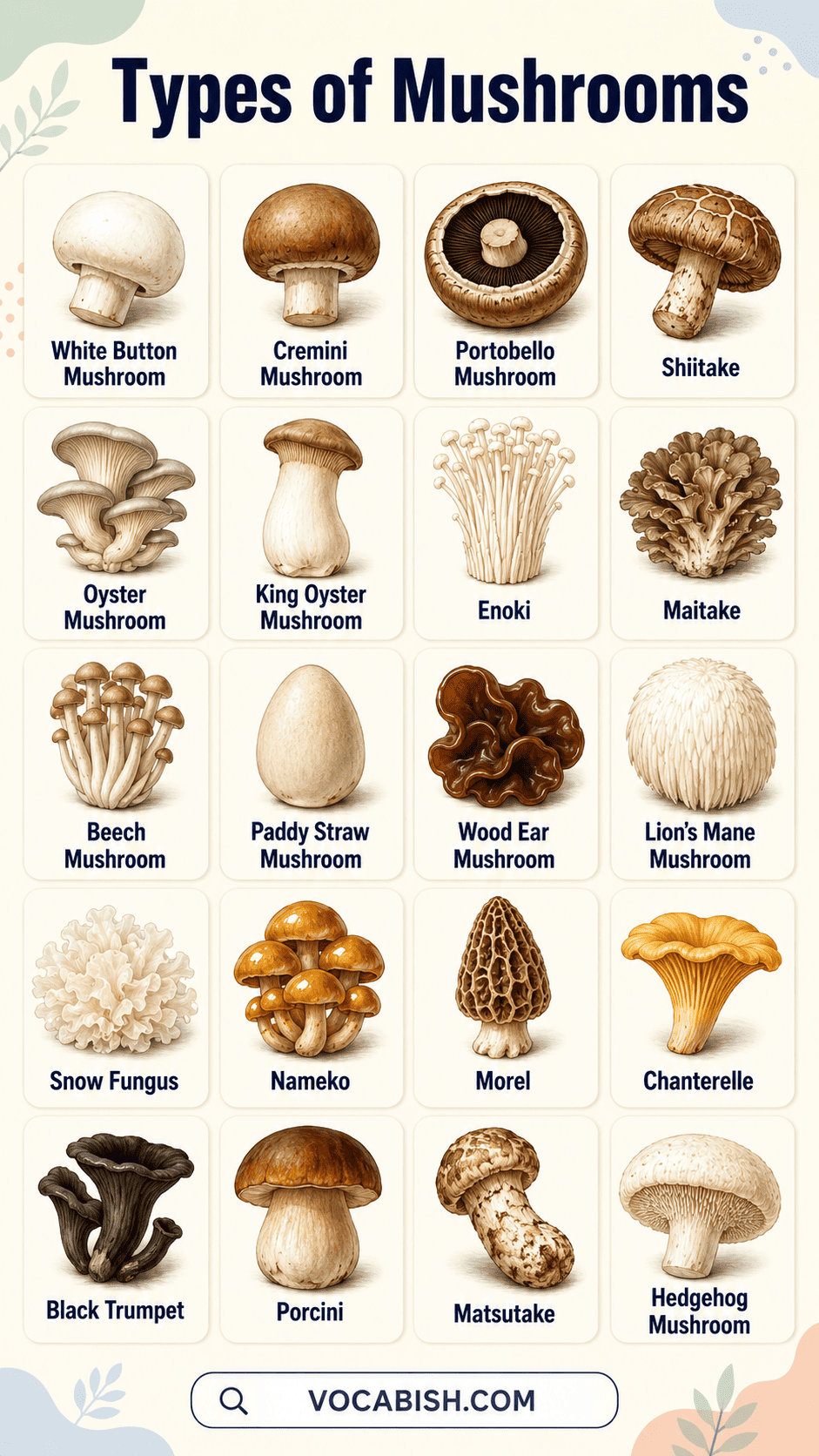
White button mushroom | Cremini mushroom | Portobello mushroom |
Shiitake | Oyster mushroom | King oyster mushroom |
Enoki | Maitake | Beech mushroom |
Paddy straw mushroom | Wood ear mushroom | Lion’s mane mushroom |
Snow fungus | Nameko | Morel |
Chanterelle | Black trumpet | Porcini |
Matsutake | Hedgehog mushroom | Lobster mushroom |
Chicken of the woods | Cauliflower mushroom | Saffron milk cap |
Parasol mushroom | Giant puffball | Shaggy mane |
Blewit | Fairy ring mushroom | Bay bolete |
Reishi | Turkey tail | Cordyceps |
Agarikon | Artist’s conk | Birch polypore |
Death cap | Destroying angel | Funeral bell |
Deadly webcap | Fool’s webcap | Fly agaric |
Panther cap | False morel | Jack-o’-lantern mushroom |
Green-spored parasol | Satan’s bolete | Brown roll-rim |
Yellow stainer | Deadly dapperling | Common stinkhorn |
Devil’s fingers | Collared earthstar | Bird’s nest fungus |
Scarlet elf cup | Orange peel fungus | Witch’s butter |
Crown-tipped coral fungus | Dryad’s saddle | Common ink cap |
Types of Mushrooms Explained by Category
The following categories are practical learning groups rather than official branches of fungal taxonomy. Some mushrooms could fit more than one category, but each appears once according to its most familiar use, risk, or physical form.
Common Cultivated and Culinary Mushrooms
These mushrooms are cultivated commercially or regularly sold as food. Their availability varies by country, and several may also grow naturally in suitable habitats.
- White button mushroom: Small, pale caps offer mild flavour and versatile everyday cooking uses.
- Cremini mushroom: Brown, immature caps provide a firmer texture and deeper savoury flavour.
- Portobello mushroom: Mature brown caps have broad gills and a dense meaty texture.
- Shiitake: Brown umbrella caps deliver rich umami flavour and chewy cooked texture.
- Oyster mushroom: Fan shaped clusters have delicate flesh and a mild savoury taste.
- King oyster mushroom: Thick edible stems remain firm, making them excellent for grilling.
- Enoki: Long, slender stems and tiny caps provide crisp, delicate texture.
- Maitake: Layered, feathery clusters develop robust flavour and crisp edges when cooked.
- Beech mushroom: Small clustered caps taste mildly nutty and become tender after cooking.
- Paddy straw mushroom: Egg-shaped young mushrooms are widely cooked across Southeast Asian cuisines.
- Wood ear mushroom: Thin, ear-shaped fruiting bodies add springy texture to dishes.
- Lion’s mane mushroom: White cascading spines create a tender texture and mild seafood flavour.
- Snow fungus: Translucent frilly lobes become softly gelatinous in soups and desserts.
- Nameko: Amber caps have a natural slippery coating and gentle earthy flavour.
Wild Edible Mushrooms
Wild edible mushrooms are collected from forests, grasslands, and other natural habitats. Their inclusion here describes recognised culinary use, not permission to eat an unidentified specimen.
Many edible species have poisonous look-alikes, and edibility can depend on correct identification, condition, and preparation.
- Morel: Honeycombed caps and hollow stems distinguish these prized spring mushrooms.
- Chanterelle: Golden funnel-shaped caps feature blunt ridges and fruity aromas.
- Black trumpet: Dark, thin funnels offer concentrated flavour despite their delicate appearance.
- Porcini: Stout stems and sponge-like pores accompany a deep nutty flavour.
- Matsutake: Firm white flesh carries a distinctive spicy, pine-scented aroma.
- Hedgehog mushroom: Tooth-like spines beneath the cap replace ordinary mushroom gills.
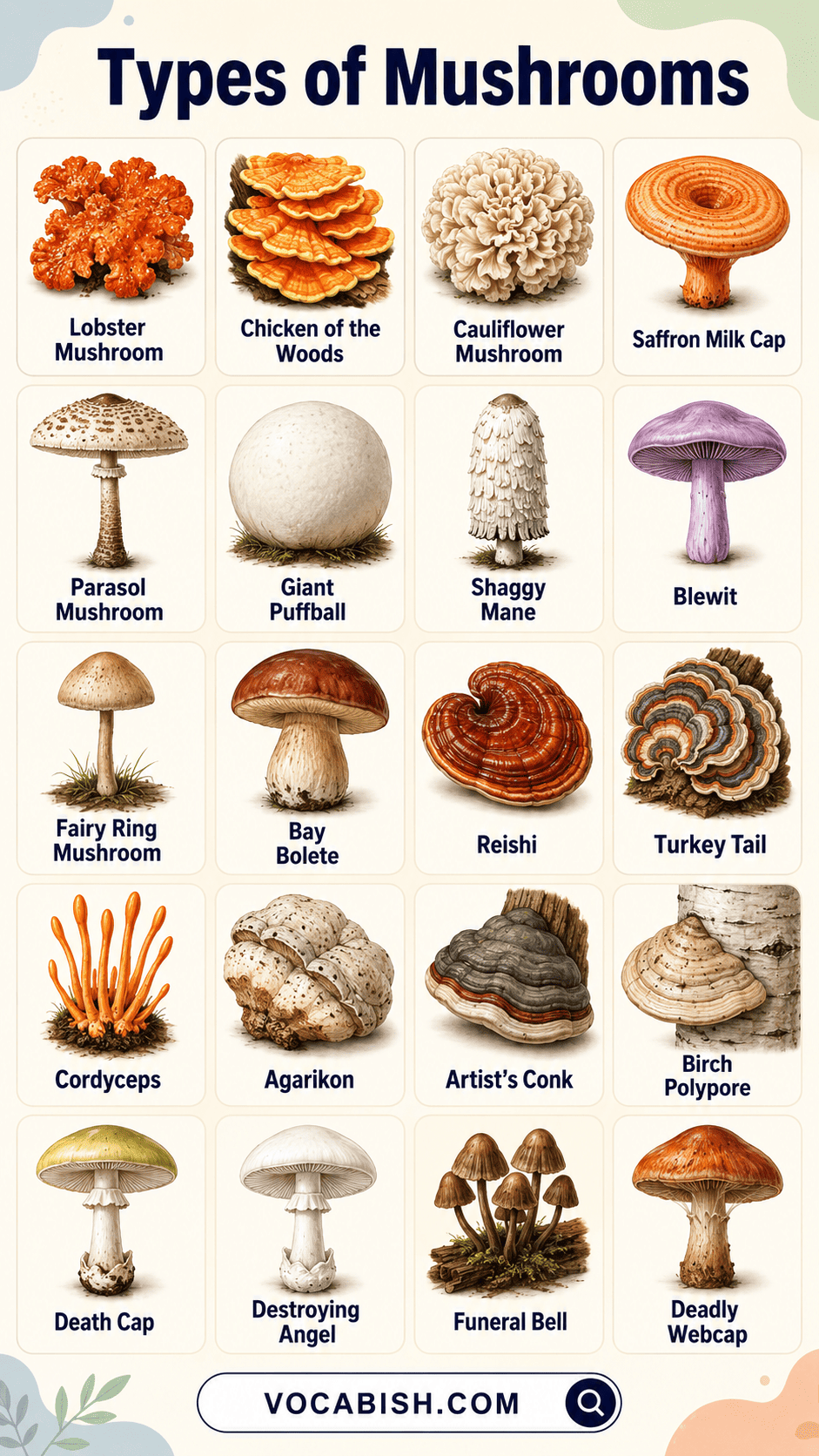
- Lobster mushroom: A parasitic fungus transforms another mushroom into a firm orange form.
- Chicken of the woods: Bright shelf-like clusters have tender flesh and striking yellow margins.
- Cauliflower mushroom: Creamy branching folds resemble ruffled cauliflower and grow near tree bases.
- Saffron milk cap: Orange caps release coloured latex and often show concentric surface rings.
- Parasol mushroom: Tall stems support broad scaly caps with a movable ring.
- Giant puffball: Large round fruiting bodies contain solid white flesh when immature.
- Shaggy mane: Tall scaly caps quickly dissolve into dark spore-filled liquid.
- Blewit: Lilac to purple colouring fades as the smooth cap matures.
- Fairy ring mushroom: Small tan caps often appear in arcs across grassy ground.
- Bay bolete: Chestnut caps sit above yellow pores that may bruise blue.
Traditional-Use and Functional Mushrooms
“Functional mushroom” is a commercial and traditional-use expression, not a formal scientific classification. These fungi are sold as teas, powders, extracts, or decorative specimens, but their inclusion does not establish any medical benefit.
Several names also represent species complexes or products made from cultivated mycelium rather than complete fruiting bodies.
- Reishi: Glossy reddish brackets have a tough texture and longstanding traditional uses.
- Turkey tail: Thin multicolored fans form overlapping bands across decaying hardwood logs.
- Cordyceps: Slender club-shaped fruiting bodies emerge from infected insect hosts.
- Agarikon: Large hoof-shaped conks grow slowly on mature conifer trees.
- Artist’s conk: Flat perennial brackets develop white undersides that permanently mark when scratched.
- Birch polypore: Rounded pale brackets grow mainly on birch and decompose wood.
Poisonous and Deadly Mushrooms
Poisonous mushrooms produce toxins that may affect the digestive system, liver, kidneys, or nervous system. Symptom timing varies, and some dangerous poisonings begin only after an apparently symptom-free delay.
Cooking, soaking, drying, or freezing cannot be assumed to neutralise mushroom toxins. Unknown wild specimens should never be tasted as an identification test.
- Death cap: Olive-tinted caps, white gills, a ring, and a volva signal extreme danger.
- Destroying angel: Entirely white Amanita mushrooms combine white gills, a ring, and a basal volva.
- Funeral bell: Small brown wood-growing caps contain potentially fatal amatoxin compounds.
- Deadly webcap: Rust-colored gills and cortina remnants accompany dangerous delayed poisoning.
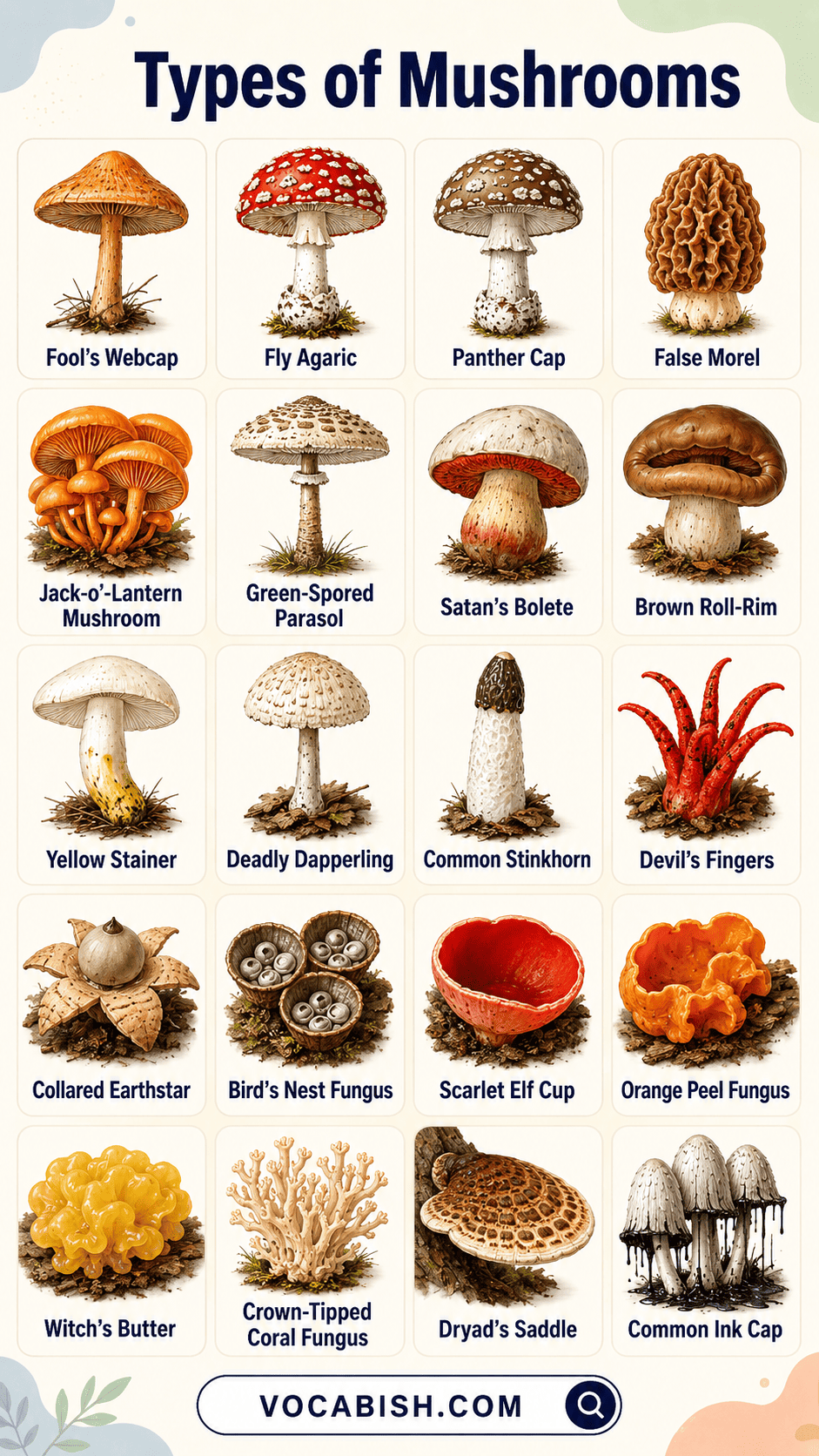
- Fool’s webcap: Orange-brown woodland caps contain orellanine, causing delayed kidney injury.
- Fly agaric: Red caps with white warts contain psychoactive and toxic compounds.
- Panther cap: Brown caps with white warts contain potent nervous system toxins.
- False morel: Wrinkled, brain-like caps may contain dangerous gyromitrin toxins when eaten.
- Jack-o’-lantern mushroom: Bright orange clusters have true gills and can cause severe illness.
- Green-spored parasol: Large lawn mushrooms develop greenish spores and frequently cause gastrointestinal poisoning.
- Satan’s bolete: Pale caps, red pores, and blue bruising identify this toxic bolete.
- Brown roll-rim: Inrolled brown margins conceal a mushroom linked to severe immune reactions.
- Yellow stainer: White caps rapidly yellow when bruised and often smell medicinal.
- Deadly dapperling: Small-scaled caps may contain amatoxins capable of fatal liver damage.
Unusual Shapes and Ecological Forms
Not every mushroom has a conventional cap, stem, and gills. Fungal fruiting bodies may resemble cups, stars, coral branches, nests, jelly, fingers, or shelves.
These forms demonstrate why visual shape alone does not indicate taxonomic relationship or edibility.
- Common stinkhorn: Phallic, spongy stems carry foul-smelling spore slime, attracting flies.
- Devil’s fingers: Red tentacle-like arms emerge dramatically from a pale egg.
- Collared earthstar: Outer layers split into star points surrounding a central spore sac.
- Bird’s nest fungus: Tiny cups hold spore packets resembling miniature eggs inside nests.
- Scarlet elf cup: Bright red cup-shaped bodies appear on damp decaying twigs.
- Orange peel fungus: Vivid orange cups resemble discarded citrus peel on disturbed soil.
- Witch’s butter: Yellow gelatinous lobes swell in wet weather on dead wood.
- Crown-tipped coral fungus: Repeated crown-shaped branch tips distinguish this delicate wood decomposer.
- Dryad’s saddle: Large patterned brackets smell cucumber-like and grow on hardwood trunks.
- Common ink cap: Grey clustered caps liquefy into black fluid as spores mature.
Important Differences Between Similar Mushrooms
The following comparisons highlight major visual distinctions, but they cannot replace complete identification. Age, weather, location, and natural variation can change a mushroom’s appearance.
Common Confusion | First Type | Second Type | Main Difference |
|---|---|---|---|
Three market forms | White button | Cremini and portobello | All are maturity or colour forms of one species |
Morel identification | True morel | False morel | True morels usually have hollow interiors and attached honeycombed caps |
Orange woodland mushrooms | Chanterelle | Jack-o’-lantern | Chanterelles have blunt ridges; jack-o’-lanterns have sharp true gills |
Large lawn mushrooms | Parasol | Green-spored parasol | Spore colour differs, but complete expert identification remains necessary |
Round immature forms | Giant puffball | Young Amanita | Puffballs are uniformly solid inside without developing cap structures |
Underside structures | Porcini | Ordinary gilled mushroom | Porcini release spores through pores rather than blade-shaped gills |
How to Identify Different Types of Mushrooms
Mushroom identification requires a combination of characteristics. Never determine edibility from one feature, photograph, mobile application, or common-name match.
- Examine the cap’s shape, surface, colour, scales, moisture, and margins.
- Check underneath for gills, pores, teeth, folds, or smooth tissue.
- Observe stem texture, ring structures, colour changes, and internal consistency.
- Carefully inspect the complete base for bulbs, cups, or buried structures.
- Record habitat, host trees, substrate, growth pattern, season, and location.
- Use spore colour and microscopic features when reliable identification requires them.
Wild mushrooms should be eaten only after identification by a suitably experienced local expert. Folklore tests involving silver spoons, insects, peeling, smell, or discolouration are unreliable.
Confusions and Terms About Types of Mushrooms
- Mushroom versus fungus: A mushroom is one reproductive structure produced by a fungus.
- Species versus market form: Button, cremini, and portobello are forms of one species.
- Mushroom versus toadstool: Toadstool has no precise or official scientific definition.
- Edible versus safe specimen: An edible species may still be spoiled, contaminated, or misidentified.
- Common name versus species: One common name can represent several related fungal species.
- Colour versus toxicity: Bright colouring does not consistently indicate whether mushrooms are poisonous.
Summary of the Main Mushroom Types
Category | Key Characteristic | Common Examples | Main Relevance |
|---|---|---|---|
Cultivated culinary mushrooms | Grown under controlled commercial conditions | Button, shiitake, oyster, enoki | Everyday cooking and food production |
Wild edible mushrooms | Collected from naturally occurring populations | Morel, chanterelle, porcini | Seasonal cooking and specialist foraging |
Traditional-use mushrooms | Commonly processed into non-culinary products | Reishi, turkey tail, cordyceps | Traditional practices and ongoing research |
Poisonous mushrooms | Contain harmful or potentially fatal toxins | Death cap, webcap, false morel | Identification awareness and poisoning prevention |
Unusual fungal forms | Lack the familiar cap-and-stem structure | Earthstar, stinkhorn, cup fungus | Ecology, morphology and nature study |
FAQs About Types of Mushrooms
Mushrooms are visible, spore-producing fruiting bodies made by certain fungi. Most of the organism remains hidden as mycelium within soil, wood, living roots, or other moist organic material beneath surfaces.
There is no single fixed total because mushroom is an informal structural term, not one taxonomic group. This article covers 60 widely recognised culinary, wild, toxic, traditional-use, and unusual forms.
Practical categories include cultivated culinary mushrooms, wild edible mushrooms, traditional-use fungi, poisonous species, and unusual ecological forms. Scientific classification instead relies on evolutionary relationships, anatomy, spores, microscopic features, and genetic evidence.
No. White button, cremini, and portobello are commercial forms of Agaricus bisporus harvested at different maturity stages, with colour, cap size, exposed gills, flavour, firmness, and texture changing during development.
There is no formal scientific difference. “Toadstool” is an informal word often applied to poisonous or inedible mushrooms, but appearance and vocabulary cannot reliably establish whether a wild fungus is safe.
Common market mushrooms include white button, cremini, portobello, shiitake, oyster, king oyster, enoki, maitake, beech, and lion’s mane. Availability and everyday culinary use differ substantially between countries, cuisines, seasons, and retailers.
No general cooking method makes poisonous mushrooms safe. Some toxins resist ordinary heating, while preparation requirements differ among edible species, so unknown wild mushrooms should never be tested through cooking or tasting.
Purchase correctly labelled mushrooms from reputable food retailers or approved growers. Choose firm specimens without excessive slime or decay, refrigerate them appropriately, and follow preparation advice provided for that particular type.
Important Facts About Mushrooms
- The article includes 60 cultivated, wild, poisonous, traditional-use, and unusual mushrooms.
- These practical categories are useful for learning but are not formal taxonomy.
- Mushroom forms include gilled caps, boletes, brackets, cups, corals, and puffballs.
- White button, cremini, and portobello are forms of the same species.
- Wild mushroom edibility requires complete identification rather than visual resemblance.
- Common names and total counts vary across regions and classification systems.
Conclusion
Understanding the main types of mushrooms makes it easier to compare their structures, culinary roles, habitats, and potential risks. Cultivated varieties such as button, shiitake, and oyster mushrooms are familiar food products, while morels, chanterelles, and porcini are associated with specialist wild collection. Brackets, cups, puffballs, and coral fungi show how widely fungal fruiting bodies can vary.
The most important distinction is between recognising a general mushroom form and confirming a species safely. Common names, photographs, and individual features are not enough for determining edibility. Learning these 60 types of mushrooms provides a practical foundation for cooking, nature study, and further exploration of fungal diversity.
You May Also Like