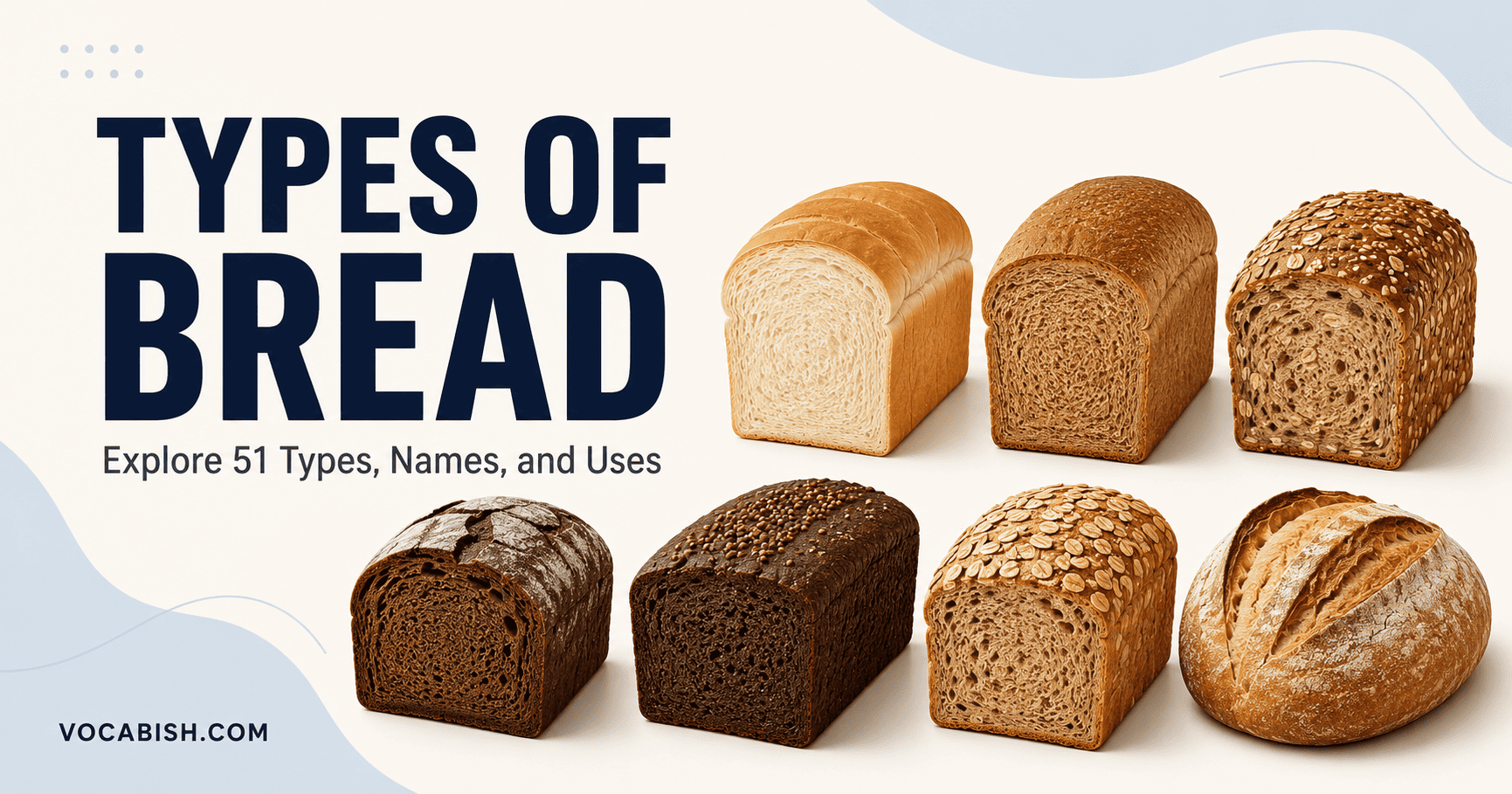

Bread includes many regional and traditional foods made from flour, water, and other ingredients. Common types of bread include white bread, sourdough, baguette, rye bread, brioche, pita, naan, tortillas, bagels, and cornbread.
In this blog post, you will learn 51 bread names organised by flour, preparation method, shape, texture, leavening, and cooking technique. You will also learn how to identify, compare, and choose bread for different meals.
What Is Bread?
Bread is a food prepared from dough or batter containing flour and liquid. It may be baked, steamed, fried, griddled, or cooked against the wall of a hot oven.
Bread types are commonly identified by:
- Flour or grain
- Leavening method
- Added fat, eggs, or milk
- Shape and thickness
- Crust and crumb texture
- Cooking method
- Regional tradition
- Intended use
These classifications can overlap. Sourdough describes a fermentation method, baguette describes a recognised loaf style, rye bread is named after its flour, and flatbread describes shape rather than one specific recipe.
Names of the 51 Types of Bread
White Bread | Challah | Barbari |
Wholemeal Bread | Pain de Campagne | Taftoon |
Multigrain Bread | Pain de Mie | Piadina |
Rye Bread | Vienna Bread | Yufka |
Pumpernickel | Japanese Milk Bread | Bagel |
Oat Bread | Pita | Pretzel |
Spelt Bread | Naan | Simit |
Sprouted-Grain Bread | Roti (Chapati) | Bialy |
Potato Bread | Paratha | Kaiser Roll |
Gluten-Free Bread | Puri | English Muffin |
Sourdough | Kulcha | Crumpet |
Baguette | Lavash | Bao |
Boule | Matzo | Soda Bread |
Bâtard | Tortilla | Cornbread |
Ciabatta | Arepa | Bannock |
Focaccia | Injera | Damper |
Brioche | Sangak | Banana Bread |
Everyday and Grain-Based Breads
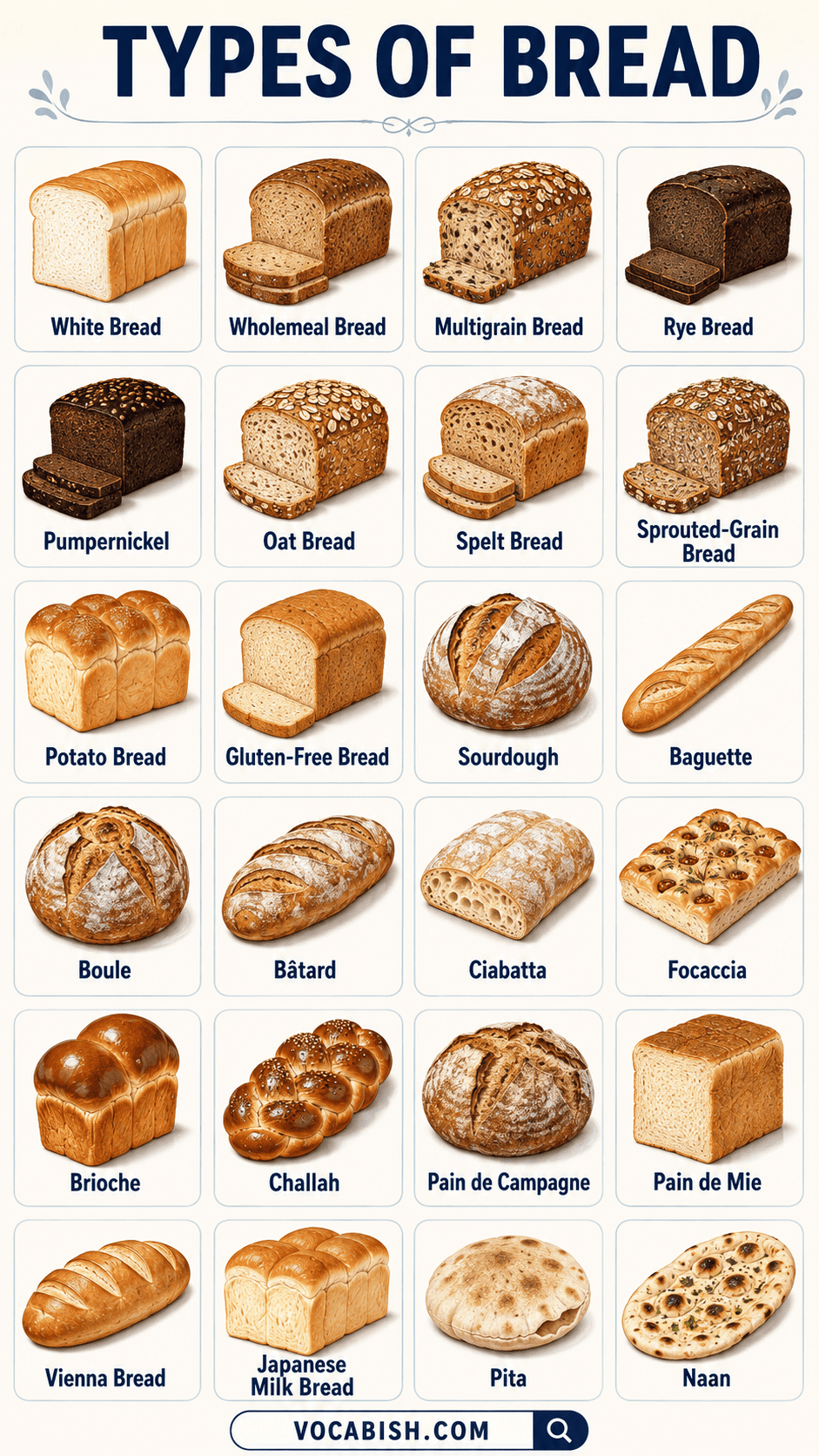
These breads are mainly distinguished by their primary flour, grain mixture, or ingredient composition. Whole-grain flour contains the bran, germ, and endosperm, while refined flour mainly retains the endosperm.
- White Bread: Refined wheat flour creates soft slices with a mild, neutral flavour.
- Wholemeal Bread: Whole wheat flour retains bran, germ, and endosperm for heartier texture.
- Multigrain Bread: Several grains or seeds create varied flavour, texture, and appearance.
- Rye Bread: Rye flour provides earthy flavour, darker colour, and dense texture.
- Pumpernickel: Coarse rye meal produces a dark, dense loaf with deep flavour.
- Oat Bread: Oats add gentle sweetness, moisture, and softness to wheat-based dough.
- Spelt Bread: Spelt flour gives bread a nutty taste and tender crumb.
- Sprouted-Grain Bread: Sprouted cereal grains provide robust flavour and a firm, hearty crumb.
- Potato Bread: Potato or potato flour creates moist, soft, resilient sandwich slices.
- Gluten-Free Bread: Alternative flours and binders effectively replace wheat gluten’s structural function.
Gluten-free bread is a broad product category rather than one recipe. Regulations vary between countries, so people avoiding gluten should check recognised labels, ingredients, and cross-contact warnings. Under United States rules, foods labelled gluten-free must contain less than 20 parts per million of gluten.
Fermented, Artisan, and Enriched Breads
These breads are distinguished by fermentation, shaping, crust formation, or enriching ingredients such as eggs, butter, milk, and oil.
- Sourdough: Natural fermentation develops tangy flavour, chewy texture, and aromatic crust.
- Baguette: Long French loaves feature crisp crusts and light, open interiors.
- Boule: Round artisan loaves develop broad crusts and substantial, evenly baked interiors.
- Bâtard: Oval shaping offers crusty character with practical, evenly sized slices.
- Ciabatta: Wet Italian dough creates flat loaves with irregular interior holes.
- Focaccia: Olive oil enriches dimpled Italian bread, often topped with herbs.
- Brioche: Butter and eggs produce a rich, tender, lightly sweet crumb.
- Challah: Braided egg-enriched bread offers soft texture, richness, and subtle sweetness.
- Pain de Campagne: French country loaves commonly combine wheat, rye, and natural fermentation.
- Pain de Mie: Lidded tins produce square loaves with fine, evenly textured crumbs.
- Vienna Bread: Fine white flour, milk, and yeast create a light, glossy loaf.
- Japanese Milk Bread: Milk and tangzhong often create exceptionally soft, fluffy, lasting slices.
Sourdough uses a fermented starter containing wild yeasts and lactic acid bacteria. The starter affects the bread’s rise, acidity, aroma, and texture.
Baguettes are strongly associated with French baking traditions. Their preparation normally includes mixing, fermentation, dividing, resting, shaping, scoring, and baking. The craft and culture surrounding French baguette production received international heritage recognition in 2022.
Flatbreads and Their Names
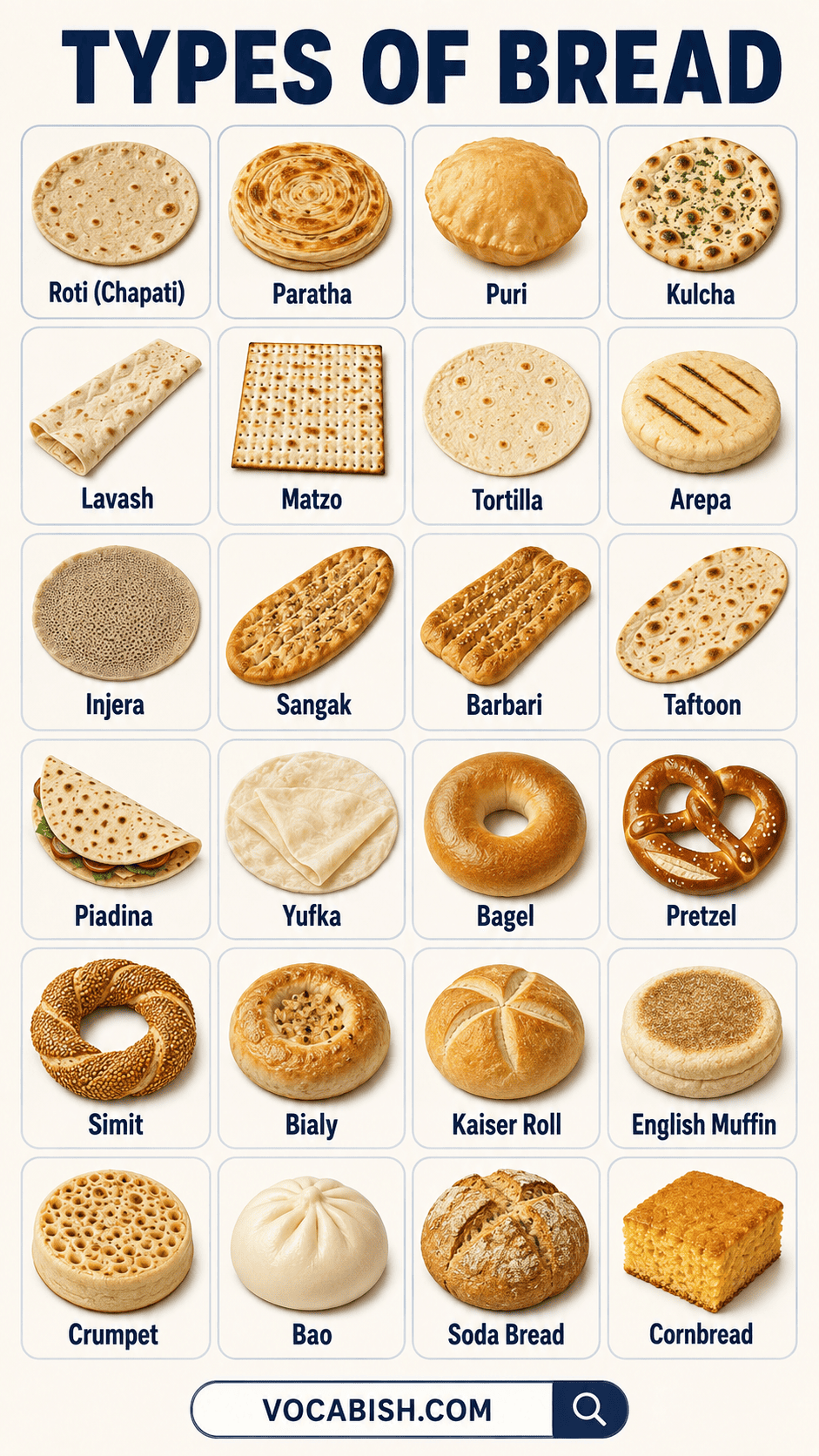
Flatbreads are shaped into thin or flattened pieces before cooking. Some are unleavened, while others use yeast, natural fermentation, or chemical leaveners. They may be baked, fried, griddled, steamed, or cooked in tandoors.
- Pita: High baking heat separates dough layers, forming a central pocket.
- Naan: Leavened South Asian flatbread traditionally cooks against hot tandoor walls.
- Roti (Chapati): Unleavened whole-wheat dough cooks quickly on a hot flat griddle.
- Paratha: Layered dough and fat create flaky, crisp sections during cooking.
- Puri: Small unleavened dough rounds puff dramatically when fried in hot oil.
- Kulcha: Soft leavened flatbread may be plain, stuffed, griddled, or tandoor-baked.
- Lavash: Thin Armenian flatbread remains soft when fresh, becoming crisp when dried.
- Matzo: Unleavened Jewish bread bakes rapidly into thin, firm, crisp sheets.
- Tortilla: Maize masa or wheat flour creates flexible breads for wrapping.
- Arepa: Maize dough forms thick griddled cakes, commonly split for fillings.
- Injera: Fermented teff batter creates spongy flatbread with pleasantly sour flavour.
- Sangak: Persian whole-wheat flatbread traditionally bakes across small heated river stones.
- Barbari: Thick Persian flatbread features lengthwise ridges and a crisp surface.
- Taftoon: Thin Persian flatbread uses leavened dough traditionally baked in tandoors.
- Piadina: Thin Italian griddle bread remains tender, foldable, and suitable for fillings.
- Yufka: Very thin Turkish flatbread dries well and stores for extended periods.
Pita develops two layers when steam expands rapidly inside the dough during high-temperature baking. Roti and chapati are usually single-layered, while naan is commonly leavened and cooked in a tandoor.
Shaped and Specially Cooked Breads
These breads are identified by their shape or a distinctive cooking stage such as boiling, alkaline treatment, griddling, or steaming.
- Bagel: Boiling before baking creates a shiny crust and chewy interior.
- Pretzel: An alkaline bath creates deep browning and a distinctive savoury crust.
- Simit: Sesame-coated Turkish rings combine crisp surfaces with pleasantly chewy centres.
- Bialy: Round rolls feature onion-filled dimples instead of complete central holes.
- Kaiser Roll: A segmented, star-shaped top distinguishes this crisp European bread roll.
- English Muffin: Griddle cooking produces round breads with open, craggy internal texture.
- Crumpet: Loose batter forms porous griddle breads that readily absorb butter.
- Bao: Steamed leavened dough creates soft buns served plain or filled.
Bagels are boiled or briefly simmered before baking, helping create their glossy exterior and firm, chewy texture. Pretzels receive an alkaline treatment that encourages deeper browning and their characteristic crust.
English muffins are cooked on a griddle rather than baked as conventional pan loaves. Crumpets use a looser batter, producing visible surface holes and a softer, more porous structure.
Quick and Rustic Breads
Quick breads rise without extended yeast fermentation. Many use bicarbonate of soda or baking powder, while rustic breads may be cooked on hot surfaces, over fires, or among heated coals.
- Soda Bread: Bicarbonate raises this quick bread without yeast or lengthy fermentation.
- Cornbread: Maize meal produces golden bread ranging from crumbly to cake-like.
- Bannock: Simple round dough is griddled, baked, or cooked over fire.
- Damper: Australian bush bread traditionally cooks in campfire coals or ashes.
- Banana Bread: Mashed bananas flavour and moisten this sweet, cake-like quick loaf.
Banana bread is normally classified as a quick bread because baking powder, bicarbonate, or both raise its batter. Its sweetness and soft crumb also make it similar to cake.
Main Differences Between Bread Types
Category | Main Ingredient or Method | Typical Texture | Common Examples |
|---|---|---|---|
Refined-flour bread | Refined wheat flour | Soft and light | White bread, pain de mie |
Whole-grain bread | Complete grain kernel | Firm and grainy | Wholemeal, rye, sprouted-grain |
Sourdough bread | Fermented starter | Chewy and aromatic | Sourdough boule, country bread |
Enriched bread | Eggs, milk, butter, or oil | Soft and rich | Brioche, challah, milk bread |
Flatbread | Flattened dough or batter | Thin, flexible, or crisp | Roti, pita, naan, tortilla |
Specially cooked bread | Boiling, steaming, or griddling | Method-dependent | Bagel, bao, crumpet |
Quick bread | Chemical leavening | Tender or cake-like | Soda bread, cornbread, banana bread |
Yeast Bread vs Sourdough vs Quick Bread
Feature | Yeast Bread | Sourdough Bread | Quick Bread |
|---|---|---|---|
Main leavener | Commercial yeast | Fermented starter | Baking powder or bicarbonate |
Rising time | Usually required | Usually longer | Little or none |
Typical flavour | Mild and yeasty | Tangy and complex | Sweet or savoury |
Common texture | Soft or chewy | Chewy with developed crust | Tender, crumbly, or cake-like |
Examples | White bread, brioche | Sourdough, pain de campagne | Soda bread, banana bread |
How to Identify Different Types of Bread
- Check the flour: Wheat, rye, maize, oat, spelt, and teff produce different colours and flavours.
- Observe the shape: Long, round, braided, square, ring-shaped, and flat forms provide useful clues.
- Examine the crumb: Large irregular holes suggest wetter dough, while even cells suggest pan baking.
- Inspect the crust: Boiling, steam, oil, alkaline treatment, and direct heat create different surfaces.
- Consider the cooking method: Bread may be baked, fried, steamed, griddled, or tandoor-cooked.
- Read the label: Ingredient lists clarify whole-grain, multigrain, enriched, seeded, and gluten-free claims.
How to Choose the Right Bread
- Choose white bread, pain de mie, or milk bread for soft sandwiches.
- Select sourdough, rye, or pumpernickel for strong flavours and firm fillings.
- Use pita, tortillas, lavash, or roti for wraps and filled meals.
- Serve baguettes, boules, or ciabatta with soups, cheese, and dipping oils.
- Pick brioche or challah for rich breakfasts, toast, and French toast.
- Choose naan, kulcha, or paratha for curries, grilled foods, and sauces.
Common Confusions and Terms About Breads
- Wholemeal and whole-wheat usually mean the same thing. Wholemeal is more common in British English, while whole-wheat is common in North American English.
- Multigrain does not always mean whole grain. A loaf can contain several refined grains.
- Brown bread is not automatically wholemeal. Malt, molasses, or other ingredients can darken bread.
- Flatbread does not always mean unleavened. Naan, pita, kulcha, and injera rise through leavening or fermentation.
- Sourdough is not one loaf shape. Sourdough dough can become boules, baguettes, bâtards, pan loaves, or flatbreads.
- Gluten-free is not a grain type. It describes products formulated and handled to meet applicable gluten limits.
- Roti and chapati are often overlapping terms. Their exact meanings vary by country, region, and household.
- Banana bread is generally a quick bread. Its sweetness and texture also resemble cake.
Whole grain means that the bran, germ, and endosperm remain in their original relative proportions. Colour alone does not confirm that bread is whole grain.
Summary of Bread Categories
Category | Defining Characteristic | Common Examples | Typical Uses |
|---|---|---|---|
Grain-based loaves | Named mainly by flour or grain | White, rye, oat | Toast and sandwiches |
Artisan breads | Shaped and crust-focused | Baguette, boule, ciabatta | Dipping and table service |
Enriched breads | Made with added fat, eggs, or milk | Brioche, challah | Breakfasts and rich sandwiches |
Flatbreads | Thin or flattened | Pita, naan, roti | Wrapping, filling, and scooping |
Specially cooked breads | Boiled, steamed, or griddled | Bagel, bao, crumpet | Snacks and breakfast meals |
Quick breads | Chemically leavened | Soda bread, cornbread | Fast baking and side dishes |
Rustic breads | Simple ingredients and cooking | Bannock, damper | Outdoor or traditional cooking |
FAQs About Types of Breads
There are hundreds of recognised breads worldwide. They differ according to grain, ingredients, fermentation, shape, thickness, cooking method, regional tradition, and local naming practices.
The main groups include grain-based loaves, artisan breads, sourdough breads, enriched breads, flatbreads, steamed breads, specially shaped breads, rustic breads, and chemically leavened quick breads.
White sandwich bread is widely sold internationally, but common bread differs by region. Roti, tortillas, pita, baguettes, rye loaves, and other traditional breads are daily staples elsewhere.
White bread uses refined flour with most bran and germ removed. Wholemeal bread uses flour containing the complete wheat kernel, producing a fuller flavour and firmer texture.
Sourdough differs mainly through fermentation rather than one guaranteed nutritional profile. Its nutritional value depends on flour, salt, added ingredients, serving size, and the finished recipe.
Gluten-free bread replaces conventional gluten-containing grains with suitable flours, starches, and binders. Manufacturing controls are also important because cross-contact can introduce gluten into the final product.
Pain de mie, white bread, wholemeal bread, rye, sourdough, and milk bread all suit sandwiches. The best choice depends on filling weight, moisture, flavour, and preferred texture.
Important Points You Should Know About
- The article includes 51 types of bread across five main groups.
- Bread is classified by flour, leavening, enrichment, shape, and cooking method.
- Flatbreads may be leavened, fermented, chemically raised, or unleavened.
- Sourdough describes a fermentation process rather than one fixed loaf shape.
- Multigrain, wholemeal, and gluten-free describe different product characteristics.
- Flour, crumb, crust, shape, and cooking method help identify bread.
Conclusion
The many types of bread can be understood by examining their flour, fermentation, ingredients, shape, texture, and cooking method. White, wholemeal, rye, and oat breads are mainly identified by grain, while sourdough, baguettes, and ciabatta are recognised through fermentation and shaping.
Brioche, challah, and milk bread use enriched doughs. Pita, naan, roti, lavash, and tortillas belong to the broad flatbread category, while bagels, bao, and crumpets use distinctive cooking methods. Recognising these differences makes it easier to compare unfamiliar breads and choose suitable options for sandwiches, wraps, breakfast dishes, soups, curries, and table service.
You May Also Like