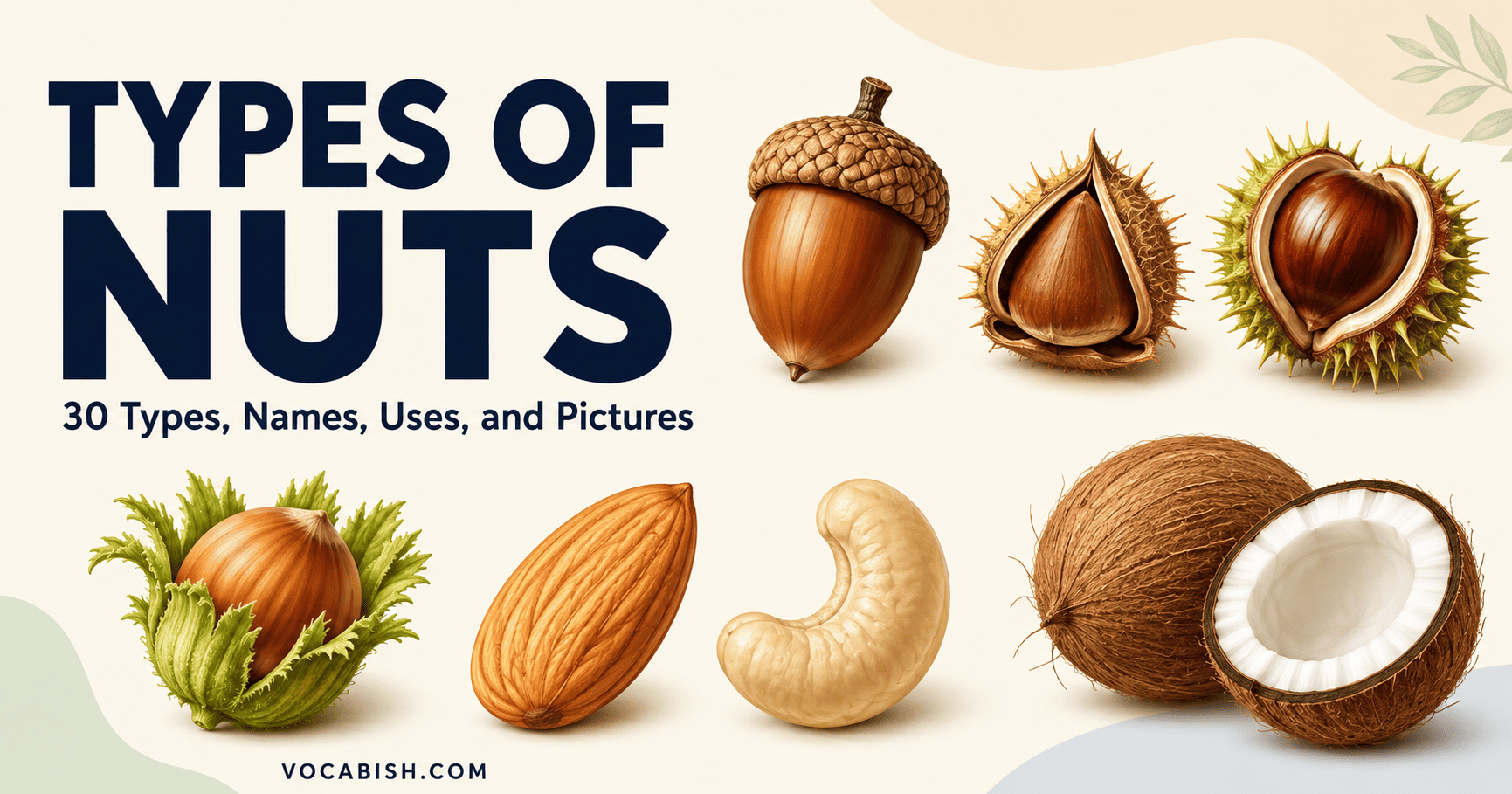

Types of nuts include true botanical nuts such as chestnuts and hazelnuts, drupe kernels such as almonds and walnuts, edible seeds such as Brazil nuts and pine nuts, and nut-named foods such as peanuts and tiger nuts.
In this blog post, you will explore 30 recognised nut names, their botanical or culinary categories, identifying features, common uses, and important differences. The names are organised into practical groups without treating every food called a nut as botanically identical.
What Are Nuts?
Nuts are hard-shelled fruits, seeds, or kernels commonly eaten as snacks or used in cooking. In botany, a true nut is a dry, usually one-seeded fruit with a hardened fruit wall that remains closed at maturity. Culinary usage is much broader and includes several seeds, drupe kernels, legumes, tubers, and corms.
Because botanical, culinary, commercial, and regional definitions overlap, there is no universally fixed total number of nut types. This article includes 30 edible nuts and nut-like foods while excluding named cultivars, ornamental seeds, and dangerous lookalikes such as horse chestnuts.
List of 30 Types of Nuts and Their Names
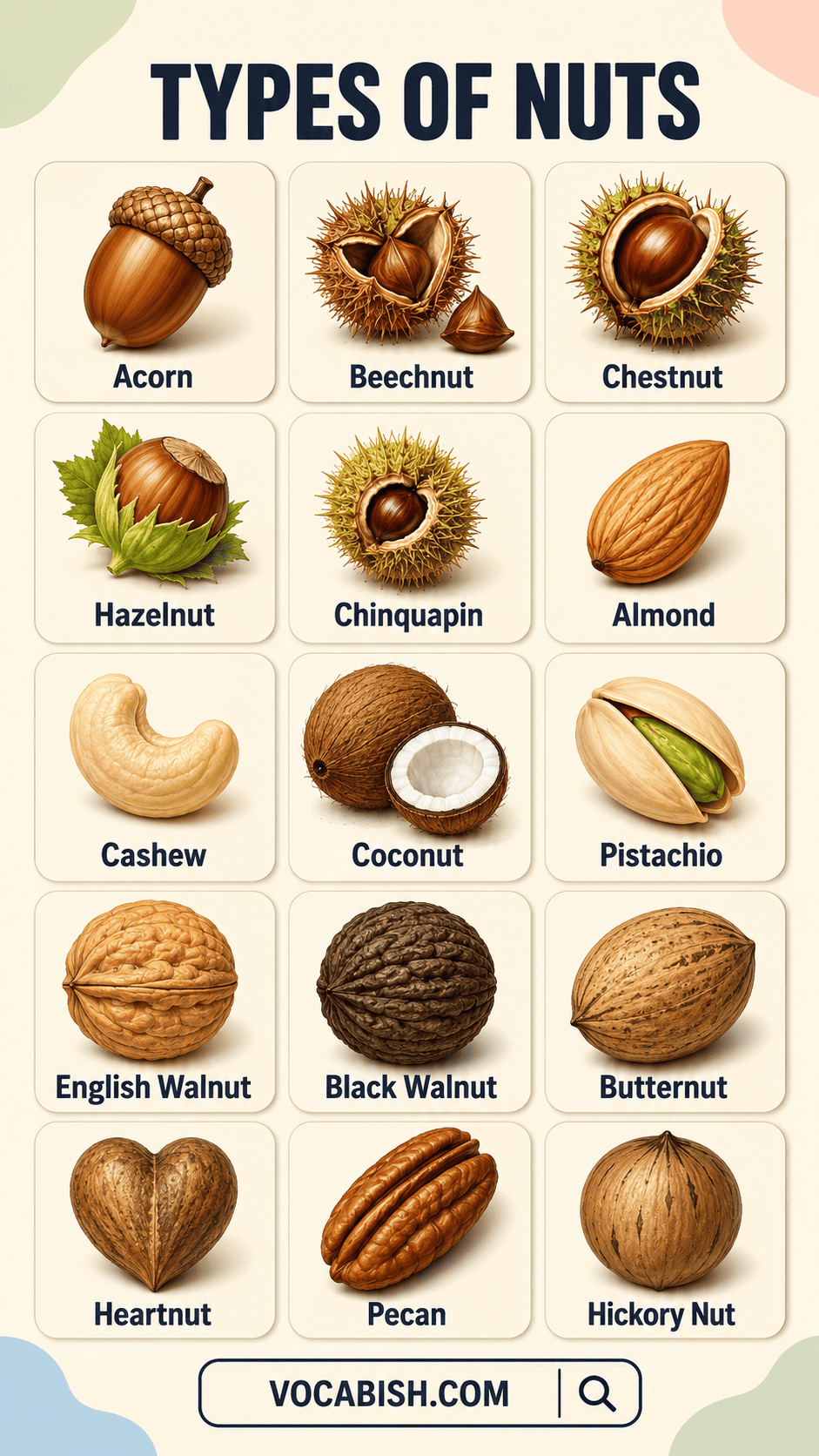
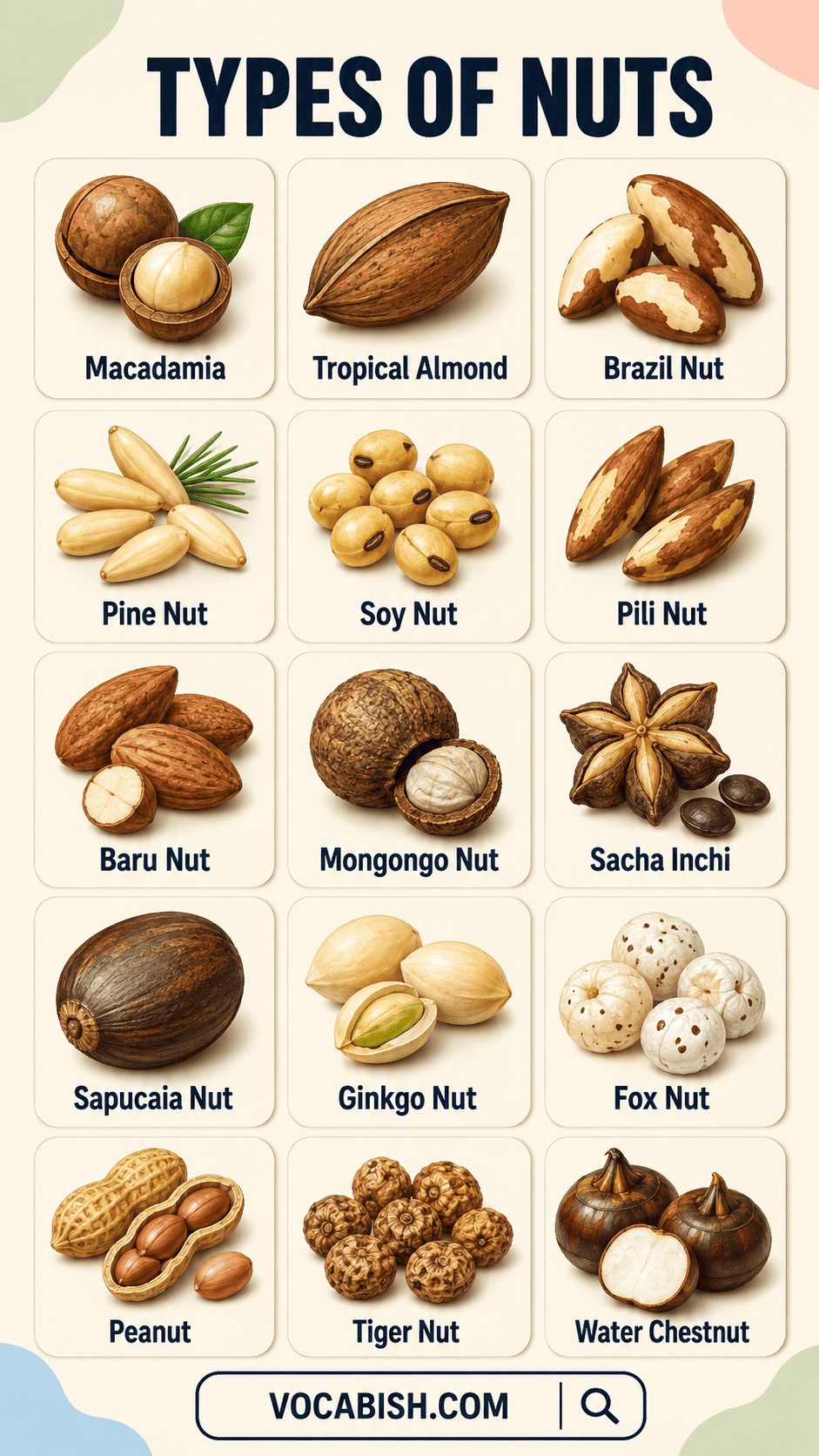
1. Acorn | 11. Black walnut | 21. Pili nut |
2. Beechnut | 12. Butternut | 22. Baru nut |
3. Chestnut | 13. Heartnut | 23. Mongongo nut |
4. Hazelnut | 14. Pecan | 24. Sacha inchi |
5. Chinquapin | 15. Hickory nut | 25. Sapucaia nut |
6. Almond | 16. Macadamia | 26. Ginkgo nut |
7. Cashew | 17. Tropical almond | 27. Fox nut |
8. Coconut | 18. Brazil nut | 28. Peanut |
9. Pistachio | 19. Pine nut | 29. Tiger nut |
10. English walnut | 20. Soy nut | 30. Water chestnut |
Main Types of Nuts and Their Classification
The word “nut” covers foods with different plant structures. The following categories separate true botanical nuts from drupe kernels, other edible seeds, legumes, and underground plant parts.
True Botanical Nuts
True nuts are dry fruits with hardened walls that do not split open naturally when mature. Acorns, chestnuts, beechnuts, and hazelnuts are standard examples used to explain this botanical structure.
- Acorn: Oak fruit with a hard shell, commonly roasted after careful leaching.
- Beechnut: Small triangular true nut produced inside prickly husks on beech trees.
- Chestnut: Starchy, mildly sweet true nut usually roasted, boiled, or milled.
- Hazelnut: Round true nut with rich flavour, used in spreads and confectionery.
- Chinquapin: Small chestnut relative bearing sweet edible nuts within spiny burs.
Chestnuts have a noticeably starchier texture than most culinary nuts and have traditionally been roasted or ground into flour. Hazelnuts are also called filberts in some commercial and regional contexts.
Drupe Kernels and Related Tree Seeds
A drupe develops with an outer layer surrounding a hard stone that normally contains a seed. Almonds are clear examples, while walnuts, pecans, coconuts, and pistachios are commonly described as drupe-like fruits or edible kernels rather than strict botanical nuts.
- Almond: Drupe kernel with firm texture, eaten raw, roasted, or ground.
- Cashew: Kidney-shaped seed attached beneath a fleshy cashew apple on branches.
- Coconut: Large fibrous drupe supplying edible flesh, milk, water, and oil.
- Pistachio: Greenish drupe seed with a splitting shell and subtly sweet flavour.
- English walnut: Wrinkled, mild-flavoured kernel widely used in baking, salads, and snacks.
- Black walnut: Bold, earthy walnut with thick shells and strongly aromatic kernels.
- Butternut: Elongated walnut relative offering oily kernels with a mild, buttery taste.
- Heartnut: Heart-shaped Japanese walnut with smoother shells and pleasantly mild-tasting kernels.
- Pecan: Sweet, buttery hickory kernel commonly added to pies and desserts.
- Hickory nut: Hard-shelled Carya fruit with rich kernels varying greatly by species.
- Macadamia: Round, creamy seed protected by one of the hardest edible shells.
- Tropical almond: Edible drupe kernel from a tropical shade tree, tasting almond-like.
Common walnut species produce edible seeds within green outer husks, although English walnuts are more commercially widespread than strongly flavoured black walnuts. Cashew seeds develop below a swollen, fleshy stalk commonly called the cashew apple.
Other Edible Seeds Commonly Called Nuts
Several familiar nuts are actually seeds removed from cones, capsules, drupaceous fruits, or other plant structures. Their culinary textures and uses explain why they are grouped with conventional nuts.
- Brazil nut: Large angular seed developing inside massive woody capsules in Amazon forests.
- Pine nut: Small edible pine seed prized for pesto, baking, and sauces.
- Pili nut: Long, creamy tropical seed commonly roasted and used in sweets.
- Baru nut: Roasted Brazilian legume seed with a crisp texture and cocoa-like notes.
- Mongongo nut: Southern African seed with a hard shell and rich oily kernel.
- Sacha inchi: Star-shaped capsule seed typically roasted before eating or pressing for oil.
- Sapucaia nut: Brazilian rainforest seed from woody pot-shaped fruits, eaten raw or roasted.
- Ginkgo nut: Firm yellow seed used cooked in several East Asian dishes.
- Fox nut: Puffed water-lily seed known as makhana, eaten as a crunchy snack.
Brazil nuts are seeds obtained from large woody fruits rather than individual botanical nuts. Pine nuts are the edible seeds of selected pine species, including the Mediterranean stone pine.
Baru, mongongo, sacha inchi, sapucaia, and pili nuts are regional edible seeds produced by unrelated plant families. Their common names reflect culinary use rather than one shared botanical classification.
Fox nuts come from Euryale ferox, an aquatic flowering plant. The seeds are generally processed and puffed to produce makhana.
Legumes, Tubers, Corms, and Processed Nut-Like Foods
Some foods contain “nut” in their names because of their size, flavour, texture, or preparation. They are not fruits or seeds with the structure of botanical nuts.
- Peanut: Underground legume seed commonly roasted, boiled, ground, or pressed for oil.
- Tiger nut: Small chewy sedge tuber used for snacks, flour, and horchata.
- Soy nut: Roasted soybean product offering a crunchy texture similar to snack nuts.
- Water chestnut: Crisp aquatic corm retaining its crunch after cooking in stir-fries.
Peanuts belong to the legume family and develop in pods beneath the ground. Tiger nuts are tubers produced by a sedge, while Chinese water chestnuts are underground corms from an aquatic plant.
Soy nuts are roasted soybeans rather than a separate botanical crop. Their nut-like name describes the finished product’s crunchy texture and snack use.
True Nuts vs Culinary Nuts
Example | Actual Structure | Main Identifying Feature | Common Use |
|---|---|---|---|
Hazelnut | True botanical nut | Hard fruit wall surrounding one seed | Spreads, baking, confectionery |
Almond | Drupe kernel | Edible seed removed from a hard stone | Snacking, flour, marzipan |
Brazil nut | Capsule seed | Large seed enclosed with others inside woody fruit | Snacking and baking |
Pine nut | Gymnosperm seed | Small seed extracted from selected pine cones | Pesto, sauces, pastries |
Peanut | Legume seed | Develops underground inside a pod | Butter, snacks, sauces |
Tiger nut | Sedge tuber | Small underground storage organ | Horchata, flour, snacks |
Water chestnut | Aquatic corm | White, crisp underground stem structure | Stir-fries and salads |
The main difference is structural: a true nut is the complete hardened fruit, whereas many culinary nuts are seeds or kernels removed from another fruit structure. Peanuts, tiger nuts, and water chestnuts belong to entirely different plant categories.
How to Identify and Choose Different Nuts
- Examine the shell, kernel shape, colour, texture, and packaging name.
- Choose raw nuts for flexible cooking and roasted nuts for stronger flavour.
- Select unsalted products when controlling seasoning in recipes or snacks.
- Use almonds or hazelnuts for flour, spreads, confectionery, and baking.
- Choose walnuts or pecans when a softer, crinkled kernel is suitable.
- Follow preparation instructions for unfamiliar seeds instead of eating them raw.
- Never consume a wild nut unless its identity and preparation are confirmed.
People with food allergies should read the complete ingredient list and follow individual medical advice. Peanuts and tree nuts are treated as separate allergen groups, and packaged-food rules can differ between countries. Current United States guidance also requires listed tree-nut sources to be identified specifically rather than declared only as “tree nuts.”
Confusions and Terms About the Types of Nuts
- Botanical nuts and culinary nuts are different: Many foods called nuts are seeds, kernels, legumes, tubers, or corms.
- Peanuts do not grow on trees: They are legumes whose pods develop beneath the soil.
- Filberts and hazelnuts are not completely separate foods: Filbert is a regional or commercial name commonly applied to hazelnuts.
- Sweet chestnuts and horse chestnuts are different: Sweet chestnuts are edible, while horse chestnuts are toxic and should not be consumed.
- Coconut classification depends on context: Botanically, it is a fibrous drupe rather than a true nut.
- Tree nut is not one botanical family: Commercially grouped tree nuts come from numerous unrelated plant families.
- Nut allergy rules are jurisdiction-specific: Regulatory allergen lists do not define botanical classification and may change over time.
Summary of the Main Nut Types
Category | Key Characteristic | Common Examples | Best Known For |
|---|---|---|---|
True botanical nuts | Entire hard-walled fruit encloses the seed | Hazelnut, chestnut, acorn | Clear botanical nut structure |
Drupe kernels | Seed or kernel develops inside a stone fruit | Almond, walnut, coconut | Baking, snacks, oils |
Other edible seeds | Seeds come from cones, capsules, or varied fruits | Brazil nut, pine nut, pili nut | Regional cuisines and speciality foods |
Legume products | Seeds develop inside legume pods | Peanut, soy nut | Spreads and roasted snacks |
Underground plant parts | Edible tuber or corm rather than fruit | Tiger nut, water chestnut | Drinks, flour, and savoury cooking |
FAQs About Types of Nuts
Nuts are edible kernels or fruits with hard coverings. Botanically, true nuts are dry, single-seeded fruits that remain closed at maturity, while culinary usage also includes drupe kernels, seeds, legumes, and tubers.
True botanical nuts are dry, indehiscent fruits with hardened fruit walls and usually one mature seed. Familiar examples include hazelnuts, chestnuts, acorns, beechnuts, and chinquapins, although classification can vary between references.
A peanut is a legume, not a botanical nut. Its seeds develop inside pods underground, but peanuts are grouped with nuts in cooking because they have similar texture, flavour, nutrition, and uses.
Almonds are seeds found inside the hard stones of drupes. The fleshy outer layer dries and splits at maturity, leaving the familiar shell and edible kernel sold as an almond.
Tree nuts are a culinary and regulatory group of edible nuts and seeds produced by trees. The group may include almonds, walnuts, pecans, pistachios, cashews, hazelnuts, and other specified species, depending on jurisdiction.
Commonly eaten nuts include almonds, peanuts, walnuts, cashews, pistachios, hazelnuts, pecans, Brazil nuts, macadamias, chestnuts, and pine nuts. Availability varies by country, cuisine, climate, price, local agriculture, and season.
Identify nuts by examining shell shape, kernel form, colour, texture, aroma, and packaging name.
Almonds, walnuts, pecans, hazelnuts, pistachios, and macadamias suit baking because their flavours remain distinctive after heating.
Not every nut-like food should be eaten raw. Some require roasting, boiling, leaching, or specialist preparation, so follow reliable product instructions and avoid unfamiliar wild kernels or seeds without expert identification.
Important Facts About Nuts
- The word nut has different botanical, culinary, and commercial meanings.
- This article covers 30 edible nuts and established nut-like foods.
- Hazelnuts, chestnuts, acorns, beechnuts, and chinquapins are true nuts.
- Almonds, walnuts, coconuts, pistachios, and several others are drupe kernels.
- Brazil nuts, pine nuts, and many regional nuts are technically seeds.
- Peanuts are legumes, tiger nuts are tubers, and water chestnuts are corms.
- Wild nuts should never be eaten without dependable identification and preparation.
Conclusion
Understanding the different types of nuts requires separating everyday food terminology from botanical classification. True nuts include hazelnuts, chestnuts, acorns, beechnuts, and chinquapins, while almonds, walnuts, pecans, cashews, pistachios, and coconuts come from other fruit or seed structures.
Brazil nuts and pine nuts are edible seeds, peanuts are legumes, tiger nuts are tubers, and water chestnuts are corms. Recognising these distinctions makes it easier to compare ingredients, understand labels, select suitable nuts for cooking, and avoid misleading names or unsafe lookalikes. The culinary category remains useful even though its members are not botanically identical.
You May Also Like