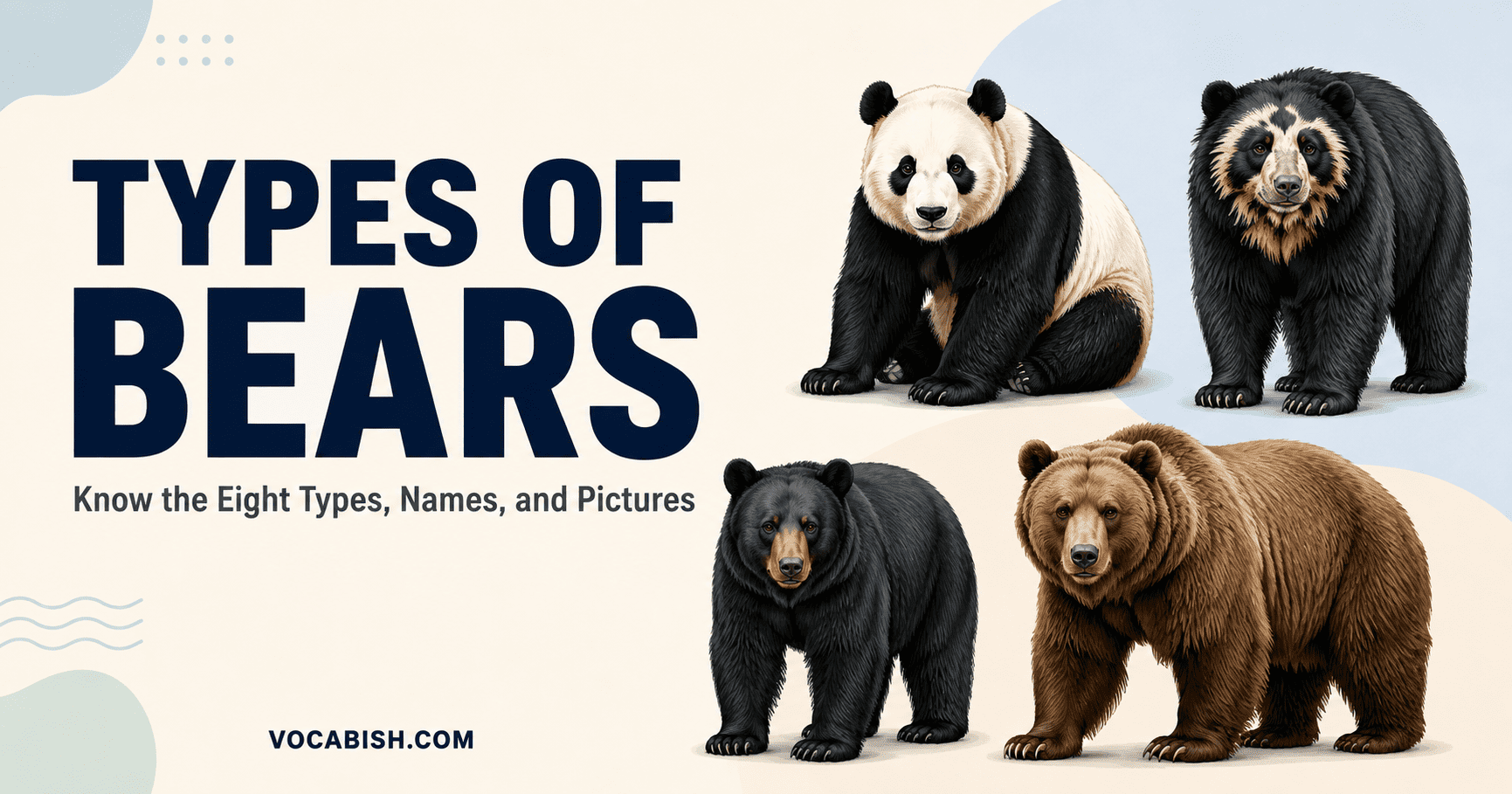

There are eight living types of bears: the giant panda, Andean bear, American black bear, brown bear, polar bear, Asiatic black bear, sun bear, and sloth bear. Each is a distinct species within the bear family, Ursidae.
In this blog post, you will learn their common and scientific names, natural ranges, habitats, diets, physical traits, and major differences. The species are organised by their scientific subfamilies, followed by practical identification guidance and answers to common questions.
What Are Bears?
Bears are large mammals belonging to the family Ursidae within the order Carnivora. They generally have powerful bodies, short tails, plantigrade feet, strong jaws, non-retractable claws, and an excellent sense of smell.
In this context, “types of bears” means the eight recognised living species. They are classified into five genera and three subfamilies according to their evolutionary relationships.
Regional forms such as grizzly bears and Kodiak bears are not separate species. They belong to the brown bear species.
List of the 8 Types of Bears
- Giant panda
- Andean bear
- American black bear
- Brown bear
- Polar bear
- Asiatic black bear
- Sun bear
- Sloth bear
Scientific Classification of Bear Species
The eight living bear species are divided into three scientific subfamilies: Ailuropodinae, Tremarctinae, and Ursinae.
Ailuropodinae
This subfamily contains the giant panda, the only surviving species in its evolutionary branch.
- Giant panda (Ailuropoda melanoleuca): Black-and-white Chinese bear adapted for eating bamboo in mountain forests.
Tremarctinae
This subfamily contains the Andean bear, the only living bear native to South America.
- Andean bear (Tremarctos ornatus): South American mountain bear recognised by variable pale facial markings.
Ursinae
Ursinae contains six living species found across North America, Europe, Asia, and the Arctic.
- American black bear (Ursus americanus): Adaptable North American omnivore with varied coat colours and habitats.
- Brown bear (Ursus arctos): Large northern bear distinguished by powerful shoulders and long front claws.
- Polar bear (Ursus maritimus): Arctic marine bear specialised for hunting seals across seasonal sea ice.
- Asiatic black bear (Ursus thibetanus): Asian forest bear identified by large ears and pale chest crescent.
- Sun bear (Helarctos malayanus): Small tropical bear with short fur, curved claws, and chest marking.
- Sloth bear (Melursus ursinus): Shaggy South Asian bear adapted for extracting ants and termites.
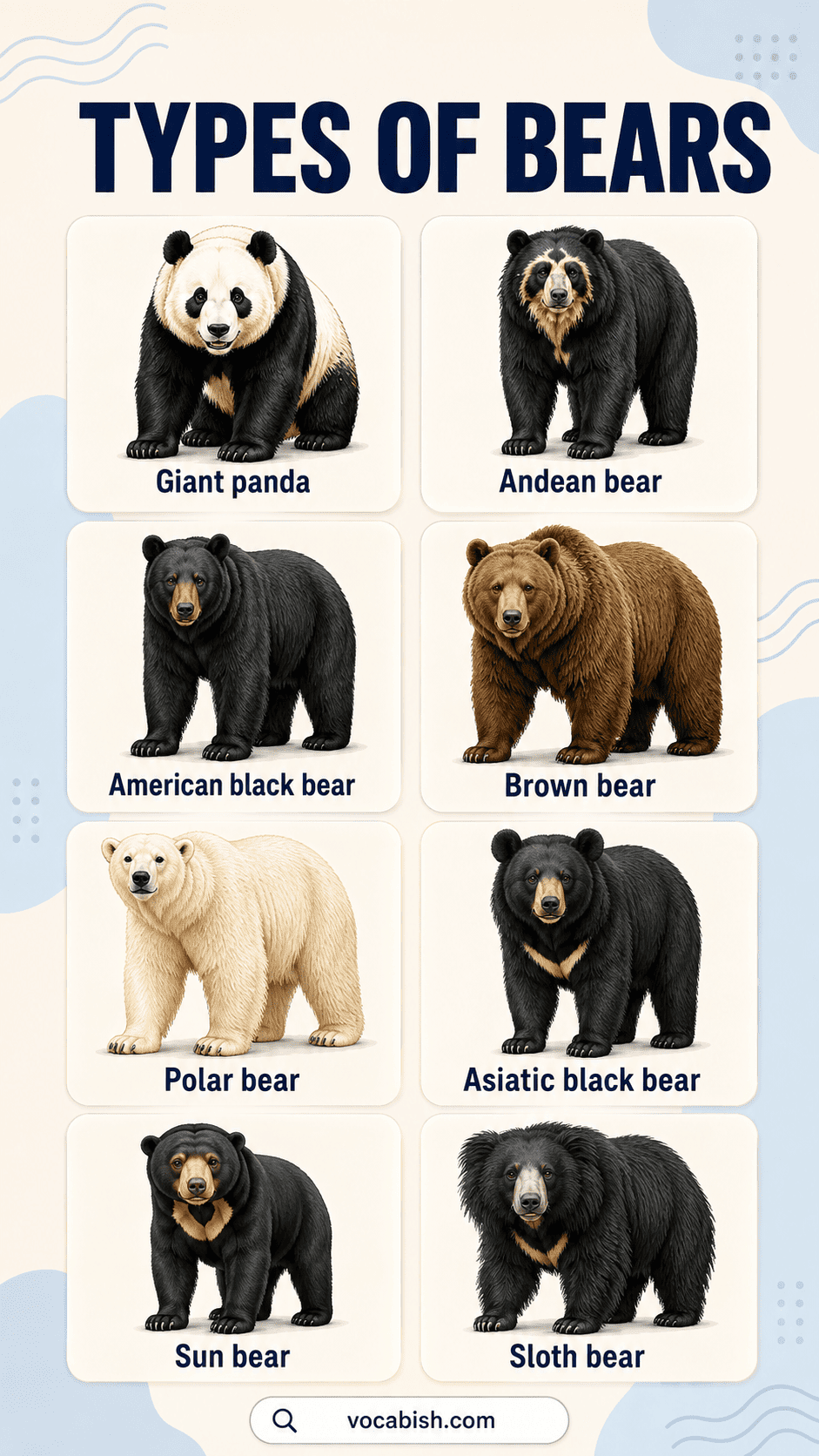
Comparison of the 8 Types of Bears
Bear Species | Natural Range | Key Identifying Feature | Typical Diet |
|---|---|---|---|
Giant panda | Central China | Black-and-white coat and dark eye patches | Mainly bamboo |
Andean bear | Tropical Andes | Pale markings around eyes and muzzle | Fruits, plants, and occasional animal matter |
American black bear | North America | Straight facial profile and no shoulder hump | Plants, fruits, insects, and animal matter |
Brown bear | Northern Eurasia and North America | Shoulder hump and long front claws | Varied omnivorous diet |
Polar bear | Circumpolar Arctic | Long neck, large paws, and pale coat | Mainly seals |
Asiatic black bear | Southern and eastern Asia | Large ears and pale chest crescent | Fruits, nuts, insects, and animal matter |
Sun bear | Southeast Asia | Small body and yellowish chest marking | Fruits, insects, honey, and small animals |
Sloth bear | Indian subcontinent | Shaggy coat, long muzzle, and mobile lips | Termites, ants, fruits, and honey |
Main Differences Between Bear Species
Habitat
Bear habitats range from tropical rainforests to Arctic sea ice. Polar bears depend strongly on marine environments, while giant pandas occupy mountain forests with abundant bamboo. Sun bears and sloth bears live mainly in warmer parts of Asia.
Diet
Most bears are omnivores, but their diets differ considerably. Giant pandas depend heavily on bamboo, polar bears mainly hunt seals, and sloth bears are particularly adapted for eating termites and ants.
Body Shape
Body structure provides useful identification clues. Brown bears usually have prominent shoulder humps, polar bears have long necks and large paws, and sun bears have compact bodies suited to tropical forests.
Coat and Markings
Several bears have distinctive markings. Giant pandas have black-and-white coats, Andean bears may have pale facial patterns, and Asiatic black bears commonly display crescent-shaped chest markings.
Brown Bear vs American Black Bear
Brown bears and American black bears can have similar coat colours. Body shape, claws, ears, and facial profile are more reliable than colour alone.
Feature | Brown Bear | American Black Bear |
|---|---|---|
Shoulder | Prominent muscular hump | No prominent shoulder hump |
Facial profile | Concave or dish-shaped | Straighter profile |
Ears | Short and rounded | Taller and more pointed |
Front claws | Long and relatively straight | Shorter and more curved |
Back profile | Shoulders usually appear higher | Rump may appear higher |
Coat colour | Blonde, brown, dark brown, or black | Black, brown, cinnamon, grey, or pale |
How to Identify Different Types of Bears
- Consider the location: Geographic range can quickly eliminate several species.
- Examine the shoulders: A prominent hump often indicates a brown bear.
- Check facial markings: Pale spectacles may identify an Andean bear.
- Look at the chest: Crescent markings occur on several Asian bear species.
- Compare ears and claws: Their size and shape vary between species.
- Avoid using colour alone: Different bear species can share similar coat colours.
Identification should always be performed from a safe distance. Wild bears should never be approached for a closer view.
Confusions and Terms About Bears Types
- Grizzly bears are brown bears: A grizzly is a North American form of Ursus arctos.
- Kodiak bears are not separate species: They are brown bears from Alaska’s Kodiak Archipelago.
- Spectacled bear means Andean bear: Both names refer to Tremarctos ornatus.
- Moon bear means Asiatic black bear: It is an alternative common name for the same species.
- Giant pandas are true bears: They belong to the bear family Ursidae.
- Red pandas are not bears: They belong to a separate mammal family.
- Koalas are not bears: Koalas are Australian marsupials.
- Black bears are not always black: Their coats can be brown, cinnamon, grey, or pale.
Summary of the Main Bear Groups
Subfamily | Living Species | Main Characteristic | Included Bears |
|---|---|---|---|
Ailuropodinae | 1 | Giant panda evolutionary branch | Giant panda |
Tremarctinae | 1 | Living short-faced bear branch | Andean bear |
Ursinae | 6 | Largest and most widely distributed group | American black, brown, polar, Asiatic black, sun, and sloth bears |
FAQs About Types of Bears
There are eight living bear species today. They are the giant panda, Andean bear, American black bear, brown bear, polar bear, Asiatic black bear, sun bear, and sloth bear worldwide.
Living bears belong to three scientific subfamilies: Ailuropodinae, Tremarctinae, and Ursinae. These groups represent evolutionary relationships rather than simple differences based on colour, body size, diet, behaviour, or habitat alone.
The polar bear is generally considered the largest living bear species. However, exceptionally large brown bears can reach similar sizes, so individual body mass varies with sex, age, season, food supply, and location.
The sun bear is the smallest living bear species. Its compact body, short coat, curved claws, long tongue, and pale chest marking suit life in warm tropical forests across Southeast Asia.
No, a grizzly bear is a North American form of the brown bear. It belongs to the species Ursus arctos and is commonly associated with inland habitats, mountains, and open landscapes.
No, the Kodiak bear is a brown bear subspecies found on islands of Alaska’s Kodiak Archipelago. Its large size reflects rich seasonal food supplies, geographic isolation, and favourable coastal habitats.
Yes, giant pandas are true bears in the family Ursidae. Their bamboo-dominated diet is unusual, but their anatomy, genetics, behaviour, and evolutionary history firmly place them among living bear species.
No, American black bears can be black, brown, cinnamon, bluish-grey, blonde, or pale. Body shape, ears, claws, facial profile, location, and shoulder structure provide more reliable identification features in the wild.
No, all bears do not follow the same winter dormancy pattern. Behaviour varies by species, climate, food supply, sex, reproductive condition, and latitude, especially between northern and tropical populations worldwide.
Wild bears live across North America, South America, Europe, Asia, and the Arctic. Their habitats include forests, mountains, grasslands, tundra, tropical woodland, coastlines, river valleys, and seasonal sea ice worldwide.
Facts to Know about the Types of Bears
- Eight living species belong to the bear family Ursidae.
- Bear species are divided into three scientific subfamilies.
- Their habitats range from tropical forests to Arctic sea ice.
- Diets include bamboo, fruits, insects, vegetation, fish, and marine mammals.
- Body shape and markings identify bears more reliably than coat colour.
- Grizzly and Kodiak bears belong to the brown bear species.
Conclusion
The eight recognised types of bears show how members of one mammal family can adapt to very different environments. Polar bears depend on Arctic sea ice, giant pandas rely heavily on bamboo, and sloth bears are specialised insect feeders. Brown bears and black bears use broader diets and habitats, while Andean and sun bears occupy warmer forest regions.
Understanding their classification makes it easier to identify each species correctly and avoid confusing species with subspecies or informal names. Location, body shape, facial profile, markings, claws, and habitat provide the most useful clues when comparing different bears.
You May Also Like