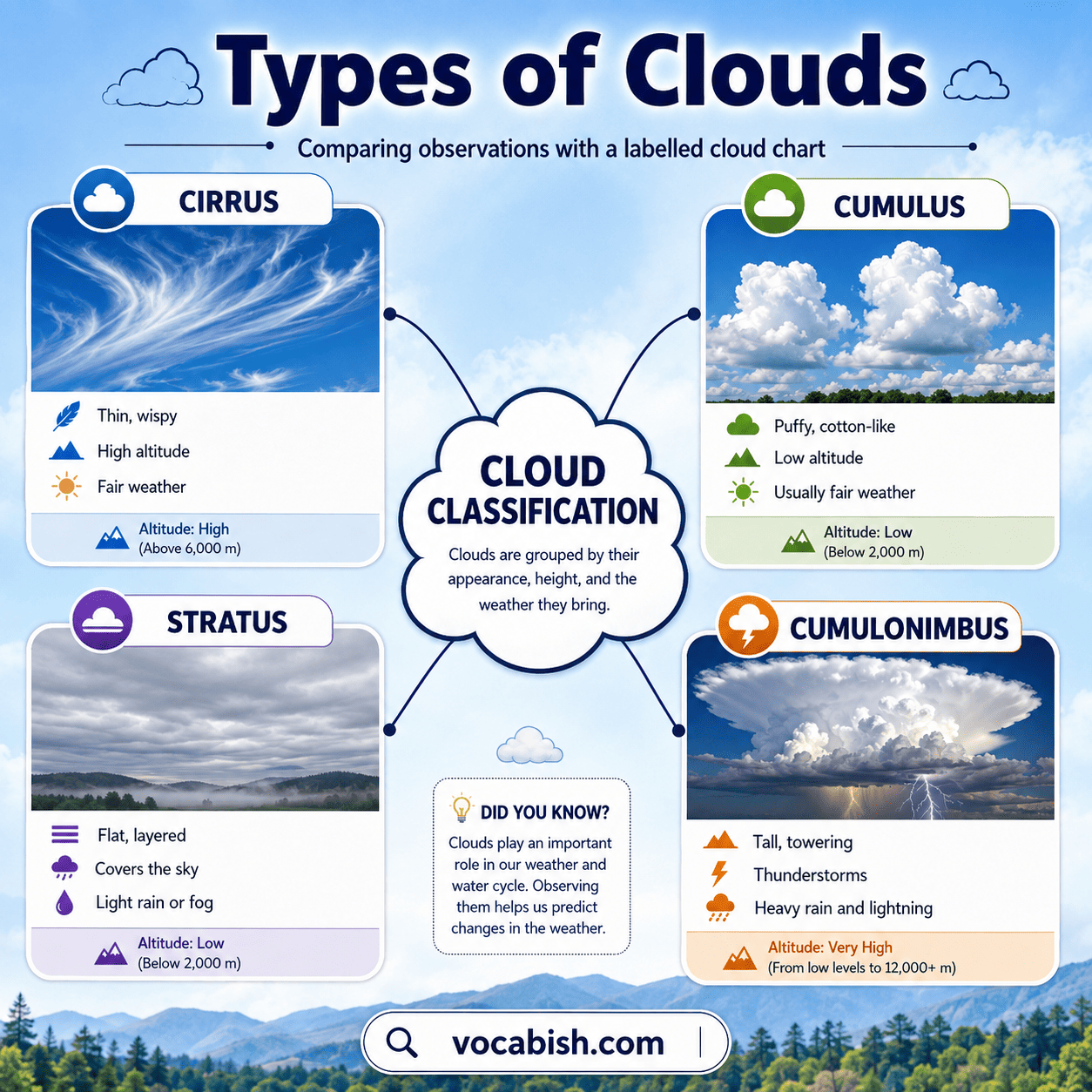

The sky can look clear one moment and fill with clouds the next. Learning the types of clouds helps you understand these changes and notice what kind of weather may follow.
Clouds contain tiny drops of water, ice crystals, or both. Scientists classify them by their height, shape, and growth in the atmosphere. There are ten main cloud types, grouped into four broad families: high-level, middle-level, low-level, and vertically developing clouds.
Some clouds bring light rain, while others signal storms. Their shape and position can help you identify them more easily.
What Are Clouds?
Clouds are visible collections of tiny water droplets or ice crystals floating in the atmosphere. They form when moist air cools and water vapour changes into liquid water or ice.
Although clouds may look light and soft, they can contain a large amount of water. The droplets remain suspended because they are extremely small and move with rising air.
How Do Clouds Form?
Cloud formation usually happens in three simple stages:
- Heat from the Sun causes water to evaporate from oceans, rivers, lakes, plants, and soil.
- Warm, moist air rises into the atmosphere and begins to cool.
- Water vapour condenses around tiny particles such as dust, salt, or smoke.
Millions of these small droplets or ice crystals collect together and become visible as a cloud.
How Are Different Types of Clouds Classified?
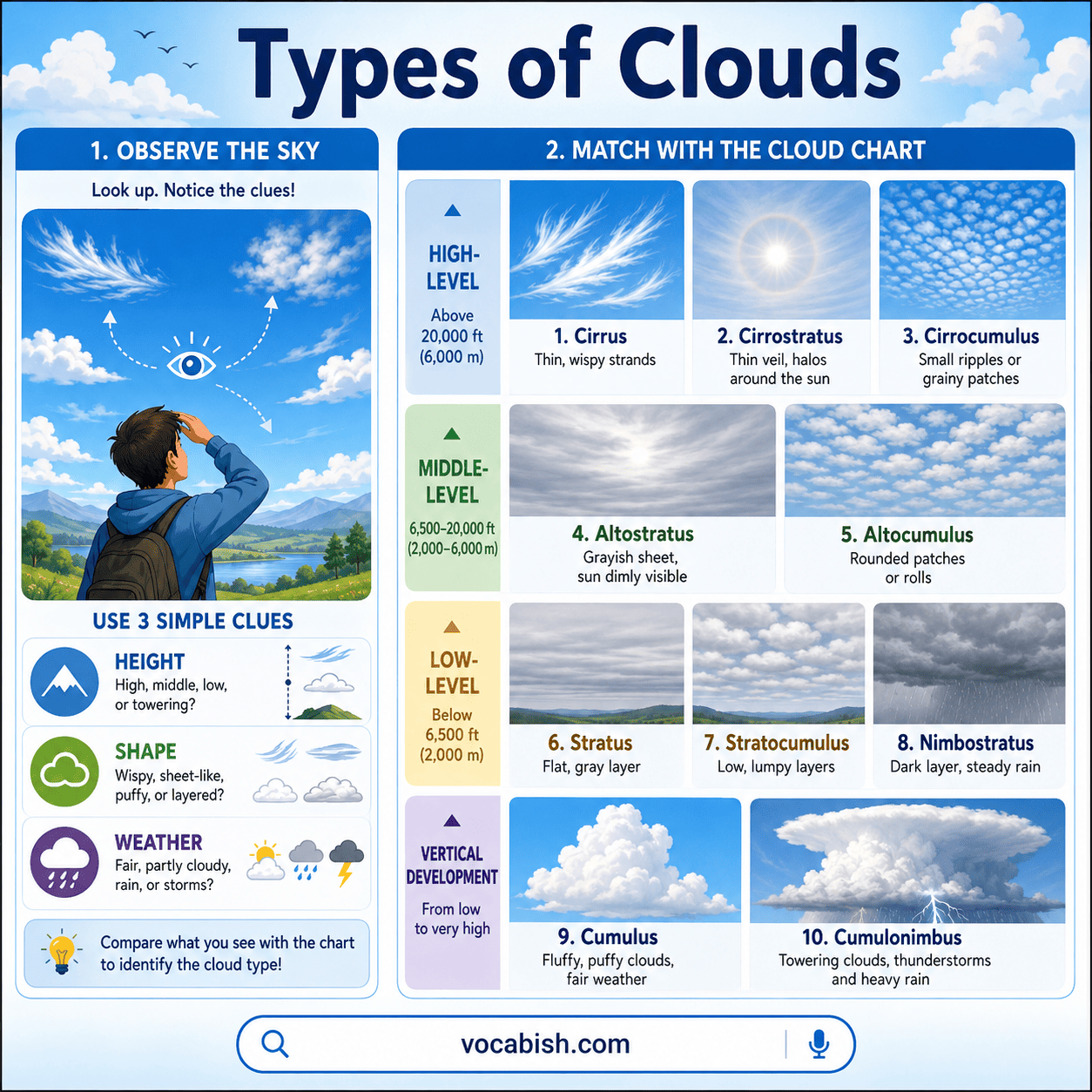
Clouds are mainly classified by their height, shape, and vertical development. Some form high in the atmosphere, while others remain close to the ground. A few cloud types can grow upward through several atmospheric levels.
Cloud Level | Approximate Height | Main Cloud Types |
|---|---|---|
High-level | Above 6,000 metres | Cirrus, Cirrostratus, Cirrocumulus |
Middle-level | 2,000–6,000 metres | Altostratus, Altocumulus |
Low-level | Surface–2,000 metres | Stratus, Stratocumulus, Nimbostratus |
Vertical development | Low base to great height | Cumulus, Cumulonimbus |
These height ranges are approximate. Cloud altitude can vary according to location, season, temperature, and latitude.
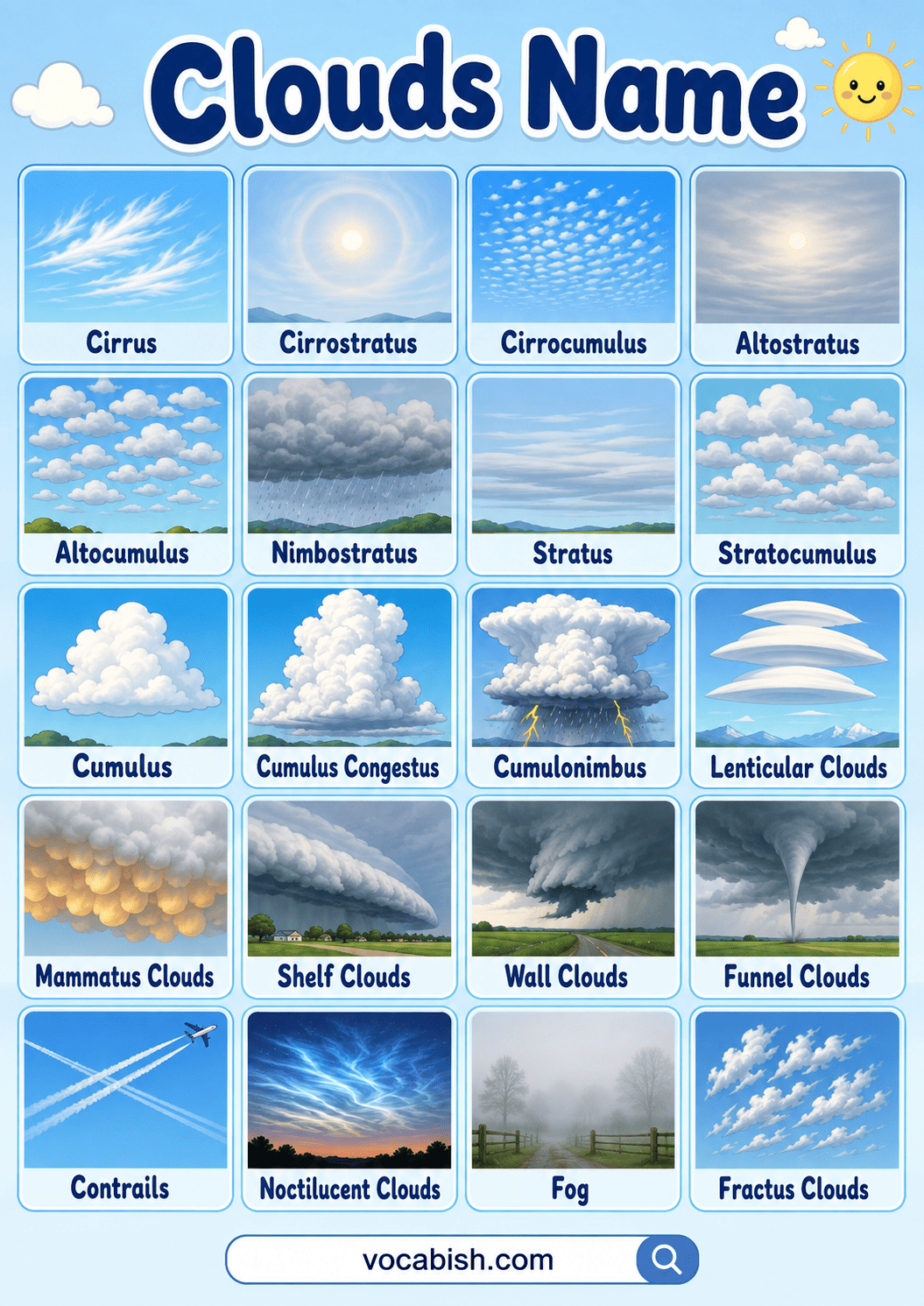
List of All Types of Clouds and Their Names
- Cirrus
- Cirrostratus
- Cirrocumulus
- Altostratus
- Altocumulus
- Nimbostratus
- Stratus
- Stratocumulus
- Cumulus
- Cumulus Congestus
- Cumulonimbus
- Lenticular Clouds
- Mammatus Clouds
- Shelf Clouds
- Wall Clouds
- Funnel Clouds
- Contrails
- Noctilucent Clouds
- Kelvin–Helmholtz Clouds
- Asperitas Clouds
- Pyrocumulus Clouds
- Fog
- Fractus Clouds
Four Main Types of Clouds by Altitude
The ten main cloud types belong to four broad groups. Knowing these groups makes individual clouds easier to recognise.
High-Level Clouds
High-level clouds form in the cold upper atmosphere. They usually contain ice crystals and often appear thin, white, or delicate.
This group includes:
- Cirrus
- Cirrostratus
- Cirrocumulus
These clouds do not usually bring rain directly to the ground, but they can signal an approaching change in the weather.
Middle-Level Clouds
Middle-level clouds form between high and low cloud layers. They may contain water droplets, ice crystals, or a mixture of both.
This group includes:
- Altostratus
- Altocumulus
They often appear before rain, snow, or unstable weather.
Low-Level Clouds
Low-level clouds form close to the Earth’s surface. They often create dull, overcast skies and may bring mist, drizzle, rain, or snow.
This group includes:
- Stratus
- Stratocumulus
- Nimbostratus
Some low clouds form in flat layers, while others appear as rounded masses.
Clouds With Vertical Development
These clouds have low bases but grow upward through the atmosphere. Their size can range from small fair-weather clouds to powerful storm clouds.
This group includes:
- Cumulus
- Cumulonimbus
Their height and shape often show whether the atmosphere is stable or becoming stormy.
Cloud Profiles Explained with Examples
High-Level Types of Clouds
Cirrus Clouds
Cirrus clouds are thin, white, and wispy. They often look like feathers, fine hair, or brushstrokes across a blue sky.
They form high in the atmosphere, where temperatures are very low, so they mainly contain ice crystals. Cirrus clouds do not usually produce rain that reaches the ground.
A few cirrus clouds may appear during fair weather. However, a growing layer of cirrus can sometimes signal that a weather system is approaching.
Identification tip: Look for long, delicate white streaks high in the sky.
Cirrostratus Clouds
Cirrostratus clouds form a thin, transparent sheet across much or all of the sky. The sky may still look bright because sunlight can pass through the cloud layer.
These clouds often create a ring, known as a halo, around the Sun or Moon. The halo forms when light passes through ice crystals.
Cirrostratus clouds may appear before a warm front and can signal that rain or snow is approaching within the next day.
Identification tip: Look for a pale cloud veil and a visible halo around the Sun or Moon.
Cirrocumulus Clouds
Cirrocumulus clouds appear as small white patches arranged in rows, ripples, or wave-like patterns. They may create a sky pattern sometimes called a “mackerel sky.”
These clouds form high in the atmosphere and mainly contain ice crystals. They usually do not produce precipitation that reaches the ground.
Cirrocumulus clouds look similar to altocumulus clouds, but their individual cloud pieces are generally smaller, higher, and whiter.
Identification tip: Hold one finger toward the cloud. Most cirrocumulus cloud pieces will appear smaller than your finger.
Middle-Level Cloud Types
Altostratus Clouds
Altostratus clouds form a wide gray or blue-gray sheet across the sky. They can cover such a large area that the sky appears completely overcast.
The Sun may remain visible through a thin altostratus layer, but it usually looks like a faint or blurred disk. Clear shadows often disappear.
These clouds frequently form before long periods of rain or snow. As the cloud layer becomes thicker and lower, it may develop into nimbostratus.
Identification tip: Look for a smooth gray sky with a weak, watery-looking Sun.
Altocumulus Clouds
Altocumulus clouds appear as rounded patches, rolls, or groups of white and gray clouds. Their lower parts may have visible shading.
They form at middle heights and mainly contain water droplets, although ice may also be present in colder conditions.
Altocumulus clouds do not always bring rain. However, tall or rapidly growing altocumulus clouds on a warm, humid morning may suggest that thunderstorms could develop later.
Identification tip: Their cloud pieces look larger than cirrocumulus clouds but smaller than most low-level cloud masses.
Low-Level Types of Clouds
Stratus Clouds
Stratus clouds form a low, flat, and uniform gray layer. They often make the sky look dull and may cover a wide area.
These clouds can produce mist or light drizzle, but they rarely bring heavy rain. They commonly appear during cool, calm, and damp weather.
Stratus clouds look similar to fog. The main difference is that fog touches the ground, while stratus clouds form above it.
Identification tip: They look like a layer of fog that has lifted into the sky.
Stratocumulus Clouds
Stratocumulus clouds are low, rounded cloud masses that often join together in rows or broad layers. Gaps of blue sky may appear between them.
They may look dark and dramatic, especially near sunset, but they usually produce little precipitation. Light rain or drizzle can sometimes fall from a thick layer.
Stratocumulus clouds often form after a weather front has passed or when cool air moves over a warmer surface.
Identification tip: Look for large, low cloud rolls or lumps spread across much of the sky.
Nimbostratus Clouds
Nimbostratus clouds are thick, dark, and widespread rain clouds. They usually cover the entire sky and block the Sun.
These clouds bring steady rain or snow that can continue for several hours. They do not normally produce thunder, lightning, or sudden violent weather.
Nimbostratus differs from cumulonimbus because it produces continuous precipitation rather than short, intense thunderstorms.
Identification tip: Look for a dark, featureless cloud layer during long-lasting rain or snow.
Vertically Developing Clouds
Cumulus Clouds
Cumulus clouds are white, fluffy clouds with flat bases and rounded tops. Many people compare their shape to cotton balls or cauliflower.
Small cumulus clouds usually form during fair weather. Sunlight warms the ground, causing pockets of warm air to rise and cool.
If the atmosphere remains stable, the clouds stay small. If warm air continues rising strongly, they may grow taller and develop into larger storm clouds.
Identification tip: Look for bright, puffy clouds with clear edges and a flat bottom.
Cumulonimbus Clouds
Cumulonimbus clouds are tall, powerful storm clouds. They begin with a low base and may rise through several levels of the atmosphere.
A fully developed cumulonimbus often has a dark base, a towering middle, and a wide anvil-shaped top. Strong air currents move rapidly inside it.
These clouds may produce:
- Thunderstorms
- Heavy rain
- Lightning
- Hail
- Strong winds
- Tornadoes in some conditions
Cumulonimbus clouds can develop from rapidly growing cumulus clouds. Their great height makes them easy to recognise from a distance.
Identification tip: Look for a huge vertical cloud with a dark base and a flattened, anvil-shaped top.
Types of Clouds and Their Weather Meaning
Clouds can offer useful clues about changing weather. However, one cloud alone cannot provide a complete forecast.
Cloud Type | Common Appearance | Possible Weather |
|---|---|---|
Cirrus | Thin and wispy | Weather may change |
Cirrostratus | Transparent veil | Rain or snow may approach |
Cirrocumulus | Small rippled patches | Usually fair but cold upper air |
Altostratus | Gray sheet | Prolonged precipitation possible |
Altocumulus | Rounded patches | Changing or unstable conditions |
Stratus | Low gray layer | Mist or light drizzle |
Stratocumulus | Low rolling masses | Mostly dry or light rain |
Nimbostratus | Thick dark layer | Continuous rain or snow |
Cumulus | Puffy cotton shapes | Usually fair weather |
Cumulonimbus | Towering anvil shape | Thunderstorms and heavy rain |
Cloud appearance is only one weather indicator. Meteorologists also study air pressure, temperature, wind, humidity, satellite images, and radar data.
How to Identify Cloud Types
You do not need special equipment to begin identifying clouds. Start by observing their position, shape, colour, and surrounding weather.
Check the Cloud’s Height
First, decide whether the cloud appears low, middle, or high in the sky.
High clouds usually look thin and delicate. Low clouds often appear larger, darker, and closer. Vertically developing clouds may begin low but rise to a great height.
Estimating height takes practice, so combine this clue with the cloud’s shape.
Observe Its Shape
Cloud shape provides one of the clearest identification clues.
- Wispy: Often cirrus
- Layered: Often stratus, altostratus, or cirrostratus
- Puffy: Often cumulus or altocumulus
- Towering: Often cumulonimbus
- Rippled: Often cirrocumulus or altocumulus
Notice whether the cloud has sharp edges, a smooth sheet, separate patches, or strong upward growth.
Look at Its Colour and Thickness
Thin clouds often appear bright white because sunlight passes through them easily. Thick clouds may look gray or dark because less light reaches their base.
Colour alone does not identify a cloud, but it can help you judge its thickness and moisture content.
Notice the Weather Around It
Pay attention to what is happening around the cloud. Is the air warm and humid? Is the wind increasing? Can you hear thunder? Has steady rain already started?
These signs can help you separate similar-looking clouds and understand what weather they may bring.
Difference Between Similar-Looking Clouds
Several cloud types look alike at first. Their height, thickness, size, and weather effects help separate them.
Cirrocumulus vs Altocumulus
Cirrocumulus clouds form higher and have smaller cloud pieces. They usually look white and show little or no shading.
Altocumulus clouds form lower, appear larger, and often have gray shading on their lower parts.
Stratus vs Nimbostratus
Stratus clouds are low and flat. They may bring mist or light drizzle but usually do not produce heavy precipitation.
Nimbostratus clouds are thicker, darker, and more widespread. They bring steady rain or snow over a longer period.
Cumulus vs Cumulonimbus
Cumulus clouds are usually small, white, and linked with fair weather. They have rounded tops and limited vertical growth.
Cumulonimbus clouds are much taller and darker. They produce thunderstorms, heavy rain, lightning, hail, and strong winds.
Altostratus vs Cirrostratus
Altostratus clouds form at middle heights and usually appear as a gray or blue-gray sheet. They can make the Sun look dim or blurred.
Cirrostratus clouds form higher and create a thinner, more transparent veil. They often produce a halo around the Sun or Moon.
What Do Cloud Names Mean?
Many cloud names come from Latin words that describe their shape, height, or weather.
- Cirrus: Curl or lock of hair
- Cumulus: Heap or pile
- Stratus: Layer or sheet
- Nimbus: Rain-bearing cloud
- Alto: Middle-level cloud
These word parts also appear in combined cloud names. For example, cumulonimbus describes a piled or towering rain cloud, while cirrostratus refers to a high, thin cloud layer.
Understanding these roots makes cloud names easier to remember.
Why Are Clouds Important?
Clouds play an important role in weather, climate, and the water cycle.
They return water to the Earth through rain and snow. They also move moisture between different regions and provide water for plants, animals, rivers, and lakes.
Clouds influence temperature as well. During the day, some clouds reflect sunlight and keep the surface cooler. At night, they can trap heat and slow down cooling.
Without clouds, weather patterns and the global water cycle would work very differently.
Types of Clouds for Kids and Beginners
Beginners can remember the main cloud words by connecting each one with a simple shape or weather clue:
- Cirrus: Thin and feathery
- Stratus: Flat and layered
- Cumulus: Puffy and fluffy
- Nimbus: Rain-bearing
- Cumulonimbus: Tall storm cloud
A simple way to practise is to look at the sky each day and write down the cloud’s shape, colour, height, and weather. Comparing your observations with a labelled cloud chart can improve your identification skills.
FAQs About Types of Clouds
There are ten main cloud types, also known as cloud genera. They are cirrus, cirrostratus, cirrocumulus, altostratus, altocumulus, stratus, stratocumulus, nimbostratus, cumulus, and cumulonimbus. These clouds belong to high-level, middle-level, low-level, or vertically developing groups.
The four main cloud groups are high-level clouds, middle-level clouds, low-level clouds, and clouds with vertical development. These groups describe where clouds form and how they grow.
Cumulonimbus clouds can bring intense, heavy rain during thunderstorms. They may also produce lightning, hail, and strong winds. Nimbostratus clouds bring steady, widespread rain or snow that usually lasts longer but is less violent than a thunderstorm.
Small cumulus clouds often indicate fair weather. They usually have bright white tops, flat bases, and limited vertical growth. However, if they grow rapidly upward and become darker, they may develop into storm-producing cumulonimbus clouds.
Cirrus, cirrostratus, and cirrocumulus are the main high-level clouds. They often form above 6,000 metres, although their exact altitude varies by location and latitude. Because the upper atmosphere is very cold, these clouds mainly contain ice crystals.
Fog is a cloud that forms at ground level. Both fog and clouds contain tiny water droplets or ice crystals. The main difference is their position: fog touches the Earth’s surface, while most clouds form higher in the atmosphere.
Cumulonimbus clouds cause thunderstorms. These large clouds grow vertically and may develop an anvil-shaped top. They can produce thunder, lightning, heavy rain, hail, strong winds, and, in some weather systems, tornadoes.
Clouds look gray or dark when they become thick enough to block or scatter much of the sunlight passing through them. Less light reaches the cloud base, so it appears darker from the ground.
Summary of the Main Cloud Types
The ten main types of clouds belong to four broad groups. Cirrus, cirrostratus, and cirrocumulus form high in the atmosphere. Altostratus and altocumulus form at middle levels. Stratus, stratocumulus, and nimbostratus develop closer to the ground, while cumulus and cumulonimbus grow vertically.
You can identify clouds by observing their height, shape, colour, thickness, and surrounding weather. Thin, wispy clouds usually form high in the sky. Flat layers often bring overcast conditions, while tall clouds may signal thunderstorms.
With regular observation, cloud names become easier to recognise. The next time you look at the sky, notice whether the clouds appear feathery, layered, puffy, rippled, or towering.
Explore More Related Resources