
Preschool children learn English naturally through short sentences they hear and use every day. From saying “Good morning” and “I am hungry” to asking “Can I play?”, these sentences for preschool help children speak confidently at home, in class, and during playtime.
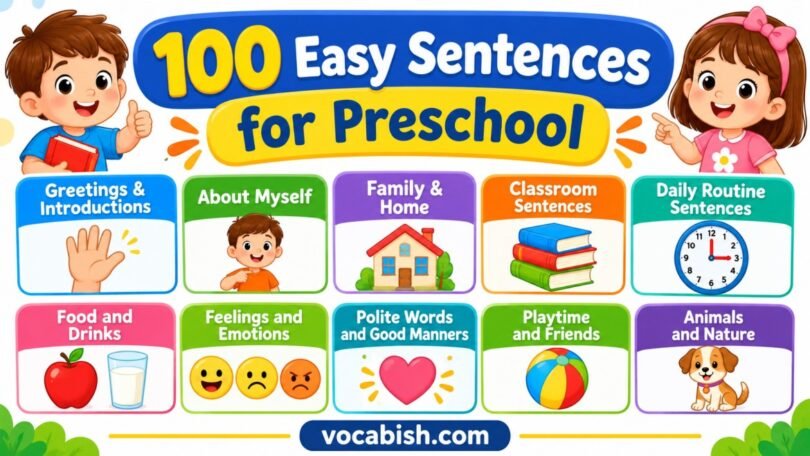
This collection includes 100 easy English sentences for preschool children, grouped by everyday situations. Each sentence uses familiar words, basic grammar, and natural expressions that children can repeat, remember, and use in conversations. Parents and teachers can practice a few sentences daily, use pictures or actions to explain their meanings, and encourage children to speak without worrying about mistakes.
How to Practice These Sentences
Children do not need to memorize all 100 sentences at once. Practice five sentences a day and connect them with activities the child already does.
- Say: Read each sentence aloud slowly.
- Repeat: Let the child repeat it two or three times.
- Show: Use objects, pictures, facial expressions, or actions.
- Practice: Ask the child to use the sentence in a suitable situation.
- Review: Repeat familiar sentences throughout the week.
Start with greetings and introductions, then move to family, classroom, food, and daily activities.
Greetings and Introductions Sentences for Preschool
These sentences help children greet people, introduce themselves, and start friendly conversations.
No. | English Sentence |
|---|---|
1 | Good morning! |
2 | Good afternoon! |
3 | Good evening! |
4 | Hello! |
5 | Hi, how are you? |
6 | I am fine. |
7 | Nice to meet you. |
8 | My name is Ali. |
9 | What is your name? |
10 | Goodbye! |
Practice: Encourage children to greet their parents, teachers, siblings, and friends using these sentences.
Sentences About Myself Sentences for Preschool
Children can use these short sentences to talk about their names, age, preferences, and personal information.
No. | English Sentence |
|---|---|
11 | I am a boy. |
12 | I am a girl. |
13 | I am four years old. |
14 | I live with my family. |
15 | I like drawing. |
16 | I like playing. |
17 | I am happy. |
18 | I can run. |
19 | I can jump. |
20 | I love my school. |
Practice: Ask children to complete sentences using their own information.
- I am ___ years old.
- My name is ___.
- I like ___.
- I can ___.
Family and Home Sentences for Preschool
These preschool sentences help children talk about family members, rooms, and familiar things around the house.
No. | English Sentence |
|---|---|
21 | This is my mother. |
22 | This is my father. |
23 | I love my parents. |
24 | I have a brother. |
25 | I have a sister. |
26 | My family is happy. |
27 | This is my house. |
28 | My room is clean. |
29 | I have a small bed. |
30 | I play at home. |
Children can point to family photographs or household objects while saying these sentences.
Classroom Sentences for Preschool
Preschool children need English expressions to communicate with teachers and classmates, ask for help, and participate in activities.
No. | English Sentence |
|---|---|
31 | I am ready. |
32 | May I come in? |
33 | May I go out? |
34 | Please help me. |
35 | I have a pencil. |
36 | This is my book. |
37 | Open your book. |
38 | I can read. |
39 | I can write. |
40 | I am listening. |
Useful classroom words: book, pencil, teacher, desk, chair, bag, board, paper, crayon, and eraser.
Daily Routine Sentences for Preschool
Children can practice English while getting ready, washing, dressing, eating, and going to bed.
No. | English Sentence |
|---|---|
41 | I wake up early. |
42 | I brush my teeth. |
43 | I wash my face. |
44 | I take a bath. |
45 | I comb my hair. |
46 | I get dressed. |
47 | I eat my breakfast. |
48 | I go to school. |
49 | I come back home. |
50 | I go to bed. |
These sentences are particularly useful because children can practice them while performing each action.
Food and Drink Sentences for Preschool
Use sentences about meals, favorite foods, and asking for water during snack time.
No. | English Sentence |
|---|---|
51 | I am hungry. |
52 | I am thirsty. |
53 | I want some water. |
54 | I like milk. |
55 | I eat an apple. |
56 | I like bananas. |
57 | This is my lunch. |
58 | The food is yummy. |
59 | I want more food. |
60 | I am full. |
Vocabulary: hungry, thirsty, water, milk, bread, apple, banana, lunch, yummy, and full.
Teach children to use “I want some water” instead of simply pointing when they need a drink.
Feelings and Emotions Sentences for Preschool
Preschool children can express their emotions using short English sentences. These expressions also help adults understand how children feel.
No. | English Sentence |
|---|---|
61 | I am happy. |
62 | I am sad. |
63 | I am sleepy. |
64 | I am tired. |
65 | I am excited. |
66 | I am scared. |
67 | I am angry. |
68 | I feel better. |
69 | I am okay. |
70 | I need a hug. |
Practice these sentences using facial expressions. Ask children to identify feelings in pictures or describe their own emotions.
Polite Words and Good Manners Sentences for Preschool
Good manners help children communicate respectfully with family members, teachers, and friends.
No. | English Sentence |
|---|---|
71 | Please give me that. |
72 | Thank you. |
73 | You are welcome. |
74 | I am sorry. |
75 | Excuse me. |
76 | May I have it? |
77 | Please wait. |
78 | Can I help you? |
79 | Please come here. |
80 | Have a nice day! |
Teach these expressions during real situations rather than only asking children to repeat them.
For example, when a child receives a toy, encourage them to say “Thank you.” When they accidentally bump into someone, practice “I am sorry.”
Playtime and Friends Sentences for Preschool
Children use these expressions when playing with toys, sharing things, and spending time with friends.
No. | English Sentence |
|---|---|
81 | Let us play. |
82 | Come and play. |
83 | This is my toy. |
84 | I have a ball. |
85 | Give me a turn. |
86 | I like this game. |
87 | We are friends. |
88 | Let us play together. |
89 | I can share. |
90 | That is fun! |
Practice activity: Give children a ball, blocks, toy cars, or crayons. Encourage them to use these sentences while playing with others.
Animals and Nature Sentences for Preschool
These English sentences introduce children to pets, animals, weather, plants, and things they see outdoors.
No. | English Sentence |
|---|---|
91 | I see a cat. |
92 | The dog is barking. |
93 | The bird can fly. |
94 | The fish can swim. |
95 | The cow gives milk. |
96 | The sun is shining. |
97 | It is raining. |
98 | The sky is blue. |
99 | I see a flower. |
100 | The tree is tall. |
Children can practice these sentences during outdoor games, activities, nature walks, or while looking at picture books.
Easy Questions and Answers for Preschool
Along with learning sentences, children should practice responding to short questions. These conversations help them use English naturally.
Question | Answer |
|---|---|
What is your name? | My name is Ali. |
How old are you? | I am four years old. |
How are you? | I am fine. |
What is this? | It is a ball. |
What color is it? | It is red. |
Where is your bag? | It is here. |
Are you hungry? | Yes, I am. |
Do you like milk? | Yes, I do. |
Can you jump? | Yes, I can. |
Who is your teacher? | My teacher is Miss Sara. |
How to Practice Conversations
Start by asking one question and giving the answer yourself. Then ask the child to answer independently.
For example:
Parent: What is your name?
Child: My name is Ahmed.
Parent: How old are you?
Child: I am five years old.
Repeat the conversation using different names, ages, objects, and colors.
Common Sentence Mistakes
Children may use incorrect words or leave out important parts of a sentence while speaking English. Correct these mistakes gently by repeating the correct expression.
– Incorrect: I am five year old.
Correct: I am five years old.
– Incorrect: My name Ali.
Correct: My name is Ali.
– Incorrect: I hungry.
Correct: I am hungry.
– Incorrect: I has a ball.
Correct: I have a ball.
– Incorrect: She are happy.
Correct: She is happy.
Encourage children to repeat the correct sentence instead of making them feel embarrassed about mistakes.
Practice English Sentences for Preschool
Short activities make sentence practice more meaningful. Children can speak while moving, playing, drawing, and responding to questions.
Activity 1: Complete the Sentences
Fill in the blanks with suitable words.
- My name is ______.
- I am ______ years old.
- I like ______.
- I have a ______.
- I am ______.
- This is my ______.
- I want some ______.
- I can ______.
- I love my ______.
- Good ______!
Activity 2: Match the Sentences
Match each sentence with the correct action.
Sentence | Action |
|---|---|
I am sleeping. | Close your eyes. |
I am jumping. | Jump up. |
I am eating. | Pretend to eat. |
I am running. | Run in place. |
I am clapping. | Clap your hands. |
Activity 3: Choose the Correct Sentence
1. a) I am happy.
b) I happy.
2. a) She have a doll.
b) She has a doll.
3. a) I want water.
b) I wants water.
4. a) This is my book.
b) This my book.
5. a) He is sleeping.
b) He sleeping.
Practice Answers
Activity 1: Answers will vary. Children can complete the sentences using their own information.
Activity 2:
- I am sleeping. — Close your eyes.
- I am jumping. — Jump up.
- I am eating. — Pretend to eat.
- I am running. — Run in place.
- I am clapping. — Clap your hands.
Activity 3:
- a) I am happy.
- b) She has a doll.
- a) I want water.
- a) This is my book.
- a) He is sleeping.
Download Easy Sentences for Preschool PDF Book
FAQs About Sentences for Preschool
Easy English sentences use familiar words and short grammar patterns to help preschool children communicate about themselves, family, school, food, feelings, and play.
Practice three to five sentences daily. Repeat them during everyday activities so children can remember their meanings and use them naturally.
Use pictures, toys, gestures, repetition, songs, and everyday conversations. Say each sentence clearly and encourage children to repeat and use it.
Start with greetings, introductions, requests, feelings, and daily routine sentences such as “Hello,” “I am happy,” and “I want water.”
Children can improve by listening to English daily, repeating short expressions, answering simple questions, describing pictures, and speaking during playtime.
Yes. These sentences are suitable for preschool and kindergarten children who are beginning to speak English or practice basic spoken English.
Parents can practice during meals, dressing, bedtime, playtime, and household activities by asking short questions and encouraging complete answers.
Complete sentences help children express their needs, describe objects, communicate feelings, answer questions, and develop early speaking and listening skills.
Conclusion
These 100 sentences for preschool introduce children to everyday English conversations through greetings, family, classroom activities, daily routines, food, feelings, manners, playtime, and nature.
Start with a few expressions each day. Repeat them during familiar activities, ask simple questions, and give children opportunities to respond in their own words. Regular speaking practice helps children become more comfortable using English at home and in school.
The goal is not to memorize every sentence in one day. It is to help children use English naturally, one sentence at a time.