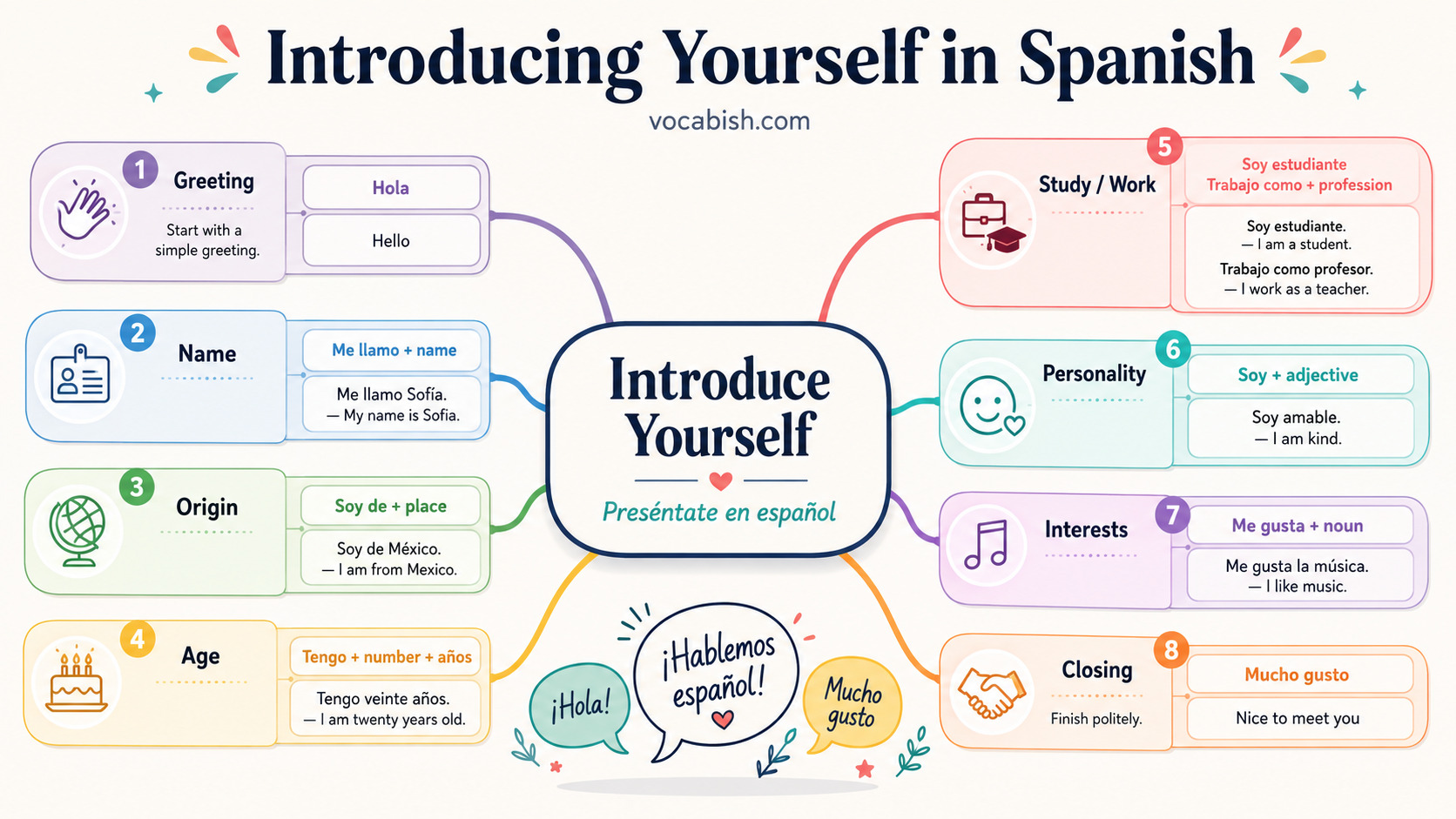

Learning how to Introduce Yourself in Spanish is one of the first steps toward having comfortable conversations. Whether you are meeting classmates, talking to a teacher, introducing yourself at work, or making new friends while traveling, a good introduction helps you start a conversation naturally.
Many learners know individual Spanish words but feel unsure when putting them together into complete sentences. This article focuses on practical introductions, common phrases, and natural sentence patterns that people use in everyday situations.
Why Learning to Introduce Yourself in Spanish Matters
When meeting someone for the first time, introductions help create a connection. Learning a few common Spanish introduction patterns allows you to start conversations naturally and understand how native speakers introduce themselves.
The goal isn’t to memorize long speeches. Instead, focus on useful sentences you can use in different situations.
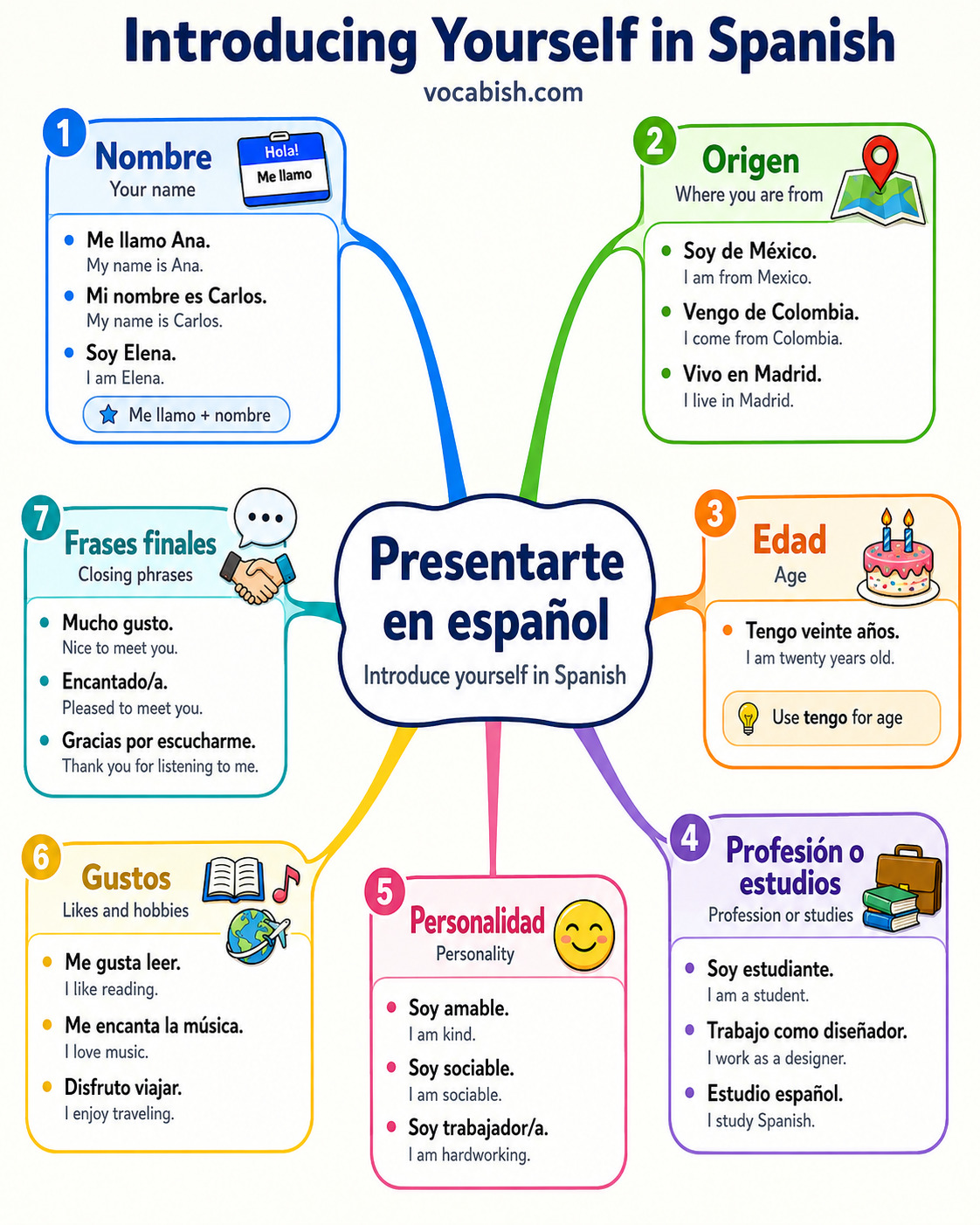
Basic Sentences to Introduce Yourself in Spanish
These are some of the most useful sentences for beginners. They can be used in schools, language classes, social events, and everyday conversations.
- Hola, me llamo Sofía. — Hello, my name is Sofia.
- Mi nombre es Andrés. — My name is Andrés.
- Soy Miguel. — I am Miguel.
- Hola, soy Elena. — Hello, I am Elena.
- Mucho gusto. — Nice to meet you.
- Encantado de conocerte. — Pleased to meet you.
- Es un placer conocerte. — It is a pleasure to meet you.
- Me alegra conocerte. — I’m happy to meet you.
- ¿Cómo te llamas? — What is your name?
- Soy tu nuevo compañero. — I am your new classmate.
- Estoy aquí para aprender. — I am here to learn.
- Soy de una ciudad pequeña. — I am from a small town.
- Esta es mi primera clase. — This is my first class.
- Me gusta conocer personas nuevas. — I like meeting new people.
- Gracias por recibirme. — Thank you for welcoming me.
- Espero aprender mucho. — I hope to learn a lot.
- Estoy emocionado por estar aquí. — I am excited to be here.
- Hola a todos. — Hello everyone.
- Gracias por escucharme. — Thank you for listening to me.
- Soy parte del equipo. — I am part of the team.
- Quiero practicar mi español. — I want to practice my Spanish.
- Estoy feliz de conocerte. — I am happy to meet you.
- Espero que seamos amigos. — I hope we become friends.
- Gracias por tu amabilidad. — Thank you for your kindness.
- Es bueno estar aquí. — It is good to be here.
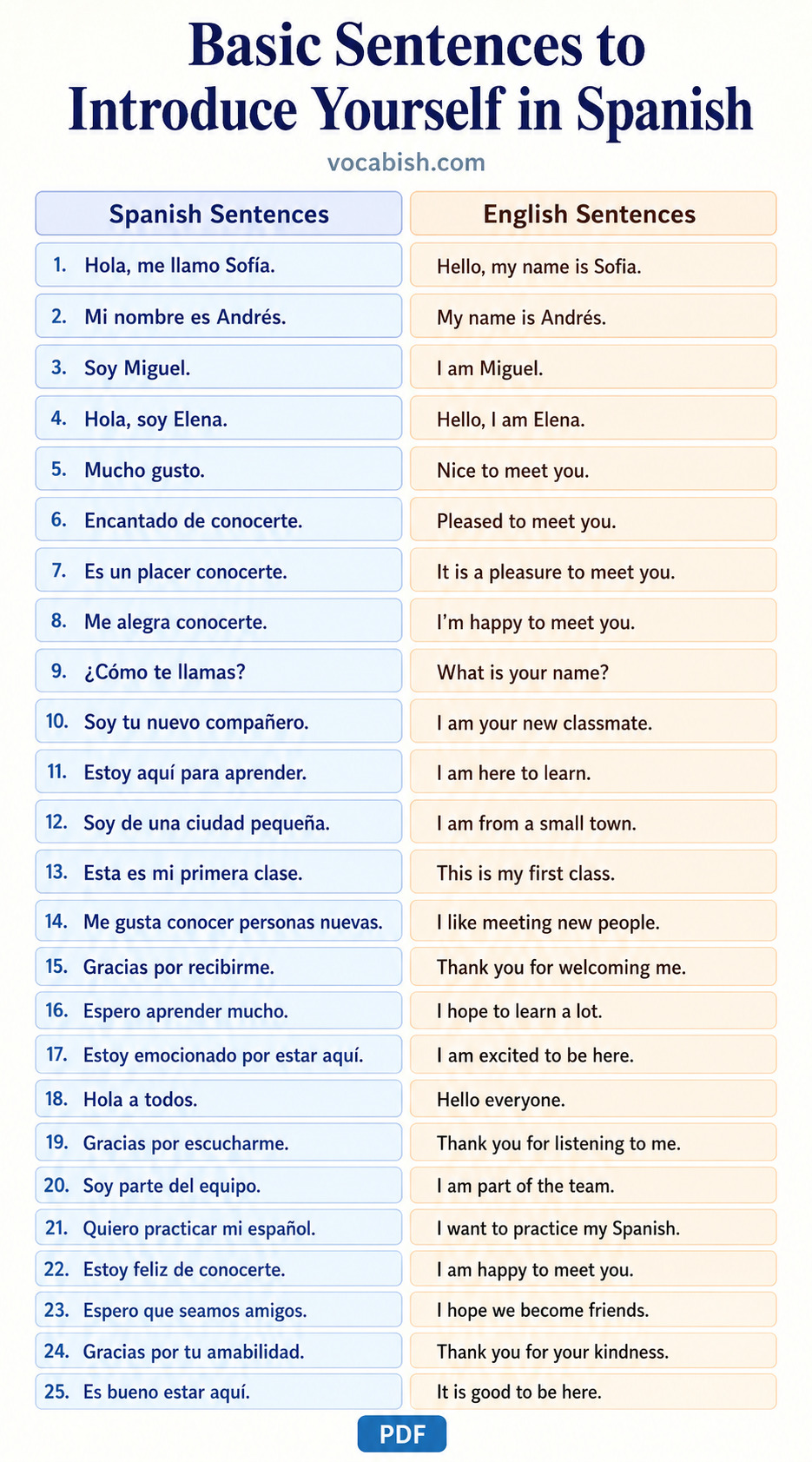
Saying Your Name
When introducing yourself in Spanish, the first thing you usually tell someone is your name. Spanish offers several natural ways to do this, depending on the situation and level of formality.
1: Saying Your Name
A common way to introduce yourself in everyday conversations.
Formula: Me llamo + Name
Examples:
- Me llamo Carlos. — meh YAH-moh KAR-los — My name is Carlos.
- Me llamo Sofía. — meh YAH-moh soh-FEE-ah — My name is Sofia.
- Me llamo Daniel. — meh YAH-moh dah-NYEL — My name is Daniel.
2: Introducing Yourself Formally
Often heard during presentations, interviews, or formal introductions.
Formula: Mi nombre es + Name
Examples:
- Mi nombre es Ana. — mee NOM-breh ess AH-nah — My name is Ana.
- Mi nombre es Marta. — mee NOM-breh ess MAR-tah — My name is Marta.
- Mi nombre es Javier. — mee NOM-breh ess hah-BYEHR — My name is Javier.
3: Introducing Yourself Briefly
A short and direct option when introducing yourself.
Formula: Soy + Name
Examples:
- Soy David. — soy dah-VEED — I am David.
- Soy Laura. — soy LOW-rah — I am Laura.
- Soy Miguel. — soy mee-GEL — I am Miguel.
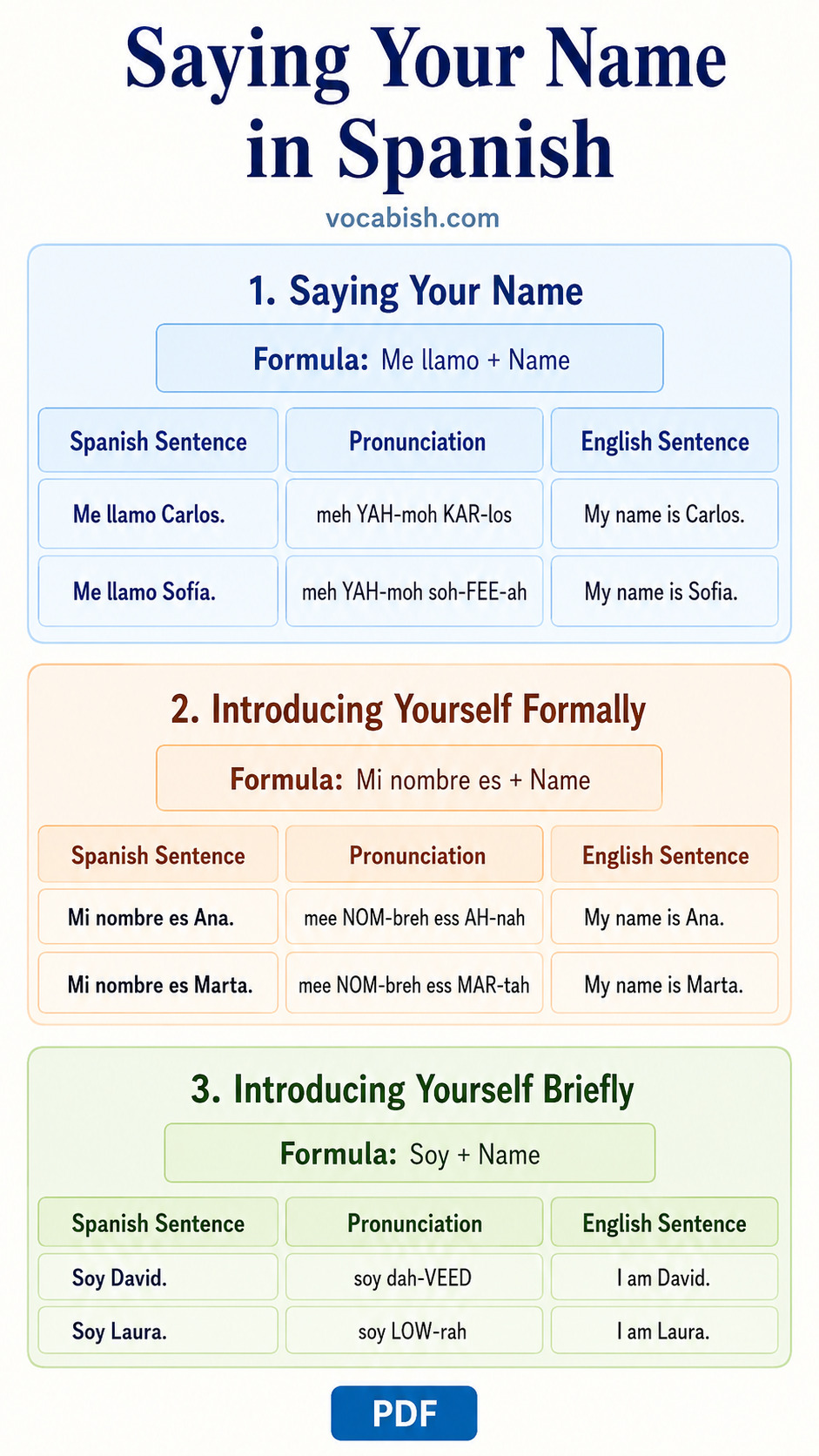
Talking About Nationality and Origin
After saying your name, it is common to mention where you are from. In Spanish, people often talk about both their place of origin and their nationality. These details help others learn more about you and can naturally continue the conversation.
1: Saying Where You Are From
A common way to share your hometown, city, or country.
Formula: Soy de + Country/City
Examples:
- Soy de España. — soy deh es-PAHN-yah — I am from Spain.
- Soy de México. — soy deh MEH-hee-koh — I am from Mexico.
- Soy de Argentina. — soy deh ar-hen-TEE-nah — I am from Argentina.
2: Saying Where You Come From
Often heard when people talk about their background or family roots.
Formula: Vengo de + Country/City
Examples:
- Vengo de Colombia. — BEN-go deh koh-LOHM-bee-ah — I come from Colombia.
- Vengo de Chile. — BEN-go deh CHEE-leh — I come from Chile.
- Vengo de Perú. — BEN-go deh peh-ROO — I come from Peru.
3: Saying Where You Live
Helpful when mentioning your current city or place of residence.
Formula: Vivo en + Place
Examples:
- Vivo en Madrid. — BEE-bo en mah-DREED — I live in Madrid.
- Vivo en Barcelona. — BEE-bo en bar-theh-LOH-nah — I live in Barcelona.
- Vivo en Lima. — BEE-bo en LEE-mah — I live in Lima.
4: Saying Your Nationality
A direct way to tell others your nationality.
Formula: Soy + Nationality
Examples:
- Soy español. — soy es-pah-NYOL — I am Spanish.
- Soy mexicana. — soy meh-hee-KAH-nah — I am Mexican.
- Soy colombiano. — soy koh-lom-bee-AH-noh — I am Colombian.
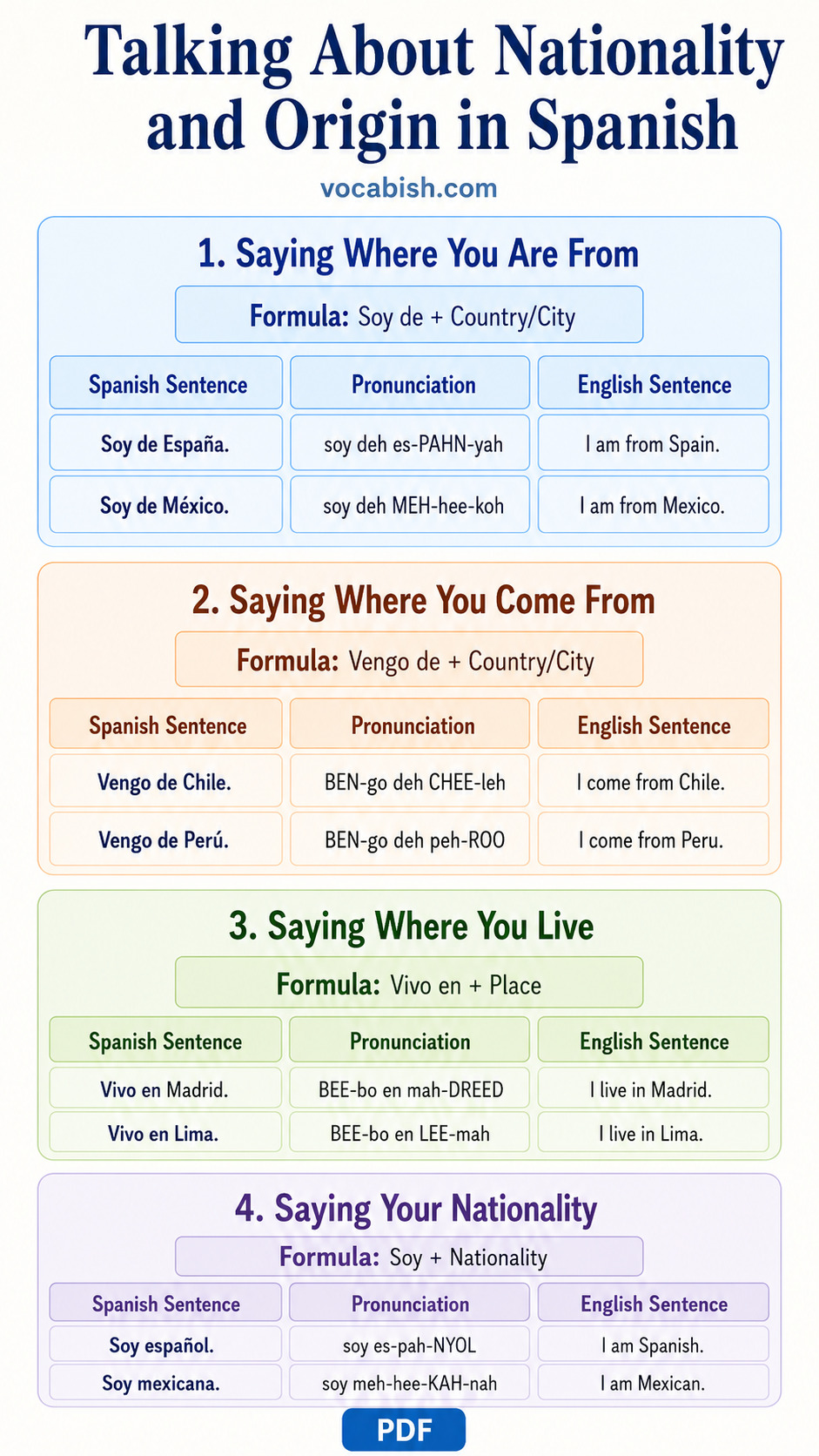
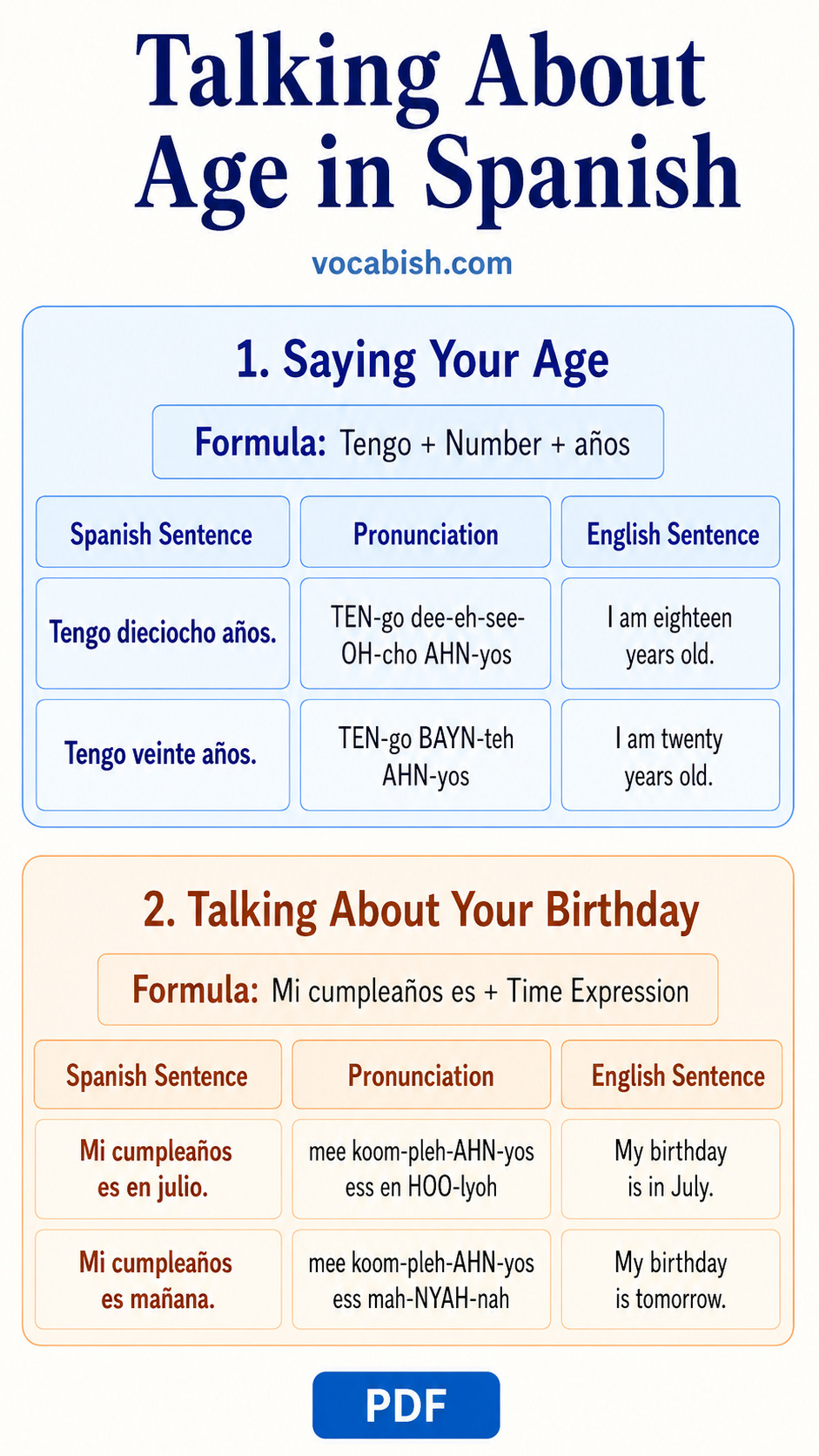
Talking About Age
Age is another common detail people share during introductions. In Spanish, age is expressed with the verb tener (to have), not the verb “to be.”
1: Saying Your Age
Spanish speakers use this expression when talking about how old they are.
Formula: Tengo + Number + años
Examples:
- Tengo dieciocho años. — TEN-go dee-eh-see-OH-cho AHN-yos — I am eighteen years old.
- Tengo veinte años. — TEN-go BAYN-teh AHN-yos — I am twenty years old.
- Tengo veintidós años. — TEN-go bayn-tee-DOHS AHN-yos — I am twenty-two years old.
Related Resource: Numbers in Spanish
2: Talking About Your Birthday
A natural option for sharing birthday-related information.
Formula: Mi cumpleaños es + Time Expression
Examples:
- Mi cumpleaños es en julio. — mee koom-pleh-AHN-yos ess en HOO-lyoh — My birthday is in July.
- Mi cumpleaños es mañana. — mee koom-pleh-AHN-yos ess mah-NYAH-nah — My birthday is tomorrow.
- Mi cumpleaños es en marzo. — mee koom-pleh-AHN-yos ess en MAR-soh — My birthday is in March.
Talking About Professions
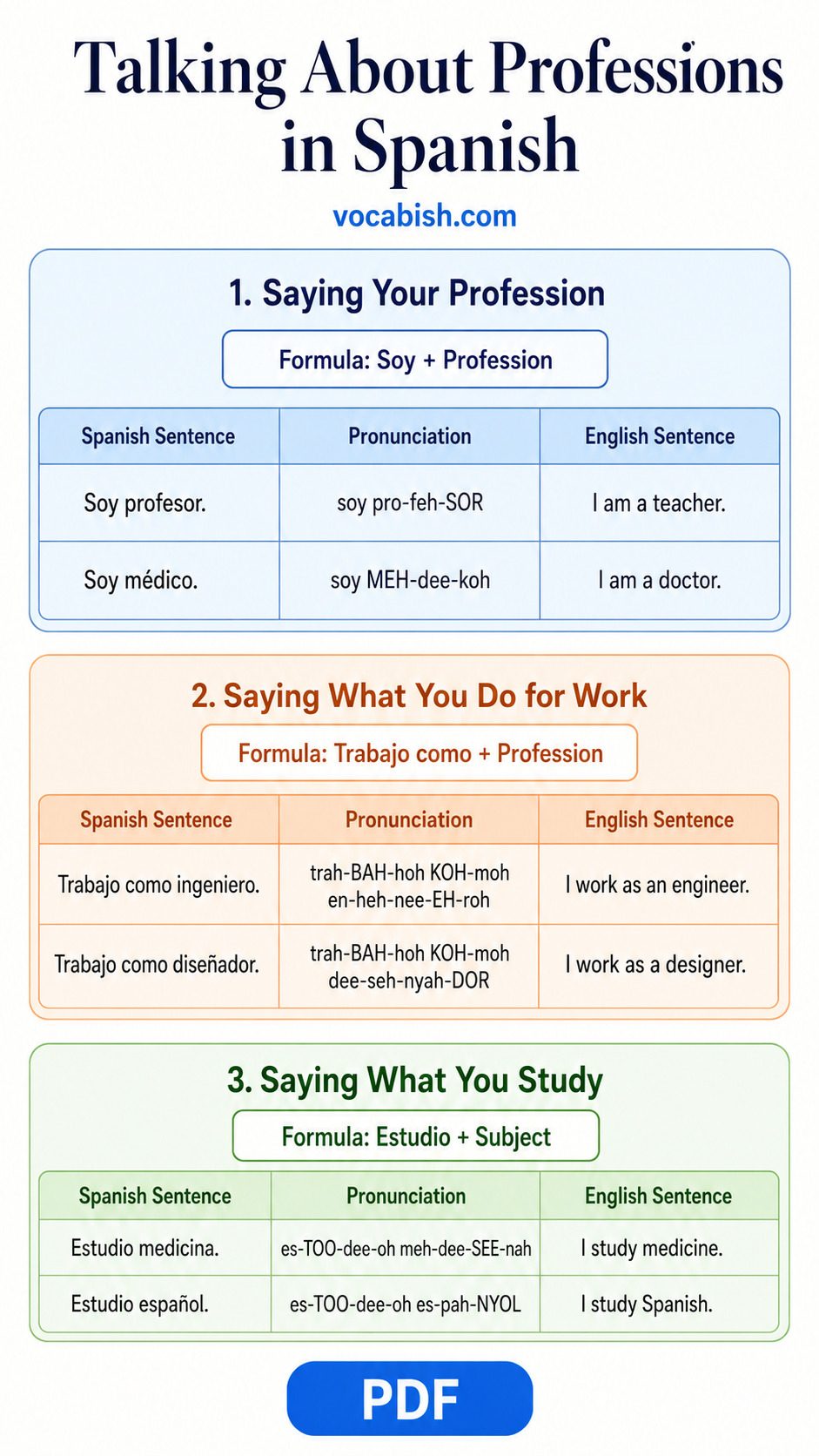
In introductions, adults often mention their occupation or field of study. This helps others understand what they do.
1: Saying Your Profession
One of the most common ways to mention your job or occupation.
Formula: Soy + Profession
Examples:
- Soy profesor. — soy pro-feh-SOR — I am a teacher.
- Soy médico. — soy MEH-dee-koh — I am a doctor.
- Soy estudiante. — soy es-too-dee-AHN-teh — I am a student.
2: Saying What You Do for Work
Useful when explaining your role rather than simply naming your profession.
Formula: Trabajo como + Profession
Examples:
- Trabajo como ingeniero. — trah-BAH-hoh KOH-moh en-heh-nee-EH-roh — I work as an engineer.
- Trabajo como diseñador. — trah-BAH-hoh KOH-moh dee-seh-nyah-DOR — I work as a designer.
- Trabajo como programador. — trah-BAH-hoh KOH-moh proh-grah-mah-DOR — I work as a programmer.
3: Saying What You Study
Frequently used by students when talking about their academic field.
Formula: Estudio + Subject
Examples:
- Estudio medicina. — es-TOO-dee-oh meh-dee-SEE-nah — I study medicine.
- Estudio ingeniería. — es-TOO-dee-oh en-heh-nee-eh-REE-ah — I study engineering.
- Estudio español. — es-TOO-dee-oh es-pah-NYOL — I study Spanish.
Describing Physical Appearance
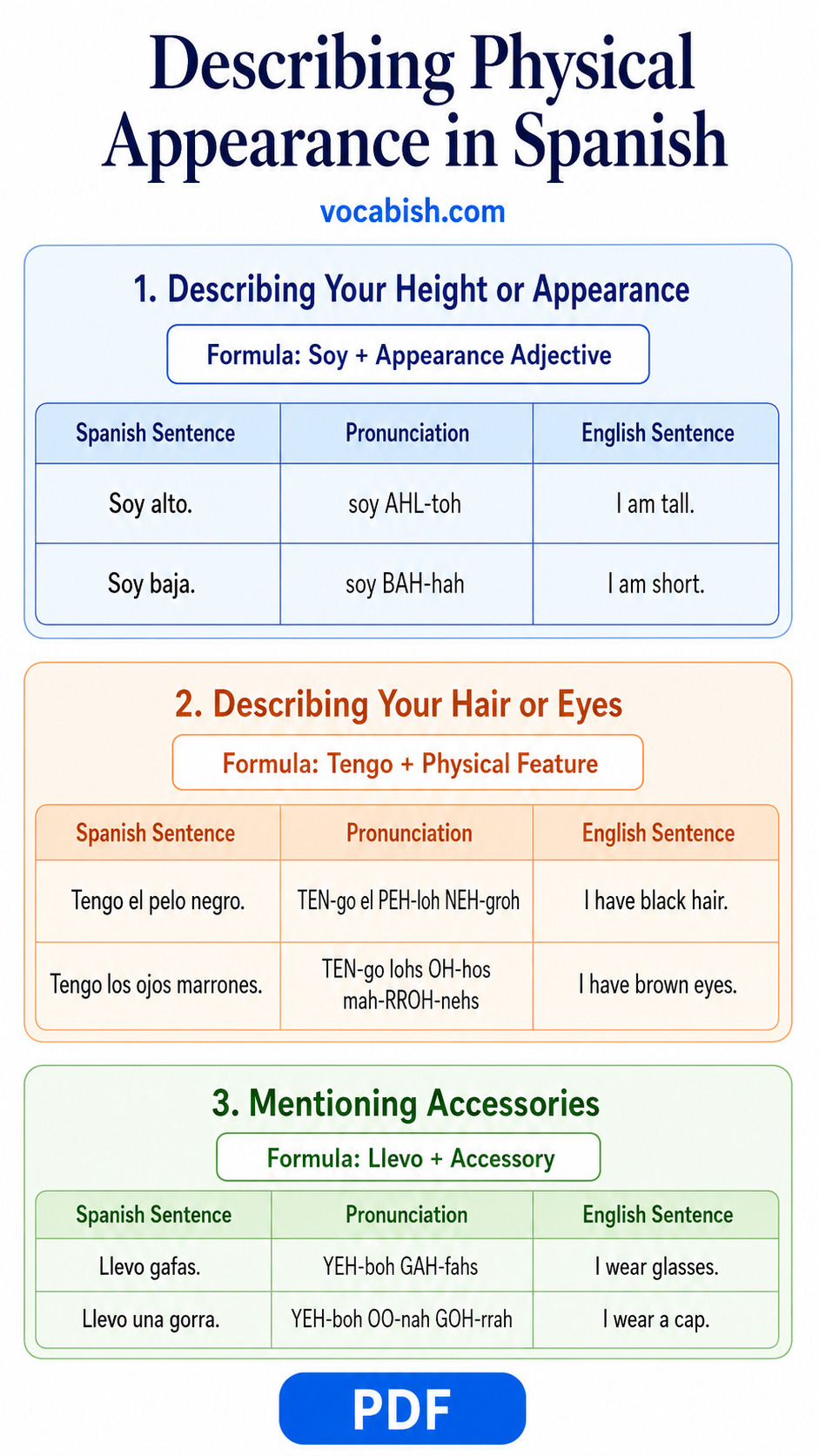
Sometimes people describe themselves briefly when introducing themselves, especially in written profiles or language-learning activities.
1: Describing Your Height or Appearance
Suitable for talking about height and general physical features.
Formula: Soy + Appearance Adjective
Examples:
- Soy alto. — soy AHL-toh — I am tall.
- Soy baja. — soy BAH-hah — I am short.
- Soy morena. — soy moh-REH-nah — I am dark-haired.
2: Describing Your Hair or Eyes
A popular choice when giving more details about your appearance.
Formula: Tengo + Physical Feature
Examples:
- Tengo el pelo negro. — TEN-go el PEH-loh NEH-groh — I have black hair.
- Tengo los ojos marrones. — TEN-go lohs OH-hos mah-RROH-nehs — I have brown eyes.
- Tengo el pelo rubio. — TEN-go el PEH-loh ROO-bee-oh — I have blonde hair.
3: Mentioning Accessories
Sometimes learners include glasses or accessories as part of a personal description.
Formula: Llevo + Accessory
Examples:
- Llevo gafas. — YEH-boh GAH-fahs — I wear glasses.
- Llevo lentes. — YEH-boh LEN-tehs — I wear glasses.
- Llevo una gorra. — YEH-boh OO-nah GOH-rrah — I wear a cap.
Talking About Personality and Appearance
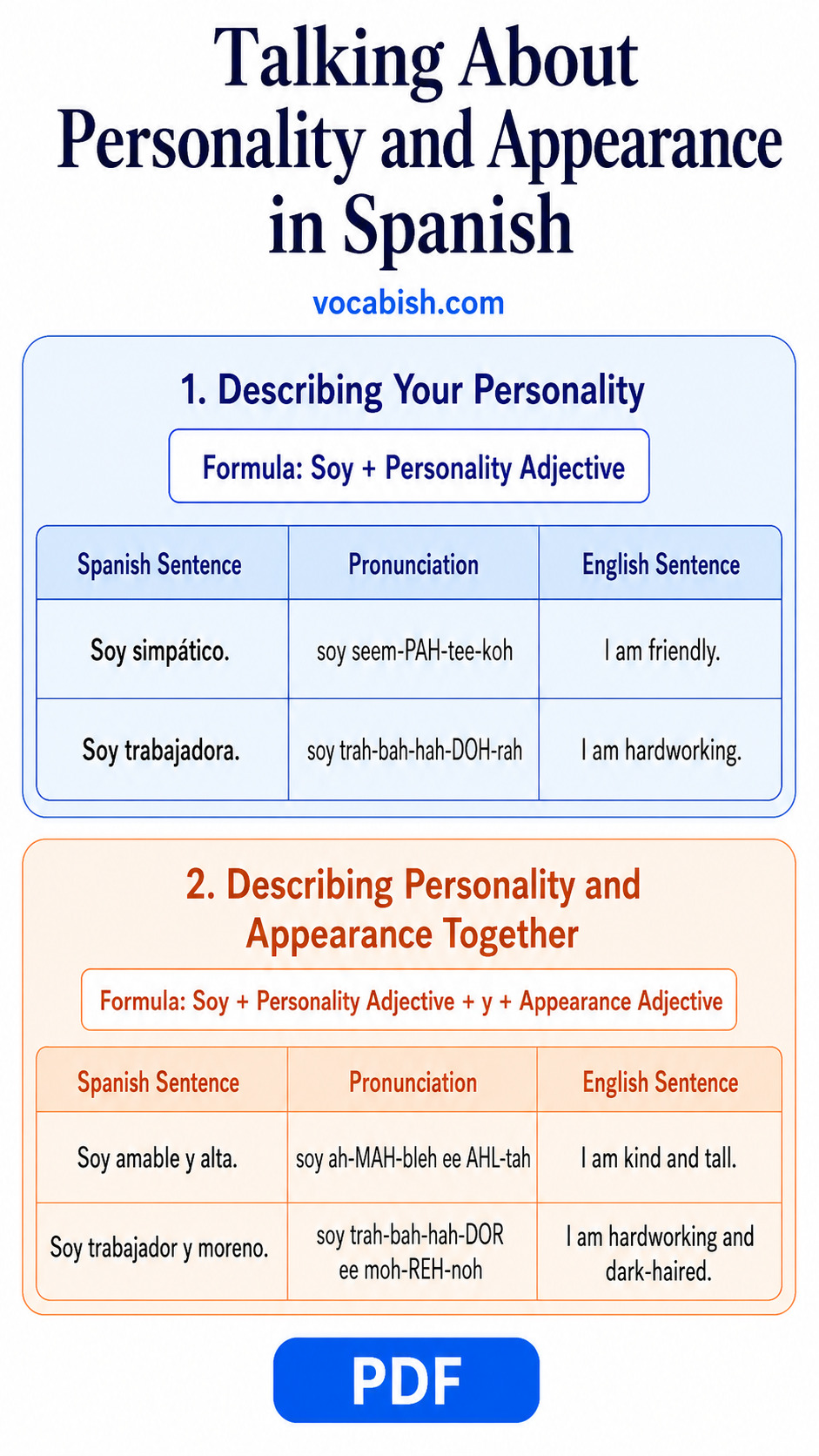
When introducing yourself in Spanish, you can talk about your personality and physical appearance using the verb ser (to be) followed by an adjective. This is one of the most common ways to describe yourself in everyday conversations.
Remember that Spanish adjectives often change according to gender. Masculine adjectives usually end in -o, while feminine adjectives often end in -a. Some adjectives have the same form for both masculine and feminine subjects.
Useful Adjectives:
Spanish (Masculine) | Spanish (Feminine) | English |
|---|---|---|
simpático | simpática | friendly |
tímido | tímida | shy |
extrovertido | extrovertida | outgoing |
trabajador | trabajadora | hardworking |
inteligente | inteligente | intelligent |
alto | alta | tall |
bajo | baja | short |
moreno | morena | dark-haired |
rubio | rubia | blonde |
guapo | guapa | good-looking |
1: Describing Your Personality
Often included when you want people to know a little more about your character.
Formula: Soy + Personality Adjective
Examples:
- Soy simpático. — soy seem-PAH-tee-koh — I am friendly.
- Soy trabajadora. — soy trah-bah-hah-DOH-rah — I am hardworking.
- Soy inteligente. — soy een-teh-lee-HEN-teh — I am intelligent.
2: Describing Personality and Appearance Together
Brings personal qualities and physical traits together in a single sentence.
Formula: Soy + Personality Adjective + y + Appearance Adjective
Examples:
- Soy amable y alta. — soy ah-MAH-bleh ee AHL-tah — I am kind and tall.
- Soy trabajador y moreno. — soy trah-bah-hah-DOR ee moh-REH-noh — I am hardworking and dark-haired.
- Soy simpática y baja. — soy seem-PAH-tee-kah ee BAH-hah — I am friendly and short.
Grammar Reminder: Gender and Number Agreement
In Spanish, adjectives must agree with the subject in both gender (masculine or feminine) and number (singular or plural). This agreement is an important part of Spanish sentence construction.
Masculine Singular to Masculine Plural
Add -s to many adjectives ending in -o.
- Soy alto. — I am tall.
- Somos altos. — We are tall.
Feminine Singular to Feminine Plural
Add -s to many adjectives ending in -a.
- Soy baja. — I am short.
- Somos bajas. — We are short.
Adjectives Ending in -e
Many adjectives ending in -e stay the same for masculine and feminine subjects, but become plural with -s.
- Soy inteligente. — I am intelligent.
- Somos inteligentes. — We are intelligent.
Adjectives Ending in a Consonant
Many adjectives ending in a consonant add -es in the plural form.
- Soy trabajador. — I am hardworking.
- Somos trabajadores. — We are hardworking.
Quick Tip:
Whenever you describe yourself in Spanish, check two things:
- Is the subject masculine or feminine?
- Is the subject singular or plural?
Making sure your adjective matches both will help your Spanish sound natural and grammatically correct.
Personality and Interests
Describing your personality helps people understand your character and how you interact with others.
1: Describing Yourself with an Adjective
A simple way to highlight your personality.
Formula: Soy + Personality Adjective
Examples:
- Soy sociable. — soy soh-see-AH-bleh — I am sociable.
- Soy optimista. — soy ohp-tee-MEES-tah — I am optimistic.
- Soy paciente. — soy pah-see-EN-teh — I am patient.
2: Talking About the Kind of Person You Are
Common in self-introductions, presentations, and classroom activities.
Formula: Soy una persona + Adjective
Examples:
- Soy una persona amable. — soy OO-nah pehr-SOH-nah ah-MAH-bleh — I am a kind person.
- Soy una persona responsable. — soy OO-nah pehr-SOH-nah rehs-pon-SAH-bleh — I am a responsible person.
- Soy una persona creativa. — soy OO-nah pehr-SOH-nah kreh-ah-TEE-bah — I am a creative person.
Likes and Hobbies
Sharing hobbies is one of the easiest ways to continue a conversation after introducing yourself.
1: Talking About Things You Like
Great for sharing everyday interests and favorite activities.
Formula: Me gusta + Activity
Examples:
- Me gusta leer. — meh GOOS-tah leh-ER — I like reading.
- Me gusta viajar. — meh GOOS-tah bee-ah-HAR — I like traveling.
2: Talking About Things You Love
Shows stronger enthusiasm for an activity or interest.
Formula: Me encanta + Activity
Examples:
- Me encanta bailar. — meh en-KAHN-tah bah-ee-LAR — I love dancing.
- Me encanta la música. — meh en-KAHN-tah lah MOO-see-kah — I love music.
3: Talking About Your Hobbies
Works well when discussing activities you regularly enjoy in your free time.
Formula: Disfruto + Activity
Examples:
- Disfruto cocinar. — dees-FROO-toh koh-see-NAR — I enjoy cooking.
- Disfruto tomar fotografías. — dees-FROO-toh toh-MAR foh-toh-grah-FEE-ahs — I enjoy taking photographs.
Mini Dialogue for Introducing Yourself in Spanish
This short conversation shows how a Spanish introduction can sound in everyday communication.
María: Hola, me llamo María. ¿Cómo te llamas?
Hello, my name is Maria. What is your name?
Juan: Hola, soy Juan. Mucho gusto.
Hello, I am Juan. Nice to meet you.
María: Mucho gusto. ¿De dónde eres?
Nice to meet you. Where are you from?
Juan: Soy de Colombia. ¿Y tú?
I am from Colombia. And you?
María: Soy de México. Tengo veinte años y soy estudiante.
I am from Mexico. I am twenty years old and I am a student.
Juan: Yo también soy estudiante. Me gusta aprender idiomas.
I am a student too. I like learning languages.
María: A mí también. Me encanta practicar español.
Me too. I love practicing Spanish.
Juan: Qué bien. Espero que podamos ser amigos.
That’s great. I hope we can be friends.
Final Self-Introduction Example
Hola. Me llamo Carlos. Soy de México y soy mexicano. Tengo veintidós años. Soy estudiante de ingeniería. Tengo el pelo negro y los ojos marrones. Soy amable y trabajador. Me gusta leer, viajar y escuchar música. Mucho gusto.
Hello. My name is Carlos. I am from Mexico and I am Mexican. I am twenty-two years old. I am an engineering student. I have black hair and brown eyes. I am kind and hardworking. I like reading, traveling, and listening to music. Nice to meet you.
Common Mistakes When Introducing Yourself in Spanish
Most beginners make a few small mistakes when introducing themselves in Spanish. Being aware of these common errors can help you sound more natural and communicate with greater confidence.
Using “Soy” Instead of “Tengo” for Age
In Spanish, age is expressed with the verb tener (to have), not ser (to be).
- Soy veinte años. — I am twenty years old. ❌
- Tengo veinte años. — I am twenty years old. ✅
Forgetting Gender Agreement
Many Spanish adjectives change according to gender. Make sure the adjective matches the person being described.
- Soy simpático. (female speaker) ❌
- Soy simpática. — I am friendly. ✅
- Soy mexicano. (female speaker) ❌
- Soy mexicana. — I am Mexican. ✅
Translating Directly from English
Word-for-word translations often sound unnatural in Spanish.
- Mi nombre Carlos. ❌
- Mi nombre es Carlos. — My name is Carlos. ✅
- Yo soy de vivir en Madrid. ❌
- Vivo en Madrid. — I live in Madrid. ✅
Mixing Formal and Informal Introductions
Try to keep the same level of formality throughout your introduction.
Formal introductions often use:
- Mi nombre es…
- Mucho gusto.
- Es un placer conocerte.
Informal introductions often use:
- Me llamo…
- Hola.
- Encantado.
Forgetting Accent Marks
Accent marks can change pronunciation and meaning.
- Tengo veintidos años. ❌
- Tengo veintidós años. — I am twenty-two years old. ✅
- Mi cumpleaños es en marzo y estudio ingles. ❌
- Mi cumpleaños es en marzo y estudio inglés. — My birthday is in March and I study English. ✅
You May Also Like:
Introduce Yourself in Spanish PDF
Introduce Yourself in Spanish PDF is a practical learning resource that helps you learn and understand common Spanish self-introduction phrases, sentence patterns, pronunciation, and English translations. It helps you confidently talk about your name, nationality, age, profession, personality, and hobbies in everyday conversations.
FAQs about How to Introduce Yourself in Spanish
A common introduction is: “Hola, me llamo Ana. Mucho gusto.” It means, “Hello, my name is Ana. Nice to meet you.”
“Me llamo” means “My name is” and is one of the most common ways to introduce yourself in Spanish.
Yes. You can say “Soy Carlos”, which means “I am Carlos.”
Use “Soy de…” followed by your city or country. For example: “Soy de México.”
You can say: “Hola, me llamo David. Soy estudiante y me gusta aprender español.”
You can ask questions such as “¿Cómo te llamas?” or “¿De dónde eres?”
“Mi nombre es…” is often considered slightly more formal than “Me llamo…”
Conclusion
Learning how to Introduce Yourself in Spanish becomes much easier when you focus on a few common sentence patterns. By practicing how to say your name, talk about your nationality, mention your age, describe your profession, and share your interests, you’ll be able to handle many everyday conversations with confidence.
Don’t worry about creating long introductions. A few well-structured sentences are often enough to make a great first impression. As you continue practicing these patterns, you’ll find it easier to build your own introductions and speak more naturally in Spanish.