Leaves may look simple, but they come in many forms. Botanists classify them by their structure, shape, edges, vein patterns, position on the stem, attachment, and lifespan. Learning the main types of leaf can help you identify plants and understand how they survive in different environments. This guide explains each category in easy English, with familiar examples and clear comparisons.
What Is a Leaf?
A leaf is the flat or needle-like part of a plant that usually grows from a stem or branch. Most leaves contain chlorophyll, the green pigment that helps plants use sunlight to make food through photosynthesis.
Leaves also exchange gases through tiny openings called stomata. They take in carbon dioxide, release oxygen, and control water loss through a process called transpiration.
Although most leaves are green, some appear red, purple, yellow, or variegated because they contain other pigments.
Main Parts of a Leaf
A typical leaf has several visible parts:
- Leaf blade or lamina: The broad, flat surface of the leaf
- Petiole: The stalk connecting the leaf blade to the stem
- Midrib: The main central vein running through the blade
- Veins: Smaller channels that transport water, minerals, and food
- Leaf base: The lower part where the leaf joins the stem
- Margin: The outer edge of the leaf
- Apex: The tip or upper end of the leaf
Not every plant has all these parts in the same form. For example, some leaves do not have a petiole and attach directly to the stem.
Here’s a detailed guide on: Parts of a Leaf
What Are the Main Types of Leaves?
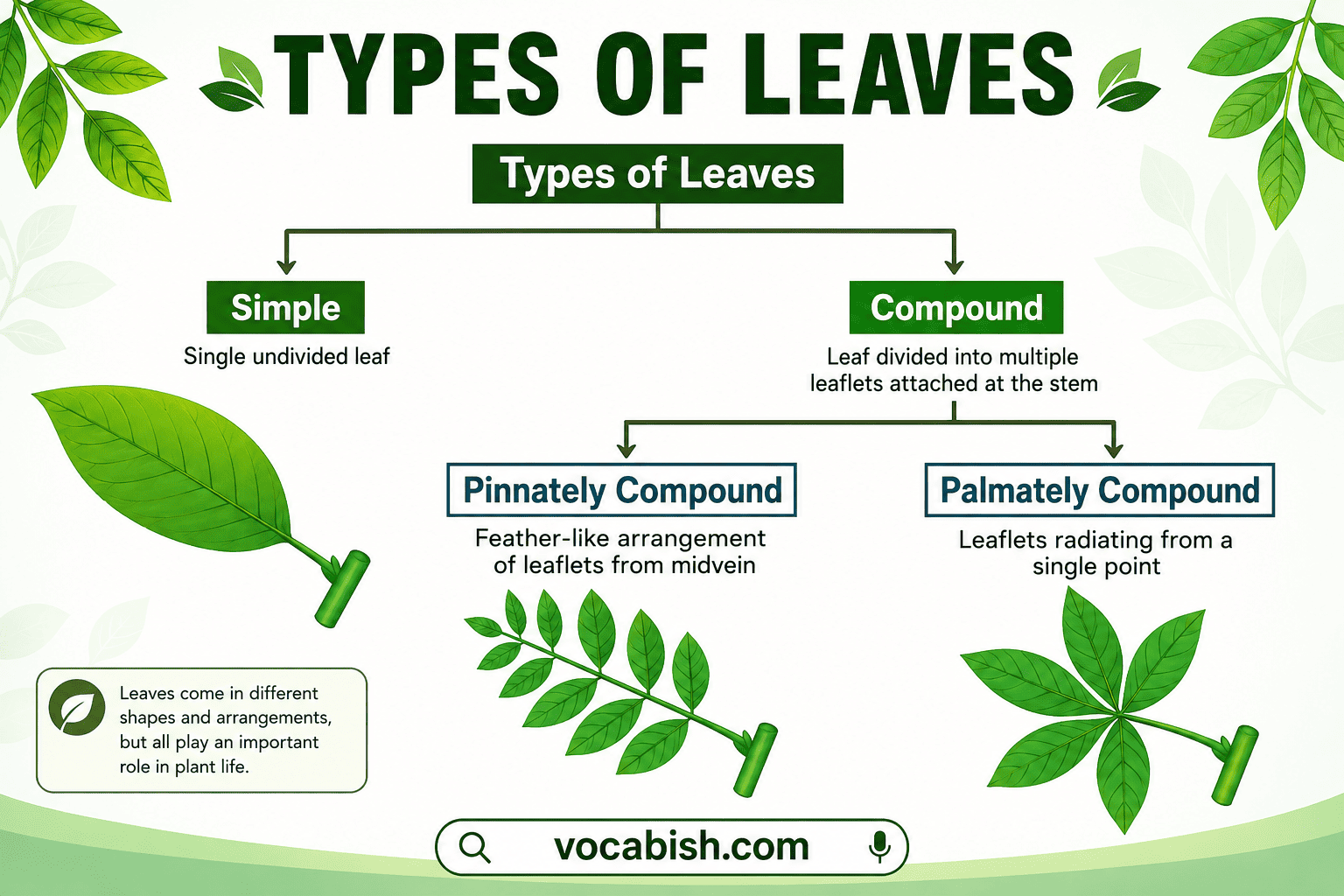
Based on structure, the two main types of leaves are:
- Simple leaves
- Compound leaves
A simple leaf has one complete blade. A compound leaf has a blade divided into smaller sections called leaflets.
Leaves can also be classified by their:
- Shape
- Margin or edge
- Venation
- Arrangement on the stem
- Method of attachment
- Lifespan
- Special functions
These features make leaf identification more accurate than looking at size or color alone.
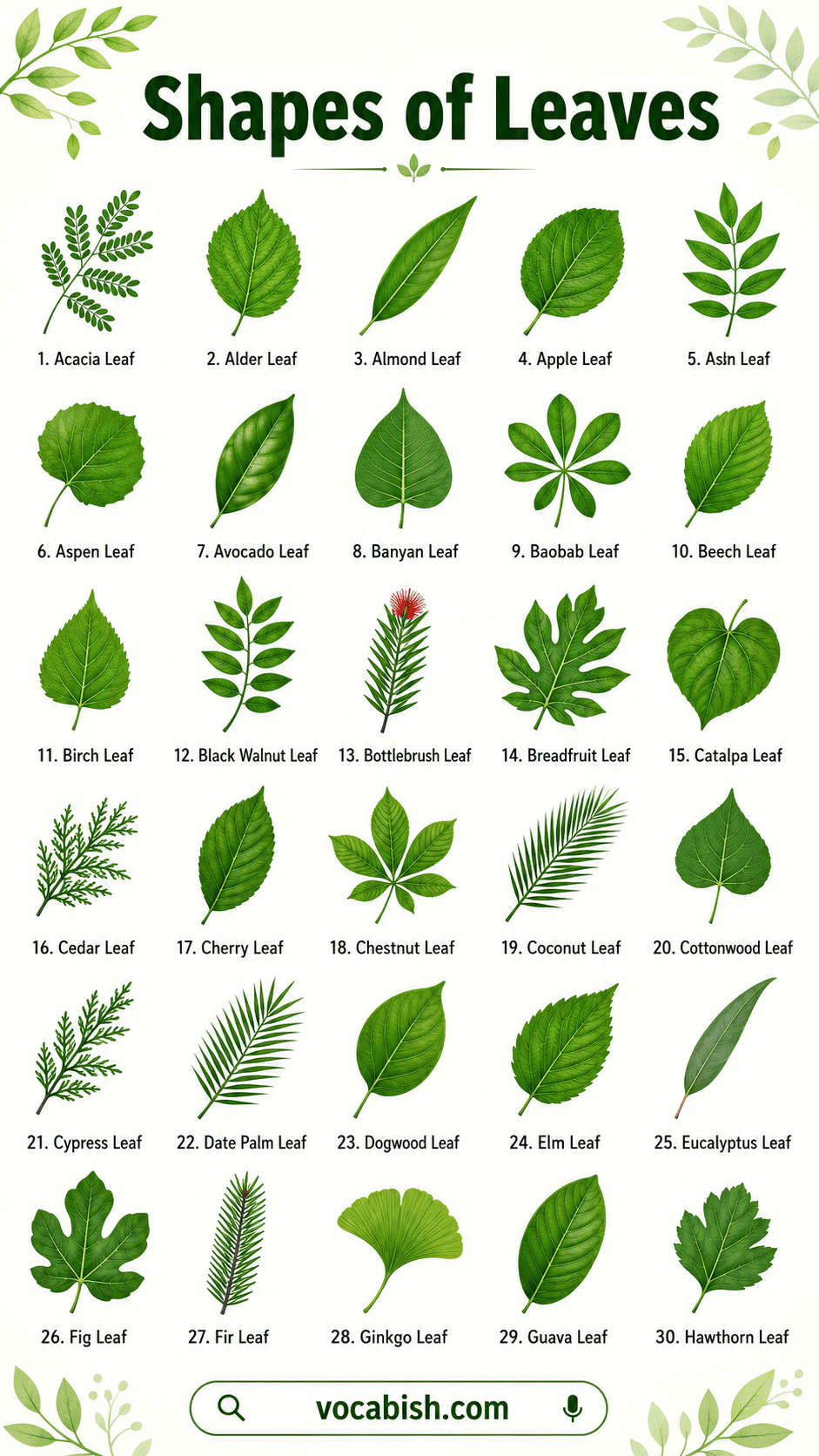
60 Types of Leaves with Their Tree Names
No. | Leaf Name | Tree Name | Main Leaf Type or Shape |
|---|---|---|---|
1 | Acacia leaf | Acacia tree | Bipinnately compound |
2 | Alder leaf | Alder tree | Simple, ovate, serrated |
3 | Almond leaf | Almond tree | Simple, lanceolate, serrated |
4 | Apple leaf | Apple tree | Simple, ovate, serrated |
5 | Ash leaf | Ash tree | Pinnately compound |
6 | Aspen leaf | Quaking aspen tree | Simple, orbicular, serrated |
7 | Avocado leaf | Avocado tree | Simple, elliptical, entire |
8 | Banyan leaf | Banyan tree | Simple, ovate, entire |
9 | Baobab leaf | Baobab tree | Palmately compound |
10 | Beech leaf | Beech tree | Simple, ovate, wavy-edged |
11 | Birch leaf | Birch tree | Simple, triangular or ovate, serrated |
12 | Black walnut leaf | Black walnut tree | Pinnately compound |
13 | Bottlebrush leaf | Bottlebrush tree | Simple, linear or lanceolate |
14 | Breadfruit leaf | Breadfruit tree | Simple, deeply lobed |
15 | Catalpa leaf | Catalpa tree | Simple, cordate, entire |
16 | Cedar leaf | Northern white-cedar tree | Scale-like |
17 | Cherry leaf | Sweet cherry tree | Simple, elliptical, serrated |
18 | Chestnut leaf | Chinese chestnut tree | Simple, oblong, sharply serrated |
19 | Coconut leaf | Coconut palm tree | Pinnately compound frond |
20 | Cottonwood leaf | Eastern cottonwood tree | Simple, deltoid, serrated |
21 | Cypress leaf | Italian cypress tree | Small, scale-like |
22 | Date palm leaf | Date palm tree | Pinnate frond |
23 | Dogwood leaf | Flowering dogwood tree | Simple, ovate, entire |
24 | Elm leaf | American elm tree | Simple, ovate, doubly serrated |
25 | Eucalyptus leaf | Eucalyptus tree | Simple, lanceolate, entire |
26 | Fig leaf | Common fig tree | Simple, palmately lobed |
27 | Fir leaf | Balsam fir tree | Flat, needle-like |
28 | Ginkgo leaf | Ginkgo tree | Simple, fan-shaped |
29 | Guava leaf | Guava tree | Simple, elliptical, entire |
30 | Hawthorn leaf | Hawthorn tree | Simple, lobed or toothed |
31 | Hazel leaf | Hazel tree | Simple, rounded or ovate, serrated |
32 | Hemlock leaf | Eastern hemlock tree | Flat, needle-like |
33 | Hickory leaf | Shagbark hickory tree | Pinnately compound |
34 | Holly leaf | American holly tree | Simple, ovate, spiny-edged |
35 | Horse chestnut leaf | Horse chestnut tree | Palmately compound |
36 | Jacaranda leaf | Jacaranda tree | Bipinnately compound |
37 | Lemon leaf | Lemon tree | Simple, elliptical, finely serrated |
38 | Linden leaf | Linden tree | Simple, cordate, serrated |
39 | Magnolia leaf | Southern magnolia tree | Simple, elliptical or obovate |
40 | Mango leaf | Mango tree | Simple, lanceolate, entire |
41 | Maple leaf | Sugar maple tree | Simple, palmately lobed |
42 | Mulberry leaf | White mulberry tree | Simple, ovate or cordate, serrated |
43 | Neem leaf | Neem tree | Pinnately compound |
44 | Oak leaf | English oak tree | Simple, deeply lobed |
45 | Olive leaf | Olive tree | Simple, lanceolate, entire |
46 | Orange leaf | Orange tree | Simple, elliptical or ovate |
47 | Pear leaf | Pear tree | Simple, ovate, finely serrated |
48 | Pecan leaf | Pecan tree | Pinnately compound |
49 | Peepal leaf | Peepal tree | Simple, cordate, long-pointed |
50 | Pomegranate leaf | Pomegranate tree | Simple, narrow oblong, entire |
51 | Redbud leaf | Eastern redbud tree | Simple, cordate, entire |
52 | Rubber leaf | Rubber tree | Simple, elliptical, entire |
53 | Sal leaf | Sal tree | Simple, ovate-oblong, entire |
54 | Sassafras leaf | Sassafras tree | Simple, entire or lobed |
55 | Silver dollar leaf | Silver dollar eucalyptus tree | Simple, orbicular |
56 | Spruce leaf | Norway spruce tree | Single, needle-like |
57 | Sweetgum leaf | Sweetgum tree | Simple, palmately lobed, star-shaped |
58 | Tamarind leaf | Tamarind tree | Even-pinnately compound |
59 | Teak leaf | Teak tree | Simple, large, ovate or elliptical |
60 | Tulip tree leaf | Tulip tree | Simple, four-lobed, flat-tipped |
Note: A single leaf can belong to several groups at once. For example, a mango leaf is simple in structure, lanceolate in shape, entire at the margin, and reticulate in venation. Leaf appearance may also vary slightly between species, varieties, and young or mature growth.
Types of Leaf Based on Structure
Leaf structure tells us whether the blade remains whole or divides into separate leaflets. This is one of the first features to check when identifying a plant.
Simple Leaf
A simple leaf has one continuous, undivided leaf blade. It may have shallow or deep lobes, but the cuts do not divide the blade into separate leaflets.
Each complete leaf has an axillary bud where its base joins the stem. This bud can later grow into a new branch, flower, or shoot.
Common examples of simple leaves include:
- Mango
- Guava
- Hibiscus
- Peepal
- Banana
- Oak
An oak leaf may have deep lobes, but it remains a simple leaf because the blade does not separate into individual leaflets.
Compound Leaf
A compound leaf has a blade divided into two or more smaller parts called leaflets. All the leaflets together form one complete leaf.
Individual leaflets may look like small leaves, but they do not have axillary buds at their bases. The axillary bud appears only at the base of the complete compound leaf.
Examples include:
- Neem
- Rose
- Acacia
- Horse chestnut
- Clover
- Gulmohar
Compound leaves may be pinnate or palmate, depending on how their leaflets are arranged.
Pinnately Compound Leaf
A pinnately compound leaf has leaflets arranged on both sides of a central stalk called the rachis. The arrangement often looks like a feather.
Pinnately compound leaves can be divided into several forms:
- Unipinnate: Leaflets attach directly to one central rachis
- Bipinnate: The main rachis divides into secondary branches carrying leaflets
- Tripinnate: The divisions occur three times
- Decompound: The leaf divides repeatedly into many smaller sections
Neem and rose have unipinnate leaves. Acacia and gulmohar commonly have bipinnate leaves.
Palmately Compound Leaf
In a palmately compound leaf, all the leaflets grow from one point at the end of the petiole. The arrangement resembles fingers spreading from the palm of a hand.
Common examples include:
- Horse chestnut
- Silk cotton
- Clover
- Lupine
The number of leaflets may vary. Some plants have three leaflets, while others have five, seven, or more.
Simple Leaf vs Compound Leaf
The easiest way to separate simple and compound leaves is to examine the blade and look for an axillary bud.
Feature | Simple Leaf | Compound Leaf |
|---|---|---|
Leaf blade | One complete blade | Divided into separate leaflets |
Cuts | Do not divide the blade into leaflets | Divisions reach the central stalk |
Axillary bud | Present at the base of the leaf | Present only at the base of the complete leaf |
Individual leaflet buds | Not applicable | Absent |
General appearance | One blade | A group of smaller leaflets |
Examples | Mango, guava, hibiscus | Neem, rose, acacia |
Do not identify a compound leaf by size alone. A large leaf can be simple, while a small leaf can be compound. Always check the divisions and the position of the axillary bud.
Types of Leaves Based on Shape
Leaf shape is one of the most noticeable plant features. To identify it correctly, look at the complete outline of the blade rather than focusing only on its tip.
Linear Leaf
A linear leaf is long, narrow, and almost equal in width from the base to the tip. Its sides usually run nearly parallel.
Examples: Grass, wheat, rice, and many other cereal plants.
Lanceolate Leaf
A lanceolate leaf is long and narrow but wider near the middle or lower section. It gradually becomes pointed toward both ends, giving it a lance-like appearance.
Examples: Willow and oleander.
Ovate Leaf
An ovate leaf resembles the shape of an egg. It is broader near the base and becomes narrower toward the tip.
Examples: Hibiscus and many basil varieties.
Elliptical Leaf
An elliptical leaf is broadest in the middle and narrows evenly toward both ends. Its shape is balanced and oval-like.
Examples: Guava and rubber plant.
Cordate Leaf
A cordate leaf has a heart-shaped blade with a noticeable notch at the base. The tip may be pointed or slightly rounded.
Examples: Betel leaf, morning glory, and sweet potato.
Needle-Shaped Leaf
A needle-shaped leaf is thin, narrow, and pointed. This shape reduces the surface area exposed to dry air and helps limit water loss.
Examples: Pine, fir, and spruce.
Orbicular Leaf
An orbicular leaf is almost round or circular. It may have a smooth, wavy, or slightly toothed margin.
Examples: Water lily and nasturtium.
Leaf Shape | Main Feature | Common Example |
|---|---|---|
Linear | Long and equally narrow | Grass |
Lanceolate | Long with pointed ends | Willow |
Ovate | Broad near the base | Hibiscus |
Elliptical | Broadest in the middle | Guava |
Cordate | Heart-shaped | Betel leaf |
Needle-shaped | Thin and pointed | Pine |
Orbicular | Nearly circular | Water lily |
Classification by Leaf Margin
The leaf margin is the outer edge of the blade. Its pattern provides an important clue when identifying trees, shrubs, herbs, and flowering plants.
Entire Margin
An entire margin is smooth and has no teeth, deep cuts, or strong waves.
Examples: Mango and banyan leaves.
Serrated Margin
A serrated margin has sharp, saw-like teeth that point toward the leaf tip.
Examples: Rose and elm leaves.
The word “serrated” comes from the appearance of a saw blade.
Dentate Margin
A dentate margin also has teeth, but they generally point outward rather than toward the leaf tip.
The teeth may be broad or sharp, depending on the species.
Crenate Margin
A crenate margin has rounded teeth or scalloped edges. Unlike serrated margins, its projections are not sharp.
Example: Indian pennywort.
Lobed Margin
A lobed margin has deep rounded or pointed sections called lobes. The cuts do not completely divide the blade into separate leaflets.
Examples: Oak, maple, and fig leaves.
Margin Type | Appearance | Example |
|---|---|---|
Entire | Smooth edge | Mango |
Serrated | Sharp teeth pointing forward | Rose |
Dentate | Teeth pointing outward | Various herbs |
Crenate | Rounded, scalloped edge | Indian pennywort |
Lobed | Deep rounded or pointed sections | Oak |
Leaf Types Based on Venation
Venation is the arrangement of veins and smaller vein branches within the leaf blade. Veins support the leaf and transport water, minerals, and prepared food.
The two main patterns are reticulate venation and parallel venation.
Reticulate Venation
In reticulate venation, smaller veins branch from larger veins and form a net-like pattern across the blade.
This pattern is common in many dicot plants, although it is not an absolute rule for every species.
Examples: Mango, rose, guava, hibiscus, and peepal.
Pinnate Reticulate Venation
Pinnate reticulate venation has one main midrib. Smaller side veins branch from it and form a network.
The complete pattern resembles a feather.
Examples: Mango and peepal.
Palmate Reticulate Venation
In palmate reticulate venation, several main veins spread from one point near the base of the leaf. Smaller veins connect them to form a network.
The pattern resembles fingers spreading from a palm.
Examples: Castor, papaya, and grapevine.
Parallel Venation
In parallel venation, the veins run side by side from the base toward the tip. They do not usually form a clearly visible net-like pattern.
Parallel venation is common in monocot plants, especially grasses and cereal crops.
Examples: Grass, wheat, maize, rice, and banana.
Pinnate Parallel Venation
Pinnate parallel venation has a clear central midrib. Smaller veins run almost parallel to one another from the midrib toward the margin.
Example: Banana.
Palmate Parallel Venation
In palmate parallel venation, several main veins spread from the leaf base in a fan-like pattern. The smaller veins remain mostly parallel.
Example: Fan palm.
Venation Type | Pattern | Common Examples |
|---|---|---|
Pinnate reticulate | One midrib with a vein network | Mango, peepal |
Palmate reticulate | Several main veins forming a network | Castor, grapevine |
Pinnate parallel | Parallel veins beside one midrib | Banana |
Palmate parallel | Parallel veins spreading from the base | Fan palm |
Leaves Based on Their Arrangement on the Stem
The arrangement of leaves on a stem or branch is called phyllotaxy. This arrangement helps plants receive sunlight efficiently without every leaf completely blocking the one below it.
Alternate Arrangement
In an alternate arrangement, one leaf grows at each node. The leaves appear on alternating sides of the stem.
Examples: Mango, sunflower, hibiscus, and mustard.
Some alternate leaves form a spiral pattern as they grow upward.
Opposite Arrangement
In an opposite arrangement, two leaves grow from the same node on opposite sides of the stem.
Examples: Guava, mint, jasmine, and basil.
The pairs may grow directly above one another or turn at right angles from one node to the next.
Whorled Arrangement
In a whorled arrangement, three or more leaves grow from the same node and circle the stem.
Examples: Oleander and Alstonia.
Arrangement | Leaves at Each Node | Example |
|---|---|---|
Alternate | One | Mango |
Opposite | Two | Guava |
Whorled | Three or more | Oleander |
Classification by Leaf Attachment
Leaves can also be grouped by how their bases connect to the plant stem.
Petiolate Leaf
A petiolate leaf connects to the stem through a visible stalk called a petiole. The petiole positions the blade where it can receive light and move with the air.
Examples: Mango, guava, and hibiscus.
Petiole length can differ greatly between species.
Sessile Leaf
A sessile leaf has no petiole. Its blade attaches directly to the stem.
Examples: Aloe, safflower, and some grass-like plants.
Some sessile leaves partially surround the stem at their base.
Sheathing Leaf
A sheathing leaf has an extended base that wraps partly or completely around the stem.
This type of attachment is common in grasses.
Examples: Wheat, maize, rice, and bamboo.
Types of Leaves Based on Lifespan
Plants do not keep their leaves for the same length of time. Some lose them during a particular season, while others replace them gradually.
Deciduous Leaves
Deciduous leaves fall from the plant during a particular season each year. The plant may shed them before winter or during a dry season to save water and energy.
Examples: Maple, oak, birch, and many temperate fruit trees.
Before falling, the leaves may change color because the green chlorophyll breaks down.
Evergreen Leaves
Evergreen leaves remain on the plant for more than one growing season. However, they do not stay forever. The plant replaces older leaves gradually while continuing to look green.
Examples: Pine, fir, mango, and many tropical trees.
Evergreen leaves are often thick, tough, waxy, or needle-shaped, depending on the environment.
Marcescent Leaves
Marcescent leaves become dry and dead but remain attached to the plant for some time. They may stay through winter and fall when new growth begins.
This feature can appear on young beech and oak trees.
Modified Leaves and Their Functions
Not every leaf has a broad, flat blade. In some plants, leaves change their form to perform special jobs such as protection, climbing, food storage, water storage, or insect trapping.
Leaf Spines
Leaf spines are sharp structures formed from modified leaves or parts of leaves. They protect the plant from animals and reduce the surface area through which water can escape.
Example: Cactus.
In many cacti, the green stem performs photosynthesis while the leaves remain modified as spines.
Leaf Tendrils
Leaf tendrils are thin, sensitive, coiling structures that help weak-stemmed plants climb. They wrap around nearby support when they touch it.
Example: Pea plant.
In peas, some leaflets change into tendrils while the other parts of the leaf remain visible.
Storage Leaves
Storage leaves become thick or fleshy because they hold water or food.
Examples:
- Aloe stores water in its thick leaves.
- Onion stores food in fleshy underground leaf bases.
- Succulents store water for dry conditions.
These leaves help plants survive when water or nutrients are temporarily unavailable.
Insectivorous Leaves
Insectivorous leaves trap and digest insects. These plants usually grow in soils that lack important nutrients, especially nitrogen.
Examples:
- Venus flytrap
- Pitcher plant
- Sundew
- Bladderwort
The plant still makes food through photosynthesis. It captures insects mainly to obtain extra minerals and nutrients.
Reproductive Leaves
Reproductive leaves produce buds or small plantlets that can grow into new plants.
Example: Bryophyllum.
Tiny plantlets develop along the margins of a Bryophyllum leaf. When they fall onto suitable soil, they may form roots and grow independently.
Quick Comparison of Major Leaf Types
Classification Basis | Main Types | Key Feature | Example |
|---|---|---|---|
Structure | Simple, compound | Whether the blade is divided | Mango, neem |
Shape | Linear, ovate, cordate | Overall outline of the blade | Grass, hibiscus |
Margin | Entire, serrated, lobed | Pattern of the outer edge | Mango, rose |
Venation | Reticulate, parallel | Arrangement of veins | Guava, maize |
Arrangement | Alternate, opposite, whorled | Position of leaves on the stem | Mango, guava |
Attachment | Petiolate, sessile, sheathing | Connection between leaf and stem | Hibiscus, aloe |
Lifespan | Deciduous, evergreen, marcescent | How long the leaf remains attached | Maple, pine |
Modification | Spines, tendrils, storage leaves | Special function of the leaf | Cactus, pea |
One leaf can belong to several categories at the same time. For example, a mango leaf is simple, lanceolate, entire, petiolate, alternately arranged, and reticulate-veined.
How to Identify Different Types of Leaves
You do not need advanced equipment to identify common leaf types. Start with the most visible features and examine them in a logical order.
- Check the blade. Decide whether it is whole or divided into separate leaflets.
- Look for an axillary bud. A true leaf has a bud at its base, but an individual leaflet does not.
- Observe the shape. Check whether the blade is linear, ovate, elliptical, heart-shaped, circular, or needle-like.
- Examine the margin. Look for smooth, toothed, rounded, serrated, or lobed edges.
- Study the veins. Decide whether they form a network or run mostly parallel.
- Check the attachment. See whether the leaf has a petiole or connects directly to the stem.
- Observe the stem arrangement. Count how many leaves grow from each node.
- Notice the texture. Some leaves are smooth, hairy, leathery, waxy, or fleshy.
- Compare several leaves. Avoid identifying a plant from one damaged or unusually shaped leaf.
- Use a labeled reference. Compare your observations with a trusted plant guide or botanical image.
Color alone is not a reliable identification feature. Leaf color can change because of age, season, sunlight, disease, or nutrient levels.
Why Do Plants Have Different Leaf Types?
Plants develop different leaf features because they live in different environments. Leaf shape and structure help a plant collect sunlight, manage water, exchange gases, avoid damage, and survive changes in temperature.
For example:
- Broad leaves provide a large surface for collecting sunlight.
- Needle-shaped leaves reduce water loss and can withstand cold or dry air.
- Thick, fleshy leaves store water for dry periods.
- Waxy surfaces slow down water loss.
- Hairy leaves may reflect strong sunlight or trap a layer of protective air.
- Leaf spines protect plants from grazing animals.
- Drip tips help rainwater flow quickly from leaves in wet forests.
- Floating leaves spread across the water surface to receive light.
- Climbing tendrils help plants reach brighter areas without developing thick stems.
A leaf’s form is therefore not random. It often reflects the conditions in which the plant grows and the challenges it must overcome.
FAQs About Types of Leaves
The two main types based on structure are simple leaves and compound leaves. A simple leaf has one continuous blade, while a compound leaf divides into separate leaflets. Mango has simple leaves, whereas neem and rose have compound leaves.
A complete leaf has an axillary bud at the point where it joins the stem. A leaflet does not have an axillary bud at its own base. Several leaflets may form one compound leaf, as seen in neem and rose plants.
The main types are reticulate venation and parallel venation. Reticulate veins form a network, as in mango leaves. Parallel veins run beside one another, as in grass, wheat, maize, and banana leaves.
The three main arrangements are alternate, opposite, and whorled. Alternate leaves grow one at each node, opposite leaves grow in pairs, and whorled leaves grow in groups of three or more from the same node.
A neem leaf is pinnately compound. Its small leaflets grow on both sides of a central rachis. The entire group forms one leaf, and the axillary bud appears only at the base of the complete compound leaf.
A mango plant has simple, petiolate leaves with pinnate reticulate venation. The leaves usually have an entire margin and grow alternately on the stem. Their shape is generally lanceolate or narrowly elliptical.
A modified leaf has changed from the usual flat form to perform a special function. It may protect the plant, store water or food, help it climb, trap insects, or produce new plants. Examples include cactus spines and pea tendrils.
Parallel venation commonly appears in monocot plants such as grass, maize, wheat, rice, and banana. Their veins run from the base toward the tip in nearly parallel lines instead of forming a net-like pattern.
Conclusion
Leaves can be classified by their structure, shape, margin, venation, stem arrangement, attachment, lifespan, and special functions. Simple and compound leaves form the two main structural groups, but other visible features provide more detailed identification.
Once you learn to examine the blade, veins, edge, petiole, and position on the stem, recognizing different types of leaf becomes much easier. These features also reveal how plants collect light, save water, protect themselves, and adapt to their surroundings.
Related Resources