
Have you ever wondered why English says “a book,” “the book,” but simply “books” in another sentence? Understanding Nouns with and without Articles helps you choose a, an, the, or no article correctly.
This topic becomes much easier when you know the difference between countable and uncountable nouns, specific and general nouns, and singular and plural nouns.
What Are Nouns with and without Articles?
A noun can appear with an article or without one, depending on its meaning and the grammar of the sentence.
The three English articles are:
- a
- an
- the
When no article is used before a noun, this is often called the zero article.
Compare:
- I bought a book. → one non-specific book
- I bought the book. → a particular book
- Books are useful. → books in general
The noun stays the same, but the article changes what the listener understands.
What Are English Articles?
English articles come before nouns and help show whether something is general, specific, known, singular, or uncountable.
Article | Main use | Example |
|---|---|---|
a | One non-specific singular countable noun | a teacher |
an | One non-specific singular countable noun before a vowel sound | an apple |
the | A specific or already-known noun | the teacher |
No article | General plural or uncountable nouns in many contexts | teachers, water |
A, An, The, and Zero Article
The easiest way to understand them is to ask:
Is the noun singular and countable? Is it specific? Is it general?
For example:
- I saw a dog. → any one dog
- The dog was barking. → a particular dog
- Dogs are loyal. → dogs in general
- Water is important. → water in general
When to Use A with Nouns
Use a before a singular countable noun when you mean one person, place, animal, object, or thing without identifying a particular one.
Common uses of A
Use a when:
- talking about one non-specific thing
- mentioning something for the first time
- saying what someone is or does
- describing one member of a group
Examples:
- She bought a dress.
- He is a doctor.
- We saw a bird outside.
- I need a pen.
A depends on sound, not just spelling
Use a before a consonant sound.
- a book
- a car
- a university
- a European country
Although university begins with the letter u, it starts with a /y/ sound: “you-niversity.”
When to Use An with Nouns
Use an before a singular countable noun when the next word begins with a vowel sound.
Examples:
- an apple
- an egg
- an umbrella
- an animal
- an engineer
An also depends on pronunciation
Consider these examples:
- an hour → the h is silent
- an honest person → the h is silent
- a house → the h is pronounced
- a hotel → normally pronounced with a clear h
The important point is the sound, not simply the first letter.
When to Use The with Nouns
Use the when the listener or reader can identify exactly which person, place, object, or thing you mean.
Common uses of The
Use the when:
- the noun was already mentioned
- the noun is clear from the situation
- there is only one in a particular context
- a specific noun is being identified
Examples:
- I saw a dog. The dog was very friendly.
- Please close the door.
- The teacher is in the classroom.
- We visited the museum near our hotel.
The can be used with singular, plural, and uncountable nouns
- the book
- the books
- the water
- the information
- the students
The key question is whether the noun is specific.
When to Use Nouns Without Articles
Many nouns can be used without an article when they refer to something in general.
This is commonly called the zero article.
Plural Countable Nouns in General Statements
Use no article when talking about plural countable nouns generally.
Examples:
- Dogs make good pets.
- Teachers help students learn.
- Books can teach us new ideas.
- Cars are expensive to maintain.
Compare:
- Dogs are loyal. → dogs in general
- The dogs are loyal. → specific dogs
Uncountable Nouns in General Statements
Uncountable nouns often appear without an article when discussing a substance, idea, activity, or concept generally.
Examples:
- Water is necessary for life.
- Knowledge takes time to build.
- Information can be useful.
- Music affects people differently.
Compare:
- Water is important. → water in general
- The water is cold. → specific water
Proper Nouns Commonly Used Without Articles
Many names of people, cities, countries, streets, and languages usually do not take an article.
Examples:
- Maria lives in London.
- Ahmed speaks English.
- Japan is famous for its technology.
- Paris attracts many tourists.
Some geographical and organizational names do take the, so they should be learned individually.
Examples:
- the United States
- the United Kingdom
- the Netherlands
- the Philippines
- the Alps
- the Pacific Ocean
Countable and Uncountable Nouns
Knowing whether a noun is countable or uncountable makes article choice much easier.
Countable Nouns
Countable nouns can be counted individually.
Examples:
- a chair
- a house
- an apple
- a student
- two books
A singular countable noun usually needs a determiner such as a, an, the, my, this, or one.
Incorrect:
- I bought book.
Correct:
- I bought a book.
- I bought the book.
- I bought my book.
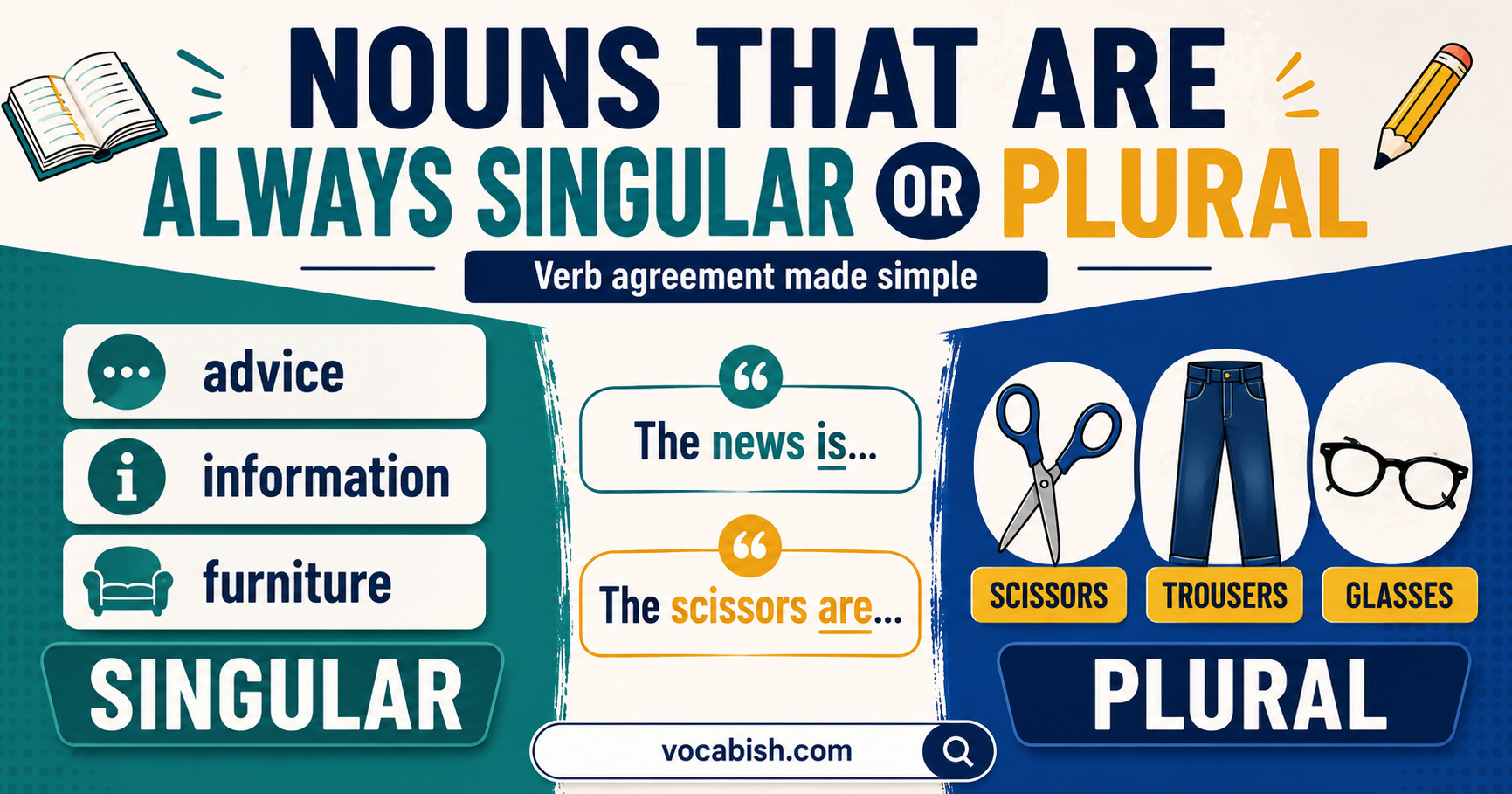
Uncountable Nouns
Uncountable nouns are not normally counted as separate individual units.
Examples:
- water
- advice
- information
- furniture
- knowledge
- rice
They commonly appear without a/an.
Incorrect:
- an advice
- an information
- a furniture
Correct:
- some advice
- some information
- some furniture
For individual units, use another expression:
- a piece of advice
- a piece of information
- a piece of furniture
Nouns with and without Articles: Complete Examples
The table below groups common nouns by their typical use. It shows how the meaning changes when an article is present or absent.
Noun | With Article | Without Article |
|---|---|---|
teacher | a teacher / the teacher | teachers |
student | a student / the student | students |
doctor | a doctor / the doctor | doctors |
nurse | a nurse / the nurse | nurses |
engineer | an engineer / the engineer | engineers |
artist | an artist / the artist | artists |
child | a child / the child | children |
parent | a parent / the parent | parents |
friend | a friend / the friend | friends |
neighbor | a neighbor / the neighbor | neighbors |
dog | a dog / the dog | dogs |
cat | a cat / the cat | cats |
bird | a bird / the bird | birds |
horse | a horse / the horse | horses |
elephant | an elephant / the elephant | elephants |
insect | an insect / the insect | insects |
rabbit | a rabbit / the rabbit | rabbits |
tiger | a tiger / the tiger | tigers |
lion | a lion / the lion | lions |
fish | a fish / the fish | fish |
house | a house / the house | houses |
school | a school / the school | schools |
hospital | a hospital / the hospital | hospitals |
library | a library / the library | libraries |
park | a park / the park | parks |
hotel | a hotel / the hotel | hotels |
restaurant | a restaurant / the restaurant | restaurants |
office | an office / the office | offices |
airport | an airport / the airport | airports |
university | a university / the university | universities |
book | a book / the book | books |
pen | a pen / the pen | pens |
chair | a chair / the chair | chairs |
table | a table / the table | tables |
computer | a computer / the computer | computers |
phone | a phone / the phone | phones |
bag | a bag / the bag | bags |
umbrella | an umbrella / the umbrella | umbrellas |
apple | an apple / the apple | apples |
orange | an orange / the orange | oranges |
sandwich | a sandwich / the sandwich | sandwiches |
cake | a cake / the cake | cakes |
egg | an egg / the egg | eggs |
banana | a banana / the banana | bananas |
rice | the rice | rice |
bread | the bread | bread |
milk | the milk | milk |
sugar | the sugar | sugar |
gold | the gold | gold |
silver | the silver | silver |
wood | the wood | wood |
water | the water | water |
glass | the glass | glass |
knowledge | the knowledge | knowledge |
information | the information | information |
advice | the advice | advice |
education | the education | education |
freedom | the freedom | freedom |
happiness | the happiness | happiness |
love | the love | love |
music | the music | music |
sport | the sport | sport |
work | the work | work |
school | the school | school |
breakfast | the breakfast | breakfast |
lunch | the lunch | lunch |
dinner | the dinner | dinner |
car | a car / the car | cars |
bus | a bus / the bus | buses |
train | a train / the train | trains |
bicycle | a bicycle / the bicycle | bicycles |
airplane | an airplane / the airplane | airplanes |
phone | a phone / the phone | phones |
computer | a computer / the computer | computers |
camera | a camera / the camera | cameras |
internet | the internet | internet |
tree | a tree / the tree | trees |
flower | a flower / the flower | flowers |
river | a river / the river | rivers |
mountain | a mountain / the mountain | mountains |
ocean | an ocean / the ocean | oceans |
rain | the rain | rain |
snow | the snow | snow |
sunlight | the sunlight | sunlight |
What This Table Shows:
A noun does not automatically require one fixed article. Its article depends on number, specificity, context, pronunciation, and noun type.
Compare these patterns:
- a book → one non-specific book
- the book → one specific book
- books → books in general
- the books → specific books
For an uncountable noun:
- water → water generally
- the water → particular water
Nouns with Articles vs. Nouns Without Articles
The main difference is often the level of specificity.
Structure | Typical meaning | Example |
|---|---|---|
a + singular countable noun | One non-specific item | I saw a bird. |
an + singular countable noun | One non-specific item before a vowel sound | She ate an apple. |
the + noun | A specific or identifiable item | The bird flew away. |
plural noun without article | General meaning | Birds can fly. |
uncountable noun without article | General meaning | Water is necessary. |
the + plural noun | Specific group | The birds are noisy. |
the + uncountable noun | Specific substance or idea | The water is dirty. |
When Articles Change the Meaning
An article can change a sentence from general to specific.
General vs. Specific
- Teachers need patience.
- The teachers need patience.
The first sentence refers to teachers generally. The second refers to a particular group.
Another example:
- Coffee is popular.
- The coffee is hot.
The first sentence talks about coffee in general. The second refers to particular coffee.
First Mention and Second Mention
A common pattern is:
a/an → the
Example:
- I saw a movie last night.
- The movie was funny.
The first mention introduces something. The second mention identifies the same thing.
Common Expressions with No Article
Some fixed expressions commonly appear without an article.
Examples include:
- go to school
- go to bed
- be at home
- go to work
- have breakfast
- have lunch
- have dinner
- play football
- study mathematics
- speak English
Compare:
- She goes to school every day. → school as an activity
- Her mother went to the school to meet the teacher. → a particular building
The absence of an article can change the meaning.
Proper Nouns and Articles
Names normally do not need a/an, but some proper nouns use the.
Usually Without an Article
- Ali
- Sarah
- Pakistan
- India
- London
- Asia
- Monday
- January
- English
Examples:
- Ali lives in Pakistan.
- We speak English.
- London is crowded.
Common Proper Nouns That Use The
- the United States
- the United Kingdom
- the United Arab Emirates
- the Netherlands
- the Maldives
- the Himalayas
- the Atlantic Ocean
- the Nile
These forms are established names and should be learned as complete expressions.
Common Mistakes with Articles
- Incorrect: I bought book.
Correct: I bought a book. - Incorrect: She gave me an advice.
Correct: She gave me some advice. - Incorrect: The dogs are loyal. (when talking about dogs generally)
Better: Dogs are loyal. - Incorrect: He is a honest man.
Correct: He is an honest man. - Incorrect: I went to the school every morning. (when describing the activity of attending school)
Better: I went to school every morning.
Quick Rules to Remember
- Use a for one non-specific singular countable noun before a consonant sound.
- Use an for one non-specific singular countable noun before a vowel sound.
- Use the when the noun is specific, known, identified, or clearly understood.
- Use no article for many plural nouns and uncountable nouns when speaking generally.
Remember that article choice depends on meaning and context, not just the noun itself.
FAQs Nouns With and Without Articles
Nouns with articles are nouns preceded by a, an, or the, such as a book, an apple, or the house.
Nouns without articles appear with the zero article, especially general plural nouns and uncountable nouns such as books and water.
Use a before a singular countable noun when referring to one non-specific thing beginning with a consonant sound.
Use an before a singular countable noun beginning with a vowel sound, such as an apple or an hour.
Use the when the noun is specific, already mentioned, identifiable, or understood from the situation.
Yes. Plural nouns often take no article when they refer to people or things generally, such as Students need practice.
Yes. Uncountable nouns commonly take no article when used generally, such as Milk contains calcium or Knowledge grows.
An article can signal whether a noun is general or specific, as in school for an activity and the school for a particular building.
Conclusion
Understanding Nouns with and without Articles becomes easier when you focus on the noun’s number, countability, specificity, and context.
Use a and an for singular, non-specific countable nouns. Use the for specific nouns. Use no article when general plural or uncountable nouns do not need one.
Once you compare forms such as a book, the book, books, and the books, article choice becomes much more predictable.
Explore More Related Articles