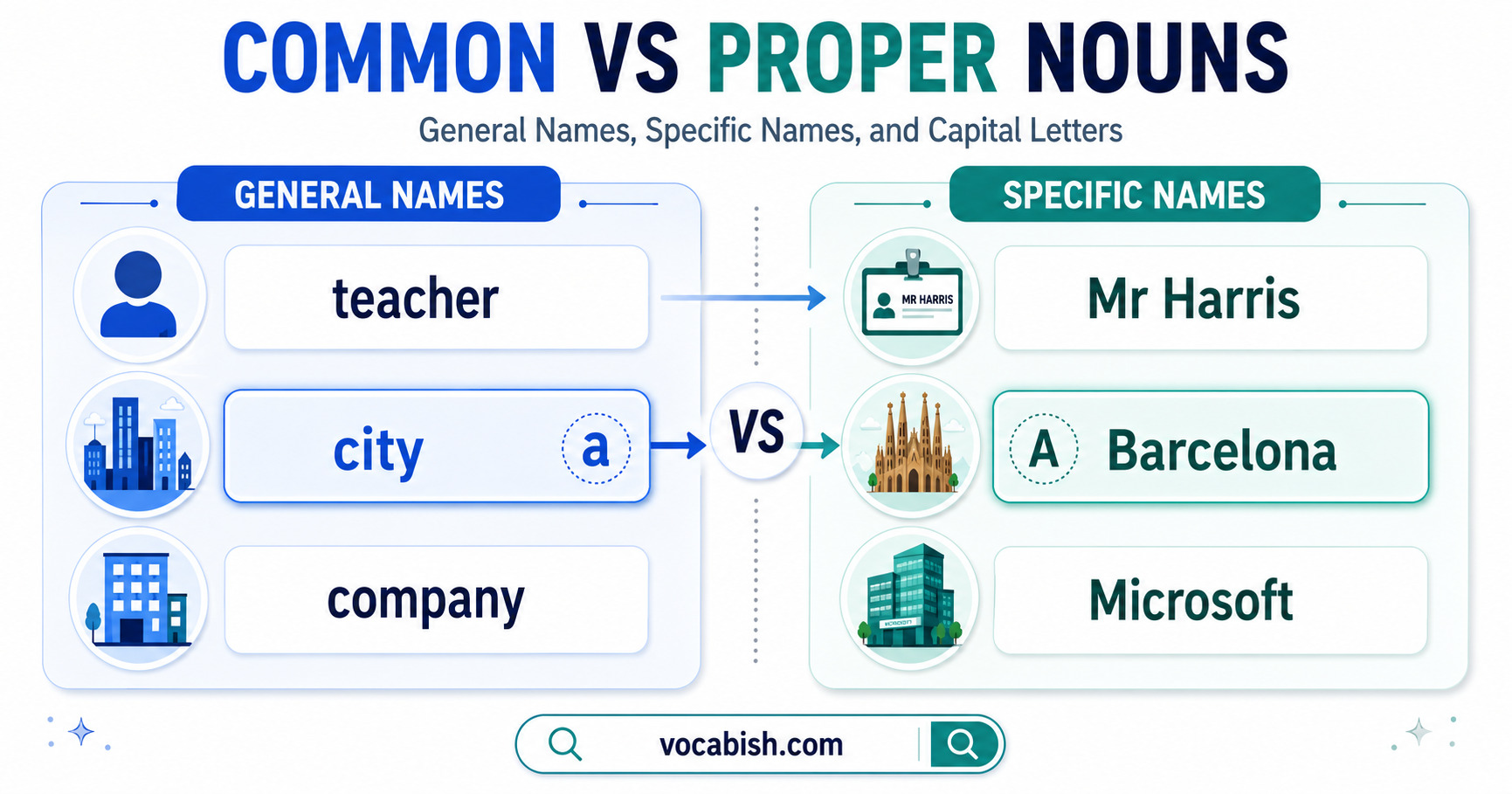

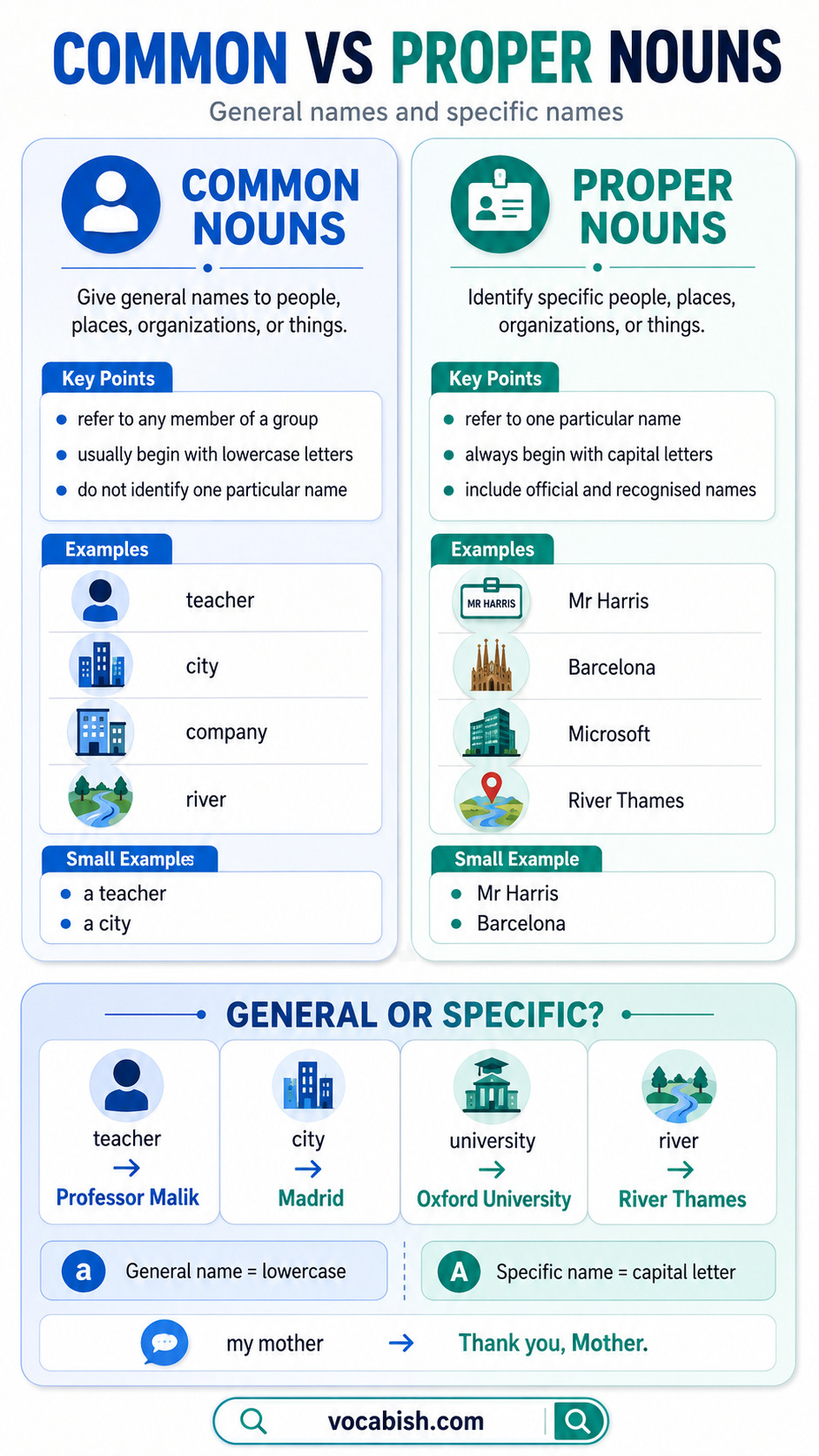
Common nouns vs proper nouns differ in one clear way: common nouns give general names, while proper nouns identify specific people, places, organizations, or things. This difference may seem small, but it determines whether a noun needs a capital letter and can even change the meaning of a sentence.
The Main Difference
Common Noun | Proper Noun |
|---|---|
Gives a general name | Gives a specific name |
Usually begins with a lowercase letter | Always begins with a capital letter |
Can refer to any member of a group | Refers to one particular person, place, or thing |
Examples: teacher, city, company | Examples: Mrs Taylor, Madrid, Samsung |
Compare:
- I spoke to a teacher.
- I spoke to Mr Harris.
In the first sentence, teacher could mean any teacher. In the second, Mr Harris identifies one particular person.
General Names and Specific Names
A common noun names a general category.
- girl
- country
- river
- restaurant
- language
- month
A proper noun names a particular member of that category.
- Aisha
- Pakistan
- the River Thames
- The Ivy
- Spanish
- September
The difference depends on specificity:
- We visited a beautiful city.
- We visited Barcelona.
- She works for a large company.
- She works for Microsoft.
Capitalization Rules
Proper nouns begin with capital letters wherever they appear in a sentence.
Rule | Example |
|---|---|
Capitalize personal names | Daniel Cooper arrived early. |
Capitalize countries and cities | She lives in France. |
Capitalize days and months | The meeting is on Monday. |
Capitalize languages and nationalities | He speaks Arabic. |
Capitalize official organizations | She works for the World Health Organization. |
Capitalize named buildings and landmarks | We photographed the Eiffel Tower. |
Capitalize brand names | They bought a Toyota. |
Common nouns remain lowercase unless they begin a sentence.
- The river flows through the town.
- Rivers provide water for farms.
Do not capitalize a word simply because it seems important. Capitalization depends on whether the word is an official or specific name.
Common and Proper Noun Pairs
Common Noun | Proper Noun |
|---|---|
boy | Hamza |
doctor | Dr Wilson |
city | Rome |
country | Italy |
ocean | the Atlantic Ocean |
mountain | Mount Everest |
school | Greenfield School |
university | Oxford University |
company | Apple |
newspaper | The Guardian |
language | French |
day | Friday |
month | December |
holiday | Eid al-Fitr |
planet | Mars |
Notice that some proper names contain common nouns:
- Oxford University
- Lake Victoria
- Central Park
- Amazon River
Words such as university, lake, park, and river are common nouns by themselves. They become part of proper nouns when included in official names.
Titles, Places, and Organizations
Titles
Capitalize a title when it appears directly before a person’s name.
- Professor Malik delivered the lecture.
- We met Doctor Evans.
- President Lewis addressed the audience.
Use lowercase when the title is general or appears after the name.
- The professor delivered the lecture.
- Dr Evans is an experienced doctor.
- Lewis became president last year.
Places
Capitalize the complete official name of a place.
- Hyde Park
- South Africa
- Buckingham Palace
- Oxford Street
- the Indian Ocean
Keep general descriptions lowercase.
- a public park
- an African country
- a royal palace
- a busy street
- a large ocean
Organizations
Capitalize the official names of businesses, schools, charities, government departments, and other organizations.
- United Nations
- Harvard University
- British Red Cross
- Ministry of Education
Use lowercase when referring to the type of organization generally.
- an international organization
- a private university
- a local charity
- a government ministry
Words That Change by Context
Some nouns can be common or proper depending on how they are used.
Common Use | Proper Use |
|---|---|
My mother is at work. | Thank you, Mother. |
His dad drives carefully. | Can you help me, Dad? |
We crossed the river. | We crossed the River Nile. |
She studies at a university. | She studies at Karachi University. |
The president gave a speech. | President Adams gave a speech. |
Soil covered the earth beneath us. | Earth moves around the Sun. |
We visited the old palace. | We visited Kensington Palace. |
The children returned to school. | They attend Westfield School. |
Family words are capitalized when they replace a person’s name or are used in direct address.
- I asked my mum for advice.
- I asked Mum for advice.
- Could you call me later, Dad?
- Her dad called yesterday.
Common Capitalization Errors
- Incorrect: We travelled to the City of london.
Correct: We travelled to the City of London. - Incorrect: She speaks english and french.
Correct: She speaks English and French. - Incorrect: My Brother studies medicine.
Correct: My brother studies medicine. - Incorrect: I will see you on monday.
Correct: I will see you on Monday. - Incorrect: He works at a Bank.
Correct: He works at a bank. - Incorrect: She works for national bank limited.
Correct: She works for National Bank Limited. - Incorrect: We spoke to Professor after class.
Correct: We spoke to the professor after class. - Incorrect: We spoke to professor Ahmed after class.
Correct: We spoke to Professor Ahmed after class.
Comparison Exercise
Choose the correct form in each sentence.
- My sister studies at (university / University).
- She attends (Oxford university / Oxford University).
- We visited (central park / Central Park).
- The children played in the (Park / park).
- I will call you on (friday / Friday).
- Her (Mother / mother) works from home.
- “Can you help me, (Mum / mum)?”
- They crossed the (River Thames / river Thames).
- Mr Khan is the school (Principal / principal).
- (Principal Khan / principal Khan) welcomed the students.
Answers:
- university
- Oxford University
- Central Park
- park
- Friday
- mother
- Mum
- River Thames
- principal
- Principal Khan
FAQs
A common noun gives a general name, while a proper noun identifies a particular person, place, organization, event, or named thing.
Yes. Proper nouns begin with capital letters because they identify specific people, places, organizations, brands, days, months, languages, or named objects.
Yes. A word can be common in a general description and proper when it forms part of an official or specific name.
Job titles are usually common nouns, but they are capitalized when placed directly before a person’s name as an official title.
Capitalize family words when they replace a name or address someone directly, but use lowercase when they follow words such as “my.”
Days and months are proper nouns and require capitals. Seasons are normally common nouns unless they appear within an official title.
Languages and nationalities are treated as proper nouns and adjectives because they refer to specific countries, cultures, peoples, or recognized language names.
Short Summary
Common nouns name general people, places, things, and ideas, while proper nouns give their specific names. Common nouns usually remain lowercase, but proper nouns always begin with capital letters. Pay close attention to official names, titles before names, family words used as names, and nouns whose capitalization changes with context.
You May Also Like