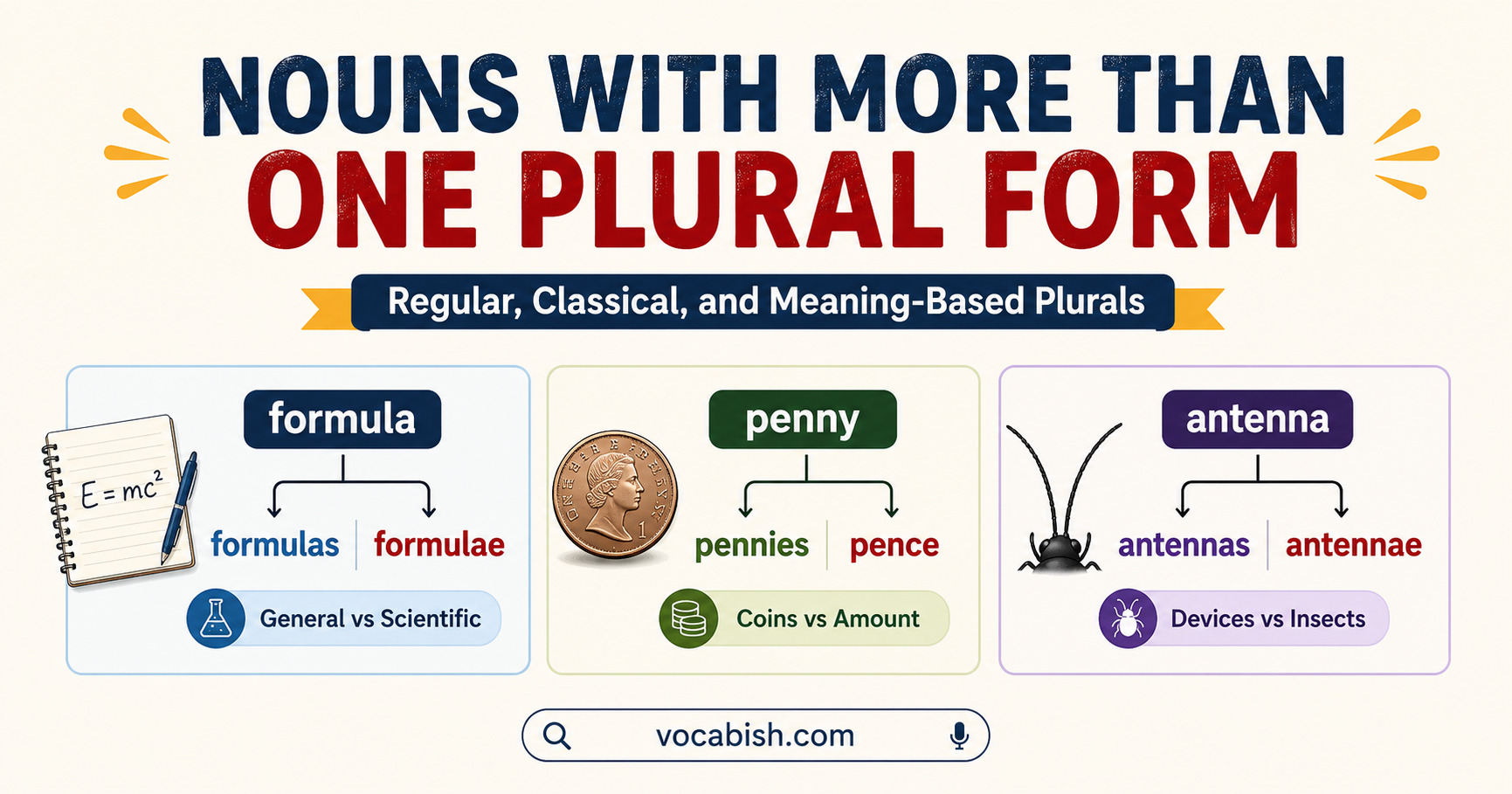

Nouns with more than one plural form are nouns that accept two or more plural forms, sometimes with the same meaning and sometimes with different meanings.
These nouns may follow a regular English pattern, retain a Latin or Greek plural, or change their plural according to context.
For example, both formulas and formulae are correct. However, pennies refers to separate coins, while pence expresses a total amount of money.
Why Some Nouns Have Two Plurals
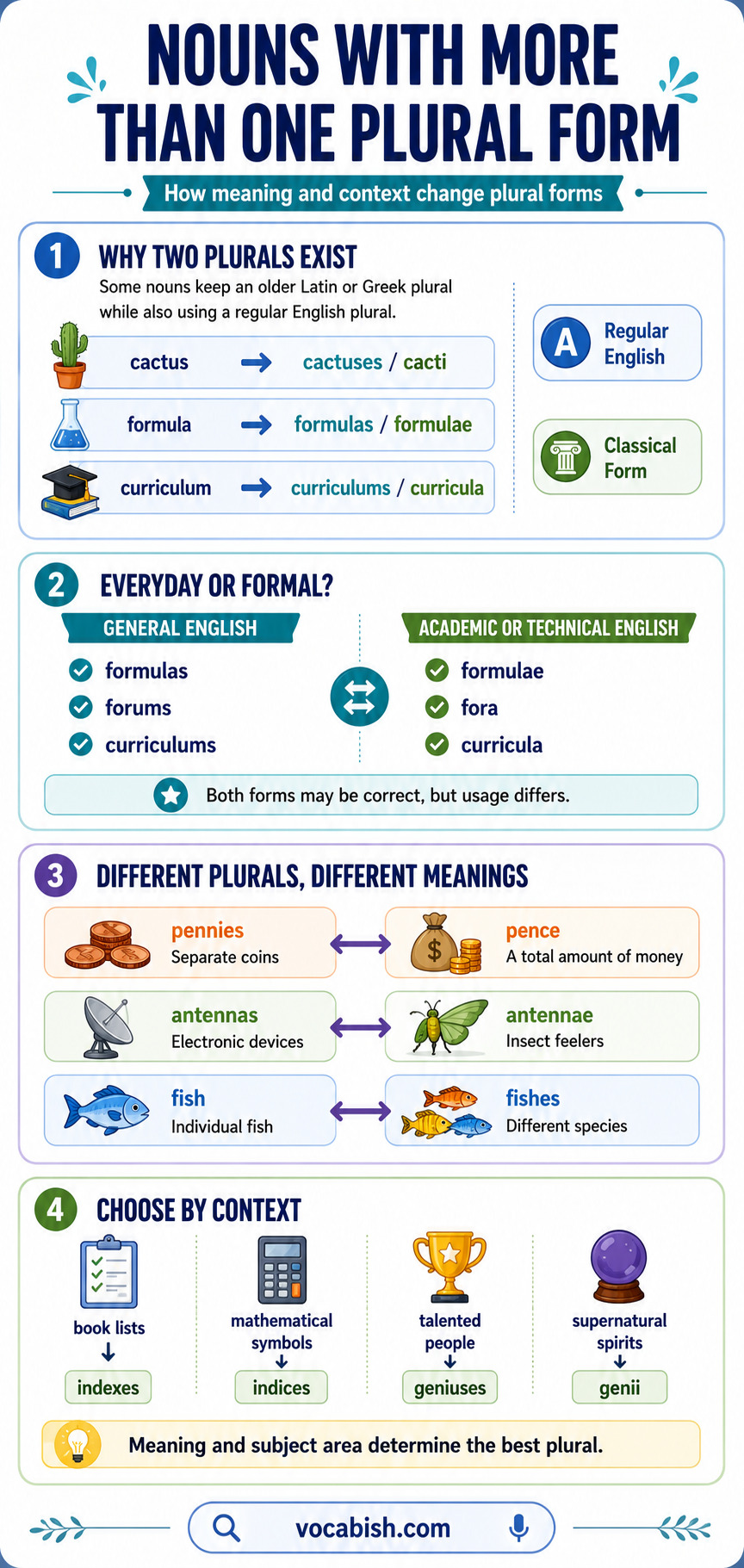
English has borrowed thousands of words from other languages. Some borrowed nouns kept their original plurals, while English speakers also created regular plurals ending in -s or -es.
Common reasons include:
- English and classical plural patterns exist together.
- Different plurals developed for different meanings.
- Academic fields retained older Latin or Greek forms.
- Everyday English favoured simpler regular plurals.
- Usage changed over time without removing the older form.
There is no single rule that works for every noun. Meaning and context usually determine the best choice.
Regular and Classical Plural Forms
A regular plural normally adds -s or -es. A classical plural follows the noun’s original Latin or Greek pattern.
Singular | Regular English plural | Classical plural |
|---|---|---|
cactus | cactuses | cacti |
curriculum | curriculums | curricula |
formula | formulas | formulae |
forum | forums | fora |
memorandum | memorandums | memoranda |
radius | radiuses | radii |
syllabus | syllabuses | syllabi |
symposium | symposiums | symposia |
vacuum | vacuums | vacua |
vertex | vertexes | vertices |
Both forms may be correct, but their frequency and setting can differ.
- Formulas is natural in general English.
- Formulae is common in scientific and mathematical writing.
- Forums is standard for online discussion spaces.
- Fora sounds formal and is uncommon in ordinary conversation.
- Vacuums usually refers to vacuum cleaners or empty spaces.
- Vacua appears mainly in physics and technical writing.
Plurals with Different Meanings
Some plural forms are not freely interchangeable. Choosing a different plural can change the meaning.
Singular | Plural form | Meaning |
|---|---|---|
antenna | antennas | Devices that receive or transmit signals |
antenna | antennae | Sensory organs of insects and other animals |
brother | brothers | Male siblings |
brother | brethren | Members of a religious or close social group |
die | dies | Tools used for cutting, shaping, or stamping |
die | dice | Small numbered objects used in games |
fish | fish | Several individual fish, usually of one or unspecified species |
fish | fishes | Different species or separate populations |
genius | geniuses | Highly intelligent or talented people |
genius | genii | Spirits or supernatural beings in older usage |
medium | media | Communication channels, artistic materials, or data formats |
medium | mediums | Spiritual communicators or particular substances and methods |
penny | pennies | Separate one-penny coins |
penny | pence | A combined amount of money |
person | people | Human beings in ordinary usage |
person | persons | Individuals in formal or legal language |
person | peoples | Separate ethnic, cultural, or national groups |
Compare the Meanings:
- I found five old pennies under the sofa.
- The notebook costs fifty pence.
- Several colourful fish were swimming near the rocks.
- The lake supports many native fishes.
- The building has three television antennas.
- A butterfly uses its antennae to sense its surroundings.
- The two brothers live in Manchester.
- The organisation provides support to its brethren abroad.
Here’s a comprehensive guide on: Regular and Irregular Plural Nouns
Formal and Everyday Plural Usage
In many cases, the regular English plural sounds more natural in conversation. The classical form may appear in academic, legal, scientific, or highly formal writing.
Everyday or general usage | Formal or specialist usage |
|---|---|
formulas | formulae |
forums | fora |
memorandums | memoranda |
curriculums | curricula |
symposiums | symposia |
indexes | indices |
focuses | foci |
spectrums | spectra |
maximums | maxima |
minimums | minima |
These are preferences rather than absolute rules. A regular form is not automatically incorrect simply because a classical form exists.
For example:
- The teachers revised the school curriculums.
- The university revised several degree curricula.
Both sentences are grammatically acceptable. The second sounds more academic.
Scientific and Academic Plurals
Technical subjects often favour classical plural forms because they help maintain established terminology.
General plural | Technical plural | Common subject area |
|---|---|---|
focuses | foci | Optics, geometry, medicine |
formulas | formulae | Mathematics and science |
genuses | genera | Biology and classification |
matrixes | matrices | Mathematics and computing |
maximums | maxima | Mathematics and statistics |
minimums | minima | Mathematics and statistics |
radiuses | radii | Geometry and anatomy |
spectrums | spectra | Physics and chemistry |
vertexes | vertices | Geometry and computer graphics |
vacuums | vacua | Physics |
Examples:
- The ellipse has two foci.
- The researchers compared several linguistic corpora.
- The programme performs calculations using large matrices.
- The graph contains two local maxima.
- The telescope recorded the stars’ light spectra.
A learner writing an academic paper should follow the terminology normally used in that subject.
Common Examples in Sentences
- Several desert cactuses grow near the house.
- The garden contains rare South American cacti.
- Two new aquariums opened in the city.
- The research centre maintains several marine aquaria.
- Our website contains searchable indexes.
- The equation uses three different indices.
- The dentist examined the tooth’s curved roots and radii.
- Her report included four detailed appendixes.
- The medical textbook shows several human appendices.
- The festival organised three public forums.
- The scholars presented their work at international symposia.
- Different teaching methods and media were tested.
- Two spiritual mediums appeared on the programme.
- The stadium’s emergency plan covers several nearby stadiums.
- Ancient cities sometimes contained large public stadia.
Frequent Plural Choice Errors
Treating Every Latin-Looking Noun the Same
Not every noun ending in -us changes to -i.
Correct:
- cactus → cactuses or cacti
- focus → focuses or foci
- virus → viruses
- campus → campuses
- bonus → bonuses
Incorrect forms include viri, campi, and boni when these words are used in ordinary English.
Assuming Both Forms Always Mean the Same Thing
Some pairs have separate meanings:
- pennies and pence
- antennas and antennae
- media and mediums
- people, persons, and peoples
- brothers and brethren
Always check the intended meaning before choosing.
Using a Classical Plural to Sound More Formal
A classical form is not always better.
- Forums is normally better than fora for internet discussion boards.
- Formulas is fully correct in general writing.
- Indexes is usually clearer for books and databases.
- Vacuums is required when referring to cleaning machines.
Creating Unaccepted Alternative Plurals
Some nouns have only one standard plural even when they resemble nouns with alternatives.
Incorrect | Correct |
|---|---|
criterions | criteria |
phenomenons | phenomena |
analysises | analyses |
childs | children |
sheeps | sheep |
informations | information |
rooves | roofs |
Misusing Octopus Plurals
The safest and most widely used plural is octopuses.
- Octopuses follows normal English plural formation.
- Octopi is widely recognised but was created through a Latin-style pattern.
- Octopodes reflects the word’s Greek origin but is rare.
For normal ESL writing, use octopuses.
List of All Nouns with More Than One Plural Form
The following table covers the most useful and widely recognised examples. English also contains rare historical and highly specialised alternatives.
Singular noun | Accepted plural forms | Main usage note |
|---|---|---|
antenna | antennas, antennae | Devices; biological feelers |
appendix | appendixes, appendices | Both accepted; preference varies |
aquarium | aquariums, aquaria | Aquaria is formal or specialist |
automaton | automatons, automata | Automata is common in computing |
brother | brothers, brethren | Siblings; group members |
cactus | cactuses, cacti | Both widely accepted |
corpus | corpuses, corpora | Corpora is common in linguistics |
curriculum | curriculums, curricula | Curricula is common academically |
die | dies, dice | Tools; gaming objects |
dwarf | dwarfs, dwarves | Dwarves is common in fantasy |
fish | fish, fishes | Individuals; different species |
focus | focuses, foci | General; technical |
formula | formulas, formulae | General; scientific or formal |
forum | forums, fora | Forums is far more common |
fungus | fungi, funguses | Fungi is the usual form |
genius | geniuses, genii | Gifted people; spirits |
genus | genera, genuses | Genera is standard in biology |
helix | helices, helixes | Helices is more common technically |
hoof | hoofs, hooves | Both accepted; hooves is common |
index | indexes, indices | Lists; mathematical indicators |
matrix | matrixes, matrices | Matrices is standard technically |
maximum | maximums, maxima | General; mathematical |
medium | media, mediums | Channels; people or substances |
memorandum | memorandums, memoranda | General; formal |
millennium | millenniums, millennia | Millennia is more common |
minimum | minimums, minima | General; mathematical |
octopus | octopuses, octopi, octopodes | Octopuses is the safest choice |
penny | pennies, pence | Separate coins; monetary amount |
person | people, persons, peoples | Ordinary, legal, or cultural use |
radius | radiuses, radii | General; technical |
scarf | scarfs, scarves | Both accepted; scarves is common |
spectrum | spectrums, spectra | General; scientific |
stadium | stadiums, stadia | Stadiums is more common |
syllabus | syllabuses, syllabi | Both accepted |
symposium | symposiums, symposia | Symposia is common academically |
tornado | tornadoes, tornados | Both accepted |
vacuum | vacuums, vacua | General; physics |
vertex | vertexes, vertices | Vertices is standard technically |
volcano | volcanoes, volcanos | Both accepted |
wharf | wharfs, wharves | Both accepted |
zero | zeros, zeroes | Both accepted |
Quick Practice
Choose the most suitable plural form.
- The butterfly moved its antenna / antennas / antennae.
- The textbook contains two alphabetical indexes / indices.
- The equation contains several numerical indexes / indices.
- I found three old pennies / pence in the drawer.
- The ticket costs seventy pennies / pence.
- The country’s news media / mediums covered the election.
- Two spiritual media / mediums attended the event.
- Researchers recorded several related fish / fishes in the river system.
- The ellipse contains two focuses / foci.
- The school updated its science curriculums / curricula.
Answers:
- antennae
- indexes
- indices
- pennies
- pence
- media
- mediums
- fishes
- foci
- curriculums or curricula
FAQs
Some nouns entered English from Latin or Greek, while others developed separate plurals for different meanings, subjects, or levels of formality.
No. Many pairs overlap, but some forms carry different meanings in use, such as pennies and pence, or antennas and antennae.
Usually, the regular English plural sounds more natural in everyday conversation, while the classical plural is common in formal or technical writing.
Both are correct. Formulas is common in general English, while formulae appears more often in scientific, mathematical, or highly formal contexts.
Use indexes for alphabetical lists, books, and databases. Use indices mainly for mathematics, economics, statistics, and other specialised technical subjects.
Fish usually refers to several individual fish. Fishes is used when discussing different species, varieties, or separate populations of fish.
Check a reliable learner’s dictionary because usage depends on meaning and context. Do not assume every Latin-looking noun keeps a classical plural.
Short Summary
- Some nouns have both regular English and classical plurals.
- The two forms may be interchangeable or carry different meanings.
- Regular forms are often more natural in everyday English.
- Classical forms remain common in scientific and academic subjects.
- Meaning determines choices such as pennies/pence and antennas/antennae.
- When uncertain, check the noun’s meaning and subject-specific usage.
You May Also Like