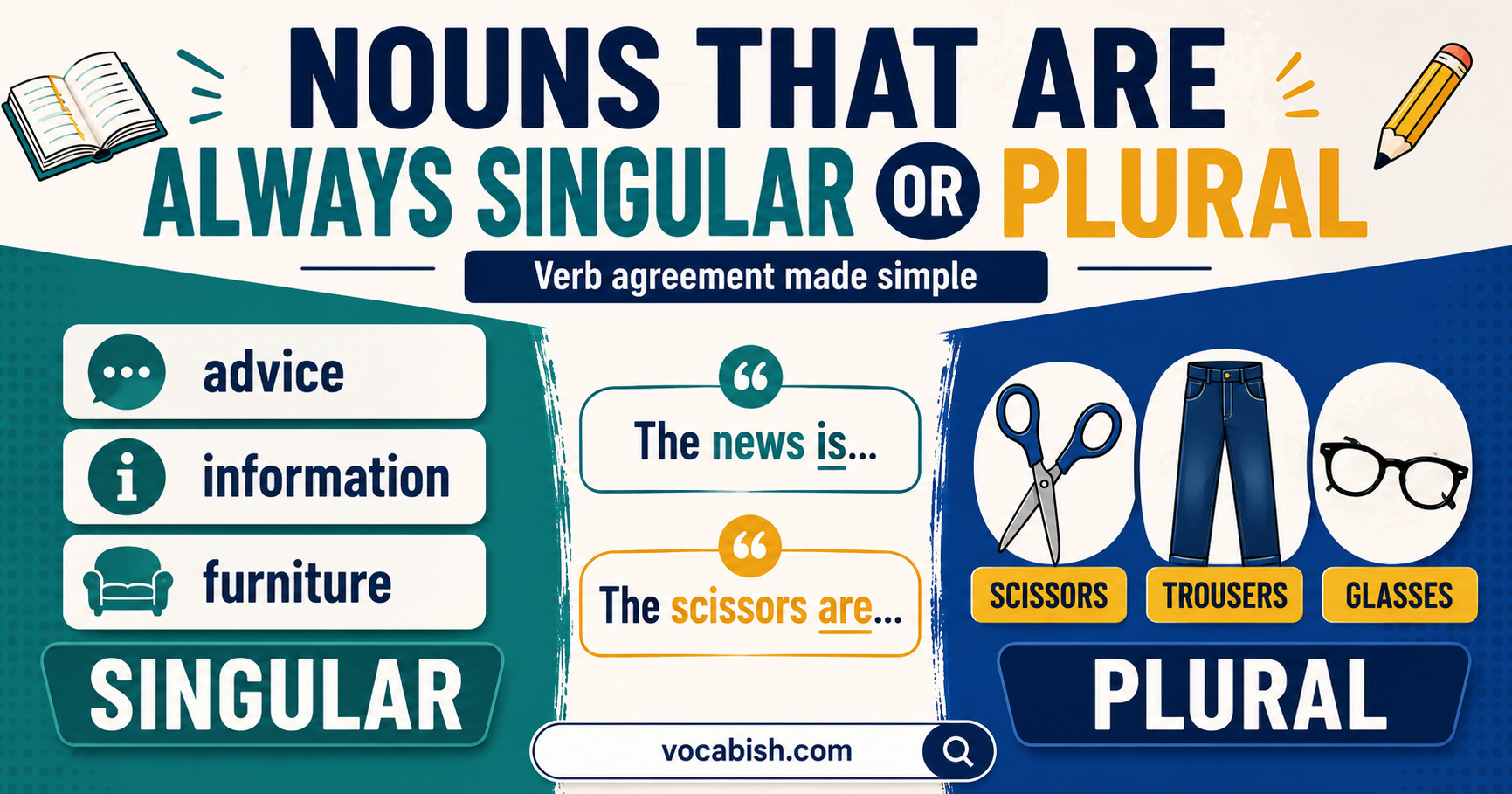

Some English nouns do not follow the usual singular and plural pattern. Words such as advice, information, and furniture are normally singular, while scissors, trousers, and police are usually plural.
Learning which nouns are always singular or plural helps you choose the correct verb, article, quantifier, and pronoun.
Singular-Only and Plural-Only Nouns
Singular-only nouns are generally treated as one grammatical unit. Many of them are uncountable, so they do not normally have plural forms.
Plural-only nouns are used with plural verbs, even when they refer to one object or one group.
Noun type | Example | Correct verb agreement |
|---|---|---|
Singular-only noun | The information | The information is useful. |
Plural-only noun | The scissors | The scissors are sharp. |
Pair noun with “a pair of” | A pair of trousers | A pair of trousers is expensive. |
Plural-looking singular noun | Mathematics | Mathematics is difficult. |
Singular-looking plural noun | Police | The police are investigating. |
Nouns Usually Used in the Singular
Many singular-only nouns describe ideas, substances, collections, or general categories. They usually:
- take a singular verb
- do not use a or an
- do not normally end in -s
- use expressions such as some, much, a piece of, or an item of
Advice
Advice is an uncountable noun. It does not normally have the plural form advices.
- Your advice is helpful.
- She gave me some advice.
- He gave me a useful piece of advice.
- I need more advice before deciding.
Incorrect: She gave me an advice.
Correct: She gave me some advice.
Incorrect: His advices were helpful.
Correct: His advice was helpful.
Use a piece of advice when referring to one suggestion.
Information
Information is singular and uncountable.
- The information is accurate.
- We need some information about the course.
- She gave me an important piece of information.
- This information comes from a reliable source.
Incorrect: I need an information.
Correct: I need some information.
Incorrect: These informations are useful.
Correct: This information is useful.
To count separate facts, use pieces of information.
Furniture
Furniture refers collectively to movable objects such as chairs, tables, beds, and cupboards.
- The furniture is new.
- We bought some furniture for the office.
- That piece of furniture is damaged.
- The room contains several items of furniture.
Incorrect: We bought three furnitures.
Correct: We bought three pieces of furniture.
Individual objects can be counted:
- two chairs
- four tables
- six items of furniture
News
Although news ends in -s, it is normally singular.
- The news is surprising.
- This news sounds encouraging.
- The latest news was announced this morning.
- I have some good news for you.
Incorrect: The news are shocking.
Correct: The news is shocking.
To refer to one report, say:
- a news story
- a news report
- a piece of news
Equipment
Equipment is an uncountable noun referring to tools, machines, or other items needed for an activity.
- The equipment is ready.
- We need new equipment for the laboratory.
- Each piece of equipment was tested.
- The workers carried several items of equipment.
Incorrect: The company bought new equipments.
Correct: The company bought new equipment.
Singular-only noun | One unit | More than one unit |
|---|---|---|
advice | a piece of advice | two pieces of advice |
information | a piece of information | several pieces of information |
furniture | an item of furniture | five items of furniture |
news | a piece of news | three news stories |
equipment | a piece of equipment | several pieces of equipment |
Nouns Usually Used in the Plural
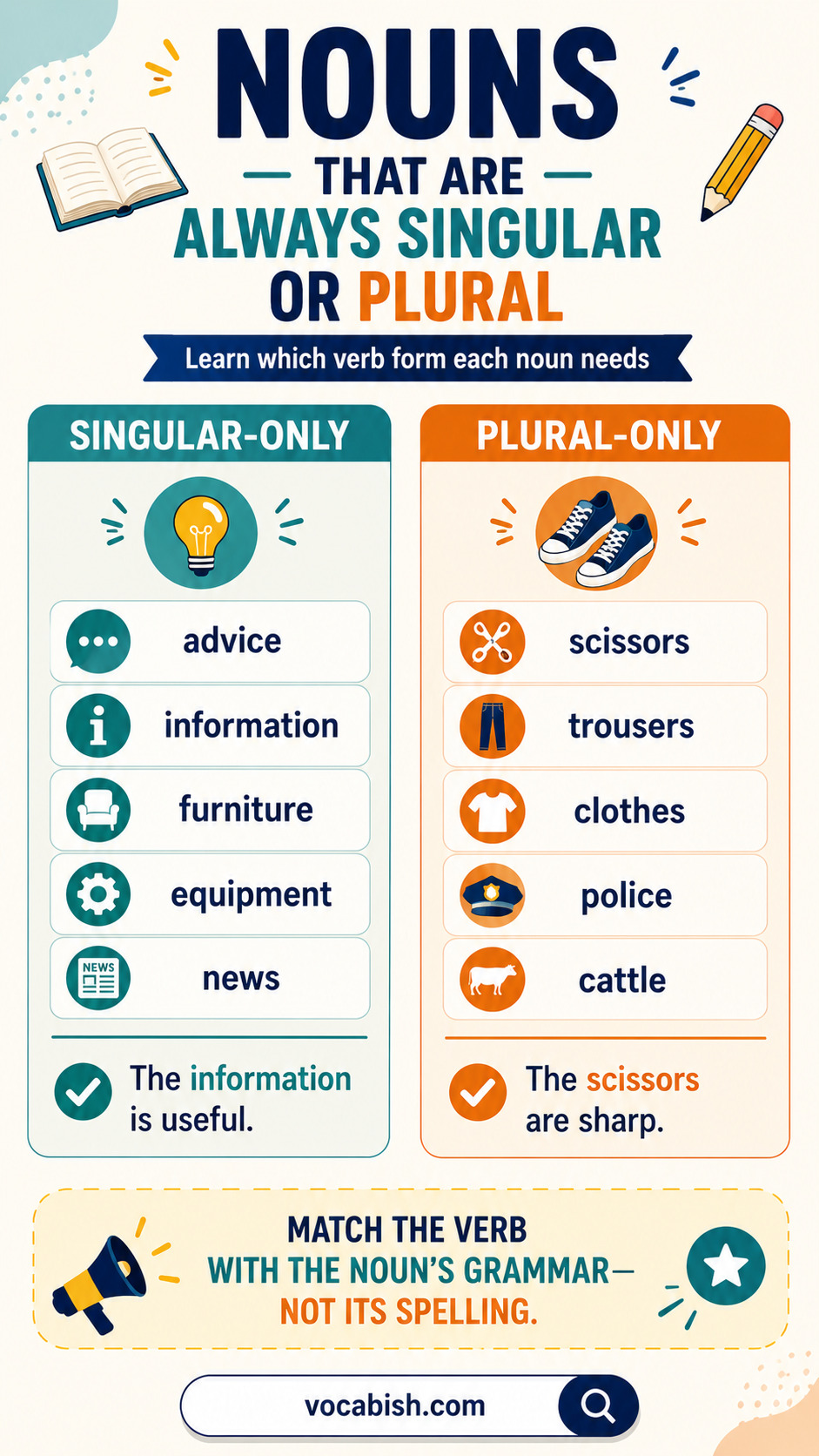
Some nouns are normally used only in the plural. They take plural verbs and plural pronouns.
Scissors
Scissors refers to a cutting tool with two joined blades.
- These scissors are sharp.
- Where are my scissors?
- The scissors were lying on the desk.
- They need cleaning.
For one object, use a pair of scissors:
- This pair of scissors is sharp.
- Two pairs of scissors are missing.
Incorrect: A scissors is on the table.
Correct: A pair of scissors is on the table.
Trousers
Trousers is a plural noun because the garment has two connected legs.
- These trousers are too long.
- My trousers need washing.
- The trousers were expensive.
- They fit me well.
For one garment, use a pair of trousers:
- This pair of trousers is comfortable.
- I bought two pairs of trousers.
Clothes
Clothes is always plural and refers to the things people wear.
- Your clothes are dry.
- Her clothes were packed in a suitcase.
- These clothes belong to me.
- My clothes need washing.
There is no singular form a clothe for one item of clothing.
Use:
- a shirt
- a dress
- a coat
- an item of clothing
- a piece of clothing
Incorrect: This clothe is expensive.
Correct: This item of clothing is expensive.
Police
Police is normally treated as plural when it refers to police officers collectively.
- The police are investigating the incident.
- The police have arrested a suspect.
- Several police officers were present.
- They are asking witnesses for information.
Incorrect: The police is coming.
Correct: The police are coming.
For one person, use:
- a police officer
- a policeman
- a policewoman
Do not say a police.
Cattle
Cattle is a plural collective noun for cows, bulls, and related farm animals.
- The cattle are grazing.
- The farmer’s cattle were moved to another field.
- These cattle belong to a local farmer.
- They need fresh water.
Incorrect: The cattle is in the field.
Correct: The cattle are in the field.
For one animal, use:
- a cow
- a bull
- an animal
- a head of cattle
Pair Nouns
Pair nouns usually describe objects made of two connected or matching parts.
Common pair nouns include:
- scissors
- trousers
- shorts
- jeans
- pyjamas
- glasses
- binoculars
- pliers
- tights
- headphones
Without “a pair of” | With “a pair of” |
|---|---|
These scissors are sharp. | This pair of scissors is sharp. |
My trousers are wet. | My pair of trousers is wet. |
Her glasses are broken. | Her new pair of glasses is broken. |
Those jeans look comfortable. | That pair of jeans looks comfortable. |
The verb agrees with the grammatical subject:
- The trousers are clean.
- The pair is clean.
- Two pairs are clean.
Singular-Looking Plural Nouns
Some nouns do not end in -s, but they have plural meanings and take plural verbs.
Noun | Correct example |
|---|---|
police | The police are questioning him. |
cattle | The cattle are feeding. |
people | Many people are waiting. |
children | The children are playing. |
men | The men were working. |
women | The women have arrived. |
Do not choose the verb only by looking at the noun’s ending. Consider its grammatical meaning.
Plural-Looking Singular Nouns
Some nouns end in -s but usually refer to one subject, field, activity, or body of information. They normally take singular verbs.
News
News is singular despite its final -s.
- The news is encouraging.
- Today’s news was unexpected.
- No news is good news.
Mathematics
Mathematics names one academic subject, so it normally takes a singular verb.
- Mathematics is my favourite subject.
- Mathematics requires regular practice.
- Applied mathematics is useful in engineering.
The shortened form maths in British English and math in American English is also singular.
Politics
When politics means the subject, profession, or general activity, it normally takes a singular verb.
- Politics is a complicated subject.
- International politics affects trade.
- Politics has always interested her.
When the word refers to someone’s political beliefs or activities, plural agreement may appear:
- His politics are difficult to describe.
- Their politics have changed over time.
Plural-looking noun | Meaning | Usual agreement |
|---|---|---|
news | reports or recent information | singular |
mathematics | an academic subject | singular |
politics | a subject or field | singular |
economics | an academic subject | singular |
physics | an academic subject | singular |
Verb Agreement Rules
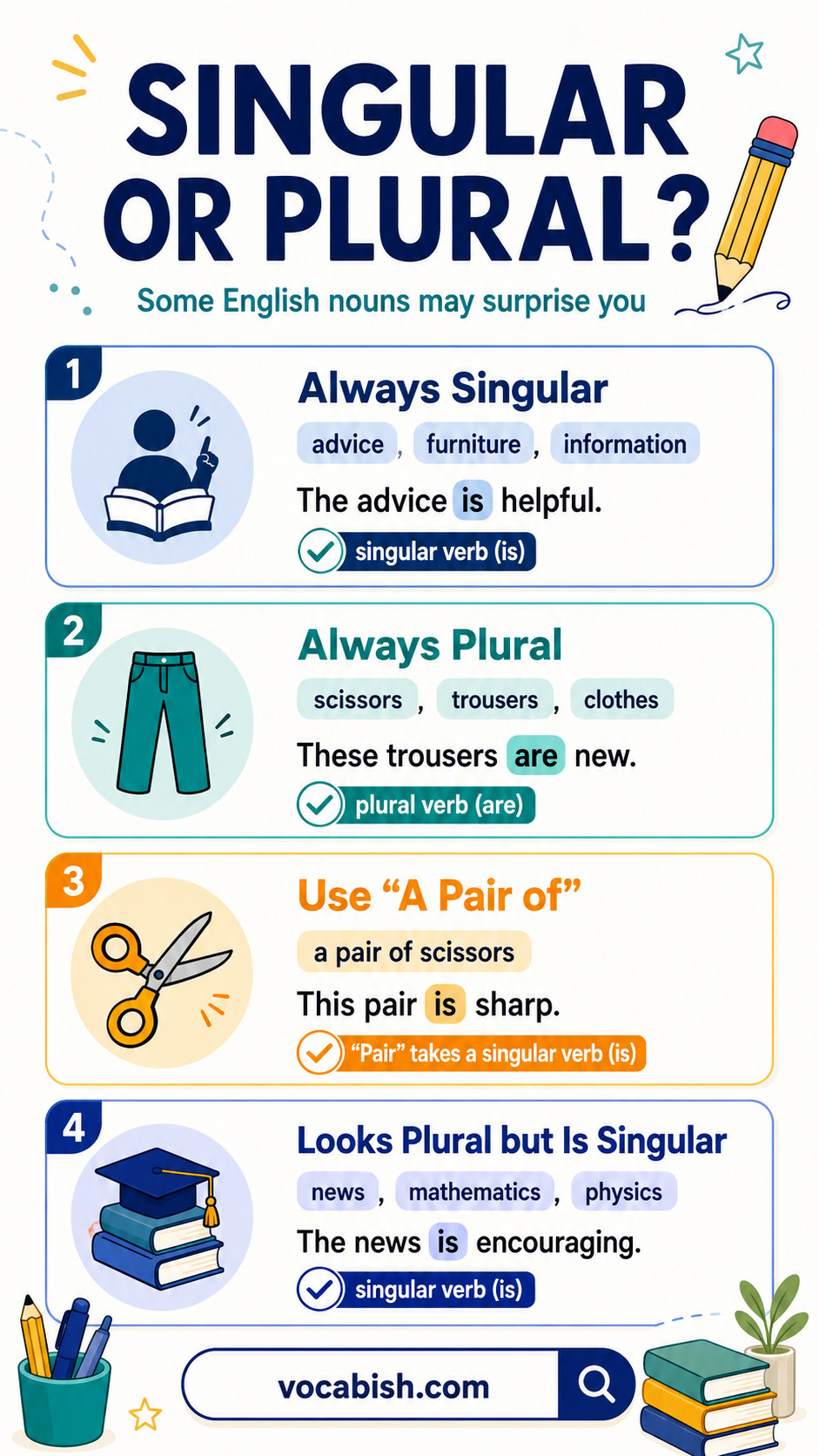
Use these rules when choosing between singular and plural verbs:
- Use a singular verb with uncountable nouns.
- The information is correct.
- The equipment was expensive.
- Use a plural verb with plural-only nouns.
- The scissors are missing.
- Her clothes were wet.
- Use a singular verb after a pair of.
- A pair of trousers is hanging outside.
- Use a plural verb after two pairs of, three pairs of, and similar expressions.
- Two pairs of trousers are hanging outside.
- Treat police, cattle, and people as plural.
- The police have arrived.
- The cattle are moving.
- Treat school subjects ending in -s as singular.
- Mathematics is useful.
- Physics requires careful study.
Explore More: Noun-Verb Agreement Rules and Examples
Common Errors You Should Avoid
- Using a plural form for an uncountable noun
Incorrect: I received many informations.
Correct: I received a lot of information. - Using “a” or “an” before an uncountable noun
Incorrect: She gave me an advice.
Correct: She gave me a piece of advice. - Using a singular verb with a plural-only noun
Incorrect: These trousers is new.
Correct: These trousers are new. - Using a plural verb with a plural-looking singular noun
Incorrect: Mathematics are difficult.
Correct: Mathematics is difficult. - Using “police” for one officer
Incorrect: A police questioned me.
Correct: A police officer questioned me. - Making “equipment” or “furniture” plural
Incorrect: We purchased several equipments and furnitures.
Correct: We purchased several pieces of equipment and furniture.
Practice Exercise
Choose the correct answer.
- The information is / are available online.
- These scissors needs / need cleaning.
- Her advice was / were helpful.
- The police has / have questioned the driver.
- Mathematics is / are taught every morning.
- My trousers is / are too loose.
- The furniture looks / look expensive.
- A pair of glasses was / were found outside.
- The cattle is / are drinking water.
- Politics is / are an interesting subject.
- We bought three equipments / pieces of equipment.
- She gave me two advices / pieces of advice.
- The news sounds / sound encouraging.
- His clothes was / were covered in dust.
- Two pairs of jeans is / are on sale.
Correct the mistakes in these sentences.
- The news are very surprising.
- I need an advice about my application.
- This scissors is not sharp.
- The police is searching the building.
- We ordered several new furnitures.
Answer Key
- is
- need
- was
- have
- is
- are
- looks
- was
- are
- is
- pieces of equipment
- pieces of advice
- sounds
- were
- are
- The news is very surprising.
- I need some advice about my application.
- These scissors are not sharp.
- The police are searching the building.
- We ordered several new pieces of furniture.
FAQs About Nouns Always Singular or Plural
They are nouns normally restricted to one grammatical number, so they consistently require either singular or plural verbs in standard English usage.
Information is an uncountable noun representing knowledge collectively, so it takes a singular verb and is counted using “pieces of information.”
News is grammatically singular, even though it ends in “-s,” so we say “the news is” rather than “the news are.”
Scissors and trousers describe objects with two connected parts, so they normally take plural verbs and may use “a pair of.”
Police normally takes a plural verb because it refers collectively to police officers; use “a police officer” when describing one person.
Furniture and equipment are uncountable nouns, so use “pieces” or “items” to count them instead of adding a plural ending.
Politics usually takes a singular verb when naming a subject, but plural agreement is possible when referring to someone’s political beliefs.
Summary on Nouns Always Singular or Plural
Some nouns remain singular because they are uncountable or name one field of study. Others remain plural because they represent groups or two-part objects. Always match the verb with the noun’s grammatical number, not simply its spelling.
You May Also Like