
English plurals are usually easy to form: add -s or -es to a singular noun. However, some nouns follow different spelling patterns, change completely, or stay the same.
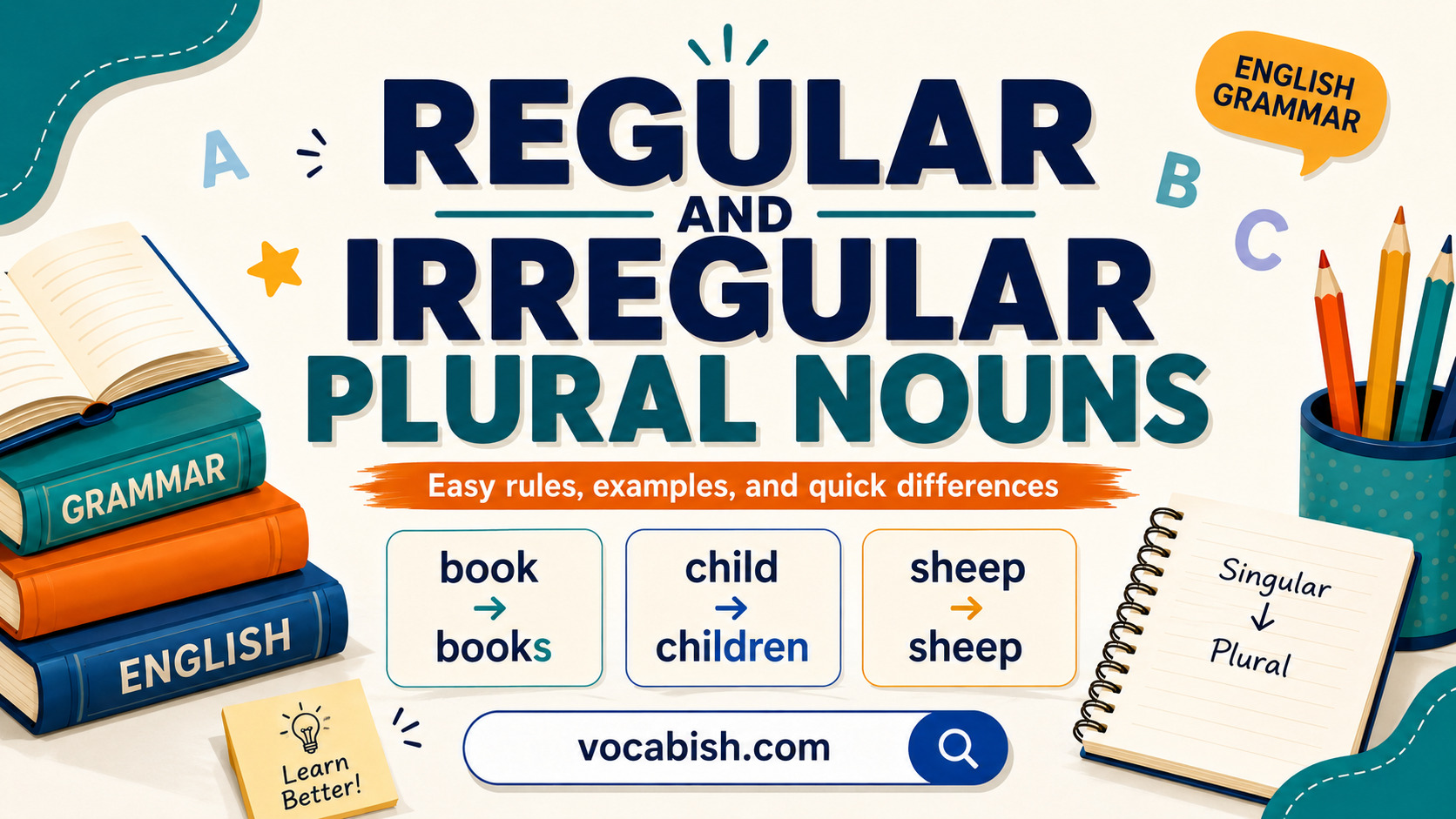
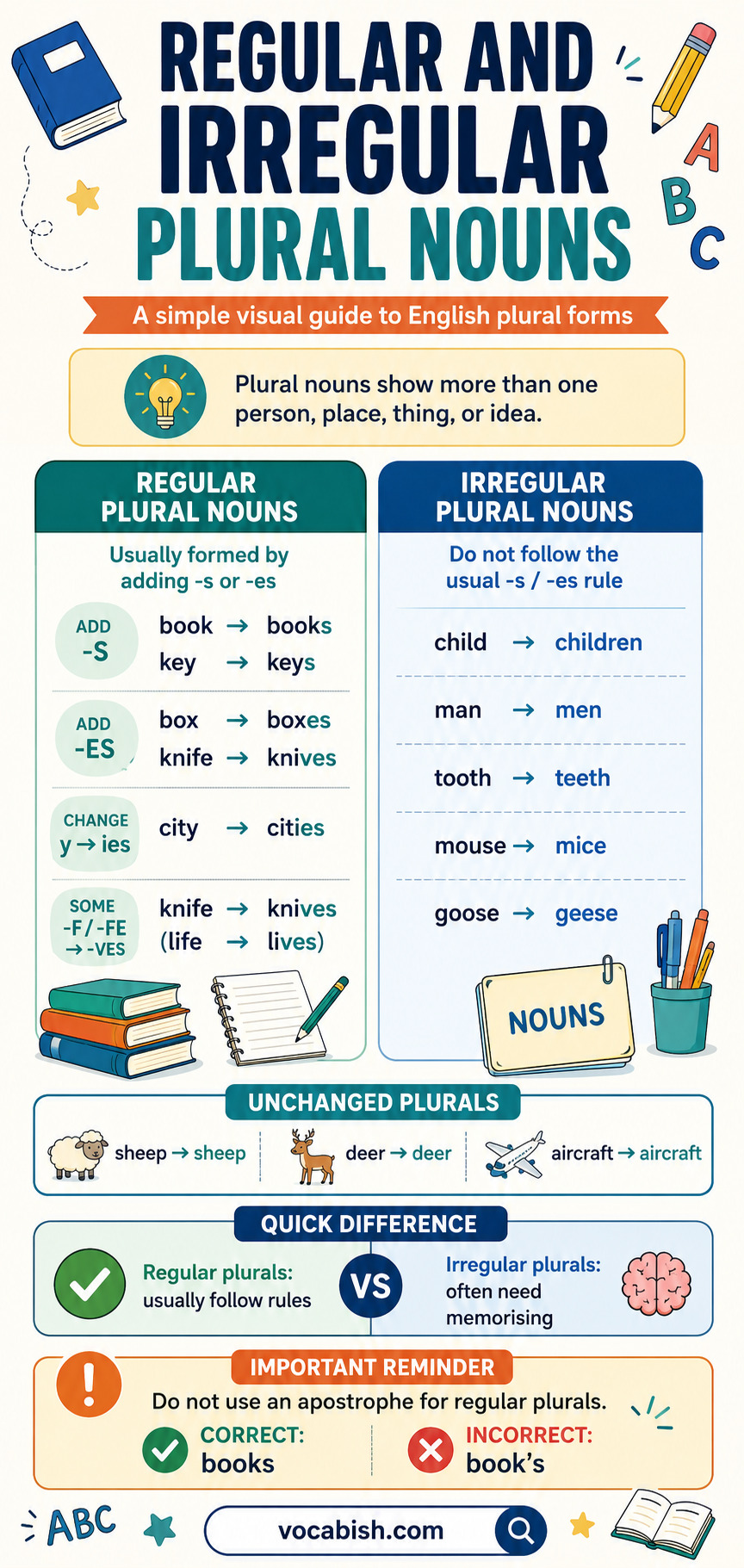
- Regular plural: book → books
- Irregular plural: child → children
- Unchanged plural: sheep → sheep
Learning the difference between regular and irregular plural nouns helps you spell nouns correctly and match them with the right verbs.
Regular Plural Nouns
Regular plural nouns follow common spelling rules. Most are formed by adding -s or -es.
Singular ending | Plural rule | Singular | Plural |
|---|---|---|---|
Most noun endings | Add -s | chair | chairs |
-s, -ss, -sh, -ch, -x, -z | Add -es | box | boxes |
Consonant + y | Change y to ies | city | cities |
Vowel + y | Add -s | key | keys |
Some consonant + o nouns | Add -es | potato | potatoes |
Many vowel + o nouns | Add -s | radio | radios |
Examples in Sentences
- The students opened their books.
- Two buses stopped outside the school.
- Several families attended the event.
- The shop sells watches and radios.
- We planted tomatoes and potatoes.
Some nouns ending in -o do not follow one fixed pattern:
- hero → heroes
- echo → echoes
- photo → photos
- piano → pianos
A dictionary can help when you are unsure.
Some nouns ending in -f or -fe change to -ves:
- leaf → leaves
- wife → wives
- knife → knives
However, others simply add -s:
- roof → roofs
- chief → chiefs
- belief → beliefs
Do not use an apostrophe to make an ordinary plural.
- Correct: three books
- Incorrect: three book’s
Irregular Plural Nouns
Irregular plural nouns do not follow the usual -s or -es rules. Their spelling may change, or the plural may look completely different.
Singular | Plural | Example |
|---|---|---|
child | children | The children are playing. |
person | people | Many people attended. |
man | men | The men entered the room. |
woman | women | Two women led the meeting. |
mouse | mice | The mice hid behind the box. |
goose | geese | The geese crossed the road. |
ox | oxen | The oxen pulled the cart. |
A few irregular nouns keep the same form in singular and plural:
Singular | Plural | Example |
|---|---|---|
sheep | sheep | One sheep escaped. Five sheep remained. |
deer | deer | We saw three deer. |
aircraft | aircraft | Two aircraft landed safely. |
series | series | She watched several series. |
species | species | Many species are endangered. |
Fish commonly works as both singular and plural:
- I caught one fish.
- We saw ten fish.
Fishes is mainly used when discussing different species:
- The aquarium contains several tropical fishes.
Related Resources: Verb Agreement with Irregular Plurals
Vowel-Changing Plurals
Some irregular nouns form their plurals by changing one or more vowels inside the word.
Singular | Plural | Vowel change |
|---|---|---|
man | men | a → e |
woman | women | a → e |
foot | feet | oo → ee |
tooth | teeth | oo → ee |
goose | geese | oo → ee |
mouse | mice | ou → i |
louse | lice | ou → i |
Examples:
- My feet are cold.
- The dentist checked my teeth.
- Two mice ran across the floor.
- Several men were waiting outside.
These forms need to be memorized because the same vowel change does not apply to every similar-looking noun.
- book → books, not beek
- house → houses, not hice
Foreign Plural Forms
English has borrowed many nouns from Latin, Greek, and other languages. Some keep their original plural forms, while others also accept a regular English plural.
Singular | Traditional plural | Common English alternative |
|---|---|---|
analysis | analyses | — |
basis | bases | — |
crisis | crises | — |
thesis | theses | — |
criterion | criteria | — |
phenomenon | phenomena | — |
cactus | cacti | cactuses |
syllabus | syllabi | syllabuses |
formula | formulae | formulas |
index | indices | indexes |
appendix | appendices | appendixes |
Use the form that suits the context:
- Indexes is common for book or database listings.
- Indices is often used in mathematics and economics.
- Formulas is common in general English.
- Formulae may appear in scientific or academic writing.
Do not add -s to an existing plural form:
- Correct: several criteria
- Incorrect: several criterias
- Correct: many phenomena
- Incorrect: many phenomenas
Regular vs Irregular Plurals
Feature | Regular plurals | Irregular plurals |
|---|---|---|
Main pattern | Add -s or -es | Follow special forms |
Predictability | Usually predictable | Often memorized |
Spelling change | Small or rule-based | May change greatly |
Examples | cats, boxes, cities | children, mice, people |
Singular and plural may match | Rarely | Yes: sheep, deer |
Dictionary needed | Occasionally | More often |
Compare these sentences:
- One student is waiting. Three students are waiting.
- One child is waiting. Three children are waiting.
- One sheep is grazing. Three sheep are grazing.
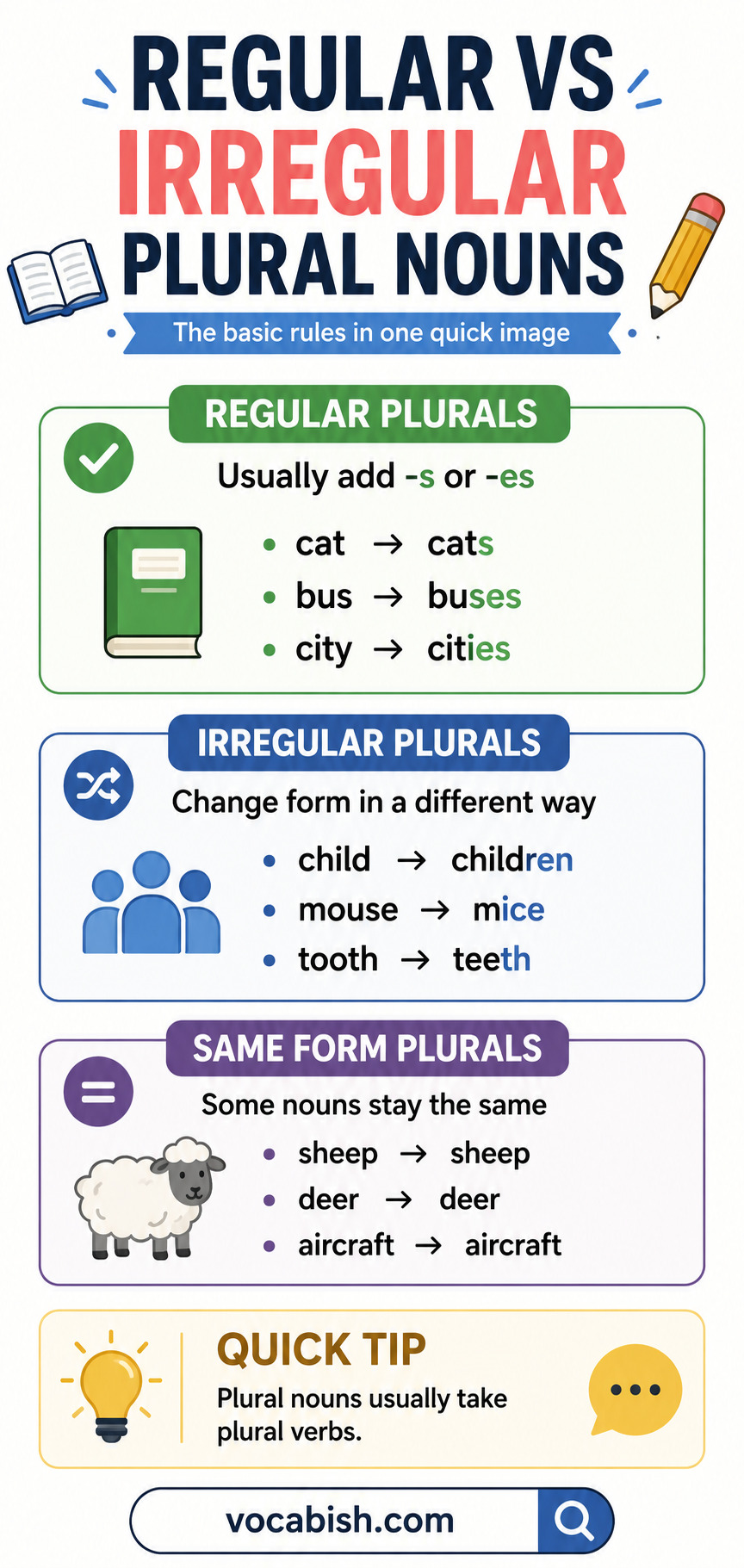
The noun form may change, but plural nouns normally take plural verbs:
- The child is sleeping.
- The children are sleeping.
- The sheep are sleeping.
Quick Practice with Answers
Complete each sentence with the correct plural form.
- Three ______ were playing in the garden. (child)
- The farmer owns six ______. (sheep)
- Please wash the dirty ______. (dish)
- Two ______ entered the kitchen. (mouse)
- The scientist studied several natural ______. (phenomenon)
- We visited four beautiful ______. (city)
- The dentist examined my ______. (tooth)
- Several ______ were parked outside. (bus)
- The report uses clear selection ______. (criterion)
- Strong winds damaged the house ______. (roof)
Answers
- children
- sheep
- dishes
- mice
- phenomena
- cities
- teeth
- buses
- criteria
- roofs
FAQs About Regular and Irregular Plural Nouns
Most regular nouns add -s or -es. Irregular nouns change spelling, use a different ending, or remain unchanged in the plural.
No. Some nouns ending in -f or -fe take -ves, but others simply add -s, such as roofs and chiefs.
Fish can be singular or plural. Fishes is used mainly when referring to different species rather than several individual fish.
Both are correct. Cactuses is common in everyday English, while cacti is traditional and often preferred in formal scientific contexts.
Children is the standard plural of child. Childs is incorrect in ordinary English, although it may appear in surnames or names.
Words such as sheep, deer, aircraft, and series usually keep the same form in both singular and plural English sentences.
Memorize common groups, notice patterns, and practise them in sentences. Frequent reading also helps irregular forms become natural over time.
Short Summary
- Regular plurals usually take -s or -es.
- Nouns ending in consonant + y usually change to -ies.
- Irregular plurals may change spelling completely.
- Some nouns change their internal vowels: foot → feet.
- A few nouns remain unchanged: sheep → sheep.
- Foreign nouns may keep traditional plurals or use accepted English alternatives.
- Irregular plural forms are best learned through groups, examples, and regular practice.
You May Also Like
- Gender of Nouns in English Grammar
- Functions of Nouns in a Sentence
- Possessive Nouns Definitions and Examples
- Differences Between Parts of Speech
- Common Nouns Explained in English
- Proper Nouns Explained with Examples
- Concrete Nouns with Examples
- Abstract Nouns in English
- Countable Nouns Definitions and Examples
- Uncountable Nouns Rules and Examples
- Collective Nouns in English with Types