
A sentence can be grammatically correct and still sound flat or repetitive. Advanced Sentence Structure Examples show how English speakers connect ideas, add detail, express conditions, contrast opinions, and make everyday communication more natural.
By learning advanced sentence construction, complex sentence patterns, and different ways to combine clauses, ESL learners can move beyond short sentences and communicate with greater variety and confidence.
What Is Advanced Sentence Structure?
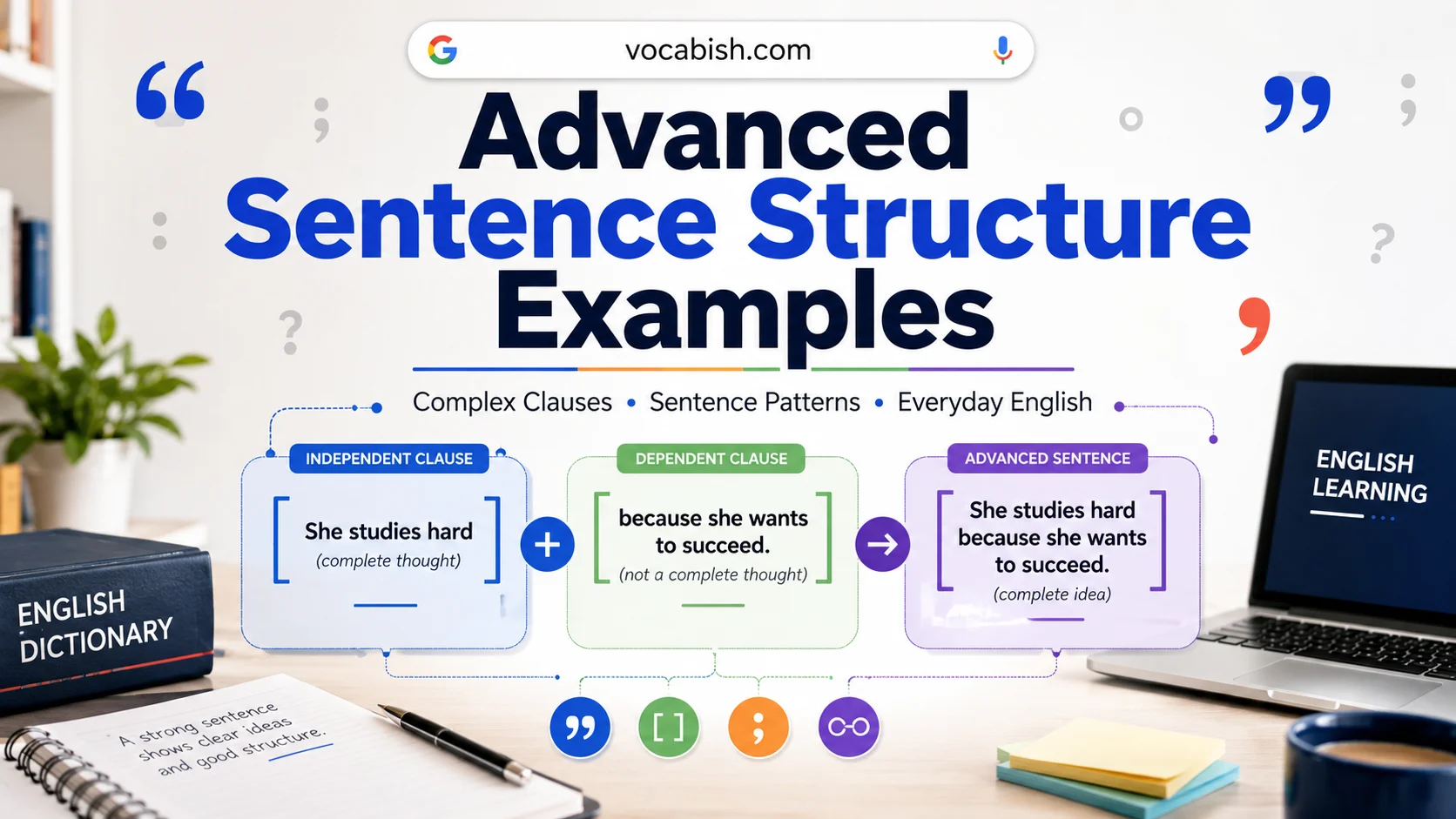
Advanced sentence structure refers to the way multiple ideas, clauses, phrases, and modifiers are organized to create more precise and natural sentences.
Advanced sentences commonly use:
- Independent and dependent clauses
- Relative clauses
- Conditional clauses
- Participial phrases
- Infinitive phrases
- Concession clauses
- Inversion
- Coordinating and subordinating conjunctions
- Embedded questions
- Parallel structures
- Multiple types of clauses in one sentence
An advanced sentence does not necessarily need to be very long. A short sentence can also have an advanced structure when its clauses are carefully arranged.
Advanced Sentence Structure in English
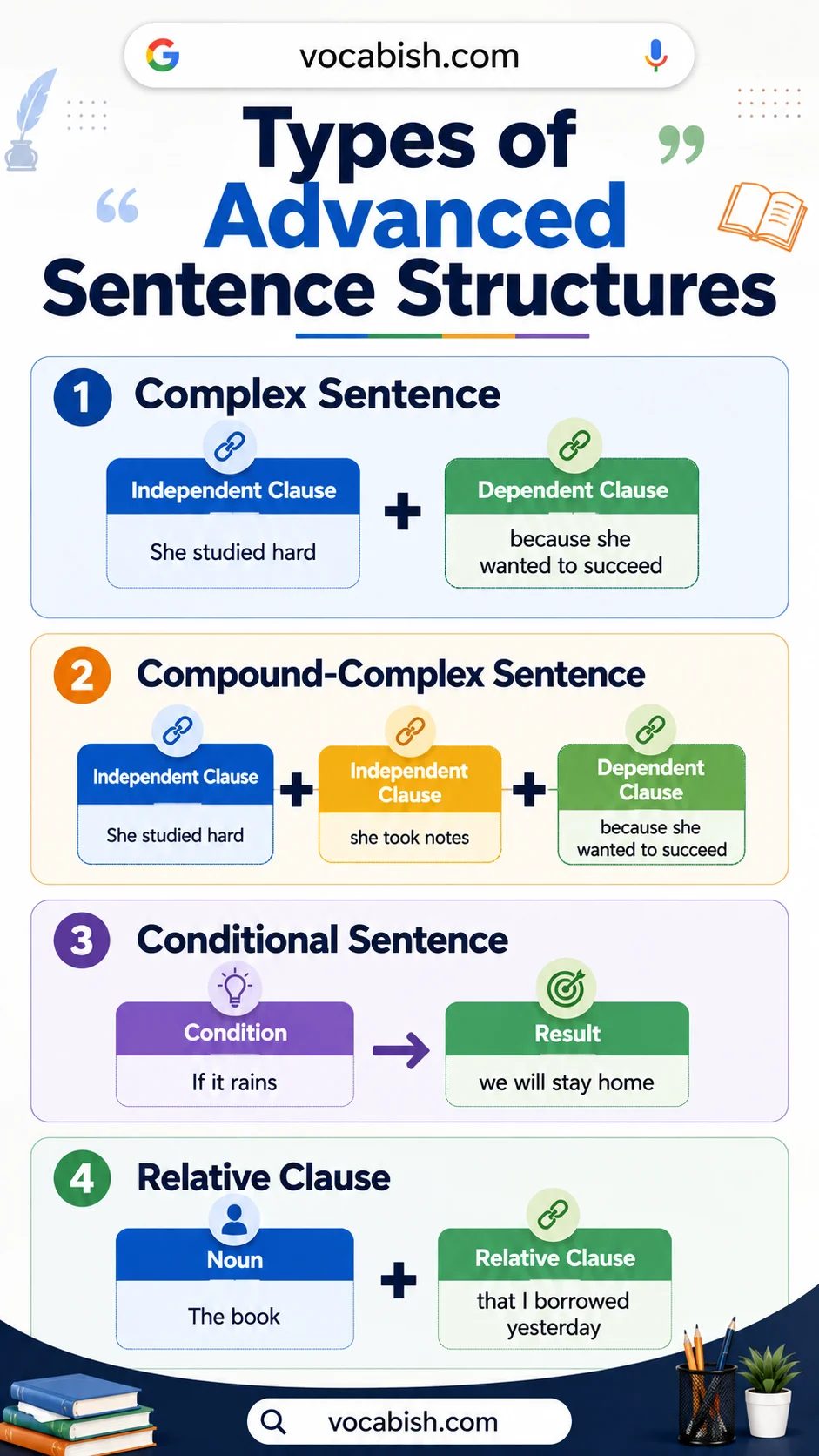
English uses several patterns to connect ideas. The most useful patterns for learners include complex sentences, compound-complex sentences, conditional structures, relative clauses, and sentences containing introductory phrases.
Here are some Advanced Sentence Structure Examples using common patterns:
- Although I was tired, I finished my homework before I went to bed.
- I wanted to call you, but I decided to wait until you were free.
- If you have enough time, we can meet after work.
- The woman who lives next door works at the hospital.
- Having finished his assignment, Daniel went outside for some fresh air.
- I would have helped you if you had told me about the problem earlier.
- What I really need is a quiet place where I can concentrate.
- Even though the restaurant was crowded, we found a table near the window.
- When the meeting ended, everyone returned to their offices.
- She speaks English so confidently that people often assume she grew up abroad.
Advanced Sentence Structure Examples
The following examples cover different sentence patterns that English learners can use in school, work, travel, friendships, and everyday conversations.
- Although I had planned to leave early, I stayed because my friend needed my help.
- If you finish your work before lunch, we can go out for coffee.
- The book that you recommended was much more interesting than I expected.
- I was about to call you when I saw your message.
- Because the weather had changed suddenly, we decided to cancel our trip.
- She accepted the job even though the salary was lower than she had expected.
- If I had known you were coming, I would have prepared something for dinner.
- The apartment we visited yesterday is closer to my office than the one we saw last week.
- While everyone else was watching television, I was preparing for tomorrow’s presentation.
- Having realized that he had forgotten his wallet, Mark returned home.
- I don’t know why she left so early, especially since the meeting had just started.
- What surprised me most was how quickly everyone accepted the new plan.
- Unless you leave now, you may miss the last bus.
- No matter how busy I am, I always try to make time for my family.
- The restaurant where we had dinner last night serves excellent food.
- Since you have already finished your assignment, you can leave whenever you want.
- I would rather stay home tonight than go somewhere that is too crowded.
- Even if it rains tomorrow, we will continue with the event.
- The reason I called you is that I need your opinion about something.
- As soon as I finish this report, I’ll send it to you.
Complex Sentence Examples
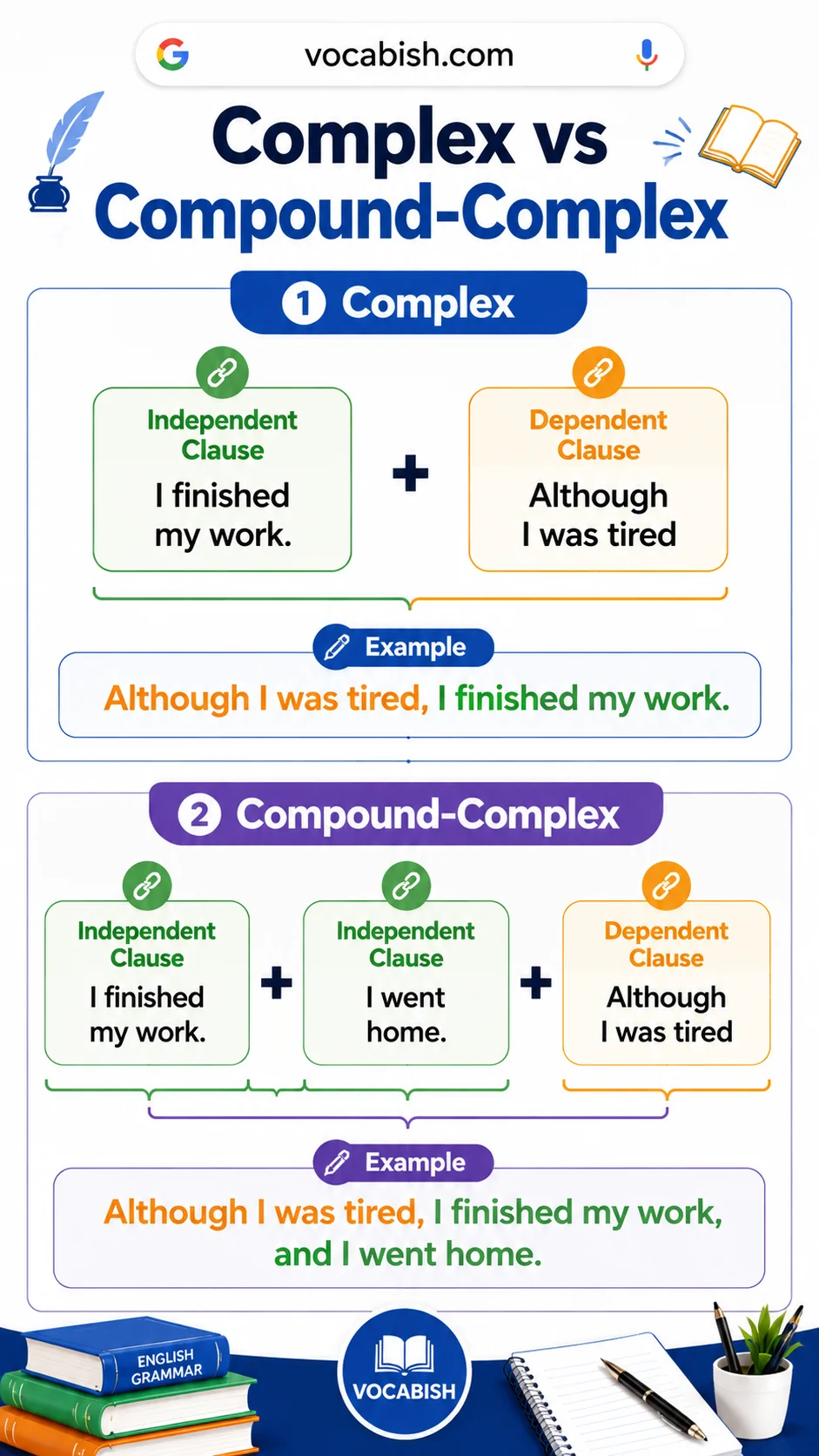
A complex sentence contains one independent clause and at least one dependent clause. These sentences are especially useful for expressing relationships between ideas.
- Although I was nervous, I answered the question confidently.
- When the teacher entered the room, everyone became quiet.
- I will call you after I finish my work.
- Because she was feeling sick, she decided to stay home.
- If you need any help, just let me know.
- While I was driving home, I received an important phone call.
- Even though he apologized, she was still upset.
- Since we arrived early, we had plenty of time to look around.
- Whenever I visit my hometown, I meet some of my old friends.
- Unless you practice regularly, your speaking skills may not improve quickly.
- Before you make a decision, think carefully about the possible consequences.
- After I finished dinner, I went for a short walk.
- Wherever you decide to live, make sure you feel comfortable there.
- Although the task looked difficult, we completed it before the deadline.
- If the weather improves, we will go hiking this weekend.
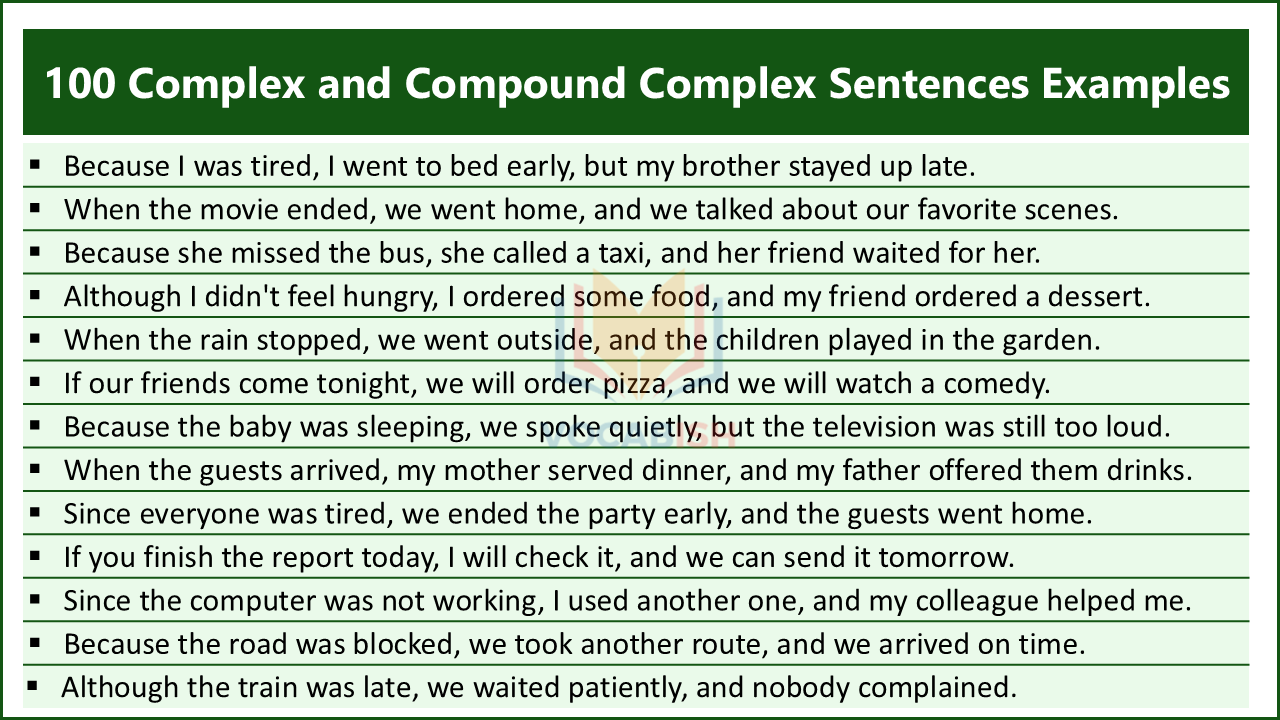
Compound-Complex Sentence Examples
Compound-complex sentences contain at least two independent clauses and one or more dependent clauses. They are useful when you want to connect several related ideas naturally.
- Although I was tired, I finished my work, and I went home as soon as the office closed.
- When the rain stopped, we left the house, and we walked to the nearest restaurant.
- I wanted to join you, but I couldn’t leave because I had an important meeting.
- Although she had never visited the city before, she found her way around easily, and she even recommended several restaurants.
- If you finish your assignment tonight, you can relax tomorrow, and you won’t have to worry about the deadline.
- Because the train was delayed, we arrived late, but everyone was still waiting for us.
- When I reached the station, the train had already left, so I decided to take a bus.
- Even though he was exhausted, he helped me carry the boxes, and we finished the job before sunset.
- If you tell me what happened, I will try to help you, and we can decide what to do next.
- Although the movie was longer than expected, we enjoyed it, and we stayed until the credits ended.
- Since she had prepared carefully, she felt confident during the interview, and she answered every question clearly.
- When the meeting ended, I spoke with my manager, and we discussed the changes that needed to be made.
- Although I didn’t agree with his opinion, I listened carefully, and I tried to understand his point of view.
- If the weather remains pleasant tomorrow, we’ll have lunch outside, and we can take a walk afterward.
- Because I had already finished my work, I joined my friends, and we spent the evening talking.
Conditional Sentence Examples
Conditional structures describe possible, unlikely, or imaginary situations and their results.
- If you study regularly, you will improve your English.
- If I have enough time tonight, I’ll finish the report.
- If you were in my position, what would you do?
- If she knew the answer, she would tell us.
- If I had more free time, I would learn another language.
- If you had called me earlier, I could have helped you.
- If they had left on time, they wouldn’t have missed the train.
- Unless you hurry, you will be late for the meeting.
- Even if he disagrees with me, I’ll respect his opinion.
- If everything goes according to plan, we should arrive before sunset.
- If I were you, I would think about the decision carefully.
- Had I known about the problem, I would have offered my help.
- If you keep practicing, you will eventually become more comfortable speaking English.
- If we had booked earlier, we might have found a better hotel.
- Provided that everyone agrees, we can start the project tomorrow.
Relative Clause Sentence Examples
Relative clauses add information about a person, place, thing, or idea without requiring a separate sentence.
- The man who helped me at the station was very friendly.
- I bought the laptop that you recommended.
- The restaurant where we ate last night was surprisingly affordable.
- My sister, who lives in London, is visiting us next month.
- The reason why I called is that I need some advice.
- The person whom you met yesterday is my manager.
- I finally found the documents that I had been looking for.
- The hotel where we stayed had a beautiful view of the mountains.
- She is someone who always keeps her promises.
- The project that we started last month is almost finished.
- I know a teacher whose students regularly win writing competitions.
- The city where I grew up has changed dramatically.
- The phone that I bought last year still works perfectly.
- The friend who introduced us is coming to dinner tonight.
- This is the place where we first met.
Participial Sentence Examples
Participial phrases can make sentences more concise while connecting actions or circumstances.
- Feeling tired after work, I went straight home.
- Having finished her homework, Maria watched television.
- Walking through the park, I noticed a beautiful old building.
- Surprised by the news, he didn’t know how to respond.
- Having forgotten his keys, Tom had to wait outside.
- Standing near the entrance, she waited for her friend.
- Exhausted after the long journey, they went to bed early.
- Looking at the clock, I realized that I was already late.
- Having completed the project, the team celebrated together.
- Worried about the results, she checked her email several times.
- Sitting by the window, I watched the rain fall.
- Having lost his phone, he couldn’t contact anyone.
- Excited about the trip, the children packed their bags early.
- Knowing that the road was closed, we chose another route.
- Having studied the instructions carefully, she completed the task correctly.
Inversion Sentence Examples
Inversion changes the normal word order of a sentence and is often used for emphasis or formal writing.
- Never have I seen such a beautiful view.
- Rarely do we get an opportunity like this.
- Not only did she finish the project, but she also helped her colleagues.
- Only after the meeting did I understand what had happened.
- Never before had he experienced such a difficult situation.
- Hardly had we arrived when the rain started.
- No sooner had I sat down than the phone rang.
- Little did I know that the decision would change my life.
- Only then did she realize how serious the situation was.
- Under no circumstances should you share your password with anyone.
Contrast and Concession Sentence Examples
These structures help speakers show that one idea happens despite another idea or that two ideas differ.
- Although I was tired, I decided to finish the assignment.
- Even though he was busy, he made time for his family.
- While I understand your point, I don’t completely agree with you.
- Despite being nervous, she gave an excellent presentation.
- In spite of the difficult circumstances, they remained positive.
- Although the apartment is small, it is comfortable and well located.
- Even though we disagreed, we managed to have a respectful conversation.
- Much as I enjoy traveling, I sometimes prefer staying at home.
- However difficult the task may seem, you can improve with practice.
- Despite having little experience, he handled the situation professionally.
Cause-and-Effect Sentence Examples
Cause-and-effect structures explain why something happened and what resulted from it.
- Because I missed the bus, I arrived late for work.
- Since the roads were blocked, we decided to stay home.
- She worked hard, so she achieved her goal.
- The internet connection was unstable, which made the meeting difficult.
- Because he had prepared well, he answered the questions confidently.
- The weather became colder, causing many people to stay indoors.
- She forgot to set her alarm, which is why she arrived late.
- As the demand increased, the company hired more employees.
- He didn’t save the document, so he lost all his changes.
- The store was closing soon; therefore, we decided to leave immediately.
- Because the instructions were unclear, several students made the same mistake.
- The traffic was unusually heavy, resulting in a much longer journey.
- She practiced speaking every day, and as a result, her confidence improved.
- Since the restaurant was full, we chose another place nearby.
- The power went out, which caused the computer to shut down.
Time and Sequence Sentence Examples
These structures help organize events clearly and make conversations and stories easier to follow.
- As soon as I get home, I’ll call you.
- Before you leave, please check that all the windows are closed.
- After we finished dinner, we went for a walk.
- While I was waiting for the bus, I checked my messages.
- Once you understand the basic pattern, the advanced structures become easier to use.
- By the time we arrived, the meeting had already started.
- Whenever I have a free evening, I like to read.
- Until you finish your work, you should stay focused.
- After she had completed the course, she applied for a new job.
- As soon as the guests arrived, we served dinner.
- Before I went to bed, I prepared everything for the next morning.
- When I opened the door, I realized that I had forgotten my keys inside.
- While everyone was talking, the manager quietly left the room.
- Once the rain stopped, the children went outside to play.
- By the time I reached the airport, my flight had already boarded.
Purpose and Result Sentence Examples
Purpose and result structures explain why an action is performed or what happens because of it.
- I left early so that I could avoid the traffic.
- She spoke slowly so that everyone could understand her.
- We saved money so that we could travel during the summer.
- He took notes in order to remember the important details.
- I turned off my phone so that I could concentrate on my work.
- She worked extra hours so that she could finish the project on time.
- The instructions were written clearly so that everyone could follow them.
- He lowered his voice in order not to disturb the other guests.
- The room was so quiet that I could hear the clock ticking.
- She was so tired that she fell asleep immediately.
- The movie was so interesting that we forgot about the time.
- He spoke loudly enough for everyone in the room to hear him.
- The road was so crowded that we arrived almost an hour late.
- I wrote everything down so that I wouldn’t forget it later.
- She practiced every day in order to become more confident.
Comparison Sentence Examples
Comparison structures allow speakers to show similarities, differences, preferences, and degrees.
- This book is more interesting than I expected.
- My new apartment is much quieter than my old one.
- She speaks English more confidently than she did last year.
- The earlier we leave, the easier the journey will be.
- The more you practice, the more naturally you will speak.
- This restaurant is not as expensive as the one we visited yesterday.
- He works harder than most people realize.
- The new system is considerably faster than the previous one.
- I would rather stay home than go somewhere crowded tonight.
- This exercise is easier than it looks.
- The weather today is much better than it was yesterday.
- She is as comfortable speaking English as she is speaking her first language.
- The more carefully you listen, the easier it becomes to understand native speakers.
- My current job is less stressful than my previous one.
- This route is slightly longer, but it is much safer.
Advanced Questions and Requests
Here are some advanced questions that often contain embedded clauses, indirect questions, or polite structures.
- Could you tell me where I can find the nearest bank?
- Do you know whether the store is still open?
- Would you mind telling me why the meeting was canceled?
- Could you explain what we are expected to do?
- Do you know when the next train is supposed to arrive?
- Could you let me know if you need any additional information?
- Would you mind explaining how this machine works?
- Do you happen to know where I can buy a replacement?
- Could you tell me what time you expect to arrive?
- I was wondering if you could help me with this problem.
- Would it be possible for you to send me the details later?
- Could you let me know when you have finished the report?
- Do you know whether they have decided what to do?
- I would appreciate it if you could send me the information today.
- Could you explain why you think this option would be better?
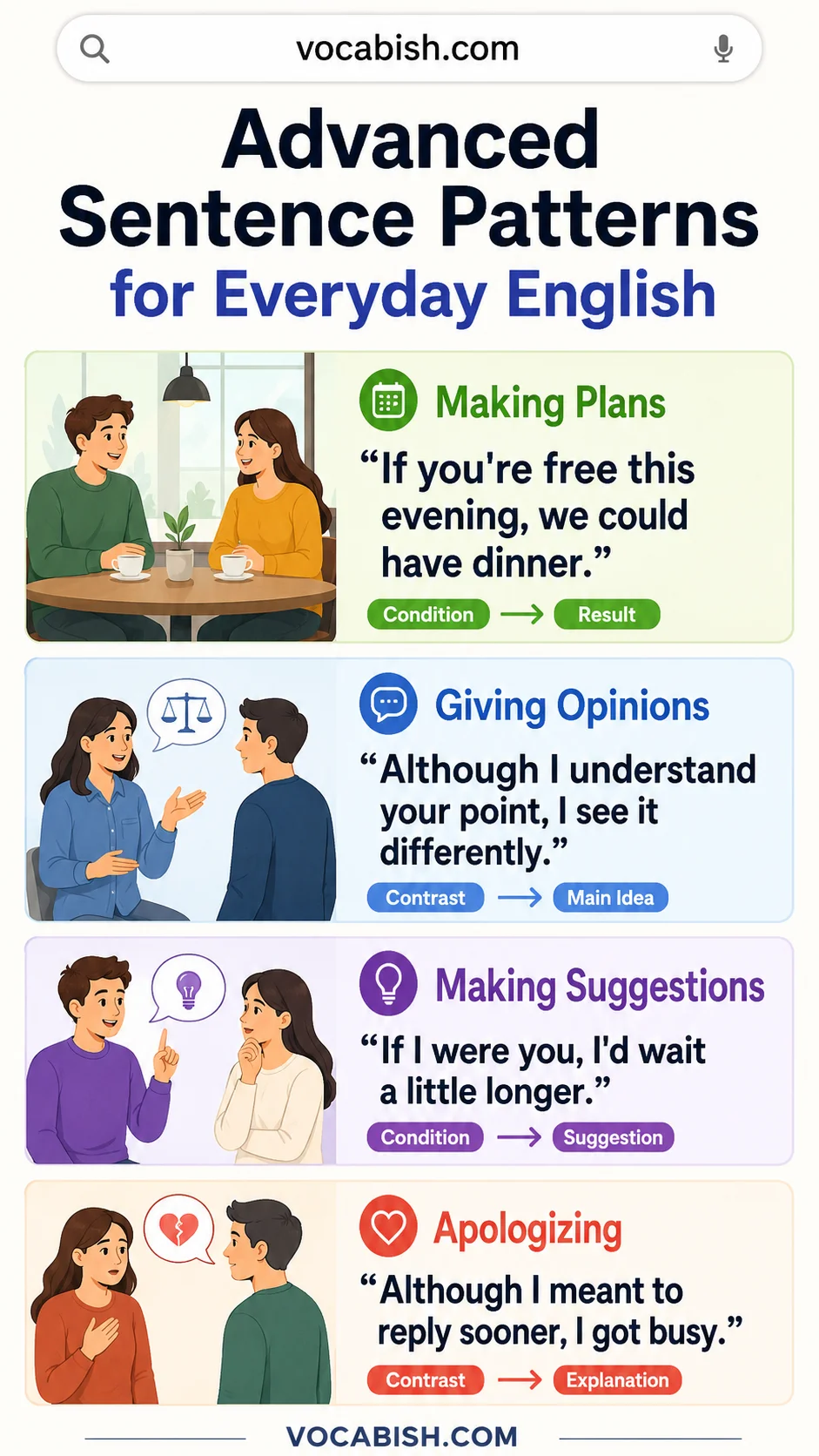
Advanced Sentences for Everyday Conversation
Advanced structures are not limited to essays or formal writing. Native speakers use them naturally in conversations every day.
Talking About Plans
- If you’re free this evening, we could grab dinner together.
- Once I finish my work, I’ll let you know whether I can join you.
- Although I have a busy day tomorrow, I should have some free time in the evening.
- If everything goes well, we should be able to finish before Friday.
- I’m thinking about going somewhere quiet where we can actually talk.
Giving Opinions
- Although I understand why you feel that way, I see the situation differently.
- From what I’ve heard, the new restaurant is much better than the old one.
- The way I see it, we should consider all the options before making a decision.
- What concerns me most is that we don’t have enough information yet.
- Even though it may seem expensive, I think it will save us money in the long run.
Making Suggestions
- If I were you, I’d wait until you have more information.
- Why don’t we go somewhere that’s less crowded?
- We could meet earlier so that we have enough time to talk.
- If you’re not sure what to choose, I’d recommend trying the one that everyone likes.
- Rather than rushing into a decision, we should take some time to think about it.
Apologizing
- I’m sorry I didn’t call you earlier because I got caught up with work.
- Although I intended to reply sooner, I completely forgot after the meeting.
- I apologize for being late, especially since you were waiting for me.
- If I had realized you were waiting, I would have called you immediately.
- I understand why you’re upset, and I hope we can sort things out.
Talking About Experiences
- The best trip I’ve ever taken was one that I planned at the last minute.
- When I first moved here, I didn’t know anyone, but I gradually made some good friends.
- Although I was nervous at first, I eventually became comfortable speaking English.
- I had never tried anything like that before, so I wasn’t sure what to expect.
- By the time the trip ended, we had visited almost every place we wanted to see.
Advanced Sentence Restructuring Examples
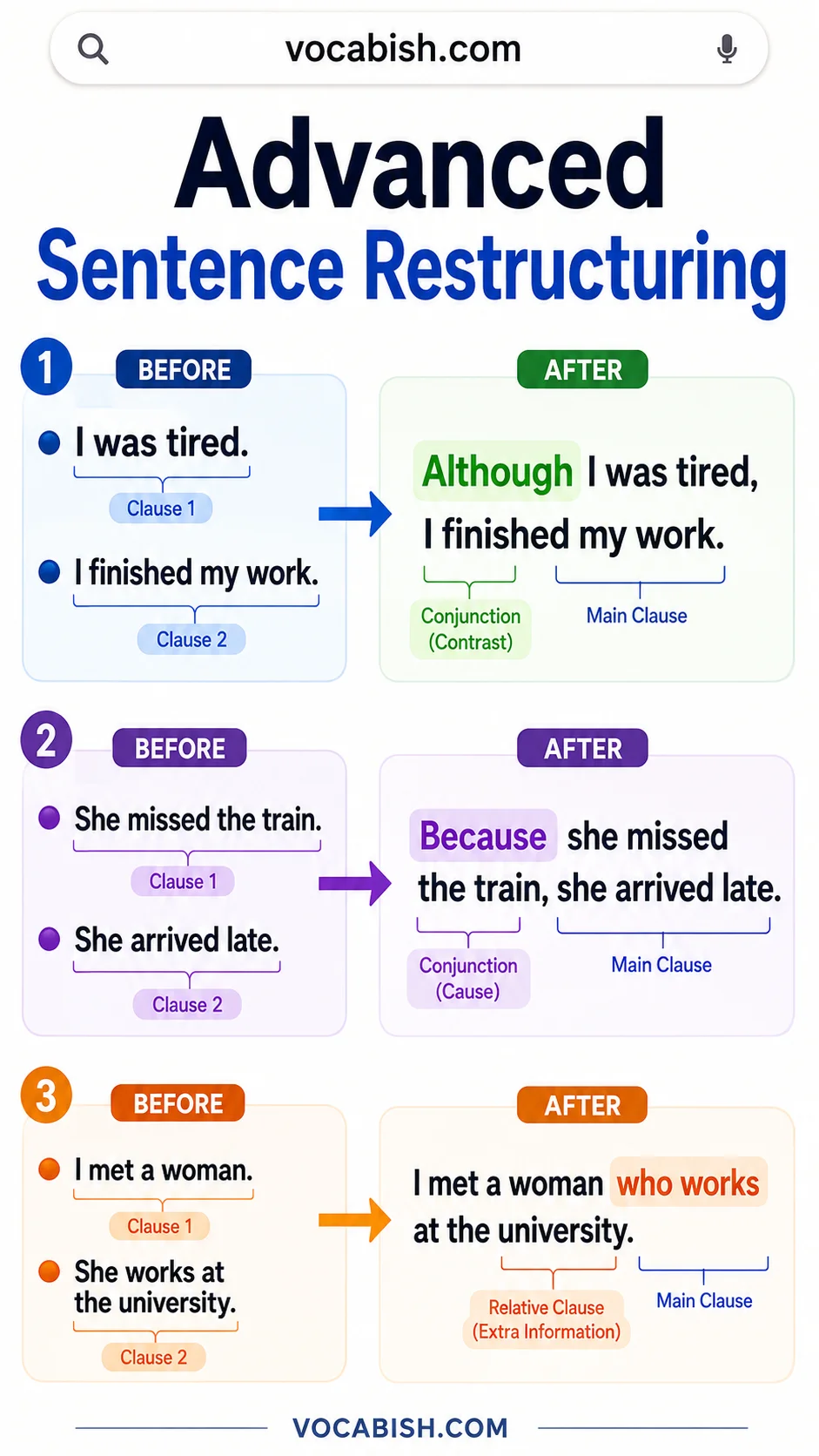
Here’s the list of some advanced sentence restructuring, which means expressing the same basic idea in a more developed, varied, or natural structure.
- Basic: I was tired. I finished my work.
Advanced: Although I was tired, I finished my work. - Basic: She studied hard. She passed the exam.
Advanced: Because she studied hard, she passed the exam. - Basic: He missed the bus. He arrived late.
Advanced: Since he missed the bus, he arrived late. - Basic: I called her. She didn’t answer.
Advanced: Although I called her several times, she didn’t answer. - Basic: We arrived early. We got good seats.
Advanced: Because we arrived early, we were able to get good seats. - Basic: He forgot his wallet. He couldn’t pay for lunch.
Advanced: Having forgotten his wallet, he couldn’t pay for lunch. - Basic: I met a woman. She works at the university.
Advanced: I met a woman who works at the university. - Basic: We stayed home. It was raining heavily.
Advanced: Since it was raining heavily, we decided to stay home. - Basic: She didn’t know the answer. She remained quiet.
Advanced: Not knowing the answer, she remained quiet. - Basic: You practice more. You become more confident.
Advanced: The more you practice, the more confident you become. - Basic: I didn’t know about the meeting. I didn’t attend it.
Advanced: If I had known about the meeting, I would have attended it. - Basic: The restaurant was crowded. We found a table.
Advanced: Although the restaurant was crowded, we managed to find a table. - Basic: He finished the project. Then he took a vacation.
Advanced: Having finished the project, he took a vacation. - Basic: She wanted to save money. She stopped eating out.
Advanced: In order to save money, she stopped eating out. - Basic: I understand your opinion. I don’t agree with it.
Advanced: Although I understand your opinion, I don’t completely agree with it.
Advanced Sentence Construction Examples for School and Work
Some advanced structures can make written and spoken communication clearer when several related ideas need to be connected.
- Although the project was challenging, our team completed it before the deadline.
- Since the deadline has been moved forward, we need to change our schedule.
- The report that you submitted yesterday needs a few minor corrections.
- If everyone completes their part on time, we should be able to finish the project this week.
- After reviewing the information carefully, the manager approved the proposal.
- The main reason we postponed the meeting was that several team members were unavailable.
- While the first proposal was promising, the second option appears to be more practical.
- Having considered all the available options, we decided to continue with the original plan.
- I would appreciate it if you could send me the updated document before Friday.
- The changes that were discussed during the meeting will be implemented next month.
Advanced Sentence Construction Examples for Speaking
Spoken English often uses connected structures rather than a series of short sentences.
- I was going to call you, but I got busy because I had to finish something for work.
- If you’re heading to the store, could you pick up some milk while you’re there?
- I don’t mind waiting as long as you let me know how long it will take.
- Although I haven’t decided yet, I’m thinking about taking a short trip next month.
- What I meant was that we should wait until everyone has arrived.
- If you don’t mind, I’d rather sit somewhere that’s a little quieter.
- The thing that surprised me most was how friendly everyone was.
- I would have joined you if I hadn’t already made other plans.
- Since we still have plenty of time, why don’t we stop somewhere for coffee?
- No matter what happens, we’ll figure out a way to deal with it.
Advanced Sentence Examples with Multiple Clauses
Some advanced sentences contain several connected clauses while remaining understandable.
- Although I wanted to stay longer, I had to leave because I needed to be home before dark.
- If you tell me what you’re looking for, I can recommend a place that sells it.
- When I arrived at the office, I realized that I had left the documents at home.
- Even though she knew that the decision would be difficult, she decided to do what she believed was right.
- Because the weather was getting worse, we decided to return home before it became dangerous.
- If I had known how complicated the process would be, I would have started earlier.
- The person who helped me when I first arrived is someone I will never forget.
- Once you understand how the system works, you’ll find that it is much easier to use.
- Although we had very little time, we managed to finish everything that needed to be done.
- I don’t know whether we’ll be able to attend, but I’ll let you know as soon as I find out.
Common Mistakes in Advanced Sentence Construction
Advanced structures become confusing when clauses are connected incorrectly or when the sentence contains unnecessary words.
- Avoid comma splices: Do not join two complete sentences with only a comma.
- Watch subject agreement: Make sure the subject and verb agree in every clause.
- Avoid dangling modifiers: The opening phrase should clearly describe the correct subject.
- Keep clauses clear: A very long sentence is not automatically an advanced sentence.
- Use conjunctions carefully: Choose words such as although, because, unless, and while according to the intended relationship.
Practice: Build Advanced Sentences
Combine the ideas below into one advanced sentence.
- I was hungry. I waited until everyone arrived.
- She missed the train. She arrived late for work.
- I don’t know the answer. I’ll ask the teacher.
- He practiced every day. His speaking improved.
- We couldn’t go outside. It was raining heavily.
- She bought a laptop. Her friend recommended it.
- I would have helped you. You didn’t tell me about the problem.
- The restaurant was expensive. We enjoyed the food.
- Finish your homework. You can watch television afterward.
- He was tired. He continued working because the deadline was close.
Answers:
- Although I was hungry, I waited until everyone arrived.
- Because she missed the train, she arrived late for work.
- I don’t know the answer, so I’ll ask the teacher.
- Because he practiced every day, his speaking improved.
- Since it was raining heavily, we couldn’t go outside.
- She bought the laptop that her friend recommended.
- I would have helped you if you had told me about the problem.
- Although the restaurant was expensive, we enjoyed the food.
- Once you finish your homework, you can watch television.
- Although he was tired, he continued working because the deadline was close.
FAQs About Advanced Sentence Structure
Advanced sentence structure uses multiple clauses, phrases, and grammatical patterns to connect ideas clearly and create more varied English sentences.
Common examples include complex sentences, compound-complex sentences, conditional sentences, relative clauses, participial phrases, and inversion.
Combine related ideas using dependent clauses, relative clauses, conjunctions, participial phrases, and precise transitions without making sentences unnecessarily long.
An advanced sentence expresses relationships between ideas using sophisticated grammatical structures while remaining clear, logical, and natural.
Advanced sentence construction involves organizing clauses and phrases in different patterns to express causes, conditions, contrast, time, purpose, and relationships.
Start with short sentences, identify their relationships, and combine them using conjunctions, relative clauses, conditionals, or participial phrases.
Advanced sentence restructuring means changing basic sentences into more varied structures while preserving their original meaning and improving grammatical complexity.
No. An advanced sentence can be short. What matters is the grammatical structure, relationship between ideas, and accurate use of clauses and phrases.
Conclusion
Learning Advanced Sentence Structure Examples help English learners move from disconnected short statements to clearer, more flexible communication. Complex clauses, conditionals, relative clauses, participial phrases, and compound-complex structures give you more ways to express ideas naturally.
The best approach is to practice one structure at a time, use it in everyday conversations, and gradually combine different patterns. With regular practice, advanced sentence structure in English becomes a natural part of speaking and writing.
Explore More Related Articles