
Formal English does not have to sound difficult. Examples of Formal Language can help you speak and write politely in school, the workplace, official conversations, emails, and other situations where respectful language matters.
Formal language usually uses polite expressions, complete sentences, respectful vocabulary, and professional wording. Learning these patterns can help ESL students communicate confidently without sounding too casual.
What Is Formal Language?
Formal language is a style of communication used when you want to sound polite, respectful, professional, or appropriate for an official situation.
You may use formal language when speaking to a teacher, manager, customer, interviewer, government official, client, or someone you do not know well.
Formal language often avoids slang, overly casual expressions, contractions, and familiar phrases.
For example, instead of saying, “Can you help me out?”, a formal speaker might say, “Could you please assist me?”
The goal is not to make every conversation sound complicated. Formal language should match the situation and relationship between speakers.
100 Examples of Formal Language
The following formal language sentences cover common situations that English learners may encounter at school, work, in public places, during telephone conversations, and in everyday communication.
Formal Requests and Questions
These sentences are useful when asking someone for information, assistance, permission, or action in a respectful way.
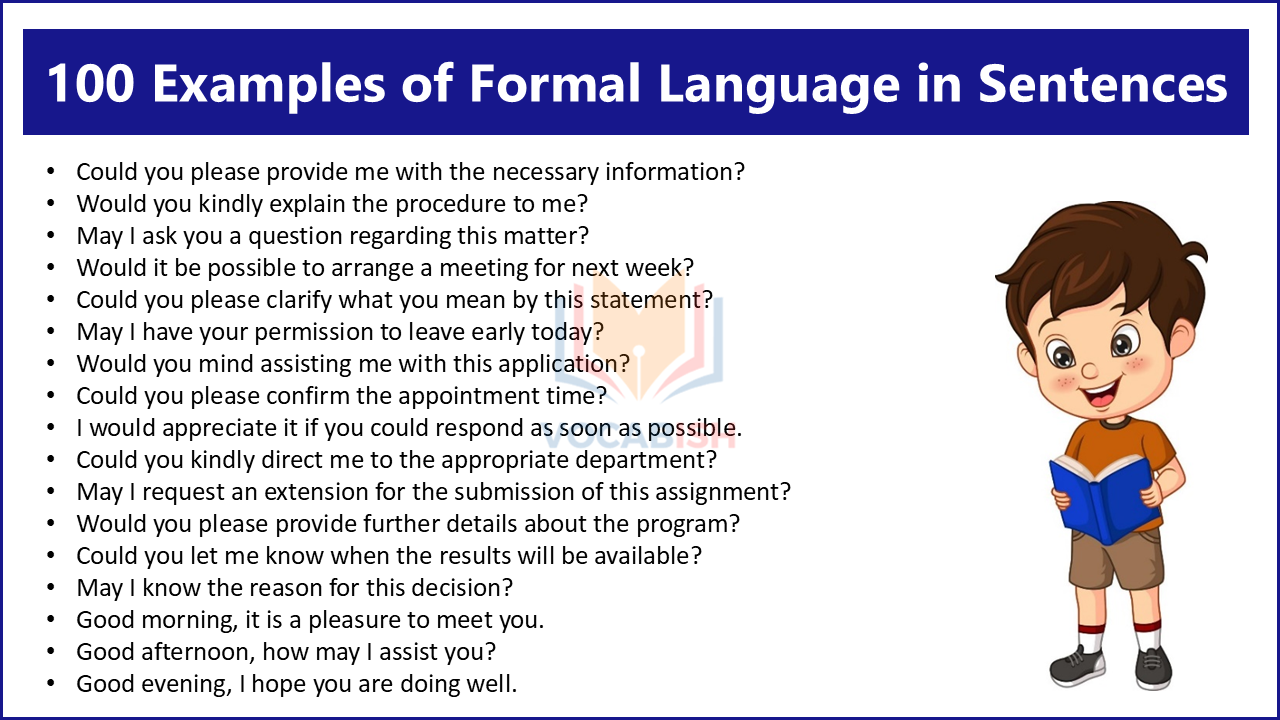
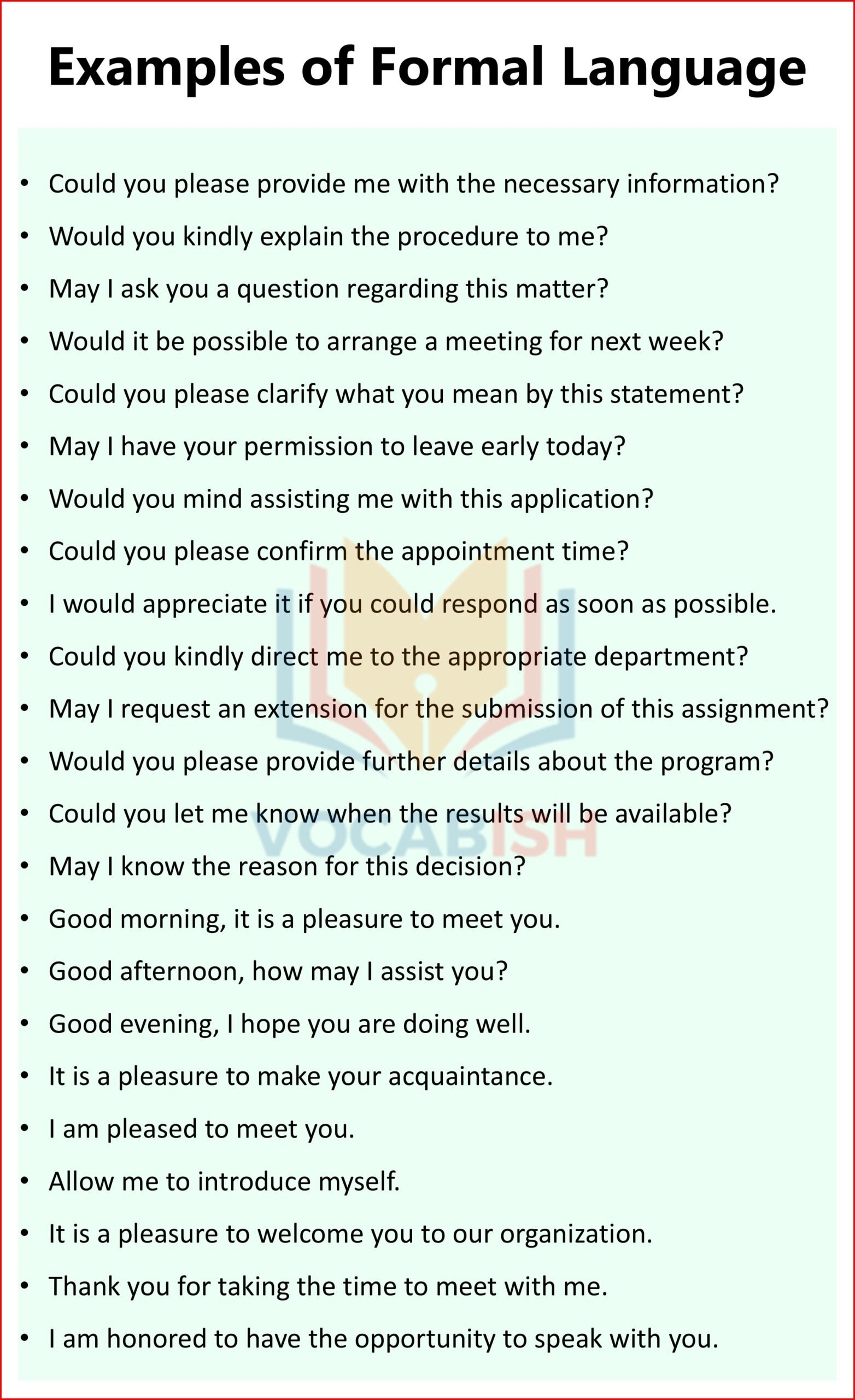
- Could you please provide me with the necessary information?
- Would you kindly explain the procedure to me?
- Could you please send me the document at your earliest convenience?
- May I ask you a question regarding this matter?
- Would it be possible to arrange a meeting for next week?
- Could you please clarify what you mean by this statement?
- May I have your permission to leave early today?
- Would you mind assisting me with this application?
- Could you please confirm the appointment time?
- I would appreciate it if you could respond as soon as possible.
- Could you kindly direct me to the appropriate department?
- May I request an extension for the submission of this assignment?
- Would you please provide further details about the program?
- Could you let me know when the results will be available?
- May I know the reason for this decision?
Formal Greetings and Introductions
Formal greetings are appropriate when meeting teachers, employers, clients, officials, senior colleagues, or unfamiliar people.
- Good morning, it is a pleasure to meet you.
- Good afternoon, how may I assist you?
- Good evening, I hope you are doing well.
- It is a pleasure to make your acquaintance.
- I am pleased to meet you.
- Allow me to introduce myself.
- My name is Ahmed, and I am here regarding the scheduled appointment.
- It is a pleasure to welcome you to our organization.
- Thank you for taking the time to meet with me.
- I am honored to have the opportunity to speak with you.
Formal Workplace Sentences
Professional communication often requires respectful and precise language, particularly when speaking with managers, colleagues, clients, or business partners.
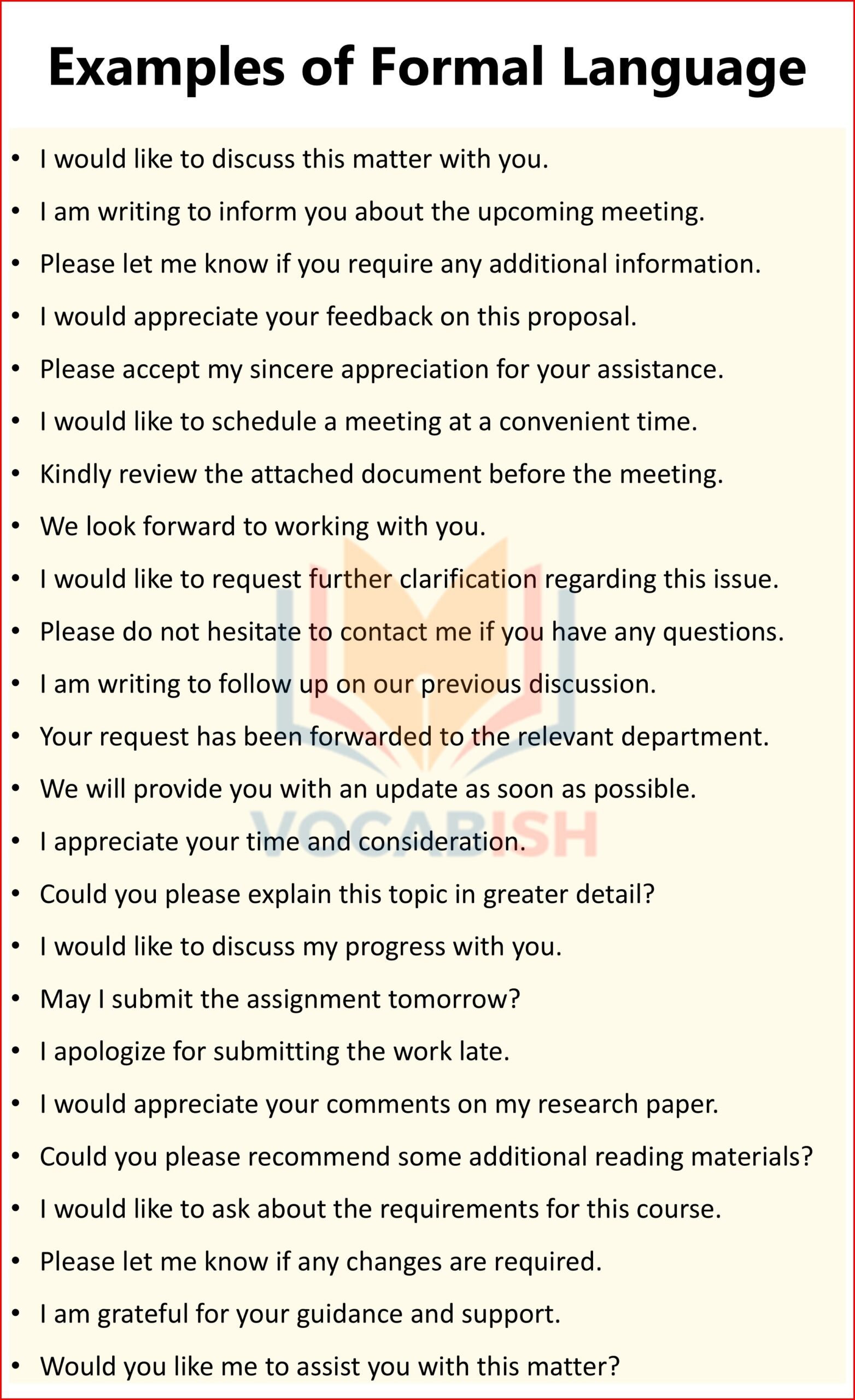
- I would like to discuss this matter with you.
- I am writing to inform you about the upcoming meeting.
- Please let me know if you require any additional information.
- I would appreciate your feedback on this proposal.
- We are pleased to inform you that your application has been accepted.
- Please accept my sincere appreciation for your assistance.
- I would like to schedule a meeting at a convenient time.
- Kindly review the attached document before the meeting.
- We look forward to working with you.
- I would like to request further clarification regarding this issue.
- Please do not hesitate to contact me if you have any questions.
- I am writing to follow up on our previous discussion.
- Your request has been forwarded to the relevant department.
- We will provide you with an update as soon as possible.
- I appreciate your time and consideration.
Formal School and Academic Sentences
Students can use these sentences when communicating with teachers, professors, school administrators, or academic staff.
- I would like to request additional information about the assignment.
- Could you please explain this topic in greater detail?
- I would like to discuss my progress with you.
- May I submit the assignment tomorrow?
- I apologize for submitting the work late.
- I would appreciate your comments on my research paper.
- Could you please recommend some additional reading materials?
- I would like to ask about the requirements for this course.
- Please let me know if any changes are required.
- I am grateful for your guidance and support.
Formal Apologies
Formal apologies are useful when communicating with someone respectfully after a mistake, delay, inconvenience, or misunderstanding.
- Please accept my sincere apologies for the inconvenience.
- I sincerely apologize for the delay.
- I regret any misunderstanding that may have occurred.
- I apologize for failing to respond earlier.
- Please accept my apologies for the mistake.
- I am sorry for any inconvenience this situation may have caused.
- I sincerely regret the error in the document.
- I apologize for not being able to attend the meeting.
- Please accept my sincere apology for the misunderstanding.
- I take full responsibility for the error.
Formal Offers and Invitations
These expressions are useful when offering assistance, inviting someone to an event, or making a professional proposal.
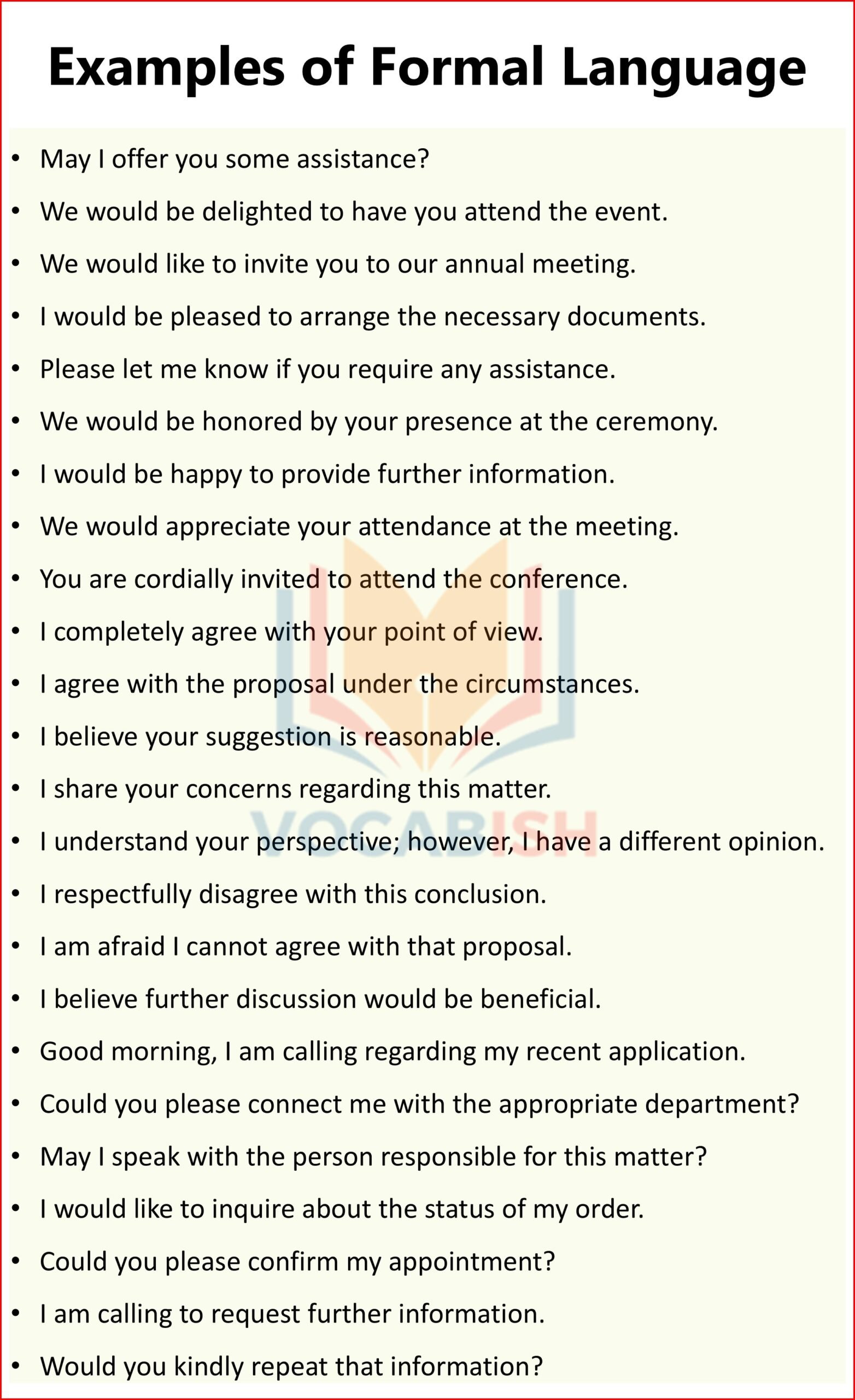
- Would you like me to assist you with this matter?
- May I offer you some assistance?
- We would be delighted to have you attend the event.
- We would like to invite you to our annual meeting.
- I would be pleased to arrange the necessary documents.
- Please let me know if you require any assistance.
- We would be honored by your presence at the ceremony.
- I would be happy to provide further information.
- We would appreciate your attendance at the meeting.
- You are cordially invited to attend the conference.
Formal Agreement and Disagreement
Formal expressions can make agreement or disagreement sound respectful rather than confrontational.
- I completely agree with your point of view.
- I agree with the proposal under the circumstances.
- I believe your suggestion is reasonable.
- I share your concerns regarding this matter.
- I understand your perspective; however, I have a different opinion.
- I respectfully disagree with this conclusion.
- I am afraid I cannot agree with that proposal.
- I appreciate your point, but I believe another approach may be more appropriate.
- I understand your argument and would like to offer another perspective.
- I believe further discussion would be beneficial.
Formal Telephone and Customer-Service Sentences
These sentences are useful when speaking to businesses, offices, receptionists, service providers, and customer-support representatives.
- Good morning, I am calling regarding my recent application.
- Could you please connect me with the appropriate department?
- May I speak with the person responsible for this matter?
- I would like to inquire about the status of my order.
- Could you please confirm my appointment?
- I am calling to request further information.
- Would you kindly repeat that information?
- Could you please provide me with your reference number?
- I would appreciate your assistance with this issue.
- Thank you for your assistance and patience.
Formal Everyday Conversation
Formal language can also be useful in ordinary situations when speaking respectfully to unfamiliar people or people in positions of responsibility.
- Excuse me, could you please tell me where the nearest station is?
- Would you kindly show me where the information desk is located?
- May I ask how much this item costs?
- Could you please tell me what time the store closes?
- I would like to make a reservation for two people.
- Would it be possible to change my appointment?
- Could you please recommend a suitable restaurant?
- I would appreciate your assistance in finding this address.
- Thank you very much for your assistance.
- It was a pleasure speaking with you.
- I hope you have a pleasant day.
- Please let me know if there is anything else I can do.
- I would be grateful if you could help me with this form.
- Could you please wait here for a moment?
- I apologize, but I am unable to assist you with that request.
Formal Language for Different Purposes
Formal English is not limited to one type of sentence. You can use it to ask, inform, apologize, invite, suggest, agree, disagree, thank, request, and respond.
The wording changes depending on your purpose and the person you are addressing.
Formal Language for Making Requests
- Could you please review this document?
- Would you kindly provide the requested information?
- I would appreciate your assistance with this matter.
- May I request your permission to leave early?
Formal Language for Giving Information
- I am writing to inform you that the meeting has been postponed.
- Please be advised that the office will remain closed tomorrow.
- We would like to inform you of the changes to the schedule.
- The requested information is provided below.
Formal Language for Giving Suggestions
- I would suggest considering an alternative approach.
- It may be advisable to review the proposal.
- I recommend that we discuss this matter further.
- It would be appropriate to consider all available options.
Formal Language for Expressing Gratitude
- Thank you for your valuable assistance.
- I sincerely appreciate your support.
- I am grateful for your time and consideration.
- Please accept my sincere thanks.
Formal Language vs. Casual Language
Formal and casual English are both useful, but they serve different communication purposes.
Formal English is generally more polite and professional, while casual English is more relaxed and conversational.
For example:
- Casual: Can you help me?
- Formal: Could you please assist me?
- Casual: I want to ask you something.
- Formal: May I ask you a question?
- Casual: Thanks for your help.
- Formal: Thank you for your assistance.
- Casual: Sorry I’m late.
- Formal: I apologize for being late.
- Casual: Tell me what happened.
- Formal: Could you please explain what happened?
Useful Words and Expressions for Formal English
Certain words and phrases frequently appear in formal communication.
- Could you please…
- Would you kindly…
- May I…
- I would appreciate…
- I would like to…
- I am writing to…
- Please accept…
- I sincerely apologize…
- Thank you for…
- I would be grateful…
- At your earliest convenience
- Please do not hesitate…
- I look forward to…
- With regard to…
- Regarding this matter
- I regret to inform you…
- It would be appreciated…
- We are pleased to inform you…
- I respectfully disagree…
- Thank you for your consideration.
When Should You Use Formal Language?
Formal language is especially appropriate in situations such as:
- Speaking with teachers or professors
- Job interviews
- Workplace communication
- Business meetings
- Formal emails
- Customer-service conversations
- Government offices
- Academic writing
- Official applications
- Speaking with unfamiliar adults
- Professional presentations
- Formal invitations
- Public announcements
- Complaints and official requests
You do not need to speak formally all the time. With close friends and family, casual English is usually more natural.
Common Formal Language Mistakes
English learners sometimes make formal sentences unnecessarily complicated. Formal does not mean using difficult vocabulary.
- Avoid adding complicated words when a clear formal expression works better.
- Do not use slang or texting abbreviations in formal communication.
- Avoid extremely casual contractions when writing highly formal documents.
- Do not confuse polite language with indirect or unclear language.
- Do not make every everyday conversation excessively formal.
Practice: Change Casual Sentences into Formal Language
Try rewriting these casual sentences using formal English.
- Can you help me with this form?
- Tell me when the meeting starts.
- I want more information about the course.
- Sorry, I can’t come to the meeting.
- Can you send me the report?
- Give me some information about the program.
- I need to change my appointment.
- Thanks for helping me.
- Tell me what I need to do.
- Can you explain this problem?
Suggested Answers:
- Could you please assist me with this form?
- Could you please let me know when the meeting begins?
- I would like to obtain further information about the course.
- I apologize, but I am unable to attend the meeting.
- Could you please send me the report?
- I would appreciate some information about the program.
- I would like to request a change to my appointment.
- Thank you very much for your assistance.
- Could you please explain what I need to do?
- Could you please explain this issue to me?
FAQs About Formal Language Examples
Examples of formal language include polite requests, professional expressions, respectful greetings, academic sentences, official statements, and workplace communication.
A formal language sentence uses respectful, professional, and appropriate wording for official, academic, workplace, or unfamiliar social situations.
Could you please assist me? I would appreciate your help. May I ask a question? Please accept my apologies. Thank you for your consideration.
Use polite expressions, complete sentences, precise vocabulary, and respectful wording while avoiding slang, texting language, and overly casual expressions.
Common formal expressions include “I would appreciate,” “Could you please,” “May I,” “I apologize,” “Thank you for your consideration,” and “Please be advised.”
An example of formal language is: “Could you please provide me with the necessary information?”
Formal language is used in schools, workplaces, interviews, business meetings, official correspondence, customer service, applications, and communication with unfamiliar people.
Formal English becomes easier with practice because many polite expressions follow common patterns used repeatedly in professional and academic communication.
Yes. Formal language can be used in everyday situations when speaking respectfully to unfamiliar people, officials, teachers, employers, customers, or senior colleagues.
Conclusion
Learning Examples of Formal Language helps English learners communicate respectfully and confidently in academic, professional, official, and social situations. The most useful formal language sentences are usually clear, polite, and direct rather than unnecessarily complicated.
Practice these expressions in emails, school conversations, workplace situations, customer-service interactions, and other settings where respectful English is appropriate. With regular practice, formal English will become a natural part of your communication.
Explore More Related Articles