Imagine a Caribbean country with tropical beaches, tall mountains, colorful music, baseball, and a capital city founded more than 500 years ago. These Dominican Republic Facts For Kids make the country an exciting place to learn about.
The Dominican Republic is a Caribbean nation on the island of Hispaniola, which it shares with Haiti. Its history includes Indigenous Taíno people, Spanish colonization, independence, and a rich mix of African, European, and Caribbean cultural influences.
From Santo Domingo and Pico Duarte to merengue, bachata, baseball, beaches, and traditional foods, there is plenty for students, teachers, and families to discover.
What Is the Dominican Republic?
The Dominican Republic is a country in the Caribbean region of the Americas.
Here are the most important facts:
- The official name is the Dominican Republic.
- In Spanish, the country is called República Dominicana.
- It is located in the Caribbean Sea.
- It occupies the eastern and central parts of the island of Hispaniola.
- Haiti occupies the western part of Hispaniola.
- The capital city is Santo Domingo.
- Spanish is the official language.
- The national currency is the Dominican peso, written as RD$.
- The country has tropical weather in many areas.
- It is known for beaches, mountains, music, baseball, food, and historical sites.
- Santo Domingo is famous for its historic colonial area.
- The Dominican Republic is one of the most visited countries in the Caribbean.
Dominican Republic Facts for Kids at a Glance
These quick facts are useful for school projects, quizzes, classroom activities, and general knowledge.
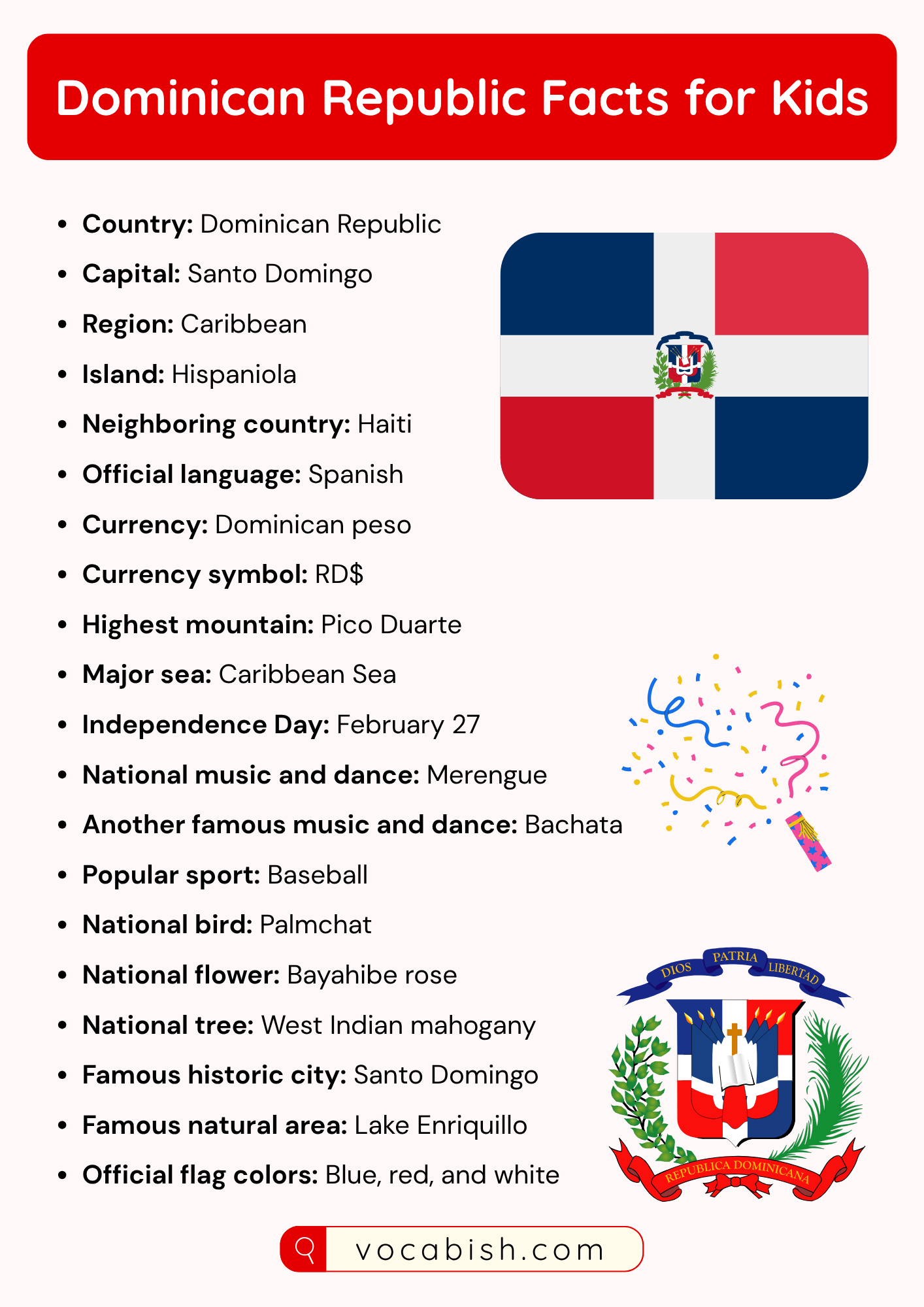
- Country: Dominican Republic
- Capital: Santo Domingo
- Region: Caribbean
- Island: Hispaniola
- Neighboring country: Haiti
- Official language: Spanish
- Currency: Dominican peso
- Currency symbol: RD$
- Highest mountain: Pico Duarte
- Major sea: Caribbean Sea
- Independence Day: February 27
- National music and dance: Merengue is closely associated with Dominican identity.
- Another famous music and dance: Bachata
- Popular sport: Baseball
- National bird: Palmchat
- National flower: Bayahibe rose
- National tree: West Indian mahogany
- Famous historic city: Santo Domingo
- Famous natural area: Lake Enriquillo
- Official flag colors: Blue, red, and white
Dominican Republic Geography Facts
The Dominican Republic has a varied landscape. Children can find beaches, mountains, forests, valleys, lakes, and dry areas within the same country.
- The Dominican Republic is in the Caribbean.
- It shares the island of Hispaniola with Haiti.
- Hispaniola is one of the larger islands in the Caribbean.
- The country has coastlines along the Atlantic Ocean and Caribbean Sea.
- The capital, Santo Domingo, is on the southern coast.
- The Dominican Republic has many sandy beaches.
- Mountain ranges cover important parts of the country.
- Pico Duarte is the highest mountain in the Dominican Republic and the highest peak in the Caribbean.
- Lake Enriquillo is a large saltwater lake in the southwest.
- Lake Enriquillo lies below sea level.
- The country has tropical forests, dry landscapes, wetlands, and coastal ecosystems.
- The climate varies from place to place because of mountains and elevation.
- Some mountain areas are much cooler than the hot coastal areas.
- The country has many rivers and waterfalls.
- Tropical plants grow widely in warm and wet regions.
- The Caribbean location gives the country warm weather for much of the year.
Why Is Hispaniola Important?
- Hispaniola is an island shared by two countries.
- The Dominican Republic occupies the eastern part.
- Haiti occupies the western part.
- The island has mountains, valleys, forests, rivers, and coastal areas.
- This makes Hispaniola geographically diverse.
Dominican Republic History Facts for Kids
The country’s history goes back long before the arrival of Europeans. Indigenous Taíno communities lived on Hispaniola before Christopher Columbus arrived in 1492.
- The Taíno were Indigenous people who lived in Hispaniola before European colonization.
- Christopher Columbus reached the island in 1492 during his first voyage across the Atlantic.
- Spanish colonization began soon afterward.
- Santo Domingo became an important early Spanish settlement in the Americas.
- The city developed into an important center of Spanish colonial activity.
- Hispaniola experienced periods of Spanish and French control in different areas.
- The eastern part eventually became the Dominican Republic.
- The Dominican Republic declared independence from Haiti on February 27, 1844.
- Juan Pablo Duarte is one of the country’s best-known founding fathers.
- Duarte helped inspire the movement for Dominican independence.
- The Dominican Republic celebrates February 27 as Independence Day.
- The country also remembers the Restoration War, which helped restore Dominican sovereignty from Spain in the 19th century.
- Santo Domingo’s Colonial City contains many important historic buildings.
- The Colonial City is recognized by UNESCO as a World Heritage Site.
Who Was Juan Pablo Duarte?
- Juan Pablo Duarte was an important Dominican patriot.
- He is widely remembered as one of the country’s founding fathers.
- He helped create La Trinitaria, a secret society that worked toward independence.
- He also helped inspire the design of the Dominican flag.
- His ideas focused on independence and national sovereignty.
- January 26 is celebrated as Duarte Day in the Dominican Republic.
Dominican Republic Culture Facts for Kids
Dominican culture brings together Indigenous, African, European, and Caribbean influences.
- Dominican culture includes music, dance, food, festivals, sports, art, and family traditions.
- Music is an important part of social life.
- Merengue is strongly connected with Dominican national identity.
- Bachata is another famous Dominican music and dance tradition.
- Baseball has a major place in Dominican life.
- Carnival celebrations include colorful costumes, music, dancing, and parades.
- Family and community gatherings are important parts of everyday social life.
- Dominican food includes rice, beans, plantains, meat, vegetables, and seafood.
- Spanish is used in schools, government, media, and everyday communication.
- Dominican Spanish has its own pronunciation, expressions, and vocabulary.
- Different regions can have their own local traditions.
- Dominican cultural traditions have also spread to communities around the world.
UNESCO has recognized Dominican traditions, including merengue, bachata, the Cocolo dance drama tradition, and the cultural space of the Brotherhood of the Holy Spirit of the Congos of Villa Mella. In 2024, traditional knowledge surrounding cassava bread was also added to UNESCO’s Intangible Cultural Heritage list.
Dominican Republic Language and People
Language helps explain how people communicate and share culture.
- Spanish is the official language of the Dominican Republic.
- Dominican Spanish is the local variety of Spanish commonly spoken in the country.
- English is also useful in tourism and international communication.
- French can also be studied as a second or additional language.
- Many Dominican people have cultural connections to other Caribbean and American countries.
- Dominican communities can be found in many parts of the world.
- Family gatherings, celebrations, music, and food often bring people together.
- People living in different regions may have different accents or expressions.
Useful Spanish Words for Kids:
- Hola = Hello
- Adiós = Goodbye
- Gracias = Thank you
- Por favor = Please
- Buenos días = Good morning
- Buenas tardes = Good afternoon
- Sí = Yes
- No = No
- Amigo = Friend
- Familia = Family
- Related Resources: 200+ Spanish Words with English Meanings
Dominican Republic Flag and National Symbols
The Dominican flag is one of the country’s most recognizable national symbols.
- The Dominican flag uses blue, red, and white.
- A white cross divides the flag into four sections.
- The national coat of arms appears in the center.
- The flag was designed from ideas associated with Juan Pablo Duarte.
- The first Dominican flag was raised on February 27, 1844, the day of independence.
- The national coat of arms contains an open Bible and a cross.
- The national motto is “Dios, Patria, Libertad,” meaning “God, Fatherland, Liberty.”
- The Dominican Republic’s coat of arms is unusual because it includes an open Bible.
- The flag, coat of arms, and national anthem are official national symbols.
National Symbols to Remember
- National bird: Palmchat
- National flower: Bayahibe rose
- National tree: West Indian mahogany
- National currency: Dominican peso
- National language: Spanish
- National anthem: Himno Nacional
- National flag: Blue, red, and white with a white cross
Dominican Republic Food Facts
Food is an important part of Dominican family and social life.
- Rice and beans are common parts of Dominican meals.
- Plantains are widely used in Dominican cooking.
- Mangú is a popular dish made from mashed green plantains.
- Mangú is often served with onions and other foods.
- La bandera dominicana is a well-known meal combining rice, beans, and meat.
- Sancocho is a hearty stew made with different meats and root vegetables.
- Tostones are fried pieces of green plantain.
- Mofongo is another plantain-based dish popular in the Caribbean.
- Seafood is common in many coastal communities.
- Tropical fruits are widely enjoyed.
- Cassava is also an important traditional food.
- Traditional knowledge about making and consuming cassava bread was added to UNESCO’s Intangible Cultural Heritage list in 2024.
Dominican Republic Music and Dance
Music and dancing are central to Dominican cultural life.
Merengue
- Merengue is one of the best-known Dominican music and dance traditions.
- It is strongly associated with Dominican national identity.
- People often dance merengue in pairs.
- Traditional merengue can use instruments such as an accordion, drum, and saxophone.
- Merengue is performed at celebrations and social gatherings.
- UNESCO added the music and dance of merengue in the Dominican Republic to its Intangible Cultural Heritage list in 2016.
- November 26 is recognized as National Merengue Day in the Dominican Republic.
Bachata
- Bachata is another famous Dominican music and dance tradition.
- It developed from a mixture of musical influences.
- Guitars are important instruments in traditional bachata.
- Bongos, maracas, güiro, and bass can also be used.
- Bachata is often danced by couples.
- Its songs commonly express feelings such as love, passion, and nostalgia.
- UNESCO added Dominican bachata to its Intangible Cultural Heritage list in 2019.
Dominican Republic Animals and Nature
The Dominican Republic has many interesting plants and animals because of its tropical environment and different habitats.
- The palmchat is the national bird of the Dominican Republic.
- The palmchat is a small bird that lives naturally in the Caribbean.
- The Bayahibe rose is the national flower.
- The West Indian mahogany is the national tree.
- Tropical forests provide homes for many species.
- Coastal areas support marine life.
- Coral reefs are important habitats for ocean animals.
- Whales can be seen in Dominican waters during parts of the year.
- Samaná Bay is well known for humpback whale watching.
- Sea turtles live in and around Dominican coastal waters.
- Iguanas can be found in some dry and protected areas.
- The country has many species found only in the Caribbean.
- National parks and protected areas help conserve important ecosystems.
- The Dominican Republic’s mountains and forests support a wide variety of wildlife.
Famous Places in the Dominican Republic
The country has both historical landmarks and natural attractions.
- Santo Domingo is the capital city.
- The Colonial City of Santo Domingo contains historic buildings and streets.
- Punta Cana is famous for beaches and tourism.
- Puerto Plata is known for beaches, mountains, and historic attractions.
- Samaná is known for nature and seasonal whale watching.
- Lake Enriquillo is a major natural feature in the southwest.
- Pico Duarte attracts people interested in mountains and hiking.
- Los Haitises National Park is known for forests, caves, mangroves, and unusual landscapes.
- La Romana is another important tourist area.
- Jarabacoa is known for mountain scenery and outdoor activities.
- Bayahibe is known for coastal scenery and access to natural attractions.
- Santo Domingo’s Colonial City is a UNESCO World Heritage Site.
Dominican Republic Sports Facts
Sports are an important part of everyday culture, especially baseball.
- Baseball is one of the most popular sports in the Dominican Republic.
- The country has produced many famous professional baseball players.
- Many children learn to play baseball at a young age.
- Baseball fields can be found in communities across the country.
- Dominican players have made a major impact on professional baseball in the United States.
- Basketball is also popular.
- Boxing and volleyball are also enjoyed.
- Soccer has grown in popularity among younger generations.
- Sports can bring families and communities together.
Dominican Republic Economy and Everyday Life
The Dominican Republic has a diverse economy with tourism, manufacturing, agriculture, services, and other industries.
- Tourism is an important part of the country’s economy.
- Visitors come for beaches, nature, history, food, and cultural experiences.
- Agriculture includes products such as sugarcane, coffee, cocoa, tobacco, bananas, and other crops.
- Manufacturing is another important economic activity.
- Mining contributes to the economy.
- Telecommunications and services are also important.
- Many people live in cities, towns, and rural communities.
- Santo Domingo is a major center for business, education, government, and culture.
- Rural communities may have stronger connections to farming and agricultural activities.
- The Dominican peso is used for everyday purchases.
Dominican Republic Fun Facts for Kids
Here are some quick facts that make the country especially interesting for young learners.
- The Dominican Republic and Haiti share the island of Hispaniola.
- The capital city is Santo Domingo.
- Santo Domingo has one of the oldest European-founded colonial areas in the Americas.
- The country became independent on February 27, 1844.
- Pico Duarte is the highest mountain in the Caribbean.
- Lake Enriquillo is below sea level.
- The Dominican flag has an open Bible in its coat of arms.
- The national motto is “Dios, Patria, Libertad.”
- Merengue is part of Dominican cultural identity.
- UNESCO recognized Dominican merengue as Intangible Cultural Heritage in 2016.
- UNESCO recognized Dominican bachata in 2019.
- Traditional cassava bread knowledge was recognized by UNESCO in 2024.
- Baseball is extremely popular in the country.
- The Dominican Republic has both Atlantic and Caribbean coastlines.
- Samaná Bay is known for seasonal humpback whale activity.
- The palmchat is the country’s national bird.
- The Bayahibe rose is the national flower.
- The Dominican peso is the country’s currency.
- Spanish is the official language.
- The country has tropical beaches as well as high mountains.
- Santo Domingo’s Colonial City is a UNESCO World Heritage Site.
- The Dominican Republic is one of the Caribbean’s major tourism destinations.
Important Dominican Republic Facts to Remember
If you need to study the topic quickly, remember these key points:
- The Dominican Republic is a Caribbean country.
- It occupies part of the island of Hispaniola.
- Haiti shares the island.
- Santo Domingo is the capital.
- Spanish is the official language.
- The Dominican peso is the currency.
- The country became independent in 1844.
- February 27 is Independence Day.
- Juan Pablo Duarte was a major independence leader.
- Pico Duarte is the country’s highest mountain.
- Merengue and bachata are famous Dominican musical traditions.
- Baseball is a very popular sport.
- The palmchat is the national bird.
- The Bayahibe rose is the national flower.
- The flag has a white cross, blue and red sections, and the national coat of arms.
- The Dominican Republic has a rich mix of Caribbean, African, European, and Indigenous influences.
Common Mistakes and Confusions
- Dominican Republic vs. Dominica: They are two different Caribbean countries.
- Dominican Republic vs. Haiti: They are separate countries that share the island of Hispaniola.
- Santo Domingo vs. Dominican Republic: Santo Domingo is the capital city, while the Dominican Republic is the country.
- Spanish vs. Dominican Spanish: Spanish is the official language, while Dominican Spanish is the local variety commonly spoken.
- Merengue vs. bachata: Both are important Dominican music and dance traditions, but they are different styles.
Quick Practice Questions
Test what you have learned.
- What is the capital of the Dominican Republic?
- Which island does the Dominican Republic share with Haiti?
- What language is officially used in the Dominican Republic?
- What currency is used in the country?
- When did the Dominican Republic declare independence?
- Who was Juan Pablo Duarte?
- What is the highest mountain in the Dominican Republic?
- Which sport is especially popular in the country?
- What are two famous Dominican music and dance traditions?
- What is the national bird of the Dominican Republic?
Answers:
- The capital is Santo Domingo.
- The Dominican Republic shares Hispaniola with Haiti.
- The official language is Spanish.
- The currency is the Dominican peso.
- Independence was declared on February 27, 1844.
- Juan Pablo Duarte was a major Dominican independence leader and founding father.
- The highest mountain is Pico Duarte.
- Baseball is especially popular.
- Two famous traditions are merengue and bachata.
- The national bird is the palmchat.
Frequently Asked Questions
The Dominican Republic is famous for its Caribbean beaches, baseball, merengue, bachata, tropical landscapes, food, and historic Santo Domingo.
The capital is Santo Domingo, Spanish is the official language, and the country shares Hispaniola with Haiti.
Santo Domingo is the capital and largest city of the Dominican Republic, located on the country’s southern coast.
Spanish is the official language, and Dominican Spanish is the local variety commonly spoken in everyday communication.
The Dominican Republic declared independence from Haiti on February 27, 1844, which is celebrated as Independence Day.
Popular Dominican foods include mangú, tostones, sancocho, rice and beans, and the traditional meal known as la bandera.
Merengue and bachata are especially famous Dominican music and dance traditions recognized as important cultural heritage.
Baseball is one of the country’s most popular sports, and Dominican players have made a major impact on professional baseball.
Conclusion
The Dominican Republic is a fascinating Caribbean country with a rich history, diverse geography, lively culture, and strong sporting traditions. Its story includes the Taíno people, Spanish colonization, independence in 1844, and cultural traditions such as merengue and bachata.
For students learning geography or world cultures, these Dominican Republic Facts For Kids provide a useful starting point for understanding the country’s people, history, food, nature, language, national symbols, and everyday life.
Explore More Kids Learning Resources