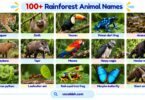
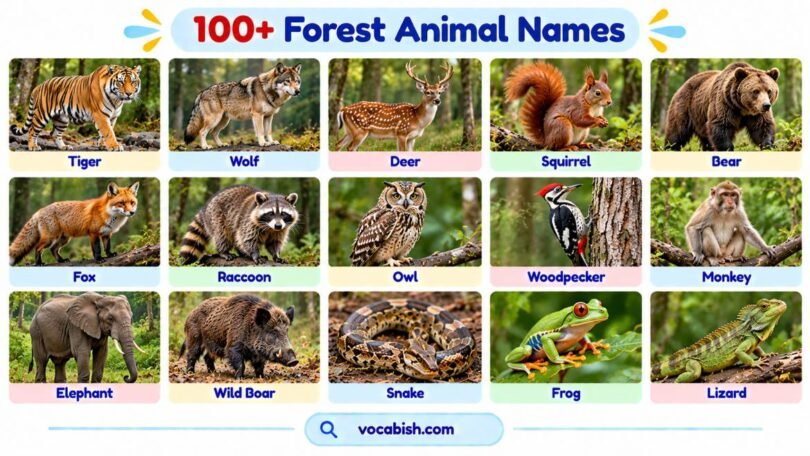

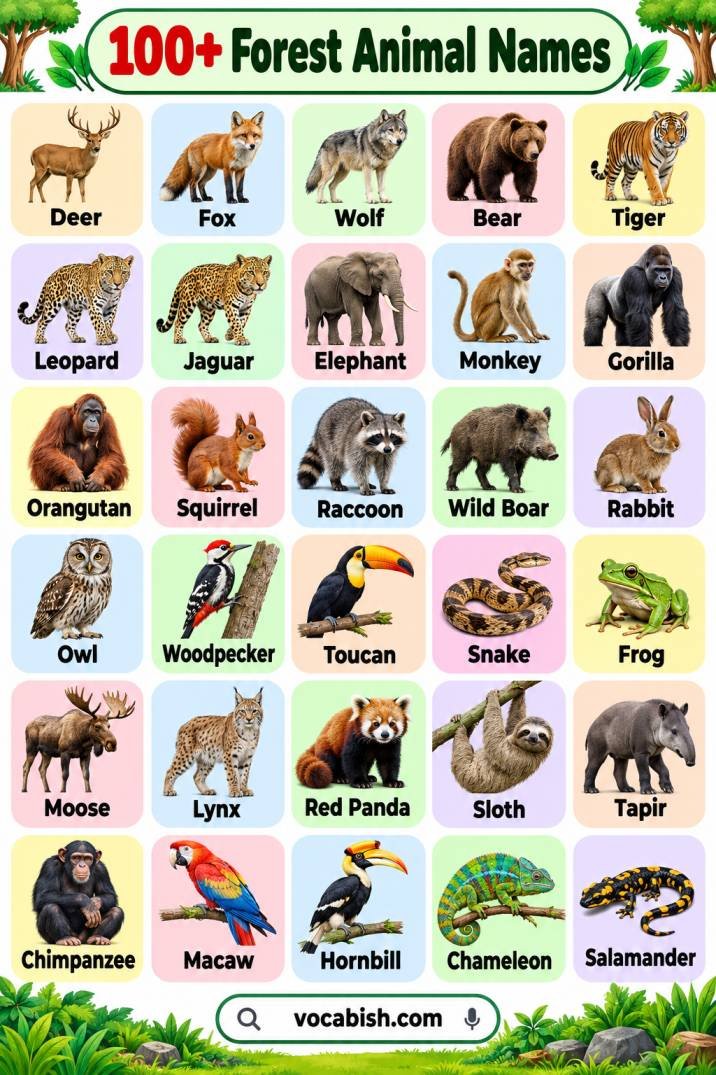
Forest animals live in many habitats, from tropical rainforests to cold boreal forests. Forest animal names include mammals, birds, reptiles, amphibians, insects, and other wildlife that depend on trees, rivers, soil, and dense vegetation. Common examples include deer, foxes, bears, wolves, monkeys, owls, snakes, frogs, and woodpeckers. Learning these names helps build animal vocabulary while also showing how different species live, move, feed, and survive in forest environments.
Explore more animals with their starting letter:
A | B | C | D | E | F | G | H | I | J | K | L | M | N | O | P | Q | R | S | T | V | W | YCommon Forest Animal Names in English with Pictures
These are some of the best-known animals associated with forests and woodlands around the world. Each name includes a few short facts to help you understand and remember the animal.
Deer
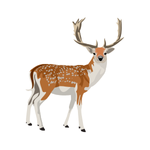
A deer is a hoofed mammal that lives in many forests, woodlands, and grasslands. Deer mainly eat leaves, grass, shoots, and other plants. Many male deer grow antlers that are shed and regrown.
Fox
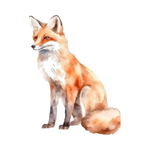
A fox is a small to medium-sized mammal with a pointed face and a bushy tail. Many fox species live in forests or wooded areas. Foxes eat small animals, insects, fruit, and other available food.
Wolf
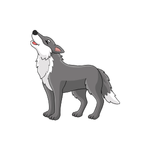
A wolf is a large wild member of the dog family. Wolves can live in forests as well as mountains, grasslands, and tundra. They are social animals and often live and hunt in family groups called packs.
Bear
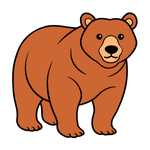
Bears are large mammals found in several forest regions of the world. Many species eat a mixture of plants, fruit, insects, fish, and other animals. Forests provide bears with food, shelter, and places to rest.
Tiger
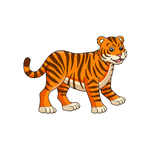
The tiger is a large striped cat native to Asia. Tigers use forests, mangroves, grasslands, and other habitats depending on the population. They are powerful carnivores that usually hunt alone.
Leopard
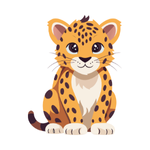
A leopard is a large spotted cat found in parts of Africa and Asia. Leopards can live in forests, woodlands, mountains, and other habitats. They are excellent climbers and often rest in trees.
Jaguar
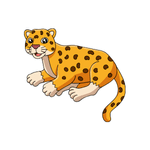
The jaguar is a large wild cat native to the Americas. It lives in several habitats but is strongly associated with tropical forests and wetlands. Jaguars are powerful hunters and are also good swimmers.
Elephant

Some elephants live in heavily forested regions. The African forest elephant inhabits forests in Central and West Africa, while Asian elephants also use forest habitats. Elephants are plant-eating mammals that feed on leaves, bark, fruit, grass, and other vegetation.
Monkey

Many monkey species live in tropical and subtropical forests. Some spend much of their time climbing and feeding in trees. Depending on the species, monkeys may eat fruit, leaves, seeds, insects, and small animals.
Gorilla
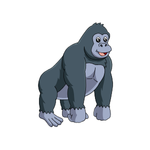
Gorillas are large apes that live in forests of central Africa. They spend much of their day eating leaves, stems, shoots, and fruit. Gorillas usually live in social groups led by an adult male known as a silverback.
Orangutan
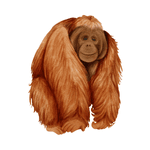
Orangutans are great apes native to the rainforests of Borneo and Sumatra. They spend much of their lives in trees and have very long arms for climbing. Their diet contains plenty of fruit as well as leaves, bark, insects, and other foods.
Squirrel

Many squirrel species live in forests and woodlands. Tree squirrels are strong climbers and often collect nuts, seeds, and fruit. Some species store food for use at a later time.
Raccoon
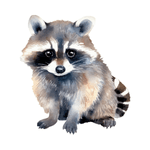
A raccoon is a medium-sized mammal easily recognized by its dark facial markings and ringed tail. Raccoons occur in forests as well as wetlands and human settlements in North America. They are omnivores and eat many different kinds of food.
Wild Boar
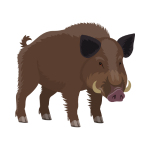
The wild boar is a strong, stocky mammal with a long snout. It lives in forests, woodlands, scrublands, and several other habitats. Wild boars use their snouts to search through soil and leaves for roots, insects, and other food.
Rabbit

Some rabbits live around forests, woodland edges, shrubs, and areas with dense vegetation. Rabbits are herbivores and mainly eat grasses and other plants. Their strong back legs help them move quickly when escaping danger.
Owl
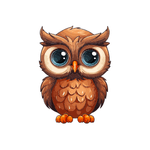
Many owl species make their homes in forests and woodlands. Owls have strong eyesight and hearing that help them locate prey. Many species are most active at night, although some also hunt during daylight.
Woodpecker
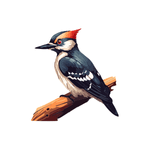
Woodpeckers are birds closely associated with trees and wooded habitats. Their strong bills help them search bark and wood for insects and create nesting cavities. Different woodpecker species occur in forests across many parts of the world.
Toucan
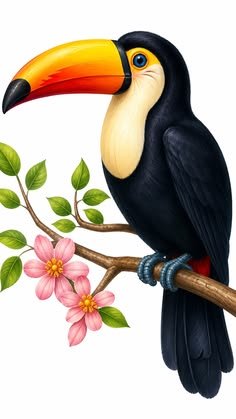
Toucans are colourful birds found mainly in tropical forests of Central and South America. They are easily recognized by their large bills. Fruit makes up an important part of the diet of many toucan species.
Snake
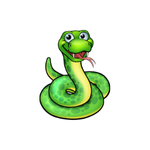
Many snake species live on forest floors, in bushes, underground, or in trees. Snakes are reptiles and depend on external heat sources to regulate their body temperature. Different species catch prey using constriction, venom, or direct swallowing.
Frog
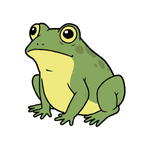
Many frogs live in moist forests, particularly tropical rainforests. Their skin needs moisture, so damp forest environments can provide suitable conditions. Many species reproduce in water or other wet places, although their breeding habits vary widely.
How to Use This Forest Animals List
- Learn the common animal names and facts first.
- Say unfamiliar names aloud using the pronunciation section.
- Study animals in groups such as mammals, birds, reptiles, and amphibians.
- Use the example sentences to learn each word in context.
- Complete the short practice activity without checking the answers first.
List of Forest Animals by Group
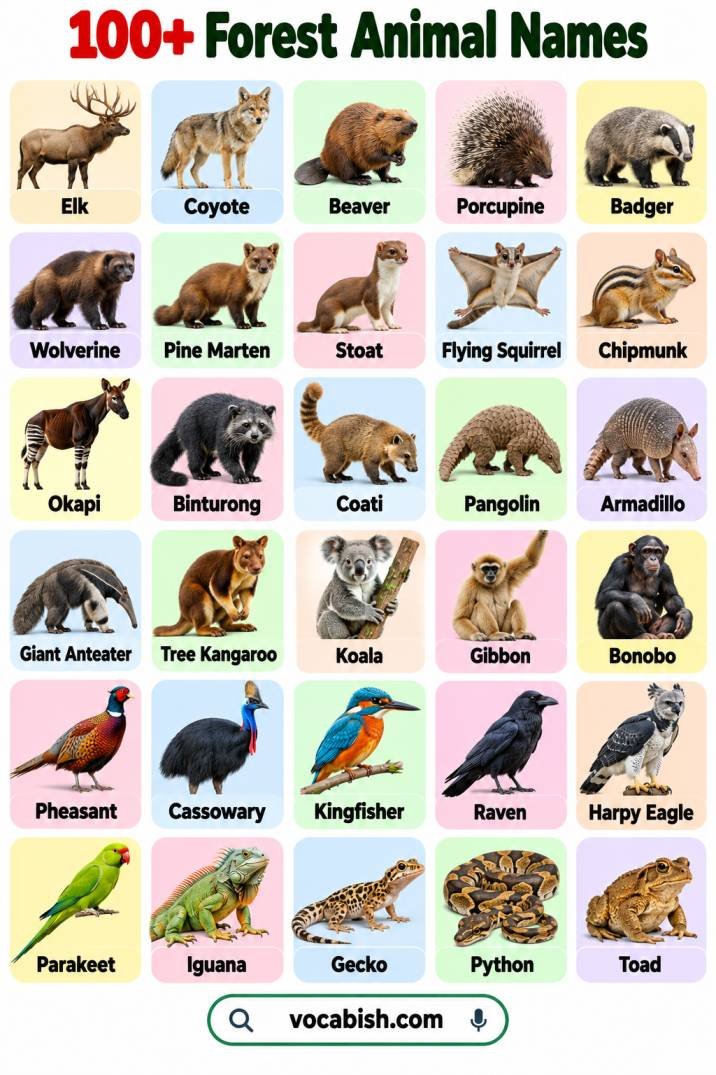
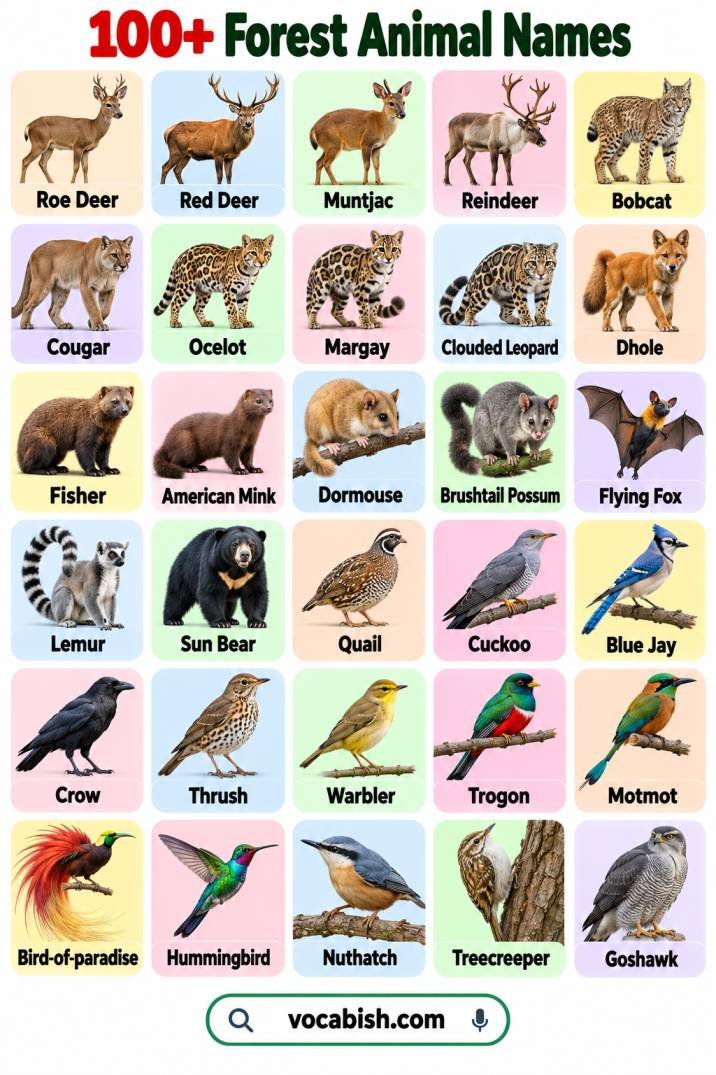
Forest animals can be grouped into mammals, birds, reptiles, amphibians, insects, and other invertebrates. The lists below make these names easier to learn and compare by animal type.
Forest Mammals
Here are the names of mammals commonly found in forests, from small tree-dwellers to large land animals.
- Moose
- Elk
- Roe Deer
- Red Deer
- Muntjac
- Reindeer
- Lynx
- Bobcat
- Cougar
- Ocelot
- Margay
- Clouded Leopard
- Dhole
- Coyote
- Pine Marten
- Fisher
- Wolverine
- European Badger
- American Mink
- Stoat
- Weasel
- North American Porcupine
- Chipmunk
- Beaver
- Flying Squirrel
- Dormouse
- Sloth
- Tapir
- Okapi
- Binturong
- Coati
- Pangolin
- Nine-banded Armadillo
- Giant Anteater
- Tamandua
- Agouti
- Paca
- Tree Kangaroo
- Koala
- Brushtail Possum
- Flying Fox
- Gibbon
- Lemur
- Bonobo
- Chimpanzee
- Red Panda
- Sun Bear
Forest Birds
This list includes bird names you may see or hear in forest habitats, from canopy birds to ground-dwelling species.
- Hornbill
- Macaw
- Cassowary
- Peafowl
- Pheasant
- Wild Turkey
- Quail
- Cuckoo
- Blue Jay
- Raven
- Crow
- Thrush
- Warbler
- Kingfisher
- Trogon
- Motmot
- Bird-of-paradise
- Hummingbird
- Nuthatch
- Treecreeper
- Goshawk
- Sparrowhawk
- Harpy Eagle
- Barbet
- Turaco
- Roller
- Drongo
- Bowerbird
- Lyrebird
- Kookaburra
- Wood Pigeon
- Parakeet
- Lorikeet
- Cockatoo
- Fairywren
- Tanager
- Manakin
- Hoatzin
Forest Reptiles
Here are some reptile names found in forests, including snakes, lizards, turtles, and other cold-blooded animals.
- Python
- Boa Constrictor
- King Cobra
- Viper
- Coral Snake
- Rat Snake
- Green Anole
- Iguana
- Chameleon
- Gecko
- Monitor Lizard
- Skink
- Box Turtle
- Red-footed Tortoise
- Yellow-footed Tortoise
- Caiman
- Forest Dragon
- Basilisk
Forest Amphibians
This list covers amphibian names often linked with damp forest floors, streams, ponds, and other moist areas.
- Salamander
- Newt
- Tree Frog
- Poison Dart Frog
- Glass Frog
- Wood Frog
- Red-eyed Tree Frog
- Toad
- Caecilian
- Mantella
- Fire Salamander
- Giant Salamander
Forest Insects and Other Invertebrates
Here you’ll find the names of insects and other small invertebrates that live on leaves, bark, soil, and the forest floor.
- Butterfly
- Moth
- Beetle
- Stag Beetle
- Rhinoceros Beetle
- Ant
- Leafcutter Ant
- Termite
- Bee
- Wasp
- Hornet
- Spider
- Orb-weaver Spider
- Tarantula
- Scorpion
- Centipede
- Millipede
- Earthworm
- Snail
- Slug
- Stick Insect
- Leaf Insect
- Praying Mantis
- Cicada
- Katydid
- Cricket
- Firefly
- Lacewing
- Weevil
- Woodlouse
Animals of Forest Rivers and Freshwater Habitats
This list includes animals found in forest rivers, streams, ponds, and nearby freshwater habitats.
- Piranha
- Arapaima
- Electric Eel
- Discus
- Freshwater Angelfish
- Tetra
- Arowana
- Freshwater Stingray
- Brook Trout
- River Otter
- Crayfish
Main Types of Forests Explained with Examples
Forests differ greatly in climate, rainfall, vegetation, and wildlife. Each forest type creates its own habitat conditions, which influence the animals that can survive there.
Tropical Rainforest
Tropical rainforests are warm, humid forests found close to the equator. They receive heavy rainfall throughout the year and grow several layers of dense vegetation, from the forest floor to the high canopy. These forests support exceptionally high biodiversity, with many animals spending most of their lives in trees.
Examples: Jaguar, Orangutan, Gorilla, Sloth, Toucan, Macaw, Poison Dart Frog, Tapir
Temperate Deciduous Forest
Temperate deciduous forests experience four distinct seasons, including cold winters and warm summers. Many trees, such as oak, maple, and beech, lose their leaves during autumn. Animals living here often change their behaviour with the seasons by storing food, migrating, growing thicker fur, or becoming less active during winter.
Examples: White-tailed Deer, Red Fox, Black Bear, Raccoon, Squirrel, Wild Boar, Woodpecker, Owl
Temperate Rainforest
Temperate rainforests grow in cooler regions that receive large amounts of rain, mist, and coastal moisture. Their trees can become extremely tall, while mosses, ferns, lichens, and fallen logs create damp habitats near the ground. The mild temperatures and constant moisture make these forests suitable for amphibians, birds, mammals, and many small invertebrates.
Examples: Roosevelt Elk, Black Bear, Cougar, Bobcat, Flying Squirrel, Banana Slug, Salamander, Spotted Owl
Boreal Forest
The boreal forest forms a huge band across northern North America, Europe, and Asia. Long, cold winters and short summers favour evergreen conifers such as spruce, pine, and fir. Many animals in this region have thick fur, large feet, seasonal coats, or migration habits that help them cope with deep snow and low temperatures.
Examples: Moose, Gray Wolf, Lynx, Wolverine, Brown Bear, Snowshoe Hare, Beaver, Great Gray Owl
Taiga
Taiga is another widely used name for the northern coniferous forest biome and is closely related to the boreal forest. The term is often associated especially with the vast forests of Russia and northern Eurasia. Wildlife must deal with freezing winters, limited winter food, and large seasonal changes in daylight.
Examples: Siberian Tiger, Eurasian Lynx, Reindeer, Brown Bear, Red Fox, Sable, Wolverine, Capercaillie
Montane Forest
Montane forests grow on mountains where altitude strongly affects temperature, rainfall, and vegetation. Conditions usually become cooler as elevation increases, so different animal communities may occur at different heights on the same mountain. These forests often provide important habitat for species adapted to steep slopes, rocky ground, and cooler air.
Examples: Red Panda, Mountain Gorilla, Clouded Leopard, Himalayan Black Bear, Takin, Goral, Langur, Pheasant
Cloud Forest
Cloud forests are moist mountain forests that are frequently covered by low clouds, fog, or mist. Water collects on leaves and branches even when it is not raining, creating ideal conditions for mosses, orchids, ferns, and other moisture-loving plants. Many cloud forest animals have very small natural ranges, which can make them especially sensitive to habitat loss and climate change.
Examples: Resplendent Quetzal, Spectacled Bear, Mountain Tapir, Howler Monkey, Glass Frog, Salamander, Hummingbird, Ocelot
Tropical Dry Forest
Tropical dry forests grow in warm regions with a pronounced wet season and dry season. During the driest months, many trees shed their leaves to reduce water loss. Animals living in these forests often adjust feeding, breeding, and movement patterns according to the seasonal availability of water and vegetation.
Examples: Asian Elephant, Bengal Tiger, Leopard, Spotted Deer, Sloth Bear, Langur, Wild Boar, Indian Peafowl
Mangrove Forest
Mangrove forests develop along tropical and subtropical coastlines where saltwater and freshwater meet. Their tangled roots create sheltered feeding and breeding areas for fish, reptiles, birds, mammals, and crustaceans. Mangroves also protect coastlines from erosion and provide an important link between land and marine ecosystems.
Examples: Proboscis Monkey, Bengal Tiger, Fishing Cat, Saltwater Crocodile, Mudskipper, Mangrove Snake, Heron, Fiddler Crab
Tricky Forest Animal Names and Pronunciation
Some animal names look harder to pronounce than they really are. These pronunciation guides use familiar English sounds rather than technical phonetic symbols.
Animal | Easy Pronunciation |
|---|---|
Squirrel | SKWIR-uhl |
Leopard | LEP-erd |
Orangutan | oh-RANG-oo-tan |
Jaguar | JAG-wahr / JAG-yoo-er |
Toucan | TOO-kan |
Muntjac | MUNT-jak |
Binturong | BIN-too-rong |
Caecilian | sih-SIL-ee-an |
Forest Animal Example Sentences
- A deer walked quietly between the trees.
- The squirrel carried a nut up the tree.
- We heard an owl calling during the night.
- The woodpecker searched the tree bark for insects.
- A jaguar can move quietly through dense forest.
- The orangutan climbed from one branch to another.
- The frog rested on a wet leaf.
- A wild boar searched the forest floor for food.
- The toucan sat high in the tropical forest canopy.
- The fox disappeared quickly among the trees.
Read More: 50+ Marine Mammals Name with Pictures
Fun Facts About Forest Animals
- Woodpeckers have shock-absorbing head structures. Their skulls, muscles, and beaks help them peck wood repeatedly while reducing the force reaching the brain.
- Flying squirrels do not actually fly. They glide between trees using a skin membrane stretched between their front and back legs.
- Orangutans build new sleeping nests. They bend and weave branches together high in trees to make a comfortable place to rest.
- Jaguars are excellent swimmers. Unlike many cats, they regularly enter rivers and wetlands to swim and hunt for food.
- Some forest frogs can change colour slightly. Changes in temperature, light, moisture, or surroundings can affect their skin colour.
- Squirrels help forests grow. When they bury nuts and forget some of them, those hidden seeds may later grow into new trees.
- Owls can turn their heads about 270 degrees. This wide movement helps them look around without moving their whole body.
- Many forest animals depend on fallen trees. Dead logs provide shelter, food, moisture, and nesting places for insects, amphibians, reptiles, birds, and small mammals.
Forest Animals Vocabulary Practice
Choose the correct answer.
1. Which animal is a great ape found in the forests of Borneo and Sumatra?
A. Raccoon
B. Orangutan
C. Deer
D. Wolf
2. Which bird uses a strong bill to make holes in wood?
A. Woodpecker
B. Toucan
C. Owl
D. Quail
3. Which animal is known for its black facial markings and ringed tail?
A. Lynx
B. Raccoon
C. Tapir
D. Wolverine
4. Which animal is an amphibian?
A. Gecko
B. Salamander
C. Python
D. Squirrel
5. Which animal is a large spotted cat from the Americas?
A. Jaguar
B. Wolf
C. Gibbon
D. Wild Boar
6. Which animal has a large colourful bill and lives in tropical forests of the Americas?
A. Raven
B. Toucan
C. Pheasant
D. Wood Pigeon
7. Which animal belongs to the reptile group?
A. Newt
B. Tree Frog
C. Chameleon
D. Beaver
8. Which word has the same form in singular and plural?
A. Fox
B. Wolf
C. Deer
D. Monkey
Answers
- B. Orangutan
- A. Woodpecker
- B. Raccoon
- B. Salamander
- A. Jaguar
- B. Toucan
- C. Chameleon
- C. Deer
FAQs
Forest animals are creatures that spend all or part of their lives in forests, including mammals, birds, reptiles, amphibians, insects, and other animals.
Common forest animals include deer, foxes, wolves, bears, squirrels, wild boars, owls, woodpeckers, snakes, frogs, monkeys, tigers, and leopards.
Tropical rainforests support animals such as jaguars, orangutans, gorillas, sloths, toucans, macaws, tree frogs, snakes, insects, monkeys, and tapirs.
Forest mammals include deer, bears, wolves, foxes, squirrels, monkeys, apes, wild boars, tapirs, lynxes, red pandas, sloths, and many others.
Forest birds include owls, woodpeckers, toucans, hornbills, macaws, cuckoos, thrushes, nuthatches, pheasants, goshawks, hummingbirds, and numerous other species.
Yes. Forest reptiles include pythons, boas, cobras, vipers, iguanas, chameleons, geckos, skinks, turtles, tortoises, caimans, and monitor lizards.
Forest floors contain ants, beetles, spiders, millipedes, centipedes, earthworms, snails, slugs, salamanders, frogs, and many other small creatures.
No. Animal communities differ according to forest type, climate, continent, food availability, elevation, water, and other environmental conditions.
Related Animal Vocabulary
- Vertebrate Animals Names
- Invertebrate Animals Names
- Mammal Names
- Bird Names
- Reptile Names
- Amphibian Names
- Insect Names
- Wild Animals Names
Conclusion
Learning Forest Animal Names makes it easier to describe wildlife and understand animal vocabulary in English. Forests contain an enormous range of mammals, birds, reptiles, amphibians, fish, insects, and other invertebrates, from familiar deer and squirrels to jaguars, orangutans, caecilians, and binturongs.
Use the common names first, then study the larger lists by animal group to build a wider and more accurate vocabulary.