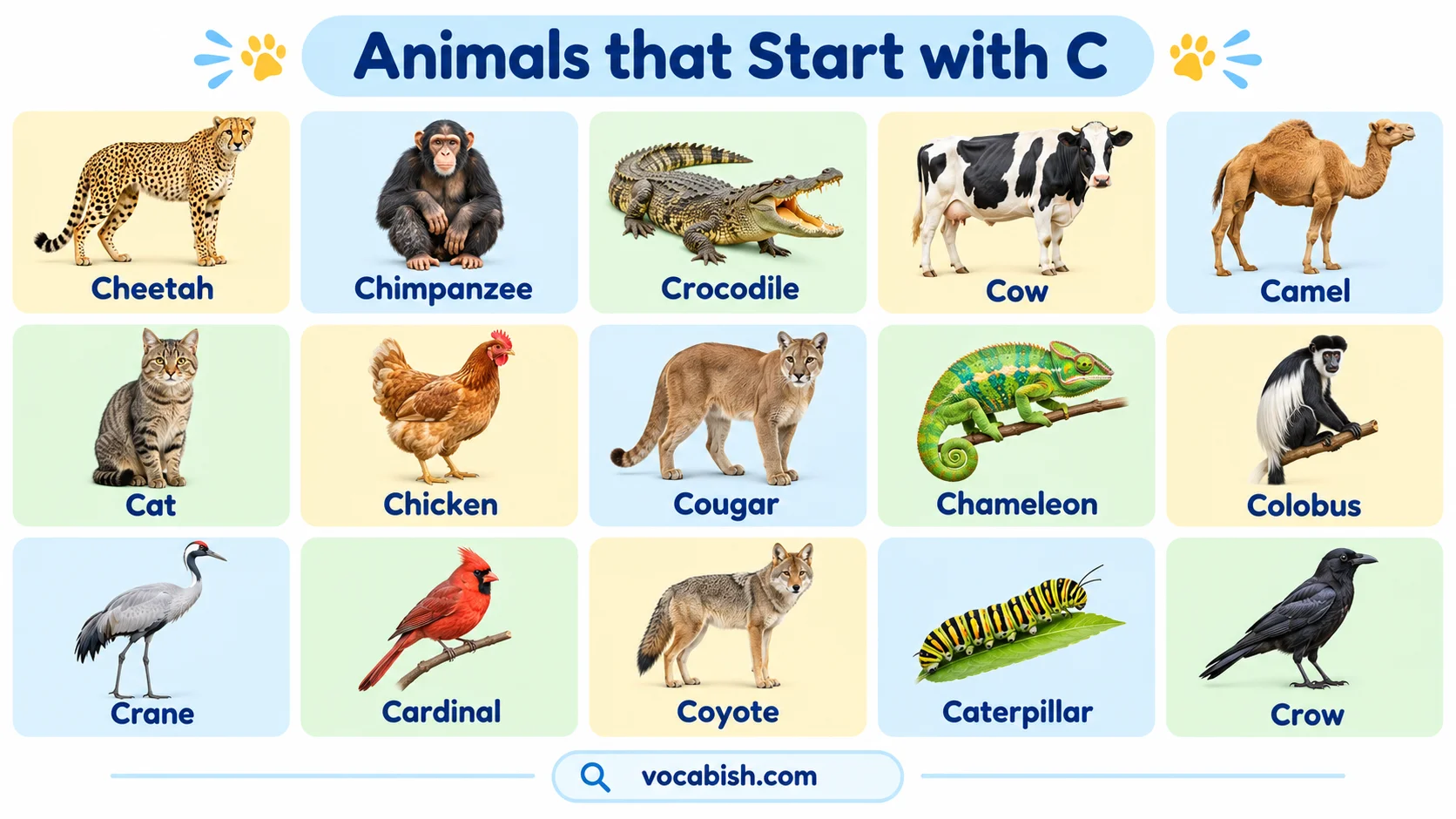

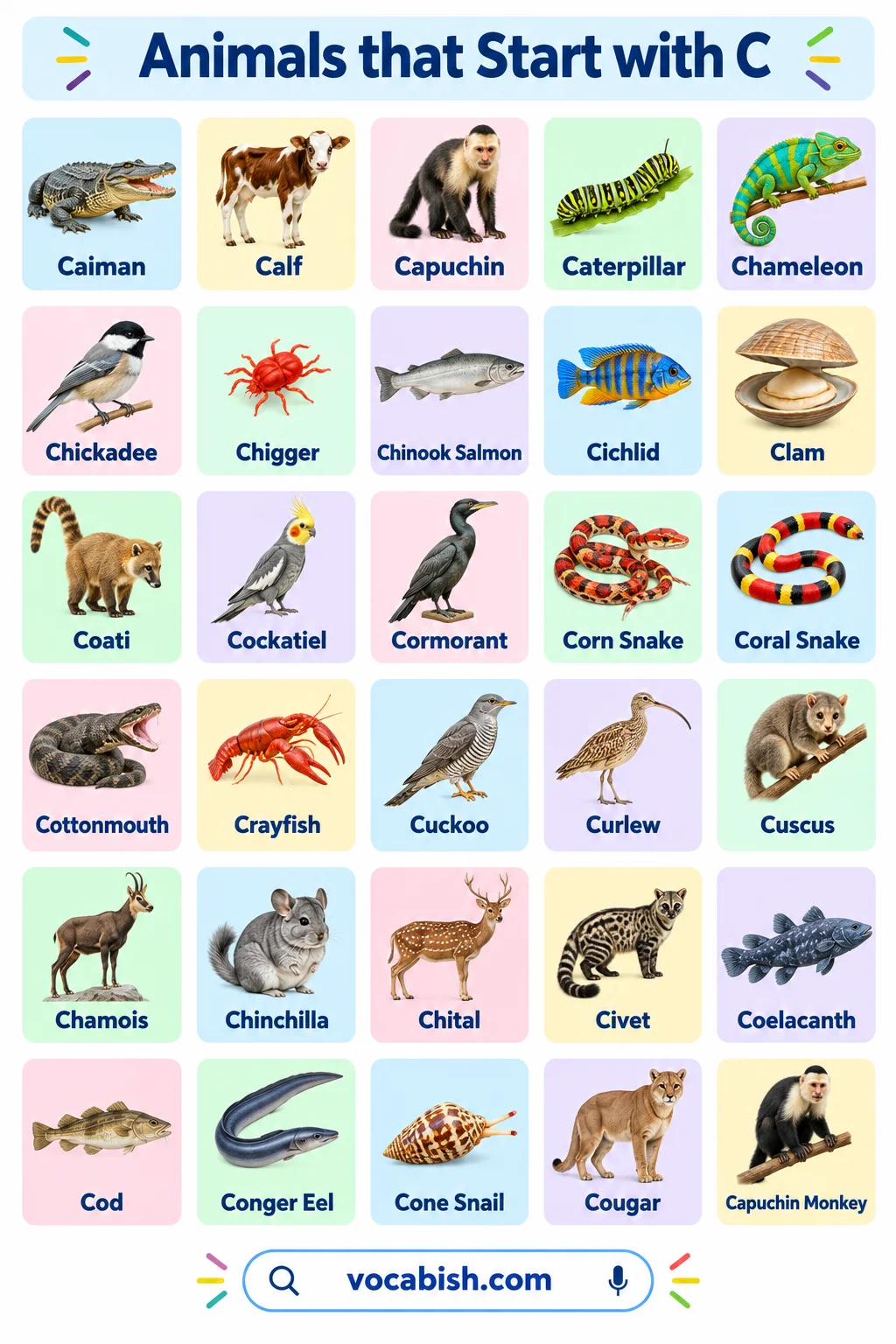
Animals That Start with C include familiar creatures such as cats, camels, cheetahs, chickens, crocodiles, and coyotes. The list also includes birds, fish, reptiles, amphibians, insects, mammals, and marine animals. This collection helps you learn animal names, meanings, animal groups, and useful vocabulary beginning with the letter C. Large animal indexes contain more than 200 C animal names, including common names, breeds, and less familiar creatures.
What Are Animals That Start with C?
Animals that start with C are animals whose common English names begin with the letter C. They range from well-known domestic animals to unusual wildlife and extinct species.
Examples include:
- Cat: A common domestic feline kept worldwide.
- Camel: A desert mammal adapted to harsh conditions.
- Capybara: The world’s largest living rodent species.
- Cheetah: The fastest land animal over short distances.
- Chimpanzee: A highly intelligent African great ape.
- Crocodile: A large aquatic reptile with powerful jaws.
- Cobra: A venomous snake found across Africa and Asia.
- Coyote: An adaptable wild canine from North America.
- Crane: A tall bird found across wetlands.
- Cuttlefish: A marine mollusk known for changing colors.
The letter C also begins names of animal groups and specialized names, such as catfish, coral snake, cottonmouth, cockatoo, clownfish, crayfish, and crocodile skink.
Common Animals Starting with C
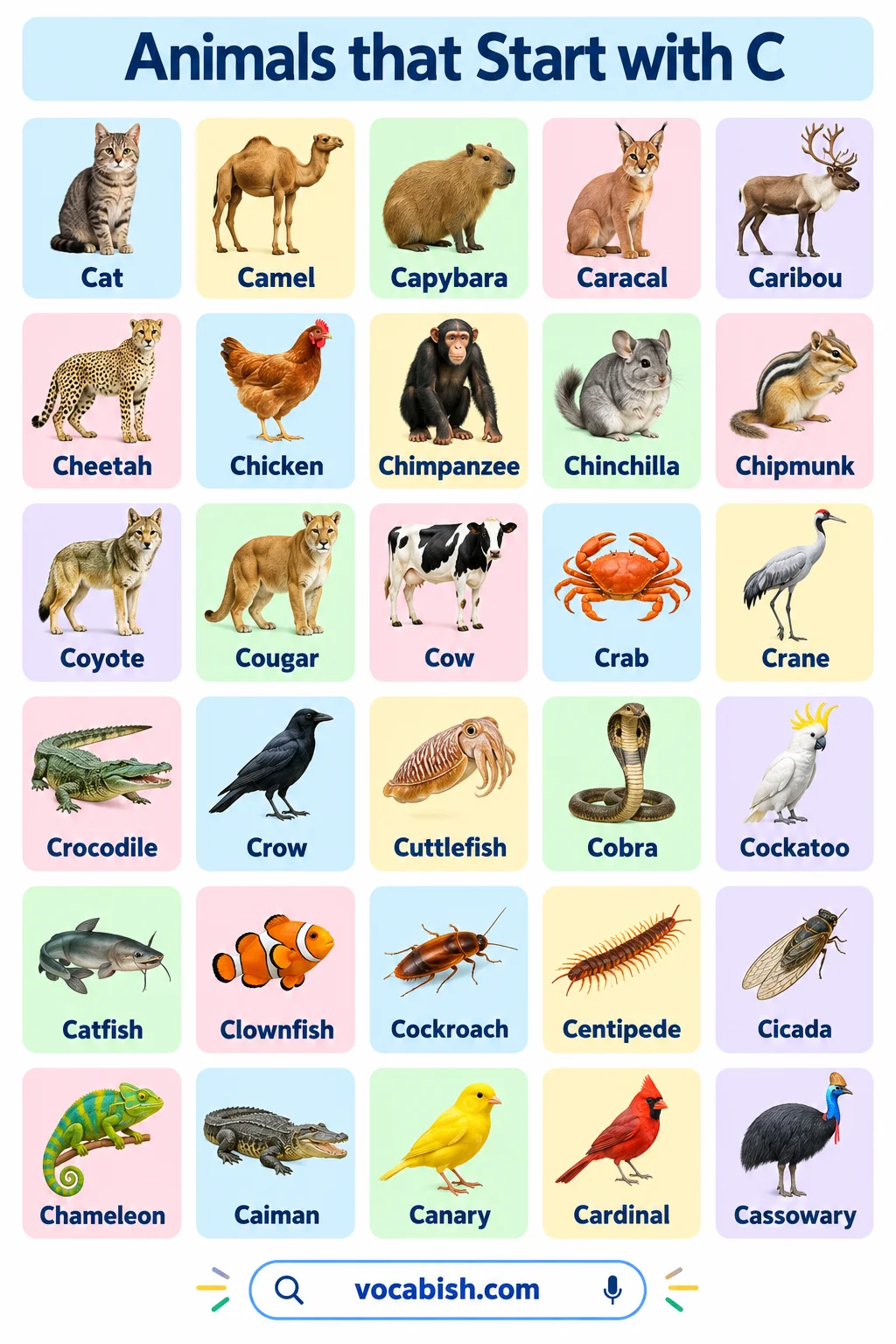
These are some of the C animals English learners are most likely to encounter in books, lessons, conversations, and animal vocabulary activities.
- Caiman: Small crocodilian living in tropical American waterways.
- Camel: Humped mammal adapted to dry desert environments.
- Capybara: Largest living rodent, native to South America.
- Caracal: Medium-sized wild cat with distinctive ears.
- Caribou: North American name for reindeer species.
- Cat: Small domesticated feline kept around homes.
- Caterpillar: Larval stage of butterflies and moths.
- Catfish: Freshwater or marine fish with whisker-like barbels.
- Centipede: Many-legged arthropod with one leg-pair.
- Chameleon: Lizard known for specialized eyes and coloration.
- Cheetah: Fast-running African cat built for speed.
- Chicken: Domesticated bird commonly raised for eggs.
- Chimpanzee: Intelligent great ape native to Africa.
- Chinchilla: Small South American rodent with dense fur.
- Chipmunk: Small striped squirrel commonly found in forests.
- Cicada: Insect famous for loud seasonal buzzing calls.
- Civet: Small mammal known for nocturnal activity.
- Clownfish: Bright reef fish living among sea anemones.
- Coati: Long-snouted mammal related to raccoons.
- Cobra: Venomous snake often displaying an expanded hood.
- Cockroach: Hardy insect found in many environments.
- Cougar: Large American cat also called mountain lion.
- Cow: Domesticated bovine raised for milk and meat.
- Coyote: Adaptable canine native to North America.
- Crab: Crustacean with sideways movement and claws.
- Crane: Long-legged bird associated with wetlands.
- Crocodile: Large semiaquatic reptile with powerful jaws.
- Crow: Intelligent black bird found worldwide.
- Cuttlefish: Marine mollusk using color-changing camouflage.
Mammals That Start with C
Many C animal names belong to mammals. They include predators, herbivores, rodents, primates, domesticated animals, and marine mammals.
- Cacomistle: Small nocturnal mammal related to raccoons.
- Camel: Humped mammal adapted to hot dry climates.
- Canada Lynx: North American cat with large paws.
- Capuchin: Intelligent New World monkey with expressive behavior.
- Capybara: Semi-aquatic South American rodent living socially.
- Caracal: Wild cat recognized by black-tufted ears.
- Caribou: Migratory deer known for large antlers.
- Cheetah: African predator specialized for rapid acceleration.
- Chimpanzee: Great ape sharing many human traits.
- Chinchilla: Nocturnal rodent with exceptionally dense fur.
- Chipmunk: Small ground squirrel with striped fur.
- Clouded Leopard: Forest cat with large cloud-shaped markings.
- Coati: Omnivorous mammal with a long flexible nose.
- Cougar: Powerful solitary cat native to the Americas.
- Cow: Farm mammal commonly raised for dairy products.
- Coyote: Omnivorous canine thriving in varied habitats.
- Crab-Eating Fox: South American canid eating diverse foods.
- Crab-Eating Macaque: Southeast Asian monkey often living near water.
- Crabeater Seal: Antarctic seal mainly feeding on krill.
- Cross Fox: Color variation of the red fox.
- Cross River Gorilla: Rare gorilla population in Nigeria-Cameroon.
- Cuscus: Arboreal marsupial found in tropical forests.
- Cottontail: Small rabbit with distinctive white tail.
- Collared Peccary: Social hoofed mammal found in Americas.
- Cotton-top Tamarin: Tiny Colombian primate with white crest.
- Chamois: Agile goat-antelope living in mountain regions.
- Chinese Water Deer: Small deer species lacking antlers.
- Cervel: Hybrid offspring of caracal and serval.
- Cama: Camelid hybrid produced from camel and llama.
- Cape Fur Seal: Coastal seal found around southern Africa.
- Cave Bear: Extinct bear that inhabited European caves.
- Cave Lion: Extinct lion that lived across Eurasia.
- Caracal: Medium-sized predator adapted to dry landscapes.
- Cervalces: Extinct deer genus with enormous antlers.
Birds That Start with C
C bird names include familiar garden birds, waterbirds, parrots, raptors, penguins, and large flightless birds.
- Cactus Wren: Desert bird commonly found in southwestern regions.
- California Condor: Critically endangered North American vulture.
- Canada Goose: Large goose common across North America.
- Canada Warbler: Small songbird breeding in northern forests.
- Canary: Small songbird known for its melodious voice.
- Canvasback: North American diving duck with red eyes.
- Cardinal: Brightly colored songbird common in North America.
- Carolina Parakeet: Extinct colorful parrot once native America.
- Carolina Wren: Small brown songbird with loud calls.
- Cassowary: Large flightless bird with helmet-like casque.
- Cedar Waxwing: Sleek bird with silky plumage and berries.
- Chachalaca: Noisy chicken-like bird from tropical Americas.
- Chestnut-sided Warbler: Small songbird with chestnut-colored body markings.
- Chickadee: Small songbird recognized by dark head.
- Chicken: Domesticated bird raised worldwide by humans.
- Chipping Sparrow: Small sparrow with distinctive head pattern.
- Chinstrap Penguin: Antarctic penguin identified by facial markings.
- Cinnamon Teal: Small duck with cinnamon-colored male plumage.
- Clark’s Grebe: North American waterbird with contrasting plumage.
- Cocoa Thrush: Forest thrush found in tropical regions.
- Cockatiel: Small Australian parrot with expressive crest.
- Cockatoo: Parrot family known for prominent crests.
- Coot: Waterbird with lobed toes and dark plumage.
- Cormorant: Diving bird that catches aquatic prey.
- Cooper’s Hawk: Forest hawk specializing in bird hunting.
- Common Buzzard: Widespread European and Asian soaring raptor.
- Common Loon: Diving waterbird known for haunting calls.
- Common Raven: Large intelligent black bird with varied calls.
- Common Yellowthroat: Small warbler with distinctive facial mask.
- Comb-crested Jacana: Australian wetland bird with colorful crest.
- Crested Caracara: Large falcon relative with distinctive crest.
- Crane: Tall long-legged bird often living wetlands.
- Crow: Intelligent black bird with strong adaptability.
- Cuckoo: Bird famous for distinctive calls and brood-parasitism.
- Curlew: Long-billed shorebird found across wetlands.
- Corella: Australian cockatoo with pale body plumage.
- Cinereous Vulture: Huge Eurasian vulture with dark plumage.
Reptiles That Start with C
C reptiles include snakes, crocodilians, lizards, turtles, and other scaly animals.
- Caiman: Small crocodilian found in Central and South America.
- Caiman Lizard: Large lizard adapted to aquatic habitats.
- California Kingsnake: Nonvenomous snake with striking banded patterns.
- California Kingsnake: Powerful constrictor native to western America.
- Cantil: Venomous pit viper from Central America.
- Carpet Python: Nonvenomous snake found across Australia.
- Carpet Viper: Venomous snake inhabiting dry African regions.
- Cascabel: Common name used for rattlesnakes.
- Central Ranges Taipan: Highly venomous Australian snake species.
- Chameleon: Arboreal lizard with independently moving eyes.
- Checkered Garter Snake: Patterned North American nonvenomous snake.
- Chicken Snake: Common name for several harmless snakes.
- Chinese Alligator: Small crocodilian restricted to eastern China.
- Chinese Cobra: Venomous Asian cobra with broad hood.
- Cinnamon Ball Python: Color variety of ball python.
- Coachwhip Snake: Fast nonvenomous snake from North America.
- Coastal Carpet Python: Large Australian python found near coasts.
- Coastal Taipan: Highly venomous snake native to Australia.
- Congo Snake: Name applied to an unusual African reptile.
- Copperhead: Venomous pit viper found in North America.
- Coral Snake: Venomous snake recognized by colorful bands.
- Corn Snake: Popular harmless snake native to America.
- Cottonmouth: Venomous North American snake also called water moccasin.
- Crocodile: Large reptile adapted to aquatic environments.
- Crocodile Monitor: Huge arboreal monitor lizard from New Guinea.
- Crocodile Skink: Armored-looking lizard native to New Guinea.
- Cuban Boa: Large nonvenomous snake endemic to Cuba.
- Cuban Cockroach: Cockroach species associated with tropical regions.
- Cumberland Slider: Freshwater turtle native to southeastern America.
- Cuban Tree Frog: Large invasive frog found widely introduced.
Amphibians That Start with C
Amphibians beginning with C include frogs and unusual legless amphibians.
- Caecilian: Legless amphibian resembling a burrowing snake.
- California Tiger Salamander: Large salamander native to California.
- Cane Toad: Large invasive amphibian with toxic glands.
- Canyon Tree Frog: Southwestern frog living around rocky habitats.
- Common Frog: Widespread European frog found near water.
- Common Toad: Widespread European amphibian with warty skin.
- Corroboree Frog: Small Australian frog with striking stripes.
- Cuban Tree Frog: Large tree frog native to Cuba.
- Crested Newt: Newt recognized by seasonal breeding crest.
Fish and Marine Animals Starting with C
C marine animals include fish, sharks, mollusks, crustaceans, and other ocean creatures.
- Carp: Freshwater fish widely introduced around the world.
- Caribbean Reef Shark: Reef shark common in tropical waters.
- Cat Shark: Small shark group found worldwide.
- Catfish: Fish named for their whisker-like barbels.
- Channel Catfish: Popular freshwater catfish with forked tail.
- Chimaera: Deep-sea cartilaginous fish related to sharks.
- Chinook Salmon: Large Pacific salmon known for migrations.
- Cichlid: Diverse freshwater fish family with many species.
- Clearnose Skate: Flat cartilaginous fish from coastal waters.
- Cobia: Large coastal fish often caught recreationally.
- Cod: Important marine fish found in cold waters.
- Coelacanth: Ancient lobe-finned fish once thought extinct.
- Coho Salmon: Pacific salmon known for spawning migrations.
- Conger Eel: Large marine eel living near seabeds.
- Cookiecutter Shark: Small shark famous for circular bites.
- Common Carp: Hardy freshwater fish raised worldwide.
- Common Angelshark: Flattened shark resembling a ray.
- Crappie: Freshwater North American fish popular with anglers.
- Crayfish: Freshwater crustacean resembling a small lobster.
- Cuttlefish: Marine mollusk using sophisticated visual camouflage.
- Clownfish: Reef fish commonly associated with anemones.
- Comb Jellyfish: Gelatinous marine animal with comb-like cilia.
- Coconut Crab: Giant land crustacean with powerful claws.
- Colossal Squid: Enormous deep-sea squid with huge eyes.
- Cone Snail: Marine snail capable of producing venom.
- Coral: Colonial marine animal forming reef structures.
- Coral Snake: Venomous snake, not a marine animal.
- Christmas Island Red Crab: Land crab famous for mass migration.
- Cubera Snapper: Large tropical reef fish with strong jaws.
- Crab: Broad group of clawed marine crustaceans.
- Crab Spider: Spider that often waits for prey.
- Cory Catfish: Small freshwater catfish popular in aquariums.
- Coley: Marine fish related to Atlantic cod.
- Cobia Fish: Fast-growing predatory fish in coastal waters.
Insects and Other Invertebrates Starting with C
The letter C appears in many insect, arachnid, mollusk, and other invertebrate names.
- Cabbage Moth: Moth whose caterpillars feed on vegetables.
- Cactus Moth: Moth whose larvae feed on cacti.
- Cactus Mouse: Small rodent adapted to desert habitats.
- Camel Cricket: Hump-backed cricket commonly found in damp places.
- Camel Spider: Fast desert arachnid often mistaken for spiders.
- Carpenter Ant: Ant species that excavates wooden nests.
- Carpet Beetle: Beetle whose larvae damage natural fabrics.
- Carrion Beetle: Beetle commonly associated with decaying animals.
- Cecropia Moth: Large North American moth with colorful wings.
- Centipede: Arthropod with numerous legs and venomous claws.
- Cicada: Singing insect spending much time underground.
- Chigger: Tiny mite whose larvae can irritate skin.
- Chilean Rose Tarantula: Large tarantula native to Chile.
- Christmas Beetle: Australian scarab beetle active during summer.
- Click Beetle: Beetle capable of making clicking movements.
- Clock Spider: Common name for certain large spiders.
- Clothes Moth: Small moth whose larvae damage fabrics.
- Cockroach: Highly adaptable insect found worldwide.
- Codling Moth: Agricultural pest affecting apples and pears.
- Comet Moth: Large African moth with long tails.
- Cone Snail: Predatory marine snail with venomous harpoon.
- Cucumber Beetle: Beetle feeding on cucurbit plants.
- Curly Hair Tarantula: Large tarantula with curly body hairs.
- Cobalt Blue Tarantula: Bright blue tarantula from Southeast Asia.
- Cat-Faced Spider: Orb-weaving spider with distinctive abdomen shape.
- Crab Spider: Ambush predator commonly found on flowers.
- Coconut Crab: Largest terrestrial arthropod, living on islands.
- Cockle: Bivalve mollusk commonly found in coastal sediments.
- Chiton: Marine mollusk protected by overlapping shell plates.
- Cuttlefish: Cephalopod mollusk capable of rapid camouflage.
- Crawfish: Regional name for freshwater crayfish.
- Carpet Viper: Venomous snake belonging to African vipers.
Extinct Animals That Start with C
Some C animal names refer to animals that no longer live today. These names are useful for science and prehistoric animal vocabulary.
- Cave Bear: Extinct European bear from the Ice Age.
- Cave Lion: Extinct Eurasian lion from prehistoric times.
- Ceratopsian: Group of horned dinosaurs including Triceratops.
- Ceratosaurus: Horned theropod dinosaur from Jurassic ecosystems.
- Cephalaspis: Extinct armored jawless fish from Devonian waters.
- Chilesaurus: Unusual herbivorous dinosaur from Jurassic Chile.
- Compsognathus: Small carnivorous dinosaur from Jurassic Europe.
- Coryphodon: Extinct mammal with large tusk-like teeth.
- Cryolophosaurus: Antarctic theropod dinosaur with unusual head crest.
- Crocodylomorph: Ancient reptile group related to modern crocodilians.
- Cervalces latifrons: Extinct giant deer with enormous antlers.
- Cameroceras: Extinct giant marine cephalopod from Paleozoic seas.
- Cacops: Extinct heavily built amphibian from Permian environments.
- Caiuajara: Extinct pterosaur from prehistoric Brazil.
- Camarasaurus: Large herbivorous dinosaur from Jurassic North America.
- Camelotia: Extinct dinosaur genus from Late Triassic Britain.
- Cape Lion: Historical lion population no longer surviving.
- Carolina Parakeet: Extinct colorful parrot once native America.
- California Grizzly Bear: Extinct California population of grizzly bears.
- Chasmosaurus: Horned dinosaur known from Late Cretaceous deposits.
Animal Names Beginning with C
Here are additional animal names that broaden the vocabulary list. Some are species, groups, breeds, regional names, or specialized animal names.
- Cairn Terrier: Small Scottish terrier bred for hunting.
- Canaan Dog: Ancient Middle Eastern dog breed.
- Cane Corso: Large Italian working dog breed.
- Canadian Horse: Strong horse breed developed in Canada.
- Carolina Dog: American dog breed with primitive traits.
- Catahoula Bulldog: American hybrid dog breed with strong build.
- Catahoula Leopard Dog: American working dog with spotted coat.
- Cavalier King Charles Spaniel: Small British companion dog breed.
- Chesapeake Bay Retriever: American retriever bred for water work.
- Chihuahua: Tiny Mexican dog breed with large personality.
- Chinese Crested Dog: Small breed with distinctive hairless varieties.
- Chinese Shar-Pei: Chinese dog breed with loose wrinkled skin.
- Chow Chow: Ancient Chinese breed with thick fur.
- Clumber Spaniel: Heavy British spaniel with short legs.
- Cocker Spaniel: Sporting dog breed known for long ears.
- Coton de Tulear: Small Madagascar breed with cotton-like coat.
- Corgi: Short-legged Welsh herding dog breed.
- Corgidor: Crossbreed between Corgi and Labrador Retriever.
- Cavapoo: Companion dog cross between Cavalier and Poodle.
- Cockapoo: Popular crossbreed between Cocker Spaniel and Poodle.
- Chiweenie: Small crossbreed between Chihuahua and Dachshund.
- Chorkie: Small crossbreed between Chihuahua and Yorkshire Terrier.
- Chusky: Crossbreed between Chow Chow and Siberian Husky.
- Cavador: Crossbreed between Cavalier and Labrador Retriever.
- Cockatiel: Australian parrot commonly kept as companion bird.
- Cockatoo: Large crested parrot from Australasia.
- Conure: Group of colorful New World parrots.
- Canine: Term referring to dogs and dog relatives.
- Cattle: Domesticated bovines raised for agricultural purposes.
- Calf: Young animal of several large mammals.
- Chick: Young bird, especially a chicken.
- Cobra: Venomous snake belonging to several related groups.
- Coyote: Wild canine adapted to many habitats.
- Cowbird: North American birds known for brood parasitism.
- Cormorant: Aquatic bird skilled at underwater hunting.
- Cottonmouth: Venomous semiaquatic pit viper of America.
- Crested Gecko: Arboreal gecko with characteristic head crests.
- Crested Penguin: Penguin group with yellow feather crests.
- Crested Ibis: Rare Asian ibis with white plumage.
- Crowned Crane: African crane with a golden crown.
- Crowned Eagle: Powerful African forest eagle species.
- Crowned Pigeon: Large pigeon with decorative head feathers.
- Common Dolphin: Highly social marine dolphin species.
- Common Octopus: Intelligent eight-armed marine mollusk.
- Common Starfish: Familiar five-armed marine echinoderm.
- Common Wombat: Australian marsupial with compact body.
- Common Potoo: Nocturnal bird with remarkable camouflage.
- Common Goldeneye: Diving duck found across northern regions.
- Common Grackle: Dark North American songbird with iridescence.
- Common Green Magpie: Colorful Asian forest bird.
- Common House Spider: Spider commonly found around buildings.
- Common Spotted Cuscus: Arboreal marsupial from New Guinea.
- Common European Adder: Venomous snake widespread across Europe.
- Common Furniture Beetle: Wood-boring beetle damaging timber structures.
- Common Frog: Widespread amphibian associated with freshwater habitats.
- Common Toad: Common European amphibian with warty skin.
- Common Yellowthroat: Small American warbler with dark mask.
- Common Raven: Large corvid known for intelligence.
- Common Buzzard: Widespread raptor often seen soaring.
- Common Angelshark: Bottom-dwelling shark with flattened body.
- Common Carp: Freshwater fish widely introduced beyond native range.
- Common Loon: North American diving bird with striking call.
- Cuvier’s Beaked Whale: Deep-diving whale found across oceans.
Animal Groups Beginning with C
Several useful biological group names also begin with C.
- Carnivores: Animals that primarily obtain food from other animals.
- Canids: Mammals including dogs, wolves, foxes, and coyotes.
- Caprines: Goat-like mammals within the sheep-goat group.
- Cetaceans: Aquatic mammals including whales, dolphins, and porpoises.
- Cephalopods: Marine mollusks including octopuses, squid, and cuttlefish.
- Crocodilians: Reptiles including crocodiles, alligators, caimans, and gharials.
- Crustaceans: Arthropods including crabs, lobsters, shrimp, and crayfish.
- Corvids: Intelligent birds including crows, ravens, and magpies.
- Cichlids: Diverse freshwater fish family with many species.
- Colubrids: Large snake family containing many nonvenomous species.
- Cnidarians: Aquatic animals including corals, jellyfish, and anemones.
Animal Names That Start with C by Type
Type | Examples |
|---|---|
Camel, Capybara, Caracal, Cheetah, Cougar, Coyote | |
Birds | Cardinal, Canary, Cassowary, Chickadee, Cockatoo, Crane |
Reptiles | Caiman, Chameleon, Cobra, Copperhead, Crocodile, Corn Snake |
Caecilian, Cane Toad, Common Frog, Common Toad | |
Fish | Carp, Catfish, Cichlid, Cobia, Cod, Coelacanth |
Marine Animals | Cuttlefish, Clownfish, Cone Snail, Crab, Coral |
Cicada, Cockroach, Click Beetle, Clothes Moth, Cucumber Beetle | |
Arachnids | Camel Spider, Crab Spider, Cobalt Blue Tarantula |
Crustaceans | Crab, Crayfish, Coconut Crab, Christmas Island Red Crab |
Cuttlefish, Chiton, Cockle, Cone Snail, Colossal Squid | |
Extinct Animals | Ceratosaurus, Compsognathus, Cryolophosaurus, Cave Lion |
Useful Animal Vocabulary with C
Learning related vocabulary makes it easier to describe C animals accurately.
- Carnivore: An animal that mainly eats other animals.
- Carnivorous: Describes an animal that eats meat.
- Camouflage: Coloring or patterns that conceal animals.
- Claw: A sharp curved structure on an animal’s foot.
- Canine: A pointed tooth used for tearing.
- Carapace: A hard protective shell covering some animals.
- Caudal: Relating to an animal’s tail region.
- Cetacean: A whale, dolphin, or porpoise.
- Crustacean: An arthropod such as crab or shrimp.
- Cephalopod: Marine mollusk such as squid or octopus.
- Crest: Raised feathers, scales, or structures on animals.
- Colony: Group of animals living closely together.
- Conservation: Protection of animals and their habitats.
- Captive: An animal kept under human care.
- Cubs: Young animals of certain mammals.
- Calf: Young animal of cattle and several other mammals.
- Chick: Young bird, especially a chicken.
- Chrysalis: Protective pupal stage of many butterflies.
Common Spelling and Meaning Confusions
- Cheetah vs. Cougar: A cheetah is built for speed; a cougar is a larger American cat.
- Caiman vs. Crocodile: Caimans are crocodilians, but they are not the same animal as crocodiles.
- Camel vs. Dromedary: A camel may refer broadly to camelids; dromedaries have one hump.
- Crab vs. Crayfish: Crabs are mainly marine or coastal; crayfish usually live in freshwater.
- Cobra vs. Coral Snake: Both can be venomous, but they belong to different snake groups.
Complete List of Animals That Start with C
Animal Name | Animal Name | Animal Name |
|---|---|---|
Cabbage Moth | Cactus Moth | Cactus Mouse |
Cactus Wren | Caecilian | Caiman |
Caiman Lizard | Cairn Terrier | California Condor |
California Kingsnake | California Tarantula | Cama |
Camel | Camel Cricket | Camel Spider |
Campine Chicken | Canaan Dog | Canada Goose |
Canada Lynx | Canada Warbler | Canadian Horse |
Cane Corso | Cane Rat | Cane Spider |
Cane Toad | Cantil | Canvasback |
Cape Lion | Cape Fur Seal | Capuchin |
Capybara | Caracal | Cardinal |
Caribbean Reef Shark | Caribou | Carolina Dog |
Carolina Parakeet | Carp | Carpenter Ant |
Carpet Beetle | Carpet Python | Carpet Viper |
Carrion Beetle | Cassowary | Cat |
Cat Snake | Cat-Eyed Snake | Cat-Faced Spider |
Catahoula Bulldog | Catahoula Leopard Dog | Caterpillar |
Catfish | Cave Bear | Cave Lion |
Cedar Waxwing | Centipede | Ceratopsian |
Ceratosaurus | Cervalces | Chain Pickerel |
Chameleon | Chamois | Cheetah |
Chesapeake Bay Retriever | Chickadee | Chicken |
Chicken Snake | Chigger | Chihuahua |
Chilean Recluse Spider | Chilean Rose Tarantula | Chilesaurus |
Chimaera | Chimpanzee | Chinchilla |
Chinese Alligator | Chinese Cobra | Chinese Crested Dog |
Chinese Shar-Pei | Chinese Water Deer | Chinook |
Chinook Salmon | Chinstrap Penguin | Chipmunk |
Chiton | Chipping Sparrow | Christmas Beetle |
Christmas Island Red Crab | Cicada | Cichlid |
Cinnamon Ball Python | Cinnamon Teal | Clark’s Grebe |
Clearnose Skate | Click Beetle | Clock Spider |
Clothes Moth | Clouded Leopard | Clownfish |
Coati | Cobalt Blue Tarantula | Cobia |
Cobra | Cockatiel | Cockatoo |
Cockle | Cockroach | Codfish |
Codling Moth | Coelacanth | Collared Peccary |
Colossal Squid | Comb Jellyfish | Common Angelshark |
Common Buzzard | Common Carp | Common Frog |
Common Goldeneye | Common Grackle | Common Green Magpie |
Common House Spider | Common Loon | Common Raven |
Common Spotted Cuscus | Common Toad | Common Yellowthroat |
Compsognathus | Cone Snail | Conger Eel |
Congo Snake | Conure | Cookiecutter Shark |
Cooper’s Hawk | Copperhead | Coral |
Coral Snake | Corella | Cormorant |
Corn Snake | Cory Catfish | Coryphodon |
Costa’s Hummingbird | Coton de Tulear | Cotton-top Tamarin |
Cottonmouth | Coues Deer | Cougar |
Cow | Coyote | Crab |
Crab Spider | Crab-Eating Fox | Crab-Eating Macaque |
Crabeater Seal | Crane | Crappie |
Crayfish | Crested Gecko | Crested Penguin |
Crocodile | Crocodile Monitor | Crocodile Shark |
Crocodile Skink | Crocodylomorph | Cross Fox |
Cross River Gorilla | Crow | Cryolophosaurus |
Cuban Boa | Cuban Cockroach | Cuban Tree Frog |
Cubera Snapper | Cuckoo | Cucumber Beetle |
Cuscus | Curlew | Curly Coated Retriever |
Curly Hair Tarantula | Cuttlefish | Czechoslovakian Wolfdog |
The list above combines common animal names with recognized species, animal groups, specialized names, breeds, and extinct animals found in major C-animal indexes. Large reference lists contain more than 200 entries beginning with C.
FAQs
Common examples include cat, camel, cow, chicken, cheetah, chimpanzee, crocodile, cobra, crab, crow, and coyote.
The cheetah is the fastest land animal, reaching very high speeds during short bursts of pursuit.
The blue whale does not qualify because its name starts with B; among C-named animals, colossal squid are exceptionally large.
Crocodiles, catfish, carp, cod, clownfish, coelacanths, crabs, cuttlefish, and many other C animals live in water.
Birds beginning with C include cardinal, canary, cassowary, chickadee, chicken, cockatoo, cormorant, crane, crow, and cuckoo.
Caiman, chameleon, cobra, copperhead, corn snake, cottonmouth, crocodile, and crocodile skink are examples of C reptiles.
Mammals beginning with C include camel, capybara, caracal, caribou, cheetah, chimpanzee, chinchilla, cougar, cow, and coyote.
Conclusion
Animals That Start with C cover a wide range of animal vocabulary. The letter C includes mammals such as the camel and cheetah, birds such as the cardinal and crane, reptiles such as the cobra and crocodile, and marine animals such as the clownfish and cuttlefish. Learning these names can build stronger English vocabulary while introducing useful animal and science terms.
Explore Animal Names by Letter
Find animal names from A to Z.