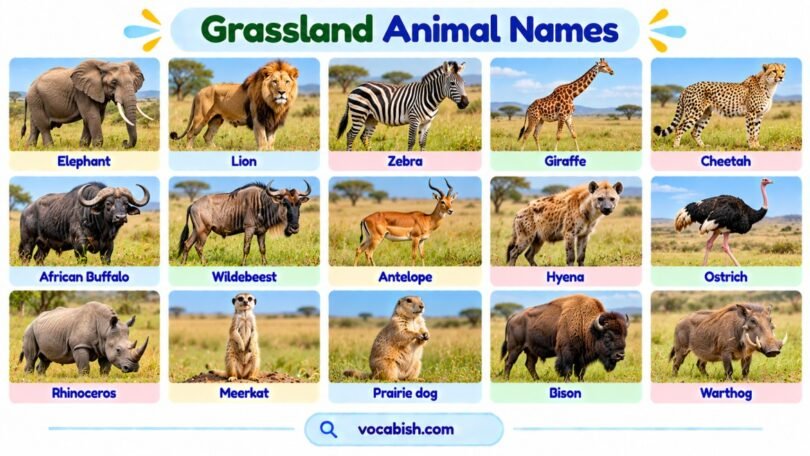

Grassland animals live in wide-open habitats covered mainly with grasses and very few trees. These animals include lions, zebras, giraffes, bison, antelopes, prairie dogs, ostriches, and many other species. Grasslands are found in regions such as savannas, prairies, steppes, pampas, and veld. This article covers grassland animal names in English with pictures, common examples, useful facts, and vocabulary lists to help you identify and learn these animals easily.
What Are Grassland Animals?
Grassland animals are animals that live in habitats where grasses are the main vegetation and large areas have few trees. They include mammals, birds, reptiles, amphibians, insects, spiders, and many other animals.
Grasslands occur on several continents and have different names, including savanna, prairie, steppe, pampas, veld, and temperate grassland. Some animals spend nearly all their lives in grasslands, while others use grasslands together with woodland, scrub, wetlands, or nearby rivers.
Common Grassland Animal Names with Facts and Pictures
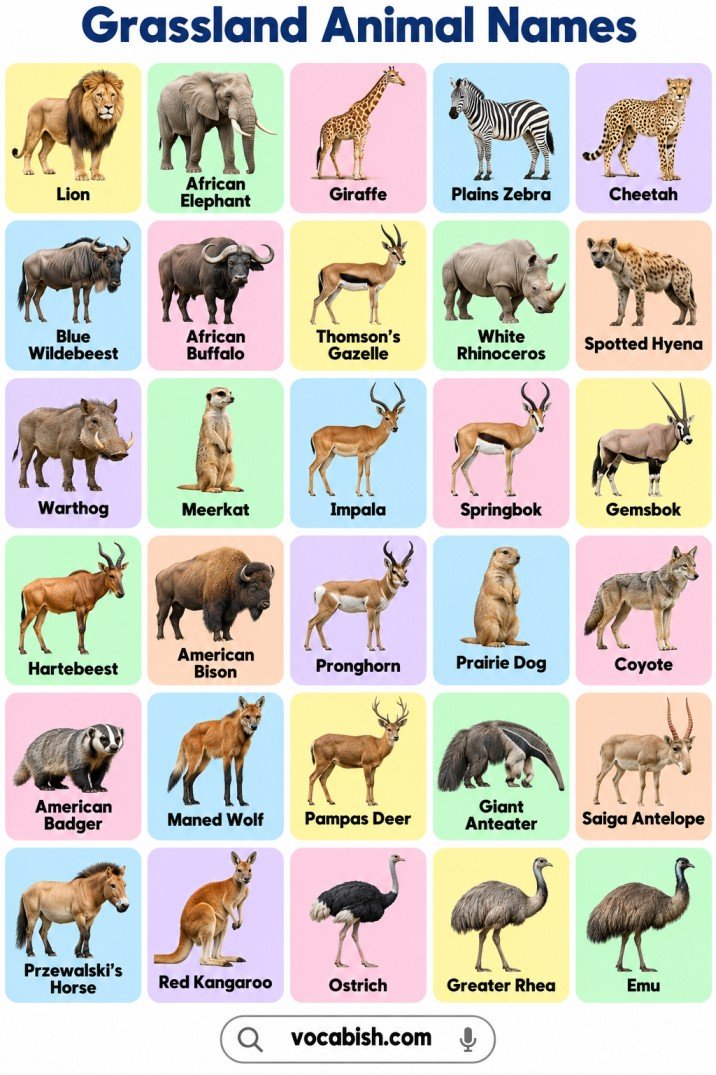
These are some of the best-known animals associated with grasslands around the world. Their body shapes, diets, movement, and behaviour help them survive in open habitats.
Lion
The lion is a large wild cat found mainly in African savannas and open grasslands. Lions live in social groups called prides. They hunt animals such as zebras, wildebeest, and antelopes. Their powerful bodies and sharp claws make them effective predators.
African Elephant
The African elephant is the largest living land animal. It can live in savannas, grasslands, woodlands, and other African habitats. Elephants use their trunks to gather grass, leaves, water, and other food. They often travel in family groups led by an experienced female.
Giraffe
The giraffe is the tallest living land animal. It lives in African savannas and open areas with scattered trees. Its long neck helps it reach leaves that many other herbivores cannot eat. Giraffes usually feed on trees and shrubs rather than grass.
Plains Zebra
The plains zebra is one of the most familiar African grassland animals. Its body has distinctive black-and-white stripes. Zebras mainly eat grasses and often move in herds. They may gather with wildebeest during seasonal migrations.
Cheetah
The cheetah is a slim, long-legged wild cat found in open African habitats. It is famous for reaching very high speeds during short chases. Cheetahs mainly hunt small to medium-sized animals such as gazelles. Open grassland gives them enough space to chase prey.
Blue Wildebeest
The blue wildebeest is a large grazing antelope of eastern and southern Africa. The word wildebeest is pronounced roughly as WIL-duh-beest. Large herds travel in search of fresh grass and water. Wildebeest are an important food source for lions, hyenas, and other predators.
African Buffalo
The African buffalo is a large, strongly built grazing mammal. It often lives in herds in savannas and grasslands near reliable water. Adults have thick horns that curve outward from the head. They mainly eat grasses and other low vegetation.
Thomson’s Gazelle
Thomson’s gazelle is a small, fast antelope of East African grasslands. It has a light brown coat, white underside, and dark stripe along each side. It feeds mainly on short grasses. Speed and quick turns help it escape predators.
White Rhinoceros
The white rhinoceros is a massive African herbivore with two horns on its snout. Unlike browsing rhinos, it has a wide mouth suited to grazing grass. It spends much of its feeding time in open grassy areas. Despite its name, its skin is gray rather than white.
Spotted Hyena
The spotted hyena is a powerful carnivore common in many African savannas. It hunts live prey but also eats animals killed by other predators. Spotted hyenas live in social groups called clans. They have extremely strong jaws that can break bones.
Warthog
The common warthog is a wild pig found in African savannas and grasslands. It eats grasses, roots, bulbs, and other plant material. Warthogs often use abandoned burrows for shelter. Their tusks help with defense and digging.
American Bison
The American bison is one of the largest mammals of North American grasslands. Huge herds once moved across the Great Plains. Bison mainly graze on grasses and sedges. Their heavy shoulders, shaggy front coat, and large head make them easy to recognize.
Prairie Dog
A prairie dog is a small burrowing rodent of North American grasslands. Prairie dogs live in connected colonies with many underground tunnels. They feed mostly on grasses and other plants. Their burrows also provide habitat for several other prairie animals.
Pronghorn
The pronghorn is a fast-running mammal of western North American plains and open country. It is not a true antelope, although people often call it one. Pronghorns feed on grasses, herbs, and shrubs. Their speed helps them escape predators in open habitats.
Meerkat
The meerkat is a small member of the mongoose family. It lives in dry open habitats, including grasslands and savanna areas of southern Africa. Meerkats live in social groups and shelter in underground burrows. One animal may stand upright to watch for danger while others feed.
Ostrich
The ostrich is the world’s largest living bird. It cannot fly, but its long and powerful legs allow it to run quickly across open ground. Ostriches eat seeds, grasses, leaves, insects, and other foods. They are native to African savannas and dry grasslands.
Main Grassland Habitat Types
Here are the main types of grassland habitats found in different parts of the world.
- Tropical Savanna
- Temperate Grassland
- Prairie
- Steppe
- Pampas
- Veld
- Cerrado
- Llanos
- Flooded Grassland
- Montane Grassland
- Alpine Grassland
- Semi-Arid Grassland
- Shortgrass Prairie
- Mixed-Grass Prairie
- Tallgrass Prairie
African Grassland Mammals
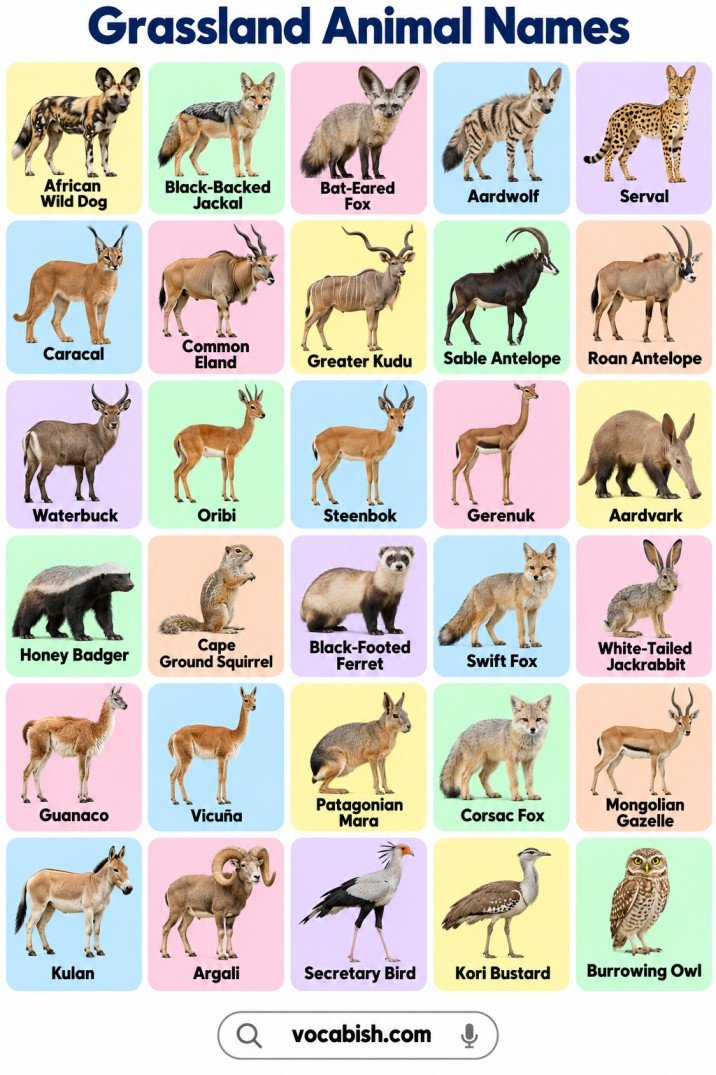
Below is a list of mammals commonly found across Africa’s open grassy regions.
- African Wild Dog
- Black-Backed Jackal
- Side-Striped Jackal
- Bat-Eared Fox
- Aardwolf
- Serval
- Caracal
- Impala
- Springbok
- Grant’s Gazelle
- Topi
- Hartebeest
- Sable Antelope
- Roan Antelope
- Common Eland
- Greater Kudu
- Waterbuck
- Oribi
- Steenbok
- Kirk’s Dik-Dik
- Gemsbok
- Blesbok
- Bontebok
- Mountain Reedbuck
- Southern Reedbuck
- Black Rhinoceros
- Gerenuk
- Common Duiker
- Bush Duiker
- Klipspringer
- African Savanna Hare
- Cape Ground Squirrel
- Striped Polecat
- Honey Badger
- Banded Mongoose
- Dwarf Mongoose
- Slender Mongoose
- Yellow Mongoose
- Aardvark
- Cape Porcupine
- African Grass Rat
- Multimammate Mouse
- African Civet
- Cape Hare
- Scrub Hare
North American Prairie Mammals
Here’s the list of mammals that live across the prairies and open plains of North America.
- American Badger
- Black-Footed Ferret
- Swift Fox
- Coyote
- Bobcat
- Cougar
- Mule Deer
- White-Tailed Deer
- Elk
- Black-Tailed Jackrabbit
- White-Tailed Jackrabbit
- Eastern Cottontail
- Desert Cottontail
- Thirteen-Lined Ground Squirrel
- Richardson’s Ground Squirrel
- Franklin’s Ground Squirrel
- Spotted Ground Squirrel
- Plains Pocket Gopher
- Northern Pocket Gopher
- Plains Harvest Mouse
- Western Harvest Mouse
- Deer Mouse
- Prairie Vole
- Meadow Vole
- Hispid Cotton Rat
- Ord’s Kangaroo Rat
- Plains Pocket Mouse
- Striped Skunk
- Long-Tailed Weasel
- Least Weasel
- Plains Woodrat
- Southern Bog Lemming
- Fox Squirrel
- Groundhog
South American Grassland Mammals
This list includes mammals found in the open grasslands and plains of South America.
- Maned Wolf
- Pampas Deer
- Marsh Deer
- Guanaco
- Vicuña
- Giant Anteater
- Southern Tamandua
- Six-Banded Armadillo
- Southern Long-Nosed Armadillo
- Big Hairy Armadillo
- Pink Fairy Armadillo
- Pampas Cat
- Geoffroy’s Cat
- Puma
- Jaguar
- Pampas Fox
- Crab-Eating Fox
- Molina’s Hog-Nosed Skunk
- Plains Viscacha
- Patagonian Mara
- Brazilian Guinea Pig
- Highland Tuco-Tuco
- Capybara
- Coypu
- Southern Mountain Cavy
- Chacoan Peccary
- Collared Peccary
- White-Lipped Peccary
Eurasian Steppe Mammals
Below are the mammals associated with the vast steppe regions of Europe and Asia.
- Saiga Antelope
- Mongolian Gazelle
- Goitered Gazelle
- Tibetan Gazelle
- Tibetan Antelope
- Wild Yak
- Kulan
- Przewalski’s Horse
- Corsac Fox
- Gray Wolf
- Pallas’s Cat
- Steppe Polecat
- Marbled Polecat
- Eurasian Badger
- Bobak Marmot
- Siberian Marmot
- European Ground Squirrel
- Long-Tailed Ground Squirrel
- Great Gerbil
- Mongolian Gerbil
- Steppe Lemming
- Brandt’s Vole
- Daurian Pika
- Tolai Hare
- European Hare
- Greater Jerboa
- Lesser Egyptian Jerboa
- Asiatic Wild Ass
- Argali
- Siberian Roe Deer
- Tarbagan Marmot
Australian Grassland Mammals
Here are the mammal names commonly linked with Australia’s open grassland habitats.
- Red Kangaroo
- Eastern Grey Kangaroo
- Western Grey Kangaroo
- Common Wallaroo
- Agile Wallaby
- Red-Necked Wallaby
- Bridled Nail-Tail Wallaby
- Black-Striped Wallaby
- Rufous Bettong
- Burrowing Bettong
- Plains Rat
- Long-Haired Rat
- Fat-Tailed Dunnart
- Stripe-Faced Dunnart
- Julia Creek Dunnart
- Greater Bilby
- Dingo
- Southern Hairy-Nosed Wombat
- Northern Hairy-Nosed Wombat
- Eastern Barred Bandicoot
- Golden Bandicoot
- Spectacled Hare-Wallaby
Grassland Bird Names
Here’s the list of bird names commonly found in or around grassy open habitats.
- Kori Bustard
- Black-Bellied Bustard
- Red-Crested Korhaan
- White-Bellied Bustard
- Helmeted Guineafowl
- Southern Ground Hornbill
- Crowned Lapwing
- Wattled Starling
- Red-Billed Quelea
- Rufous-Naped Lark
- Greater Prairie-Chicken
- Lesser Prairie-Chicken
- Sharp-Tailed Grouse
- Western Meadowlark
- Eastern Meadowlark
- Grasshopper Sparrow
- Henslow’s Sparrow
- Baird’s Sparrow
- Savannah Sparrow
- Sprague’s Pipit
- Lark Bunting
- Dickcissel
- Upland Sandpiper
- Long-Billed Curlew
- Mountain Plover
- Burrowing Owl
- Ferruginous Hawk
- Swainson’s Hawk
- Northern Harrier
- American Kestrel
- Greater Rhea
- Lesser Rhea
- Red-Legged Seriema
- Pampas Meadowlark
- Long-Tailed Meadowlark
- White-Browed Blackbird
- Spotted Nothura
- Red-Winged Tinamou
- Elegant Crested Tinamou
- Southern Lapwing
- Great Bustard
- Little Bustard
- Demoiselle Crane
- Eurasian Skylark
- Calandra Lark
- Greater Short-Toed Lark
- Steppe Eagle
- Saker Falcon
- Pallid Harrier
- Montagu’s Harrier
- Emu
- Australian Bustard
- Plains-Wanderer
- Stubble Quail
- Brown Songlark
- Australian Pipit
- Wedge-Tailed Eagle
- Banded Lapwing
- Singing Bushlark
- Brown Quail
Grassland Reptile Names
Below is a list of reptiles that live in open grassy areas and similar habitats.
- Prairie Rattlesnake
- Bullsnake
- Plains Garter Snake
- Western Hognose Snake
- Eastern Hognose Snake
- Eastern Racer
- Plains Milk Snake
- Ornate Box Turtle
- Six-Lined Racerunner
- Prairie Skink
- Great Plains Skink
- Lesser Earless Lizard
- Texas Horned Lizard
- Eastern Collared Lizard
- Leopard Tortoise
- African Spurred Tortoise
- Puff Adder
- Black Mamba
- Mozambique Spitting Cobra
- Boomslang
- Savanna Monitor
- Rock Monitor
- Flap-Necked Chameleon
- Russian Tortoise
- Steppe Agama
- Eastern Brown Snake
- Western Brown Snake
- Tiger Snake
- Shingleback
- Centralian Blue-Tongued Skink
Grassland Amphibian Names
Here’s the list of amphibian names found in grassland areas, especially near moist ground and seasonal water.
- Plains Spadefoot
- Great Plains Toad
- Western Chorus Frog
- Northern Leopard Frog
- Plains Leopard Frog
- Tiger Salamander
- African Bullfrog
- Bubbling Kassina
- Banded Rubber Frog
- Striped Marsh Frog
- Eastern Banjo Frog
- Spotted Grass Frog
- Pobblebonk
- Common Spadefoot Toad
- Mongolian Toad
Grassland Insects and Other Invertebrates
This section lists insects and other invertebrates commonly found among grasses, soil, flowers, and low vegetation.
- Differential Grasshopper
- Two-Striped Grasshopper
- Red-Legged Grasshopper
- Migratory Locust
- Desert Locust
- Field Cricket
- Mole Cricket
- Katydid
- European Mantis
- Carolina Mantis
- Dung Beetle
- Ground Beetle
- Blister Beetle
- Soldier Beetle
- Bumblebee
- Honey Bee
- Leafcutter Bee
- Sweat Bee
- Grass Spider
- Wolf Spider
- Orb-Weaver Spider
- Jumping Spider
- Harvestman
- Scorpion
- Grassland Ant
- Harvester Ant
- Termite
- Earthworm
- Monarch Butterfly
- Regal Fritillary
- Meadow Fritillary
- Dakota Skipper
- Poweshiek Skipperling
- Common Blue Butterfly
- Meadow Brown Butterfly
- Marbled White Butterfly
- Clouded Sulphur
- Painted Lady
- Common Woodlouse
- Millipede
- Centipede
Useful Grassland Vocabulary Words to Know
Word | Meaning |
|---|---|
Grassland | A large open habitat where grass is the main vegetation |
Savanna | A warm grassland with scattered trees and shrubs |
Prairie | A large temperate grassland, especially in North America |
Steppe | A dry temperate grassland with few or no trees |
Pampas | Large grasslands of southern South America |
Veld | Open grassland found in southern Africa |
Grazer | An animal that mainly feeds on grass |
Browser | An animal that mainly eats leaves, shoots, and shrubs |
Herbivore | An animal that eats plants |
Carnivore | An animal that eats other animals |
Omnivore | An animal that eats both plant and animal foods |
Predator | An animal that hunts other animals |
Prey | An animal hunted by another animal |
Herd | A group of animals such as zebras, bison, or antelopes |
Burrow | A hole or tunnel used by an animal for shelter |
Migration | Regular movement from one area to another |
How to Learn Grassland Animal Names with Pictures
Use the animal name together with a clear picture whenever possible. Seeing the body shape, colour, horns, feathers, or other features helps connect the English word with the correct animal.
- Look at one animal picture before reading its name.
- Say the name aloud two or three times.
- Notice one identifying feature of the animal.
- Group animals as mammals, birds, reptiles, or other animals.
- Review difficult names again after a day.
- Cover the labels and try to name each picture from memory.
- Use five to ten new names in each study session.
Fun Facts About Grassland Animals
- Cheetahs are the fastest land animals. They can reach very high speeds in short bursts, which helps them chase prey across open grasslands.
- Prairie dogs build underground “towns.” Their tunnel systems can contain separate areas for sleeping, raising young, and escaping from predators.
- Giraffes have the same number of neck vertebrae as humans. Both have seven, but each giraffe neck bone is much longer.
- Bison help shape grassland ecosystems. Their grazing, movement, and wallowing create different plant conditions that benefit insects, birds, and other animals.
- Meerkats use sentries to watch for danger. One member may stand upright and scan the area while the rest of the group searches for food.
- Zebra stripes may help reduce biting flies. Research suggests the striped pattern can make it harder for some flies to land successfully.
- Saiga antelopes have unusually large noses. Their flexible noses help filter dust in summer and warm cold air before it reaches the lungs in winter.
- Wildebeest can travel in enormous herds. In East Africa, large numbers migrate seasonally to find fresh grass and water, creating one of the world’s best-known wildlife movements.
Practice Section for Grassland Animals
Choose the correct animal from the word bank.
Word bank: Bison, Cheetah, Giraffe, Prairie Dog, Ostrich, Zebra, Saiga, Meerkat
- I am the tallest land animal. __________
- I am a very fast wild cat. __________
- I have black-and-white stripes. __________
- I live in underground colonies on North American grasslands. __________
- I am a large shaggy grazer of North America. __________
- I am the world’s largest living bird. __________
- I am an unusual antelope of the Eurasian steppe. __________
- I often stand upright to watch for danger. __________
Answers
- Giraffe
- Cheetah
- Zebra
- Prairie Dog
- Bison
- Ostrich
- Saiga
- Meerkat
FAQs
Grasslands support animals such as lions, zebras, bison, giraffes, gazelles, prairie dogs, ostriches, snakes, grasshoppers, and many smaller species.
Five widely recognized grassland animals are the lion, plains zebra, giraffe, American bison, and cheetah, although species differ between continents.
African grasslands support lions, elephants, zebras, wildebeest, gazelles, rhinos, buffalo, hyenas, cheetahs, warthogs, ostriches, and many antelope species.
North American prairies contain bison, pronghorn, prairie dogs, coyotes, badgers, ground squirrels, jackrabbits, prairie chickens, hawks, snakes, and numerous insects.
Many large grassland animals are herbivores, including zebras and bison, but grasslands also support carnivores, omnivores, insect eaters, and scavengers.
Herds can provide protection from predators, help animals find food or mates, and allow individuals to detect danger across open ground.
A savanna is usually a warm grassland with scattered trees, while a prairie is a temperate grassland traditionally associated with North America.
No. Grassland habitats can contain shrubs, scattered trees, wetlands, rivers, rocky areas, and burrows that provide animals with food, water, and shelter.
Related Animal Vocabulary
- Forest Animal Names
- Rainforest Animal Names
- Desert Animal Names
- Freshwater Animal Names
- Marine Mammal Names
- Vertebrate Animal Names
- Invertebrate Animal Names
- Mammal Names in English
- Bird Names in English
- Reptile Names in English
- Wild Animal Names
Conclusion
Learning grassland animal names makes it easier to describe wildlife from savannas, prairies, steppes, pampas, veld, and other open habitats. Pictures can help learners connect each English name with the animal’s appearance and remember unfamiliar vocabulary. Studying the names by region and animal group also makes large vocabulary lists easier to organize.