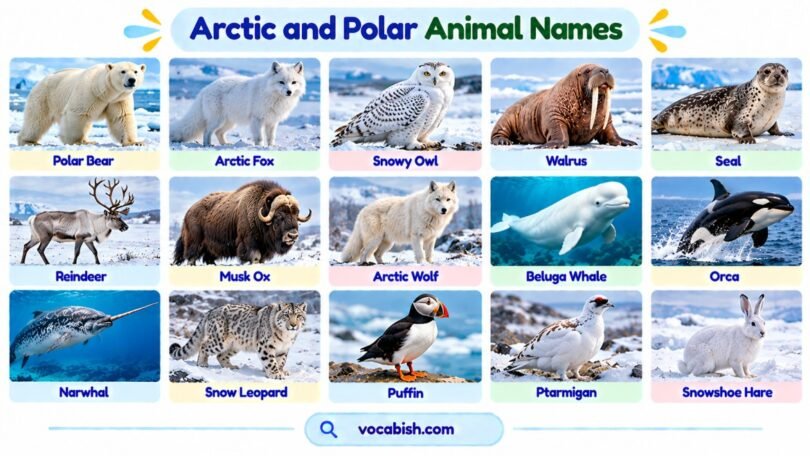

Arctic and polar animals survive in some of the coldest places on Earth. They include land mammals, marine mammals, seabirds, fish, penguins, and many smaller creatures found across the Arctic, Antarctica, tundra, sea ice, and polar oceans.
The Arctic surrounds the North Pole, while Antarctica surrounds the South Pole. Some animals live in one polar region only, while others occur in cold oceans across a much wider range. Learning their names by group makes them easier to recognize, remember, and use correctly in English.
Arctic and Polar Animal Names
Arctic and polar animals are animals adapted to cold northern or southern regions, including frozen land, tundra, pack ice, coastal waters, and polar seas. Their adaptations may include thick fur, dense feathers, insulating fat, seasonal coats, or behaviors that reduce heat loss.
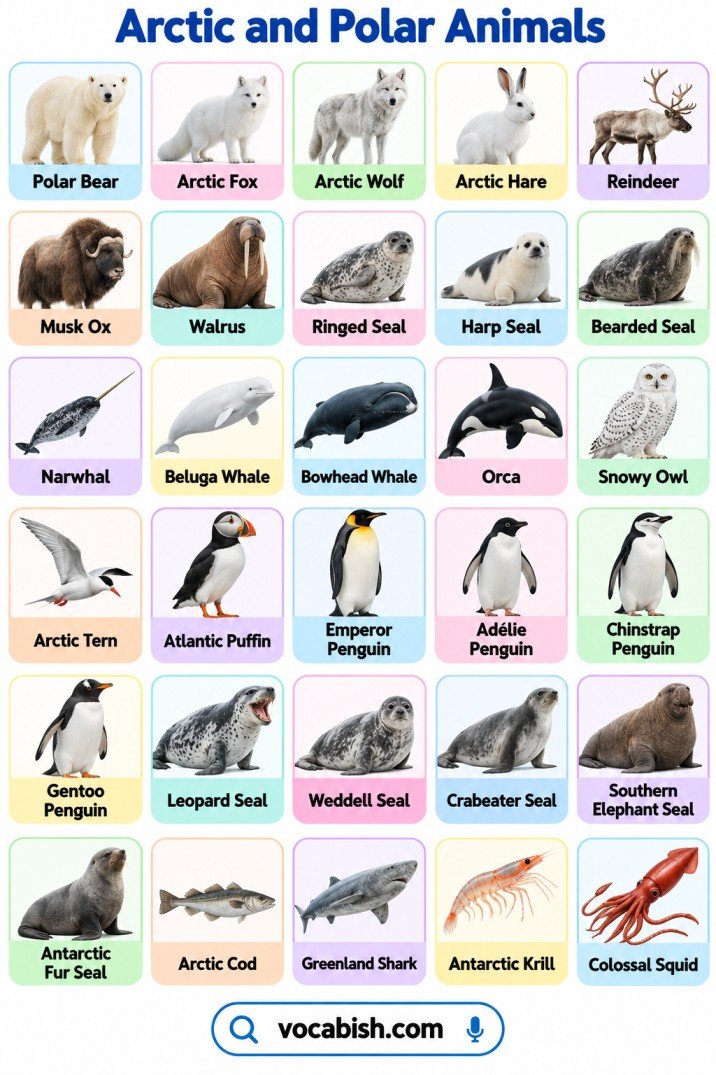
Some familiar Arctic and polar animals include:
- Polar Bear
- Arctic Fox
- Arctic Wolf
- Arctic Hare
- Reindeer
- Musk Ox
- Walrus
- Ringed Seal
- Harp Seal
- Bearded Seal
- Narwhal
- Beluga Whale
- Bowhead Whale
- Orca
- Snowy Owl
- Arctic Tern
- Emperor Penguin
- Adélie Penguin
- Leopard Seal
- Weddell Seal
- Crabeater Seal
- Antarctic Krill
- Arctic Cod
- Antarctic Toothfish
Most Common Arctic and Polar Animals
These are some of the best-known animals associated with the Arctic, Antarctica, and their surrounding cold oceans.
Polar Bear
The polar bear is a large Arctic predator found around the North Pole. Its thick fur and layer of body fat help protect it from extreme cold. Polar bears mainly hunt seals from sea ice. They do not naturally live in Antarctica.
Arctic Fox
The Arctic fox is a small fox adapted to tundra environments. Many have white winter coats that provide camouflage against snow. Their fur becomes thinner and often brown or gray during warmer months. Arctic foxes eat small mammals, birds, eggs, fish, and carrion.
Reindeer
Reindeer, also called caribou in North America, live across Arctic and subarctic regions. Their wide hooves help them move over snow and soft tundra ground. Both males and females can grow antlers. Many populations travel long distances during seasonal migrations.
Musk Ox
The musk ox is a heavy Arctic mammal with a long, shaggy coat. Beneath its outer hair is a fine insulating layer called qiviut. Musk oxen mainly eat grasses, sedges, and other tundra plants. They often form defensive groups when threatened.
Walrus
The walrus is a large marine mammal recognized by its tusks, whiskers, and thick body. It lives in Arctic coastal waters and around sea ice. Walruses mainly feed on clams and other animals from the seafloor. Their tusks can help them move onto ice and defend themselves.
Ringed Seal
The ringed seal is one of the most widespread seals in the Arctic. It maintains breathing holes in sea ice using the claws on its front flippers. Fish and small marine animals form much of its diet. Ringed seals are an important prey species for polar bears.
Harp Seal
Harp seals live mainly in the North Atlantic and Arctic waters. Young pups are famous for their pale coats, although their appearance changes as they mature. Adults eat fish and marine invertebrates. Large groups gather on ice during the breeding season.
Bowhead Whale
The bowhead whale is strongly associated with Arctic and subarctic seas. It has a massive head that can help it break through relatively thin sea ice. Bowheads filter tiny animals from seawater using baleen. They are among the longest-lived mammals known.
Beluga Whale
The beluga is a white whale found in Arctic and subarctic waters. Adults have distinctive pale skin and a rounded forehead called a melon. Belugas are highly vocal and use many clicks, whistles, and other sounds. They eat fish, squid, and crustaceans.
Narwhal
The narwhal is an Arctic whale best known for its long spiral tusk. The tusk is actually an enlarged tooth and is most commonly seen in males. Narwhals live around Greenland, Canada, and other high-Arctic waters. They feed on fish, squid, and other marine prey.
Orca
The orca, or killer whale, occurs in oceans around the world, including polar waters. Different populations may specialize in different prey such as fish, seals, or other marine mammals. Orcas live in social family groups. Their black-and-white markings make them easy to recognize.
Emperor Penguin
The emperor penguin is the largest living penguin species. It breeds on Antarctic sea ice during the extremely cold winter. Adults take turns protecting eggs and traveling to sea for food. Their diet includes fish, squid, and krill.
Adélie Penguin
Adélie penguins live around the Antarctic coast and nearby islands. They have black-and-white plumage and a noticeable white ring around each eye. These penguins feed mainly on krill and small fish. They build nests from small stones.
Leopard Seal
The leopard seal is a large Antarctic seal with a long body and powerful jaws. It eats krill, fish, squid, seabirds, and sometimes penguins or other seals. Leopard seals spend much of their time around pack ice. They are strong and agile swimmers.
Weddell Seal
The Weddell seal lives farther south than most other mammals. It can remain underwater for long periods while searching for fish and other prey. These seals use their teeth to maintain breathing holes in Antarctic ice. They often rest on fast ice near the coast.
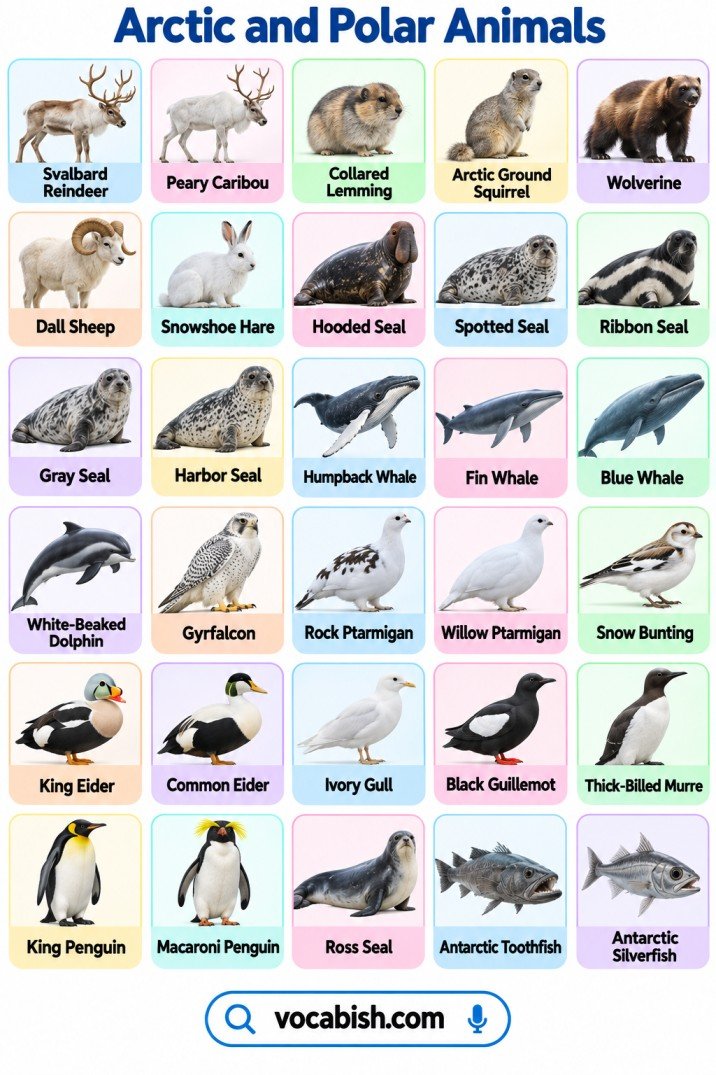
Arctic Land Mammal Names
Here’s a list of land mammals found across cold northern regions, tundra, and other high-latitude habitats.
- Polar Bear
- Arctic Fox
- Arctic Wolf
- Arctic Hare
- Musk Ox
- Reindeer
- Caribou
- Peary Caribou
- Svalbard Reindeer
- Collared Lemming
- Brown Lemming
- Norway Lemming
- Arctic Ground Squirrel
- Tundra Vole
- Northern Red-Backed Vole
- Ermine
- Wolverine
- Red Fox
- Moose
- Dall Sheep
- Snowshoe Hare
- Northern Bog Lemming
- Alaska Marmot
- Hoary Marmot
Arctic Marine Mammal Names
The following list covers marine mammals commonly found in cold northern seas, coastal waters, and areas around sea ice.
- Walrus
- Ringed Seal
- Bearded Seal
- Harp Seal
- Hooded Seal
- Spotted Seal
- Ribbon Seal
- Harbor Seal
- Gray Seal
- Bowhead Whale
- Beluga Whale
- Narwhal
- Orca
- Humpback Whale
- Fin Whale
- Common Minke Whale
- Blue Whale
- Northern Bottlenose Whale
- Harbor Porpoise
- White-Beaked Dolphin
Arctic Bird Names
Below are bird names associated with northern tundra, coastlines, islands, wetlands, and cold ocean environments.
- Snowy Owl
- Arctic Tern
- Gyrfalcon
- Rock Ptarmigan
- Willow Ptarmigan
- Snow Bunting
- Lapland Longspur
- Atlantic Puffin
- Horned Puffin
- Tufted Puffin
- Thick-Billed Murre
- Common Murre
- Black Guillemot
- Little Auk
- Razorbill
- Ivory Gull
- Glaucous Gull
- Ross’s Gull
- Sabine’s Gull
- Black-Legged Kittiwake
- Northern Fulmar
- Common Eider
- King Eider
- Spectacled Eider
- Steller’s Eider
- Long-Tailed Duck
- Red-Throated Loon
- Yellow-Billed Loon
- Red Phalarope
- Red-Necked Phalarope
- Purple Sandpiper
- Sanderling
- Dunlin
- Ruddy Turnstone
- Peregrine Falcon
- Greater White-Fronted Goose
- Snow Goose
- Brent Goose
Antarctic Mammal Names
Here’s a list of mammals that live in or regularly visit the waters and coastal areas around Antarctica.
- Leopard Seal
- Weddell Seal
- Crabeater Seal
- Ross Seal
- Southern Elephant Seal
- Antarctic Fur Seal
- Orca
- Antarctic Minke Whale
- Blue Whale
- Fin Whale
- Humpback Whale
- Southern Right Whale
- Sperm Whale
- Hourglass Dolphin
- Arnoux’s Beaked Whale
- Southern Bottlenose Whale
Antarctic Penguin Names
This section lists penguin species found in Antarctica and nearby subantarctic regions.
- Emperor Penguin
- Adélie Penguin
- Chinstrap Penguin
- Gentoo Penguin
- King Penguin
- Macaroni Penguin
- Southern Rockhopper Penguin
- Eastern Rockhopper Penguin
Antarctic and Southern Ocean Bird Names
Below are bird species commonly associated with Antarctica, surrounding islands, and the Southern Ocean.
- Antarctic Petrel
- Snow Petrel
- Cape Petrel
- Southern Fulmar
- Antarctic Prion
- Blue Petrel
- Wilson’s Storm Petrel
- Black-Bellied Storm Petrel
- South Polar Skua
- Brown Skua
- Antarctic Tern
- Wandering Albatross
- Southern Royal Albatross
- Black-Browed Albatross
- Light-Mantled Sooty Albatross
- Gray-Headed Albatross
- White-Chinned Petrel
- Southern Giant Petrel
- Northern Giant Petrel
- Kerguelen Petrel
- Soft-Plumaged Petrel
Arctic and Polar Fish Names
Here’s a list of fish found in cold northern waters, polar seas, and other low-temperature marine habitats.
- Arctic Cod
- Arctic Char
- Greenland Shark
- Greenland Halibut
- Capelin
- Saffron Cod
- Navaga
- Arctic Flounder
- Shorthorn Sculpin
- Fourhorn Sculpin
- Arctic Staghorn Sculpin
- Atlantic Wolffish
- Spotted Wolffish
- Northern Wolffish
- Polar Eelpout
- Arctic Skate
- Greenland Cod
- Snailfish
- Lanternfish
- Antarctic Toothfish
- Patagonian Toothfish
- Antarctic Silverfish
- Mackerel Icefish
- Blackfin Icefish
- Crocodile Icefish
- Emerald Rockcod
- Marbled Rockcod
- Antarctic Dragonfish
- Antarctic Lanternfish
- Antarctic Plunderfish
- Antarctic Snailfish
Polar Invertebrate Names
The following list includes invertebrates found in cold oceans and polar marine environments.
- Antarctic Krill
- Arctic Krill
- Copepod
- Amphipod
- Isopod
- Sea Spider
- Antarctic Squid
- Colossal Squid
- Giant Antarctic Octopus
- Arctic Jellyfish
- Lion’s Mane Jellyfish
- Comb Jelly
- Sea Anemone
- Sea Star
- Brittle Star
- Sea Urchin
- Sea Cucumber
- Glass Sponge
- Antarctic Sponge
- Marine Worm
- Bristle Worm
- Clam
- Scallop
- Limpet
- Marine Snail
- Sea Angel
- Sea Butterfly
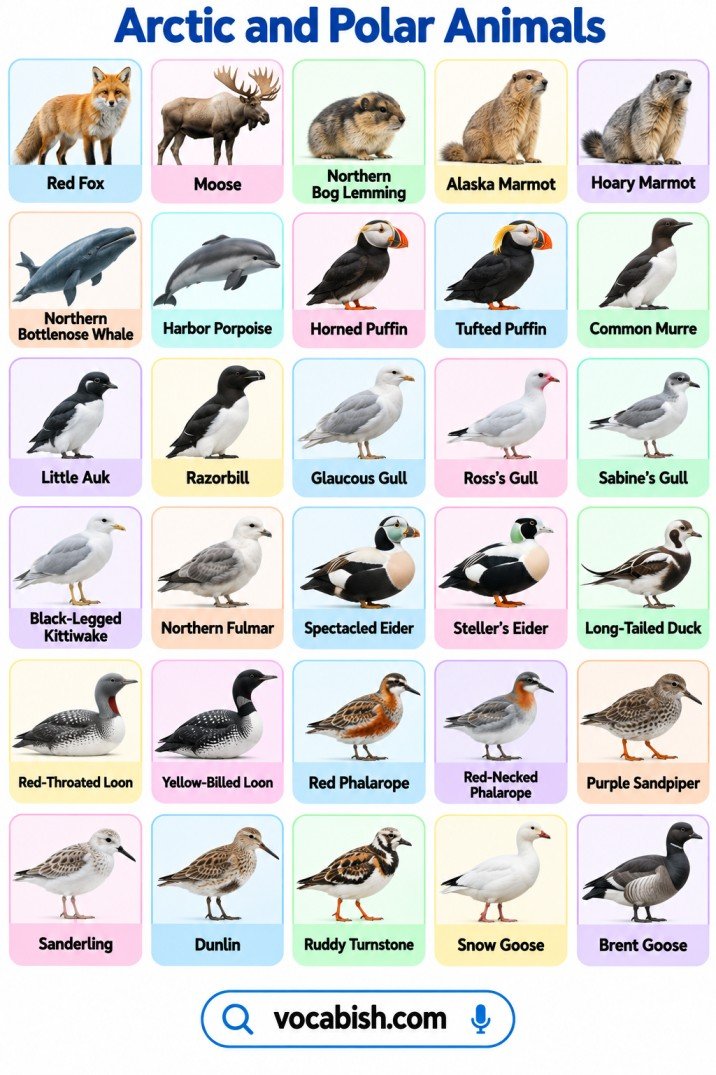
Arctic vs. Antarctic Animals
Feature | Arctic | Antarctic |
|---|---|---|
Polar region | North Pole | South Pole |
Main geography | Ocean surrounded by continents | Continent surrounded by ocean |
Polar bears | Yes | No |
Penguins | No native penguins | Yes |
Walruses | Yes | No |
Musk oxen | Yes | No |
Reindeer | Yes | No |
Emperor penguins | No | Yes |
Weddell seals | No | Yes |
Leopard seals | No | Yes |
Orcas | Yes | Yes |
Several whale species | Yes | Yes |
Sea ice | Yes | Yes |
Polar Animals by Habitat
Tundra Animals
- Arctic Fox
- Arctic Hare
- Arctic Wolf
- Reindeer
- Musk Ox
- Collared Lemming
- Brown Lemming
- Arctic Ground Squirrel
- Snowy Owl
- Rock Ptarmigan
- Snow Bunting
- Gyrfalcon
Sea-Ice Animals
- Polar Bear
- Ringed Seal
- Bearded Seal
- Walrus
- Emperor Penguin
- Weddell Seal
- Crabeater Seal
- Leopard Seal
- Adélie Penguin
Polar Ocean Animals
- Narwhal
- Beluga Whale
- Bowhead Whale
- Orca
- Blue Whale
- Humpback Whale
- Antarctic Minke Whale
- Greenland Shark
- Arctic Cod
- Antarctic Toothfish
- Antarctic Krill
- Colossal Squid
Polar Coastal Animals
- Atlantic Puffin
- Black Guillemot
- Common Eider
- Arctic Tern
- Gentoo Penguin
- Chinstrap Penguin
- Antarctic Fur Seal
- Southern Elephant Seal
- Snow Petrel
Quick Vocabulary Practice
Choose the correct answer.
- Which animal is found naturally in the Arctic: Polar Bear or Emperor Penguin?
- Which animal is strongly associated with Antarctica: Adélie Penguin or Musk Ox?
- Which Arctic whale has a long tusk: Narwhal or Bowhead Whale?
- Which animal has large tusks and lives around Arctic sea ice: Walrus or Weddell Seal?
- Which bird breeds during the Antarctic winter: Emperor Penguin or Snowy Owl?
- Which animal has a white winter coat for camouflage: Arctic Fox or Leopard Seal?
- Which small marine animal is a major Antarctic food source: Antarctic Krill or Arctic Hare?
- Which animal occurs in both northern and southern polar waters: Orca or Musk Ox?
Answers
- Polar Bear
- Adélie Penguin
- Narwhal
- Walrus
- Emperor Penguin
- Arctic Fox
- Antarctic Krill
- Orca
How to Learn Arctic and Polar Animal Names
- Learn the animals in small groups such as mammals, birds, fish, and marine animals.
- Match each animal name with a clear picture.
- Separate Arctic animals from Antarctic animals while studying.
- Say each name aloud to practise pronunciation.
- Review the names through picture cards, worksheets, or short classification activities.
FAQs
Arctic and polar animals are species living in cold northern or southern regions, including tundra, sea ice, polar coasts, and surrounding oceans.
Common Arctic animals include polar bears, Arctic foxes, reindeer, musk oxen, walruses, ringed seals, narwhals, belugas, snowy owls, and Arctic terns.
Antarctica supports emperor and Adélie penguins, Weddell seals, leopard seals, crabeater seals, Antarctic petrels, krill, whales, fish, and other marine species.
No. Polar bears naturally live in the Arctic, while wild penguins occur in the Southern Hemisphere, including Antarctica and nearby subantarctic regions.
The blue whale is the largest known animal on Earth and feeds in productive cold waters, including parts of the Arctic and Southern Ocean.
Polar bears, ringed seals, bearded seals, walruses, and several seabirds regularly use Arctic sea ice for hunting, resting, breeding, or avoiding predators.
Their diets vary widely. Polar animals may eat fish, seals, krill, squid, shellfish, birds, eggs, grasses, sedges, lichens, or other tundra plants.
No. White coloring helps some species with camouflage, but many polar animals are black, brown, gray, patterned, or brightly marked instead.
Related Animal Vocabulary
- Marine Mammal Names
- Ocean Animal Names
- Penguin Names
- Freshwater Animal Names
- Different Types of Bird with Names
Conclusion
Arctic and polar animals include a wide range of mammals, birds, fish, marine animals, and invertebrates adapted to cold environments. Polar bears, Arctic foxes, reindeer, walruses, narwhals, penguins, seals, whales, Arctic fish, and Antarctic krill are only part of this diverse wildlife. Separating Arctic animals from Antarctic species makes their names, habitats, and natural ranges much easier to understand and remember.