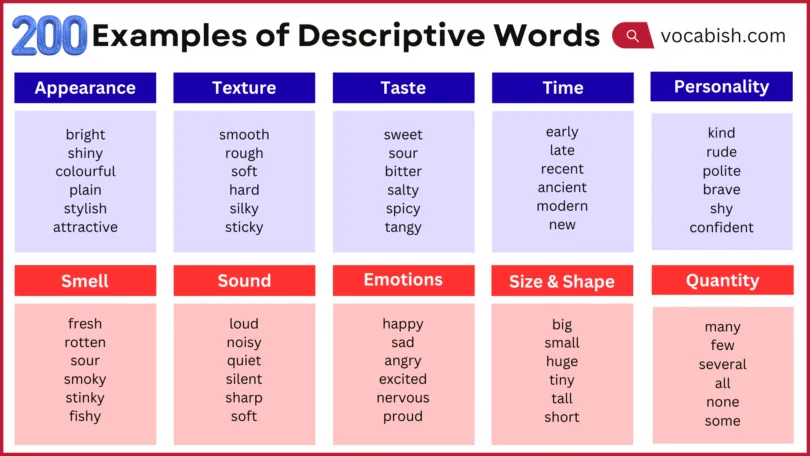

Descriptive words explain how a person, place, object, feeling, or experience appears. This guide includes 1,000 descriptive words in English with meanings and examples.
The words cover personality, food, nature, weather, sound, touch, tone, pain, music, resumes, and writing. You will also find synonyms, positive and negative words, and A–Z vocabulary. Use them to write clearer sentences and choose more precise English.
Use the table of contents below to jump directly to the section you need. It will help you find specific descriptive words without scrolling through the complete list.
What Are Descriptive Words?
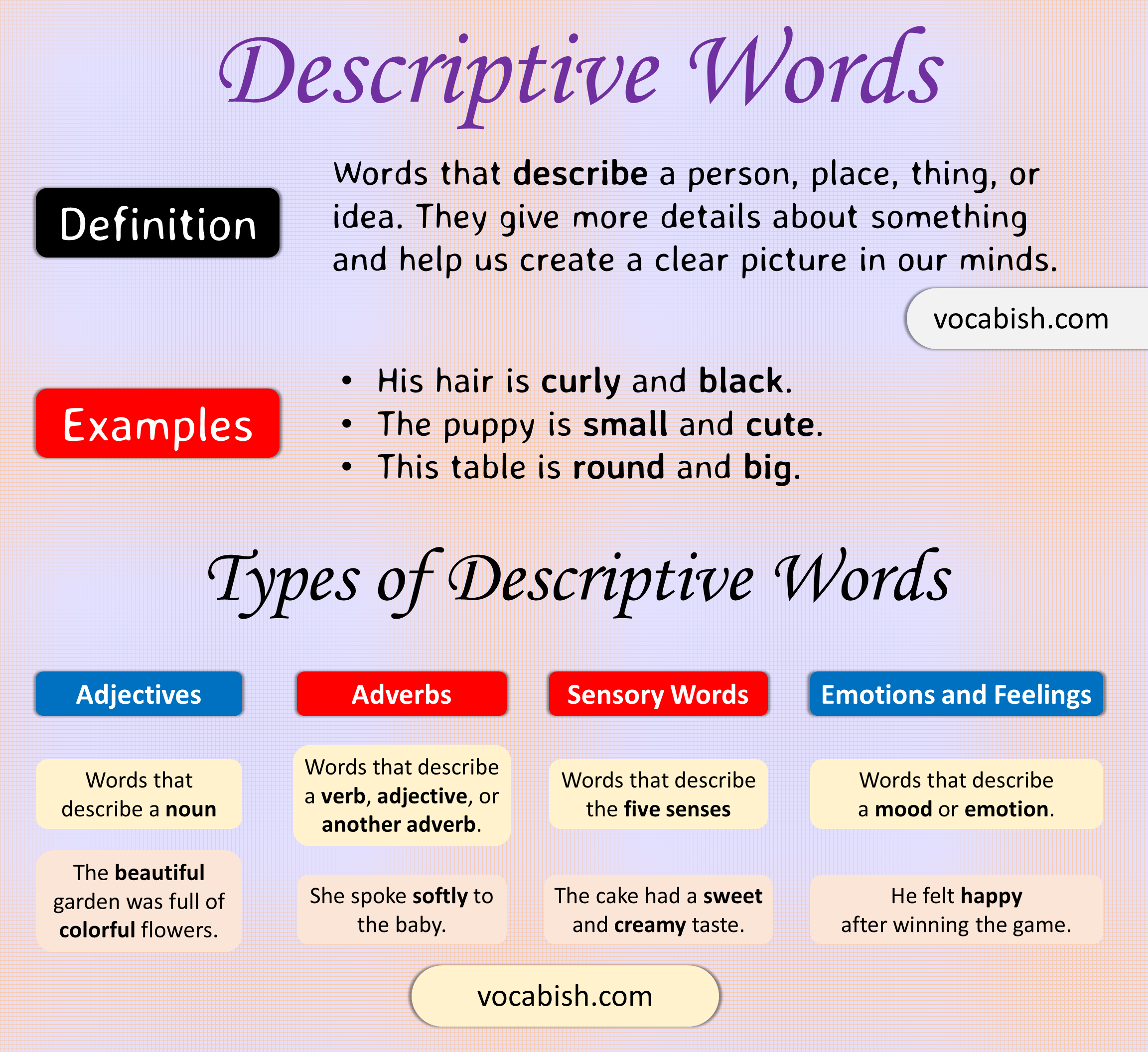
Descriptive words add information about a noun, action, condition, or experience. They help readers form a clearer mental picture.
Most describing words are adjectives, such as bright, friendly, and smooth. However, adverbs, nouns, verbs, participles, and gerunds can also perform descriptive roles.
Compare these sentences:
- She wore a dress.
- She wore a bright, flowing silk dress.
The second sentence gives useful details about the dress’s colour, movement, and material.
List of Descriptive Words
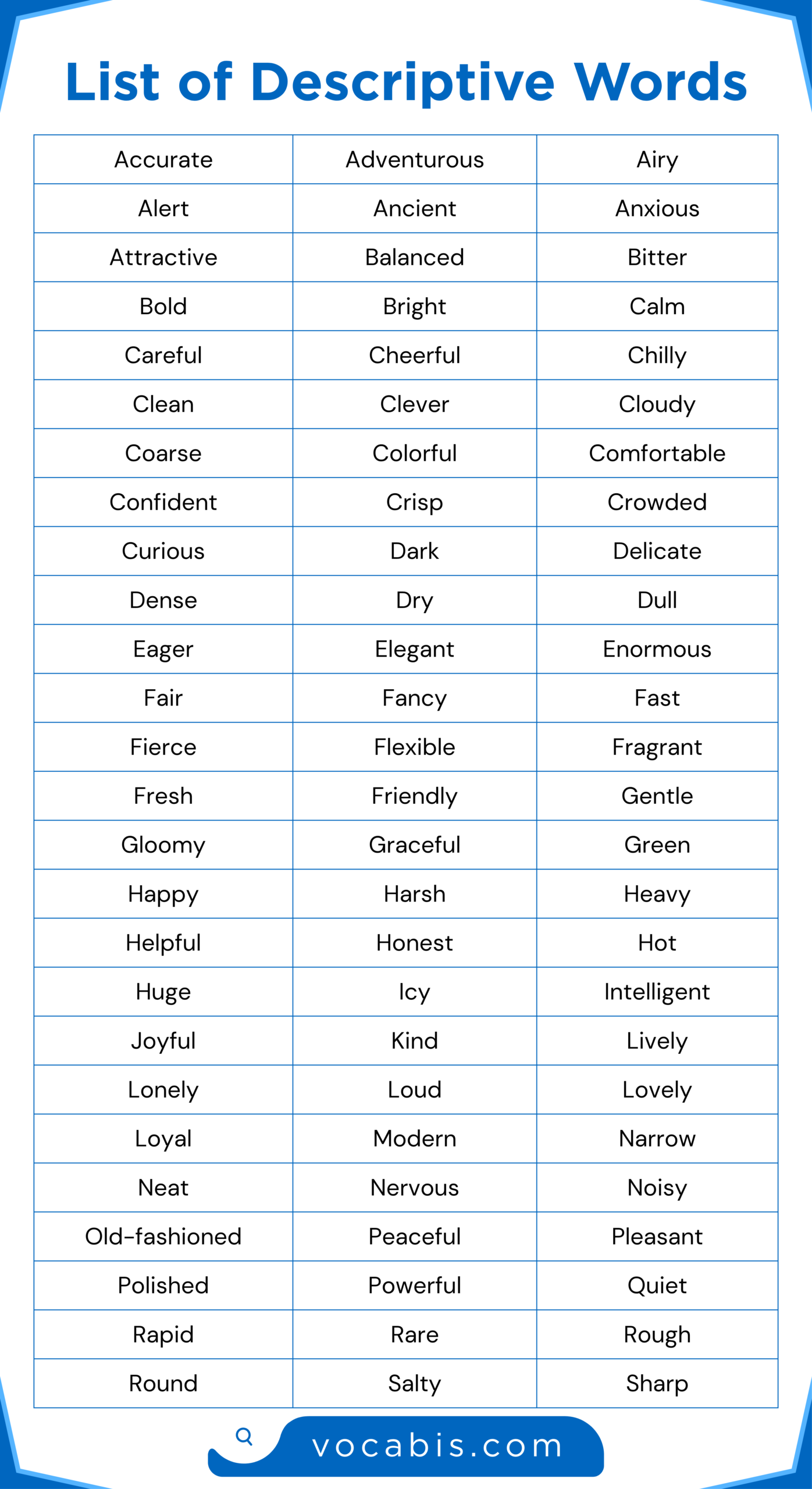
Here are 100 useful descriptive words for everyday speaking and writing.
Accurate | Adventurous | Airy |
Alert | Ancient | Anxious |
Attractive | Balanced | Bitter |
Bold | Bright | Calm |
Careful | Cheerful | Chilly |
Clean | Clever | Cloudy |
Coarse | Colorful | Comfortable |
Confident | Crisp | Crowded |
Curious | Dark | Delicate |
Dense | Dry | Dull |
Eager | Elegant | Enormous |
Fair | Fancy | Fast |
Fierce | Flexible | Fragrant |
Fresh | Friendly | Gentle |
Gloomy | Graceful | Green |
Happy | Harsh | Heavy |
Helpful | Honest | Hot |
Huge | Icy | Intelligent |
Joyful | Kind | Lively |
Lonely | Loud | Lovely |
Loyal | Modern | Narrow |
Neat | Nervous | Noisy |
Old-fashioned | Peaceful | Pleasant |
Polished | Powerful | Quiet |
Rapid | Rare | Rough |
Round | Salty | Sharp |
Shiny | Silent | Simple |
Smooth | Soft | Spacious |
Spicy | Steady | Strong |
Sweet | Tall | Tender |
Tiny | Warm | Weak |
Wide | Wild | Wise |
Wooden | Young | Zesty |
Descriptive Words for a Person
These words describe a person’s personality, behaviour, communication style, or general manner.
Word | Example sentence |
|---|---|
Adaptable | Sara is adaptable and handles change calmly. |
Ambitious | He is ambitious and sets challenging goals. |
Approachable | Our manager is friendly and approachable. |
Assertive | Nina gave an assertive but respectful answer. |
Attentive | The attentive nurse noticed every small change. |
Broad-minded | He is broad-minded about different cultures. |
Cautious | The cautious driver checked both directions. |
Charming | Her charming manner made everyone comfortable. |
Competitive | Amir becomes competitive during team games. |
Considerate | It was considerate of her to call first. |
Dependable | We need a dependable person for this role. |
Diplomatic | His diplomatic response prevented an argument. |
Disciplined | The disciplined athlete trains every morning. |
Easygoing | My easygoing colleague rarely becomes stressed. |
Energetic | The energetic guide led the entire tour. |
Expressive | Her expressive face revealed her excitement. |
Focused | He remained focused during the difficult task. |
Generous | Our generous neighbour shared fresh vegetables. |
Independent | She is independent and manages her own work. |
Insightful | Ali made an insightful comment about the problem. |
Observant | The observant child spotted the hidden bird. |
Patient | A patient teacher explains difficult ideas again. |
Practical | She offered a practical solution to the issue. |
Reliable | Bilal is reliable and always arrives on time. |
Reserved | He seems reserved until he knows people well. |
Resourceful | The resourceful traveller repaired the broken strap. |
Sociable | Hina is sociable and easily makes friends. |
Thoughtful | His thoughtful message made her feel supported. |
Trustworthy | A trustworthy employee protects private information. |
Witty | Her witty reply made the group laugh. |
Positive Descriptive Words for a Person
Use these words when describing admirable qualities and constructive behaviour.
Word | Example sentence |
|---|---|
Affectionate | The affectionate father hugged his children. |
Altruistic | Her altruistic work supports vulnerable families. |
Brave | The brave firefighter entered the smoky building. |
Compassionate | A compassionate doctor listens without judgment. |
Courteous | The courteous assistant greeted every visitor. |
Creative | She is creative and designs memorable lessons. |
Dedicated | The dedicated volunteer works every weekend. |
Empathetic | His empathetic response helped her feel heard. |
Encouraging | Our encouraging coach praised every improvement. |
Fair-minded | The fair-minded teacher heard both explanations. |
Forgiving | She was forgiving after his sincere apology. |
Genuine | His genuine concern was easy to recognise. |
Gracious | The gracious host welcomed every guest personally. |
Hardworking | The hardworking student completed every assignment. |
Humble | Despite winning, she remained humble and thankful. |
Inspiring | His inspiring story encouraged people to continue. |
Level-headed | The level-headed captain handled the emergency well. |
Open-minded | An open-minded learner considers different viewpoints. |
Optimistic | She remains optimistic during difficult projects. |
Organized | The organized coordinator kept accurate records. |
Perceptive | Her perceptive question revealed the real issue. |
Respectful | The respectful students listened without interrupting. |
Selfless | His selfless decision protected the entire team. |
Sincere | She offered a sincere apology for the mistake. |
Supportive | My supportive colleagues helped me settle in. |
Tactful | His tactful feedback did not embarrass anyone. |
Tolerant | A tolerant community respects different beliefs. |
Upbeat | Her upbeat attitude improved the office mood. |
Warmhearted | The warmhearted woman cared for abandoned animals. |
Welcoming | The welcoming staff showed us around. |
Negative Descriptive Words for a Person
These words describe difficult, harmful, or unpleasant personal qualities. Use them carefully and only when the context supports the description.
Word | Example sentence |
|---|---|
Aggressive | His aggressive response made the discussion uncomfortable. |
Arrogant | The arrogant speaker dismissed every opposing view. |
Bossy | The bossy child controlled the entire game. |
Careless | A careless worker left the door unlocked. |
Controlling | Her controlling behaviour limited everyone’s choices. |
Deceitful | The deceitful seller hid the product’s damage. |
Defensive | He became defensive when asked about the delay. |
Dishonest | A dishonest employee changed the financial records. |
Dismissive | Her dismissive reply ended the conversation. |
Envious | He felt envious of his colleague’s promotion. |
Greedy | The greedy owner kept all the profits. |
Impatient | The impatient customer repeatedly checked the time. |
Impulsive | His impulsive purchase emptied his savings. |
Inconsiderate | The inconsiderate neighbour played loud music overnight. |
Insensitive | Her insensitive joke upset several people. |
Jealous | His jealous behaviour damaged the friendship. |
Judgmental | A judgmental person often makes unfair assumptions. |
Manipulative | The manipulative caller used guilt to persuade her. |
Moody | The moody supervisor was difficult to approach. |
Narrow-minded | His narrow-minded attitude blocked useful discussion. |
Pessimistic | The pessimistic teammate predicted failure immediately. |
Possessive | Her possessive behaviour pushed her friends away. |
Reckless | The reckless cyclist crossed without looking. |
Rude | The rude customer interrupted the cashier repeatedly. |
Selfish | His selfish choice created extra work for everyone. |
Stubborn | The stubborn manager rejected every compromise. |
Suspicious | She became suspicious of harmless questions. |
Unreliable | The unreliable supplier missed another deadline. |
Vain | He was vain about his expensive clothes. |
Vindictive | Her vindictive message made the conflict worse. |
Descriptive Words About Yourself
Choose words that truthfully reflect your habits, strengths, values, and working style.
Word | Example sentence |
|---|---|
Analytical | I am analytical and compare evidence carefully. |
Authentic | I try to remain authentic in every situation. |
Collaborative | I am collaborative and value team input. |
Committed | I stay committed even when work becomes difficult. |
Conscientious | I am conscientious about quality and deadlines. |
Consistent | I produce consistent work across long projects. |
Decisive | I am decisive when enough information is available. |
Determined | I remain determined after temporary setbacks. |
Emotionally aware | I am emotionally aware during sensitive discussions. |
Flexible | I am flexible when priorities suddenly change. |
Goal-oriented | I am goal-oriented and track my progress. |
Growth-minded | I am growth-minded and welcome useful feedback. |
Honest | I am honest about mistakes and limitations. |
Imaginative | I am imaginative when developing new concepts. |
Methodical | I use a methodical approach for complex tasks. |
Motivated | I remain motivated by meaningful challenges. |
Proactive | I am proactive and raise concerns early. |
Punctual | I am punctual for meetings and appointments. |
Reflective | I am reflective about my decisions and habits. |
Resilient | I am resilient when plans do not work. |
Responsible | I take responsible ownership of my assignments. |
Self-aware | I am self-aware about my strengths and weaknesses. |
Solution-focused | I remain solution-focused during disagreements. |
Versatile | I am versatile and learn new tools quickly. |
Willing | I am willing to support unfamiliar projects. |
Descriptive Words for a Resume
Resume words should show real skills, achievements, and working methods. Support them with evidence instead of adding them as empty claims.
Word | Example sentence |
|---|---|
Accomplished | Accomplished sales professional with eight years’ experience. |
Agile | Agile coordinator experienced in changing project requirements. |
Client-focused | Client-focused adviser with strong retention results. |
Cross-functional | Led a cross-functional product improvement team. |
Data-driven | Data-driven analyst who improved forecast accuracy. |
Detail-oriented | Detail-oriented editor with strong quality-control skills. |
Efficient | Designed an efficient reporting process for managers. |
Experienced | Experienced trainer serving international teams. |
Innovative | Innovative designer who reduced production costs. |
Leadership-minded | Leadership-minded specialist who mentors junior employees. |
Measurable | Delivered measurable improvements in customer satisfaction. |
Organized | Organized administrator managing multiple schedules. |
Performance-focused | Performance-focused manager who exceeded annual targets. |
Persuasive | Persuasive presenter experienced in stakeholder approval. |
Process-driven | Process-driven coordinator with strong compliance knowledge. |
Productive | Productive writer delivering accurate weekly content. |
Proficient | Proficient user of spreadsheet and reporting software. |
Results-oriented | Results-oriented marketer who increased qualified leads. |
Scalable | Developed scalable systems for regional expansion. |
Strategic | Strategic planner with strong market knowledge. |
Technically skilled | Technically skilled engineer with automation experience. |
Team-oriented | Team-oriented supervisor who improves collaboration. |
Thorough | Conducted a thorough review of safety procedures. |
Trained | Trained facilitator experienced in workplace learning. |
Visionary | Visionary leader who developed a five-year roadmap. |
How to Use Descriptive Words in Writing
Good descriptive writing selects details that matter. Adding many adjectives does not automatically improve a sentence.
Use precise words that reveal appearance, movement, atmosphere, emotion, or sensory information. Replace general words with details the reader can imagine.
Word | Meaning |
|---|---|
Precise | Exact |
Sensory | Connected to the senses |
Specific | Clearly identified |
Vivid | Clear and powerful |
Concrete | Physical and definite |
Evocative | Creating strong feelings |
Concise | Brief but complete |
Rhythmic | Having a flowing pattern |
Atmospheric | Creating a mood |
Believable | Convincingly realistic |
Nuanced | Showing subtle differences |
Striking | Immediately noticeable |
Restrained | Carefully controlled |
Purposeful | Serving a clear reason |
Descriptive Words for Food
Food words can describe flavour, texture, temperature, aroma, freshness, and preparation.
Word | Example sentence |
|---|---|
Aromatic | The aromatic rice filled the kitchen with spice. |
Buttery | The pastry had a soft, buttery flavour. |
Caramelized | The caramelized onions tasted sweet and rich. |
Creamy | The creamy soup had a silky texture. |
Crunchy | The crunchy vegetables remained fresh after cooking. |
Flaky | The flaky fish broke apart easily. |
Fruity | The tea had a light, fruity flavour. |
Garlicky | We served the bread with garlicky butter. |
Gooey | The brownie had a warm, gooey centre. |
Hearty | The hearty stew was perfect for winter. |
Juicy | The grilled chicken remained tender and juicy. |
Mild | The mild cheese suited the simple sandwich. |
Nutty | The brown rice had a pleasant nutty taste. |
Oily | The fried snack felt slightly oily. |
Peppery | The salad leaves had a peppery bite. |
Refreshing | The cold lemonade was light and refreshing. |
Rich | The rich chocolate cake needed only a small serving. |
Ripe | The ripe mango was soft and sweet. |
Roasted | The roasted vegetables developed deeper flavours. |
Savory | The savory pie contained cheese and herbs. |
Smoky | The sauce had a deep, smoky flavour. |
Sour | The sour lemon made him close his eyes. |
Succulent | The succulent meat separated from the bone. |
Tangy | The yogurt added a tangy flavour. |
Tart | The tart berries balanced the sweet cream. |
Tender | The slow-cooked beef became wonderfully tender. |
Toasted | The toasted seeds added warmth and crunch. |
Velvety | The velvety sauce coated the pasta evenly. |
Wholesome | We prepared a wholesome meal with fresh ingredients. |
Zingy | The lime gave the dressing a zingy finish. |
Descriptive Words for Nature
Nature can be described through colour, movement, temperature, scale, sound, texture, and atmosphere. The best word depends on whether you are describing a season, landscape, plant, body of water, or weather condition.
Summer
Word | Example sentence |
|---|---|
Blazing | The blazing sun heated the empty road. |
Breezy | It was a breezy afternoon near the coast. |
Bright | Bright mornings arrived earlier in June. |
Cloudless | A cloudless sky stretched above the fields. |
Golden | Golden sunlight covered the wheat. |
Humid | The humid evening felt heavy and uncomfortable. |
Lazy | We spent a lazy afternoon beside the pool. |
Long | Long summer evenings encouraged outdoor meals. |
Radiant | The radiant sky reflected on the lake. |
Scorching | Scorching temperatures kept people indoors. |
Seasonal | Seasonal fruit appeared in every market. |
Shimmering | Shimmering heat rose from the pavement. |
Sticky | The sticky weather made sleep difficult. |
Sun-drenched | We crossed a sun-drenched courtyard. |
Sunlit | The sunlit garden looked fresh and cheerful. |
Tropical | Tropical air surrounded the island. |
Warm | A warm breeze entered through the window. |
Windless | The windless afternoon felt unusually still. |
Balmy | A balmy evening brought everyone outside. |
Vibrant | The vibrant park was crowded with families. |
Ocean
Word | Meaning |
|---|---|
Azure | Bright blue |
Boundless | Seemingly endless |
Briny | Salty-smelling |
Choppy | Rough with short waves |
Coastal | Near the coast |
Deep | Extending far downward |
Foamy | Covered with bubbles |
Glassy | Smooth like glass |
Marine | Connected to the sea |
Misty | Covered in fine moisture |
Open | Far from land |
Restless | Constantly moving |
Rolling | Moving in rounded waves |
Salty | Containing salt |
Sparkling | Shining with reflected light |
Stormy | Disturbed by bad weather |
Tidal | Influenced by tides |
Turquoise | Blue-green |
Vast | Extremely large |
Wavy | Covered in waves |
Flowers
Word | Example sentence |
|---|---|
Blooming | Blooming roses covered the garden wall. |
Blushing | Blushing petals opened in the morning. |
Botanical | The botanical display included rare flowers. |
Delicate | Delicate blossoms moved in the breeze. |
Dewy | Dewy flowers sparkled after sunrise. |
Floral | A floral fragrance filled the room. |
Fragrant | Fragrant jasmine grew beside the window. |
Fresh-cut | Fresh-cut tulips stood in a glass vase. |
Graceful | Graceful lilies curved toward the light. |
Pastel | Pastel flowers decorated the spring table. |
Petaled | The many-petaled flower resembled a small sun. |
Pollen-rich | Bees visited the pollen-rich blossoms. |
Radiant | Radiant sunflowers faced the afternoon light. |
Seasonal | Seasonal flowers changed throughout the year. |
Showy | Showy orchids formed the centrepiece. |
Soft-hued | Soft-hued roses suited the quiet room. |
Thorny | The thorny rose bush needed careful handling. |
Velvety | The velvety petals felt smooth. |
Vibrant | Vibrant flowers lined the village path. |
Wilted | The wilted bouquet needed fresh water. |
Cold
Word | Meaning |
|---|---|
Arctic | Extremely cold |
Biting | Painfully cold |
Bitter | Severely cold |
Bone-chilling | Intensely cold |
Brisk | Cool and fresh |
Cool | Slightly cold |
Freezing | At or below freezing |
Frigid | Extremely cold |
Frosty | Covered with frost |
Glacial | Ice-cold |
Icy | Covered with ice |
Numbing | Causing loss of feeling |
Polar | Related to cold polar regions |
Sharp | Suddenly cold |
Wintry | Typical of winter |
Weather
Word | Example sentence |
|---|---|
Clear | The clear sky revealed every star. |
Cloudy | Cloudy weather continued through the afternoon. |
Damp | The damp air carried the smell of soil. |
Drizzly | A drizzly morning kept the streets quiet. |
Dry | Dry weather damaged the young plants. |
Foggy | The foggy road reduced visibility. |
Gusty | Gusty conditions shook the windows. |
Hazy | A hazy sky covered the distant hills. |
Humid | Humid weather made the room uncomfortable. |
Mild | The mild afternoon was pleasant for walking. |
Overcast | An overcast sky blocked the sunlight. |
Rainy | Rainy weather returned before the weekend. |
Snowy | The snowy village looked peaceful. |
Stormy | Stormy conditions closed the mountain road. |
Sunny | A sunny morning improved everyone’s mood. |
Thundery | The thundery air felt heavy and tense. |
Unsettled | Unsettled weather continued for several days. |
Windy | The windy beach was almost empty. |
Wintry | Wintry showers reached the northern areas. |
Changeable | Changeable weather made planning difficult. |
Environment
Word | Meaning |
|---|---|
Biodiverse | Rich in species |
Contaminated | Made unsafe |
Ecological | Related to ecosystems |
Fragile | Easily harmed |
Green | Environmentally responsible |
Habitable | Suitable for life |
Healthy | Functioning well |
Littered | Covered with waste |
Low-carbon | Producing fewer emissions |
Natural | Not artificially created |
Polluted | Containing harmful substances |
Protected | Legally safeguarded |
Renewable | Naturally replaceable |
Resilient | Able to recover |
Resource-rich | Containing useful resources |
Sustainable | Maintainable long-term |
Toxic | Poisonous |
Untouched | Not significantly altered |
Urbanized | Developed into a city |
Vulnerable | Easily damaged |
List of Descriptive Words for Smell
Word | Example sentence |
|---|---|
Acrid | Acrid smoke escaped from the factory. |
Earthy | The mushrooms had an earthy smell. |
Floral | A floral perfume lingered in the room. |
Fresh | Fresh air entered through the open door. |
Fragrant | The fragrant bread filled the bakery. |
Musty | The old cupboard smelled musty. |
Musky | The perfume had a deep, musky scent. |
Perfumed | Perfumed soap rested beside the sink. |
Pungent | The pungent cheese filled the kitchen. |
Rancid | The rancid butter smelled unpleasant. |
Smoky | A smoky smell clung to his coat. |
Spicy | Spicy aromas drifted from the restaurant. |
Stale | Stale air filled the unused room. |
Sweet | A sweet scent came from the flowers. |
Woody | The candle released a warm, woody aroma. |
Citrusy | The cleaner had a bright, citrusy smell. |
Medicinal | A medicinal scent filled the clinic. |
Fishy | A fishy smell came from the harbour. |
Rotten | Rotten fruit attracted insects. |
Clean | The laundry had a clean scent. |
Common Descriptive Words for Sounds
Word | Example sentence |
|---|---|
Booming | A booming voice filled the hall. |
Buzzing | Buzzing insects circled the lamp. |
Crackling | Crackling wood burned in the fireplace. |
Deafening | The deafening explosion shook the windows. |
Echoing | Echoing footsteps travelled along the corridor. |
Faint | A faint cry came from outside. |
Hissing | Hissing steam escaped from the pipe. |
Humming | The humming machine ran all night. |
Melodic | Her melodic voice carried across the room. |
Muffled | Muffled conversation came through the wall. |
Piercing | A piercing alarm interrupted the meeting. |
Rattling | A rattling window disturbed his sleep. |
Resonant | The resonant bell sounded across the valley. |
Rhythmic | Rhythmic drums began the performance. |
Rustling | Rustling leaves revealed the approaching wind. |
Screeching | Screeching brakes startled the pedestrians. |
Shrill | A shrill whistle cut through the noise. |
Soothing | Soothing rain helped her fall asleep. |
Thudding | Thudding footsteps climbed the stairs. |
Whispering | Whispering voices came from the library. |
Descriptive Words for Touch
Word | Example sentence |
|---|---|
Bumpy | The bumpy road shook the vehicle. |
Clammy | His hands felt cold and clammy. |
Coarse | The coarse fabric irritated her skin. |
Cushiony | The cushiony seat supported his back. |
Damp | The towel still felt damp. |
Elastic | The elastic material fitted comfortably. |
Firm | The mattress felt firm and supportive. |
Fuzzy | The fuzzy blanket kept her warm. |
Greasy | The greasy handle was difficult to hold. |
Gritty | The gritty sand stuck to his feet. |
Leathery | The old leaves felt dry and leathery. |
Prickly | The prickly plant scratched his hand. |
Rubbery | The mushrooms had a rubbery texture. |
Silky | Her scarf felt soft and silky. |
Slippery | The slippery floor caused him to stumble. |
Smooth | The polished stone felt completely smooth. |
Sticky | The sticky syrup covered his fingers. |
Velvety | The flower petals felt velvety. |
Waxy | The leaves had a waxy surface. |
Woolly | The woolly sweater felt warm. |
Descriptive Words for Taste
Word | Example sentence |
|---|---|
Bitter | The medicine left a bitter taste. |
Bland | The soup was bland without salt. |
Briny | The oysters had a fresh, briny taste. |
Buttery | The biscuit tasted warm and buttery. |
Earthy | The beetroot had an earthy flavour. |
Fruity | The drink had a light, fruity taste. |
Garlicky | The sauce was rich and garlicky. |
Mild | The curry was mild enough for children. |
Minty | The tea left a cool, minty taste. |
Peppery | The leaves tasted fresh and peppery. |
Rich | The dessert had a rich chocolate flavour. |
Salty | The chips were too salty. |
Savory | The pie had a savory filling. |
Smoky | The grilled vegetables tasted smoky. |
Sour | The yogurt tasted slightly sour. |
Spicy | The spicy noodles made his eyes water. |
Sweet | The ripe peach tasted naturally sweet. |
Tangy | The dressing was bright and tangy. |
Tart | The tart apple balanced the sweet pastry. |
Umami | Mushrooms added an umami flavour. |
Tone Descriptive Words
Tone words describe the attitude or emotional quality of speech and writing.
Word | Example sentence |
|---|---|
Accusatory | His accusatory tone made her defensive. |
Admiring | She spoke in an admiring tone. |
Apologetic | His apologetic message acknowledged the mistake. |
Authoritative | The report used an authoritative tone. |
Conversational | The article has a conversational tone. |
Critical | Her critical review identified several weaknesses. |
Encouraging | The teacher’s encouraging tone reduced their anxiety. |
Formal | Use a formal tone in the application. |
Humorous | The speaker adopted a humorous tone. |
Impatient | His impatient tone was easy to notice. |
Ironic | The final line sounded deliberately ironic. |
Joyful | Her joyful voice filled the room. |
Neutral | The news report maintained a neutral tone. |
Persuasive | The advertisement used a persuasive tone. |
Respectful | His respectful response welcomed disagreement. |
Sarcastic | Her sarcastic comment upset the group. |
Serious | The conversation became serious immediately. |
Sympathetic | The adviser used a sympathetic tone. |
Urgent | The warning sounded urgent. |
Warm | She welcomed us in a warm tone. |
Descriptive Pain Words
Pain descriptions help explain location, intensity, duration, and sensation. Medical concerns should be assessed by a qualified healthcare professional.
Word | Example sentence |
|---|---|
Aching | He felt an aching pain in his shoulder. |
Burning | She described a burning sensation in her throat. |
Cramping | Cramping pain affected his lower leg. |
Crushing | He reported crushing pressure in his chest. |
Dull | A dull headache remained all afternoon. |
Electric | Electric pain travelled down her arm. |
Gnawing | A gnawing pain disturbed his sleep. |
Intense | The intense pain began suddenly. |
Nagging | A nagging ache returned every morning. |
Piercing | Piercing pain appeared behind her eye. |
Pulsing | Pulsing pain developed near the injury. |
Radiating | The pain was radiating toward his back. |
Searing | She felt searing pain around the burn. |
Sharp | A sharp pain appeared when he moved. |
Shooting | Shooting pain moved through her leg. |
Sore | His muscles felt sore after training. |
Stabbing | She experienced stabbing pain in her side. |
Tender | The swollen area was tender. |
Throbbing | A throbbing headache lasted several hours. |
Tingling | Tingling discomfort affected his fingers. |
Descriptive Words for Music
Word | Example sentence |
|---|---|
Acoustic | The café hosted an acoustic performance. |
Atmospheric | Atmospheric music played during the opening scene. |
Catchy | The song has a catchy chorus. |
Cinematic | Cinematic strings made the scene feel larger. |
Delicate | A delicate piano melody opened the piece. |
Dissonant | Dissonant notes created uneasiness. |
Energetic | Energetic drums drove the song forward. |
Gentle | Gentle music played in the background. |
Haunting | The singer delivered a haunting melody. |
Harmonious | Their harmonious voices blended naturally. |
Lively | Lively music filled the festival. |
Melodic | The track is simple but melodic. |
Mellow | Mellow guitar music suited the evening. |
Powerful | A powerful chorus ended the performance. |
Repetitive | The repetitive beat became tiring. |
Rhythmic | Rhythmic clapping accompanied the dancers. |
Soulful | Her soulful voice silenced the audience. |
Uplifting | The uplifting song ended on a hopeful note. |
Vibrant | Vibrant music welcomed the guests. |
Warm | The recording had a warm sound. |
Company Culture Descriptive Words
Use these terms when they accurately reflect how an organisation operates, communicates, leads, and treats employees.
Word | Example sentence |
|---|---|
Accountable | The company promotes an accountable working culture. |
Agile | An agile culture responds quickly to change. |
Collaborative | The collaborative workplace encourages shared decisions. |
Customer-focused | Customer-focused teams regularly review feedback. |
Diverse | A diverse workforce brings varied perspectives. |
Empowering | The empowering culture allows employees to lead. |
Ethical | Ethical leadership shapes company decisions. |
Flexible | Flexible schedules support different working needs. |
Inclusive | An inclusive workplace listens to every team. |
Innovative | The innovative culture rewards useful experiments. |
Learning-focused | A learning-focused company funds regular training. |
Mission-driven | The mission-driven team values social impact. |
Open | An open culture makes questions easier to raise. |
People-first | People-first policies support health and development. |
Performance-oriented | The performance-oriented culture tracks clear goals. |
Respectful | Respectful communication is expected at every level. |
Supportive | A supportive manager helps employees improve. |
Transparent | Transparent leadership explains major organisational changes. |
Trusting | A trusting culture avoids unnecessary supervision. |
Values-led | Values-led companies connect promises with actions. |
Descriptive Parts of Speech
Adjectives are the most familiar descriptive words, but they are not the only ones. Adverbs describe actions, while nouns, verbs, participles, and gerunds can add imagery or identify materials, movement, purpose, and atmosphere.
Adjectives
Word | Meaning |
|---|---|
Ancient | Extremely old |
Brisk | Cool and energetic |
Complex | Containing many parts |
Dazzling | Extremely bright |
Fragile | Easily broken |
Immense | Extremely large |
Narrow | Not wide |
Polished | Smooth and shiny |
Quiet | Producing little sound |
Resilient | Able to recover |
Rugged | Rough and uneven |
Slender | Thin and graceful |
Spacious | Having much room |
Steep | Rising sharply |
Sturdy | Strongly built |
Subtle | Not immediately obvious |
Swift | Fast |
Transparent | Clear enough to see through |
Uneven | Not level |
Vivid | Strong and clear |
Adverbs
Word | Meaning | Example sentence |
|---|---|---|
Boldly | In a confident way | She boldly challenged the old rule. |
Calmly | Without panic | He calmly explained the situation. |
Carefully | With attention | She carefully opened the package. |
Cheerfully | In a happy manner | They cheerfully welcomed the visitors. |
Clearly | In an understandable way | The guide clearly described the route. |
Eagerly | With excitement | The children eagerly opened their books. |
Elegantly | Gracefully | The dancer moved elegantly across the stage. |
Gently | Softly | He gently closed the door. |
Honestly | Truthfully | She honestly admitted the error. |
Loudly | With strong sound | The crowd cheered loudly. |
Neatly | In an orderly way | He neatly arranged the documents. |
Patiently | Without becoming annoyed | We patiently waited for our turn. |
Quietly | With little sound | She quietly entered the room. |
Rapidly | Very quickly | The water level rose rapidly. |
Smoothly | Without difficulty | The event progressed smoothly. |
Softly | In a gentle way | Rain fell softly on the roof. |
Steadily | At a consistent rate | The temperature climbed steadily. |
Thoughtfully | With careful consideration | He thoughtfully reviewed the proposal. |
Warmly | In a friendly manner | The host warmly greeted us. |
Wildly | Without control | The branches moved wildly in the storm. |
Nouns Used as Descriptive Words
A noun can describe another noun by identifying its material, purpose, location, season, flavour, or source.
Descriptive phrase | Example sentence |
|---|---|
Chocolate cake | We shared a chocolate cake after dinner. |
Stone wall | A stone wall surrounded the garden. |
Summer rain | Warm summer rain cooled the street. |
Office chair | She bought a supportive office chair. |
Garden path | The garden path curved behind the trees. |
Silk scarf | She wore a blue silk scarf. |
Mountain air | Fresh mountain air filled our lungs. |
Metal gate | A heavy metal gate blocked the entrance. |
Paper bag | He carried the bread in a paper bag. |
Winter coat | Her winter coat was thick and warm. |
Lemon juice | Add fresh lemon juice to the dressing. |
Village road | The narrow village road passed several farms. |
Ocean breeze | A cool ocean breeze reached the balcony. |
Coffee mug | His coffee mug sat beside the laptop. |
Glass door | The glass door reflected the garden. |
Verbs Used as Descriptive Words
Strong verbs describe movement and change without requiring many extra adjectives.
Verb | Meaning |
|---|---|
Shimmer | Reflect soft light |
Crawl | Move slowly |
Burst | Open or move suddenly |
Drift | Move gently |
Tower | Rise high above |
Curl | Form a curved shape |
Ripple | Move in small waves |
Scatter | Spread in different directions |
Cling | Hold tightly |
Creep | Move slowly and quietly |
Flash | Appear brightly and briefly |
Glide | Move smoothly |
Tremble | Shake slightly |
Glow | Produce soft light |
Echo | Repeat a sound |
Gerunds Used as Descriptive Words
Gerunds and present participles can describe ongoing actions, sounds, and conditions.
Word | Meaning | Example sentence |
|---|---|---|
Baking | Cooking with dry heat | The smell of baking bread filled the house. |
Buzzing | Making a continuous sound | Buzzing insects surrounded the flowers. |
Crashing | Striking noisily | Crashing waves reached the sea wall. |
Dancing | Moving rhythmically | Dancing shadows covered the ceiling. |
Dripping | Falling in drops | A dripping tap disturbed the silence. |
Flickering | Shining unsteadily | Flickering candles lit the room. |
Flowing | Moving continuously | Flowing water crossed the smooth stones. |
Glowing | Giving off light | Glowing windows appeared through the fog. |
Howling | Producing a long cry | Howling wind shook the roof. |
Laughing | Making sounds of amusement | Laughing children ran across the playground. |
Rolling | Moving in rounded motion | Rolling clouds gathered above the town. |
Rustling | Making soft movement sounds | Rustling leaves covered the path. |
Shining | Reflecting light | Shining metal caught his attention. |
Sparkling | Flashing with light | Sparkling water surrounded the boat. |
Whispering | Speaking very quietly | Whispering voices came from the corridor. |
Synonyms for Common Descriptive Words
Replacing a general word with a precise synonym can improve clarity. The stronger option must still match the exact context.
Common word | Stronger word | Example sentence |
|---|---|---|
Big | Enormous | An enormous tree shaded the house. |
Small | Minute | Minute cracks appeared in the glass. |
Good | Excellent | She delivered an excellent presentation. |
Bad | Awful | An awful smell came from the drain. |
Happy | Delighted | He was delighted by the result. |
Sad | Miserable | The abandoned building looked miserable. |
Angry | Furious | The customer became furious about the delay. |
Scared | Terrified | The child felt terrified during the storm. |
Tired | Exhausted | We were exhausted after the climb. |
Hungry | Starving | The hikers were starving by lunchtime. |
Cold | Freezing | Freezing air entered through the window. |
Hot | Scorching | Scorching sunlight covered the playground. |
Beautiful | Stunning | The valley offered a stunning view. |
Ugly | Hideous | A hideous stain covered the wall. |
Clean | Spotless | The kitchen looked completely spotless. |
Dirty | Filthy | His shoes were filthy after the walk. |
Fast | Swift | A swift response prevented further damage. |
Slow | Sluggish | The sluggish computer delayed our work. |
Loud | Deafening | Deafening music came from the speakers. |
Quiet | Silent | The classroom became silent immediately. |
Bright | Radiant | Her radiant smile welcomed the guests. |
Dark | Gloomy | The gloomy corridor felt unwelcoming. |
Old | Ancient | They discovered an ancient settlement. |
New | Brand-new | She arrived in a brand-new car. |
Smart | Brilliant | The engineer proposed a brilliant solution. |
Funny | Hilarious | His hilarious story made everyone laugh. |
Strong | Powerful | A powerful current pulled the boat away. |
Weak | Frail | The frail branch broke easily. |
Interesting | Fascinating | We watched a fascinating documentary. |
Boring | Tedious | The tedious meeting lasted three hours. |
Describing Words from A to Z
This alphabetical reference includes common and advanced descriptive words. The X section naturally contains less familiar terms because English has relatively few everyday adjectives beginning with X.
A – Describing Words
Able | Abrupt | Abundant |
Acidic | Active | Admirable |
Adorable | Alert | Aloof |
Ancient | Anxious |
B – Describing Words
Balanced | Barren | Bashful |
Beautiful | Bitter | Bleak |
Blissful | Bold | Bouncy |
Brittle | Bustling |
C – Describing Words
Calm | Candid | Careful |
Careless | Charming | Chilly |
Circular | Cloudy | Clumsy |
Coarse | Courageous |
D – Describing Words
Damp | Dazzling | Delicate |
Dense | Dependable | Deserted |
Detailed | Difficult | Diligent |
Distant | Dramatic |
E – Describing Words
Eager | Earthy | Easygoing |
Efficient | Elegant | Emotional |
Empty | Energetic | Enormous |
Ethical | Even |
F – Describing Words
Faint | Fair | Familiar |
Fancy | Fearless | Fertile |
Fierce | Fiery | Flexible |
Fragrant | Friendly |
G – Describing Words
Gentle | Gigantic | Glassy |
Gloomy | Glossy | Golden |
Graceful | Grainy | Grateful |
Green | Gritty |
H – Describing Words
Harsh | Hazy | Heavy |
Helpful | Heroic | Hollow |
Honest | Hopeful | Hostile |
Hot | Humid |
I – Describing Words
Icy | Ideal | Imaginative |
Immense | Impatient | Impressive |
Inactive | Independent | Innocent |
Intense | Inviting |
J – Describing Words
Jagged | Jealous | Jittery |
Jolly | Joyful | Juicy |
Jumbo | Jumpy | Just |
Justified | Juvenile |
K – Describing Words
Keen | Kind | Kindhearted |
Knotty | Knowledgeable | Kooky |
Kosher | Kaleidoscopic | Kingly |
Kittenish | Knifelike |
L – Describing Words
Large | Lazy | Leafy |
Lean | Lively | Lonely |
Loose | Loud | Lovely |
Loyal | Luminous |
M – Describing Words
Magnificent | Massive | Mature |
Mellow | Messy | Mild |
Modern | Moist | Moody |
Muddy | Mysterious |
N – Describing Words
Narrow | Natural | Neat |
Nervous | Noisy | Normal |
Notable | Nourishing | Numb |
Nutty | Nurturing |
O – Describing Words
Obedient | Oily | Old-fashioned |
Open | Optimistic | Orderly |
Organic | Ornate | Outgoing |
Oval | Overwhelming |
P – Describing Words
Pale | Patient | Peaceful |
Peppery | Polished | Powerful |
Practical | Precious | Prickly |
Proud | Pungent |
Q – Describing Words
Quaint | Qualified | Quarrelsome |
Queenly | Questioning | Quick |
Quick-minded | Quick-tempered | Quiet |
Quivering | Quotable |
R – Describing Words
Radiant | Rapid | Rare |
Raw | Reliable | Remote |
Restless | Rich | Rigid |
Rough | Round |
S – Describing Words
Salty | Sandy | Sarcastic |
Sharp | Shiny | Silent |
Silky | Simple | Smooth |
Spacious | Spicy |
T – Describing Words
Tall | Tangy | Tender |
Tense | Thick | Thoughtful |
Tiny | Toasted | Tough |
Transparent | Tropical |
U – Describing Words
Ugly | Unbiased | Uncertain |
Uncomfortable | Uncommon | Uneven |
Unfriendly | Unique | Untidy |
Upbeat | Urgent |
V – Describing Words
Vacant | Vague | Valuable |
Vast | Velvety | Vibrant |
Vicious | Vigilant | Vigorous |
Visible | Vivid |
W – Describing Words
Warm | Watery | Weak |
Wealthy | Welcoming | Wet |
Wide | Wild | Windy |
Wise | Wooden |
X – Describing Words
Xanthic | Xenial | Xenodochial |
Xenophobic | Xeric | Xerographic |
Xerophytic | Xiphoid | Xylophagous |
Xylophilous | Xylophonic |
Y – Describing Words
Yawning | Yearly | Yearning |
Yellow | Yellowish | Yielding |
Young | Youthful | Yummy |
Yappy | Yeastlike |
Z – Describing Words
Zany | Zealous | Zestful |
Zesty | Zigzag | Zinc-rich |
Zonal | Zoned | Zoological |
Zooming | Zippy |
Negative Descriptive Words
These words describe poor conditions, disappointing experiences, damaged objects, or harmful situations.
Word | Meaning | Example sentence |
|---|---|---|
Abysmal | Extremely poor | The hotel provided abysmal service. |
Broken | Damaged and unusable | A broken chair stood beside the wall. |
Chaotic | Completely disordered | The chaotic schedule confused everyone. |
Cramped | Uncomfortably small | Five people shared a cramped office. |
Dangerous | Likely to cause harm | The damaged bridge looked dangerous. |
Defective | Containing a fault | The company replaced the defective device. |
Depressing | Causing sadness | The empty building looked depressing. |
Disappointing | Failing expectations | The final result was disappointing. |
Disturbing | Causing concern | The report revealed disturbing conditions. |
Dreadful | Extremely unpleasant | We experienced dreadful weather during the trip. |
Flimsy | Weakly made | The flimsy shelf bent under the books. |
Grim | Dark and discouraging | The forecast offered a grim warning. |
Hazardous | Seriously risky | Workers removed the hazardous material. |
Inferior | Lower in quality | The replacement part was inferior. |
Messy | Untidy | His messy desk covered important documents. |
Offensive | Insulting or unpleasant | The advertisement contained offensive language. |
Painful | Causing pain | The injury made walking painful. |
Poor | Below an acceptable standard | Poor lighting made reading difficult. |
Rotten | Decayed | Rotten wood weakened the stairs. |
Shabby | Worn and neglected | The shabby room needed renovation. |
Stressful | Causing pressure | Moving house became stressful. |
Unpleasant | Not enjoyable | An unpleasant smell entered the room. |
Unstable | Likely to move or fail | The unstable ladder shook beneath him. |
Useless | Having no practical value | The outdated instructions were useless. |
Worn-out | Damaged through use | He replaced his worn-out shoes. |
Descriptive Words to Avoid
These words are not always incorrect. Avoid them when they are too vague, overused, unsupported, or less precise than an available alternative.
Overused word | Why to reconsider it | Better alternatives |
|---|---|---|
Nice | Gives little detail | Kind, pleasant, welcoming |
Good | Too general | Effective, delicious, skilful |
Bad | Does not identify the problem | Harmful, weak, disappointing |
Beautiful | Often unsupported | Elegant, radiant, picturesque |
Amazing | Frequently exaggerated | Impressive, unexpected, remarkable |
Awesome | Too informal in many contexts | Excellent, powerful, memorable |
Interesting | Does not explain why | Fascinating, unusual, thought-provoking |
Big | Lacks scale | Enormous, broad, towering |
Small | Lacks precision | Tiny, narrow, compact |
Very | Often weakens writing | Replace “very cold” with “freezing” |
Really | Common filler | Use a stronger exact word |
Great | Can mean too many things | Skilled, successful, enjoyable |
Terrible | May sound exaggerated | Damaging, unpleasant, ineffective |
Lovely | Vague in formal writing | Graceful, charming, attractive |
Unique | Often used incorrectly | Distinctive, rare, unconventional |
Download PDF of Descriptive Words
FAQs About Descriptive Words
Descriptive words provide details about a person, object, place, action, condition, feeling, or experience. They help listeners and readers understand exactly what is being described.
No. Adjectives are the most common descriptive words, but adverbs, nouns, verbs, participles, gerunds, and descriptive phrases can also add detail.
Common examples include bright, quiet, smooth, friendly, enormous, spicy, elegant, rough, cheerful, narrow, warm, fragrant, and powerful.
They make communication more specific. Instead of saying “a house,” a speaker can say “a narrow, weathered stone house,” creating a clearer picture.
Identify the exact feature you want to describe. Consider size, shape, colour, emotion, movement, texture, sound, smell, taste, temperature, or behaviour.
Useful resume words include accomplished, data-driven, strategic, proficient, client-focused, efficient, innovative, organized, and results-oriented. Each claim should be supported with evidence.
Adaptable, patient, generous, ambitious, cautious, dependable, thoughtful, sociable, reserved, witty, and resourceful are useful personality words.
They can establish atmosphere, reveal character, sharpen imagery, and engage the senses. Precise details are usually stronger than long strings of general adjectives.
Final Thoughts
The best descriptive word is not always the longest or most advanced one. It is the word that communicates the intended detail accurately.
Learn descriptive vocabulary by context rather than memorising isolated definitions. Group words by personality, food, nature, sound, touch, tone, writing, and professional use. Then practise them in short sentences.
This collection of 1,000 descriptive words in English with meanings gives learners a practical foundation for clearer speaking, stronger writing, richer descriptions, and more confident vocabulary use.
You May Also Like